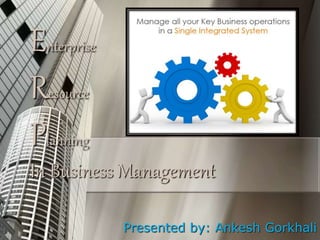


Enterprise
Resource
Planning
In Business Management
Presented by: Ankesh Gorkhali
What is ERP?
 Enterprise resource planning (ERP) is business management
software that allows an organization to use a system of integrated
applications to manage the business.
 Being Specific ERP systems are large computer systems that
integrate application programs in accounting (i.e., accounts
receivable), sales (i.e., order booking), manufacturing (i.e., product
shipping) and the other functions in the firm.
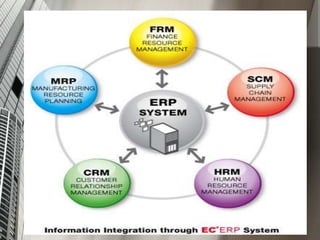
 A typical ERP system will use multiple components of
computer hardware and software to achieve the integration.
 A key ingredient of most ERP systems is the use of a unified
database to store data for various system modules.
 Broken down into business processes
 HRM
 Distribution
 Financials
 Manufacturing
Objective of ERP
 1. Enhance productivity, flexibility and
customer responsiveness
 2. Eliminate costs and inefficiencies
 3. Data consistency
 4. Extend your business using the
Internet
 5. Improve Service Experience
 6. Modernize Business Processes and
Systems
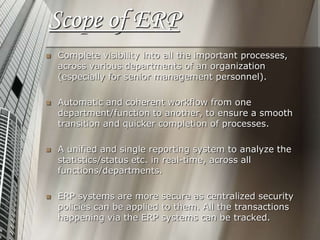
Scope of ERP
 Complete visibility into all the important processes,
across various departments of an organization
(especially for senior management personnel).
 Automatic and coherent workflow from one
department/function to another, to ensure a smooth
transition and quicker completion of processes.
 A unified and single reporting system to analyze the
statistics/status etc. in real-time, across all
functions/departments.
 ERP systems are more secure as centralized security
policies can be applied to them. All the transactions
happening via the ERP systems can be tracked.
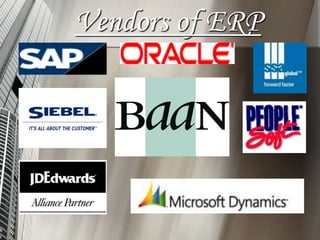
Vendors of ERP
Selecting ERP Vendors
 Depending on your organization's size and needs there are a number
of enterprise resource planning software vendors to choose from in
the large enterprise, midmarket and small business ERP markets.
 Large EnterpriseERP (ERP TierI)
The ERP market for large enterprises is dominated by three
companies: SAP, Oracle and Microsoft.
 MidmarketERP (ERP TierII)
For the midmarket vendors include Infor, QAD, Lawson,
Epicor, Sage and IFS.
 Small BusinessERP (ERP TierIII)
Exact Globe, Syspro, NetSuite, Visibility, Consona, CDC
Software and Activant Solutions round out the ERP vendors
for small businesses.
Benefits for adopting ERP
 Integrate financial information.
 Integrate customer order information.
 Standardize and speed up operations processes.
 Reduce inventory.
 Standardize Human Resources information .
 Common definitions.
 Common database.
 Update one module, automatically updates others.
 ERP systems reflect a specific way of doing business.
 Must look at your value chains, rather than functions.
Limitations of ERP
 High cost.
 Forced change of processes.
 Lack of trained people.
 Implementation timelines.
 Availability of internal technical knowledge and resources.
 Education and training.
 Implementation strategy and execution.
 Resistance to change.
Thanks
Reference: www.google.com and www.slideshare.net

Enterprise Resource Planning

  • 1.
  • 2.
    What is ERP? Enterprise resource planning (ERP) is business management software that allows an organization to use a system of integrated applications to manage the business.  Being Specific ERP systems are large computer systems that integrate application programs in accounting (i.e., accounts receivable), sales (i.e., order booking), manufacturing (i.e., product shipping) and the other functions in the firm.
  • 3.
     A typicalERP system will use multiple components of computer hardware and software to achieve the integration.  A key ingredient of most ERP systems is the use of a unified database to store data for various system modules.  Broken down into business processes  HRM  Distribution  Financials  Manufacturing
  • 4.
    Objective of ERP 1. Enhance productivity, flexibility and customer responsiveness  2. Eliminate costs and inefficiencies  3. Data consistency  4. Extend your business using the Internet  5. Improve Service Experience  6. Modernize Business Processes and Systems
  • 6.
    Scope of ERP Complete visibility into all the important processes, across various departments of an organization (especially for senior management personnel).  Automatic and coherent workflow from one department/function to another, to ensure a smooth transition and quicker completion of processes.  A unified and single reporting system to analyze the statistics/status etc. in real-time, across all functions/departments.  ERP systems are more secure as centralized security policies can be applied to them. All the transactions happening via the ERP systems can be tracked.
  • 7.
  • 8.
    Selecting ERP Vendors Depending on your organization's size and needs there are a number of enterprise resource planning software vendors to choose from in the large enterprise, midmarket and small business ERP markets.  Large EnterpriseERP (ERP TierI) The ERP market for large enterprises is dominated by three companies: SAP, Oracle and Microsoft.
  • 9.
     MidmarketERP (ERPTierII) For the midmarket vendors include Infor, QAD, Lawson, Epicor, Sage and IFS.  Small BusinessERP (ERP TierIII) Exact Globe, Syspro, NetSuite, Visibility, Consona, CDC Software and Activant Solutions round out the ERP vendors for small businesses.
  • 10.
    Benefits for adoptingERP  Integrate financial information.  Integrate customer order information.  Standardize and speed up operations processes.  Reduce inventory.  Standardize Human Resources information .  Common definitions.  Common database.  Update one module, automatically updates others.  ERP systems reflect a specific way of doing business.  Must look at your value chains, rather than functions.
  • 11.
    Limitations of ERP High cost.  Forced change of processes.  Lack of trained people.  Implementation timelines.  Availability of internal technical knowledge and resources.  Education and training.  Implementation strategy and execution.  Resistance to change.
  • 13.

Editor's Notes

  • #7  ERP systems make it easier for order tracking, inventory tracking, revenue tracking, sales forecasting and related activities.