Prepared and presented by,
N. Ganesha Pandian,
Assistant professor,
Madurai School of management.
IIyearIIISemester
Academicyear2017-2018
1
 Overview of ERP software solutions
 Small, medium and large enterprise vendor
solutions
 BPR and best business practices
 Business process management
 Functional modules
 There are basically two ways of building ERP
solutions:
1. Make a new software
2. Buy software
Option 1: Make [using internal resources]
Option 2: Buy
Option 3: Make [using External resources]
 SME stands for “small, medium enterprises”
 Most of the MNCs and big size companies have
already implemented ERP solution from on of the
top three vendors: SAP, Oracle and Microsoft
 Enterprise software beneficial to large- and mid-
sized companies in a wide range of environment
from manufacturing to distribution and
engineering and service
 Small sized were not ready to invest a large
amount for buying software
 The other solid reason for ERP vendor to move
in the direction of SMEs; millennium decade is
the decade when Generation X are reaching
their late 30’s and early 40’s leading towards
becoming entrepreneur's while Generation Y
phasing in and having the need to work
independently leading to initiate their own
business
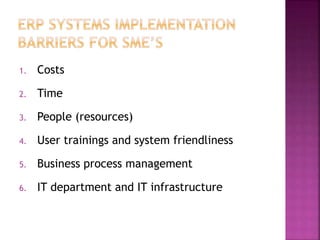
1. Costs
2. Time
3. People (resources)
4. User trainings and system friendliness
5. Business process management
6. IT department and IT infrastructure
 BPR (Business Process Reengineering) not just
change – but dramatic change and dramatic
improvements.
 To achieve the overhaul of organizational
structures, management systems, job
description, performance measurements, skills
development, and training were it should be
used by the information technology.
According to Peter F. Drucker “Reengineering is new,
and it has to be done.”
 Begin organizational change
 Building the reengineering organization
 Identifying BPR opportunities
 Understanding the existing process
 Reengineering the process
 Blueprint the new business system
 Perform the transformation
 Business process – sustainable benefits overtime
improve business performance.
In Finance
 Support each organization’s unique environment
and requirement.
 Distil lengthy, complex, multi-step process into
fewest number of steps. o Consistently handles
all document types (electronic paper, fax)
 Automate the streamline new processes
 Job of the information system function primarily
one of designing, developing, and implementing
software.
 Now design and development function are
outsourced
 ERP has changed the nature of jobs in functional
areas such as Manufacturing.
 Estimates – hardware, software, professional
services and internal staffs for full implementation
and two years of post-implementation support.
 ERP systems have become more affordable, effective
and -- to a significant degree -- essential, but
manufacturers need to pause before joining the
headlong rush toward implementation.
 Companies that do not ready themselves before
implementing ERP find it nearly impossible to fully
utilize their new systems, and risk upsetting their
organizational culture with chaotic implementation
phases.
 We will see the manufacturers, regardless of their
specialty, can prepare for ERP adoption by
benchmarking the organization against peers and
then removing all non-value-adding activities from
the supply chain.
 To establish best business practices before adopting
ERP, process manufacturers first need to develop a
comparison between their organizations and their
peer group through benchmarking.
 A business process is the set of activities
required to accomplish a common goal.
 The activities may be performed by people
or systems and are completed either
sequentially or in simultaneously
 Complexity
 Duration
 Volume
 Industry
 Department
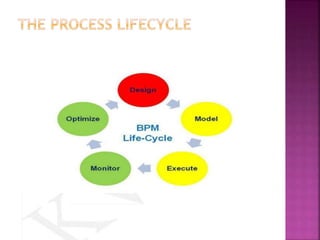
 Process design
 System configuration
 Process enactment
 Diagnosis
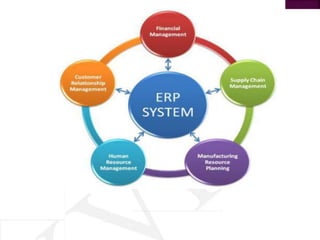
 There are many ERP modules in ERP software
solution.
 Each ERP software module corresponds to a
major functional area of an organization.
 Generally it includes, modules for material
purchasing, inventory control, product planning,
product distribution, tracking the order, financial
ERP module, accounting, marketing, and human
resource.
Financial Module
 Pay checks
 Checks for vendors
 Customer invoice
 Purchase orders
 Stock reports
 And other regular forms and reports
 Modules are
 General Ledger
 Fixed assets
 Sales order processing
 Accounts receivable
 Accounts payable
 Inventory control
 Purchase order processing
 Payroll
Marketing Module
Main goal of the marketing function
in any organization is to satisfy the
needs and wants of its customer.
Marketing personnel engage in activities such as
planning and developing new services,
advertising, promoting, selling, storing and
distributing the goods and services; providing
financing and credit to customer; and conducting
market research.
 Micromarketing and data warehouse system
 Telecommunication
 Direct mail advertising system
 Point of Sales (POS)
 Delivery Tracking and Routing system
 Electronic shopping and Advertising
 Virtual Shopping
 Electronic Kiosks
 Internet advertising
Sales Force automation system
 Prospect Information system
 Contact Management System
 Other Sales Force Automation System
 Production information system support decision
making for the operations allocation, and
planning of production resources.
 Operational production system – continuous
flow production, job order production, project
production.
 Purchasing system
 Receiving system
 Quality Control System.
 Shipping system
 Cost Accounting system
 Inventory Control System.
 Automated material
handling systems.
 Computer Aided Design and
Manufacturing system
 Image Management systems
 Material Selection system
 Shop floor scheduling
system
 Mass Customization and
Agile manufacturing system
 Human resource department are responsible for many
factors to human resource management industry
recruiting, assessment, selection, placement,
training, performance appraisal, compensation and
benefits management promotion, termination,
occupational health, safety, employee services,
compliance with legal constraints, helping managers
with human resource problems and providing top
management with information for strategic planning.
 HRIS – includes system that help managers keep
track of the organization ‘s position and
employees, conduct performance evaluation,
provide alternative or flexible scheduling,
recruit new employees, place employees, train
employees, reduce employees, terminate
employees, provide employees benefits and
provide reports to government agencies.
 Position Control System
 Employee Information System
 Performance management system
 Government Reporting System
 Applicant Selection and Placement System
 Training System
 Increased efficiency in sales and distribution
is a key factor to ensure that companies
retain a competitive edge and improve both
profit margins and customer service.
 In helping business to ‘beat them on delivery’, the
sales and distribution module of many ERP vendors
offer a comprehensive set of best-of breed
components for both order and logistics
management.
 Sales queries, such as inquiries and quotations.
 Sales orders
 Outline agreements, such as contracts and
scheduling agreements
 Delivery/ shipment
 Invoicing/Billing
 After sales support.
During sales order processing, the following basic
functions are carried out:
 Inquiry handling
 Quotation preparation and processing
 Contracts and contact management (order
management).
 Monitoring the sales transaction
 Checking the availability
 Transferring requirements to material planning
(MRP).
 Scheduling the delivery
 Calculating the pricing and taxes
 Checking credit limits
 Invoicing / Billing
 Creating, printed or electronically transmitted
document.
 Master Data Management
 Order Management
 Warehouse Management
 Shipping
 Billing
 Pricing
 Sales Support
 Transportation
 Foreign Trade
 Quality management refers to the set of actions
taken by an organization to ensure that it
creates and delivers high-quality products.
 In order to do so, organizations must comply
with national and international rules and
regulations related to product quality, but they
often also create and use internal requirements
for quality control.
 Inventory Quality Management
 Production Quality Management
 CAQ and CIQ
 Quality Management Module-Functions
 Computer-integrated Quality Management
(CIQ)
 Plant maintenance provides technical and
business reports and various presentation
options,
 Ex – Organizational unit, location, execution
period for the task or system or
manufacturing.
 The major subsystems of a plant
Maintenance module are:
 Preventive Maintenance Control
 Equipment Tracking
 Component Tracking
 Plant Maintenance Calibration Tracking
 Plant Maintenance Warranty Claims Tracking
 The Material Management module optimizes
all purchasing processes with workflow-
driven processing functions, enables
automated supplier evaluations, lower
procurement and warehousing costs with
accurate inventory and warehouse
management and integrates invoice
verification.
 The main modules of the Material
Management module are:
 Pre-purchasing Activities
 Purchasing
 Vendor Evaluation
 Inventory Management
 Invoice Verification and
 Material Inspection.
Enterprise resource planning unit 2 ERP solutions and functional modules

Enterprise resource planning unit 2 ERP solutions and functional modules

  • 1.
    Prepared and presentedby, N. Ganesha Pandian, Assistant professor, Madurai School of management. IIyearIIISemester Academicyear2017-2018 1
  • 2.
     Overview ofERP software solutions  Small, medium and large enterprise vendor solutions  BPR and best business practices  Business process management  Functional modules
  • 3.
     There arebasically two ways of building ERP solutions: 1. Make a new software 2. Buy software Option 1: Make [using internal resources] Option 2: Buy Option 3: Make [using External resources]
  • 4.
     SME standsfor “small, medium enterprises”  Most of the MNCs and big size companies have already implemented ERP solution from on of the top three vendors: SAP, Oracle and Microsoft  Enterprise software beneficial to large- and mid- sized companies in a wide range of environment from manufacturing to distribution and engineering and service
  • 5.
     Small sizedwere not ready to invest a large amount for buying software  The other solid reason for ERP vendor to move in the direction of SMEs; millennium decade is the decade when Generation X are reaching their late 30’s and early 40’s leading towards becoming entrepreneur's while Generation Y phasing in and having the need to work independently leading to initiate their own business
  • 6.
    1. Costs 2. Time 3.People (resources) 4. User trainings and system friendliness 5. Business process management 6. IT department and IT infrastructure
  • 7.
     BPR (BusinessProcess Reengineering) not just change – but dramatic change and dramatic improvements.  To achieve the overhaul of organizational structures, management systems, job description, performance measurements, skills development, and training were it should be used by the information technology.
  • 8.
    According to PeterF. Drucker “Reengineering is new, and it has to be done.”  Begin organizational change  Building the reengineering organization  Identifying BPR opportunities  Understanding the existing process  Reengineering the process  Blueprint the new business system  Perform the transformation
  • 9.
     Business process– sustainable benefits overtime improve business performance. In Finance  Support each organization’s unique environment and requirement.  Distil lengthy, complex, multi-step process into fewest number of steps. o Consistently handles all document types (electronic paper, fax)  Automate the streamline new processes
  • 10.
     Job ofthe information system function primarily one of designing, developing, and implementing software.  Now design and development function are outsourced  ERP has changed the nature of jobs in functional areas such as Manufacturing.  Estimates – hardware, software, professional services and internal staffs for full implementation and two years of post-implementation support.
  • 11.
     ERP systemshave become more affordable, effective and -- to a significant degree -- essential, but manufacturers need to pause before joining the headlong rush toward implementation.  Companies that do not ready themselves before implementing ERP find it nearly impossible to fully utilize their new systems, and risk upsetting their organizational culture with chaotic implementation phases.
  • 12.
     We willsee the manufacturers, regardless of their specialty, can prepare for ERP adoption by benchmarking the organization against peers and then removing all non-value-adding activities from the supply chain.  To establish best business practices before adopting ERP, process manufacturers first need to develop a comparison between their organizations and their peer group through benchmarking.
  • 13.
     A businessprocess is the set of activities required to accomplish a common goal.  The activities may be performed by people or systems and are completed either sequentially or in simultaneously
  • 14.
     Complexity  Duration Volume  Industry  Department
  • 16.
     Process design System configuration  Process enactment  Diagnosis
  • 17.
     There aremany ERP modules in ERP software solution.  Each ERP software module corresponds to a major functional area of an organization.  Generally it includes, modules for material purchasing, inventory control, product planning, product distribution, tracking the order, financial ERP module, accounting, marketing, and human resource.
  • 19.
    Financial Module  Paychecks  Checks for vendors  Customer invoice  Purchase orders  Stock reports  And other regular forms and reports
  • 20.
     Modules are General Ledger  Fixed assets  Sales order processing  Accounts receivable  Accounts payable  Inventory control  Purchase order processing  Payroll
  • 21.
    Marketing Module Main goalof the marketing function in any organization is to satisfy the needs and wants of its customer. Marketing personnel engage in activities such as planning and developing new services, advertising, promoting, selling, storing and distributing the goods and services; providing financing and credit to customer; and conducting market research.
  • 22.
     Micromarketing anddata warehouse system  Telecommunication  Direct mail advertising system  Point of Sales (POS)  Delivery Tracking and Routing system  Electronic shopping and Advertising
  • 23.
     Virtual Shopping Electronic Kiosks  Internet advertising Sales Force automation system  Prospect Information system  Contact Management System  Other Sales Force Automation System
  • 24.
     Production informationsystem support decision making for the operations allocation, and planning of production resources.  Operational production system – continuous flow production, job order production, project production.
  • 25.
     Purchasing system Receiving system  Quality Control System.  Shipping system  Cost Accounting system  Inventory Control System.  Automated material handling systems.  Computer Aided Design and Manufacturing system  Image Management systems  Material Selection system  Shop floor scheduling system  Mass Customization and Agile manufacturing system
  • 26.
     Human resourcedepartment are responsible for many factors to human resource management industry recruiting, assessment, selection, placement, training, performance appraisal, compensation and benefits management promotion, termination, occupational health, safety, employee services, compliance with legal constraints, helping managers with human resource problems and providing top management with information for strategic planning.
  • 27.
     HRIS –includes system that help managers keep track of the organization ‘s position and employees, conduct performance evaluation, provide alternative or flexible scheduling, recruit new employees, place employees, train employees, reduce employees, terminate employees, provide employees benefits and provide reports to government agencies.
  • 28.
     Position ControlSystem  Employee Information System  Performance management system  Government Reporting System  Applicant Selection and Placement System  Training System
  • 29.
     Increased efficiencyin sales and distribution is a key factor to ensure that companies retain a competitive edge and improve both profit margins and customer service.  In helping business to ‘beat them on delivery’, the sales and distribution module of many ERP vendors offer a comprehensive set of best-of breed components for both order and logistics management.
  • 30.
     Sales queries,such as inquiries and quotations.  Sales orders  Outline agreements, such as contracts and scheduling agreements  Delivery/ shipment  Invoicing/Billing  After sales support.
  • 31.
    During sales orderprocessing, the following basic functions are carried out:  Inquiry handling  Quotation preparation and processing  Contracts and contact management (order management).  Monitoring the sales transaction  Checking the availability
  • 32.
     Transferring requirementsto material planning (MRP).  Scheduling the delivery  Calculating the pricing and taxes  Checking credit limits  Invoicing / Billing  Creating, printed or electronically transmitted document.
  • 33.
     Master DataManagement  Order Management  Warehouse Management  Shipping  Billing  Pricing  Sales Support  Transportation  Foreign Trade
  • 34.
     Quality managementrefers to the set of actions taken by an organization to ensure that it creates and delivers high-quality products.  In order to do so, organizations must comply with national and international rules and regulations related to product quality, but they often also create and use internal requirements for quality control.
  • 35.
     Inventory QualityManagement  Production Quality Management  CAQ and CIQ  Quality Management Module-Functions  Computer-integrated Quality Management (CIQ)
  • 36.
     Plant maintenanceprovides technical and business reports and various presentation options,  Ex – Organizational unit, location, execution period for the task or system or manufacturing.
  • 37.
     The majorsubsystems of a plant Maintenance module are:  Preventive Maintenance Control  Equipment Tracking  Component Tracking  Plant Maintenance Calibration Tracking  Plant Maintenance Warranty Claims Tracking
  • 38.
     The MaterialManagement module optimizes all purchasing processes with workflow- driven processing functions, enables automated supplier evaluations, lower procurement and warehousing costs with accurate inventory and warehouse management and integrates invoice verification.
  • 39.
     The mainmodules of the Material Management module are:  Pre-purchasing Activities  Purchasing  Vendor Evaluation  Inventory Management  Invoice Verification and  Material Inspection.