VERB: MOOD The definition of the category The problem of the Imperative Mood The varieties of the Subjunctive Mood The ways the Moods   are  realized in   English The homonymity of Subjunctive forms with Indicative forms
  The category of mood in the present English verb has given rise to so many discussions, and has been treated in so many different ways, that it seems hardly possible to arrive at any more or less convincing and universally acceptable conclusion concerning it. B. A. Ilyish:
The definition of the category H. Sweet: The category of mood is represented by grammatical forms expressing different relations between the Subject and the Predicate. G. O. Curme: Moods are changes in the form of a word to show the various ways in which an action or state is thought of by the speaker.
The definition of the category Whitehall, H.: The category of mood establishes the speaker’s mood about the actuality of the happening action. M. Blokh: The category of mood expresses the character of connection between the process denoted by the verb and the actual reality, either presenting the process as a fact that really happened, happens or will happen, or treating it as an imaginary phenomenon, i.e. the subject of a hypothesis, speculation, desire.
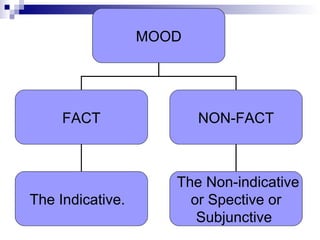
The definition of the category Mood is a grammatical category which expresses the speaker’s attitude toward the process, indicating whether it is regarded as  a fact  or  as  a non-fact , i.e. as a matter of supposition, desire, possibility, etc.  Hence there are two moods – fact and non-fact.
Presenting facts, the speaker may be  categoric and  non-categoric: John’s health is bad. vs. John’s health must be bad.
Facts  are expressed by  the Indicative mood   I go to university.  I am a student again.  Non-facts  are expressed by  the Subjunctive mood . He suggests I (should) go to university. I wish I were a student again.
The problem of the Imperative Mood M. Blokh thinks that the imperative is a variety of the mood of attitudes, i.e. the subjunctive.  Be off! _ I demand that you (should) be off. Do be careful with the papers. _ My request is that you (should) be careful with the papers. Do as I ask you! _ I insist that you (should) do as I ask you.
MOOD FACT NON-FACT The Indicative.   The Non-indicative or Spective or Subjunctive
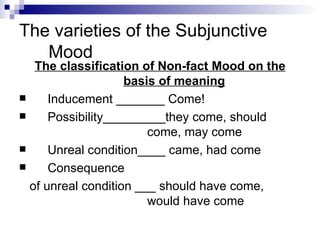
The varieties of the Subjunctive Mood The classification of Non-fact Mood on the basis of meaning Inducement _______ Come! Possibility_________they come, should  come, may come Unreal condition____ came, had come Consequence  of unreal condition ___ should have come,  would have come
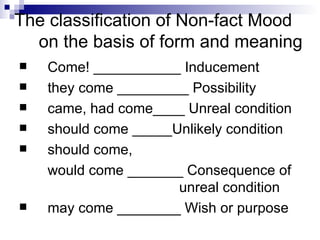
The classification of Non-fact Mood on the basis of form and meaning Come! ___________ Inducement they come _________ Possibility came, had come____ Unreal condition should come _____Unlikely condition should come,  would come _______ Consequence of  unreal condition may come ________ Wish or purpose
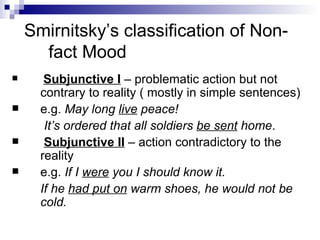
Smirnitsky’s classification of Non-fact Mood Subjunctive I  – problematic action but not contrary to reality ( mostly in simple sentences) e.g.  May long  live  peace! It’s ordered that all soldiers  be sent  home . Subjunctive II  – action contradictory to the reality e.g.  If I  were  you I should know it. If he  had put on  warm shoes, he would not be cold.
Smirnitsky’s classification of Non-fact Mood Suppositional  – problematic but not contrary to the reality (should) e.g.  Should  he come, tell him to wait. Conditional   – unreal actions due to the absence of conditions in the main clause (should/would) e.g. If I were you, I  should  go there.
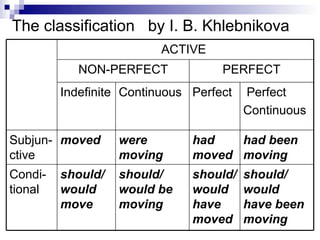
The classification  by I. B. Khlebnikova   should/ would have been moving should/would have moved should/ would be moving should/would move Condi-tional had been moving had moved were moving moved Subjun-ctive Perfect Continuous Perfect Continuous Indefinite PERFECT NON-PERFECT ACTIVE
How does English realize the moods?  The fact, or the indicative mood, is expressed by indicative mood forms. Its modalized variety is expressed by the use of appropriate modal verbs.  The imperative variety of the non-fact mood is realized by the use of the bare (i.e. unmarked) infinitive.
How does English realize the moods? The only regular inflections by which the subjunctive is distinguished from the indicative are the forms of the old subjunctive:  1) the citation form of the verb (i.e. the bare infinitive);  2) the form  were .  Mary suggests I go to university.-  the present subjunctive  My wife wishes she were a student again. -  the past subjunctive
The past subjunctive form  were  is being replaced by the form  was  in spoken English  If I was an architect, I’d re-design this house. This would still be true if Britain was out of the Community. Sometimes, however, both forms can be found in the same text: My wife says she wishes I were a thousand miles away, and I wish I was.
One and the same form can be used to express both  facts  and  non-facts .  If only I  had more time ! vs. I  had more time  when I was younger. If only I  had had more time ! vs. He said he  had had more time  then.
The homonymity of Subjunctive forms with Indicative forms Homonyms are only those homographs that belong to different microsystems and therefore express diametrically opposed grammatical features. For example:  were  in  we were there  and  if we were there ,  things would be different  are considered homonyms because they express, in a certain environment, incompatible grammatical features of reality – unreality.”   J. B. Khlebnikova (1965)
Past forms can also be viewed as polysemous, i.e. related semantically. The meaning that underlies both past forms is the  meaning of distance .  Something that occurred in the past can be treated as  distant from  the speaker’s  current situation .  In the case of  the subjunctive , the past form marks  a process  presented by the speaker as  not being close to present reality .  The past form, then, could be called the remote or distal form which can be used to communicate not only distance from the moment of speaking, but also distance from current reality (George Yule, 1996)
English possesses analytic ‘subjunctive’ forms composed of  shall/should, will/would, may/might, can/could  and the base form of a verb.  Make a note of it so that you shan’t forget. Make a note of it lest you should forget. They have arrived early so that they won’t miss the overture. They came early so that they wouldn’t miss the overture. He is going to London so that he can/may see the Queen. He bought a car so that he could/might be more mobile.
The category of mood is represented by two oppositions: the indicative mood and the spective mood.  The indicative mood is the basic mood of the verb. Morphologically it is the most developed system. Semantically, it is a fact mood; it is the least subjective of all the moods.  The spective mood, which includes the traditional imperative and the subjunctive mood, represents a process as a non-fact, i.e. as something imaginary, desirable, problematic, contrary to reality.
The imperative variety of the spective mood is morphologically the least developed mood: it is only expressed by the bare infinitive form.  The subjunctive variety of the spective mood makes use of two types of construction:  1) non-modal: a) the base form of a verb; b) were; c) forms identical with indicative mood forms;  2) modal (modal verb + the base form of a verb).
The problems that face the analyst are:  1) the linguistic status of non-modal subjunctive forms;  2) the linguistic status of the modal forms shall/should, will/would, etc.
Verbals: The Infinitive. The Gerund. The Participle. Participial   Constructions.
Verbals  There are three verbals in English –  the Infinitive,  the Gerund  the Participle.  They have a double nature: nominal and verbal. They cannot be the predicate of the sentence. They do not express person, number or mood. The tense distinctions are relative, they show only whether the action expressed by the verbal is simultaneous with the action expressed by the finite verb or prior to it.
The Infinitive developed from the verbal noun which in course of time became verbalized retaining at the same time some of its nominal properties.
Nominal character of the Infinitive is manifested in its syntactical functions: Subject,  Object,  Predicative.
Verbal characteristics of the Infinitive the Infinitive of the transitive verb can take a direct object; the Infinitive can be modified by an adverb; the Infinitive has the following grammatical categories: time-relation, voice and aspect.
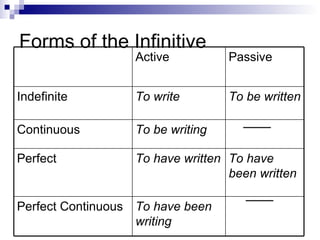
Forms of the Infinitive To have been written To have written Perfect To have been writing Perfect Continuous To be writing Continuous To be written To write Indefinite Passive Active
The infinitive has two presentation forms: Marked  The marked infinitive is an analytic grammatical form.  “ to” can be used to represent the corresponding construction as a whole,  e.g.  you can read any of the books if you want to (read).   It can also be separated from its notional part by a word or phrase, usually of adverbial nature, forming the so-called split infinitive,  e.g. To  systematically rid this town of lay abouts, we must adopt a special law .  Unmarked It is traditionally called the bare infinitive.  It is used in various analytic forms (non-modal and modal), with verbs of physical perceptions,  with the verbs let, bid, make, help (optionally),  with a few modal phrases (had better, would rather, would have, etc.),  with the relative  why .
Infinitive Constructions: the Objective-with-the-Infinitive Construction  is a construction in which the Infinitive is in predicate relation to a Noun in the Common case or a Pronoun in the Objective case; the Nominative-with-the-Infinitive Construction  is a construction in which the Infinitive is in predicate relation to a Noun in the Common case or a Pronoun in the Nominative case; the for-to-Infinitive Construction  is a construction in which the Infinitive is in predicate relation to a Noun or  Pronoun preceded by the preposition “for”.
The Gerund like the Infinitive developed from the verbal noun.  It coincides in form with Participle 1.
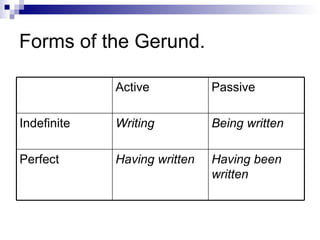
Forms of the Gerund.   Passive Active Having been written Having written Perfect Being written Writing Indefinite
Nominal characteristics of the Gerund: The Gerund can perform the function of Subject, Object, Predicative; The Gerund can be preceded by a preposition; The Gerund can be modified by a Noun in the Possessive case or by a Possessive Pronoun.
Verbal characteristics of the Gerund : the Gerund of the transitive verb can take a direct object; the Gerund can be modified by an adverb; the Gerund has time-relations and that of transitive verbs has voice distinctions.
Predicative Constructions with the Gerund is a construction in which the verbal element expressed by the Gerund is in predicate relation to the nominal element expressed by a Noun or Pronoun: Gerundial (Noun’s or Possessive Pronoun + Gerund); Half-Gerundial (Noun in the Common case or Personal Pronoun in the Objective Case + Gerund).
The child was not afraid of remaining alone vs. He was afraid to remain alone on such a stormy night. He remembered posting the letter (about the past). vs. He remembered to post the letter (about the future from the moment denoted by the finite verb). He stopped smoking (gave up the habit). He stopped to smoke (purpose). The Infinitive  - can be used with reference to a  special occasion  and  the Gerund   - to a  general statement .
The Participle is a non-finite form of the verb which has a verbal and an adjectival character or an adverbial character.  Participle 1 (4 forms) and Participle 2 (Past Participle – 1 form).
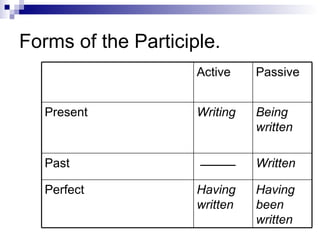
Forms of the Participle. Having been written Having written Perfect Written Past Being written Writing Present Passive Active
Adjectival or adverbial character of the Particple is manifested in its syntactical functions, those of: Attribute, Adverbial Modifier.
Verbal character of the Participle: Participle 1 of a transitive verb can take a direct object; Participle 1 and Participle 2 can be modified by an adverb; Participle 1 has tense distinctions and that of transitive verbs has voice distinctions.
Predicative Constructions with the Participle: the Objective Participial Construction  is a construction in which the Participle is in predicate relation to a Noun in the Common case or a Pronoun in the Objective case; the Subjective Participial Construction  is a construction in which the Participle is in predicate relation to a Noun in the Common case or a Pronoun in the Nominative case, which is the Subject of the sentence;
Predicative Constructions with the Participle: the Nominative Absolute Participial Construction  is a construction in which the Participle stands in predicate relation to a Noun in the Common case or a Pronoun in the Nominative case, the Noun or Pronoun is not the Subject of the sentence; the Prepositional Absolute Participial Construction  is introduced by the preposition “with”.

Mood, Non-Finite Verb Forms

  • 1.
    VERB: MOOD Thedefinition of the category The problem of the Imperative Mood The varieties of the Subjunctive Mood The ways the Moods are realized in English The homonymity of Subjunctive forms with Indicative forms
  • 2.
    Thecategory of mood in the present English verb has given rise to so many discussions, and has been treated in so many different ways, that it seems hardly possible to arrive at any more or less convincing and universally acceptable conclusion concerning it. B. A. Ilyish:
  • 3.
    The definition ofthe category H. Sweet: The category of mood is represented by grammatical forms expressing different relations between the Subject and the Predicate. G. O. Curme: Moods are changes in the form of a word to show the various ways in which an action or state is thought of by the speaker.
  • 4.
    The definition ofthe category Whitehall, H.: The category of mood establishes the speaker’s mood about the actuality of the happening action. M. Blokh: The category of mood expresses the character of connection between the process denoted by the verb and the actual reality, either presenting the process as a fact that really happened, happens or will happen, or treating it as an imaginary phenomenon, i.e. the subject of a hypothesis, speculation, desire.
  • 5.
    The definition ofthe category Mood is a grammatical category which expresses the speaker’s attitude toward the process, indicating whether it is regarded as a fact or as a non-fact , i.e. as a matter of supposition, desire, possibility, etc. Hence there are two moods – fact and non-fact.
  • 6.
    Presenting facts, thespeaker may be categoric and non-categoric: John’s health is bad. vs. John’s health must be bad.
  • 7.
    Facts areexpressed by the Indicative mood I go to university. I am a student again. Non-facts are expressed by the Subjunctive mood . He suggests I (should) go to university. I wish I were a student again.
  • 8.
    The problem ofthe Imperative Mood M. Blokh thinks that the imperative is a variety of the mood of attitudes, i.e. the subjunctive. Be off! _ I demand that you (should) be off. Do be careful with the papers. _ My request is that you (should) be careful with the papers. Do as I ask you! _ I insist that you (should) do as I ask you.
  • 9.
    MOOD FACT NON-FACTThe Indicative. The Non-indicative or Spective or Subjunctive
  • 10.
    The varieties ofthe Subjunctive Mood The classification of Non-fact Mood on the basis of meaning Inducement _______ Come! Possibility_________they come, should come, may come Unreal condition____ came, had come Consequence of unreal condition ___ should have come, would have come
  • 11.
    The classification ofNon-fact Mood on the basis of form and meaning Come! ___________ Inducement they come _________ Possibility came, had come____ Unreal condition should come _____Unlikely condition should come, would come _______ Consequence of unreal condition may come ________ Wish or purpose
  • 12.
    Smirnitsky’s classification ofNon-fact Mood Subjunctive I – problematic action but not contrary to reality ( mostly in simple sentences) e.g. May long live peace! It’s ordered that all soldiers be sent home . Subjunctive II – action contradictory to the reality e.g. If I were you I should know it. If he had put on warm shoes, he would not be cold.
  • 13.
    Smirnitsky’s classification ofNon-fact Mood Suppositional – problematic but not contrary to the reality (should) e.g. Should he come, tell him to wait. Conditional – unreal actions due to the absence of conditions in the main clause (should/would) e.g. If I were you, I should go there.
  • 14.
    The classification by I. B. Khlebnikova should/ would have been moving should/would have moved should/ would be moving should/would move Condi-tional had been moving had moved were moving moved Subjun-ctive Perfect Continuous Perfect Continuous Indefinite PERFECT NON-PERFECT ACTIVE
  • 15.
    How does Englishrealize the moods? The fact, or the indicative mood, is expressed by indicative mood forms. Its modalized variety is expressed by the use of appropriate modal verbs. The imperative variety of the non-fact mood is realized by the use of the bare (i.e. unmarked) infinitive.
  • 16.
    How does Englishrealize the moods? The only regular inflections by which the subjunctive is distinguished from the indicative are the forms of the old subjunctive: 1) the citation form of the verb (i.e. the bare infinitive); 2) the form were . Mary suggests I go to university.- the present subjunctive My wife wishes she were a student again. - the past subjunctive
  • 17.
    The past subjunctiveform were is being replaced by the form was in spoken English If I was an architect, I’d re-design this house. This would still be true if Britain was out of the Community. Sometimes, however, both forms can be found in the same text: My wife says she wishes I were a thousand miles away, and I wish I was.
  • 18.
    One and thesame form can be used to express both facts and non-facts . If only I had more time ! vs. I had more time when I was younger. If only I had had more time ! vs. He said he had had more time then.
  • 19.
    The homonymity ofSubjunctive forms with Indicative forms Homonyms are only those homographs that belong to different microsystems and therefore express diametrically opposed grammatical features. For example: were in we were there and if we were there , things would be different are considered homonyms because they express, in a certain environment, incompatible grammatical features of reality – unreality.” J. B. Khlebnikova (1965)
  • 20.
    Past forms canalso be viewed as polysemous, i.e. related semantically. The meaning that underlies both past forms is the meaning of distance . Something that occurred in the past can be treated as distant from the speaker’s current situation . In the case of the subjunctive , the past form marks a process presented by the speaker as not being close to present reality . The past form, then, could be called the remote or distal form which can be used to communicate not only distance from the moment of speaking, but also distance from current reality (George Yule, 1996)
  • 21.
    English possesses analytic‘subjunctive’ forms composed of shall/should, will/would, may/might, can/could and the base form of a verb. Make a note of it so that you shan’t forget. Make a note of it lest you should forget. They have arrived early so that they won’t miss the overture. They came early so that they wouldn’t miss the overture. He is going to London so that he can/may see the Queen. He bought a car so that he could/might be more mobile.
  • 22.
    The category ofmood is represented by two oppositions: the indicative mood and the spective mood. The indicative mood is the basic mood of the verb. Morphologically it is the most developed system. Semantically, it is a fact mood; it is the least subjective of all the moods. The spective mood, which includes the traditional imperative and the subjunctive mood, represents a process as a non-fact, i.e. as something imaginary, desirable, problematic, contrary to reality.
  • 23.
    The imperative varietyof the spective mood is morphologically the least developed mood: it is only expressed by the bare infinitive form. The subjunctive variety of the spective mood makes use of two types of construction: 1) non-modal: a) the base form of a verb; b) were; c) forms identical with indicative mood forms; 2) modal (modal verb + the base form of a verb).
  • 24.
    The problems thatface the analyst are: 1) the linguistic status of non-modal subjunctive forms; 2) the linguistic status of the modal forms shall/should, will/would, etc.
  • 25.
    Verbals: The Infinitive.The Gerund. The Participle. Participial Constructions.
  • 26.
    Verbals Thereare three verbals in English – the Infinitive, the Gerund the Participle. They have a double nature: nominal and verbal. They cannot be the predicate of the sentence. They do not express person, number or mood. The tense distinctions are relative, they show only whether the action expressed by the verbal is simultaneous with the action expressed by the finite verb or prior to it.
  • 27.
    The Infinitive developedfrom the verbal noun which in course of time became verbalized retaining at the same time some of its nominal properties.
  • 28.
    Nominal character ofthe Infinitive is manifested in its syntactical functions: Subject, Object, Predicative.
  • 29.
    Verbal characteristics ofthe Infinitive the Infinitive of the transitive verb can take a direct object; the Infinitive can be modified by an adverb; the Infinitive has the following grammatical categories: time-relation, voice and aspect.
  • 30.
    Forms of theInfinitive To have been written To have written Perfect To have been writing Perfect Continuous To be writing Continuous To be written To write Indefinite Passive Active
  • 31.
    The infinitive hastwo presentation forms: Marked The marked infinitive is an analytic grammatical form. “ to” can be used to represent the corresponding construction as a whole, e.g. you can read any of the books if you want to (read). It can also be separated from its notional part by a word or phrase, usually of adverbial nature, forming the so-called split infinitive, e.g. To systematically rid this town of lay abouts, we must adopt a special law . Unmarked It is traditionally called the bare infinitive. It is used in various analytic forms (non-modal and modal), with verbs of physical perceptions, with the verbs let, bid, make, help (optionally), with a few modal phrases (had better, would rather, would have, etc.), with the relative why .
  • 32.
    Infinitive Constructions: theObjective-with-the-Infinitive Construction is a construction in which the Infinitive is in predicate relation to a Noun in the Common case or a Pronoun in the Objective case; the Nominative-with-the-Infinitive Construction is a construction in which the Infinitive is in predicate relation to a Noun in the Common case or a Pronoun in the Nominative case; the for-to-Infinitive Construction is a construction in which the Infinitive is in predicate relation to a Noun or Pronoun preceded by the preposition “for”.
  • 33.
    The Gerund likethe Infinitive developed from the verbal noun. It coincides in form with Participle 1.
  • 34.
    Forms of theGerund. Passive Active Having been written Having written Perfect Being written Writing Indefinite
  • 35.
    Nominal characteristics ofthe Gerund: The Gerund can perform the function of Subject, Object, Predicative; The Gerund can be preceded by a preposition; The Gerund can be modified by a Noun in the Possessive case or by a Possessive Pronoun.
  • 36.
    Verbal characteristics ofthe Gerund : the Gerund of the transitive verb can take a direct object; the Gerund can be modified by an adverb; the Gerund has time-relations and that of transitive verbs has voice distinctions.
  • 37.
    Predicative Constructions withthe Gerund is a construction in which the verbal element expressed by the Gerund is in predicate relation to the nominal element expressed by a Noun or Pronoun: Gerundial (Noun’s or Possessive Pronoun + Gerund); Half-Gerundial (Noun in the Common case or Personal Pronoun in the Objective Case + Gerund).
  • 38.
    The child wasnot afraid of remaining alone vs. He was afraid to remain alone on such a stormy night. He remembered posting the letter (about the past). vs. He remembered to post the letter (about the future from the moment denoted by the finite verb). He stopped smoking (gave up the habit). He stopped to smoke (purpose). The Infinitive - can be used with reference to a special occasion and the Gerund - to a general statement .
  • 39.
    The Participle isa non-finite form of the verb which has a verbal and an adjectival character or an adverbial character. Participle 1 (4 forms) and Participle 2 (Past Participle – 1 form).
  • 40.
    Forms of theParticiple. Having been written Having written Perfect Written Past Being written Writing Present Passive Active
  • 41.
    Adjectival or adverbialcharacter of the Particple is manifested in its syntactical functions, those of: Attribute, Adverbial Modifier.
  • 42.
    Verbal character ofthe Participle: Participle 1 of a transitive verb can take a direct object; Participle 1 and Participle 2 can be modified by an adverb; Participle 1 has tense distinctions and that of transitive verbs has voice distinctions.
  • 43.
    Predicative Constructions withthe Participle: the Objective Participial Construction is a construction in which the Participle is in predicate relation to a Noun in the Common case or a Pronoun in the Objective case; the Subjective Participial Construction is a construction in which the Participle is in predicate relation to a Noun in the Common case or a Pronoun in the Nominative case, which is the Subject of the sentence;
  • 44.
    Predicative Constructions withthe Participle: the Nominative Absolute Participial Construction is a construction in which the Participle stands in predicate relation to a Noun in the Common case or a Pronoun in the Nominative case, the Noun or Pronoun is not the Subject of the sentence; the Prepositional Absolute Participial Construction is introduced by the preposition “with”.