Downloaded 817 times
![{QW [+objQW] } + Aux + Sub + (verb)+ This is the basic form of a question…](https://image.slidesharecdn.com/formulas-1215169259658010-8/85/Basic-English-Structure-4-320.jpg)
![The yellow text indicates a question word and its object (if any). Who, what, when, where, why, what time, how many, what kind of, etc. { QW [+objQW] } + Aux + Sub + (verb)+ How many lessons have you taken? What kind of medicine is she taking? Where is the nearest bookstore? With simple yes or no answer questions, we don’t use a question word, we just start with an auxiliary. Have you eaten yet?](https://image.slidesharecdn.com/formulas-1215169259658010-8/85/Basic-English-Structure-5-320.jpg)
![The auxiliary controls the tense, how we know if we’re talking about the present, past, etc. {QW [+objQW] } + Aux + Sub + (verb)+ What time does Harry get home? Where are the pillow cases? When did the first Batman comic come out?](https://image.slidesharecdn.com/formulas-1215169259658010-8/85/Basic-English-Structure-6-320.jpg)
![The subject is the doer of the action, what goes first when you answer the question: {QW [+objQW] } + Aux + Sub + (verb)+ When does Peter teach class? Peter teaches class on Thursdays.](https://image.slidesharecdn.com/formulas-1215169259658010-8/85/Basic-English-Structure-7-320.jpg)
![When an action verb is necessary, it goes here. {QW [+objQW] } + Aux + Sub + ( verb )+ Does Peter speak Spanish? Peter doesn’t speak Spanish Peter speaks Spanish Whenever an auxiliary is present in a clause, it is the auxiliary that is conjugated except in present and past perfect forms. Have you seen my dog?](https://image.slidesharecdn.com/formulas-1215169259658010-8/85/Basic-English-Structure-8-320.jpg)

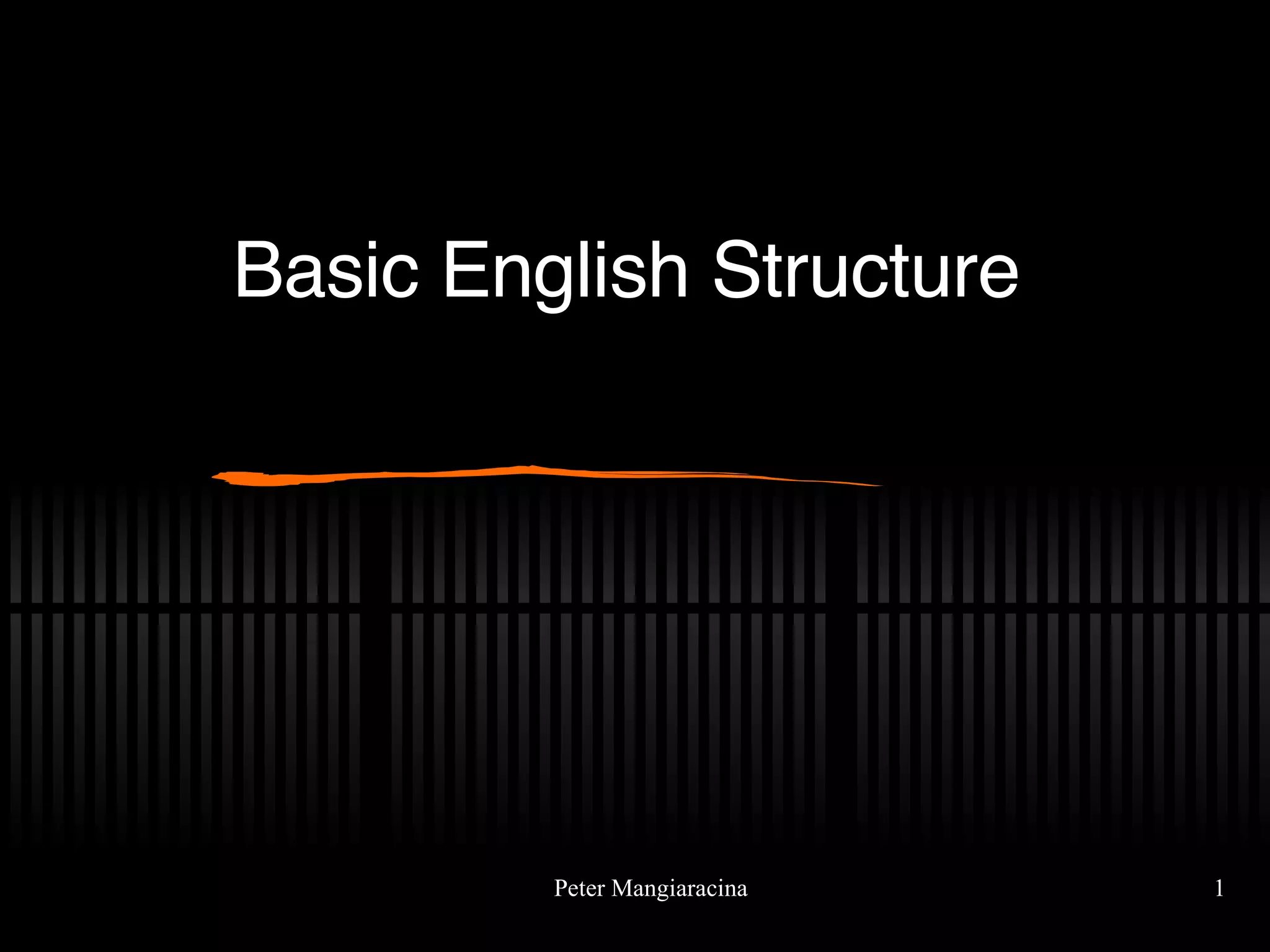
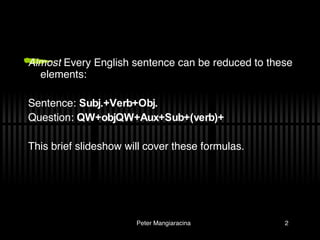
The document outlines the basic structure of English sentences and questions. It explains that most English sentences can be reduced to a subject, verb, and optional object. Questions follow a similar structure but start with an interrogative word like who, what, when, where, or why, followed by an auxiliary verb and the subject and main verb. The auxiliary controls the tense of the question and is what gets conjugated, not the main verb. The subject performs the action indicated by the main verb.


