ENGLISH SYNTAX I Bimestre Escuela:  Inglés Nombres:  Dra. María Rosario Burneo B. Fecha:  Abril/Agosto 2009
FIRST PART UNITS I, II AND III
LANGUAGE language is a social, cultural and psychological phenomenon that serves the purpose of communication among human beings
4 LINGUISTICS   Linguistics can be  defined  as the study of human  language  in all  its   manifestations.
LINGUISTICS Linguistics focuses on different aspects of the language, such as: Word formation and  inflection; (Morphology);  Sounds (Phonology). Structure (Syntax). Meaning (Semantics), and  The relationship between language use and society (Pragmatics ).
UNIT ONE:   BASIC SENTENCE STRUCTURES Lexical categories are word based: noun, verb, adjective. Phrasal categories are phrase-based: noun phrase, verb phrase, prepositional phrase, etc .
Linguistic Phenomena Anaphora (or anaphor) is a linguistic phenomenon referring to entities mentioned before in the same sentence or discourse: Mary likes her new job.  Students and teachers feel tired.
Linguistic Phenomena Coordination uses conjunctions to join words or phrases belonging to the same category: Teachers and students are attending a lecture Recursion enables speakers to make use of a finite set of rules to generate an infinite number of sentences. Mike, who is a doctor, lives next door .
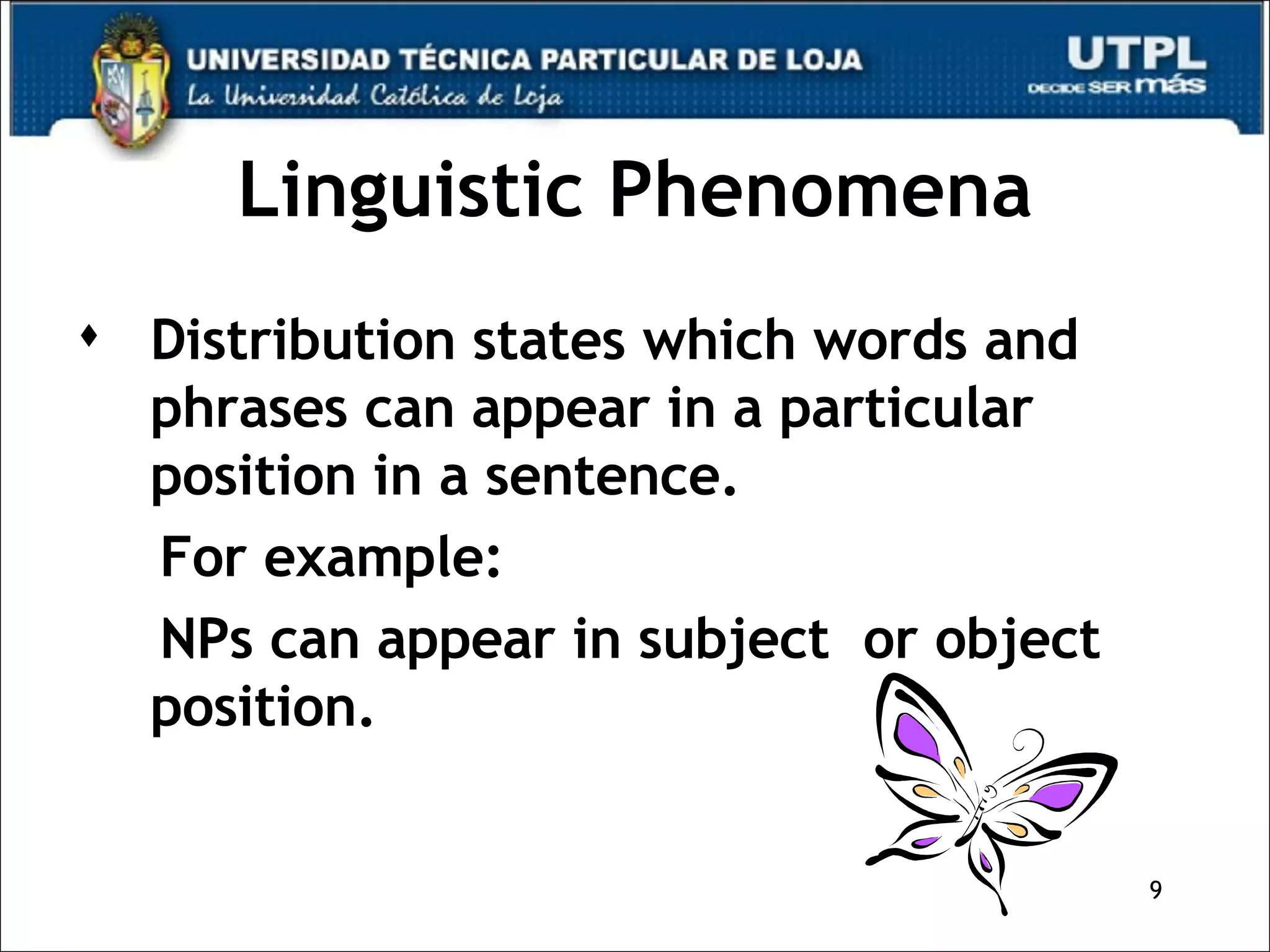
Linguistic Phenomena Distribution states which words and phrases can appear in a particular position in a sentence. For example: NPs can appear in subject  or object position.
LINGUISTIC PHENOMENA Intrusión  refers  to the insertion of parenthetical  expressions  like “I guess”, “certainly”, usually” and others. I guess, it is fine
Core Sentence Patterns Core sentence patterns are basic strings of  words that express meaning and have an associated structural description called Base Phrase Marker.
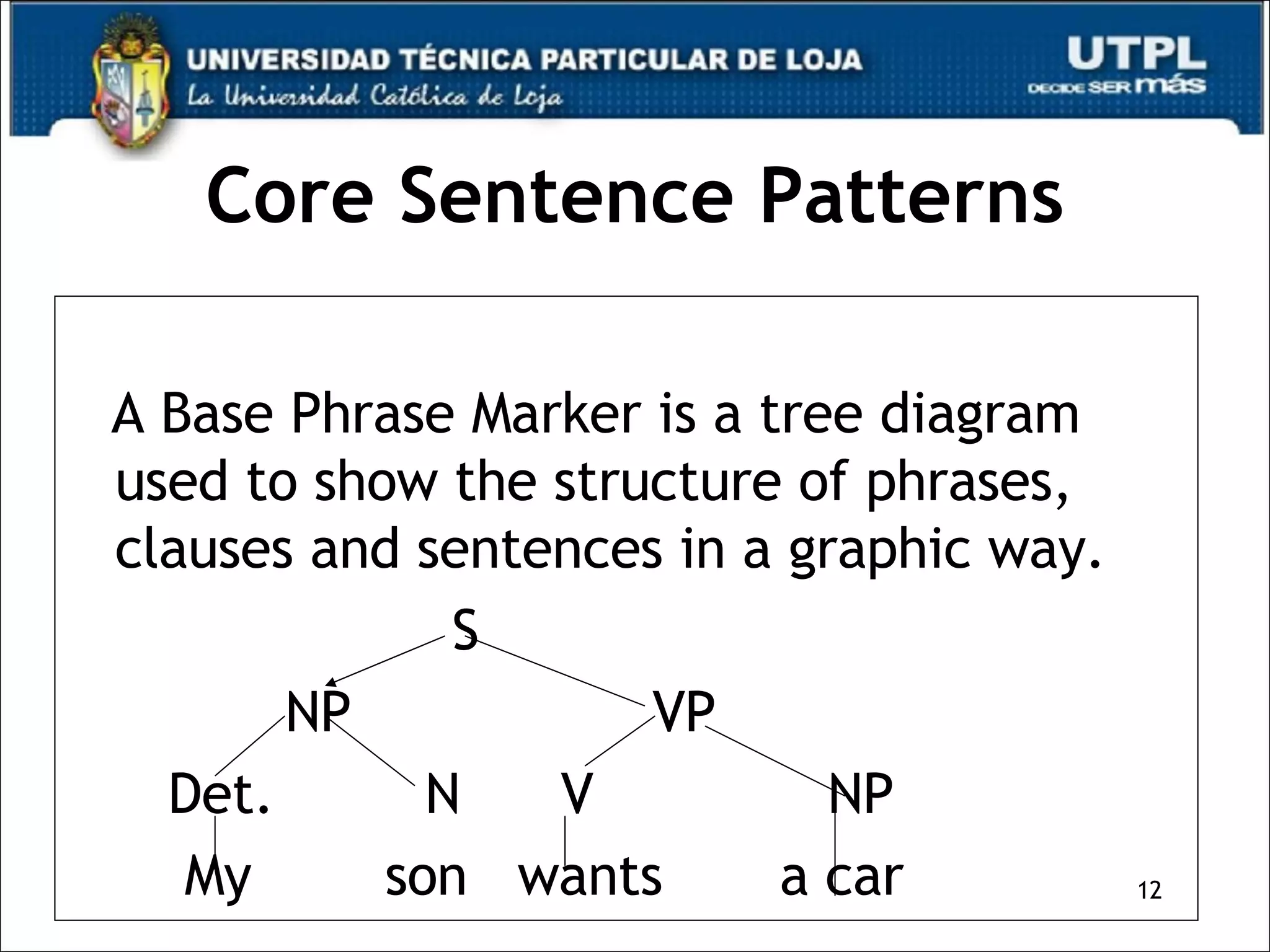
Core Sentence Patterns A Base Phrase Marker is a tree diagram used to show the structure of phrases, clauses and sentences in a graphic way. S NP  VP Det.  N  V  NP My  son  wants  a car
The Five Core Patterns PATTERN ONE S = NP + VP intransitive + (Adv.P) Mike walks slowly Elizabeth runs
PATTERN TWO S = NP + VP linking + NP George became a doctor S = NP + VP linking + Adj. Phrase Mr. Johnson looks tired
Pattern THREE It is built around one-place transitive verbs. S = NP+VP one-place trans+ NP Robert washed his car
Pattern FOUR This pattern has  two versions: S = NP + VP transitive +NP + NP + (Adv.P) Rose gave him an interesting book - This structure takes two objects, a DO and an IO. - I bought a car for my son yesterday.
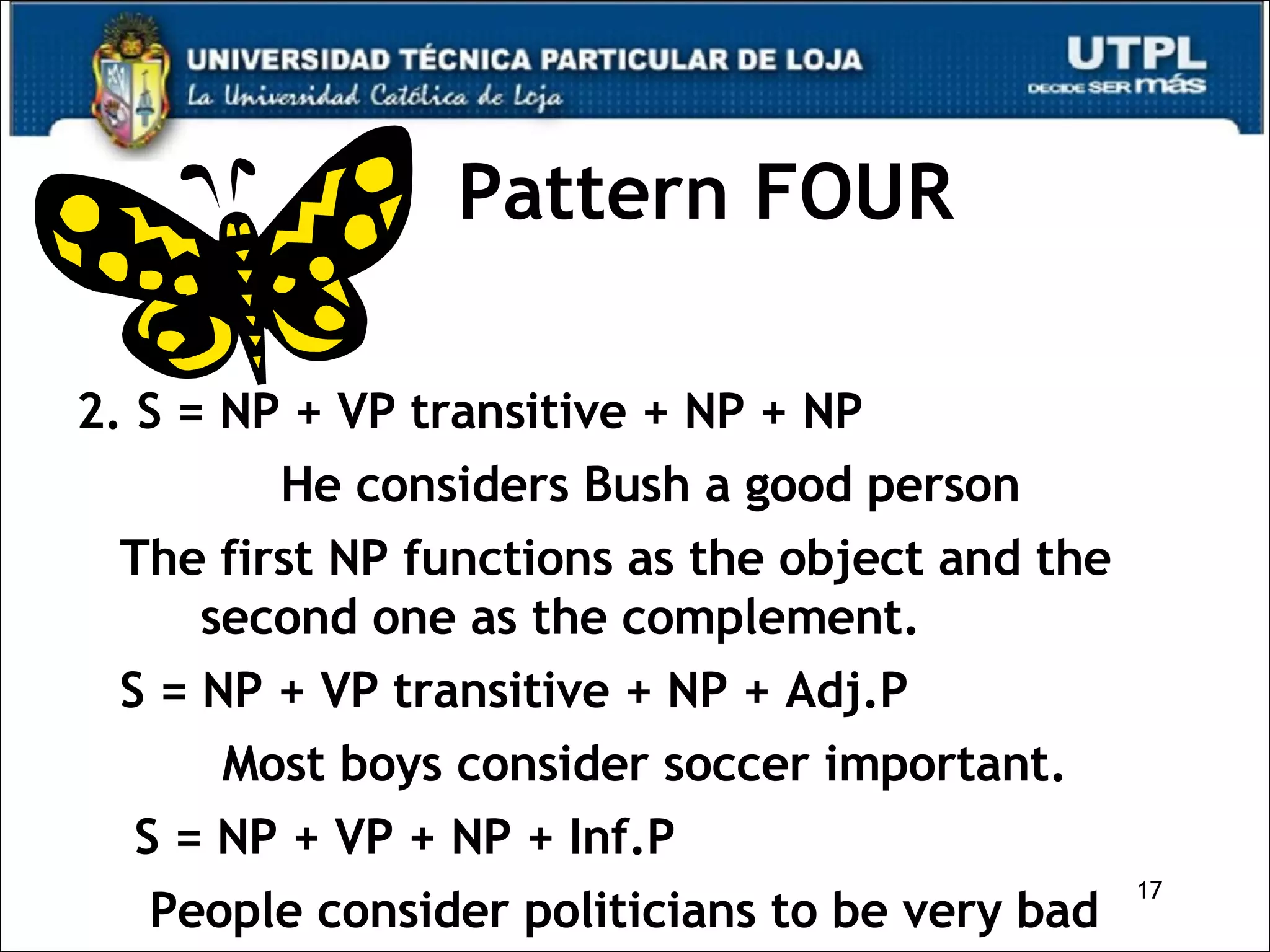
Pattern FOUR 2. S = NP + VP transitive + NP + NP  He considers Bush a good person The first NP functions as the object and the second one as the complement. S = NP + VP transitive + NP + Adj.P  Most boys consider soccer important. S = NP + VP + NP + Inf.P People consider politicians to be very bad
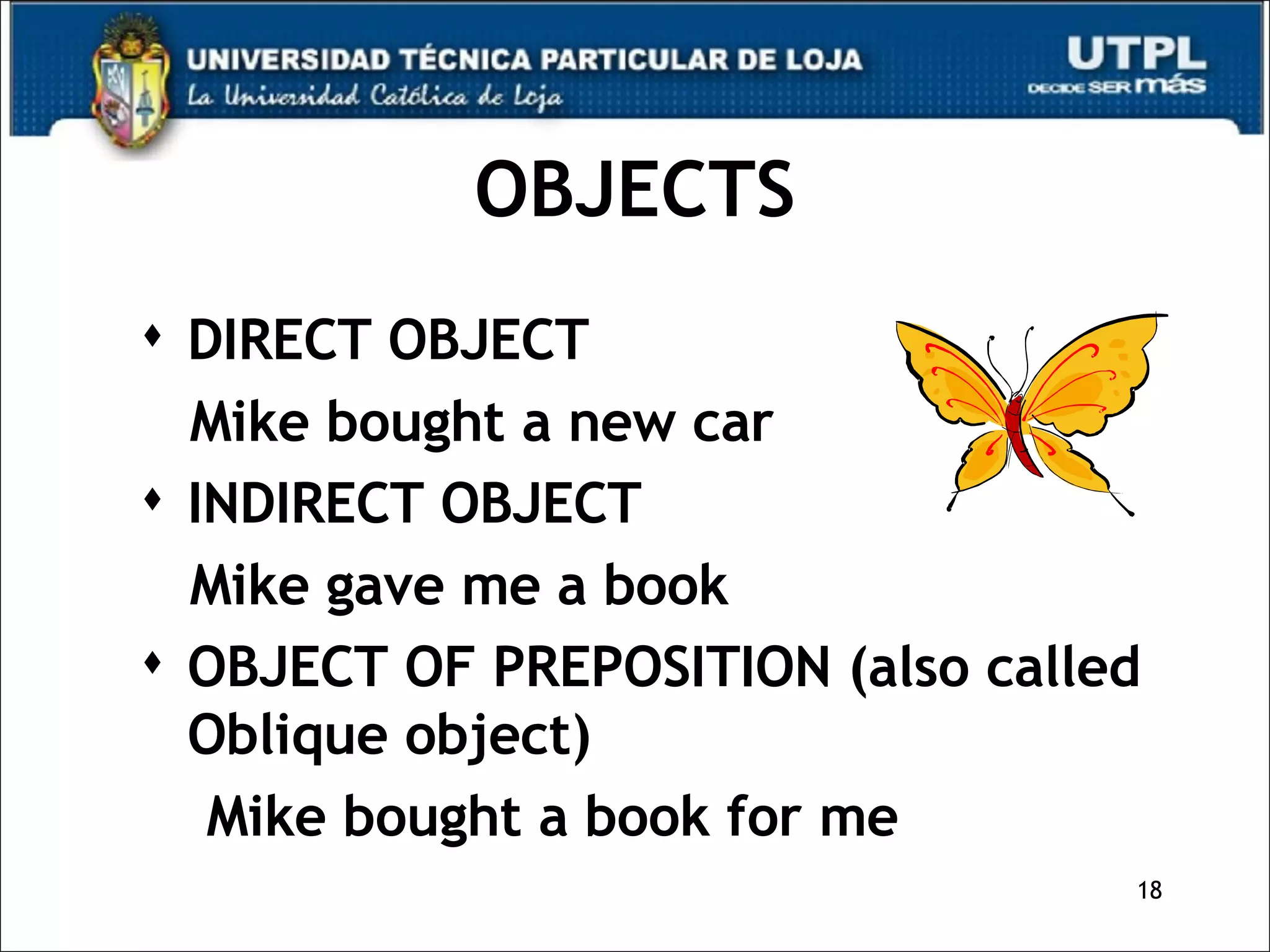
OBJECTS DIRECT OBJECT Mike bought a new car INDIRECT OBJECT Mike gave me a book OBJECT OF PREPOSITION (also called Oblique object) Mike bought a book for me
Pattern FIVE This pattern is built around the verb  BE. S = NP + VP be + NP Martha is a teacher S = NP + VP be + Adj.P Martha is smart S = NP + VP be + Adv.P Martha is in the classroom
UNIT TWO: ENGLISH PHRASE STRUCTURES Constituents can be lexical (words) or phrasal (phrases).  Words form phrases: This  new  house det.  Adj.  noun Phrases form clauses: This new house is beautiful NP  PV
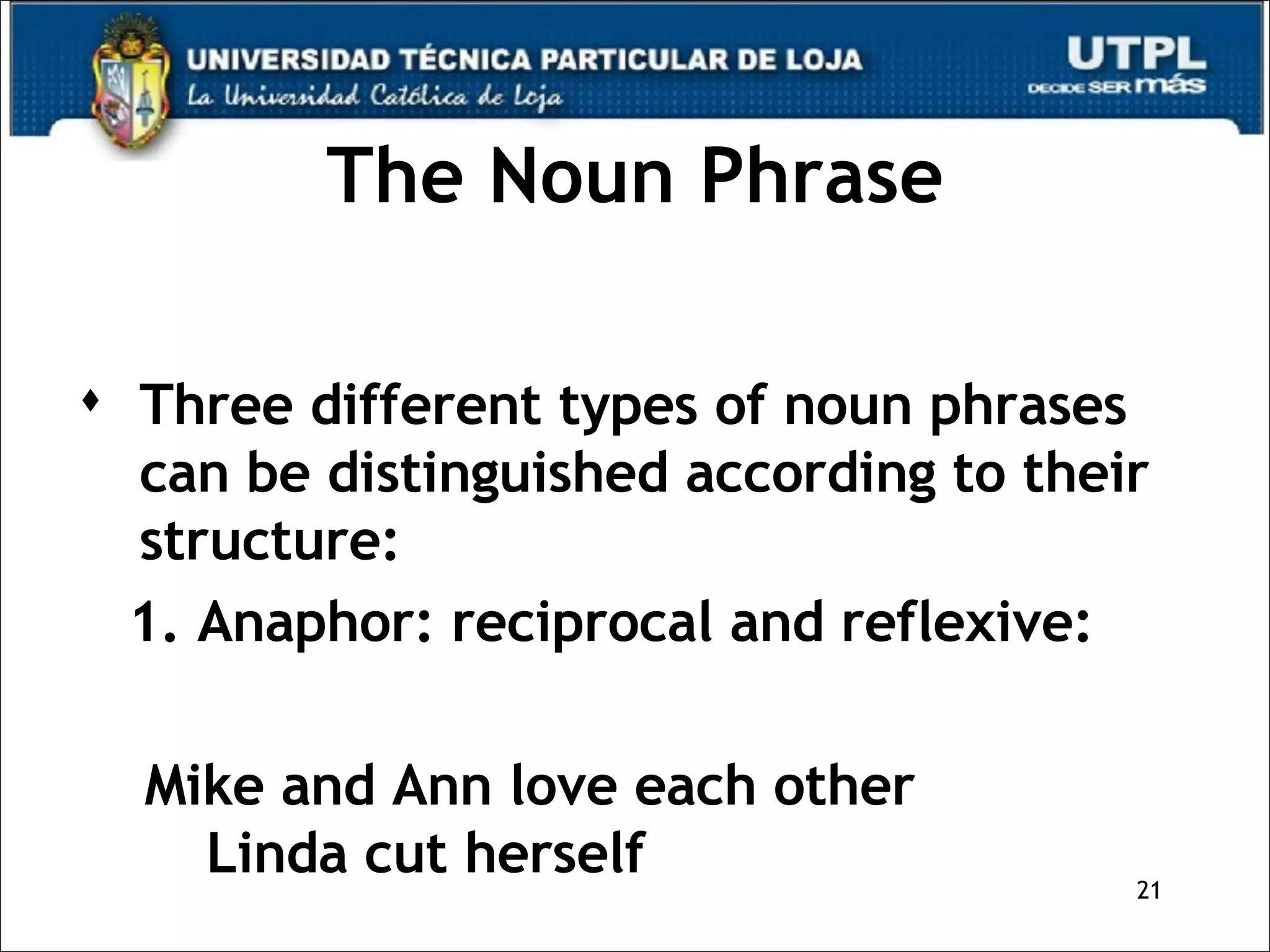
The Noun Phrase Three different types of noun phrases can be distinguished according to their structure: 1. Anaphor: reciprocal and reflexive: Mike and Ann love each other  Linda cut herself
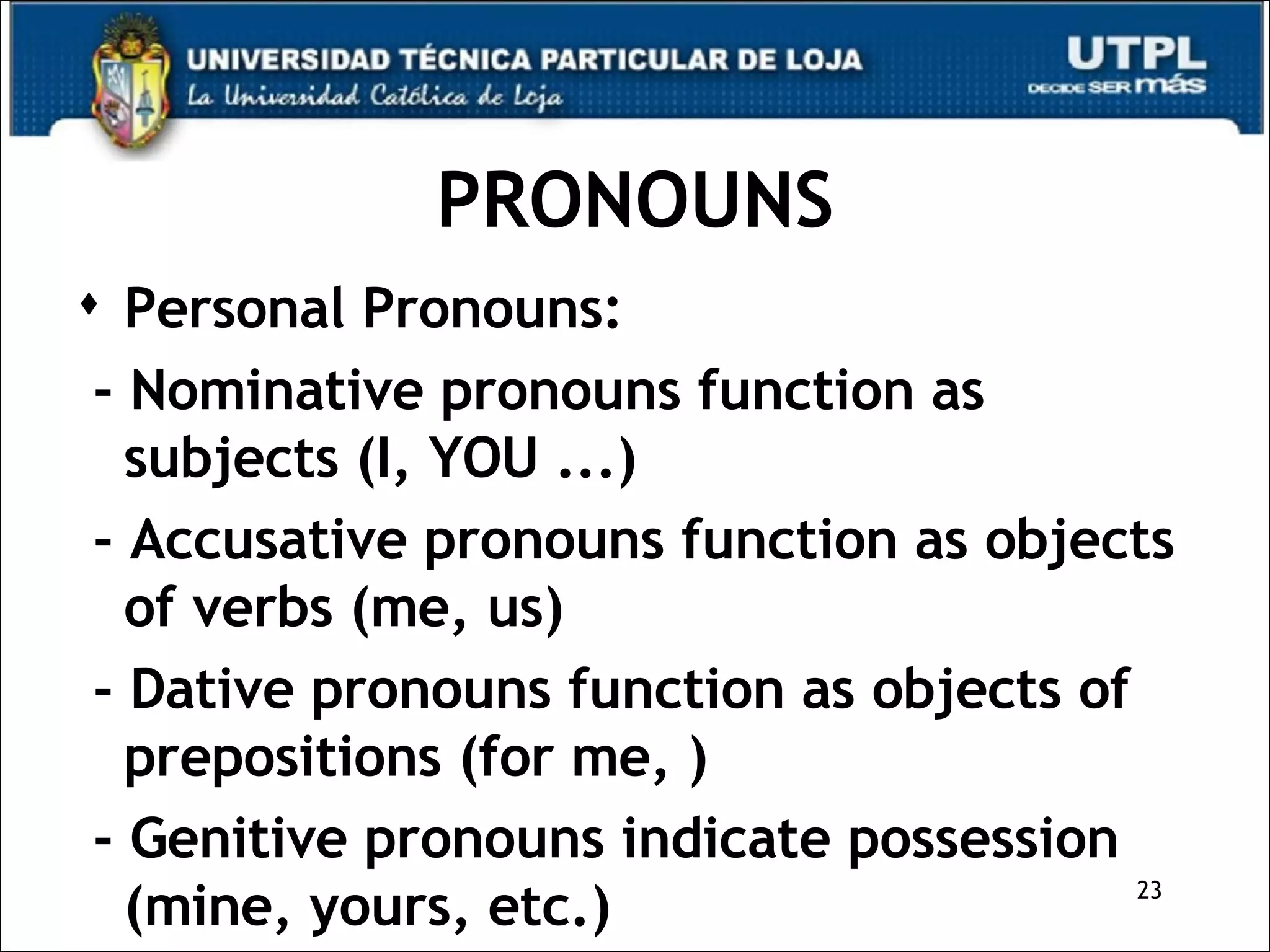
PRONOUNS Personal Pronouns: - Nominative pronouns function as subjects (I, YOU ...)  - Accusative pronouns function as objects of verbs (me, us) - Dative pronouns function as objects of prepositions (for me, ) - Genitive pronouns indicate possession (mine, yours, etc.)
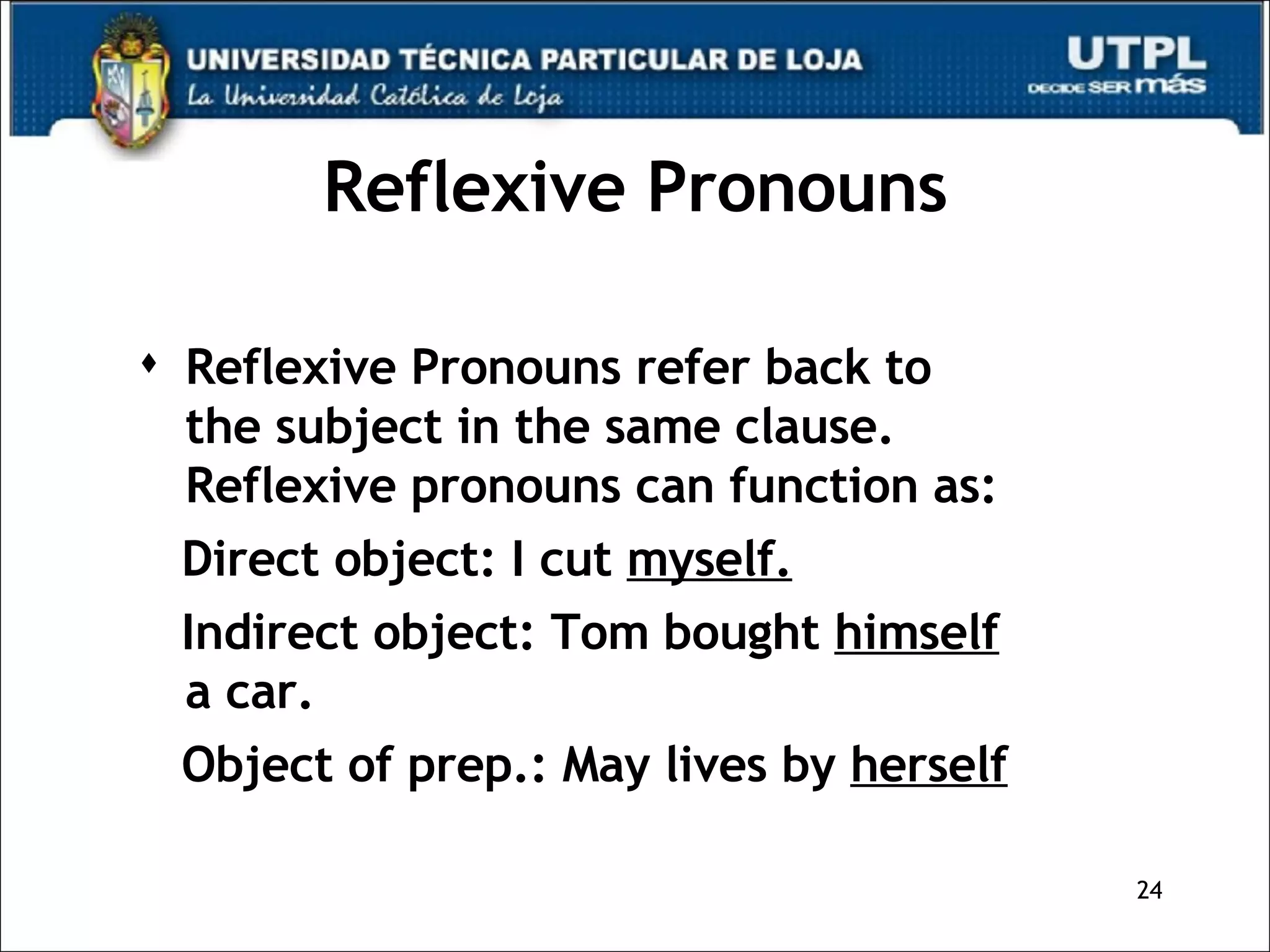
Reflexive Pronouns Reflexive Pronouns refer back to  the subject in the same clause. Reflexive pronouns can function as: Direct object: I cut  myself. Indirect object: Tom bought  himself  a car. Object of prep.: May lives by  herself
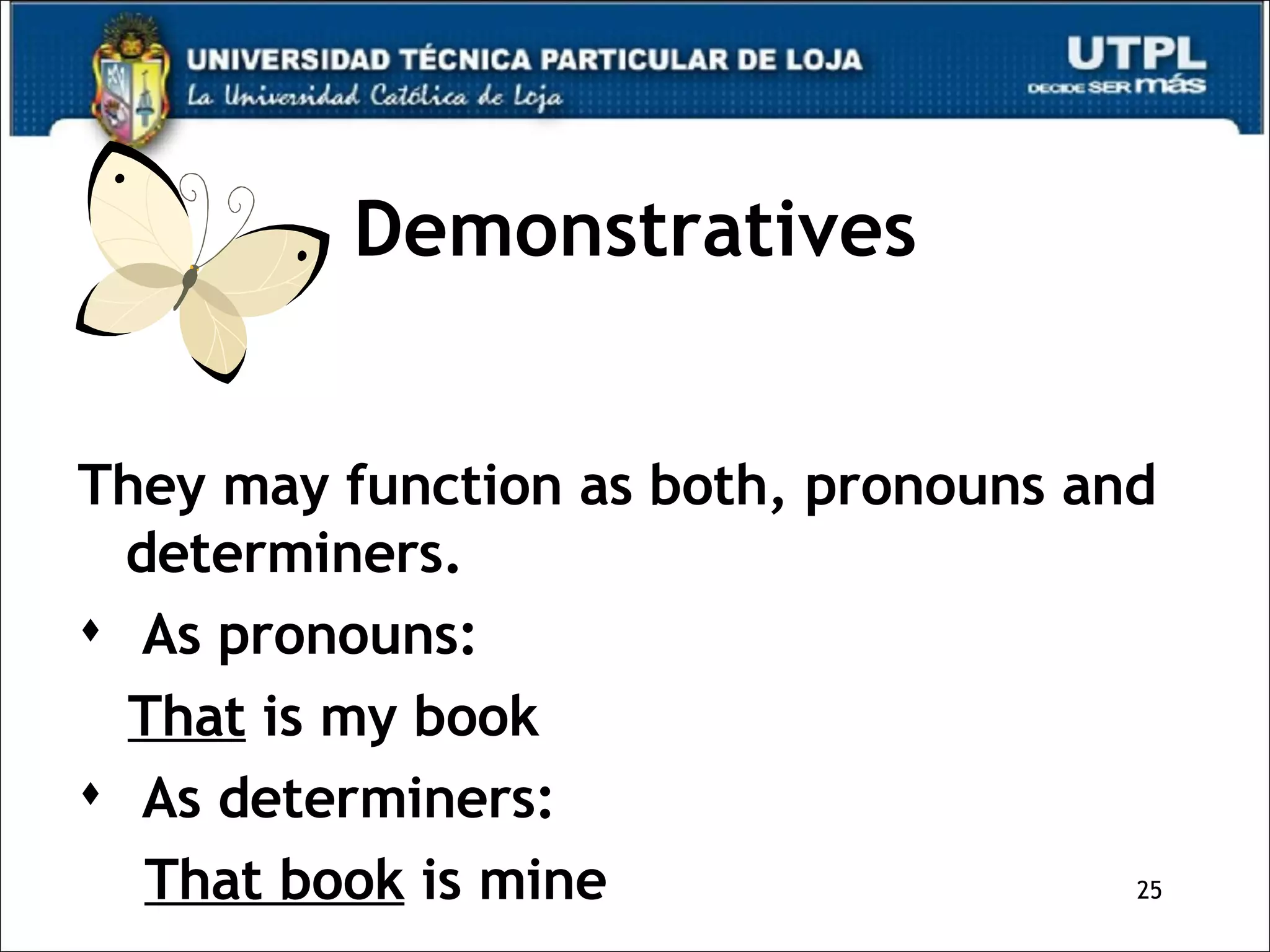
Demonstratives They may function as both, pronouns and  determiners. As pronouns:  That  is my book As determiners: That book  is mine
Functions of Noun Phrases A noun phrase is a string of words headed by a noun and which expresses meaning. According to its external syntax, a noun phrase may function as a subject, as an object and as a complement: Those boys  play tennis very well My friend sold  his old car He is  a dentist
Types of Noun Phrases according to their structure Elementary noun phrases may consist of proper nouns and pronouns. You  came yesterday (Nominative)  Mike gave  me  a book  (Accusative) Mike is in  his  company (Genitive) Robert   likes to hunt  (Proper NP )
Types of Noun Phrases Noun phrases have nouns as their heads. A head noun is the word that dictates the internal structure of the  phrase.  Proper nouns Carlos  is very smart Common noun phrases Cats  are beautiful
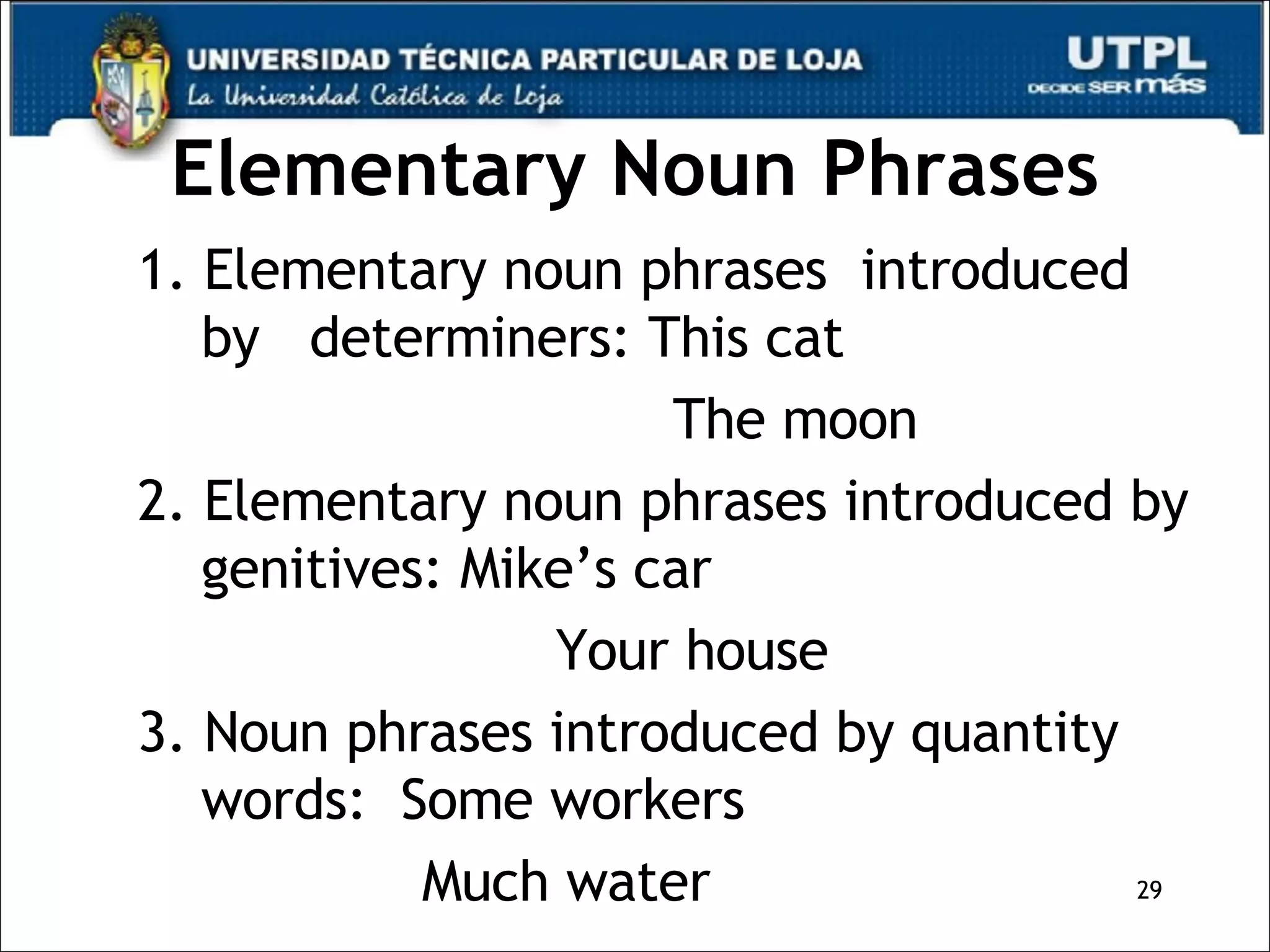
Elementary Noun Phrases 1. Elementary noun phrases  introduced by  determiners: This cat The moon 2. Elementary noun phrases introduced by genitives: Mike’s car Your house 3. Noun phrases introduced by quantity words:  Some workers Much water
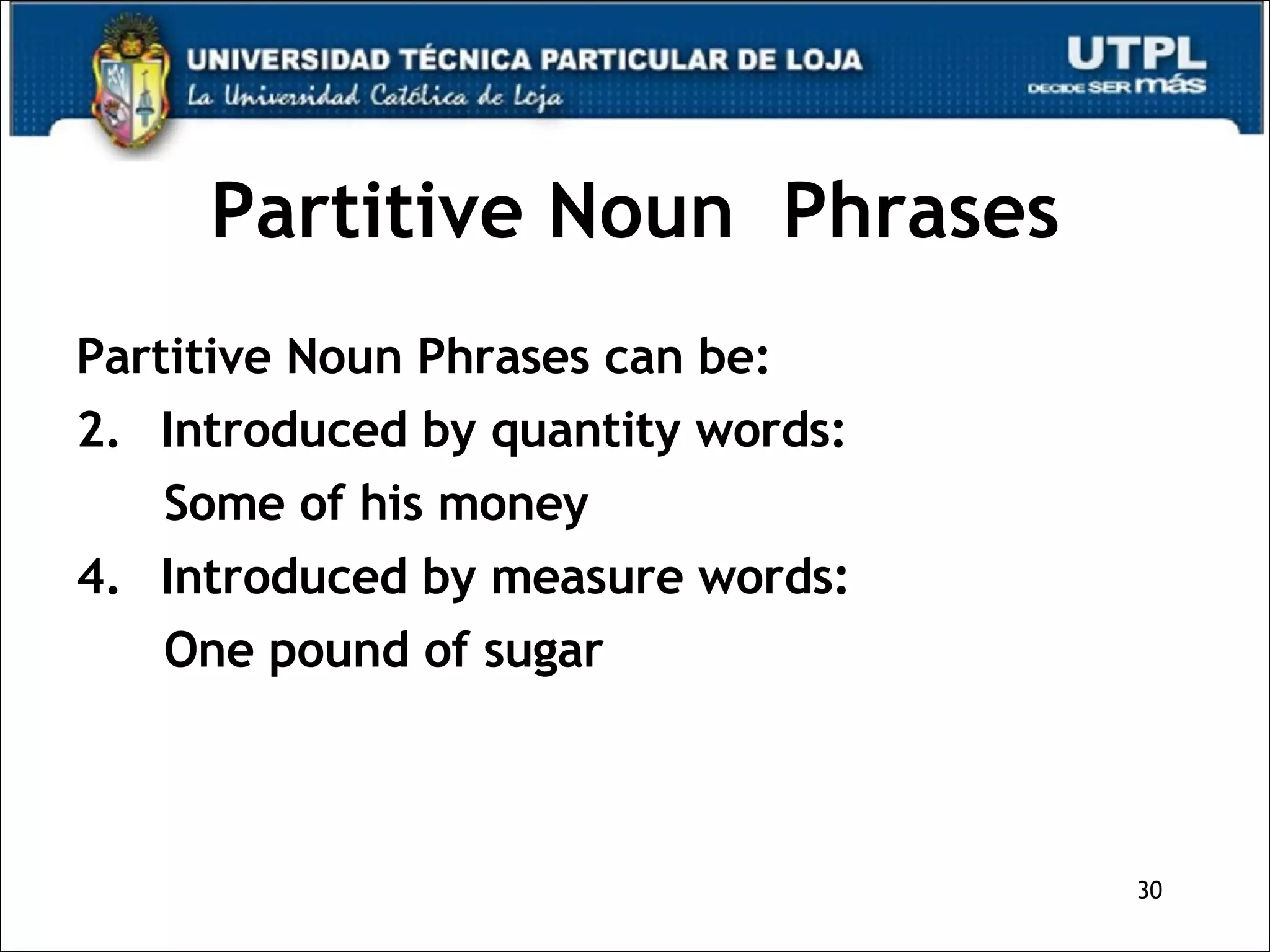
Partitive Noun  Phrases Partitive Noun Phrases can be: Introduced by quantity words: Some of his money Introduced by measure words: One pound of sugar
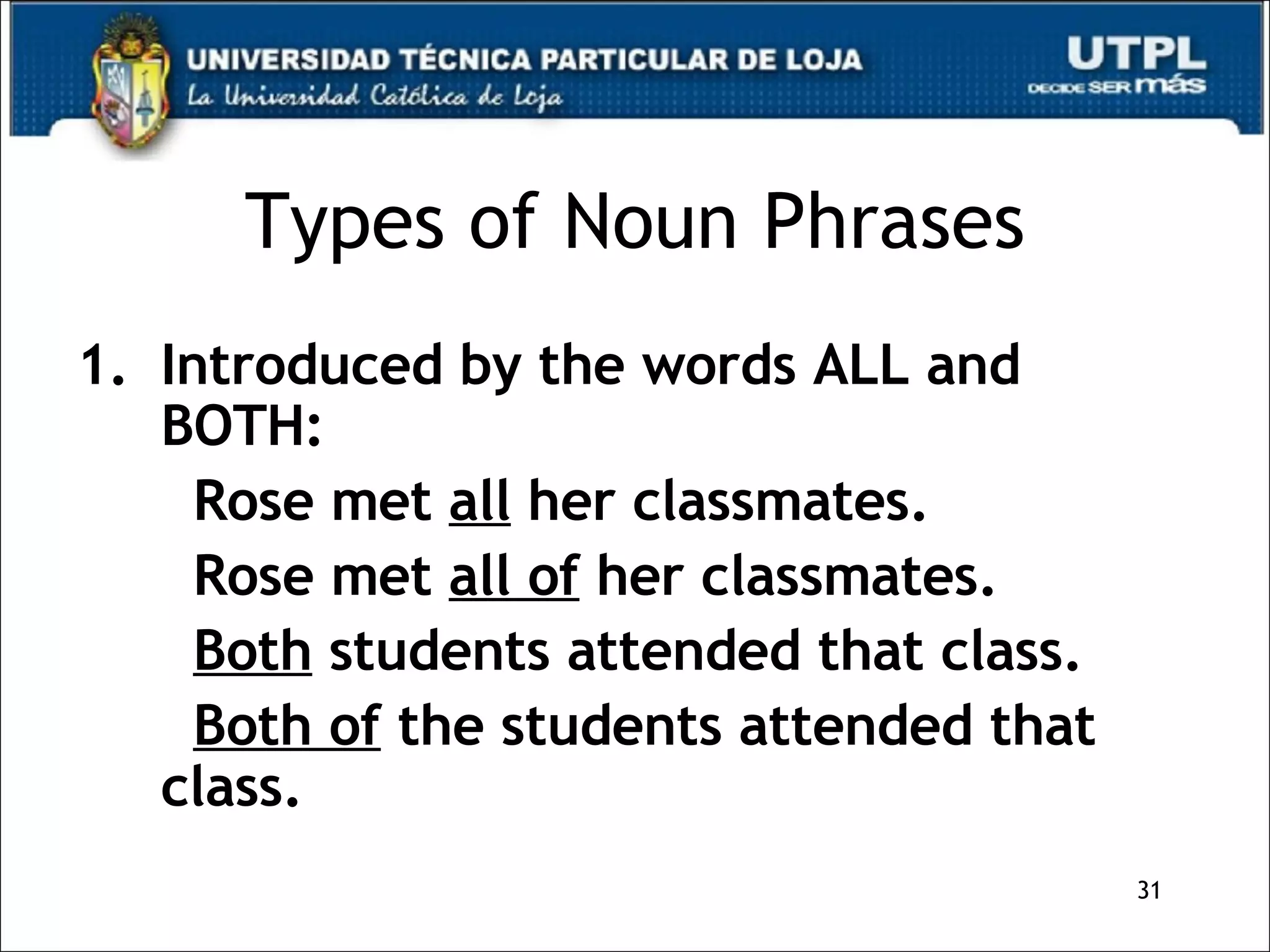
Types of Noun Phrases Introduced by the words ALL and BOTH: Rose met  all  her classmates. Rose met  all of  her classmates.  Both  students attended that class. Both of  the students attended that class.
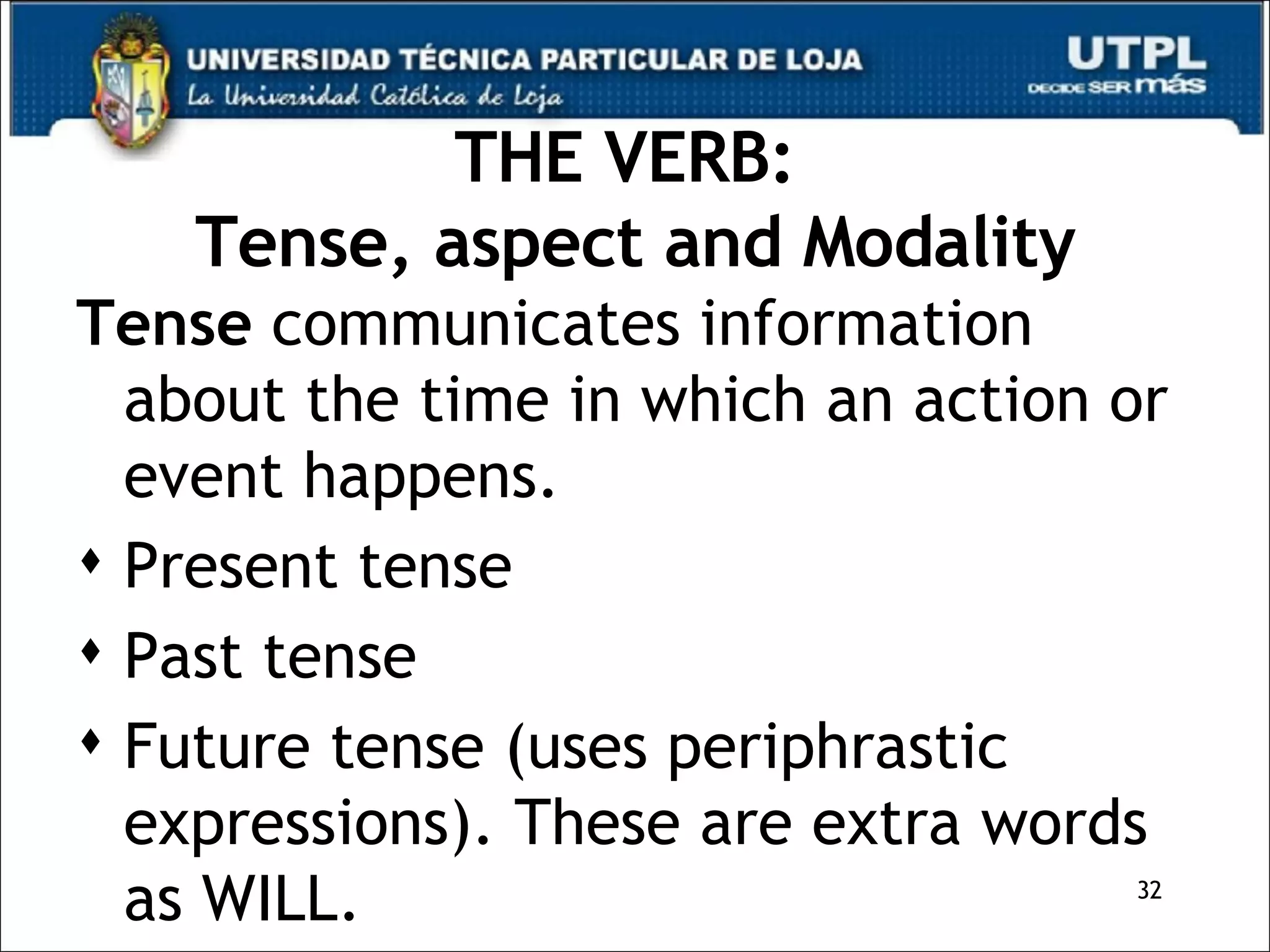
THE VERB:  Tense, aspect and Modality Tense  communicates information about the time in which an action or event happens. Present tense Past tense Future tense (uses periphrastic expressions). These are extra words as WILL.
Aspect Aspect  indicates the way an action or event is seen or experienced. It can be ongoing or resultant. The progressive aspect is ongoing. María is washing her car. The Perfect aspect is resultant. Experts have predicted a new crisis .
Modality Mood refers to the purpose of a sentence. It can be: - Indicative for statements - Interrogative for questions - Imperative for commands - Subjunctive for wishes - Conditional for possibility, certainty, obligation, necessity, promise or threat This book might become a best seller
Action and Belief Modalities The Action (or deontic) modality involves language and potential action. It is used to make promises, to order, or to place an obligation. No smoking (order) I promise to help you (promise) Can you help me?  (request)
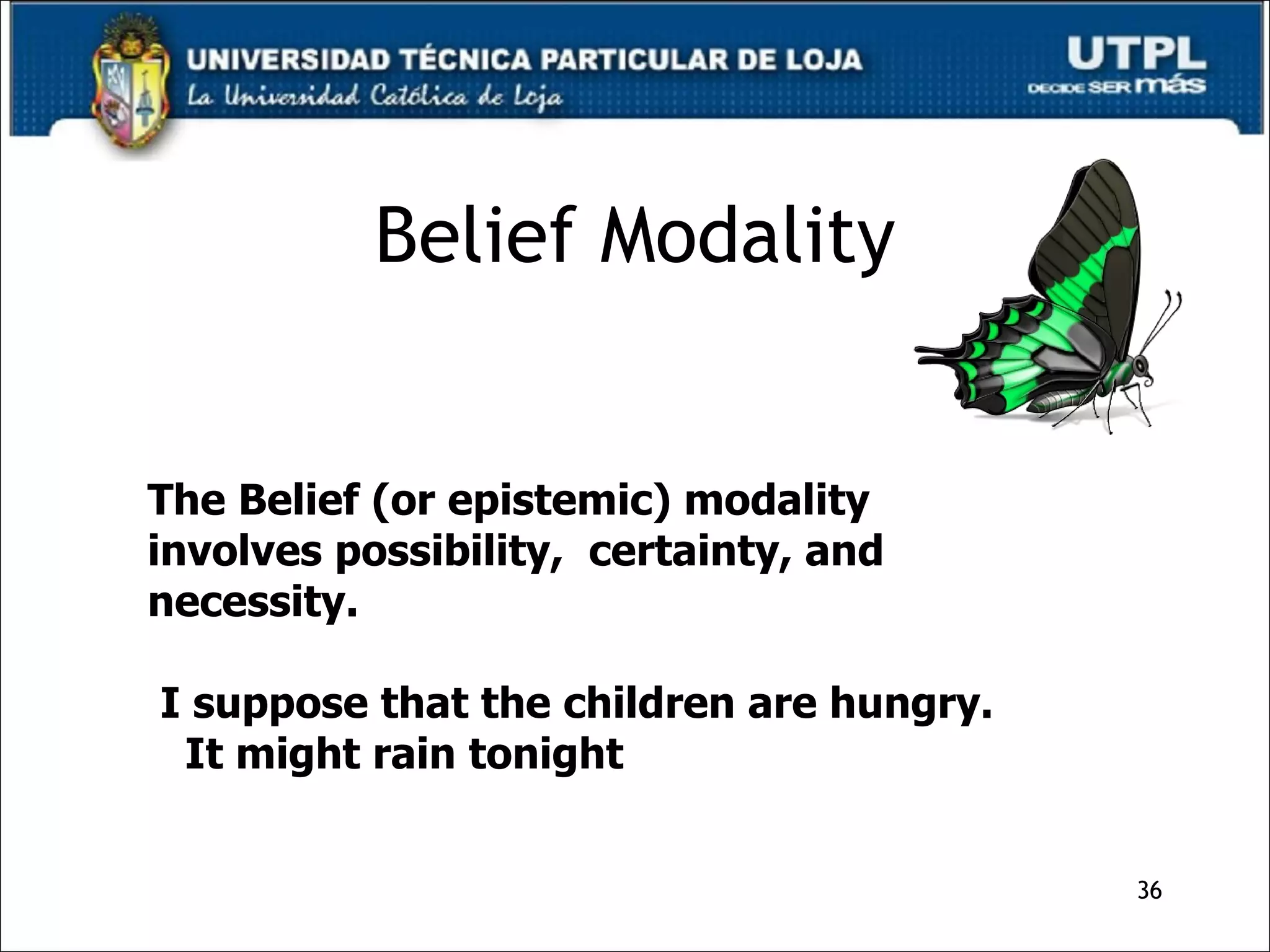
Belief Modality The Belief (or epistemic) modality involves possibility,  certainty, and necessity. I suppose that the children are hungry. It might rain tonight
UNIT THREE   The Internal and External Syntax of Phrases Internal Syntax refers to the way words are put together to form phrases or clauses. External syntax refers to the function constituents (as phrases) might perform in a sentence or clause.
Subcategorization Each word has a set of syntactic features indicating the context in which it can be inserted. Ken broke the window –Brake: V + NP Catty put the pen on the desk– Put: V + NP + PP
Noun Phrases as Complements NPs can function as subjects, objects and complements. In complement position, they function as arguments and as predicates.
Arguments and Predicates As arguments they indicate that the subject  plays certain role: That hunter  killed a lion As predicates, they provide information about the subject  Mike is  a soldier
Complements Infinitives as verb phrase complements : That bird seems  to be sick Infinitives as complements of adjectives: We are eager  to travel to Europe . Infinitives as complement of nouns : The plan  to save wild life  is good.
God bless you Thank you
English Syntax Primer Bimestre

English Syntax Primer Bimestre

  • 1.
    ENGLISH SYNTAX IBimestre Escuela: Inglés Nombres: Dra. María Rosario Burneo B. Fecha: Abril/Agosto 2009
  • 2.
    FIRST PART UNITSI, II AND III
  • 3.
    LANGUAGE language isa social, cultural and psychological phenomenon that serves the purpose of communication among human beings
  • 4.
    4 LINGUISTICS Linguistics can be defined as the study of human language in all its manifestations.
  • 5.
    LINGUISTICS Linguistics focuseson different aspects of the language, such as: Word formation and inflection; (Morphology); Sounds (Phonology). Structure (Syntax). Meaning (Semantics), and The relationship between language use and society (Pragmatics ).
  • 6.
    UNIT ONE: BASIC SENTENCE STRUCTURES Lexical categories are word based: noun, verb, adjective. Phrasal categories are phrase-based: noun phrase, verb phrase, prepositional phrase, etc .
  • 7.
    Linguistic Phenomena Anaphora(or anaphor) is a linguistic phenomenon referring to entities mentioned before in the same sentence or discourse: Mary likes her new job. Students and teachers feel tired.
  • 8.
    Linguistic Phenomena Coordinationuses conjunctions to join words or phrases belonging to the same category: Teachers and students are attending a lecture Recursion enables speakers to make use of a finite set of rules to generate an infinite number of sentences. Mike, who is a doctor, lives next door .
  • 9.
    Linguistic Phenomena Distributionstates which words and phrases can appear in a particular position in a sentence. For example: NPs can appear in subject or object position.
  • 10.
    LINGUISTIC PHENOMENA Intrusión refers to the insertion of parenthetical expressions like “I guess”, “certainly”, usually” and others. I guess, it is fine
  • 11.
    Core Sentence PatternsCore sentence patterns are basic strings of words that express meaning and have an associated structural description called Base Phrase Marker.
  • 12.
    Core Sentence PatternsA Base Phrase Marker is a tree diagram used to show the structure of phrases, clauses and sentences in a graphic way. S NP VP Det. N V NP My son wants a car
  • 13.
    The Five CorePatterns PATTERN ONE S = NP + VP intransitive + (Adv.P) Mike walks slowly Elizabeth runs
  • 14.
    PATTERN TWO S= NP + VP linking + NP George became a doctor S = NP + VP linking + Adj. Phrase Mr. Johnson looks tired
  • 15.
    Pattern THREE Itis built around one-place transitive verbs. S = NP+VP one-place trans+ NP Robert washed his car
  • 16.
    Pattern FOUR Thispattern has two versions: S = NP + VP transitive +NP + NP + (Adv.P) Rose gave him an interesting book - This structure takes two objects, a DO and an IO. - I bought a car for my son yesterday.
  • 17.
    Pattern FOUR 2.S = NP + VP transitive + NP + NP He considers Bush a good person The first NP functions as the object and the second one as the complement. S = NP + VP transitive + NP + Adj.P Most boys consider soccer important. S = NP + VP + NP + Inf.P People consider politicians to be very bad
  • 18.
    OBJECTS DIRECT OBJECTMike bought a new car INDIRECT OBJECT Mike gave me a book OBJECT OF PREPOSITION (also called Oblique object) Mike bought a book for me
  • 19.
    Pattern FIVE Thispattern is built around the verb BE. S = NP + VP be + NP Martha is a teacher S = NP + VP be + Adj.P Martha is smart S = NP + VP be + Adv.P Martha is in the classroom
  • 20.
    UNIT TWO: ENGLISHPHRASE STRUCTURES Constituents can be lexical (words) or phrasal (phrases). Words form phrases: This new house det. Adj. noun Phrases form clauses: This new house is beautiful NP PV
  • 21.
    The Noun PhraseThree different types of noun phrases can be distinguished according to their structure: 1. Anaphor: reciprocal and reflexive: Mike and Ann love each other Linda cut herself
  • 22.
    The Noun PhraseThree different types of noun phrases can be distinguished according to their structure: 1. Anaphor: reciprocal and reflexive: Mike and Ann love each other Linda cut herself
  • 23.
    PRONOUNS Personal Pronouns:- Nominative pronouns function as subjects (I, YOU ...) - Accusative pronouns function as objects of verbs (me, us) - Dative pronouns function as objects of prepositions (for me, ) - Genitive pronouns indicate possession (mine, yours, etc.)
  • 24.
    Reflexive Pronouns ReflexivePronouns refer back to the subject in the same clause. Reflexive pronouns can function as: Direct object: I cut myself. Indirect object: Tom bought himself a car. Object of prep.: May lives by herself
  • 25.
    Demonstratives They mayfunction as both, pronouns and determiners. As pronouns: That is my book As determiners: That book is mine
  • 26.
    Functions of NounPhrases A noun phrase is a string of words headed by a noun and which expresses meaning. According to its external syntax, a noun phrase may function as a subject, as an object and as a complement: Those boys play tennis very well My friend sold his old car He is a dentist
  • 27.
    Types of NounPhrases according to their structure Elementary noun phrases may consist of proper nouns and pronouns. You came yesterday (Nominative) Mike gave me a book (Accusative) Mike is in his company (Genitive) Robert likes to hunt (Proper NP )
  • 28.
    Types of NounPhrases Noun phrases have nouns as their heads. A head noun is the word that dictates the internal structure of the phrase. Proper nouns Carlos is very smart Common noun phrases Cats are beautiful
  • 29.
    Elementary Noun Phrases1. Elementary noun phrases introduced by determiners: This cat The moon 2. Elementary noun phrases introduced by genitives: Mike’s car Your house 3. Noun phrases introduced by quantity words: Some workers Much water
  • 30.
    Partitive Noun Phrases Partitive Noun Phrases can be: Introduced by quantity words: Some of his money Introduced by measure words: One pound of sugar
  • 31.
    Types of NounPhrases Introduced by the words ALL and BOTH: Rose met all her classmates. Rose met all of her classmates. Both students attended that class. Both of the students attended that class.
  • 32.
    THE VERB: Tense, aspect and Modality Tense communicates information about the time in which an action or event happens. Present tense Past tense Future tense (uses periphrastic expressions). These are extra words as WILL.
  • 33.
    Aspect Aspect indicates the way an action or event is seen or experienced. It can be ongoing or resultant. The progressive aspect is ongoing. María is washing her car. The Perfect aspect is resultant. Experts have predicted a new crisis .
  • 34.
    Modality Mood refersto the purpose of a sentence. It can be: - Indicative for statements - Interrogative for questions - Imperative for commands - Subjunctive for wishes - Conditional for possibility, certainty, obligation, necessity, promise or threat This book might become a best seller
  • 35.
    Action and BeliefModalities The Action (or deontic) modality involves language and potential action. It is used to make promises, to order, or to place an obligation. No smoking (order) I promise to help you (promise) Can you help me? (request)
  • 36.
    Belief Modality TheBelief (or epistemic) modality involves possibility, certainty, and necessity. I suppose that the children are hungry. It might rain tonight
  • 37.
    UNIT THREE The Internal and External Syntax of Phrases Internal Syntax refers to the way words are put together to form phrases or clauses. External syntax refers to the function constituents (as phrases) might perform in a sentence or clause.
  • 38.
    Subcategorization Each wordhas a set of syntactic features indicating the context in which it can be inserted. Ken broke the window –Brake: V + NP Catty put the pen on the desk– Put: V + NP + PP
  • 39.
    Noun Phrases asComplements NPs can function as subjects, objects and complements. In complement position, they function as arguments and as predicates.
  • 40.
    Arguments and PredicatesAs arguments they indicate that the subject plays certain role: That hunter killed a lion As predicates, they provide information about the subject Mike is a soldier
  • 41.
    Complements Infinitives asverb phrase complements : That bird seems to be sick Infinitives as complements of adjectives: We are eager to travel to Europe . Infinitives as complement of nouns : The plan to save wild life is good.
  • 42.
    God bless youThank you

Editor's Notes