] TENSE AND ASPECT ]
Siti Fatimah 
(1205085003) 
Mulia Hariana 
(1205085010) 
Fithri Durotul Uyun 
(1205085029)
. . . Overview 
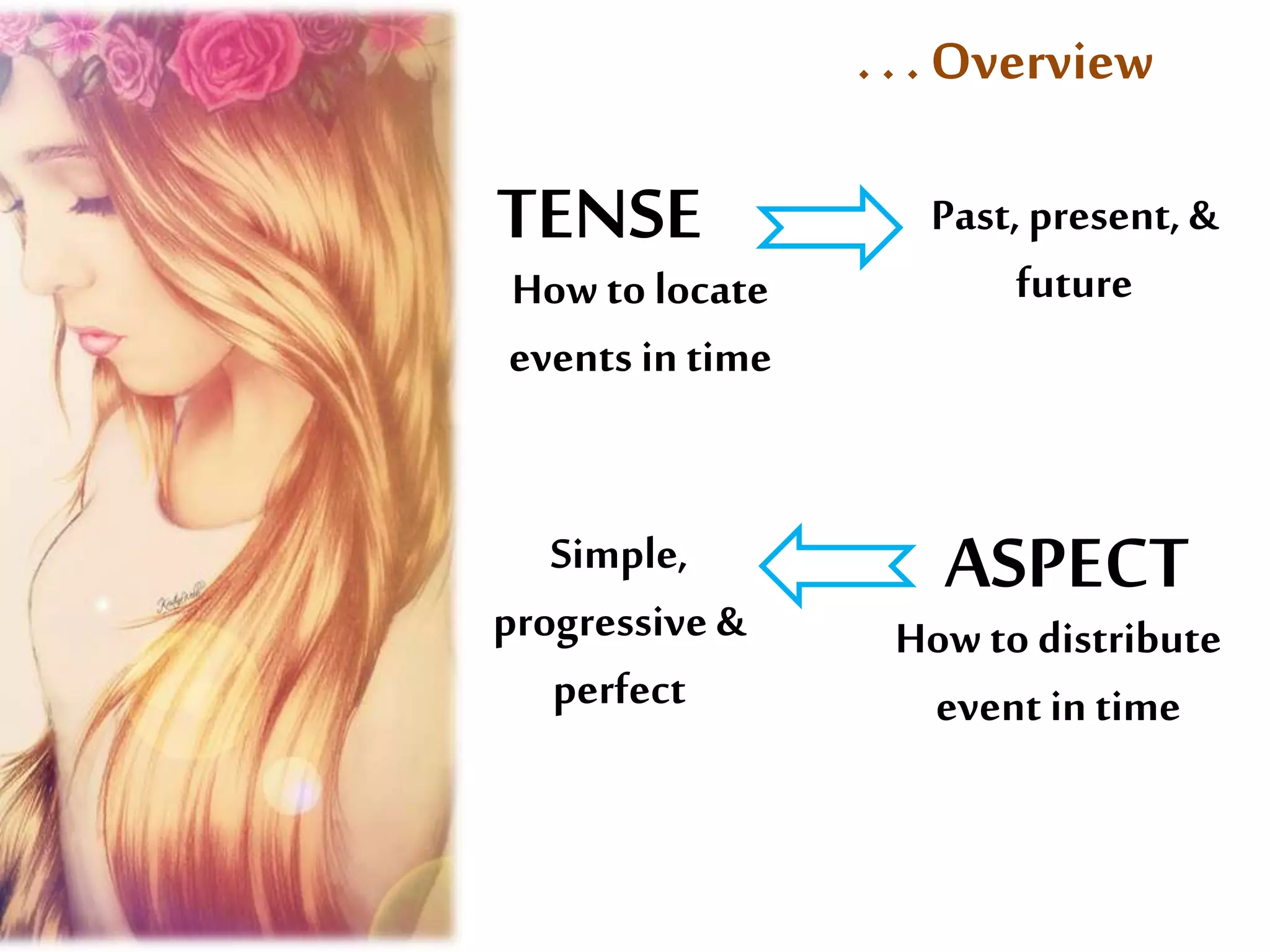
TENSE 
Past, present, & 
future 
ASPECT 
How to locate 
events in time 
How to distribute 
event in time 
Simple, 
progressive & 
perfect
. . . Overview 
“When I told people I was spending time with farmers, they 
would say : how can you stand it, they just complain all day 
and they’ve always got their hand out.”
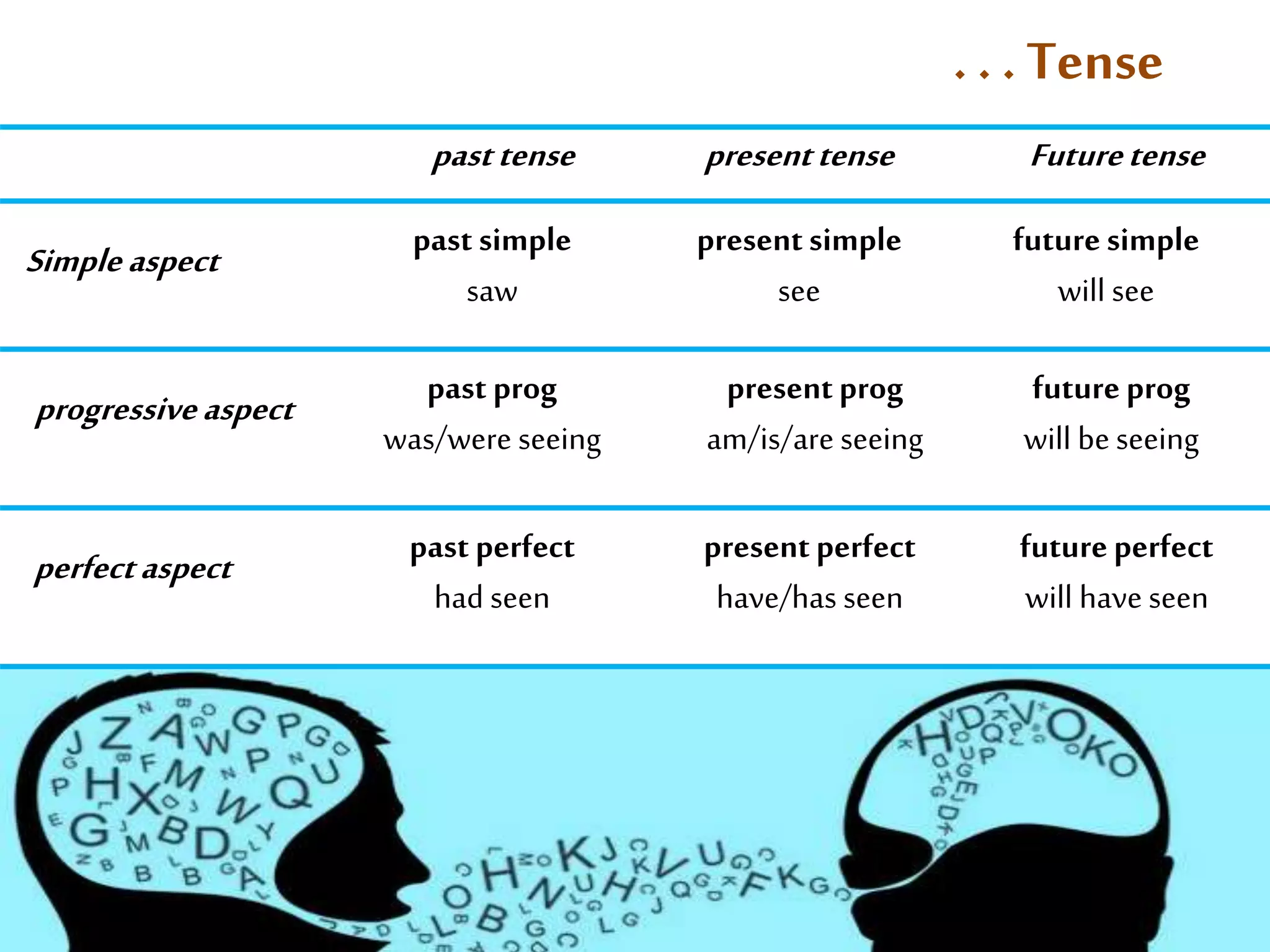
. . . Tense 
past tense present tense Future tense 
Simple aspect 
progressive aspect 
perfect aspect 
past simple 
saw 
past prog 
was/were seeing 
past perfect 
had seen 
present simple 
see 
future simple 
will see 
present prog 
am/is/are seeing 
present perfect 
have/has seen 
future prog 
will be seeing 
future perfect 
will have seen
&Preliminaries & 
Tense has to be explicated in relation to the 
time of utterance which makes it a deictic 
feature of language 
Present Tense 
Past Tense 
Future Tense 
Before the time 
utterance 
After the time 
utterance 
In the time 
utterance
&Preliminaries & 
Tenses are indicated by : 
1. Auxiliary verbs : will, have, be 
2. Irregular verbs : saw, seen, thoughts, is, 
was, would 
3. Inflectional suffixes : 
- Past tense : -ed 
- Present tense : -s or –es 
- Progressive : -ing 
- Past participle : -(e)n or -ed
&Present . past . future & 
PRESENT : exist in a period of time that includes the time of 
utterance. 
The cat is happy (now). 
And also used for timeless truths. 
At sea level, water (always) boils at 100°C.
&Present . past . future & 
There is also the present tense forms signal the future. 
You arrive in Australia in time for the Melbourne Cup next year. 
Next Wednesday I am examining in Newcastle.
&Present . past . future & 
PAST : exist in a period before the time of utterance. 
We ate at 7 o’clock this morning. 
And also illustrated the historic present. 
They were watching TV when suddenly a runaway truck crashes through 
their living room wall.
&Present . past . future & 
FUTURE : exist in a period after the time of utterance. Such 
prediction : 
Lemon juice will remove that stain. 
Not only use will + verb but also use going to + verb 
He’s going to stay at home and look after the kids. 
Can also be used for timeless truths. 
A diamond will cut glass.
&tense and adverbials& 
past time present tense Future tense 
then 
now then 
last year 
at present 
Next year 
last Batille Day 
nowadays 
Tomorrow 
yesterday 
In forty-five minutes from 
now 
today, this week, this year
&tense and adverbials& 
Today, this week, andthis year can’t be 
just ‘at the time of utterance’ because they 
denote periods too long to count as the 
time of utterance. 
And they sets include not only the time of 
utterance but also either times prior to the 
moment of utterance or times after the 
moment of utterance, or both.
. . . aspect 
Tense is deictic but aspect is not 
deictic. 
Grammatical resources for encoding 
the times profiles of states and events 
within an interval of time.
&habituality and simple aspect& 
She loves music nowadays. (state) 
He drinks decaffeinated coffee nowadays. 
(activity) 
Little Mauric brushes his teeth by himself 
nowadays. (accomplishment) 
The clown pops the ballon nowadays. (achievement) 
c
&habituality and simple aspect& 
past simple present simple Future simple 
She loved music. 
He drank decaffeinated 
coffee. 
Little Mauric brushed 
his teeth by himself. 
The clown popped the 
balloon. 
She loves music. 
He drinks decaffeinated 
coffee. 
Little Mauric brushs 
his teeth by himself. 
The clown pops the balloon. 
She will love music. 
He will drink decaffeinated 
coffee. 
Little Mauric will brush his 
teeth by himself. 
The clown will pop the 
balloon.
&habituality and simple aspect& 
Habitual interpretations can be made obligatory by means of 
certain adverbials : 
- In those days ( past tense ) 
- Nowadays / these days ( present tense ) 
- In future ( future tense )
&progressive aspect& 
Marked by BE + verb-ing and presenting as an ongoing activity. 
When the team reached the site at five-thirty in the morning, one of two 
family members would be waiting for them.
&progressive aspect& 
It can be used to mentally extend even a short event like the 
departure of a bus into an ongoing activity. 
Hurry, the bus is leaving.
&progressive aspect& 
The progressive aspect disregards the end of an event is clearly 
seen in an effect that it has on the entailments with situation of 
the accomplishment type
&progressive aspect& 
a. The firm demolished the building. 
>>>>> The building came down. 
b. The firm has demolished the building. 
>>>>> ditto 
c. The firm was demolishing the building. 
doesn’t entail ditto
&perfect aspect& 
The combination of the auxiliary HAVE 
(have,has or had ) in front of the past 
participle form of a verb. 
Used to indicate occurrences in the 
aftermath of an event or state.
&perfect aspect& 
a. The rain started. 
b. The rain has started. 
c. The rain was starting. 
A switch from not 
raining to raining 
occurred. 
We are in the after-math 
of a switch 
from not raining to 
raining. 
There was a switch 
from not raining to 
raining.
&perfect aspect& 
Klein (1992) has pointed out about using 
recently that it behaves as a past time 
adverb. 
*I have arrived yesterday. 
*They go there recently. 
They went there recently. 
They have been there recently. 
They have been there since 1999.
&perfect aspect& 
In past perfect, we are talking about a 
time in the aftermath. 
When he phoned, I had already sent the email. 
When he phoned, I had sent the email.
. . . summary 
Tense is deictic. It locates events in 
relation to the time of utterance : 
present, past, and future. But time 
adverbials can help reveal the mapping 
between tense forms and time. 
Aspect is about the time profile of events 
: progressive and perfect.

TENSE AND ASPECT

  • 1.
    ] TENSE ANDASPECT ]
  • 2.
    Siti Fatimah (1205085003) Mulia Hariana (1205085010) Fithri Durotul Uyun (1205085029)
  • 3.
    . . .Overview TENSE Past, present, & future ASPECT How to locate events in time How to distribute event in time Simple, progressive & perfect
  • 4.
    . . .Overview “When I told people I was spending time with farmers, they would say : how can you stand it, they just complain all day and they’ve always got their hand out.”
  • 5.
    . . .Tense past tense present tense Future tense Simple aspect progressive aspect perfect aspect past simple saw past prog was/were seeing past perfect had seen present simple see future simple will see present prog am/is/are seeing present perfect have/has seen future prog will be seeing future perfect will have seen
  • 6.
    &Preliminaries & Tensehas to be explicated in relation to the time of utterance which makes it a deictic feature of language Present Tense Past Tense Future Tense Before the time utterance After the time utterance In the time utterance
  • 7.
    &Preliminaries & Tensesare indicated by : 1. Auxiliary verbs : will, have, be 2. Irregular verbs : saw, seen, thoughts, is, was, would 3. Inflectional suffixes : - Past tense : -ed - Present tense : -s or –es - Progressive : -ing - Past participle : -(e)n or -ed
  • 8.
    &Present . past. future & PRESENT : exist in a period of time that includes the time of utterance. The cat is happy (now). And also used for timeless truths. At sea level, water (always) boils at 100°C.
  • 9.
    &Present . past. future & There is also the present tense forms signal the future. You arrive in Australia in time for the Melbourne Cup next year. Next Wednesday I am examining in Newcastle.
  • 10.
    &Present . past. future & PAST : exist in a period before the time of utterance. We ate at 7 o’clock this morning. And also illustrated the historic present. They were watching TV when suddenly a runaway truck crashes through their living room wall.
  • 11.
    &Present . past. future & FUTURE : exist in a period after the time of utterance. Such prediction : Lemon juice will remove that stain. Not only use will + verb but also use going to + verb He’s going to stay at home and look after the kids. Can also be used for timeless truths. A diamond will cut glass.
  • 12.
    &tense and adverbials& past time present tense Future tense then now then last year at present Next year last Batille Day nowadays Tomorrow yesterday In forty-five minutes from now today, this week, this year
  • 13.
    &tense and adverbials& Today, this week, andthis year can’t be just ‘at the time of utterance’ because they denote periods too long to count as the time of utterance. And they sets include not only the time of utterance but also either times prior to the moment of utterance or times after the moment of utterance, or both.
  • 14.
    . . .aspect Tense is deictic but aspect is not deictic. Grammatical resources for encoding the times profiles of states and events within an interval of time.
  • 15.
    &habituality and simpleaspect& She loves music nowadays. (state) He drinks decaffeinated coffee nowadays. (activity) Little Mauric brushes his teeth by himself nowadays. (accomplishment) The clown pops the ballon nowadays. (achievement) c
  • 16.
    &habituality and simpleaspect& past simple present simple Future simple She loved music. He drank decaffeinated coffee. Little Mauric brushed his teeth by himself. The clown popped the balloon. She loves music. He drinks decaffeinated coffee. Little Mauric brushs his teeth by himself. The clown pops the balloon. She will love music. He will drink decaffeinated coffee. Little Mauric will brush his teeth by himself. The clown will pop the balloon.
  • 17.
    &habituality and simpleaspect& Habitual interpretations can be made obligatory by means of certain adverbials : - In those days ( past tense ) - Nowadays / these days ( present tense ) - In future ( future tense )
  • 18.
    &progressive aspect& Markedby BE + verb-ing and presenting as an ongoing activity. When the team reached the site at five-thirty in the morning, one of two family members would be waiting for them.
  • 19.
    &progressive aspect& Itcan be used to mentally extend even a short event like the departure of a bus into an ongoing activity. Hurry, the bus is leaving.
  • 20.
    &progressive aspect& Theprogressive aspect disregards the end of an event is clearly seen in an effect that it has on the entailments with situation of the accomplishment type
  • 21.
    &progressive aspect& a.The firm demolished the building. >>>>> The building came down. b. The firm has demolished the building. >>>>> ditto c. The firm was demolishing the building. doesn’t entail ditto
  • 22.
    &perfect aspect& Thecombination of the auxiliary HAVE (have,has or had ) in front of the past participle form of a verb. Used to indicate occurrences in the aftermath of an event or state.
  • 23.
    &perfect aspect& a.The rain started. b. The rain has started. c. The rain was starting. A switch from not raining to raining occurred. We are in the after-math of a switch from not raining to raining. There was a switch from not raining to raining.
  • 24.
    &perfect aspect& Klein(1992) has pointed out about using recently that it behaves as a past time adverb. *I have arrived yesterday. *They go there recently. They went there recently. They have been there recently. They have been there since 1999.
  • 25.
    &perfect aspect& Inpast perfect, we are talking about a time in the aftermath. When he phoned, I had already sent the email. When he phoned, I had sent the email.
  • 26.
    . . .summary Tense is deictic. It locates events in relation to the time of utterance : present, past, and future. But time adverbials can help reveal the mapping between tense forms and time. Aspect is about the time profile of events : progressive and perfect.