Syntax
Syntax is thearrangement of words in sentences, clauses
and phrases. It is the study of the formation of sentences and
the relationship of their component parts.
It refers to word order and depends on lexical categories.
(parts of speech)
3.
The Part ofSpeech
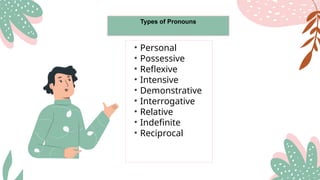
• It simply refer to types of words.
• The part of speech indicates how the word functions in
meaning as well as grammatically within the sentence.
Noun
A noun isa part of a sentence that identifies the places,
things, ideas, people, events, and other objects.
Examples:
• Albert Einstein
• Disney Land
• shoe
• freedom
Proper Nouns
• Nounsthat are used to name a person, place or thing
specifically are called a proper noun. Proper nouns always
begin with a capital letter.
Examples:
• My name is Rose. (Name of a particular person)
• This is my dog, Bruno. (Name of a specific pet animal owned
by someone).
9.
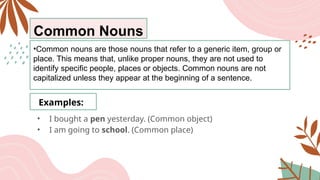
Common Nouns
•Common nounsare those nouns that refer to a generic item, group or
place. This means that, unlike proper nouns, they are not used to
identify specific people, places or objects. Common nouns are not
capitalized unless they appear at the beginning of a sentence.
Examples:
• I bought a pen yesterday. (Common object)
• I am going to school. (Common place)
10.
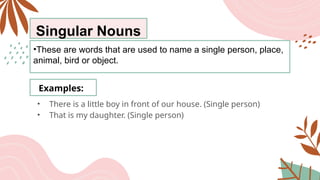
Singular Nouns
•These arewords that are used to name a single person, place,
animal, bird or object.
Examples:
• There is a little boy in front of our house. (Single person)
• That is my daughter. (Single person)
11.
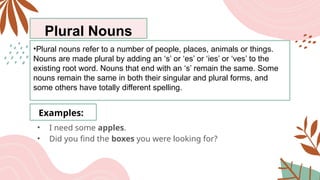
Plural Nouns
•Plural nounsrefer to a number of people, places, animals or things.
Nouns are made plural by adding an ‘s’ or ‘es’ or ‘ies’ or ‘ves’ to the
existing root word. Nouns that end with an ‘s’ remain the same. Some
nouns remain the same in both their singular and plural forms, and
some others have totally different spelling.
Examples:
• I need some apples.
• Did you find the boxes you were looking for?
12.
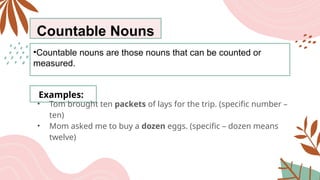
Countable Nouns
•Countable nounsare those nouns that can be counted or
measured.
Examples:
• Tom brought ten packets of lays for the trip. (specific number –
ten)
• Mom asked me to buy a dozen eggs. (specific – dozen means
twelve)
13.
Uncountable
Nouns
•Uncountable nouns arethose nouns that cannot be counted.
This category of nouns includes both concrete and abstract
nouns.
Examples:
• I have a lot of homework to do. (Not specific)
• I have a cup of tea. (Cannot count)
14.
Collective Nouns
•A collectivenoun is a naming word that is used to denote a
group of objects, animals or people.
Examples:
Collective nouns for groups of animals:
• A pride of lions
• A flock of sheep
15.
Examples:
Collective nouns forgroups of people:
• A band of musicians
• A board of directors
Collective nouns for groups of things/objects:
• A pair of shoes
• A bunch of grapes
16.
Concrete Nouns
•A concretenoun refers to objects that are material and can be
perceived by the human senses.
Examples:
• The book is on the table.
• Sharon opened the windows.
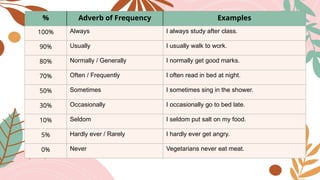
17.
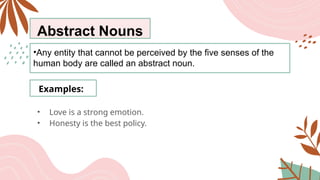
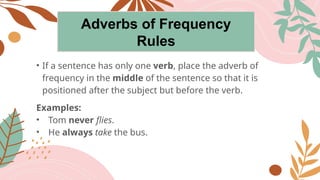
Abstract Nouns
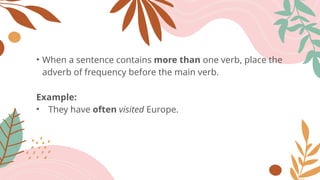
•Any entitythat cannot be perceived by the five senses of the
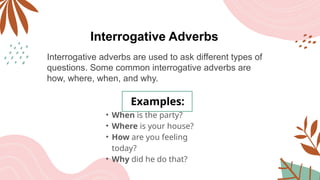
human body are called an abstract noun.
Examples:
• Love is a strong emotion.
• Honesty is the best policy.
18.
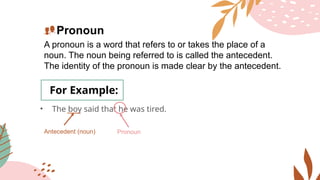
Pronoun
A pronoun isa word that refers to or takes the place of a
noun. The noun being referred to is called the antecedent.
The identity of the pronoun is made clear by the antecedent.
For Example:
• The boy said that he was tired.
Antecedent (noun) Pronoun
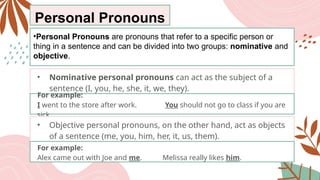
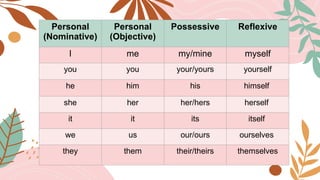
Personal Pronouns
•Personal Pronounsare pronouns that refer to a specific person or
thing in a sentence and can be divided into two groups: nominative and
objective.
• Nominative personal pronouns can act as the subject of a
sentence (I, you, he, she, it, we, they).
For example:
I went to the store after work. You should not go to class if you are
sick.
• Objective personal pronouns, on the other hand, act as objects
of a sentence (me, you, him, her, it, us, them).
For example:
Alex came out with Joe and me. Melissa really likes him.
21.
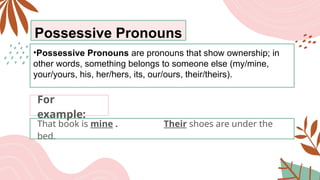
Possessive Pronouns
•Possessive Pronounsare pronouns that show ownership; in
other words, something belongs to someone else (my/mine,
your/yours, his, her/hers, its, our/ours, their/theirs).
That book is mine . Their shoes are under the
bed.
For
example:
22.
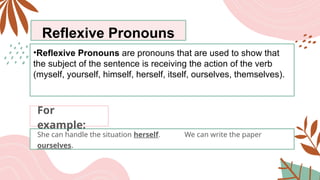
Reflexive Pronouns
•Reflexive Pronounsare pronouns that are used to show that
the subject of the sentence is receiving the action of the verb
(myself, yourself, himself, herself, itself, ourselves, themselves).
She can handle the situation herself. We can write the paper
ourselves.
For
example:
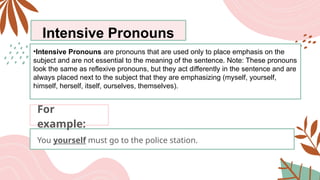
Intensive Pronouns
•Intensive Pronounsare pronouns that are used only to place emphasis on the
subject and are not essential to the meaning of the sentence. Note: These pronouns
look the same as reflexive pronouns, but they act differently in the sentence and are
always placed next to the subject that they are emphasizing (myself, yourself,
himself, herself, itself, ourselves, themselves).
You yourself must go to the police station.
For
example:
25.
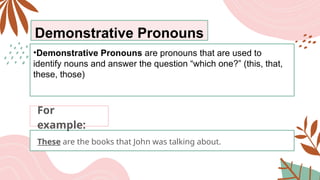
Demonstrative Pronouns
•Demonstrative Pronounsare pronouns that are used to
identify nouns and answer the question “which one?” (this, that,
these, those)
These are the books that John was talking about.
For
example:
26.
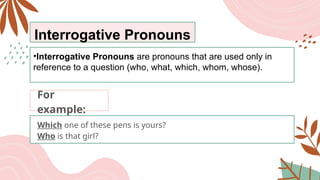
Interrogative Pronouns
•Interrogative Pronounsare pronouns that are used only in
reference to a question (who, what, which, whom, whose).
Which one of these pens is yours?
Who is that girl?
For
example:
27.
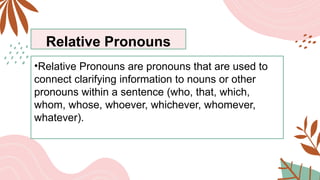
Relative Pronouns
•Relative Pronounsare pronouns that are used to
connect clarifying information to nouns or other
pronouns within a sentence (who, that, which,
whom, whose, whoever, whichever, whomever,
whatever).
28.
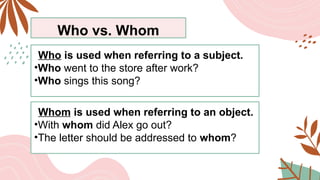
Who vs. Whom
Whois used when referring to a subject.
•Who went to the store after work?
•Who sings this song?
Whom is used when referring to an object.
•With whom did Alex go out?
•The letter should be addressed to whom?
29.
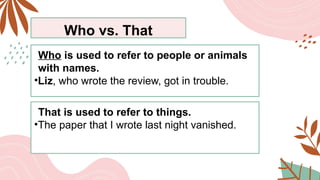
Who vs. That
Whois used to refer to people or animals
with names.
•Liz, who wrote the review, got in trouble.
That is used to refer to things.
•The paper that I wrote last night vanished.
30.
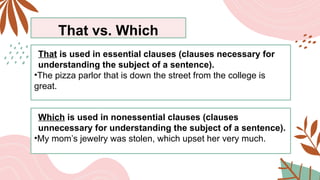
That vs. Which
Thatis used in essential clauses (clauses necessary for
understanding the subject of a sentence).
•The pizza parlor that is down the street from the college is
great.
Which is used in nonessential clauses (clauses
unnecessary for understanding the subject of a sentence).
•My mom’s jewelry was stolen, which upset her very much.
31.
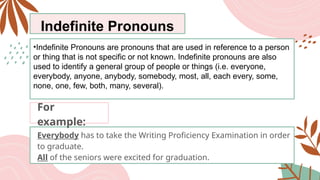
Indefinite Pronouns
•Indefinite Pronounsare pronouns that are used in reference to a person
or thing that is not specific or not known. Indefinite pronouns are also
used to identify a general group of people or things (i.e. everyone,
everybody, anyone, anybody, somebody, most, all, each every, some,
none, one, few, both, many, several).
Everybody has to take the Writing Proficiency Examination in order
to graduate.
All of the seniors were excited for graduation.
For
example:
32.
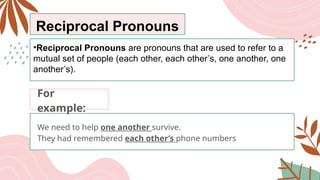
Reciprocal Pronouns
•Reciprocal Pronounsare pronouns that are used to refer to a
mutual set of people (each other, each other’s, one another, one
another’s).
We need to help one another survive.
They had remembered each other’s phone numbers
For
example:
Verb
Verb is aword or phrase that describes an action, conditon, or
experience.
• A verb is one of the most important part of a sentence.
• It tells the subjects actions, events, or state of being.
• It is always found in the predicate of a sentence.
Simple Verb Tense
•A tense is a verb form that shows the time of an action or condition. Verbs have three
simple tenses: the present, the past, and the future. The present tense shows an
action or condition that occurs now. The past tense shows an action or condition that
was completed in the past. The future tense shows an action or condition that will occur
in the future.
37.
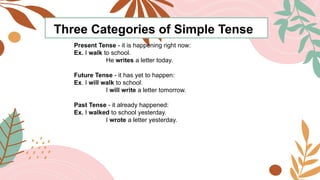
Three Categories ofSimple Tense
Present Tense - it is happening right now:
Ex. I walk to school.
He writes a letter today.
Future Tense - it has yet to happen:
Ex. I will walk to school.
I will write a letter tomorrow.
Past Tense - it already happened:
Ex. I walked to school yesterday.
I wrote a letter yesterday.
38.
VERB TENSES
•Verb tensesare used to indicate time.
•It refers to when the action in a sentence takes place-whether
it happened in the past, is happening in the present, or will
happen in the future.
39.
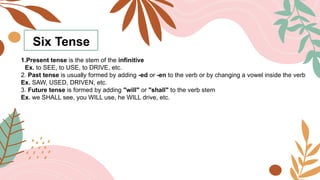
Six Tense
1.Present tenseis the stem of the infinitive
Ex. to SEE, to USE, to DRIVE, etc.
2. Past tense is usually formed by adding -ed or -en to the verb or by changing a vowel inside the verb
Ex. SAW, USED, DRIVEN, etc.
3. Future tense is formed by adding "will" or "shall" to the verb stem
Ex. we SHALL see, you WILL use, he WILL drive, etc.
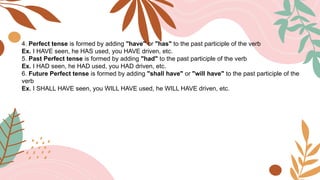
40.
4. Perfect tenseis formed by adding "have" or "has" to the past participle of the verb
Ex. I HAVE seen, he HAS used, you HAVE driven, etc.
5. Past Perfect tense is formed by adding "had" to the past participle of the verb
Ex. I HAD seen, he HAD used, you HAD driven, etc.
6. Future Perfect tense is formed by adding "shall have" or "will have" to the past participle of the
verb
Ex. I SHALL HAVE seen, you WILL HAVE used, he WILL HAVE driven, etc.
41.
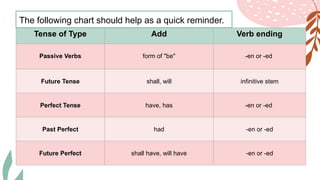
Tense of TypeAdd Verb ending
Passive Verbs form of "be" -en or -ed
Future Tense shall, will infinitive stem
Perfect Tense have, has -en or -ed
Past Perfect had -en or -ed
Future Perfect shall have, will have -en or -ed
The following chart should help as a quick reminder.
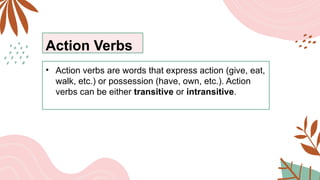
Action Verbs
• Actionverbs are words that express action (give, eat,
walk, etc.) or possession (have, own, etc.). Action
verbs can be either transitive or intransitive.
44.
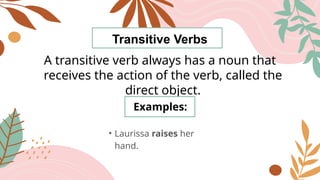
Transitive Verbs
A transitiveverb always has a noun that
receives the action of the verb, called the
direct object.
Examples:
• Laurissa raises her
hand.
45.
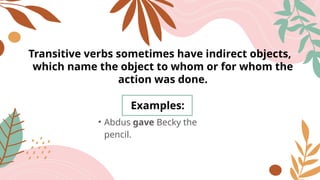
Transitive verbs sometimeshave indirect objects,
which name the object to whom or for whom the
action was done.
Examples:
• Abdus gave Becky the
pencil.
46.
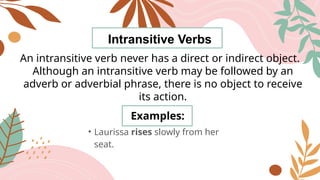
Intransitive Verbs
An intransitiveverb never has a direct or indirect object.
Although an intransitive verb may be followed by an
adverb or adverbial phrase, there is no object to receive
its action.
Examples:
• Laurissa rises slowly from her
seat.
47.
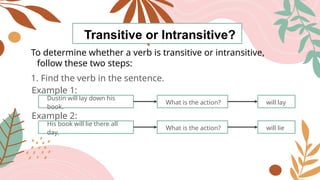
Transitive or Intransitive?
Todetermine whether a verb is transitive or intransitive,
follow these two steps:
1. Find the verb in the sentence.
Example 1:
Example 2:
Dustin will lay down his
book.
What is the action? will lay
His book will lie there all
day.
What is the action? will lie
48.
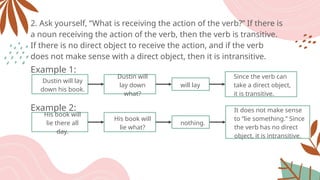
2. Ask yourself,“What is receiving the action of the verb?” If there is
a noun receiving the action of the verb, then the verb is transitive.
If there is no direct object to receive the action, and if the verb
does not make sense with a direct object, then it is intransitive.
Example 1:
Dustin will lay
down his book.
Dustin will
lay down
what?
will lay
Since the verb can
take a direct object,
it is transitive.
Example 2:
His book will
lie there all
day.
His book will
lie what?
nothing.
It does not make sense
to “lie something.” Since
the verb has no direct
object, it is intransitive.
49.
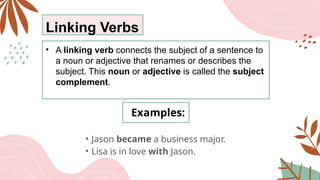
Linking Verbs
• Alinking verb connects the subject of a sentence to
a noun or adjective that renames or describes the
subject. This noun or adjective is called the subject
complement.
Examples:
• Jason became a business major.
• Lisa is in love with Jason.
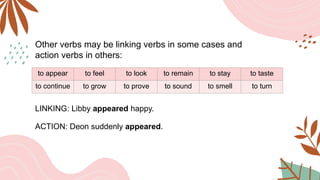
50.
Other verbs maybe linking verbs in some cases and
action verbs in others:
to appear to feel to look to remain to stay to taste
to continue to grow to prove to sound to smell to turn
LINKING: Libby appeared happy.
ACTION: Deon suddenly appeared.
51.
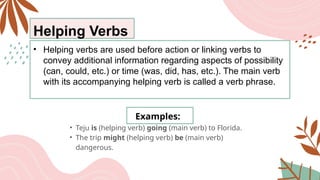
Helping Verbs
• Helpingverbs are used before action or linking verbs to
convey additional information regarding aspects of possibility
(can, could, etc.) or time (was, did, has, etc.). The main verb
with its accompanying helping verb is called a verb phrase.
Examples:
• Teju is (helping verb) going (main verb) to Florida.
• The trip might (helping verb) be (main verb)
dangerous.
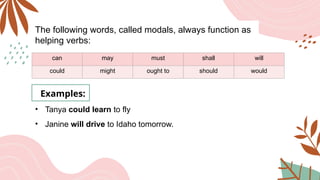
52.
The following words,called modals, always function as
helping verbs:
can may must shall will
could might ought to should would
• Tanya could learn to fly
helicopters.
• Janine will drive to Idaho tomorrow.
Examples:
53.
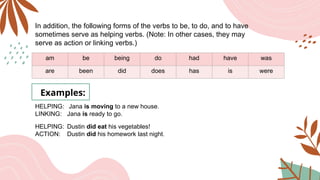
In addition, thefollowing forms of the verbs to be, to do, and to have
sometimes serve as helping verbs. (Note: In other cases, they may
serve as action or linking verbs.)
am be being do had have was
are been did does has is were
HELPING: Jana is moving to a new house.
LINKING: Jana is ready to go.
Examples:
HELPING: Dustin did eat his vegetables!
ACTION: Dustin did his homework last night.
54.
Regular and IrregularVerbs
English uses two types of verbs: regular and irregular. The
difference between these types can be seen when using the
simple past and past participle forms of the verbs. There are
no differences in form between regular and irregular verbs
when using the simple present, present participle, and
infinitive.
55.
Regular Verbs
Regular verbsare called such because they
are predictable: both the simple past and the
past participle forms add -ed to the infinitive
form of the verb.
56.
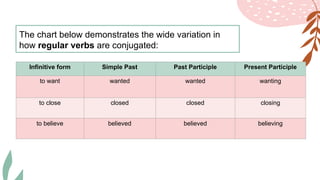
Infinitive form SimplePast Past Participle Present Participle
to want wanted wanted wanting
to close closed closed closing
to believe believed believed believing
The chart below demonstrates the wide variation in
how regular verbs are conjugated:
57.
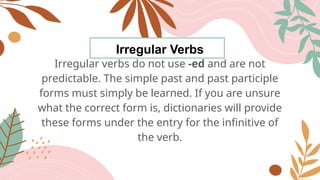
Irregular Verbs
Irregular verbsdo not use -ed and are not
predictable. The simple past and past participle
forms must simply be learned. If you are unsure
what the correct form is, dictionaries will provide
these forms under the entry for the infinitive of
the verb.
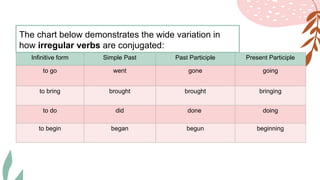
58.
Infinitive form SimplePast Past Participle Present Participle
to go went gone going
to bring brought brought bringing
to do did done doing
to begin began begun beginning
The chart below demonstrates the wide variation in
how irregular verbs are conjugated:
Adjective
Adjectives are descriptivewords that
modify nouns or pronouns. Adjective
provides more information about a noun or
pronoun, indicating things like color, size,
condition, sound, appearance and etcetera.
Coordinate Adjectives
The termcoordinate adjectives is used to refer to adjectives that
can be written in any order and are usually separated by a comma
or the word and.
Examples:
• She was a friendly, warm, kind woman
• He was carrying a huge, heavy stone.
63.
Cumulative Adjectives
Are adjectivesthat do not modify a noun separately. In other
words, they have to stay together in a particular order and does
not use comma.
Examples:
• The rich dark chocolate was delicious.
• Three large gray squirrels skittered up the tree.
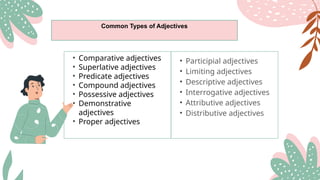
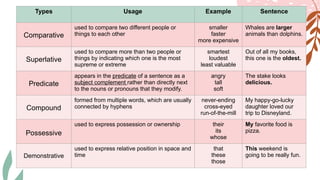
Types Usage ExampleSentence
Comparative
used to compare two different people or
things to each other
smaller
faster
more expensive
Whales are larger
animals than dolphins.
Superlative
used to compare more than two people or
things by indicating which one is the most
supreme or extreme
smartest
loudest
least valuable
Out of all my books,
this one is the oldest.
Predicate
appears in the predicate of a sentence as a
subject complement rather than directly next
to the nouns or pronouns that they modify.
angry
tall
soft
The stake looks
delicious.
Compound
formed from multiple words, which are usually
connected by hyphens
never-ending
cross-eyed
run-of-the-mill
My happy-go-lucky
daughter loved our
trip to Disneyland.
Possessive
used to express possession or ownership their
its
whose
My favorite food is
pizza.
Demonstrative
used to express relative position in space and
time
that
these
those
This weekend is
going to be really fun.
66.
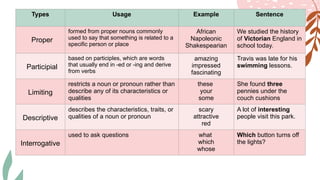
Types Usage ExampleSentence
Proper
formed from proper nouns commonly
used to say that something is related to a
specific person or place
African
Napoleonic
Shakespearian
We studied the history
of Victorian England in
school today.
Participial
based on participles, which are words
that usually end in -ed or -ing and derive
from verbs
amazing
impressed
fascinating
Travis was late for his
swimming lessons.
Limiting
restricts a noun or pronoun rather than
describe any of its characteristics or
qualities
these
your
some
She found three
pennies under the
couch cushions
Descriptive
describes the characteristics, traits, or
qualities of a noun or pronoun
scary
attractive
red
A lot of interesting
people visit this park.
Interrogative
used to ask questions what
which
whose
Which button turns off
the lights?
67.
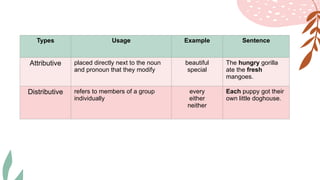
Types Usage ExampleSentence
Attributive placed directly next to the noun
and pronoun that they modify
beautiful
special
The hungry gorilla
ate the fresh
mangoes.
Distributive refers to members of a group
individually
every
either
neither
Each puppy got their
own little doghouse.
Adverb
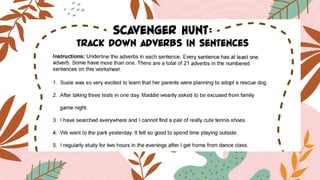
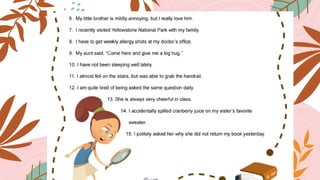
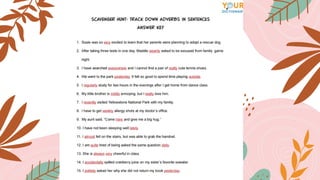
Adverb is apart of speech in which it is a word that describes
a verb, an adjective, or another adverb. It can also modify
phrases, clauses, and sentences. Adverbs answer one of the
following question: When? Where? Why? How? Under what
conditions? And to what extent?
70.
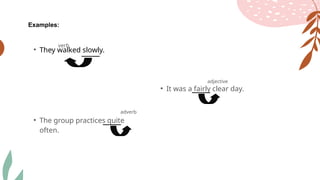
Examples:
• They walkedslowly.
verb
• It was a fairly clear day.
adjective
• The group practices quite
often.
adverb
71.
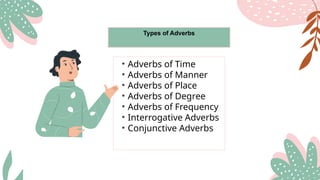
Types of Adverbs
•Adverbs of Time
• Adverbs of Manner
• Adverbs of Place
• Adverbs of Degree
• Adverbs of Frequency
• Interrogative Adverbs
• Conjunctive Adverbs
72.
Adverbs of Time
Anadverb of time answers the question When? It can
tell us about when an action happens, or how frequently
an action happens.
73.
Examples:
• I willbe going to my cousin’s place tomorrow.
• I thought I could finish cleaning my house today.
• Yesterday, Donie met Emilia at the supermarket.
74.
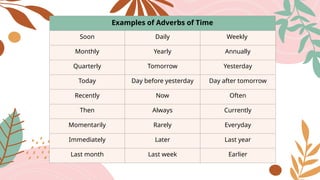
Examples of Adverbsof Time
Soon Daily Weekly
Monthly Yearly Annually
Quarterly Tomorrow Yesterday
Today Day before yesterday Day after tomorrow
Recently Now Often
Then Always Currently
Momentarily Rarely Everyday
Immediately Later Last year
Last month Last week Earlier
75.
Adverbs of Manner
Anadverb of manner is a word or phrase that illustrates
how an action is done in the context of a sentence. This
type of adverb modifies a verb, particularly how that
adverb is carried out.
76.
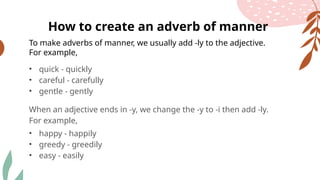
To make adverbsof manner, we usually add -ly to the adjective.
For example,
• quick - quickly
• careful - carefully
• gentle - gently
When an adjective ends in -y, we change the -y to -i then add -ly.
For example,
• happy - happily
• greedy - greedily
• easy - easily
How to create an adverb of manner
77.
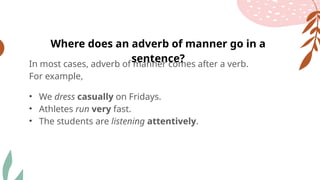
In most cases,adverb of manner comes after a verb.
For example,
• We dress casually on Fridays.
• Athletes run very fast.
• The students are listening attentively.
Where does an adverb of manner go in a
sentence?
78.
Sometimes however, theadverb is put before the verb to add
emphasis to the meaning. For example,
• She hurriedly opened the present.
• They sadly left before we arrived.
• I quickly ran to the shops.
If there are two verbs in the sentence, the position of the adverb can
change the meaning. For example,
• They accepted the offer immediately and moved out.
• They accepted the offer and moved out immediately.
79.
Adverbs of Place
Adverbsof place tell us where an action happens. It
could also give us information on direction, distance,
and movement. And it answers the question, ‘Where?’.
80.
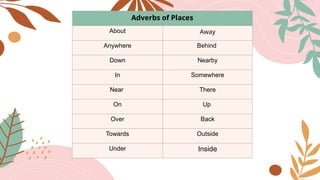
Adverbs of Places
AboutAway
Anywhere Behind
Down Nearby
In Somewhere
Near There
On Up
Over Back
Towards Outside
Under Inside
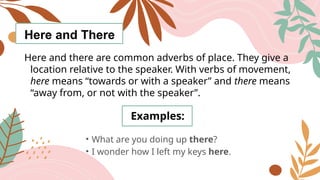
Here and There
Hereand there are common adverbs of place. They give a
location relative to the speaker. With verbs of movement,
here means “towards or with a speaker” and there means
“away from, or not with the speaker”.
Examples:
• What are you doing up there?
• I wonder how I left my keys here.
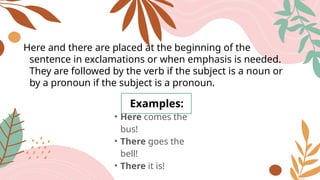
83.
Here and thereare placed at the beginning of the
sentence in exclamations or when emphasis is needed.
They are followed by the verb if the subject is a noun or
by a pronoun if the subject is a pronoun.
Examples:
• Here comes the
bus!
• There goes the
bell!
• There it is!
84.
Adverbs of placethat are also prepositions
Many adverbs of place can also be used as
prepositions. When used as prepositions. They must
be followed by a noun.
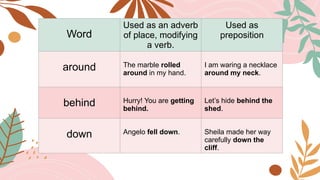
85.
Word
Used as anadverb
of place, modifying
a verb.
Used as
preposition
around The marble rolled
around in my hand.
I am waring a necklace
around my neck.
behind Hurry! You are getting
behind.
Let’s hide behind the
shed.
down Angelo fell down. Sheila made her way
carefully down the
cliff.
86.
Adverbs of placeending in -where
Adverbs of place that end in -where express the idea of
location without specifying a specific location or
direction.
Examples:
• I would like to go somewhere warm for vacation.
• Is there anywhere I can find a perfect plate of
spaghetti around here?
87.
Adverbs of placeending in -wards
Adverbs of place that end in -wards express movement in a
particular direction.
Examples:
• Cats don’t usually walk backwards.
• The ship sailed westwards.
88.
BE CAREFUL!
Examples:
• Hewalked towards the
car.
• She ran towards me.
Towards is a preposition, not an adverb, so it is
always followed by a noun or a pronoun.
89.
Adverbs of Degree
Adverbsof degree is used to discuss the degree or
intensity of an adjective, an action, or another adverb.
They are usually placed before the adjective, adverb, or
verb that they modify. It usually answers the question
‘to what extent’.
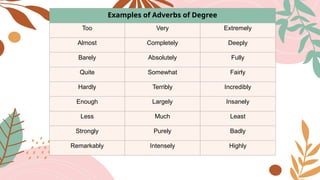
90.
Examples of Adverbsof Degree
Too Very Extremely
Almost Completely Deeply
Barely Absolutely Fully
Quite Somewhat Fairly
Hardly Terribly Incredibly
Enough Largely Insanely
Less Much Least
Strongly Purely Badly
Remarkably Intensely Highly
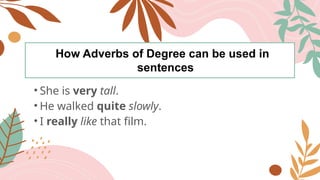
91.
How Adverbs ofDegree can be used in
sentences
• She is very tall.
• He walked quite slowly.
• I really like that film.
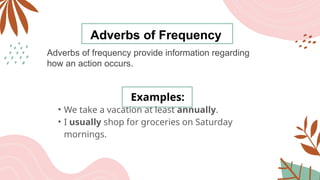
92.
Adverbs of Frequency
Adverbsof frequency provide information regarding
how an action occurs.
Examples:
• We take a vacation at least annually.
• I usually shop for groceries on Saturday
mornings.
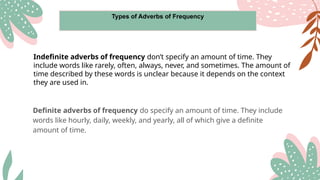
93.
Types of Adverbsof Frequency
Indefinite adverbs of frequency don’t specify an amount of time. They
include words like rarely, often, always, never, and sometimes. The amount of
time described by these words is unclear because it depends on the context
they are used in.
Definite adverbs of frequency do specify an amount of time. They include
words like hourly, daily, weekly, and yearly, all of which give a definite
amount of time.
94.
% Adverb ofFrequency Examples
100% Always I always study after class.
90% Usually I usually walk to work.
80% Normally / Generally I normally get good marks.
70% Often / Frequently I often read in bed at night.
50% Sometimes I sometimes sing in the shower.
30% Occasionally I occasionally go to bed late.
10% Seldom I seldom put salt on my food.
5% Hardly ever / Rarely I hardly ever get angry.
0% Never Vegetarians never eat meat.
95.
Adverbs of Frequency
Rules
•If a sentence has only one verb, place the adverb of
frequency in the middle of the sentence so that it is
positioned after the subject but before the verb.
Examples:
• Tom never flies.
• He always take the bus.
96.
• When asentence contains more than one verb, place the
adverb of frequency before the main verb.
Example:
• They have often visited Europe.
97.
Interrogative Adverbs
Interrogative adverbsare used to ask different types of
questions. Some common interrogative adverbs are
how, where, when, and why.
Examples:
• When is the party?
• Where is your house?
• How are you feeling
today?
• Why did he do that?
98.
Types of InterrogativeAdverbs
• Interrogative Adverbs of Time
• Interrogative Adverbs of Place
• Interrogative Adverbs of
Reason
• Interrogative Adverbs of
Manner
• Interrogative Adverbs of
Amount, Quantity, and Degree
99.
Interrogative Adverbs ofTime
When an interrogative adverb is used to ask about a time-
related matter, it is known as an interrogative adverb of time.
Typically, the interrogative adverb will be when, but how is
also used to ask time-related questions.
Examples:
• When will this film end?
• How often do you come to the
cinema?
100.
Interrogative Adverbs ofPlace
The interrogative adverb ‘where’ is used to ask about a
place.
For Example:
• Where is the cinema?
101.
Interrogative Adverbs ofReason
The interrogative adverb ‘why’ is used to ask about a
reason.
For
Example:
• Why are you watching this film
again?
102.
Interrogative Adverbs ofManner
The interrogative adverb ‘how’ is used to ask about
manner.
For
Example:
• How quickly can you get home?
103.
Interrogative Adverbs ofAmount, Quantity and Degree
The interrogative adverb ‘how’ is used to ask for amounts,
quantities, and degrees.
Examples:
• How much coke have you got left?
• How many sweets have you eaten?
104.
Interrogative adverbs canalso be used in Indirect
Questions
Note: an indirect question is a question
embedded inside a statement or another
question.
Examples:
• She asked where you were going.
• Did she ask where you were going?
105.
Word Order inan Indirect Question
The word order in an indirect question is the same as for a
declarative sentence and an interrogative sentence.
Examples:
• Are you happy?
• You are happy.
• She is asking if you are
happy.
106.
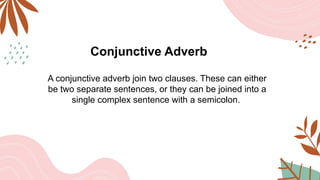
Conjunctive Adverb
A conjunctiveadverb join two clauses. These can either
be two separate sentences, or they can be joined into a
single complex sentence with a semicolon.
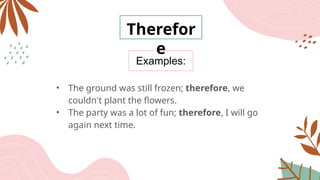
Examples:
Therefor
e
• The groundwas still frozen; therefore, we
couldn't plant the flowers.
• The party was a lot of fun; therefore, I will go
again next time.
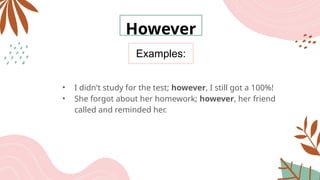
109.
Examples:
However
• I didn'tstudy for the test; however, I still got a 100%!
• She forgot about her homework; however, her friend
called and reminded her.
110.
Examples:
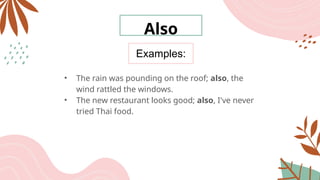
Also
• The rainwas pounding on the roof; also, the
wind rattled the windows.
• The new restaurant looks good; also, I've never
tried Thai food.
111.
Examples:
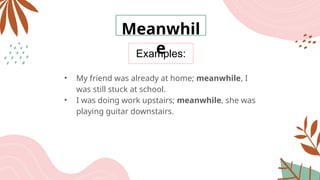
Meanwhil
e
• My friendwas already at home; meanwhile, I
was still stuck at school.
• I was doing work upstairs; meanwhile, she was
playing guitar downstairs.
112.
Examples:
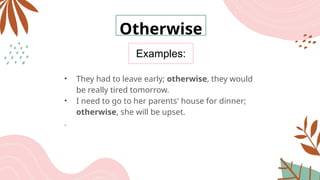
Otherwise
• They hadto leave early; otherwise, they would
be really tired tomorrow.
• I need to go to her parents' house for dinner;
otherwise, she will be upset.
.
113.
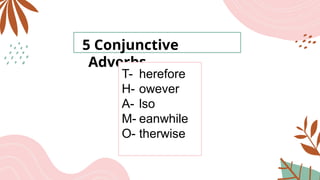
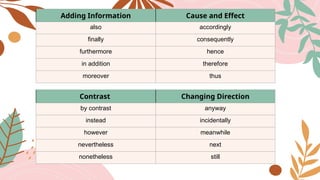
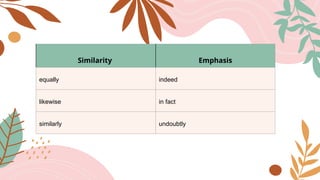
Adding Information Causeand Effect
also accordingly
finally consequently
furthermore hence
in addition therefore
moreover thus
Contrast Changing Direction
by contrast anyway
instead incidentally
however meanwhile
nevertheless next
nonetheless still
For Example:
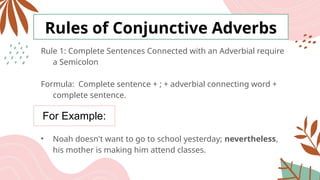
Rules ofConjunctive Adverbs
Rule 1: Complete Sentences Connected with an Adverbial require
a Semicolon
Formula: Complete sentence + ; + adverbial connecting word +
complete sentence.
• Noah doesn't want to go to school yesterday; nevertheless,
his mother is making him attend classes.
116.
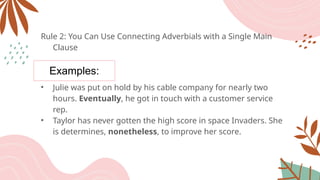
Examples:
Rule 2: YouCan Use Connecting Adverbials with a Single Main
Clause
• Julie was put on hold by his cable company for nearly two
hours. Eventually, he got in touch with a customer service
rep.
• Taylor has never gotten the high score in space Invaders. She
is determines, nonetheless, to improve her score.
117.
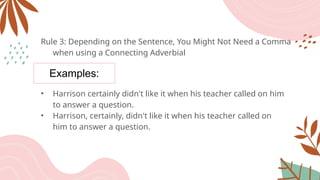
Examples:
Rule 3: Dependingon the Sentence, You Might Not Need a Comma
when using a Connecting Adverbial
• Harrison certainly didn't like it when his teacher called on him
to answer a question.
• Harrison, certainly, didn't like it when his teacher called on
him to answer a question.
Prepositions
A preposition isa word used to link nouns, pronouns,
or phrases to other words within a sentence. They act
to connect the people, objects, time, and location.
120.
Two Important Rules
Tomake sentences clear, specific prepositions are needed.
For example, the preposition in means one thing and the preposition
on cannot substitute for it in all cases. Some prepositions are
interchangeable but not always. The correct preposition means one
particular thing and using different preposition will give the sentence a
very different meaning.
Rule 1:
Examples:
• I want to see you in the house now, Bill!
• I want to see you on the house now, Bill!
121.
Two Important Rules
Thesecond rule for using prepositions is that prepositions are generally
followed by noun or pronouns. There was a time in the past when
teachers held strictly to this rule, but it made for some clunky
sentences.
Rule 2:
Examples:
x I am seeking someone I can depend on.
Someone I can depend on is whom I am
seeking.
122.
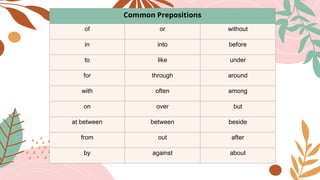
Common Prepositions
of orwithout
in into before
to like under
for through around
with often among
on over but
at between between beside
from out after
by against about
123.
Uses of Prepositions
•They are used to show the direction of
something.
• They can refer to the time of something
happening.
• They can be used to denote the position on
location of an object in the sentence.
• They are also used to represent spatial
relationship.
• Prepositional phrases, in particular, can be used
to do all of these when used in sentences.
124.
Different Types of
Prepositions
•Prepositions of Time
• Prepositions of Place
• Prepositions of Direction
• Prepositions of Location
• Prepositions of Spatial
Relationship
125.
The preposition oftime is a preposition that allows
you to discuss a specific time period such as a date o
the calendar, one of the days of the week, or the
actual time something takes place.
Prepositions of Time
Examples:
• We will be meeting on Friday.
• She supermarket will be closed from 9 p.m. to 9 a.m.
126.
The preposition ofplace is used to refer to a
place where something or someone is located.
Prepositions of Place
Examples:
• The dog jumped over the
fence.
• Henry hid behind the door.
127.
The preposition ofdirection tell us about the way
which a person or a thig that moves or is directed, in
relation to other people and things.
Prepositions of Direction
Examples:
• Jerry jumped into the river to help his
sister.
• Mina liver across the street.
128.
The preposition oflocation are words that are used to
describe the place where a certain time.
Prepositions of Location
Examples:
• I lay on the floor for a really long time.
• Make sure you keep all the toys back in its place after you
play.
129.
The preposition ofspatial relationship is used to
denote an object’s movement away from the source
and towards a source.
Prepositions of Spatial Relationship
Examples:
• Anya sat beneath the trees.
• Lana sat leaning against the
wall.
130.
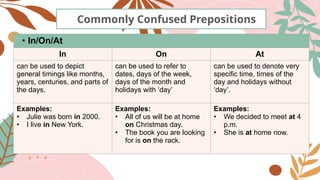
Commonly Confused Prepositions
•In/On/At
In On At
can be used to depict
general timings like months,
years, centuries, and parts of
the days.
can be used to refer to
dates, days of the week,
days of the month and
holidays with ‘day’
can be used to denote very
specific time, times of the
day and holidays without
‘day’.
Examples:
• Julie was born in 2000.
• I live in New York.
Examples:
• All of us will be at home
on Christmas day.
• The book you are looking
for is on the rack.
Examples:
• We decided to meet at 4
p.m.
• She is at home now.
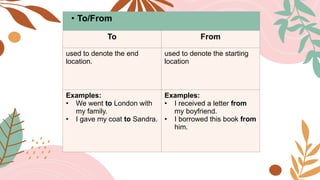
131.
• To/From
To From
usedto denote the end
location.
used to denote the starting
location
Examples:
• We went to London with
my family.
• I gave my coat to Sandra.
Examples:
• I received a letter from
my boyfriend.
• I borrowed this book from
him.
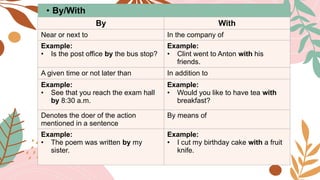
132.
• By/With
By With
Nearor next to In the company of
Example:
• Is the post office by the bus stop?
Example:
• Clint went to Anton with his
friends.
A given time or not later than In addition to
Example:
• See that you reach the exam hall
by 8:30 a.m.
Example:
• Would you like to have tea with
breakfast?
Denotes the doer of the action
mentioned in a sentence
By means of
Example:
• The poem was written by my
sister.
Example:
• I cut my birthday cake with a fruit
knife.
Conjunctions
Conjunctions are partsof speech that connect
words, phrases, clauses, and sentence.
Examples:
• I love Monica and Raquelle.
• I spent three hours fishing, but I never caught
anything.
• I want a dog or a lama
• I went to see the doctor because I thought I was
dying.
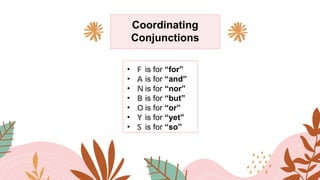
Coordinating
Conjunctions
• is for“for”
• is for “and”
• is for “nor”
• is for “but”
• is for “or”
• is for “yet”
• is for “so”
• F
• A
• N
• B
• O
• Y
• S
138.
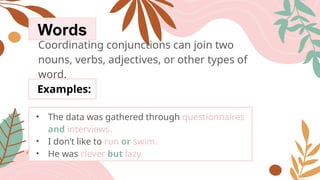
Words
Coordinating conjunctions canjoin two
nouns, verbs, adjectives, or other types of
word.
Examples:
• The data was gathered through questionnaires
and interviews.
• I don’t like to run or swim.
• He was clever but lazy.
139.
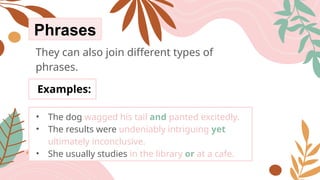
Phrases
They can alsojoin different types of
phrases.
Examples:
• The dog wagged his tail and panted excitedly.
• The results were undeniably intriguing yet
ultimately inconclusive.
• She usually studies in the library or at a cafe.
140.
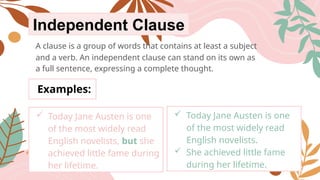
Independent Clause
A clauseis a group of words that contains at least a subject
and a verb. An independent clause can stand on its own as
a full sentence, expressing a complete thought.
Examples:
Today Jane Austen is one
of the most widely read
English novelists, but she
achieved little fame during
her lifetime.
Today Jane Austen is one
of the most widely read
English novelists.
She achieved little fame
during her lifetime.
141.
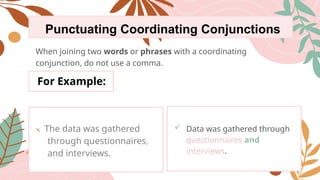
Punctuating Coordinating Conjunctions
Whenjoining two words or phrases with a coordinating
conjunction, do not use a comma.
For Example:
x The data was gathered
through questionnaires,
and interviews.
Data was gathered through
questionnaires and
interviews.
142.
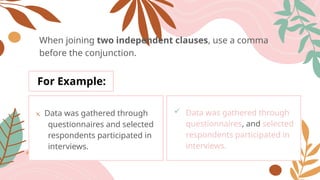
When joining twoindependent clauses, use a comma
before the conjunction.
For Example:
x Data was gathered through
questionnaires and selected
respondents participated in
interviews.
Data was gathered through
questionnaires, and selected
respondents participated in
interviews.
143.
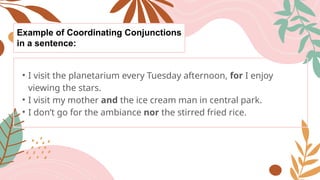
Example of CoordinatingConjunctions
in a sentence:
• I visit the planetarium every Tuesday afternoon, for I enjoy
viewing the stars.
• I visit my mother and the ice cream man in central park.
• I don’t go for the ambiance nor the stirred fried rice.
144.
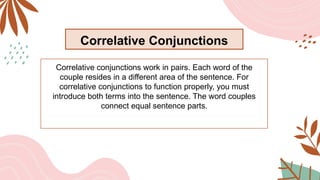
Correlative Conjunctions
Correlative conjunctionswork in pairs. Each word of the
couple resides in a different area of the sentence. For
correlative conjunctions to function properly, you must
introduce both terms into the sentence. The word couples
connect equal sentence parts.
145.
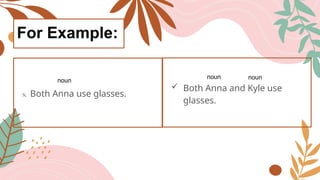
For Example:
BothAnna and Kyle use
glasses.
x Both Anna use glasses.
noun
noun noun
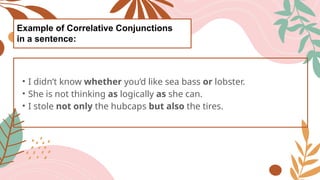
Example of CorrelativeConjunctions
in a sentence:
• I didn’t know whether you’d like sea bass or lobster.
• She is not thinking as logically as she can.
• I stole not only the hubcaps but also the tires.
148.
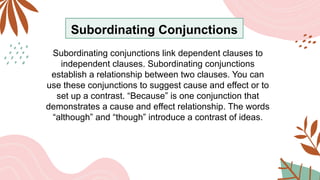
Subordinating Conjunctions
Subordinating conjunctionslink dependent clauses to
independent clauses. Subordinating conjunctions
establish a relationship between two clauses. You can
use these conjunctions to suggest cause and effect or to
set up a contrast. “Because” is one conjunction that
demonstrates a cause and effect relationship. The words
“although” and “though” introduce a contrast of ideas.
149.
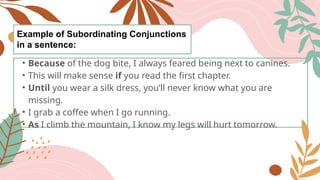
Example of SubordinatingConjunctions
in a sentence:
• Because of the dog bite, I always feared being next to canines.
• This will make sense if you read the first chapter.
• Until you wear a silk dress, you’ll never know what you are
missing.
• I grab a coffee when I go running.
• As I climb the mountain, I know my legs will hurt tomorrow.
150.
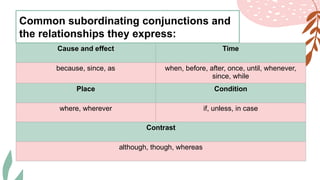
Cause and effectTime
because, since, as when, before, after, once, until, whenever,
since, while
Place Condition
where, wherever if, unless, in case
Contrast
although, though, whereas
Common subordinating conjunctions and
the relationships they express:
151.
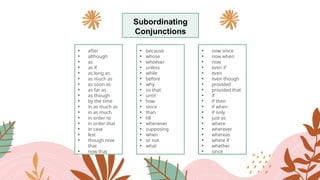
Subordinating
Conjunctions
• after
• although
•as
• as if
• as long as
• as much as
• as soon as
• as far as
• as though
• by the time
• in as much as
• in as much
• in order to
• in order that
• in case
• lest
• though now
that
• now that
• now since
• now when
• now
• even if
• even
• even though
• provided
• provided that
• if
• if then
• if when
• if only
• just as
• where
• wherever
• whereas
• where if
• whether
• since
• because
• whose
• whoever
• unless
• while
• before
• why
• so that
• until
• how
• since
• than
• till
• whenever
• supposing
• when
• or not
• what
152.
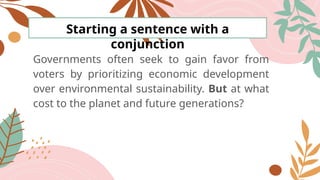
Starting a sentencewith a
conjunction
Governments often seek to gain favor from
voters by prioritizing economic development
over environmental sustainability. But at what
cost to the planet and future generations?
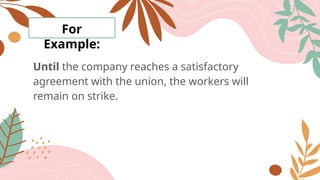
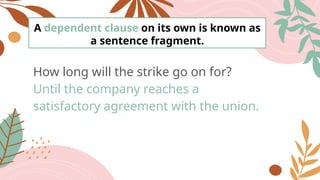
A dependent clauseon its own is known as
a sentence fragment.
How long will the strike go on for?
Until the company reaches a
satisfactory agreement with the union.
155.
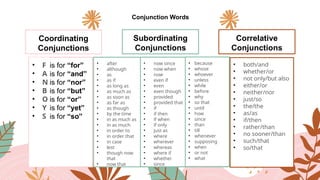
Conjunction Words
Coordinating
Conjunctions
• isfor “for”
• is for “and”
• is for “nor”
• is for “but”
• is for “or”
• is for “yet”
• is for “so”
Subordinating
Conjunctions
Correlative
Conjunctions
• F
• A
• N
• B
• O
• Y
• S
• after
• although
• as
• as if
• as long as
• as much as
• as soon as
• as far as
• as though
• by the time
• in as much as
• in as much
• in order to
• in order that
• in case
• lest
• though now
that
• now that
• now since
• now when
• now
• even if
• even
• even though
• provided
• provided that
• if
• if then
• if when
• if only
• just as
• where
• wherever
• whereas
• where if
• whether
• since
• because
• whose
• whoever
• unless
• while
• before
• why
• so that
• until
• how
• since
• than
• till
• whenever
• supposing
• when
• or not
• what
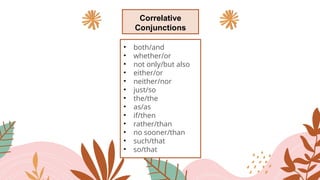
• both/and
• whether/or
• not only/but also
• either/or
• neither/nor
• just/so
• the/the
• as/as
• if/then
• rather/than
• no sooner/than
• such/that
• so/that
Interjection
Interjections are wordsor phrases that are
inserted into a sentence to express an
emotion or to clarify something. It is a word
that expresses strong emotion. It stands alone
and is not grammatically related to the rest of
the sentence. You can use an interjection to
express joy, surprise, approval, or disapproval.
158.
Examples:
• Oh no!I’m late for my meeting.
• Yay! We won the game.
• Hmm, I wonder what she meant by that
comment.
159.
Types of Interjections
Typesof Interjection Based on
Emotions
Main Types of Interjections
Mild and Strong Interjections
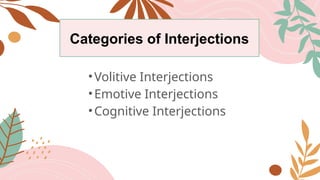
Categories of Interjections
160.
Types of InterjectionsBased on
Emotions
•Interjection of Greetings
•Interjection of Joy
•Interjection of Surprise
•Interjection of
Approval/Praise
•Interjection of Attention
•Interjection of Sorrow/Pain
161.
Interjection of Greetings
Thegreeting interjection indicates the feeling
of warmth and joy in meeting with anyone.
Hello! Hi, Hey, Heya! and so on.
Examples:
• Hey! What are your plans for tonight?
• Hi! Hope you are doing well!
• Hello! My name is Danny, and I am your new
lecturer.
162.
Interjection of Joy
Theinterjection of joy is used to communicate
immediate delight and gladness on a specific
occasion.
Wow ! Congratulations ! Cheers ! Good ! Hooray !
Examples:
• Great! We've progressed to the next stage.
• Wow! They look stunning !
• Hooray! Our team won the game !
163.
Interjection of Surprise
Thesurprise interjection is used to show surprise at
any situation that has occurred.
Oh! What! Ah! Ha! and so on.
Examples:
• Ah! I received my first paycheck.
• What! Are you sure ?
• Oh! I ran into him today.
• Ha! What a delightful experience.
164.
Interjection of Approval/Praise
Theapproval interjection is used to show approval or
consent in a statement.
Bravo! Good work! Brilliant! and so on.
Examples:
• Kudos! You have successfully finished the mission.
• Brilliant! You accurately spelled it.
• Well done, you have performed very well in the class.
165.
Interjection of Attention
Theattention interjection is used to draw somebody's
attention towards us.
See! Listen! Hush! Behold! Shh! and so on.
Examples:
• See! I am exhausted now, and I'm not going anywhere with you.
• Look! I noticed something in the background.
• Shh! keep your mouth closed.
• Hush! Roy, alerted Miller.
• Yoo-hoo! Is there anyone here?
166.
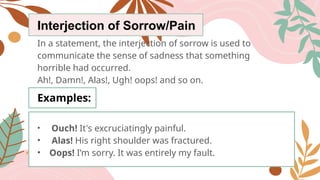
Interjection of Sorrow/Pain
Ina statement, the interjection of sorrow is used to
communicate the sense of sadness that something
horrible had occurred.
Ah!, Damn!, Alas!, Ugh! oops! and so on.
Examples:
• Ouch! It's excruciatingly painful.
• Alas! His right shoulder was fractured.
• Oops! I’m sorry. It was entirely my fault.
167.
Main Types ofInterjections
•Primary Interjection
•Secondary Interjection
168.
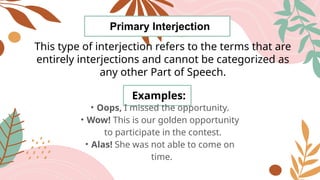
Primary Interjection
This typeof interjection refers to the terms that are
entirely interjections and cannot be categorized as
any other Part of Speech.
Examples:
• Oops, I missed the opportunity.
• Wow! This is our golden opportunity
to participate in the contest.
• Alas! She was not able to come on
time.
169.
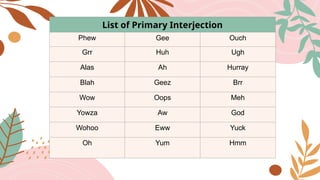
List of PrimaryInterjection
Phew Gee Ouch
Grr Huh Ugh
Alas Ah Hurray
Blah Geez Brr
Wow Oops Meh
Yowza Aw God
Wohoo Eww Yuck
Oh Yum Hmm
170.
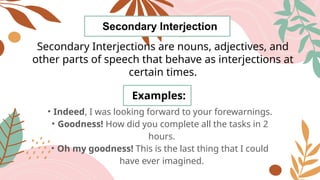
Secondary Interjection
Secondary Interjectionsare nouns, adjectives, and
other parts of speech that behave as interjections at
certain times.
Examples:
• Indeed, I was looking forward to your forewarnings.
• Goodness! How did you complete all the tasks in 2
hours.
• Oh my goodness! This is the last thing that I could
have ever imagined.
171.
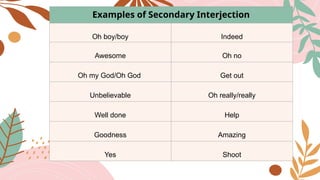
Examples of SecondaryInterjection
Oh boy/boy Indeed
Awesome Oh no
Oh my God/Oh God Get out
Unbelievable Oh really/really
Well done Help
Goodness Amazing
Yes Shoot
172.
Two Kinds ofInterjections
• Mild Interjections
• Strong
Interjections
173.
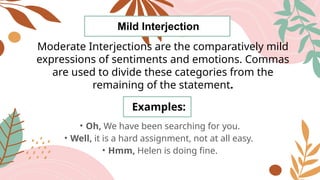
Mild Interjection
Moderate Interjectionsare the comparatively mild
expressions of sentiments and emotions. Commas
are used to divide these categories from the
remaining of the statement.
Examples:
• Oh, We have been searching for you.
• Well, it is a hard assignment, not at all easy.
• Hmm, Helen is doing fine.
174.
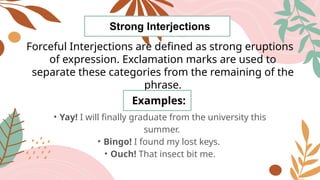
Strong Interjections
Forceful Interjectionsare defined as strong eruptions
of expression. Exclamation marks are used to
separate these categories from the remaining of the
phrase.
Examples:
• Yay! I will finally graduate from the university this
summer.
• Bingo! I found my lost keys.
• Ouch! That insect bit me.
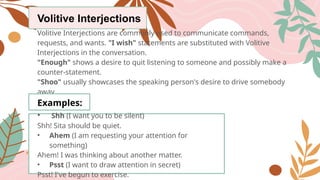
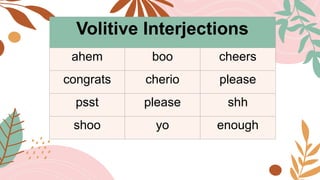
Volitive Interjections
Volitive Interjectionsare commonly used to communicate commands,
requests, and wants. "I wish" statements are substituted with Volitive
Interjections in the conversation.
"Enough" shows a desire to quit listening to someone and possibly make a
counter-statement.
"Shoo" usually showcases the speaking person's desire to drive somebody
away.
Examples:
• Shh (I want you to be silent)
Shh! Sita should be quiet.
• Ahem (I am requesting your attention for
something)
Ahem! I was thinking about another matter.
• Psst (I want to draw attention in secret)
Psst! I've begun to exercise.
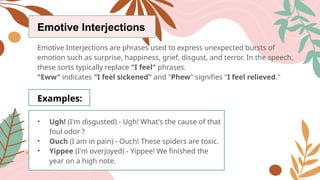
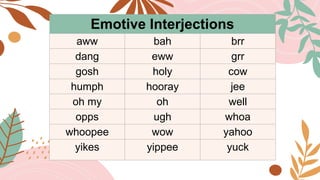
Emotive Interjections
Emotive Interjectionsare phrases used to express unexpected bursts of
emotion such as surprise, happiness, grief, disgust, and terror. In the speech,
these sorts typically replace "I feel" phrases.
"Eww" indicates "I feel sickened" and "Phew" signifies "I feel relieved."
Examples:
• Ugh! (I'm disgusted) - Ugh! What's the cause of that
foul odor ?
• Ouch (I am in pain) - Ouch! These spiders are toxic.
• Yippee (I'm overjoyed) - Yippee! We finished the
year on a high note.
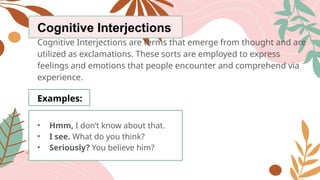
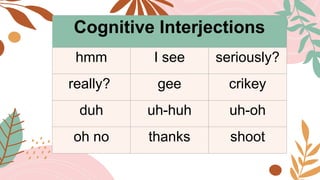
Cognitive Interjections
Cognitive Interjectionsare terms that emerge from thought and are
utilized as exclamations. These sorts are employed to express
feelings and emotions that people encounter and comprehend via
experience.
Examples:
• Hmm, I don’t know about that.
• I see. What do you think?
• Seriously? You believe him?
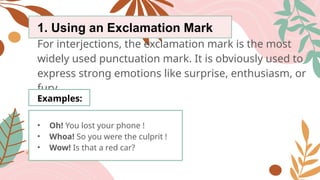
1. Using anExclamation Mark
For interjections, the exclamation mark is the most
widely used punctuation mark. It is obviously used to
express strong emotions like surprise, enthusiasm, or
fury.
Examples:
• Oh! You lost your phone !
• Whoa! So you were the culprit !
• Wow! Is that a red car?
184.
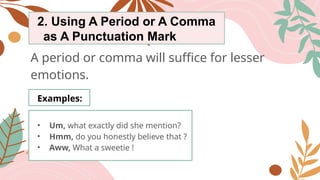
2. Using APeriod or A Comma
as A Punctuation Mark
A period or comma will suffice for lesser
emotions.
Examples:
• Um, what exactly did she mention?
• Hmm, do you honestly believe that ?
• Aww, What a sweetie !
185.
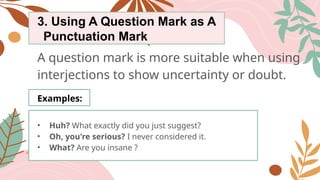
3. Using AQuestion Mark as A
Punctuation Mark
A question mark is more suitable when using
interjections to show uncertainty or doubt.
Examples:
• Huh? What exactly did you just suggest?
• Oh, you're serious? I never considered it.
• What? Are you insane ?
186.
4 Interjection UsageGuidelines
1. Interjections might take the form of a single word or a
short phrase.
2. Interjections are normally put at the start of a sentence,
but there are always exceptions.
3. These interjections should be used to depict character
exclamations, serve as a substitute for emoticons, and
make tale reading more entertaining.
4. The other significance of interjections is that they can
communicate feelings that are often hard to express
through sentences.
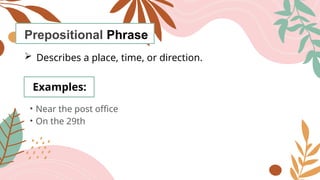
Phrases
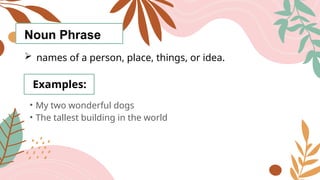
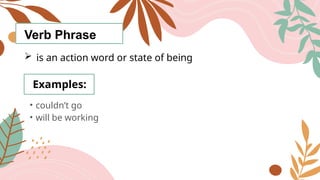
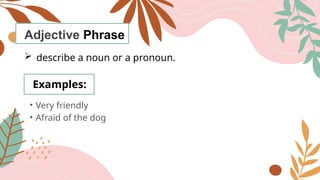
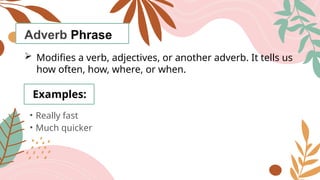
• A phraseis a group of words, without a subject and verb
combination, that functions in a sentence as one part of
speech.
Examples:
• leaving behind the dog
• smashing into fence
• before the first test
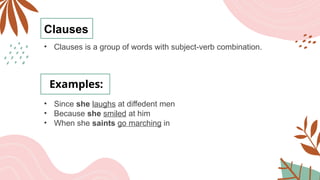
Clauses
• Clauses isa group of words with subject-verb combination.
Examples:
• Since she laughs at diffedent men
• Because she smiled at him
• When she saints go marching in
196.
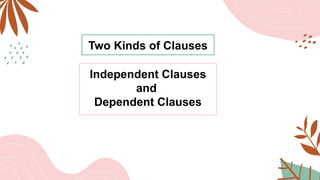
Two Kinds ofClauses
Independent Clauses
and
Dependent Clauses
197.
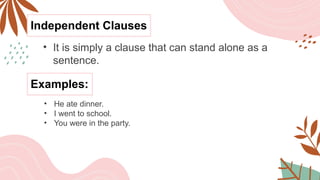
Independent Clauses
• Itis simply a clause that can stand alone as a
sentence.
Examples:
• He ate dinner.
• I went to school.
• You were in the party.
198.
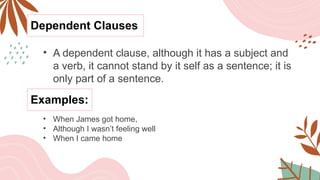
Dependent Clauses
• Adependent clause, although it has a subject and
a verb, it cannot stand by it self as a sentence; it is
only part of a sentence.
Examples:
• When James got home,
• Although I wasn’t feeling well
• When I came home
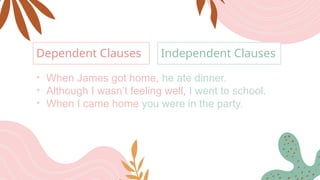
199.
• When Jamesgot home, he ate dinner.
• Although I wasn’t feeling well, I went to school.
• When I came home you were in the party.
Independent Clauses
Dependent Clauses
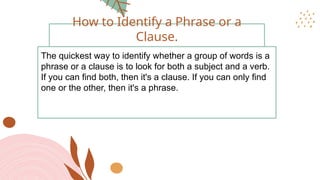
200.
The quickest wayto identify whether a group of words is a
phrase or a clause is to look for both a subject and a verb.
If you can find both, then it's a clause. If you can only find
one or the other, then it's a phrase.
How to Identify a Phrase or a
Clause.
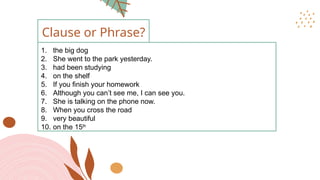
201.
1. the bigdog
2. She went to the park yesterday.
3. had been studying
4. on the shelf
5. If you finish your homework
6. Although you can’t see me, I can see you.
7. She is talking on the phone now.
8. When you cross the road
9. very beautiful
10. on the 15th
Clause or Phrase?
Sentence
A sentence isthe basic unit of language which
expresses a complete thought. It does this by
following the grammatical basic rules of syntax.
Examples:
• Ali was listening to music when he suddenly had an
afflatus.
• Kohli is writing a novel about the life of a college
student.
• Coco is my favorite fantasy-film.
SUBJECT
• The subjectis what (or whom) the
sentence is about.
•Judy and her dog run on the beach every morning.
•The audience littered the theatre floor with torn
wrappings and spilled popcorn.
Examples:
206.
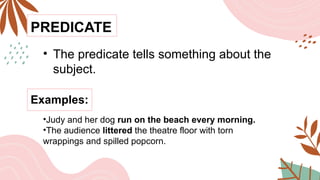
PREDICATE
• The predicatetells something about the
subject.
Examples:
•Judy and her dog run on the beach every morning.
•The audience littered the theatre floor with torn
wrappings and spilled popcorn.
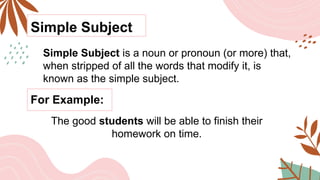
Simple Subject
Simple Subjectis a noun or pronoun (or more) that,
when stripped of all the words that modify it, is
known as the simple subject.
For Example:
The good students will be able to finish their
homework on time.
209.
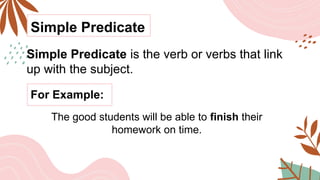
Simple Predicate
Simple Predicateis the verb or verbs that link
up with the subject.
For Example:
The good students will be able to finish their
homework on time.
Compound Subject
Compound subject-- a simple subject
consisting of more than a noun or pronoun.
For Example:
June and her friend walked slowly through the Inuit art
gallery and admired the sculptures exhibited there.
212.
Compound Predicate
Compound predicateis a predicate that includes
more than one verb pertaining to the same
subject
For Example:
June and her friend walked slowly through the Inuit art
gallery and admired the sculptures exhibited there.
213.
Kinds of Sentences
(ACCORDINGTO USE, ACCORDING TO PURPOSE)
Declarative Sentences
Interrogative Sentences
Imperative Sentences
Exclamatory Sentences
214.
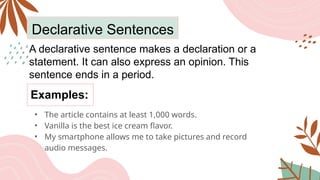
Declarative Sentences
A declarativesentence makes a declaration or a
statement. It can also express an opinion. This
sentence ends in a period.
Examples:
• The article contains at least 1,000 words.
• Vanilla is the best ice cream flavor.
• My smartphone allows me to take pictures and record
audio messages.
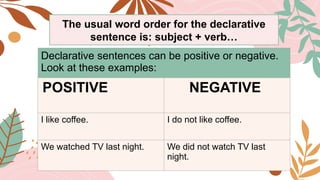
215.
Declarative sentences canbe positive or negative.
Look at these examples:
POSITIVE NEGATIVE
I like coffee. I do not like coffee.
We watched TV last night. We did not watch TV last
night.
The usual word order for the declarative
sentence is: subject + verb…
216.
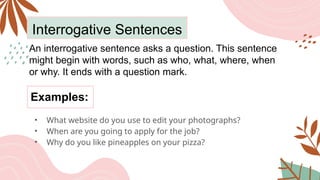
Interrogative Sentences
An interrogativesentence asks a question. This sentence
might begin with words, such as who, what, where, when
or why. It ends with a question mark.
• What website do you use to edit your photographs?
• When are you going to apply for the job?
• Why do you like pineapples on your pizza?
Examples:
217.
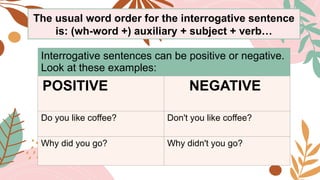
Interrogative sentences canbe positive or negative.
Look at these examples:
POSITIVE NEGATIVE
Do you like coffee? Don't you like coffee?
Why did you go? Why didn't you go?
The usual word order for the interrogative sentence
is: (wh-word +) auxiliary + subject + verb…
218.
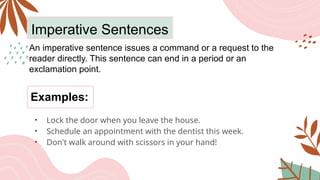
Imperative Sentences
An imperativesentence issues a command or a request to the
reader directly. This sentence can end in a period or an
exclamation point.
• Lock the door when you leave the house.
• Schedule an appointment with the dentist this week.
• Don't walk around with scissors in your hand!
Examples:
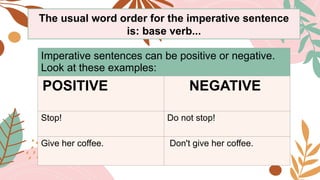
219.
Imperative sentences canbe positive or negative.
Look at these examples:
POSITIVE NEGATIVE
Stop! Do not stop!
Give her coffee. Don't give her coffee.
The usual word order for the imperative sentence
is: base verb...
220.
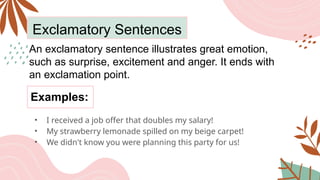
Exclamatory Sentences
An exclamatorysentence illustrates great emotion,
such as surprise, excitement and anger. It ends with
an exclamation point.
• I received a job offer that doubles my salary!
• My strawberry lemonade spilled on my beige carpet!
• We didn't know you were planning this party for us!
Examples:
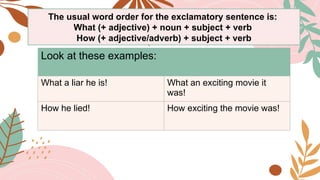
221.
Look at theseexamples:
What a liar he is! What an exciting movie it
was!
How he lied! How exciting the movie was!
The usual word order for the exclamatory sentence is:
What (+ adjective) + noun + subject + verb
How (+ adjective/adverb) + subject + verb
Declarative Sentences
A declarativesentence is usually a general statement
that imparts information. You might use this type of
sentence to give information to coworkers or just in
informal conversation. This is a common type of
sentence, so it is one you might use often during your
day. For example, "I just woke up," or "I have to get
coffee before work today," are both declarative
sentences that you could use daily.
224.
Interrogative Sentences
An interrogativesentence asks a question where you
expect a response. You may use this sentence type
regularly to gather more information and form clearer
plans for your own work. "Did you finish the slides for
the presentation?" is an example of an interrogative
sentence that may help you learn more about the
next steps that you plan to take.
225.
Imperative Sentences
Consider usingimperative sentences when delivering
instructions when you're composing an email or developing
training programs. For instance, to show an employee how to
use their login credentials for the company's database, you can
write, "Click the link to create a new username and password."
Compile imperative sentences together to communicate to your
audience that you're requesting them to take specific actions.
They can also understand that following your request is
essential to achieving the desired result.
226.
Exclamatory Sentences
Use exclamatorysentences to highlight urgency. This sentence can deliver
information, similar to the declarative type, but the exclamation point can
suggest that your message is emotional, so it can capture your audience's
attention. For example, when communicating with a teammate, you may write,
“Our professor moved the our project’s deadline to tomorrow!" in a chat.
Now your teammate knows that it's urgent that you prioritize the project over
other tasks to turn in the work on time. After submitting the assignment, you
may send another message that reads, "The client loved our work!" Since
you're exclaiming in your message, your audience knows that you're
celebrating an accomplishment.
Sentence Patterns
Sentence patternswill help you identify subjects,
verbs, and clause connectors so we can analyze our
writing style and improve it by using a variety of
sentence patterns.
229.
Subjects, Verbs, andClauses
In its simplest form, an English sentence has two parts: a
subject and a verb that express a complete thought when they
are together.
The subject shows who or what is doing the action. It is always
some form of noun or pronoun.
The verb shows the action or the state of being. It can be an
action verb, like “run,” or a state verb, like “seem.”
230.
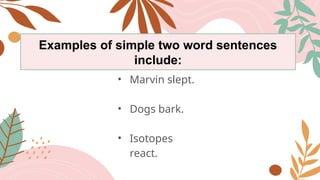
Examples of simpletwo word sentences
include:
• Marvin slept.
• Dogs bark.
• Isotopes
react.
231.
Real sentences arerarely so short. We usually want to convey
much more information, so we modify the main subject and
verb with other words and phrases, as in the sentences below:
• Unfortunately, Marvin slept fitfully.
• Dogs bark louder after midnight.
• Heavy isotopes react more slowly than
light isotopes of the same element.
232.
Compound subject (twosubjects related to the same verb):
• Javier and his colleagues collaborated on the research
article.
Compound verb (two verbs related to the same subject):
• Javier conducted the experiment and documented the results.
Compound subject with compound verb:
• Javier, his colleagues, and their advisor drafted and revised
the article several times.
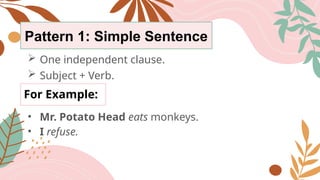
Pattern 1: SimpleSentence
One independent clause.
For Example:
• Mr. Potato Head eats monkeys.
• I refuse.
Subject + Verb.
235.
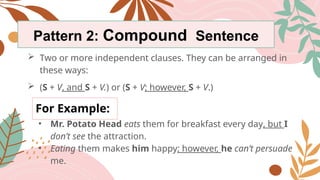
Pattern 2: CompoundSentence
Two or more independent clauses. They can be arranged in
these ways:
For Example:
• Mr. Potato Head eats them for breakfast every day, but I
don’t see the attraction.
• Eating them makes him happy; however, he can’t persuade
me.
(S + V, and S + V.) or (S + V; however, S + V.)
236.
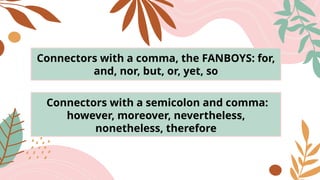
Connectors with acomma, the FANBOYS: for,
and, nor, but, or, yet, so
Connectors with a semicolon and comma:
however, moreover, nevertheless,
nonetheless, therefore
237.
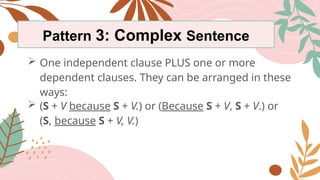
One independentclause PLUS one or more
dependent clauses. They can be arranged in these
ways:
(S + V because S + V.) or (Because S + V, S + V.) or
(S, because S + V, V.)
Pattern 3: Complex Sentence
238.
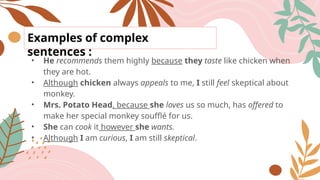
Examples of complex
sentences:
• He recommends them highly because they taste like chicken when
they are hot.
• Although chicken always appeals to me, I still feel skeptical about
monkey.
• Mrs. Potato Head, because she loves us so much, has offered to
make her special monkey soufflé for us.
• She can cook it however she wants.
• Although I am curious, I am still skeptical.
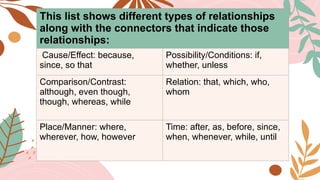
239.
This list showsdifferent types of relationships
along with the connectors that indicate those
relationships:
Cause/Effect: because,
since, so that
Possibility/Conditions: if,
whether, unless
Comparison/Contrast:
although, even though,
though, whereas, while
Relation: that, which, who,
whom
Place/Manner: where,
wherever, how, however
Time: after, as, before, since,
when, whenever, while, until
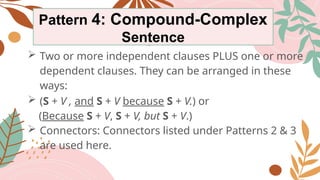
240.
Pattern 4: Compound-Complex
Sentence
Two or more independent clauses PLUS one or more
dependent clauses. They can be arranged in these
ways:
(S + V , and S + V because S + V.) or
(Because S + V, S + V, but S + V.)
Connectors: Connectors listed under Patterns 2 & 3
are used here.
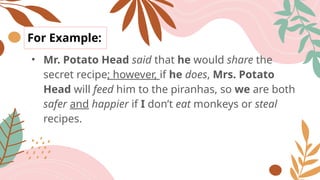
241.
For Example:
• Mr.Potato Head said that he would share the
secret recipe; however, if he does, Mrs. Potato
Head will feed him to the piranhas, so we are both
safer and happier if I don’t eat monkeys or steal
recipes.
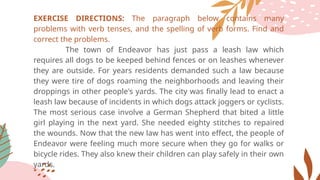
EXERCISE DIRECTIONS: Theparagraph below contains many
problems with verb tenses, and the spelling of verb forms. Find and
correct the problems.
The town of Endeavor has just pass a leash law which
requires all dogs to be keeped behind fences or on leashes whenever
they are outside. For years residents demanded such a law because
they were tire of dogs roaming the neighborhoods and leaving their
droppings in other people's yards. The city was finally lead to enact a
leash law because of incidents in which dogs attack joggers or cyclists.
The most serious case involve a German Shepherd that bited a little
girl playing in the next yard. She needed eighty stitches to repaired
the wounds. Now that the new law has went into effect, the people of
Endeavor were feeling much more secure when they go for walks or
bicycle rides. They also knew their children can play safely in their own
yards.
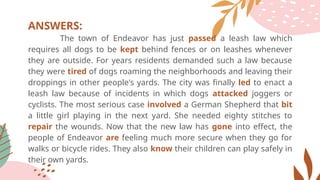
247.
ANSWERS:
The town ofEndeavor has just passed a leash law which
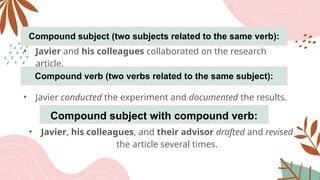
requires all dogs to be kept behind fences or on leashes whenever
they are outside. For years residents demanded such a law because
they were tired of dogs roaming the neighborhoods and leaving their
droppings in other people's yards. The city was finally led to enact a
leash law because of incidents in which dogs attacked joggers or
cyclists. The most serious case involved a German Shepherd that bit
a little girl playing in the next yard. She needed eighty stitches to
repair the wounds. Now that the new law has gone into effect, the
people of Endeavor are feeling much more secure when they go for
walks or bicycle rides. They also know their children can play safely in
their own yards.
248.
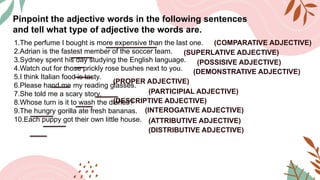
Pinpoint the adjectivewords in the following sentences
and tell what type of adjective the words are.
1.The perfume I bought is more expensive than the last one.
2.Adrian is the fastest member of the soccer team.
3.Sydney spent his day studying the English language.
4.Watch out for those prickly rose bushes next to you.
5.I think Italian food is tasty.
6.Please hand me my reading glasses.
7.She told me a scary story.
8.Whose turn is it to wash the dishes?
9.The hungry gorilla ate fresh bananas.
10.Each puppy got their own little house.
(COMPARATIVE ADJECTIVE)
(SUPERLATIVE ADJECTIVE)
(POSSISIVE ADJECTIVE)
(DEMONSTRATIVE ADJECTIVE)
(PROPER ADJECTIVE)
(PARTICIPIAL ADJECTIVE)
(DESCRIPTIVE ADJECTIVE)
(INTEROGATIVE ADJECTIVE)
(ATTRIBUTIVE ADJECTIVE)
(DISTRIBUTIVE ADJECTIVE)
252.
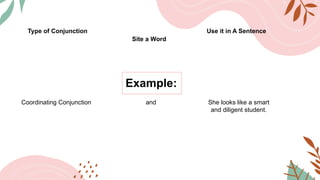
Type of ConjunctionUse it in A Sentence
Site a Word
Coordinating Conjunction and She looks like a smart
and diligent student.
Example:
253.
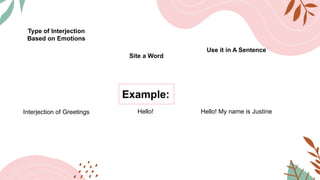
Type of Interjection
Basedon Emotions
Use it in A Sentence
Site a Word
Interjection of Greetings Hello! Hello! My name is Justine
Example:
254.
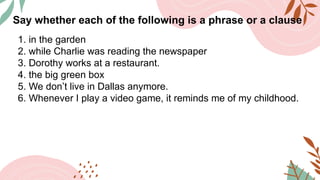
Say whether eachof the following is a phrase or a clause
1. in the garden
2. while Charlie was reading the newspaper
3. Dorothy works at a restaurant.
4. the big green box
5. We don’t live in Dallas anymore.
6. Whenever I play a video game, it reminds me of my childhood.
255.
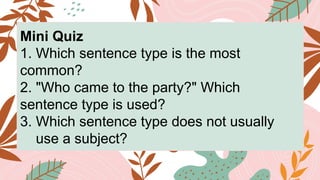
Mini Quiz
1. Whichsentence type is the most
common?
2. "Who came to the party?" Which
sentence type is used?
3. Which sentence type does not usually
use a subject?






![Parts of speech review[1]](https://cdn.slidesharecdn.com/ss_thumbnails/partsofspeechreview1-150701121837-lva1-app6892-thumbnail.jpg?width=640&height=640&fit=bounds)


