English class 8

Elementary level


        Juan José Simón Pérez
   Mail: simondeibi@gmail.com
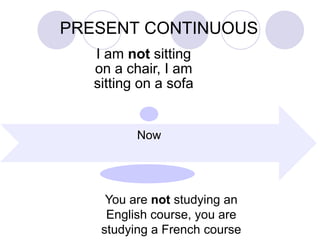
PRESENT CONTINUOUS
   I am not sitting
   on a chair, I am
   sitting on a sofa


          Now


     You are not studying an
     English course, you are
    studying a French course
PRESENT CONTINUOUS
Estructura en frases negativas:
Sujeto + am/are/is not + verbo -ing + resto de
  la frase
Ejemplos:
I am not going out today / I’m not going…
You are not eating anything / You aren’t
  eating…
It is not snowing this winter / It isn’t snowing…
We are not living in London any more / We
  aren’t living…
PRESENT CONTINUOUS
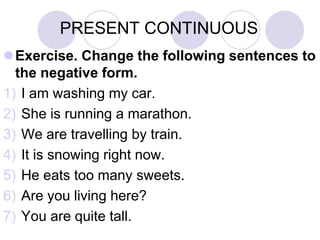
Exercise. Change the following sentences to
  the negative form.
1) I am washing my car.
2) She is running a marathon.
3) We are travelling by train.
4) It is snowing right now.
5) He eats too many sweets.
6) Are you living here?
7) You are quite tall.
PRESENT CONTINUOUS
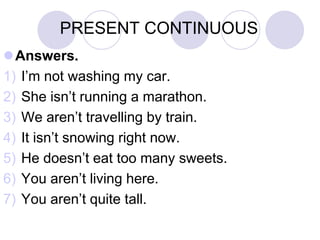
Answers.
1) I’m not washing my car.
2) She isn’t running a marathon.
3) We aren’t travelling by train.
4) It isn’t snowing right now.
5) He doesn’t eat too many sweets.
6) You aren’t living here.
7) You aren’t quite tall.
PRESENT CONTINUOUS
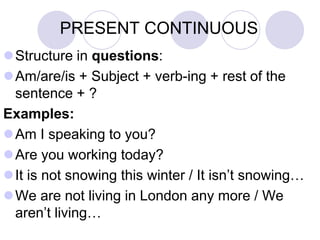
Structure in questions:
Am/are/is + Subject + verb-ing + rest of the
 sentence + ?
Examples:
Am I speaking to you?
Are you working today?
It is not snowing this winter / It isn’t snowing…
We are not living in London any more / We
 aren’t living…
PRESENT CONTINUOUS
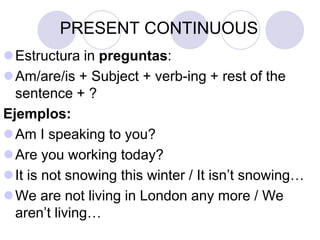
Estructura in preguntas:
Am/are/is + Subject + verb-ing + rest of the
  sentence + ?
Ejemplos:
Am I speaking to you?
Are you working today?
It is not snowing this winter / It isn’t snowing…
We are not living in London any more / We
  aren’t living…
PRESENT CONTINUOUS
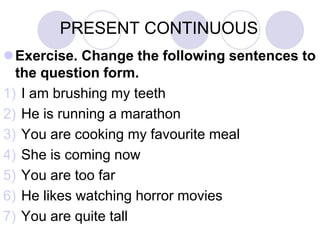
Exercise. Change the following sentences to
  the question form.
1) I am brushing my teeth
2) He is running a marathon
3) You are cooking my favourite meal
4) She is coming now
5) You are too far
6) He likes watching horror movies
7) You are quite tall
PRESENT CONTINUOUS
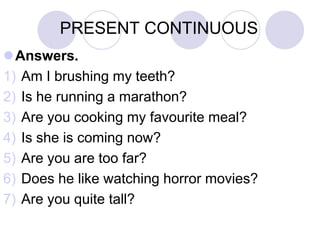
Answers.
1) Am I brushing my teeth?
2) Is he running a marathon?
3) Are you cooking my favourite meal?
4) Is she is coming now?
5) Are you are too far?
6) Does he like watching horror movies?
7) Are you quite tall?
CAN / WOULD
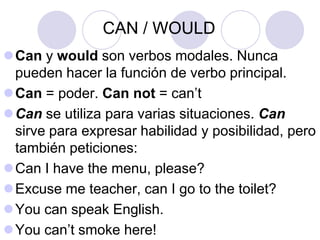
Can y would son verbos modales. Nunca
 pueden hacer la función de verbo principal.
Can = poder. Can not = can’t
Can se utiliza para varias situaciones. Can
 sirve para expresar habilidad y posibilidad, pero
 también peticiones:
Can I have the menu, please?
Excuse me teacher, can I go to the toilet?
You can speak English.
You can’t smoke here!
CAN / WOULD
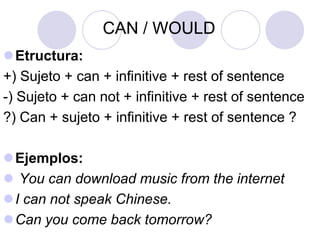
Etructura:
+) Sujeto + can + infinitive + rest of sentence
-) Sujeto + can not + infinitive + rest of sentence
?) Can + sujeto + infinitive + rest of sentence ?

Ejemplos:
 You can download music from the internet
I can not speak Chinese.
Can you come back tomorrow?
CAN / WOULD

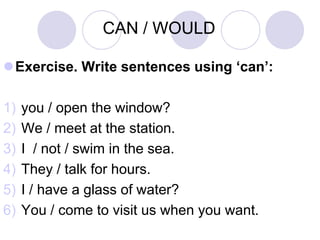
Exercise. Write sentences using ‘can’:

1)   you / open the window?
2)   We / meet at the station.
3)   I / not / swim in the sea.
4)   They / talk for hours.
5)   I / have a glass of water?
6)   You / come to visit us when you want.
CAN / WOULD

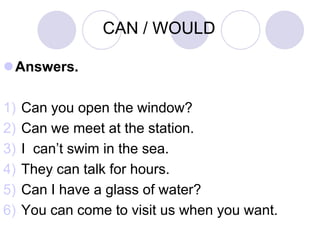
Answers.

1)   Can you open the window?
2)   Can we meet at the station.
3)   I can’t swim in the sea.
4)   They can talk for hours.
5)   Can I have a glass of water?
6)   You can come to visit us when you want.
CAN / WOULD
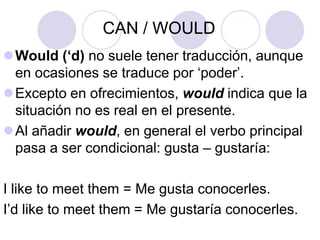
Would (‘d) no suele tener traducción, aunque
 en ocasiones se traduce por ‘poder’.
Excepto en ofrecimientos, would indica que la
 situación no es real en el presente.
Al añadir would, en general el verbo principal
 pasa a ser condicional: gusta – gustaría:

I like to meet them = Me gusta conocerles.
I’d like to meet them = Me gustaría conocerles.
CAN / WOULD
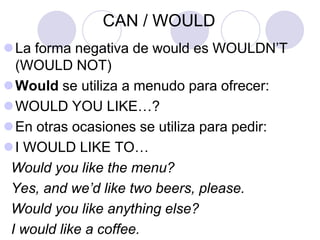
La forma negativa de would es WOULDN’T
  (WOULD NOT)
Would se utiliza a menudo para ofrecer:
WOULD YOU LIKE…?
En otras ocasiones se utiliza para pedir:
I WOULD LIKE TO…
 Would you like the menu?
 Yes, and we’d like two beers, please.
 Would you like anything else?
 I would like a coffee.
CAN / WOULD

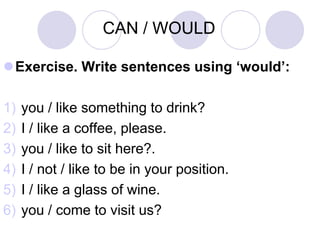
Exercise. Write sentences using ‘would’:

1)   you / like something to drink?
2)   I / like a coffee, please.
3)   you / like to sit here?.
4)   I / not / like to be in your position.
5)   I / like a glass of wine.
6)   you / come to visit us?
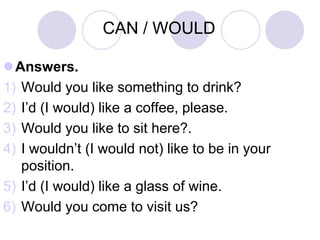
CAN / WOULD

Answers.
1) Would you like something to drink?
2) I’d (I would) like a coffee, please.
3) Would you like to sit here?.
4) I wouldn’t (I would not) like to be in your
   position.
5) I’d (I would) like a glass of wine.
6) Would you come to visit us?
Thank you for your attention!

English class 8(a)

  • 1.
    English class 8 Elementarylevel Juan José Simón Pérez Mail: simondeibi@gmail.com
  • 2.
    PRESENT CONTINUOUS I am not sitting on a chair, I am sitting on a sofa Now You are not studying an English course, you are studying a French course
  • 3.
    PRESENT CONTINUOUS Estructura enfrases negativas: Sujeto + am/are/is not + verbo -ing + resto de la frase Ejemplos: I am not going out today / I’m not going… You are not eating anything / You aren’t eating… It is not snowing this winter / It isn’t snowing… We are not living in London any more / We aren’t living…
  • 4.
    PRESENT CONTINUOUS Exercise. Changethe following sentences to the negative form. 1) I am washing my car. 2) She is running a marathon. 3) We are travelling by train. 4) It is snowing right now. 5) He eats too many sweets. 6) Are you living here? 7) You are quite tall.
  • 5.
    PRESENT CONTINUOUS Answers. 1) I’mnot washing my car. 2) She isn’t running a marathon. 3) We aren’t travelling by train. 4) It isn’t snowing right now. 5) He doesn’t eat too many sweets. 6) You aren’t living here. 7) You aren’t quite tall.
  • 6.
    PRESENT CONTINUOUS Structure inquestions: Am/are/is + Subject + verb-ing + rest of the sentence + ? Examples: Am I speaking to you? Are you working today? It is not snowing this winter / It isn’t snowing… We are not living in London any more / We aren’t living…
  • 7.
    PRESENT CONTINUOUS Estructura inpreguntas: Am/are/is + Subject + verb-ing + rest of the sentence + ? Ejemplos: Am I speaking to you? Are you working today? It is not snowing this winter / It isn’t snowing… We are not living in London any more / We aren’t living…
  • 8.
    PRESENT CONTINUOUS Exercise. Changethe following sentences to the question form. 1) I am brushing my teeth 2) He is running a marathon 3) You are cooking my favourite meal 4) She is coming now 5) You are too far 6) He likes watching horror movies 7) You are quite tall
  • 9.
    PRESENT CONTINUOUS Answers. 1) AmI brushing my teeth? 2) Is he running a marathon? 3) Are you cooking my favourite meal? 4) Is she is coming now? 5) Are you are too far? 6) Does he like watching horror movies? 7) Are you quite tall?
  • 10.
    CAN / WOULD Cany would son verbos modales. Nunca pueden hacer la función de verbo principal. Can = poder. Can not = can’t Can se utiliza para varias situaciones. Can sirve para expresar habilidad y posibilidad, pero también peticiones: Can I have the menu, please? Excuse me teacher, can I go to the toilet? You can speak English. You can’t smoke here!
  • 11.
    CAN / WOULD Etructura: +)Sujeto + can + infinitive + rest of sentence -) Sujeto + can not + infinitive + rest of sentence ?) Can + sujeto + infinitive + rest of sentence ? Ejemplos:  You can download music from the internet I can not speak Chinese. Can you come back tomorrow?
  • 12.
    CAN / WOULD Exercise.Write sentences using ‘can’: 1) you / open the window? 2) We / meet at the station. 3) I / not / swim in the sea. 4) They / talk for hours. 5) I / have a glass of water? 6) You / come to visit us when you want.
  • 13.
    CAN / WOULD Answers. 1) Can you open the window? 2) Can we meet at the station. 3) I can’t swim in the sea. 4) They can talk for hours. 5) Can I have a glass of water? 6) You can come to visit us when you want.
  • 14.
    CAN / WOULD Would(‘d) no suele tener traducción, aunque en ocasiones se traduce por ‘poder’. Excepto en ofrecimientos, would indica que la situación no es real en el presente. Al añadir would, en general el verbo principal pasa a ser condicional: gusta – gustaría: I like to meet them = Me gusta conocerles. I’d like to meet them = Me gustaría conocerles.
  • 15.
    CAN / WOULD Laforma negativa de would es WOULDN’T (WOULD NOT) Would se utiliza a menudo para ofrecer: WOULD YOU LIKE…? En otras ocasiones se utiliza para pedir: I WOULD LIKE TO… Would you like the menu? Yes, and we’d like two beers, please. Would you like anything else? I would like a coffee.
  • 16.
    CAN / WOULD Exercise.Write sentences using ‘would’: 1) you / like something to drink? 2) I / like a coffee, please. 3) you / like to sit here?. 4) I / not / like to be in your position. 5) I / like a glass of wine. 6) you / come to visit us?
  • 17.
    CAN / WOULD Answers. 1)Would you like something to drink? 2) I’d (I would) like a coffee, please. 3) Would you like to sit here?. 4) I wouldn’t (I would not) like to be in your position. 5) I’d (I would) like a glass of wine. 6) Would you come to visit us?
  • 18.
    Thank you foryour attention!