English class 11
Elementary level
http://learnenglishesol.weebly.com/
Juan José Simón Pérez
PAST SIMPLE
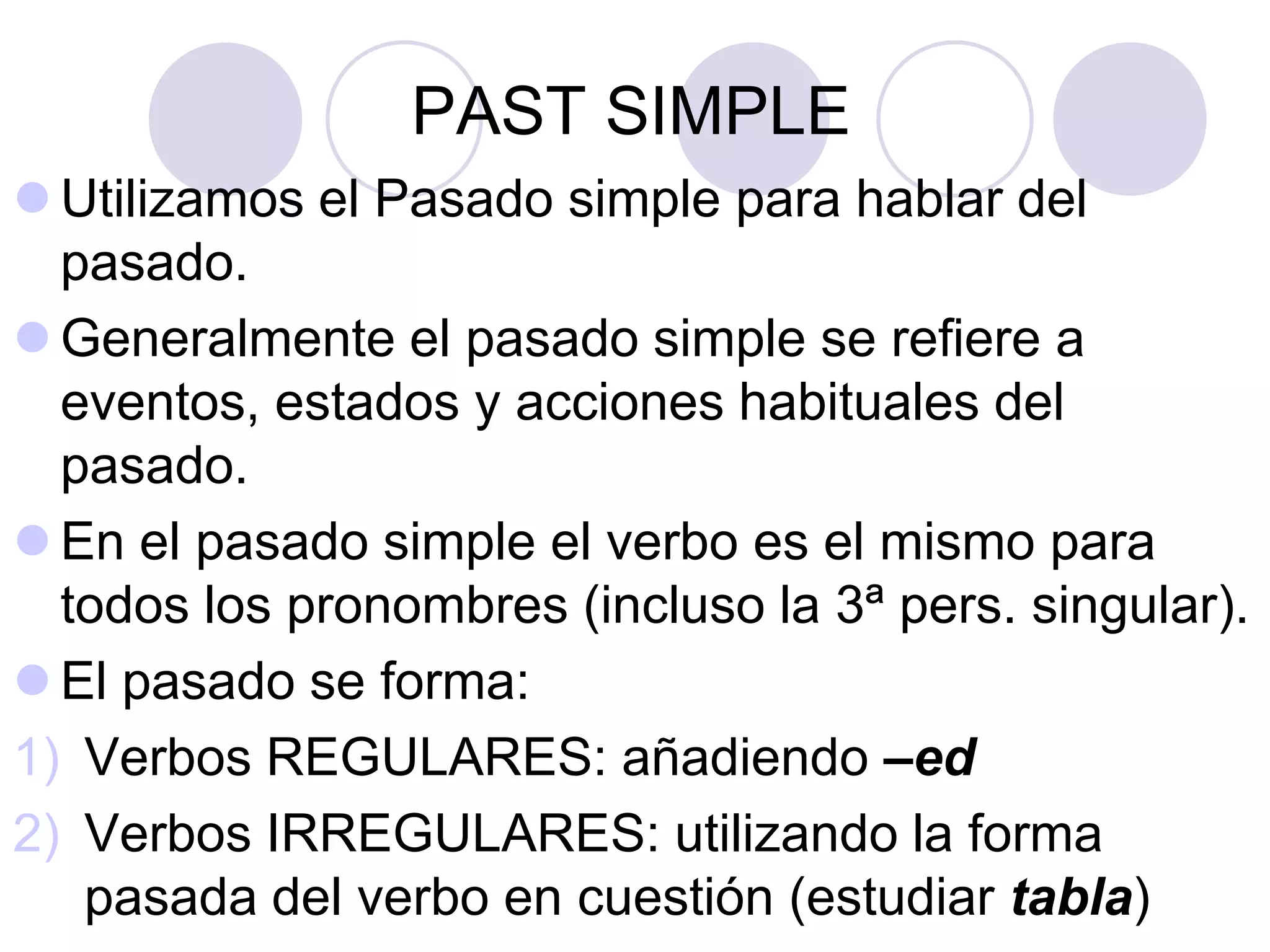
 Utilizamos el Pasado simple para hablar del
pasado.
 Generalmente el pasado simple se refiere a
eventos, estados y acciones habituales del
pasado.
 En el pasado simple el verbo es el mismo para
todos los pronombres (incluso la 3ª pers. singular).
 El pasado se forma:
1) Verbos REGULARES: añadiendo –ed
2) Verbos IRREGULARES: utilizando la forma
pasada del verbo en cuestión (estudiar tabla)
PAST SIMPLE
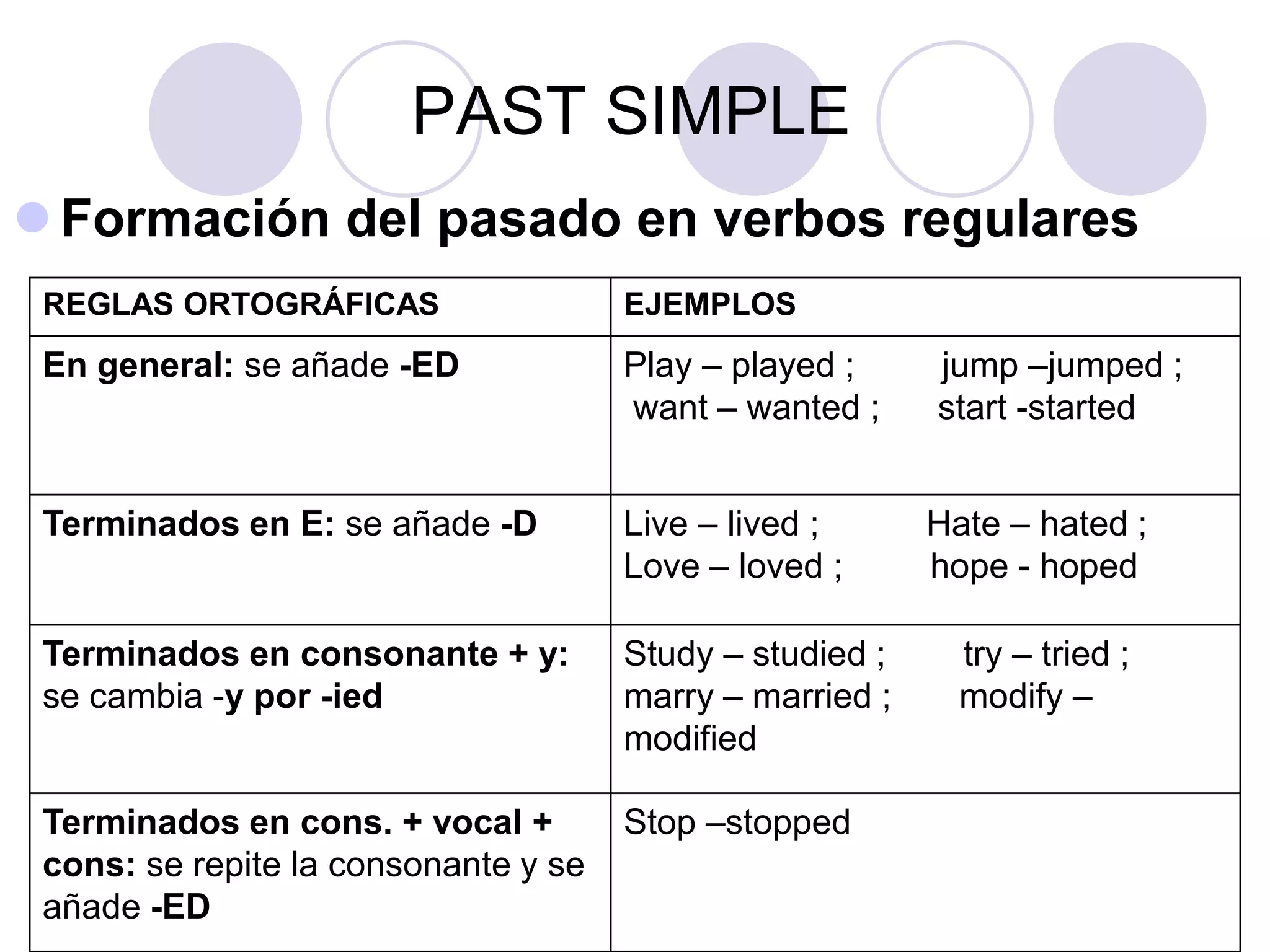
 Formación del pasado en verbos regulares
REGLAS ORTOGRÁFICAS EJEMPLOS
En general: se añade -ED Play – played ; jump –jumped ;
want – wanted ; start -started
Terminados en E: se añade -D Live – lived ; Hate – hated ;
Love – loved ; hope - hoped
Terminados en consonante + y:
se cambia -y por -ied
Study – studied ; try – tried ;
marry – married ; modify –
modified
Terminados en cons. + vocal +
cons: se repite la consonante y se
añade -ED
Stop –stopped
PAST SIMPLE
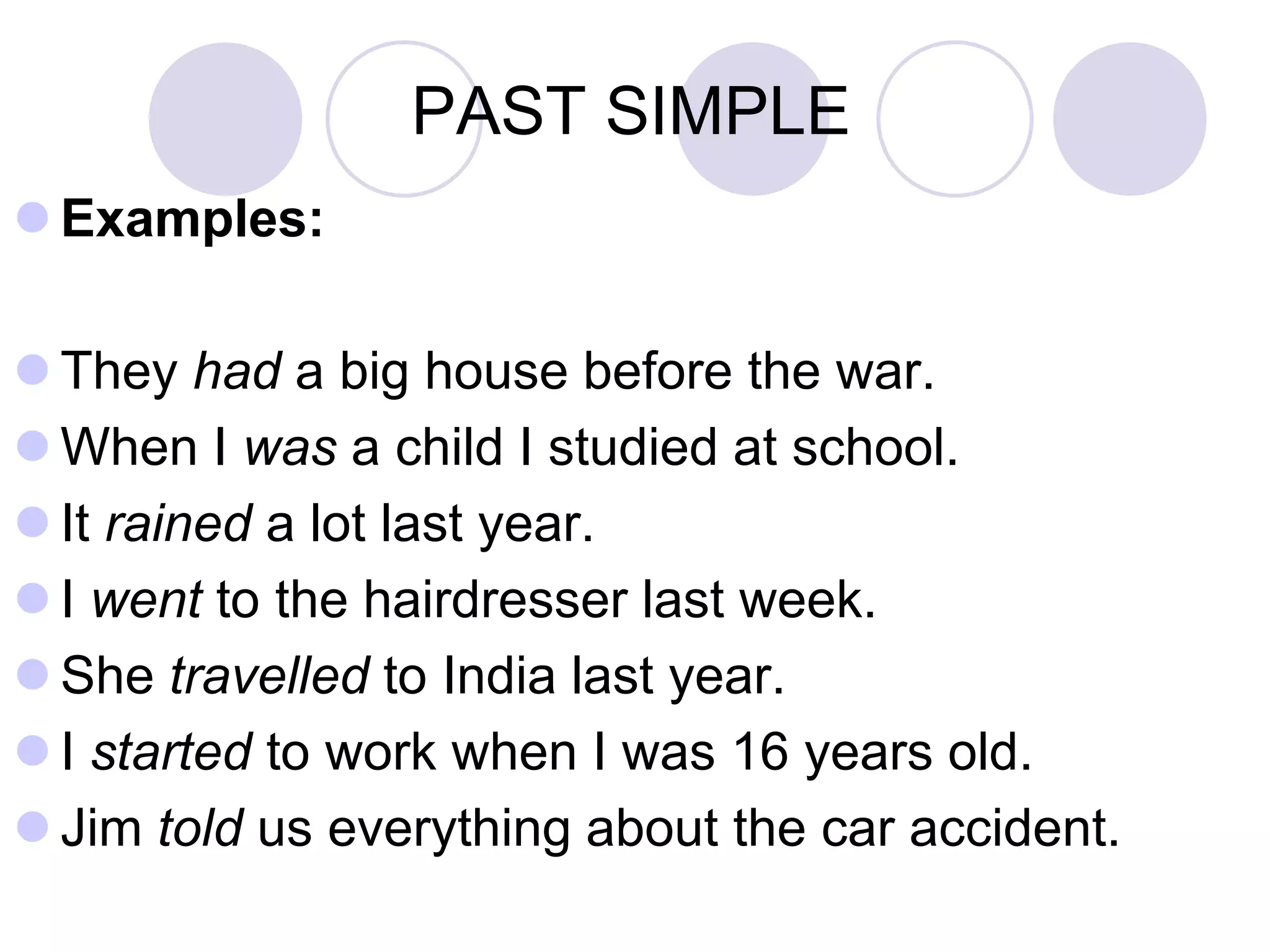
 Examples:
 They had a big house before the war.
 When I was a child I studied at school.
 It rained a lot last year.
 I went to the hairdresser last week.
 She travelled to India last year.
 I started to work when I was 16 years old.
 Jim told us everything about the car accident.
PAST SIMPLE
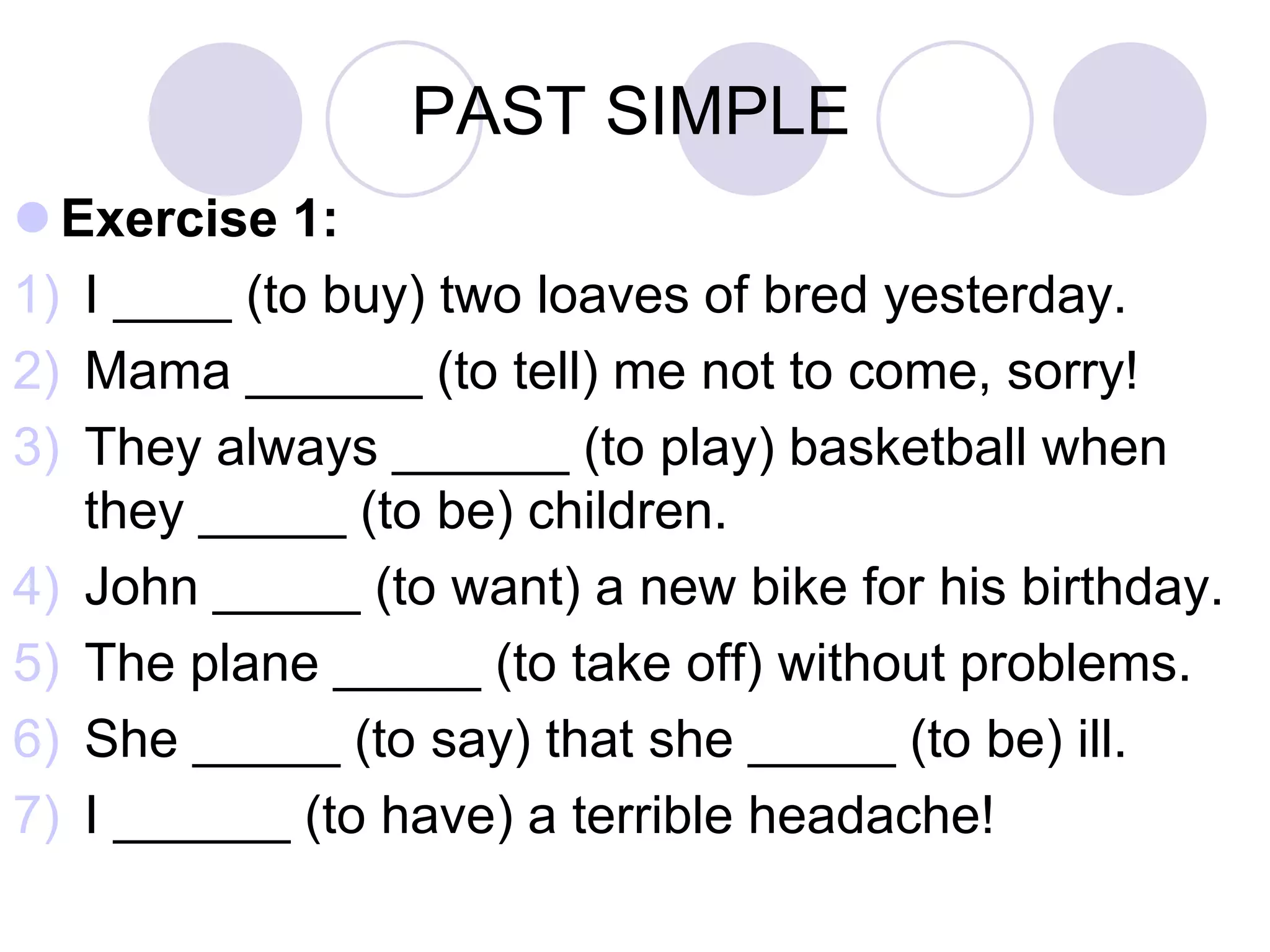
 Exercise 1:
1) I ____ (to buy) two loaves of bred yesterday.
2) Mama ______ (to tell) me not to come, sorry!
3) They always ______ (to play) basketball when
they _____ (to be) children.
4) John _____ (to want) a new bike for his birthday.
5) The plane _____ (to take off) without problems.
6) She _____ (to say) that she _____ (to be) ill.
7) I ______ (to have) a terrible headache!
PAST SIMPLE
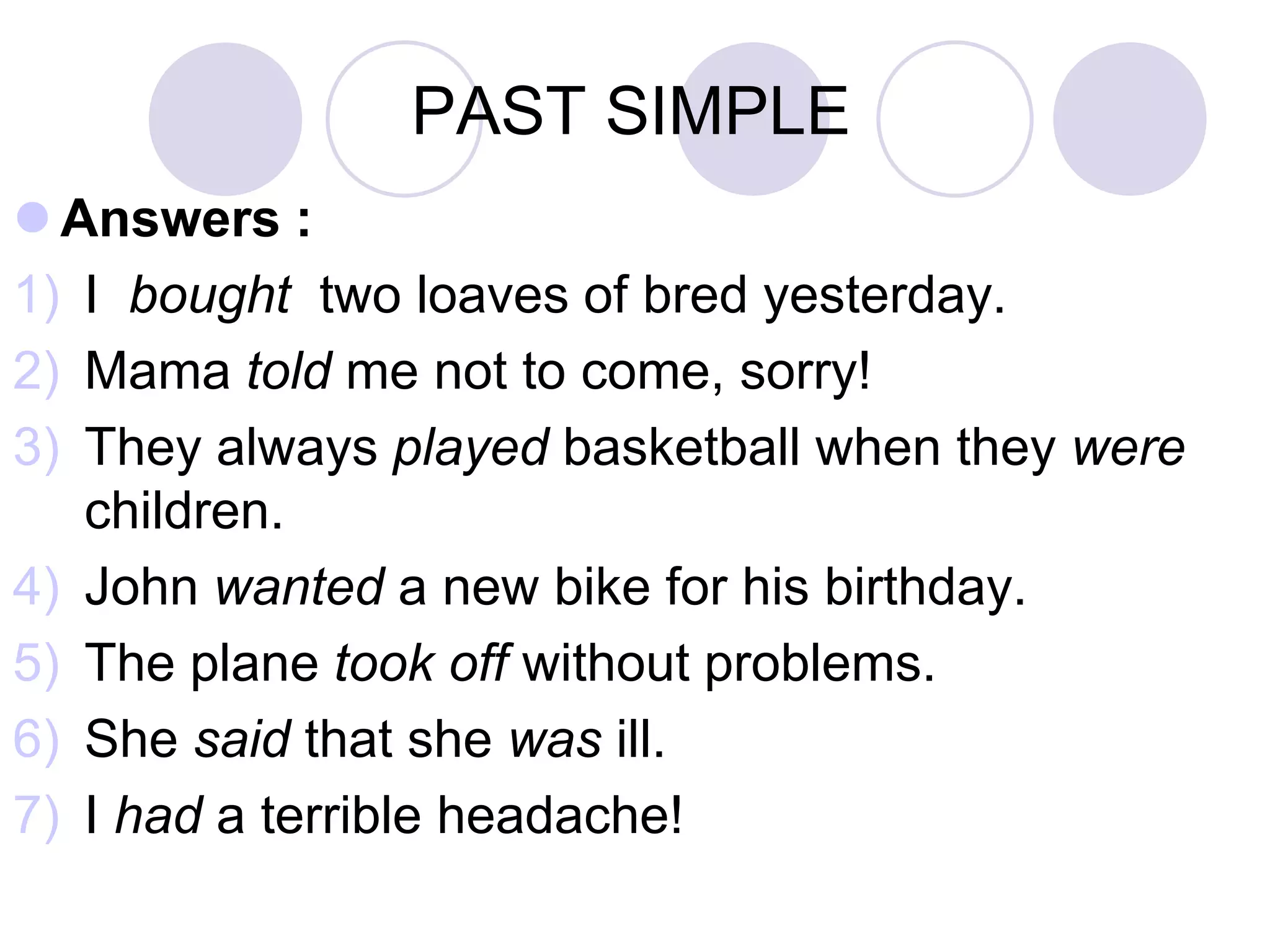
 Answers :
1) I bought two loaves of bred yesterday.
2) Mama told me not to come, sorry!
3) They always played basketball when they were
children.
4) John wanted a new bike for his birthday.
5) The plane took off without problems.
6) She said that she was ill.
7) I had a terrible headache!
PAST SIMPLE (negative & question)
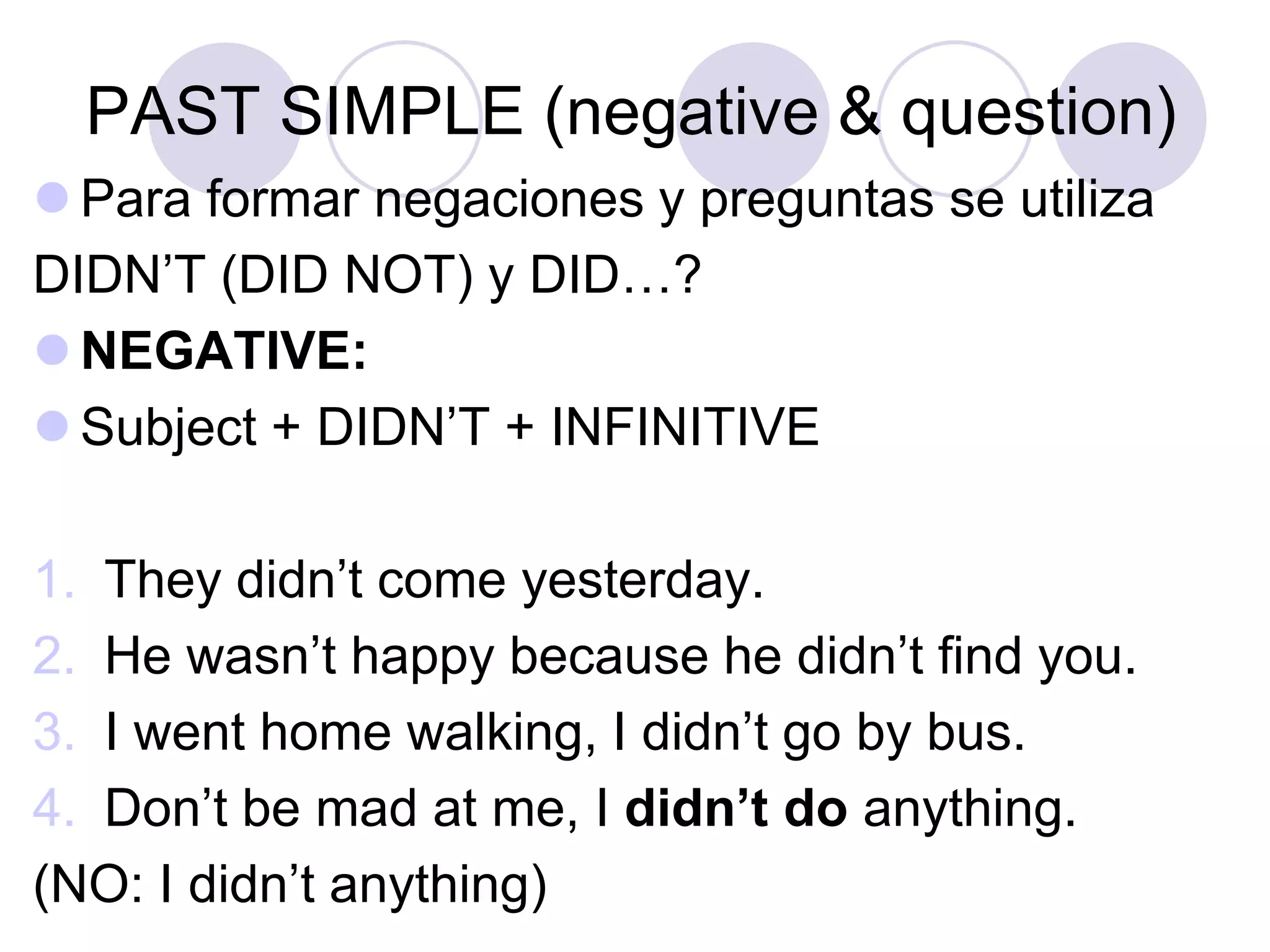
 Para formar negaciones y preguntas se utiliza
DIDN’T (DID NOT) y DID…?
 NEGATIVE:
 Subject + DIDN’T + INFINITIVE
1. They didn’t come yesterday.
2. He wasn’t happy because he didn’t find you.
3. I went home walking, I didn’t go by bus.
4. Don’t be mad at me, I didn’t do anything.
(NO: I didn’t anything)
PAST SIMPLE (negative & question)
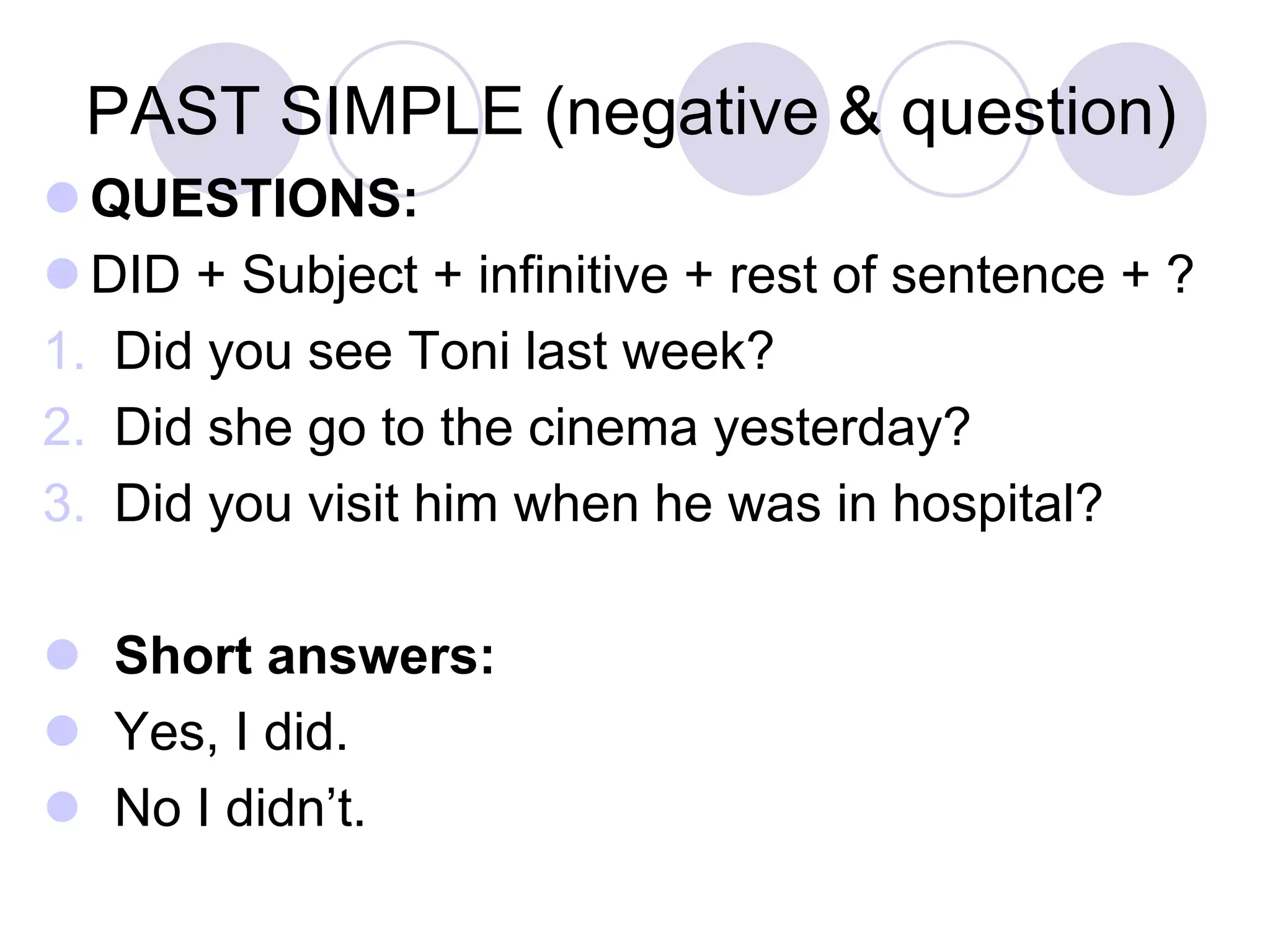
 QUESTIONS:
 DID + Subject + infinitive + rest of sentence + ?
1. Did you see Toni last week?
2. Did she go to the cinema yesterday?
3. Did you visit him when he was in hospital?
 Short answers:
 Yes, I did.
 No I didn’t.
PAST SIMPLE (negative & question)
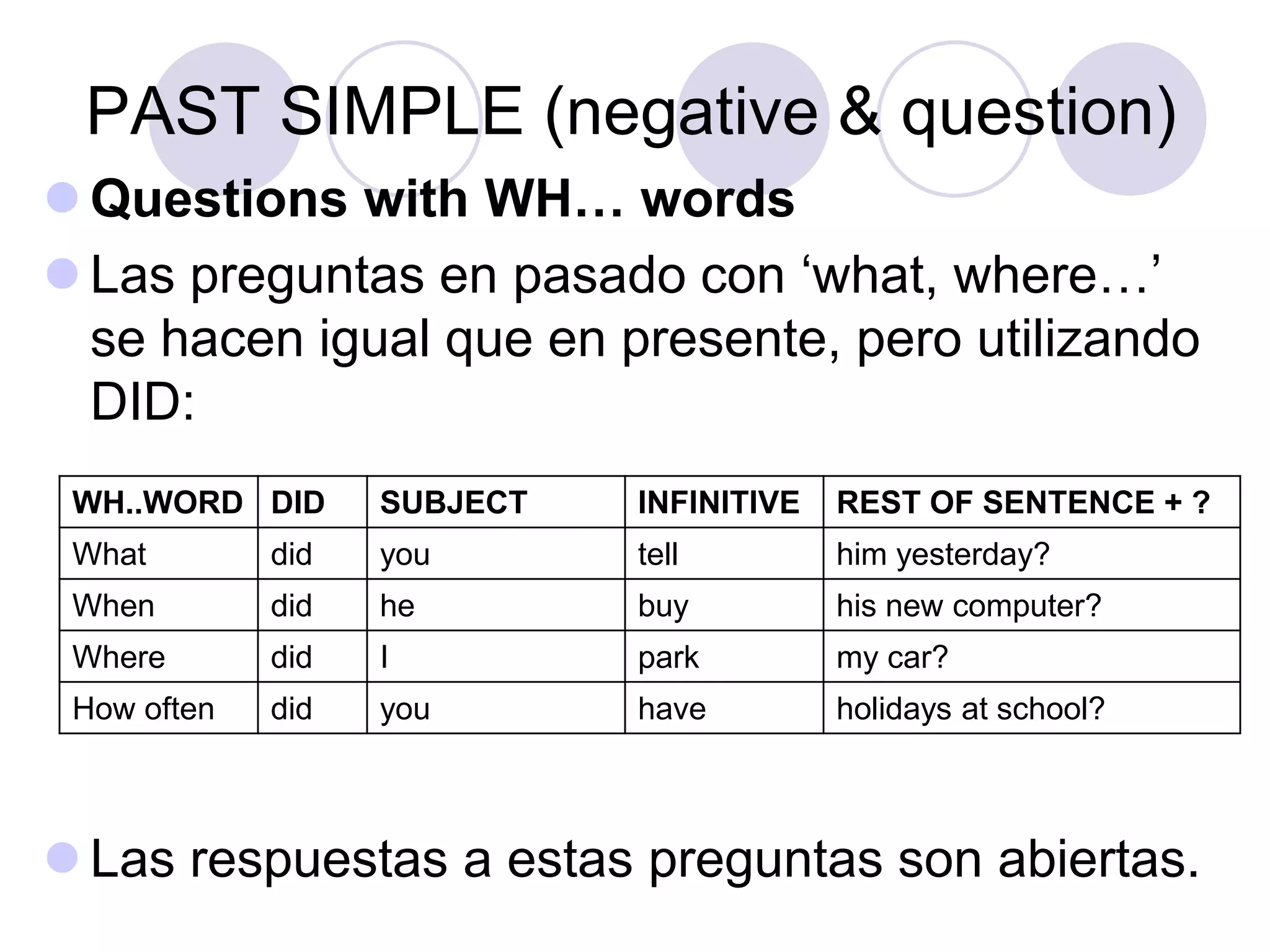
 Questions with WH… words
 Las preguntas en pasado con ‘what, where…’
se hacen igual que en presente, pero utilizando
DID:
 Las respuestas a estas preguntas son abiertas.
WH..WORD DID SUBJECT INFINITIVE REST OF SENTENCE + ?
What did you tell him yesterday?
When did he buy his new computer?
Where did I park my car?
How often did you have holidays at school?
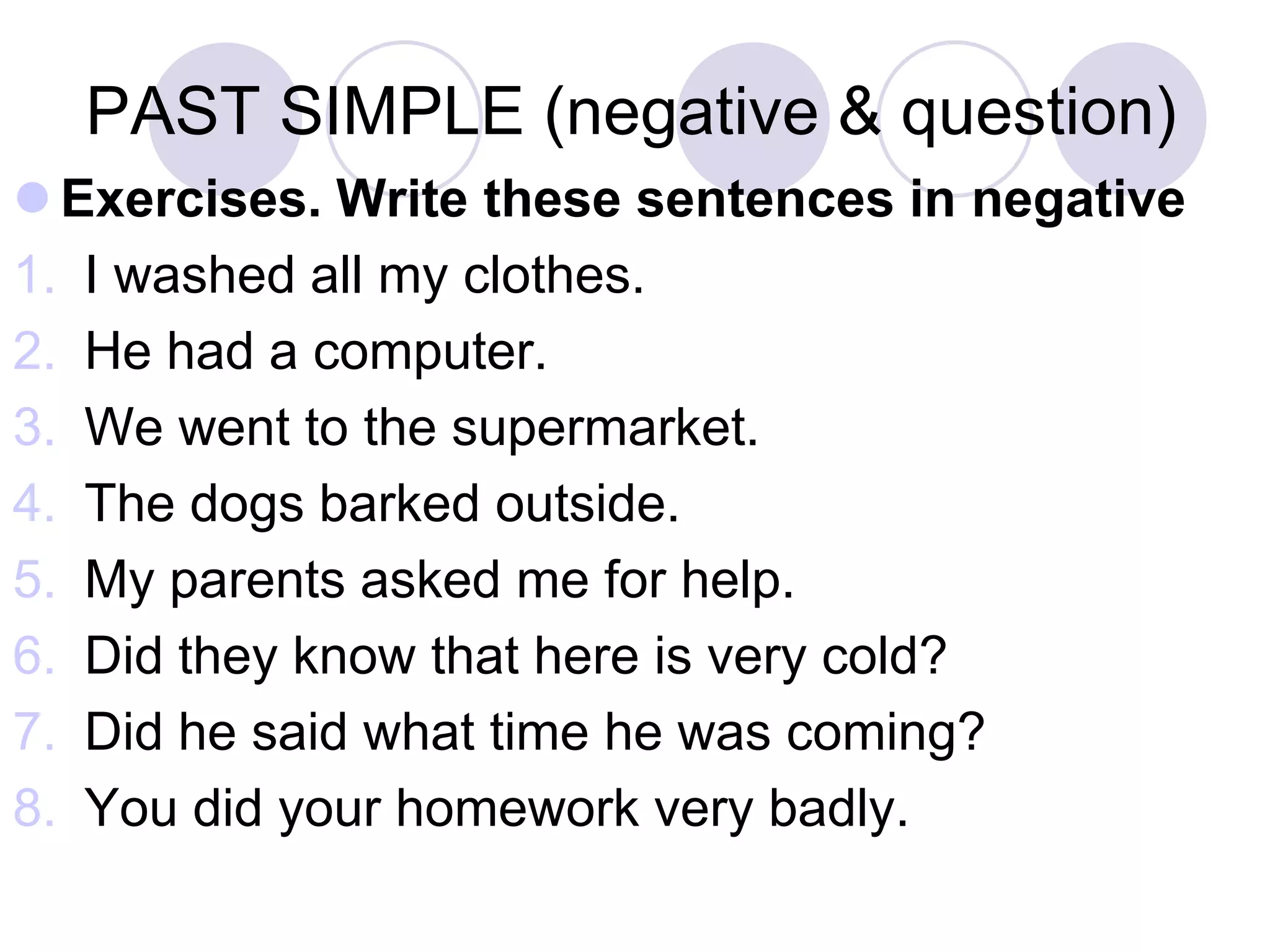
PAST SIMPLE (negative & question)
 Exercises. Write these sentences in negative
1. I washed all my clothes.
2. He had a computer.
3. We went to the supermarket.
4. The dogs barked outside.
5. My parents asked me for help.
6. Did they know that here is very cold?
7. Did he said what time he was coming?
8. You did your homework very badly.
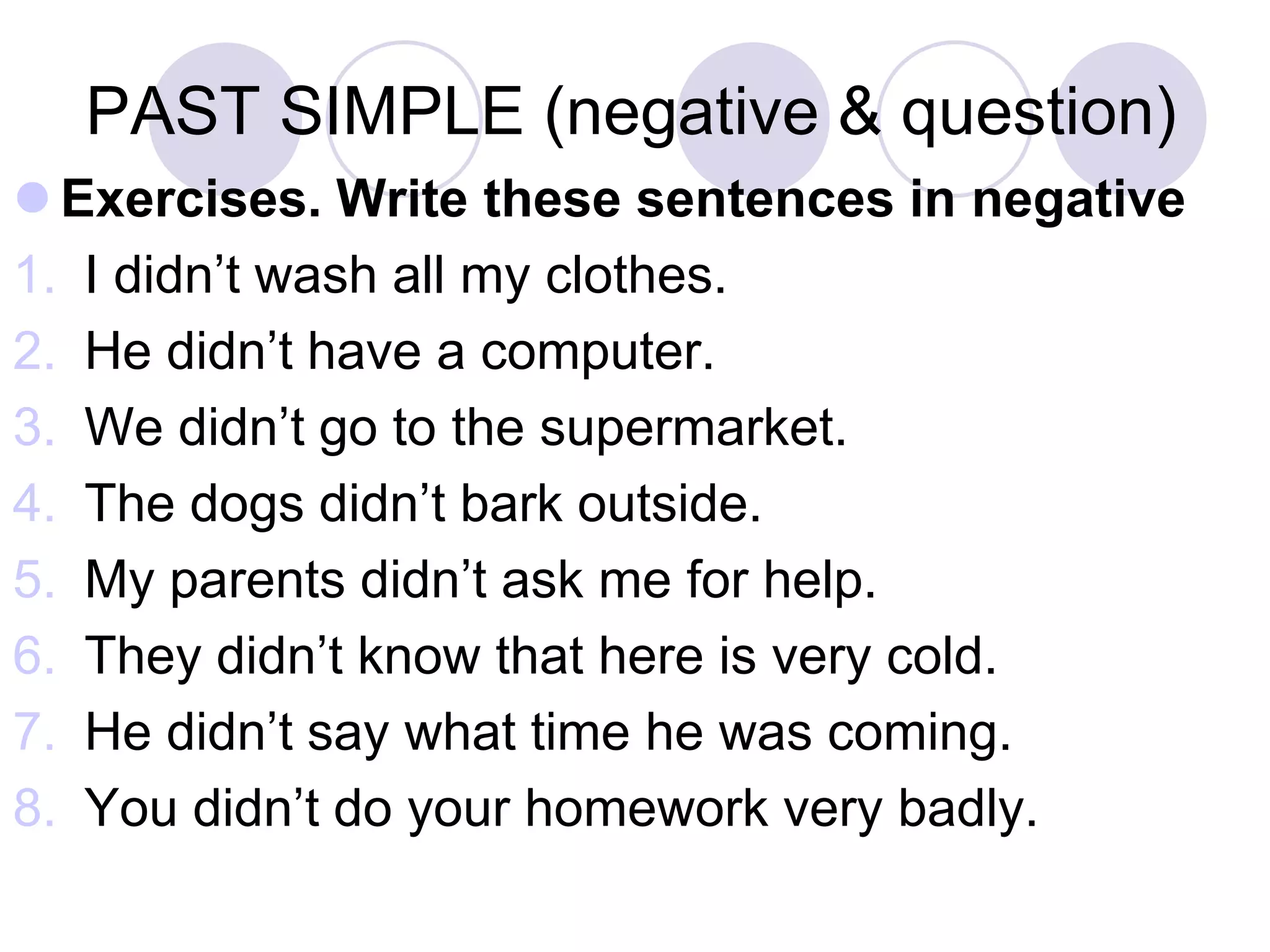
PAST SIMPLE (negative & question)
 Exercises. Write these sentences in negative
1. I didn’t wash all my clothes.
2. He didn’t have a computer.
3. We didn’t go to the supermarket.
4. The dogs didn’t bark outside.
5. My parents didn’t ask me for help.
6. They didn’t know that here is very cold.
7. He didn’t say what time he was coming.
8. You didn’t do your homework very badly.
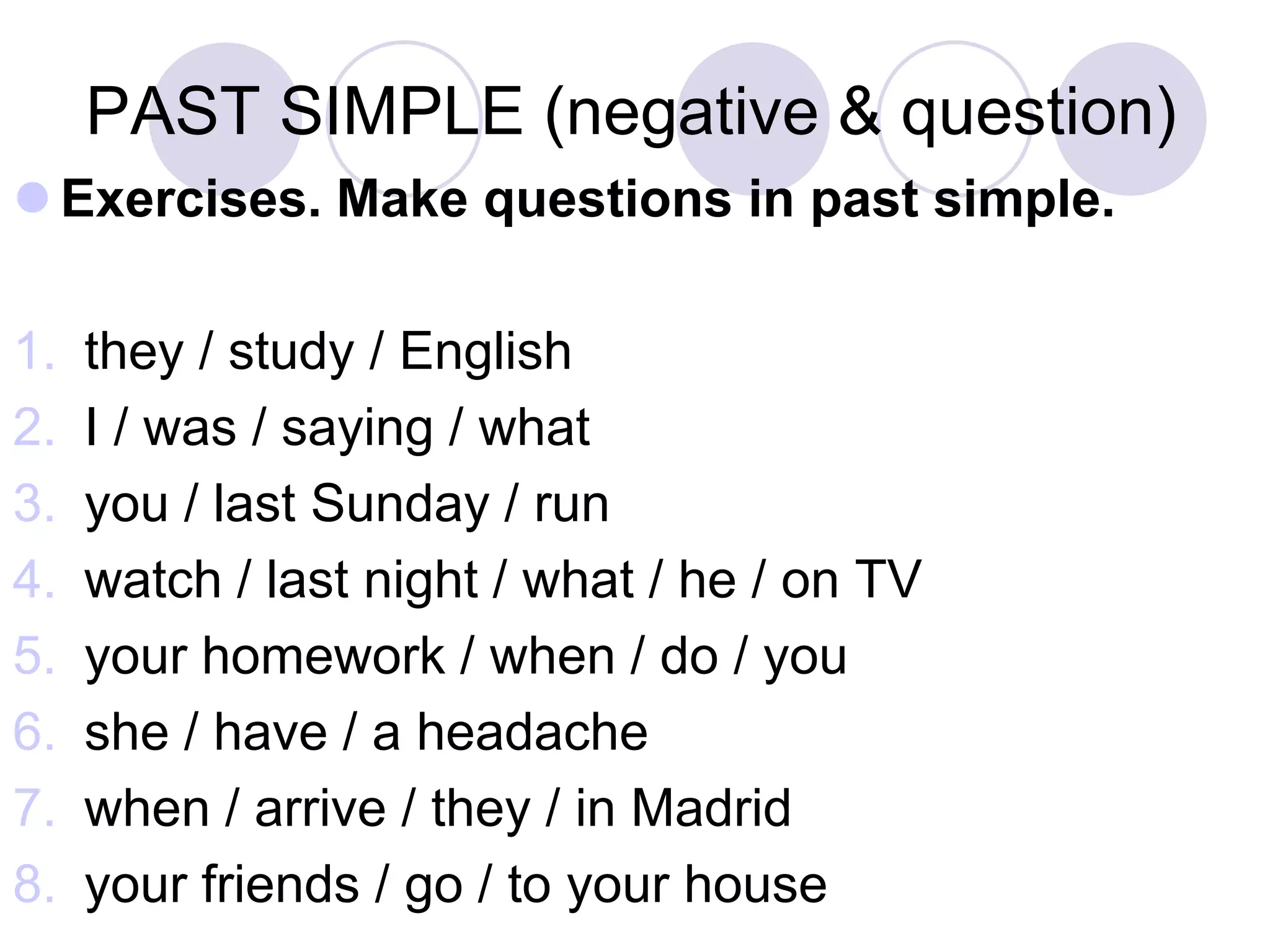
PAST SIMPLE (negative & question)
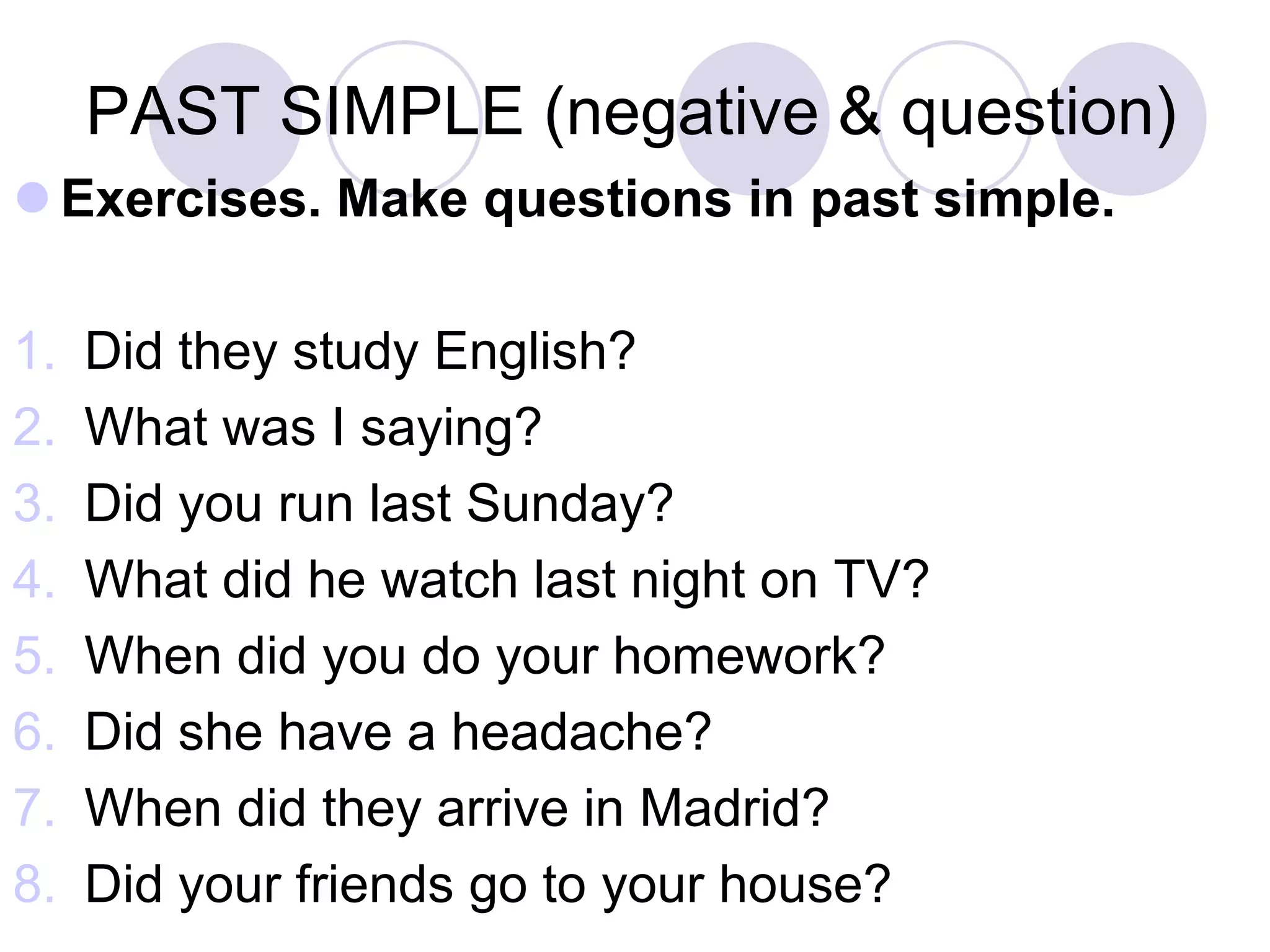
 Exercises. Make questions in past simple.
1. they / study / English
2. I / was / saying / what
3. you / last Sunday / run
4. watch / last night / what / he / on TV
5. your homework / when / do / you
6. she / have / a headache
7. when / arrive / they / in Madrid
8. your friends / go / to your house
PAST SIMPLE (negative & question)
 Exercises. Make questions in past simple.
1. Did they study English?
2. What was I saying?
3. Did you run last Sunday?
4. What did he watch last night on TV?
5. When did you do your homework?
6. Did she have a headache?
7. When did they arrive in Madrid?
8. Did your friends go to your house?
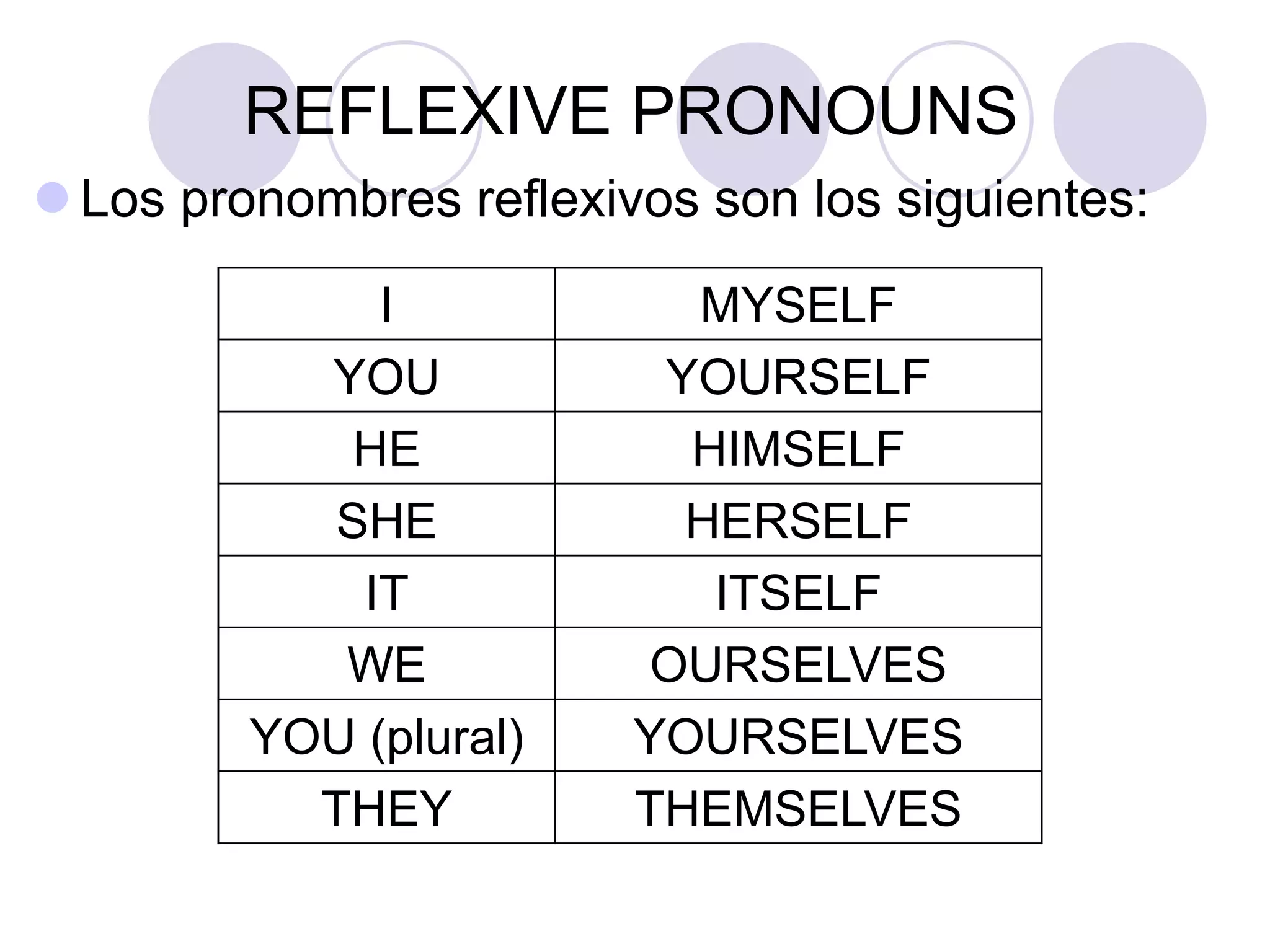
REFLEXIVE PRONOUNS
 Los pronombres reflexivos son los siguientes:
I MYSELF
YOU YOURSELF
HE HIMSELF
SHE HERSELF
IT ITSELF
WE OURSELVES
YOU (plural) YOURSELVES
THEY THEMSELVES
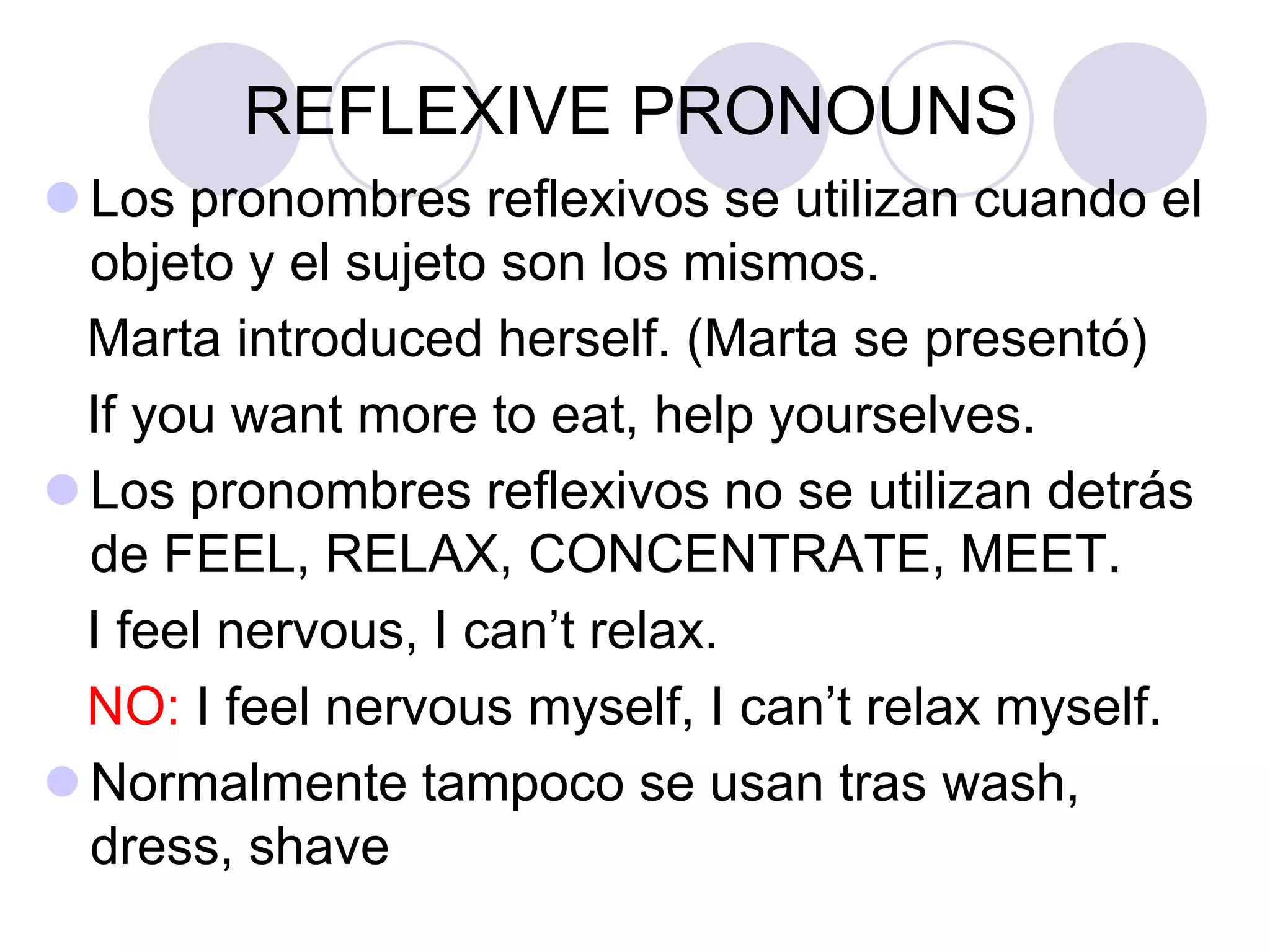
REFLEXIVE PRONOUNS
 Los pronombres reflexivos se utilizan cuando el
objeto y el sujeto son los mismos.
Marta introduced herself. (Marta se presentó)
If you want more to eat, help yourselves.
 Los pronombres reflexivos no se utilizan detrás
de FEEL, RELAX, CONCENTRATE, MEET.
I feel nervous, I can’t relax.
NO: I feel nervous myself, I can’t relax myself.
 Normalmente tampoco se usan tras wash,
dress, shave
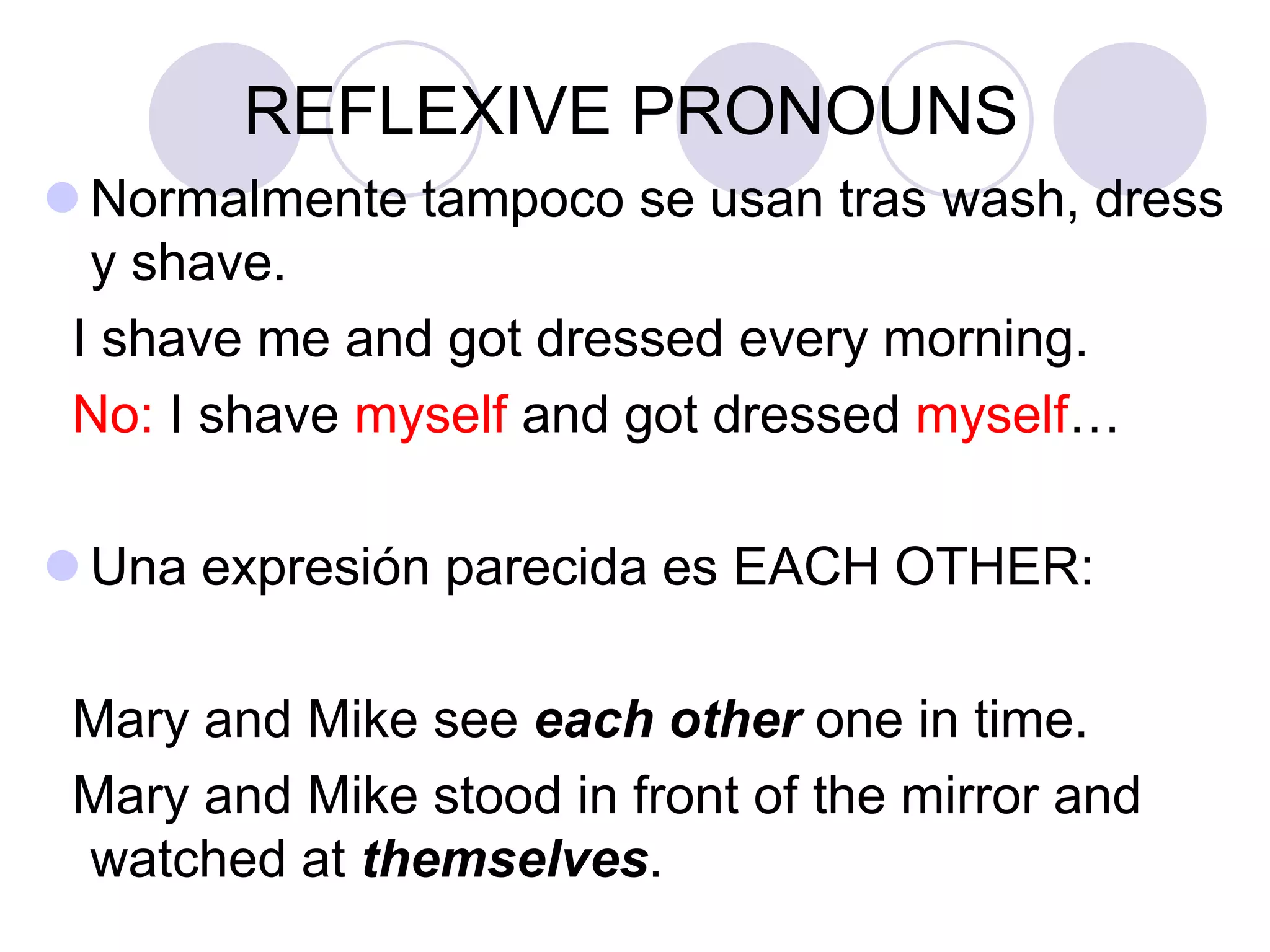
REFLEXIVE PRONOUNS
 Normalmente tampoco se usan tras wash, dress
y shave.
I shave me and got dressed every morning.
No: I shave myself and got dressed myself…
 Una expresión parecida es EACH OTHER:
Mary and Mike see each other one in time.
Mary and Mike stood in front of the mirror and
watched at themselves.
REFLEXIVE PRONOUNS
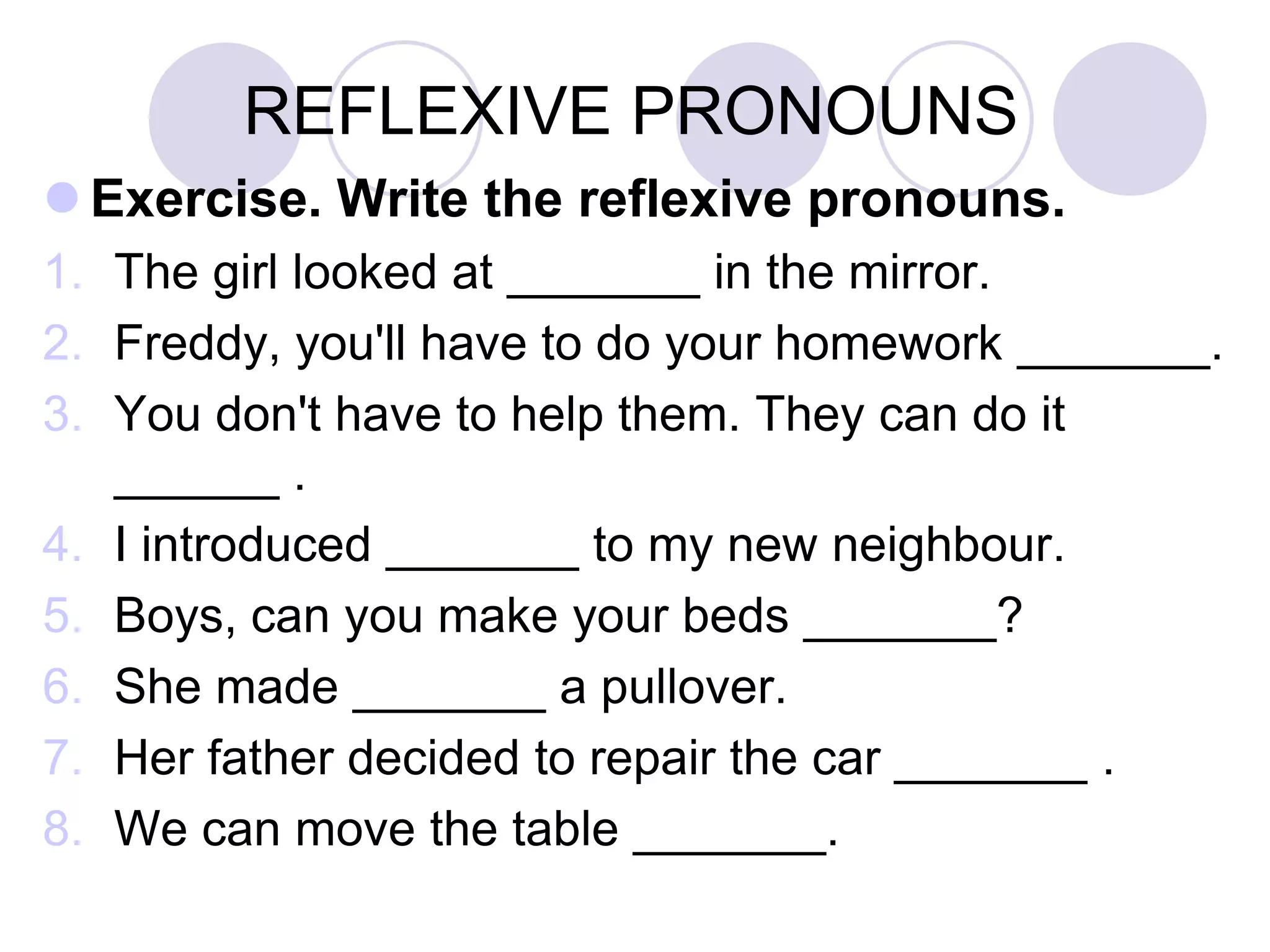
 Exercise. Write the reflexive pronouns.
1. The girl looked at _______ in the mirror.
2. Freddy, you'll have to do your homework _______.
3. You don't have to help them. They can do it
______ .
4. I introduced _______ to my new neighbour.
5. Boys, can you make your beds _______?
6. She made _______ a pullover.
7. Her father decided to repair the car _______ .
8. We can move the table _______.
REFLEXIVE PRONOUNS
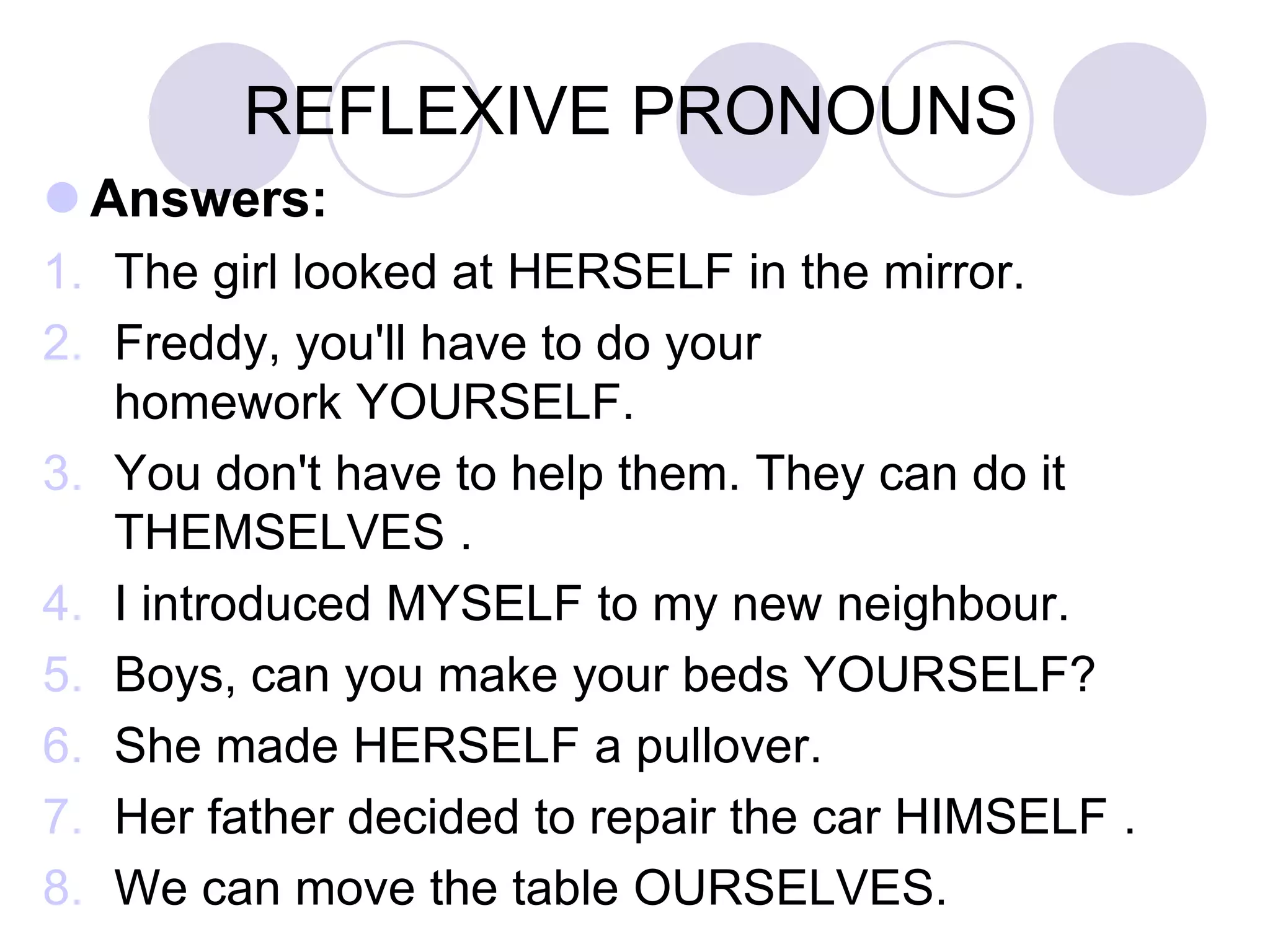
 Answers:
1. The girl looked at HERSELF in the mirror.
2. Freddy, you'll have to do your
homework YOURSELF.
3. You don't have to help them. They can do it
THEMSELVES .
4. I introduced MYSELF to my new neighbour.
5. Boys, can you make your beds YOURSELF?
6. She made HERSELF a pullover.
7. Her father decided to repair the car HIMSELF .
8. We can move the table OURSELVES.
REFLEXIVE PRONOUNS
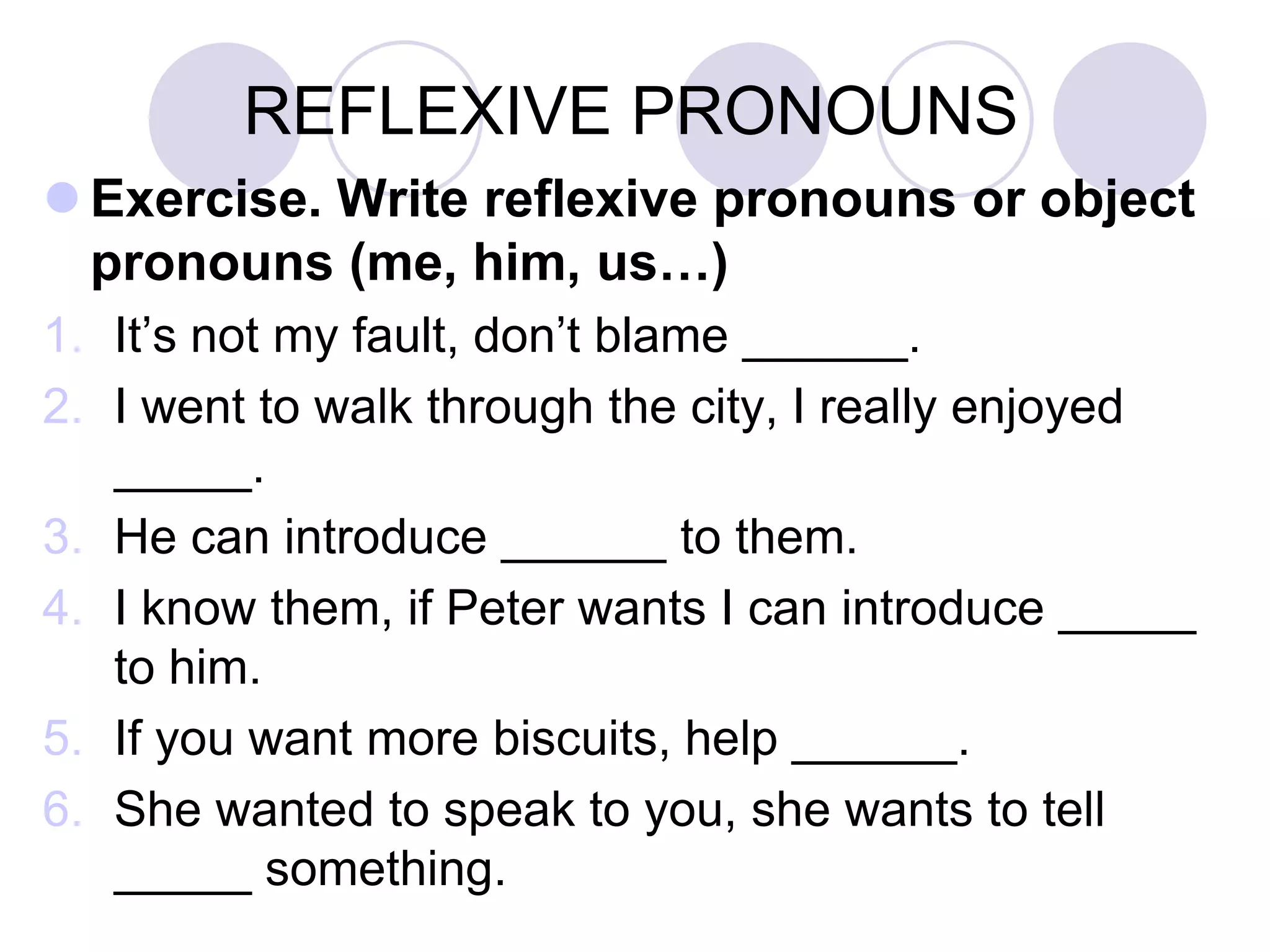
 Exercise. Write reflexive pronouns or object
pronouns (me, him, us…)
1. It’s not my fault, don’t blame ______.
2. I went to walk through the city, I really enjoyed
_____.
3. He can introduce ______ to them.
4. I know them, if Peter wants I can introduce _____
to him.
5. If you want more biscuits, help ______.
6. She wanted to speak to you, she wants to tell
_____ something.
REFLEXIVE PRONOUNS
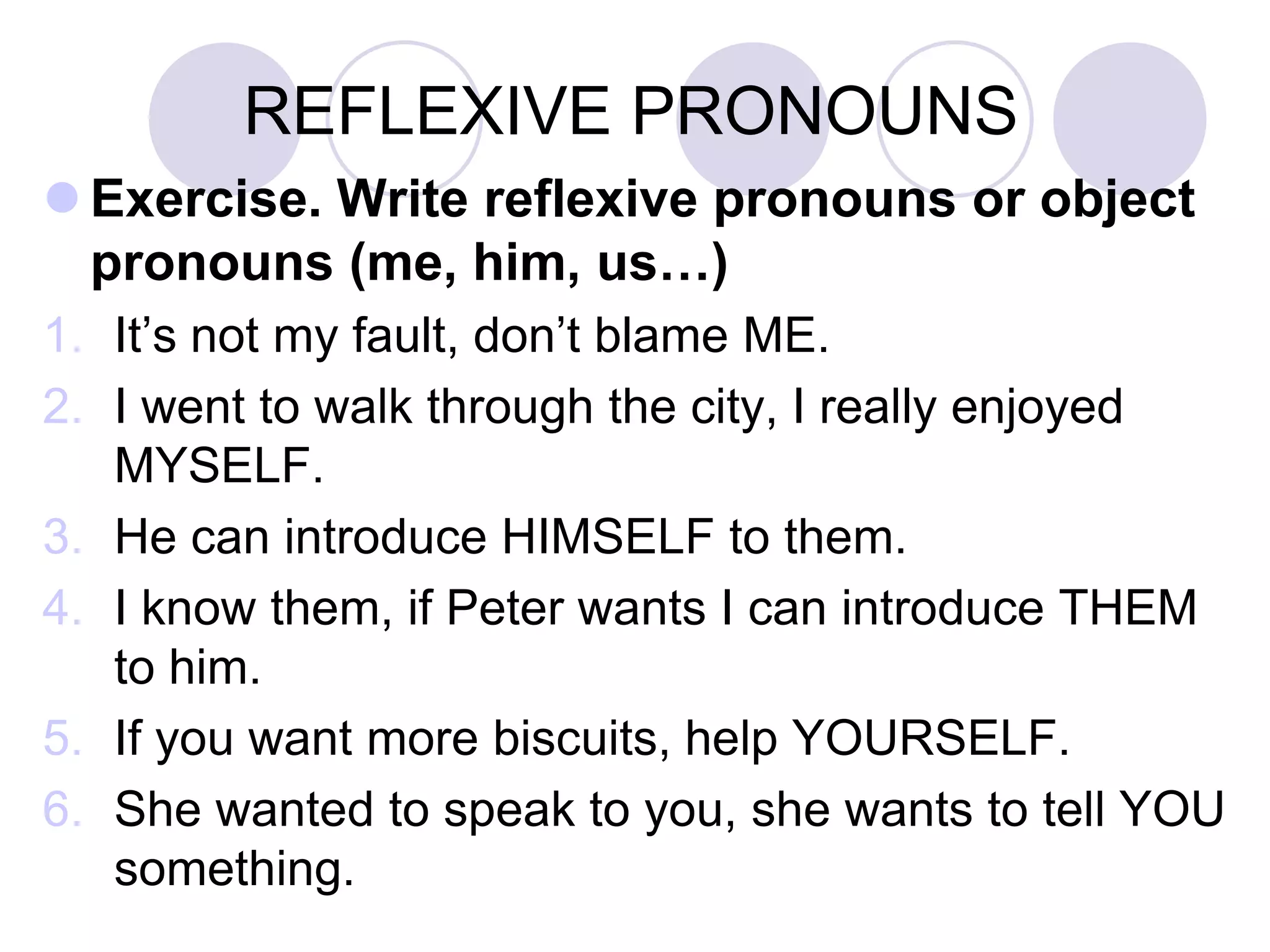
 Exercise. Write reflexive pronouns or object
pronouns (me, him, us…)
1. It’s not my fault, don’t blame ME.
2. I went to walk through the city, I really enjoyed
MYSELF.
3. He can introduce HIMSELF to them.
4. I know them, if Peter wants I can introduce THEM
to him.
5. If you want more biscuits, help YOURSELF.
6. She wanted to speak to you, she wants to tell YOU
something.
Thank you for your attention!

English class 11(a)

  • 1.
    English class 11 Elementarylevel http://learnenglishesol.weebly.com/ Juan José Simón Pérez
  • 2.
    PAST SIMPLE  Utilizamosel Pasado simple para hablar del pasado.  Generalmente el pasado simple se refiere a eventos, estados y acciones habituales del pasado.  En el pasado simple el verbo es el mismo para todos los pronombres (incluso la 3ª pers. singular).  El pasado se forma: 1) Verbos REGULARES: añadiendo –ed 2) Verbos IRREGULARES: utilizando la forma pasada del verbo en cuestión (estudiar tabla)
  • 3.
    PAST SIMPLE  Formacióndel pasado en verbos regulares REGLAS ORTOGRÁFICAS EJEMPLOS En general: se añade -ED Play – played ; jump –jumped ; want – wanted ; start -started Terminados en E: se añade -D Live – lived ; Hate – hated ; Love – loved ; hope - hoped Terminados en consonante + y: se cambia -y por -ied Study – studied ; try – tried ; marry – married ; modify – modified Terminados en cons. + vocal + cons: se repite la consonante y se añade -ED Stop –stopped
  • 4.
    PAST SIMPLE  Examples: They had a big house before the war.  When I was a child I studied at school.  It rained a lot last year.  I went to the hairdresser last week.  She travelled to India last year.  I started to work when I was 16 years old.  Jim told us everything about the car accident.
  • 5.
    PAST SIMPLE  Exercise1: 1) I ____ (to buy) two loaves of bred yesterday. 2) Mama ______ (to tell) me not to come, sorry! 3) They always ______ (to play) basketball when they _____ (to be) children. 4) John _____ (to want) a new bike for his birthday. 5) The plane _____ (to take off) without problems. 6) She _____ (to say) that she _____ (to be) ill. 7) I ______ (to have) a terrible headache!
  • 6.
    PAST SIMPLE  Answers: 1) I bought two loaves of bred yesterday. 2) Mama told me not to come, sorry! 3) They always played basketball when they were children. 4) John wanted a new bike for his birthday. 5) The plane took off without problems. 6) She said that she was ill. 7) I had a terrible headache!
  • 7.
    PAST SIMPLE (negative& question)  Para formar negaciones y preguntas se utiliza DIDN’T (DID NOT) y DID…?  NEGATIVE:  Subject + DIDN’T + INFINITIVE 1. They didn’t come yesterday. 2. He wasn’t happy because he didn’t find you. 3. I went home walking, I didn’t go by bus. 4. Don’t be mad at me, I didn’t do anything. (NO: I didn’t anything)
  • 8.
    PAST SIMPLE (negative& question)  QUESTIONS:  DID + Subject + infinitive + rest of sentence + ? 1. Did you see Toni last week? 2. Did she go to the cinema yesterday? 3. Did you visit him when he was in hospital?  Short answers:  Yes, I did.  No I didn’t.
  • 9.
    PAST SIMPLE (negative& question)  Questions with WH… words  Las preguntas en pasado con ‘what, where…’ se hacen igual que en presente, pero utilizando DID:  Las respuestas a estas preguntas son abiertas. WH..WORD DID SUBJECT INFINITIVE REST OF SENTENCE + ? What did you tell him yesterday? When did he buy his new computer? Where did I park my car? How often did you have holidays at school?
  • 10.
    PAST SIMPLE (negative& question)  Exercises. Write these sentences in negative 1. I washed all my clothes. 2. He had a computer. 3. We went to the supermarket. 4. The dogs barked outside. 5. My parents asked me for help. 6. Did they know that here is very cold? 7. Did he said what time he was coming? 8. You did your homework very badly.
  • 11.
    PAST SIMPLE (negative& question)  Exercises. Write these sentences in negative 1. I didn’t wash all my clothes. 2. He didn’t have a computer. 3. We didn’t go to the supermarket. 4. The dogs didn’t bark outside. 5. My parents didn’t ask me for help. 6. They didn’t know that here is very cold. 7. He didn’t say what time he was coming. 8. You didn’t do your homework very badly.
  • 12.
    PAST SIMPLE (negative& question)  Exercises. Make questions in past simple. 1. they / study / English 2. I / was / saying / what 3. you / last Sunday / run 4. watch / last night / what / he / on TV 5. your homework / when / do / you 6. she / have / a headache 7. when / arrive / they / in Madrid 8. your friends / go / to your house
  • 13.
    PAST SIMPLE (negative& question)  Exercises. Make questions in past simple. 1. Did they study English? 2. What was I saying? 3. Did you run last Sunday? 4. What did he watch last night on TV? 5. When did you do your homework? 6. Did she have a headache? 7. When did they arrive in Madrid? 8. Did your friends go to your house?
  • 14.
    REFLEXIVE PRONOUNS  Lospronombres reflexivos son los siguientes: I MYSELF YOU YOURSELF HE HIMSELF SHE HERSELF IT ITSELF WE OURSELVES YOU (plural) YOURSELVES THEY THEMSELVES
  • 15.
    REFLEXIVE PRONOUNS  Lospronombres reflexivos se utilizan cuando el objeto y el sujeto son los mismos. Marta introduced herself. (Marta se presentó) If you want more to eat, help yourselves.  Los pronombres reflexivos no se utilizan detrás de FEEL, RELAX, CONCENTRATE, MEET. I feel nervous, I can’t relax. NO: I feel nervous myself, I can’t relax myself.  Normalmente tampoco se usan tras wash, dress, shave
  • 16.
    REFLEXIVE PRONOUNS  Normalmentetampoco se usan tras wash, dress y shave. I shave me and got dressed every morning. No: I shave myself and got dressed myself…  Una expresión parecida es EACH OTHER: Mary and Mike see each other one in time. Mary and Mike stood in front of the mirror and watched at themselves.
  • 17.
    REFLEXIVE PRONOUNS  Exercise.Write the reflexive pronouns. 1. The girl looked at _______ in the mirror. 2. Freddy, you'll have to do your homework _______. 3. You don't have to help them. They can do it ______ . 4. I introduced _______ to my new neighbour. 5. Boys, can you make your beds _______? 6. She made _______ a pullover. 7. Her father decided to repair the car _______ . 8. We can move the table _______.
  • 18.
    REFLEXIVE PRONOUNS  Answers: 1.The girl looked at HERSELF in the mirror. 2. Freddy, you'll have to do your homework YOURSELF. 3. You don't have to help them. They can do it THEMSELVES . 4. I introduced MYSELF to my new neighbour. 5. Boys, can you make your beds YOURSELF? 6. She made HERSELF a pullover. 7. Her father decided to repair the car HIMSELF . 8. We can move the table OURSELVES.
  • 19.
    REFLEXIVE PRONOUNS  Exercise.Write reflexive pronouns or object pronouns (me, him, us…) 1. It’s not my fault, don’t blame ______. 2. I went to walk through the city, I really enjoyed _____. 3. He can introduce ______ to them. 4. I know them, if Peter wants I can introduce _____ to him. 5. If you want more biscuits, help ______. 6. She wanted to speak to you, she wants to tell _____ something.
  • 20.
    REFLEXIVE PRONOUNS  Exercise.Write reflexive pronouns or object pronouns (me, him, us…) 1. It’s not my fault, don’t blame ME. 2. I went to walk through the city, I really enjoyed MYSELF. 3. He can introduce HIMSELF to them. 4. I know them, if Peter wants I can introduce THEM to him. 5. If you want more biscuits, help YOURSELF. 6. She wanted to speak to you, she wants to tell YOU something.
  • 21.
    Thank you foryour attention!