English class 18
Elementary level
Juan José Simón Pérez
learnenglishesol.weebly.com
HAD BETTER / WOULD RATHER
 Had better y would rather son expresiones
muy utilizadas en inglés.
 No son modales (aquí el único modal es
‘would’), aunque cumplen algunas reglas de
estos.
You had better tell him the truth.
I would rather watch another movie.
HAD BETTER / WOULD RATHER
 HAD BETTER = es aconsejable (sería mejor
que...)
 A pesar de que HAD es pasado, had better solo
se utiliza para presente y futuro.
He had better pay today
I had better talk to the boss tomorrow
 En inglés hablado se contrae ‘HAD’
I’d better go now
She’d better take a taxi
HAD BETTER / WOULD RATHER
 ESTRUCTURA:
 (+) Subject + had better (‘d better) + infinitive…
It’s getting cold, you’d better take a coat.
 (-) Subject + had better not (‘d better not) +
infinitive
You had better not go out tonight.
 (?) (Wh..) + Had + subject + better + infinitive…?
Where had I better go on holiday?
HAD BETTER / WOULD RATHER
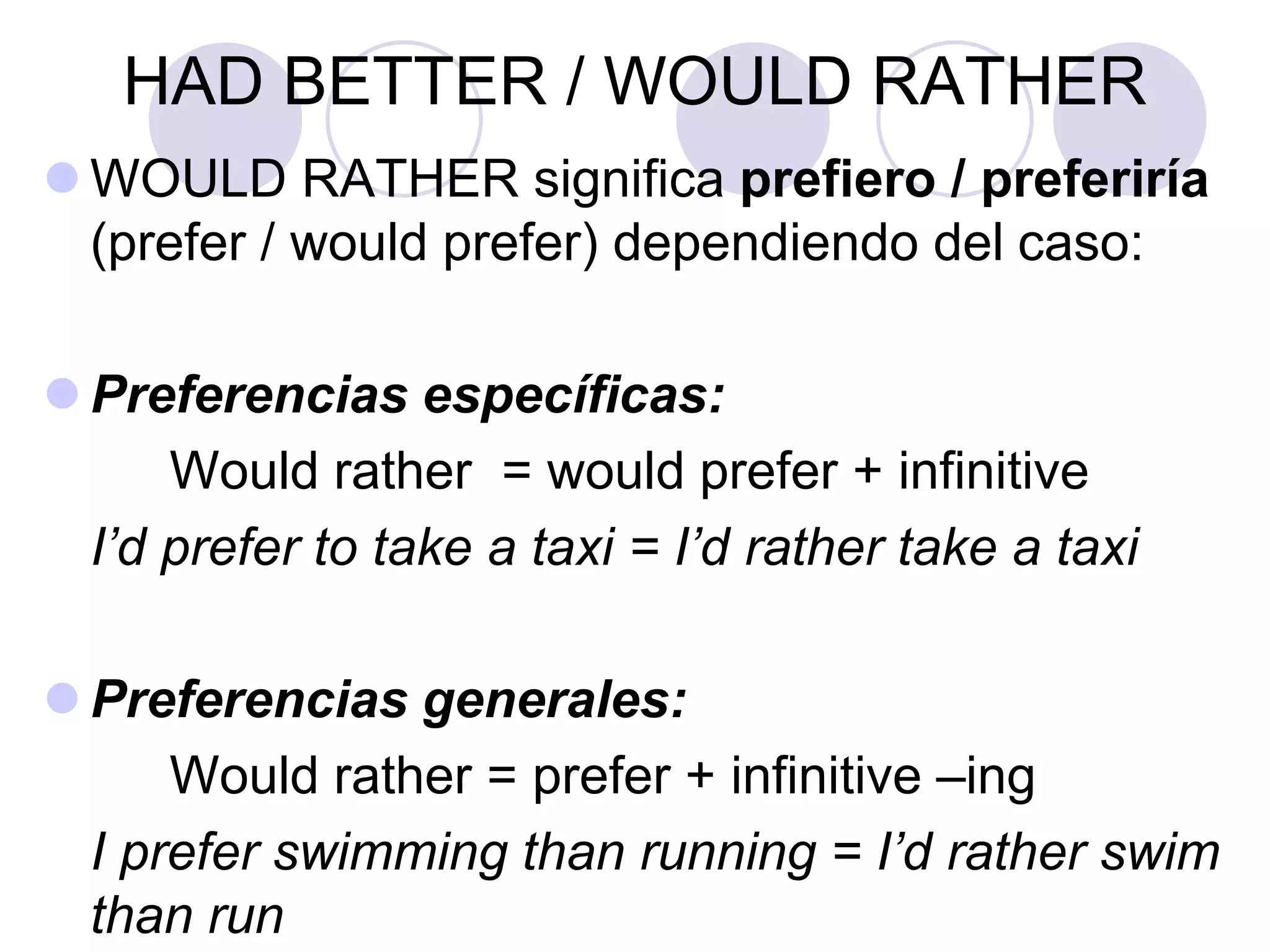
 WOULD RATHER significa prefiero / preferiría
(prefer / would prefer) dependiendo del caso:
 Preferencias específicas:
Would rather = would prefer to + infinitive
I’d prefer to take a taxi = I’d rather take a taxi
 Preferencias generales:
Would rather = prefer + infinitive –ing
I prefer swimming than running = I’d rather swim
than run
HAD BETTER / WOULD RATHER
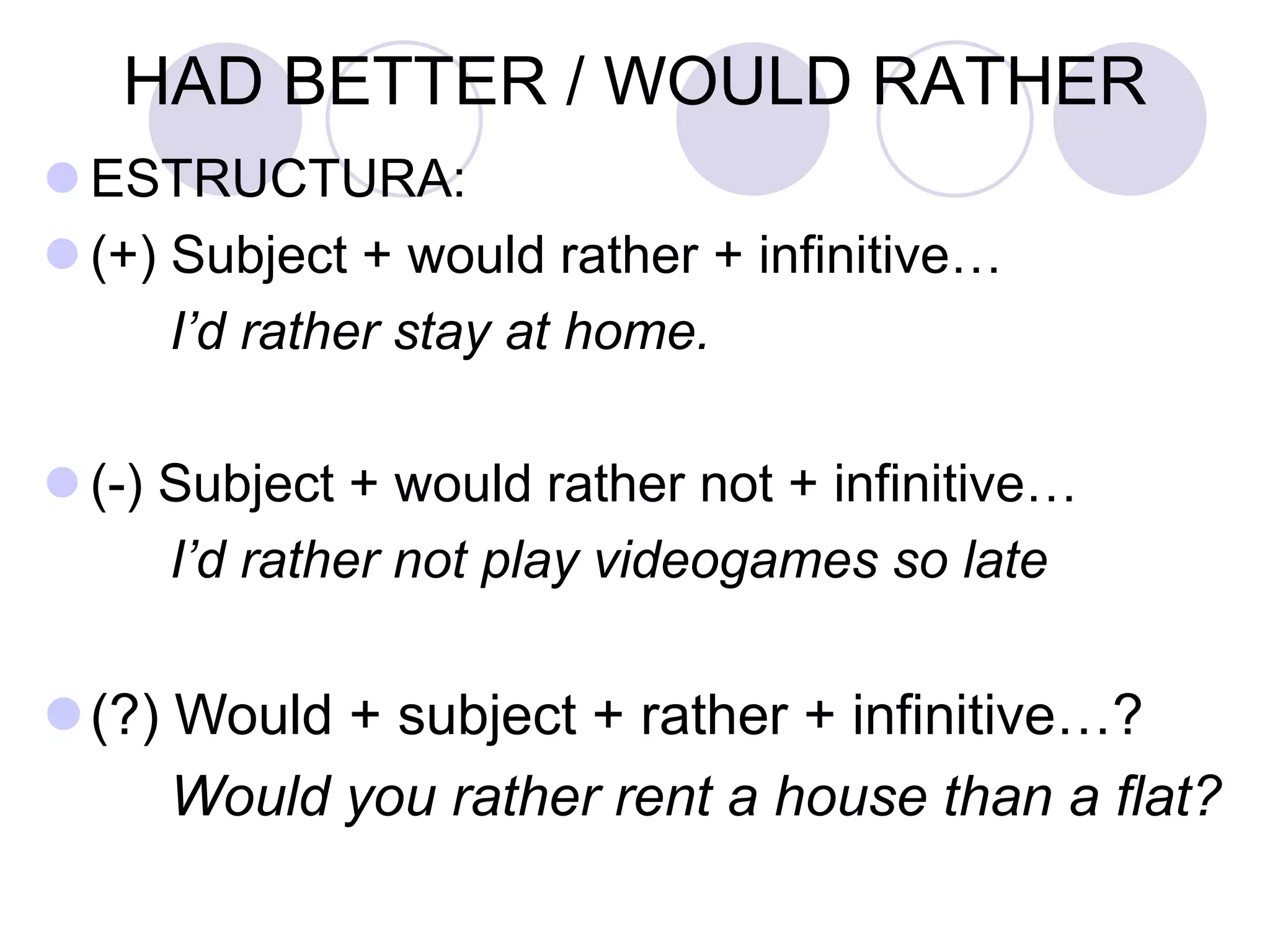
 ESTRUCTURA:
 (+) Subject + would rather + infinitive…
I’d rather stay at home.
 (-) Subject + would rather not + infinitive…
I’d rather not play videogames so late
(?) Would + subject + rather + infinitive…?
Would you rather rent a house than a flat?
HAD BETTER / WOULD RATHER
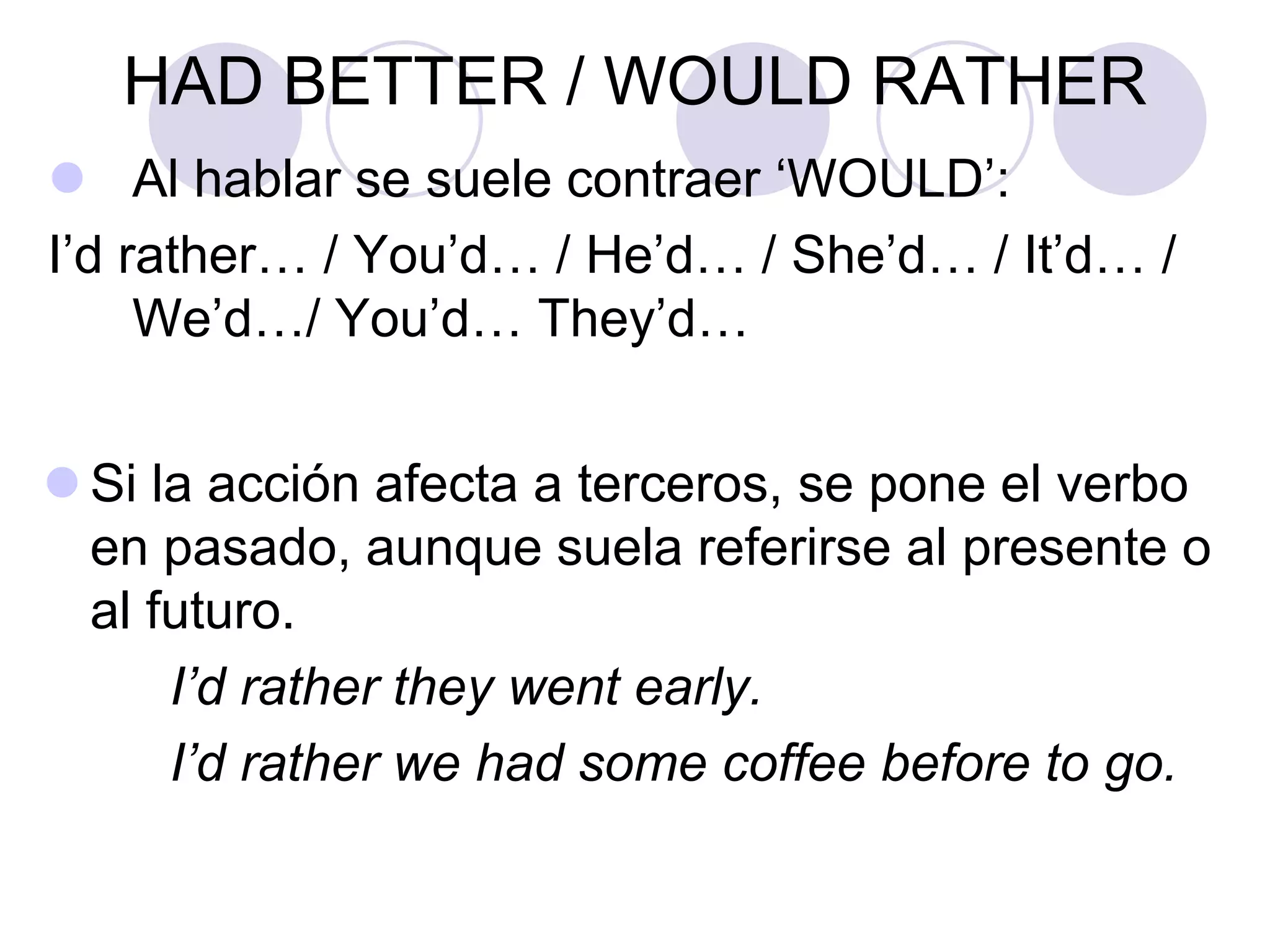
 Al hablar se suele contraer ‘WOULD’:
I’d rather… / You’d… / He’d… / She’d… / It’d… /
We’d…/ You’d… They’d…
 Si la acción afecta a terceros, se pone el verbo
en pasado, aunque suela referirse al presente o
al futuro.
I’d rather they went early.
I’d rather we had some coffee before to go.
HAD BETTER / WOULD RATHER
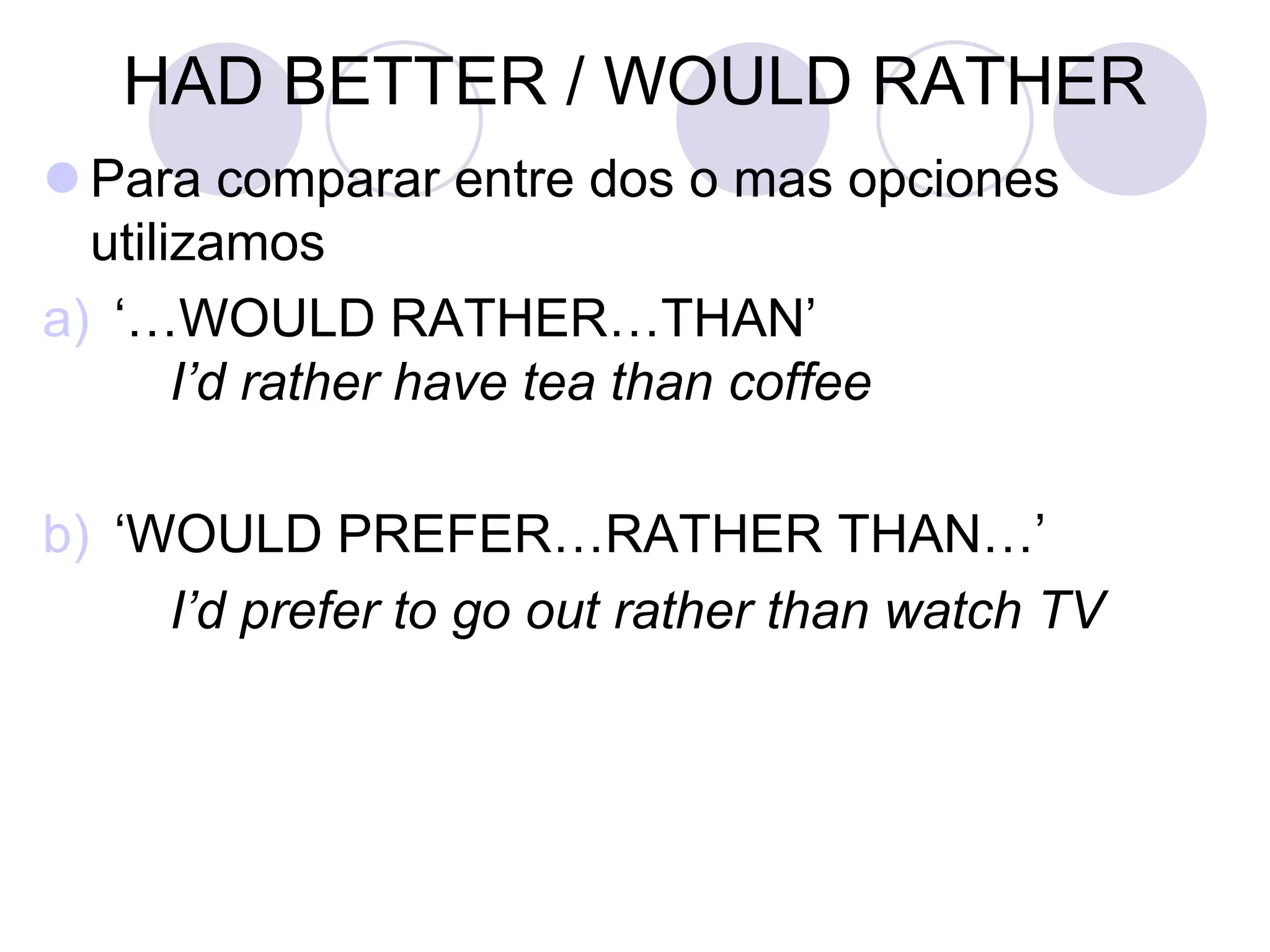
 Para comparar entre dos o mas opciones
utilizamos
a) ‘…WOULD RATHER…THAN’
I’d rather have tea than coffee
b) ‘WOULD PREFER…RATHER THAN…’
I’d prefer to go out rather than watch TV
HAD BETTER / WOULD RATHER
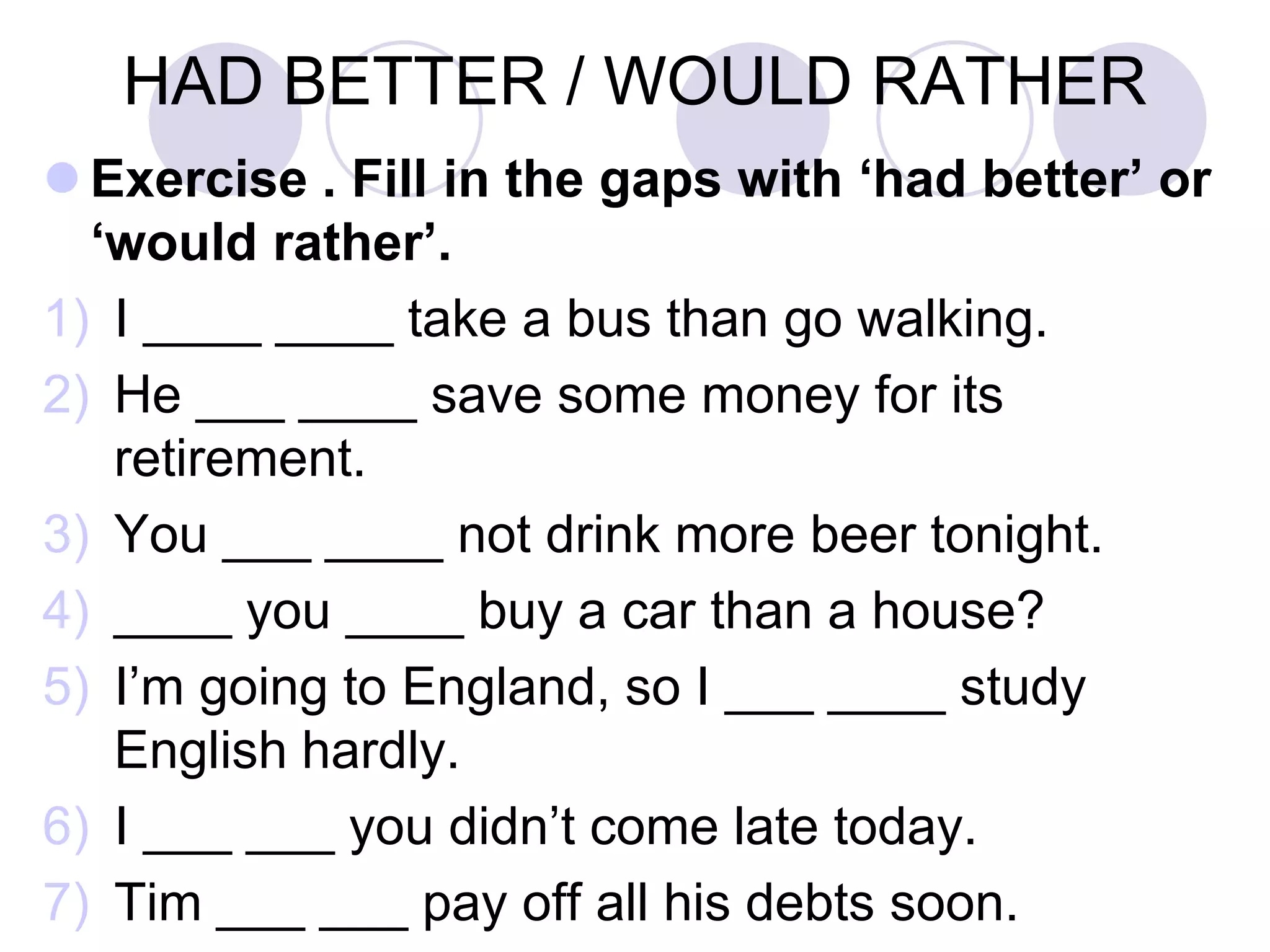
 Exercise . Fill in the gaps with ‘had better’ or
‘would rather’.
1) I ____ ____ take a bus than go walking.
2) He ___ ____ save some money for its
retirement.
3) You ___ ____ not drink more beer tonight.
4) ____ you ____ buy a car than a house?
5) I’m going to England, so I ___ ____ study
English hardly.
6) I ___ ___ you didn’t come late today.
7) Tim ___ ___ pay off all his debts soon.
HAD BETTER / WOULD RATHER
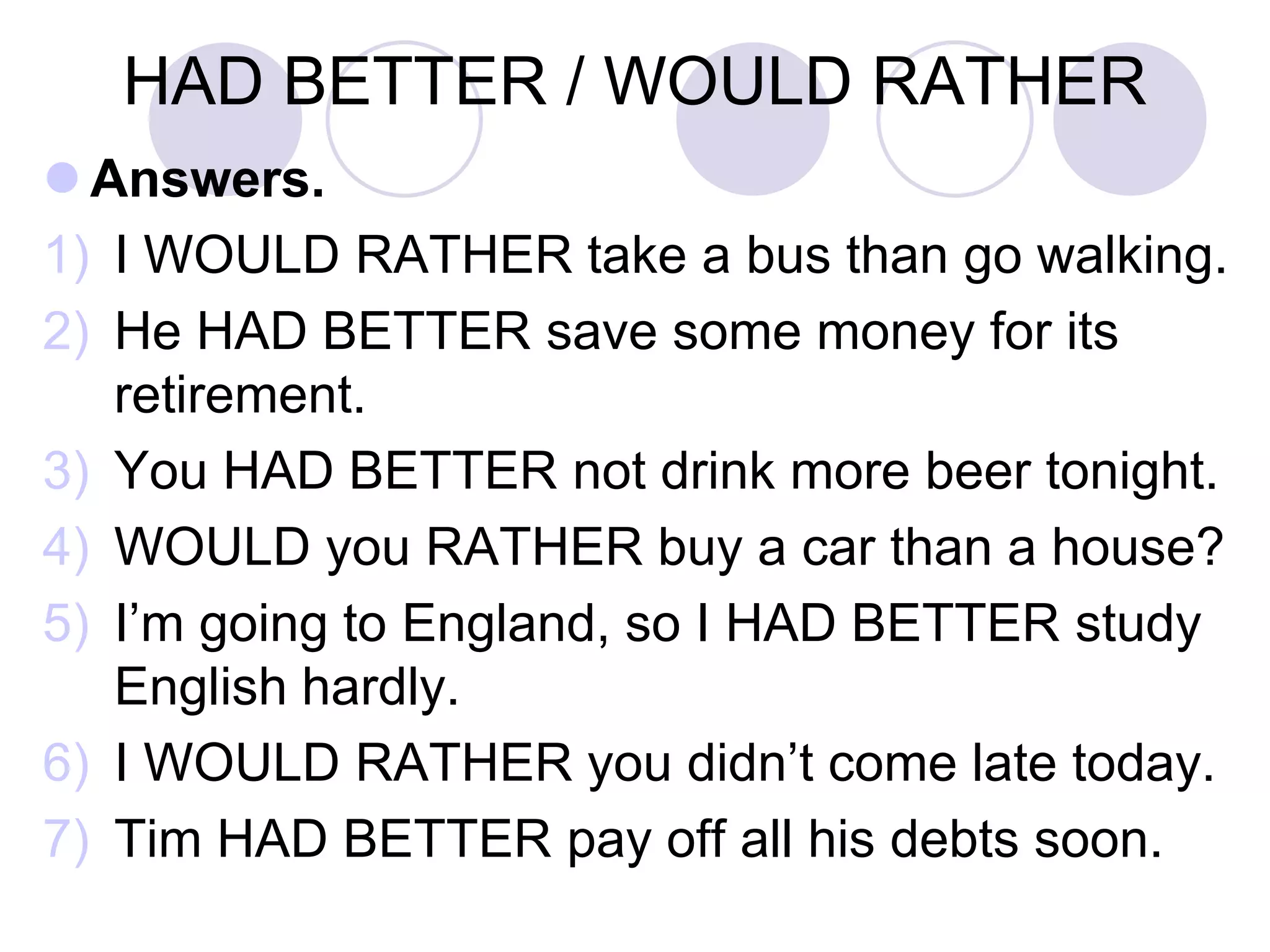
 Answers.
1) I WOULD RATHER take a bus than go walking.
2) He HAD BETTER save some money for its
retirement.
3) You HAD BETTER not drink more beer tonight.
4) WOULD you RATHER buy a car than a house?
5) I’m going to England, so I HAD BETTER study
English hardly.
6) I WOULD RATHER you didn’t come late today.
7) Tim HAD BETTER pay off all his debts soon.
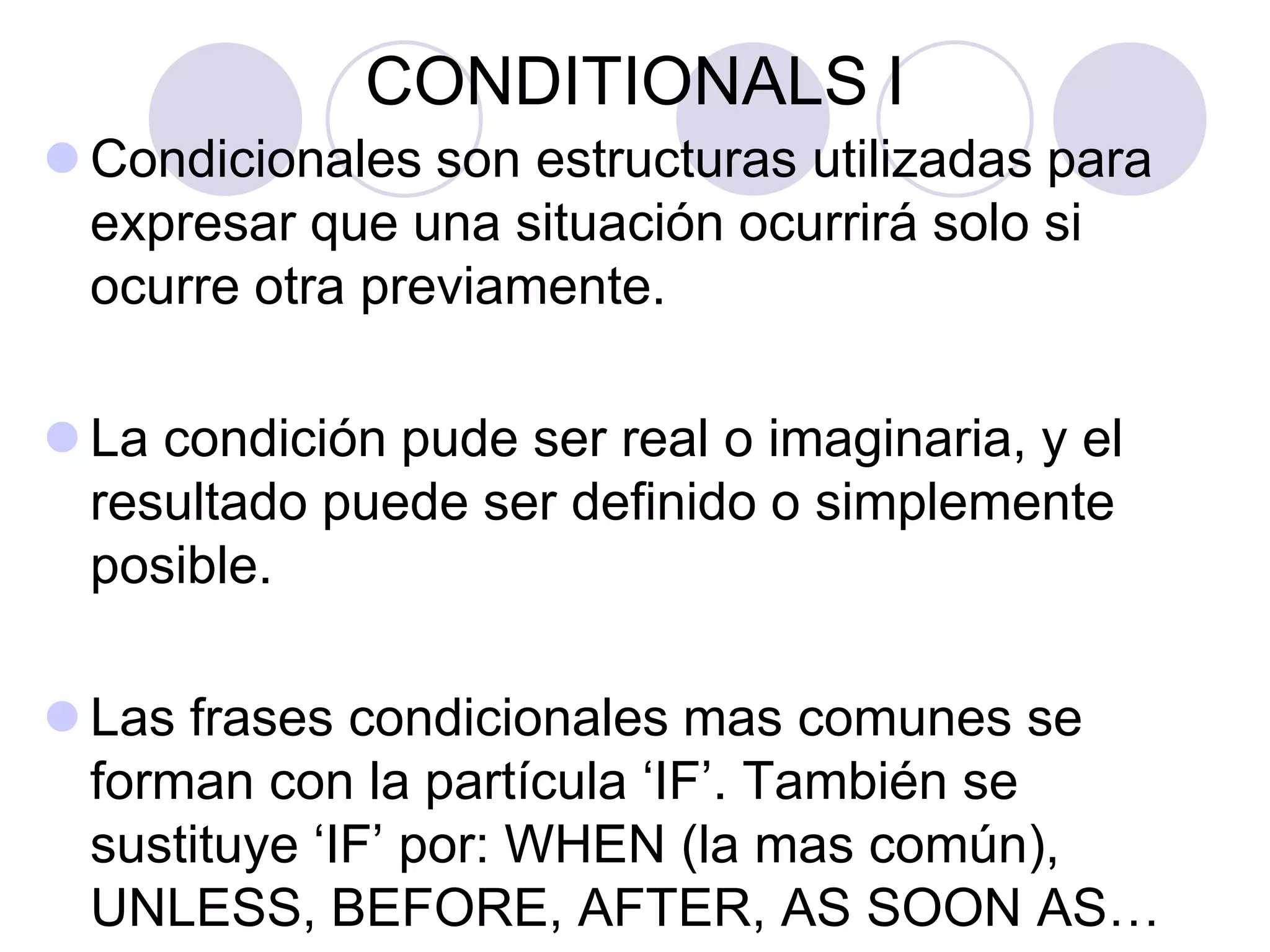
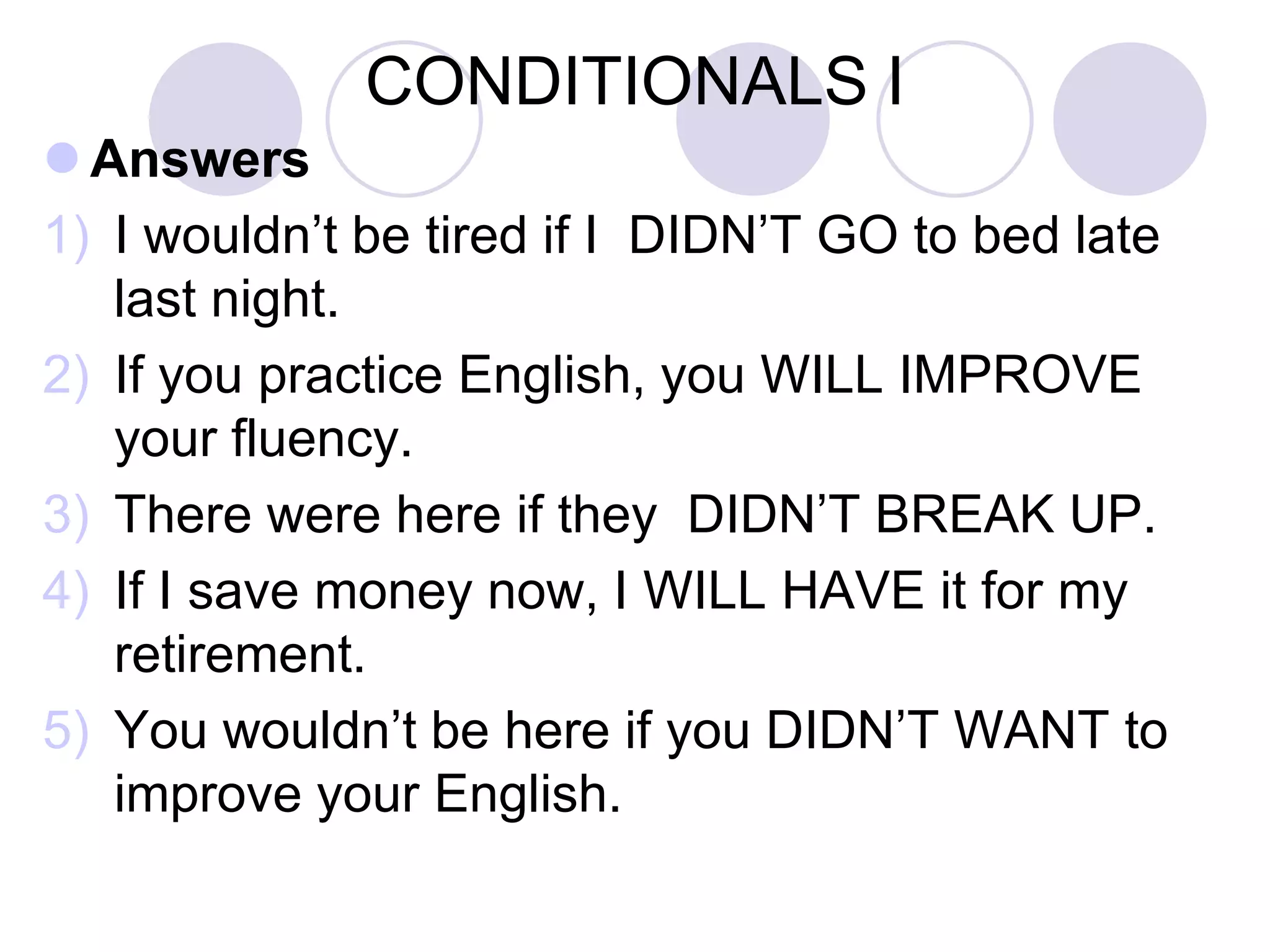
CONDITIONALS I
 Condicionales son estructuras utilizadas para
expresar que una situación ocurrirá solo si
ocurre otra previamente.
 La condición pude ser real o imaginaria, y el
resultado puede ser definido o simplemente
posible.
 Las frases condicionales mas comunes se
forman con la partícula ‘IF’. También se
sustituye ‘IF’ por: WHEN (la mas común),
UNLESS, BEFORE, AFTER, AS SOON AS…
CONDITIONALS I
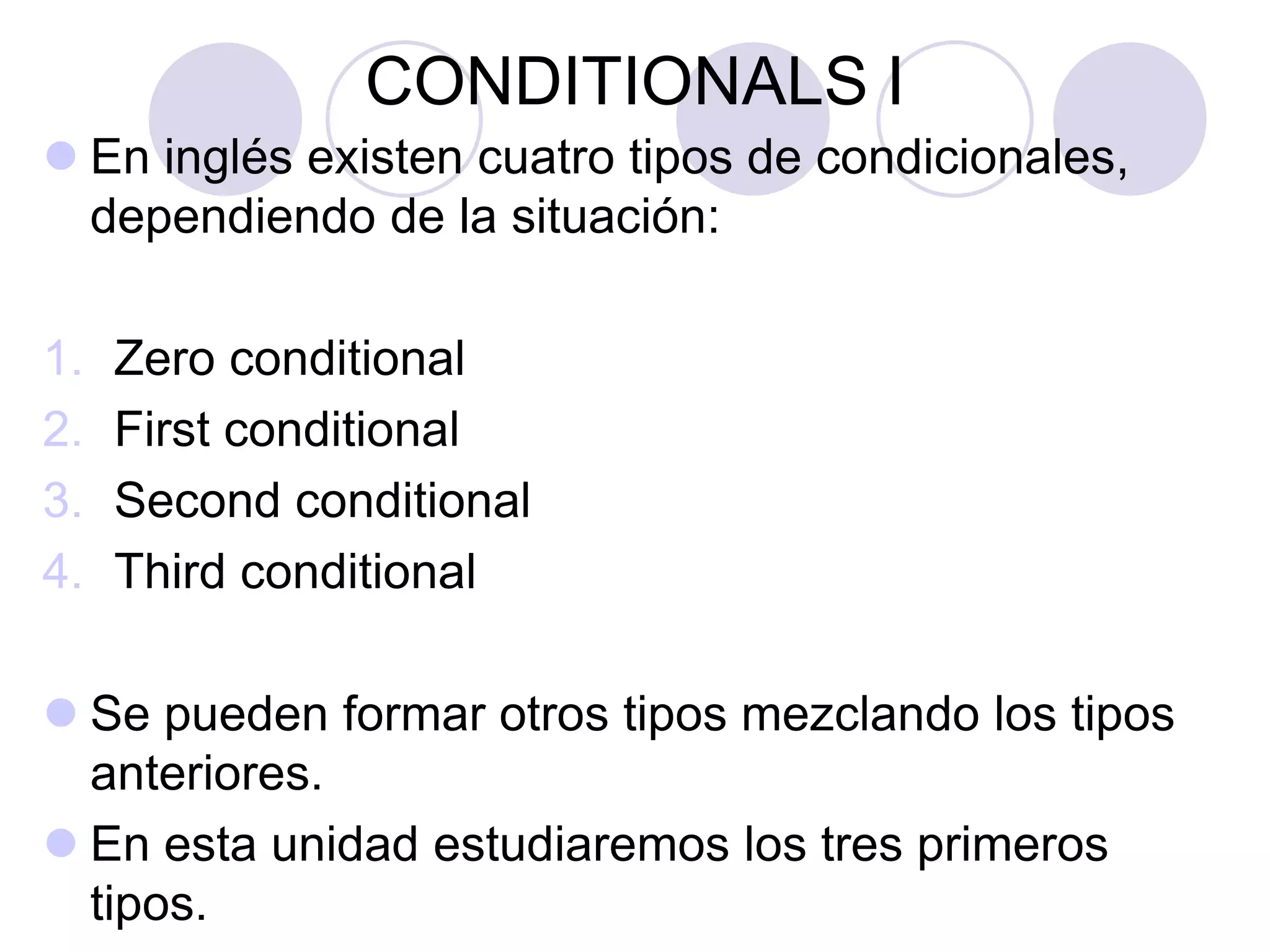
 En inglés existen cuatro tipos de condicionales,
dependiendo de la situación:
1. Zero conditional
2. First conditional
3. Second conditional
4. Third conditional
 Se pueden formar otros tipos mezclando los tipos
anteriores.
 En esta unidad estudiaremos los tres primeros
tipos.
CONDITIONALS I
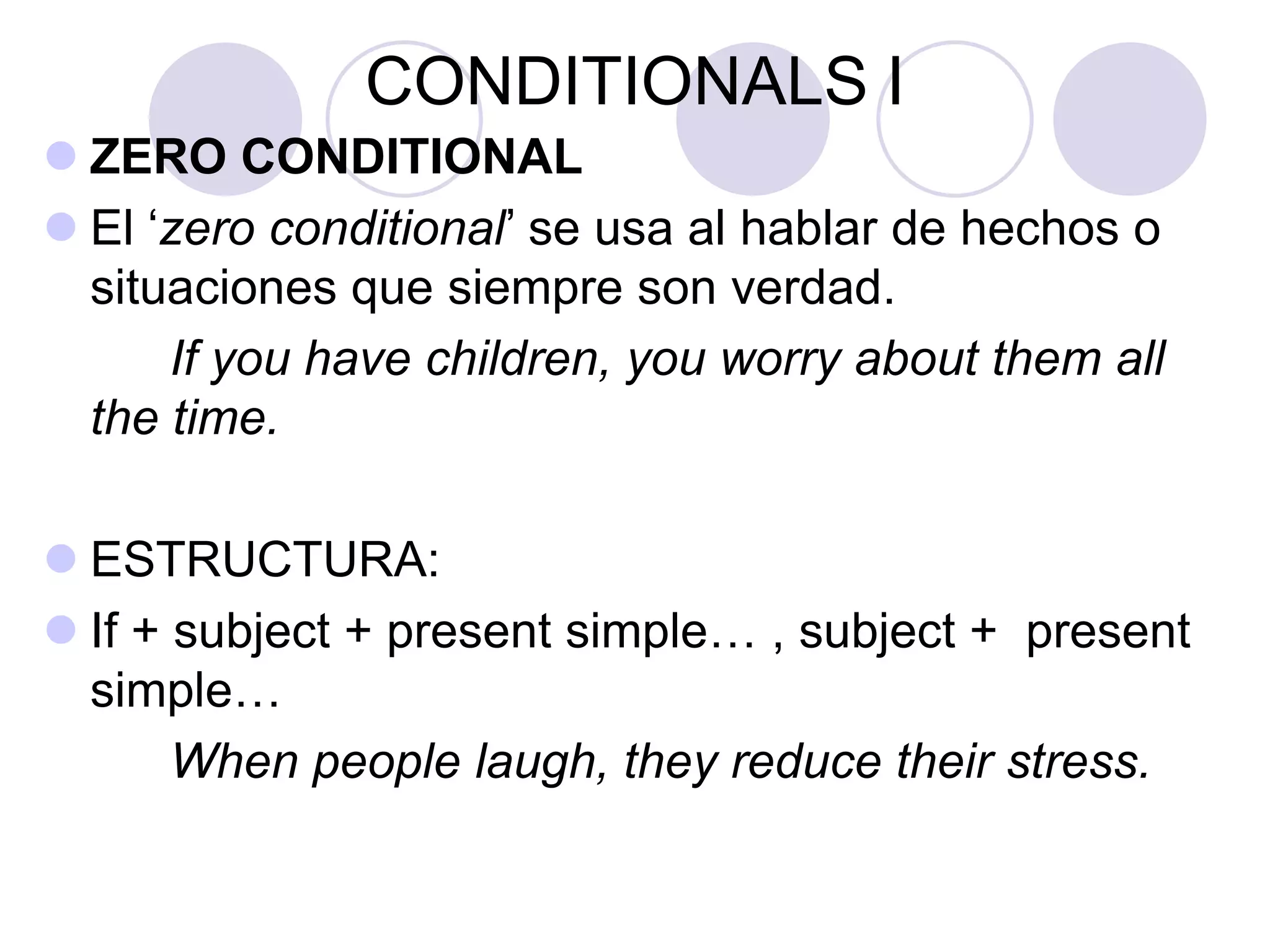
 ZERO CONDITIONAL
 El ‘zero conditional’ se usa al hablar de hechos o
situaciones que siempre son verdad.
If you have children, you worry about them all
the time.
 ESTRUCTURA:
 If + subject + present simple… , subject + present
simple…
When people laugh, they reduce their stress.
CONDITIONALS I
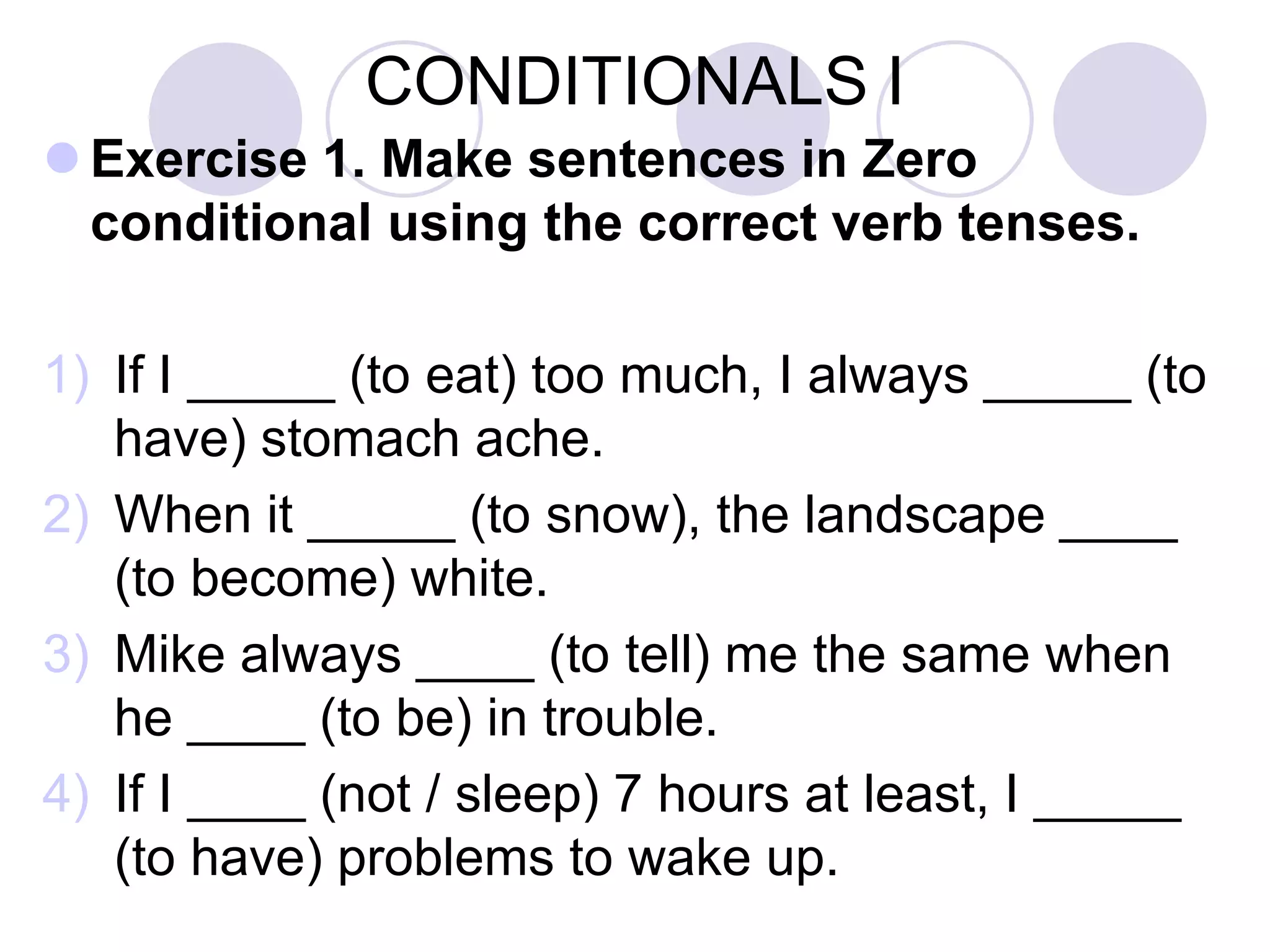
 Exercise 1. Make sentences in Zero
conditional using the correct verb tenses.
1) If I _____ (to eat) too much, I always _____ (to
have) stomach ache.
2) When it _____ (to snow), the landscape ____
(to become) white.
3) Mike always ____ (to tell) me the same when
he ____ (to be) in trouble.
4) If I ____ (not / sleep) 7 hours at least, I _____
(to have) problems to wake up.
CONDITIONALS I
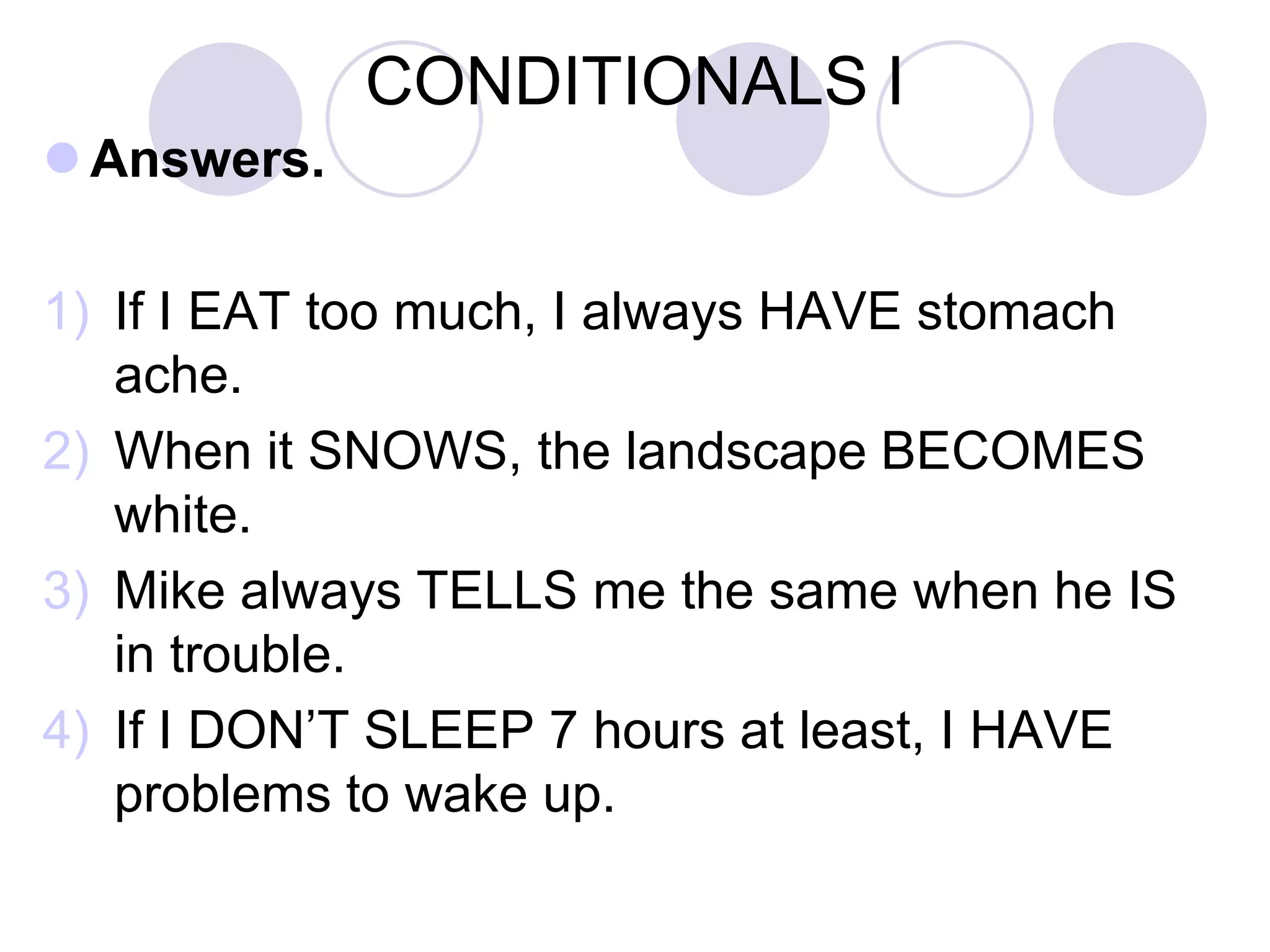
 Answers.
1) If I EAT too much, I always HAVE stomach
ache.
2) When it SNOWS, the landscape BECOMES
white.
3) Mike always TELLS me the same when he IS
in trouble.
4) If I DON’T SLEEP 7 hours at least, I HAVE
problems to wake up.
CONDITIONALS I
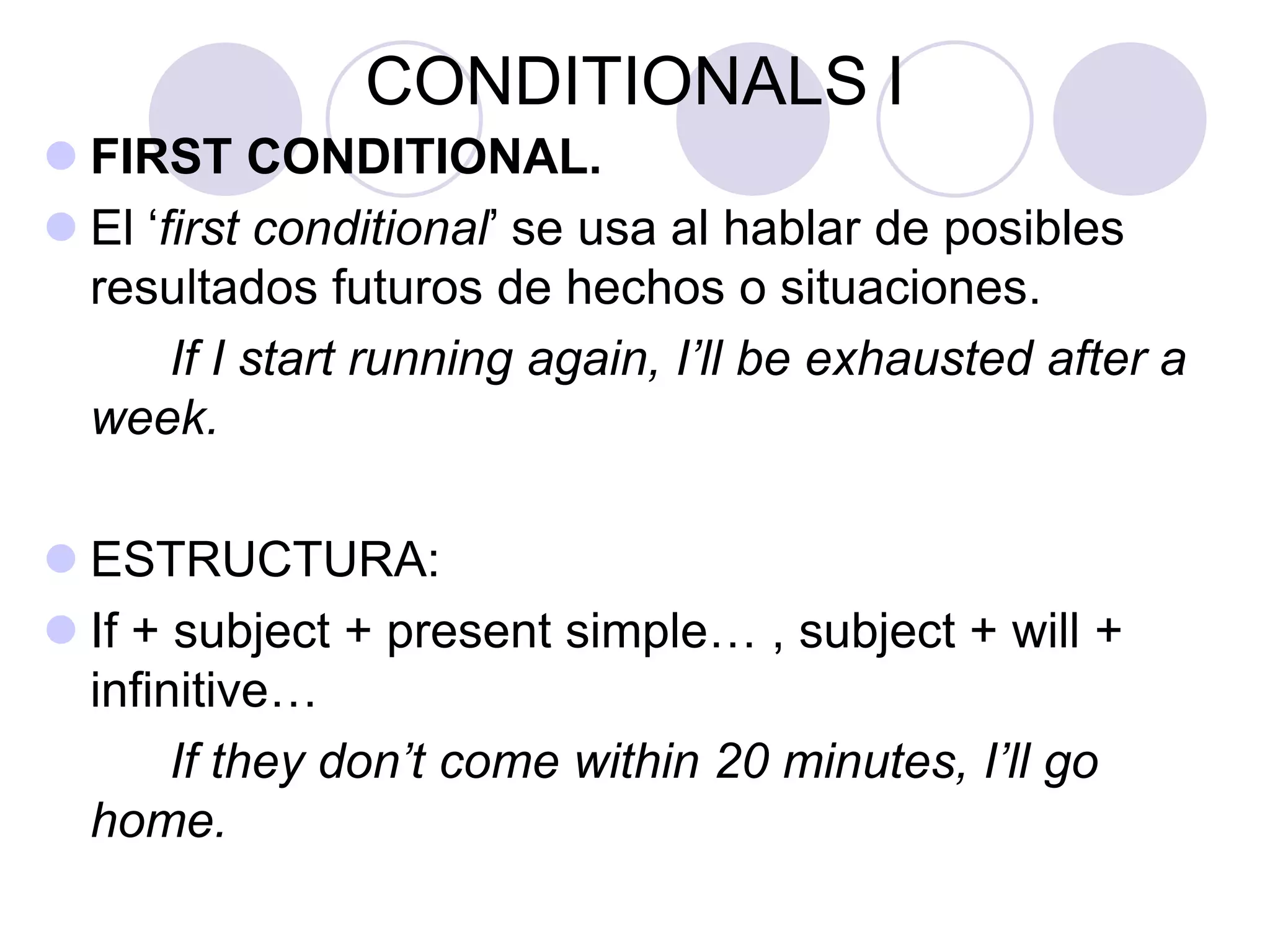
 FIRST CONDITIONAL.
 El ‘first conditional’ se usa al hablar de posibles
resultados futuros de hechos o situaciones.
If I start running again, I’ll be exhausted after a
week.
 ESTRUCTURA:
 If + subject + present simple… , subject + will +
infinitive…
If they don’t come within 20 minutes, I’ll go
home.
CONDITIONALS I
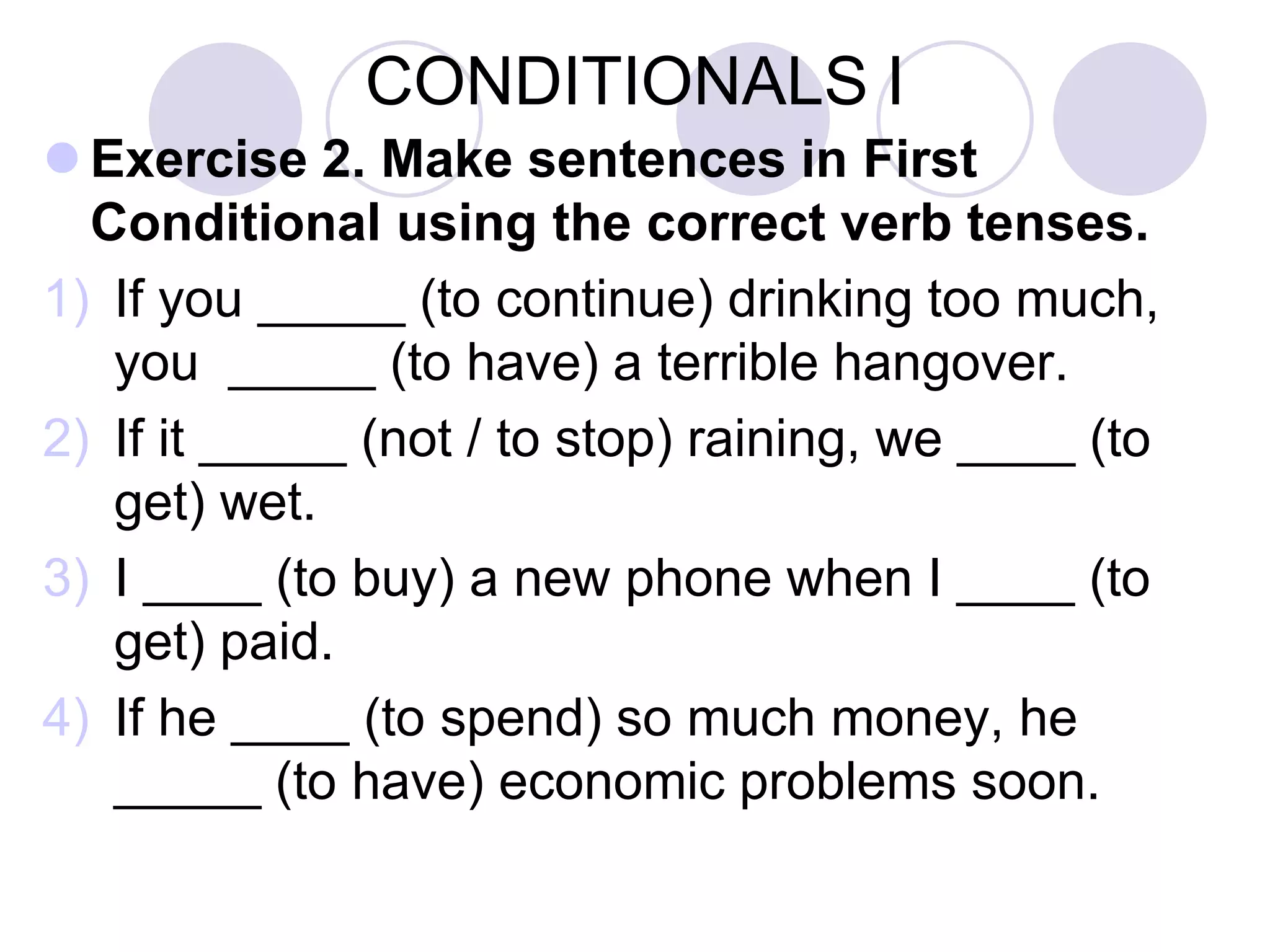
 Exercise 2. Make sentences in First
Conditional using the correct verb tenses.
1) If you _____ (to continue) drinking too much,
you _____ (to have) a terrible hangover.
2) If it _____ (not / to stop) raining, we ____ (to
get) wet.
3) I ____ (to buy) a new phone when I ____ (to
get) paid.
4) If he ____ (to spend) so much money, he
_____ (to have) economic problems soon.
CONDITIONALS I
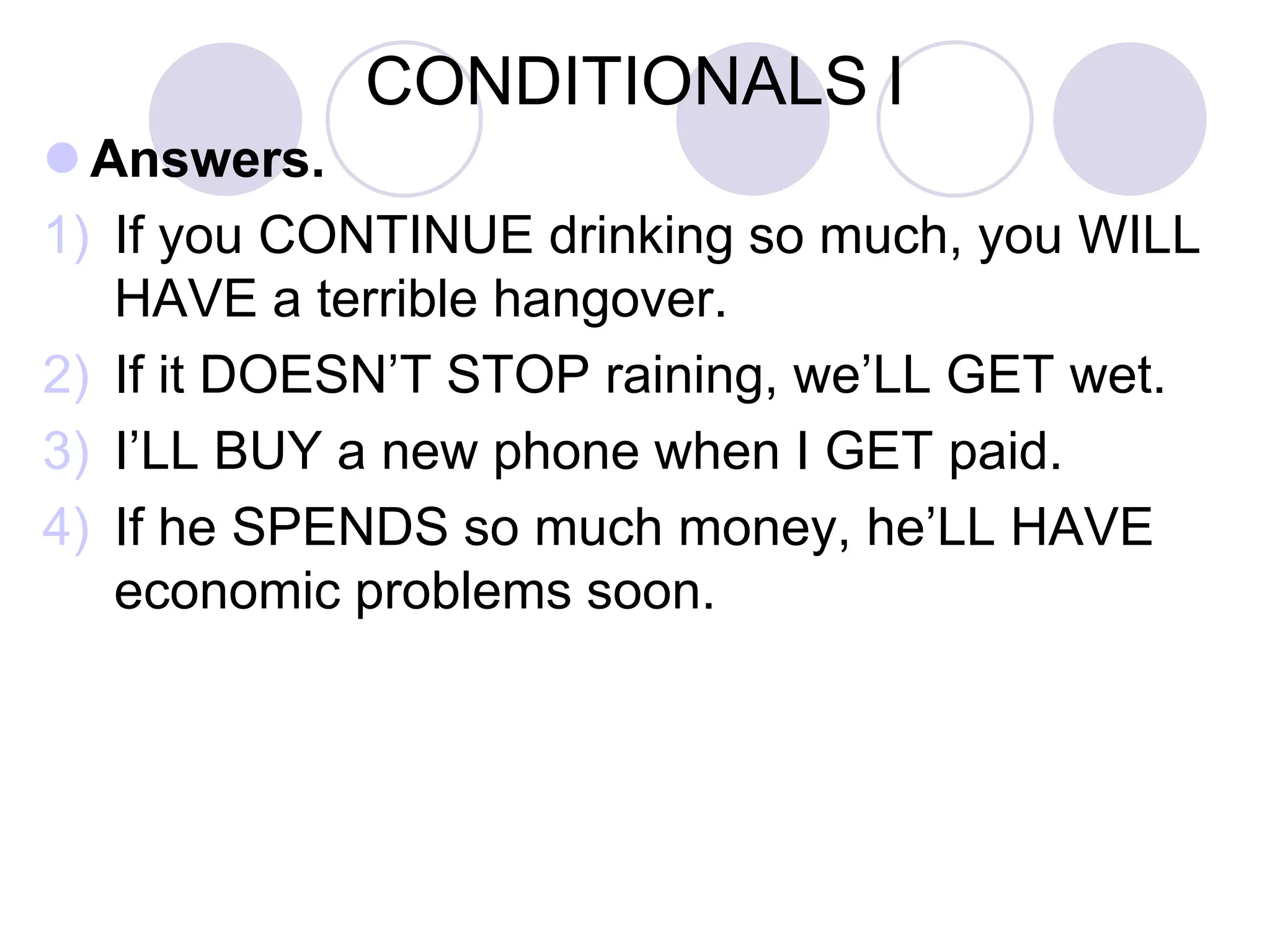
 Answers.
1) If you CONTINUE drinking so much, you WILL
HAVE a terrible hangover.
2) If it DOESN’T STOP raining, we’LL GET wet.
3) I’LL BUY a new phone when I GET paid.
4) If he SPENDS so much money, he’LL HAVE
economic problems soon.
CONDITIONALS I
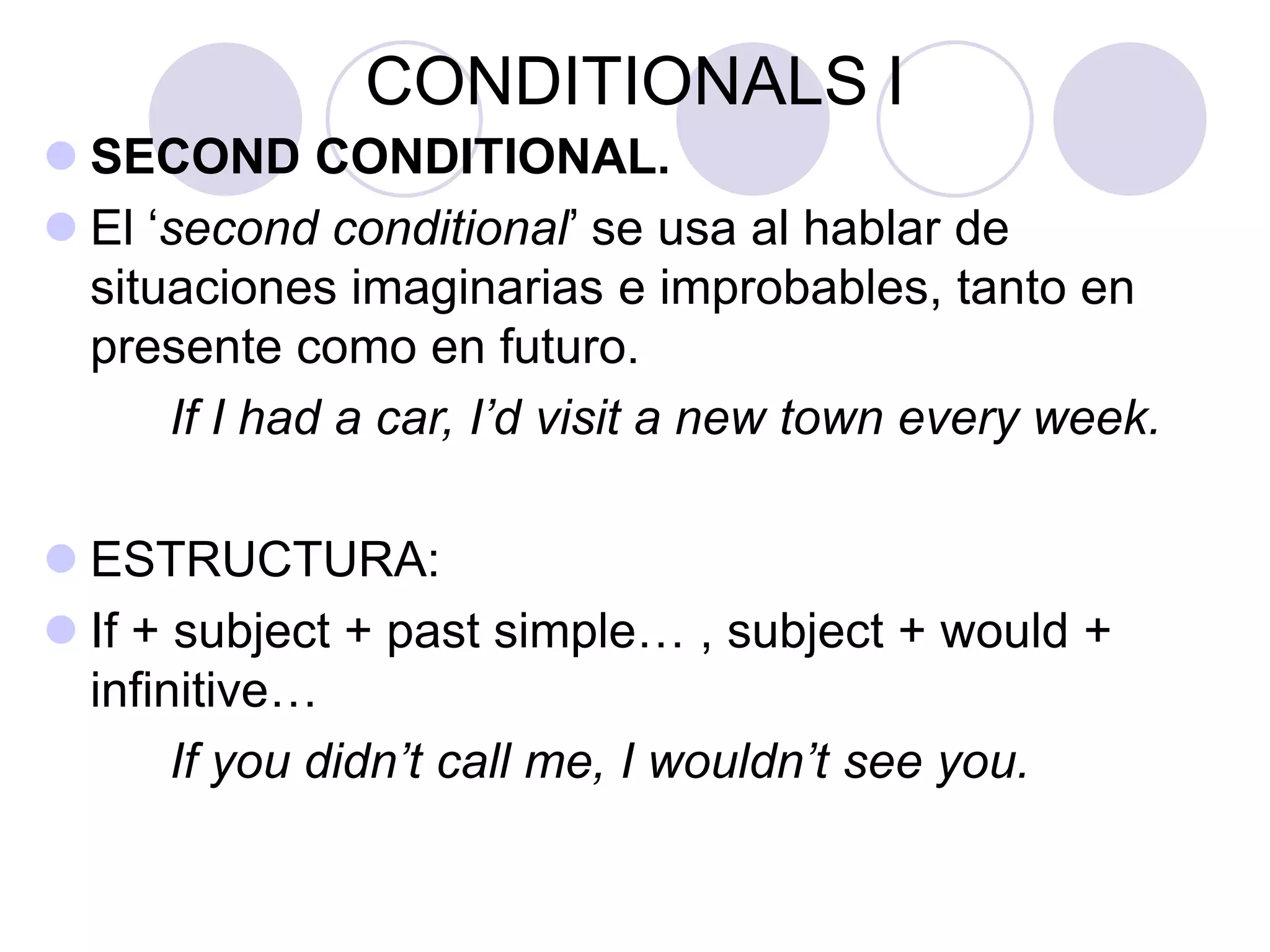
 SECOND CONDITIONAL.
 El ‘second conditional’ se usa al hablar de
situaciones imaginarias e improbables, tanto en
presente como en futuro.
If I had a car, I’d visit a new town every week.
 ESTRUCTURA:
 If + subject + past simple… , subject + would +
infinitive…
If you didn’t call me, I wouldn’t see you.
CONDITIONALS I
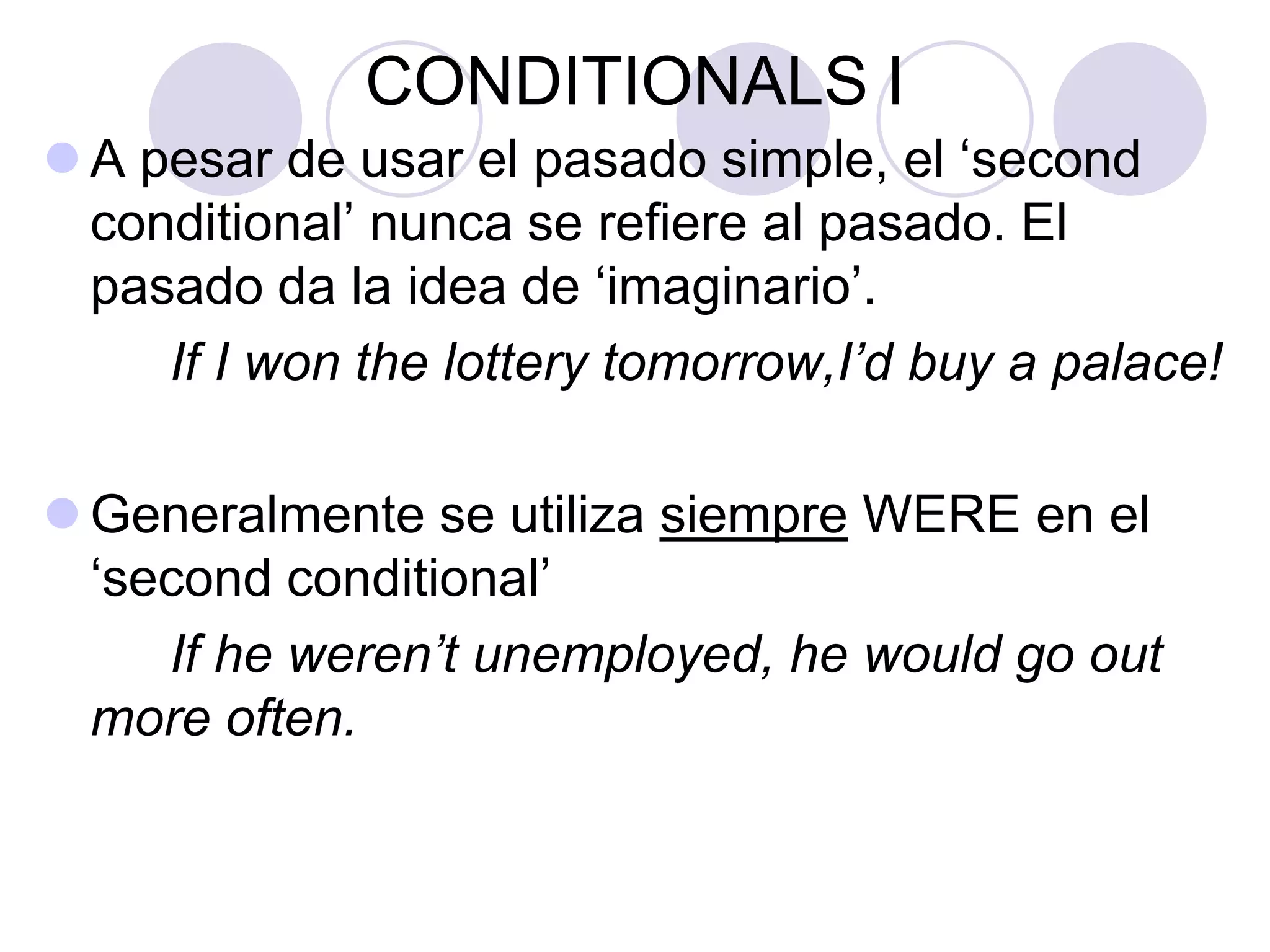
 A pesar de usar el pasado simple, el ‘second
conditional’ nunca se refiere al pasado. El
pasado da la idea de ‘imaginario’.
If I won the lottery tomorrow,I’d buy a palace!
 A menudo se utiliza WERE para todas las
‘personas’ en el ‘second conditional’
If he weren’t unemployed, he would go out more
often.
CONDITIONALS I
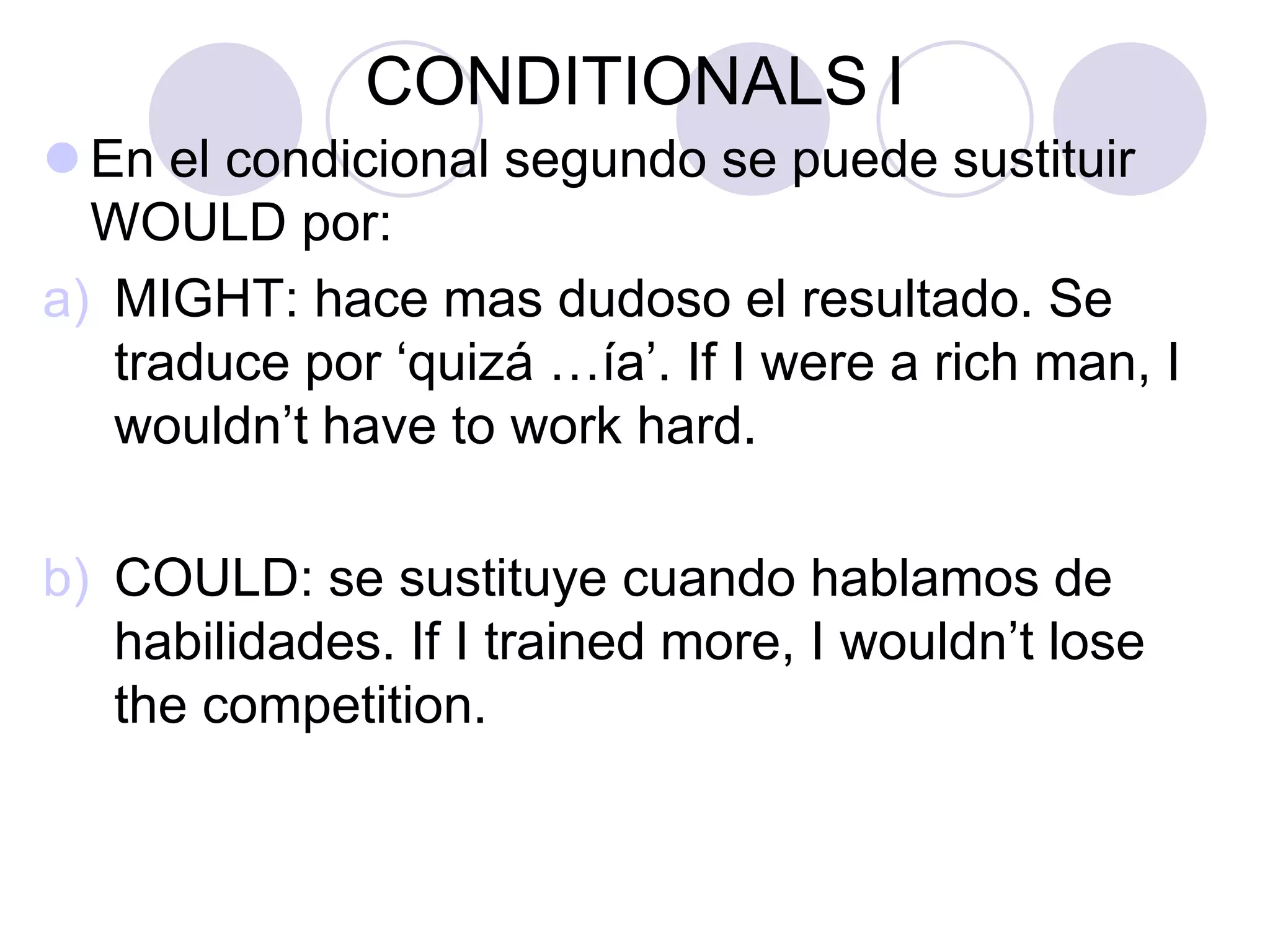
 En el condicional segundo se puede sustituir
WOULD por:
a) MIGHT: hace mas dudoso el resultado. Se
traduce por ‘quizá …ía’.
If we worked hard, we might earn more money
b) COULD: se sustituye cuando hablamos de
habilidades.
If I trained more, I could win the competition
CONDITIONALS I
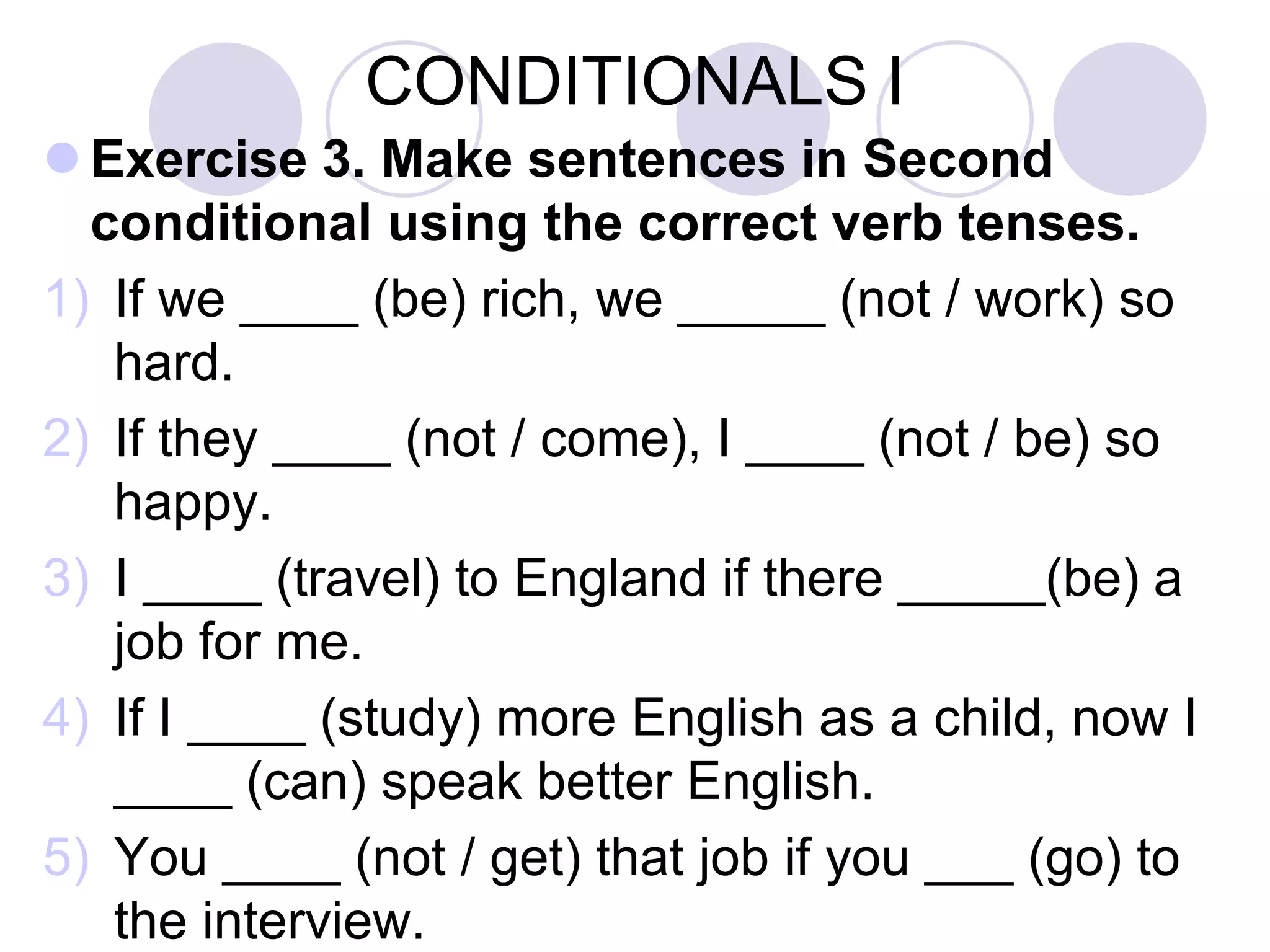
 Exercise 3. Make sentences in Second
conditional using the correct verb tenses.
1) If we ____ (be) rich, we _____ (not / work) so
hard.
2) If they ____ (not / come), I ____ (not / be) so
happy.
3) I ____ (travel) to England if there _____(be) a
job for me.
4) If I ____ (study) more English, I ____ (can) get
better marks in the exams.
5) You ____ (be) more efficient if you ____
(sleep) enough hours.
CONDITIONALS I
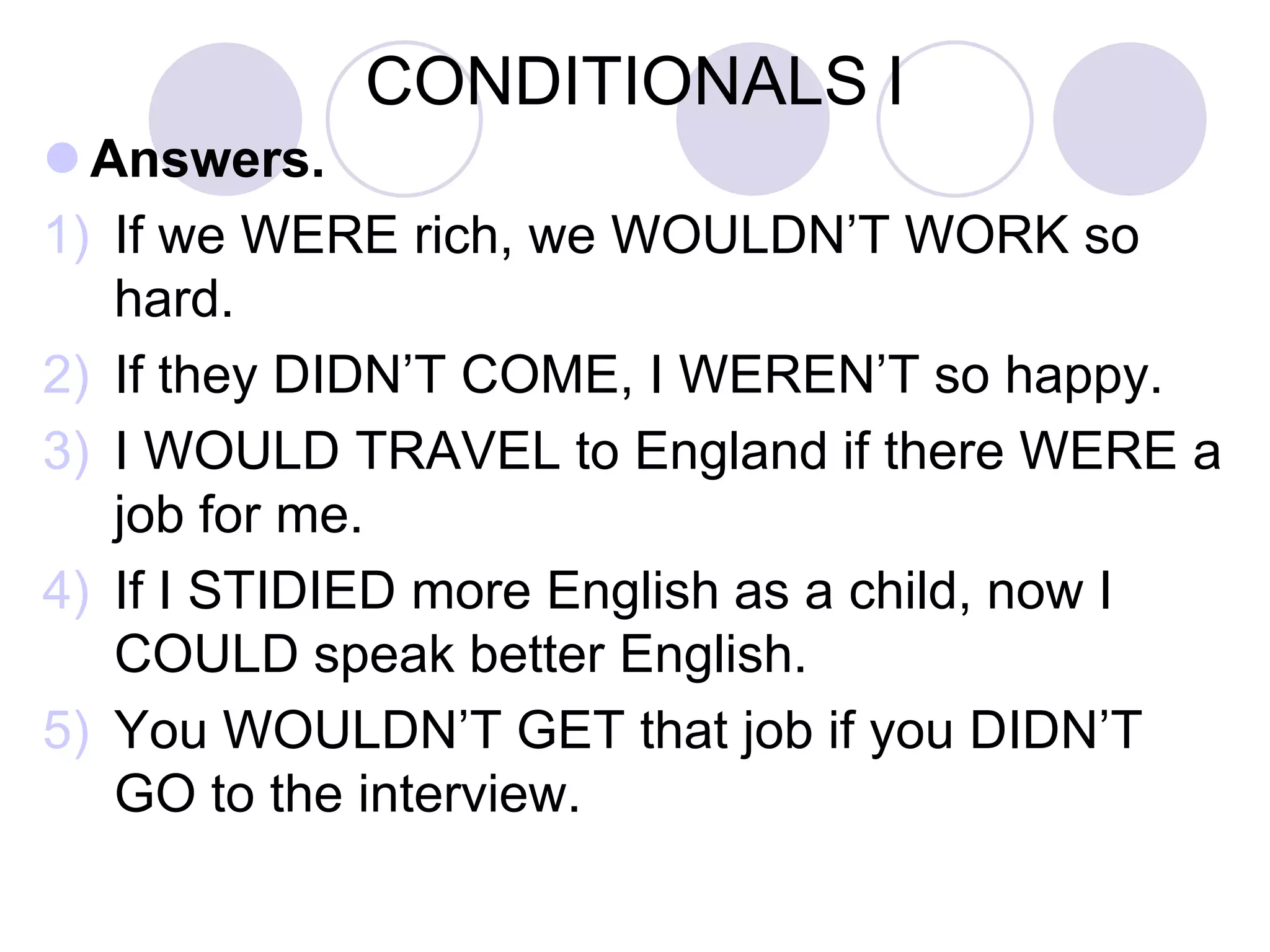
 Answers.
1) If we WERE rich, we WOULDN’T WORK so
hard.
2) If they DIDN’T COME, I WOULDN’T BE so
happy.
3) I WOULD TRAVEL to England if there WERE a
job for me.
4) If I STUDIED English HARDER, I COULD get
better marks in the exams.
5) You WOULD BE more efficient if you SLEPT
enough hours.
CONDITIONALS I
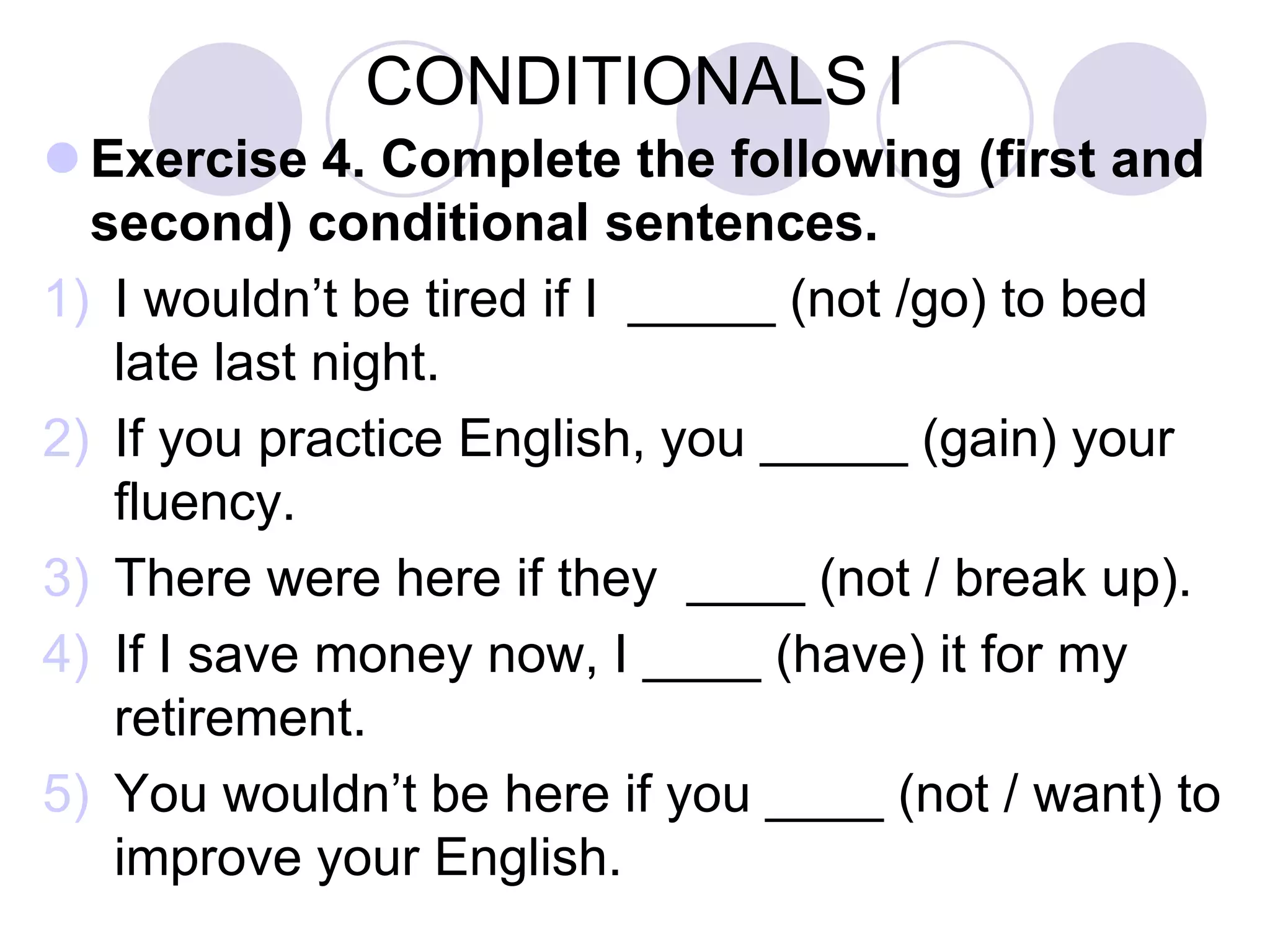
 Exercise 4. Complete the following (first and
second) conditional sentences.
1) If you practice English, you _____ (improve)
your fluency.
2) I ____ (be) happy if I ____(win) the lottery.
3) What ____ (do) if you ____ (see) a being from
Mars?
4) If I save money now, I ____ (have) it for my
retirement.
5) Tom ____ (be) surprised if we ____ (can) visit
him.
CONDITIONALS I
 Exercise 4. Complete the following (first and
second) conditional sentences.
1) If you practice English, you WILL IMPROVE
your fluency.
2) I WOULD BE happy if I WON the lottery.
3) What WOULD YOU DO if you SAW a being
from Mars?
4) If I save money now, I WILL HAVE it for my
retirement.
5) Tom WOULD BEsurprised if we COULD visit
him.
Thank you for your attention!

English class 18 a

  • 1.
    English class 18 Elementarylevel Juan José Simón Pérez learnenglishesol.weebly.com
  • 2.
    HAD BETTER /WOULD RATHER  Had better y would rather son expresiones muy utilizadas en inglés.  No son modales (aquí el único modal es ‘would’), aunque cumplen algunas reglas de estos. You had better tell him the truth. I would rather watch another movie.
  • 3.
    HAD BETTER /WOULD RATHER  HAD BETTER = es aconsejable (sería mejor que...)  A pesar de que HAD es pasado, had better solo se utiliza para presente y futuro. He had better pay today I had better talk to the boss tomorrow  En inglés hablado se contrae ‘HAD’ I’d better go now She’d better take a taxi
  • 4.
    HAD BETTER /WOULD RATHER  ESTRUCTURA:  (+) Subject + had better (‘d better) + infinitive… It’s getting cold, you’d better take a coat.  (-) Subject + had better not (‘d better not) + infinitive You had better not go out tonight.  (?) (Wh..) + Had + subject + better + infinitive…? Where had I better go on holiday?
  • 5.
    HAD BETTER /WOULD RATHER  WOULD RATHER significa prefiero / preferiría (prefer / would prefer) dependiendo del caso:  Preferencias específicas: Would rather = would prefer to + infinitive I’d prefer to take a taxi = I’d rather take a taxi  Preferencias generales: Would rather = prefer + infinitive –ing I prefer swimming than running = I’d rather swim than run
  • 6.
    HAD BETTER /WOULD RATHER  ESTRUCTURA:  (+) Subject + would rather + infinitive… I’d rather stay at home.  (-) Subject + would rather not + infinitive… I’d rather not play videogames so late (?) Would + subject + rather + infinitive…? Would you rather rent a house than a flat?
  • 7.
    HAD BETTER /WOULD RATHER  Al hablar se suele contraer ‘WOULD’: I’d rather… / You’d… / He’d… / She’d… / It’d… / We’d…/ You’d… They’d…  Si la acción afecta a terceros, se pone el verbo en pasado, aunque suela referirse al presente o al futuro. I’d rather they went early. I’d rather we had some coffee before to go.
  • 8.
    HAD BETTER /WOULD RATHER  Para comparar entre dos o mas opciones utilizamos a) ‘…WOULD RATHER…THAN’ I’d rather have tea than coffee b) ‘WOULD PREFER…RATHER THAN…’ I’d prefer to go out rather than watch TV
  • 9.
    HAD BETTER /WOULD RATHER  Exercise . Fill in the gaps with ‘had better’ or ‘would rather’. 1) I ____ ____ take a bus than go walking. 2) He ___ ____ save some money for its retirement. 3) You ___ ____ not drink more beer tonight. 4) ____ you ____ buy a car than a house? 5) I’m going to England, so I ___ ____ study English hardly. 6) I ___ ___ you didn’t come late today. 7) Tim ___ ___ pay off all his debts soon.
  • 10.
    HAD BETTER /WOULD RATHER  Answers. 1) I WOULD RATHER take a bus than go walking. 2) He HAD BETTER save some money for its retirement. 3) You HAD BETTER not drink more beer tonight. 4) WOULD you RATHER buy a car than a house? 5) I’m going to England, so I HAD BETTER study English hardly. 6) I WOULD RATHER you didn’t come late today. 7) Tim HAD BETTER pay off all his debts soon.
  • 11.
    CONDITIONALS I  Condicionalesson estructuras utilizadas para expresar que una situación ocurrirá solo si ocurre otra previamente.  La condición pude ser real o imaginaria, y el resultado puede ser definido o simplemente posible.  Las frases condicionales mas comunes se forman con la partícula ‘IF’. También se sustituye ‘IF’ por: WHEN (la mas común), UNLESS, BEFORE, AFTER, AS SOON AS…
  • 12.
    CONDITIONALS I  Eninglés existen cuatro tipos de condicionales, dependiendo de la situación: 1. Zero conditional 2. First conditional 3. Second conditional 4. Third conditional  Se pueden formar otros tipos mezclando los tipos anteriores.  En esta unidad estudiaremos los tres primeros tipos.
  • 13.
    CONDITIONALS I  ZEROCONDITIONAL  El ‘zero conditional’ se usa al hablar de hechos o situaciones que siempre son verdad. If you have children, you worry about them all the time.  ESTRUCTURA:  If + subject + present simple… , subject + present simple… When people laugh, they reduce their stress.
  • 14.
    CONDITIONALS I  Exercise1. Make sentences in Zero conditional using the correct verb tenses. 1) If I _____ (to eat) too much, I always _____ (to have) stomach ache. 2) When it _____ (to snow), the landscape ____ (to become) white. 3) Mike always ____ (to tell) me the same when he ____ (to be) in trouble. 4) If I ____ (not / sleep) 7 hours at least, I _____ (to have) problems to wake up.
  • 15.
    CONDITIONALS I  Answers. 1)If I EAT too much, I always HAVE stomach ache. 2) When it SNOWS, the landscape BECOMES white. 3) Mike always TELLS me the same when he IS in trouble. 4) If I DON’T SLEEP 7 hours at least, I HAVE problems to wake up.
  • 16.
    CONDITIONALS I  FIRSTCONDITIONAL.  El ‘first conditional’ se usa al hablar de posibles resultados futuros de hechos o situaciones. If I start running again, I’ll be exhausted after a week.  ESTRUCTURA:  If + subject + present simple… , subject + will + infinitive… If they don’t come within 20 minutes, I’ll go home.
  • 17.
    CONDITIONALS I  Exercise2. Make sentences in First Conditional using the correct verb tenses. 1) If you _____ (to continue) drinking too much, you _____ (to have) a terrible hangover. 2) If it _____ (not / to stop) raining, we ____ (to get) wet. 3) I ____ (to buy) a new phone when I ____ (to get) paid. 4) If he ____ (to spend) so much money, he _____ (to have) economic problems soon.
  • 18.
    CONDITIONALS I  Answers. 1)If you CONTINUE drinking so much, you WILL HAVE a terrible hangover. 2) If it DOESN’T STOP raining, we’LL GET wet. 3) I’LL BUY a new phone when I GET paid. 4) If he SPENDS so much money, he’LL HAVE economic problems soon.
  • 19.
    CONDITIONALS I  SECONDCONDITIONAL.  El ‘second conditional’ se usa al hablar de situaciones imaginarias e improbables, tanto en presente como en futuro. If I had a car, I’d visit a new town every week.  ESTRUCTURA:  If + subject + past simple… , subject + would + infinitive… If you didn’t call me, I wouldn’t see you.
  • 20.
    CONDITIONALS I  Apesar de usar el pasado simple, el ‘second conditional’ nunca se refiere al pasado. El pasado da la idea de ‘imaginario’. If I won the lottery tomorrow,I’d buy a palace!  A menudo se utiliza WERE para todas las ‘personas’ en el ‘second conditional’ If he weren’t unemployed, he would go out more often.
  • 21.
    CONDITIONALS I  Enel condicional segundo se puede sustituir WOULD por: a) MIGHT: hace mas dudoso el resultado. Se traduce por ‘quizá …ía’. If we worked hard, we might earn more money b) COULD: se sustituye cuando hablamos de habilidades. If I trained more, I could win the competition
  • 22.
    CONDITIONALS I  Exercise3. Make sentences in Second conditional using the correct verb tenses. 1) If we ____ (be) rich, we _____ (not / work) so hard. 2) If they ____ (not / come), I ____ (not / be) so happy. 3) I ____ (travel) to England if there _____(be) a job for me. 4) If I ____ (study) more English, I ____ (can) get better marks in the exams. 5) You ____ (be) more efficient if you ____ (sleep) enough hours.
  • 23.
    CONDITIONALS I  Answers. 1)If we WERE rich, we WOULDN’T WORK so hard. 2) If they DIDN’T COME, I WOULDN’T BE so happy. 3) I WOULD TRAVEL to England if there WERE a job for me. 4) If I STUDIED English HARDER, I COULD get better marks in the exams. 5) You WOULD BE more efficient if you SLEPT enough hours.
  • 24.
    CONDITIONALS I  Exercise4. Complete the following (first and second) conditional sentences. 1) If you practice English, you _____ (improve) your fluency. 2) I ____ (be) happy if I ____(win) the lottery. 3) What ____ (do) if you ____ (see) a being from Mars? 4) If I save money now, I ____ (have) it for my retirement. 5) Tom ____ (be) surprised if we ____ (can) visit him.
  • 25.
    CONDITIONALS I  Exercise4. Complete the following (first and second) conditional sentences. 1) If you practice English, you WILL IMPROVE your fluency. 2) I WOULD BE happy if I WON the lottery. 3) What WOULD YOU DO if you SAW a being from Mars? 4) If I save money now, I WILL HAVE it for my retirement. 5) Tom WOULD BEsurprised if we COULD visit him.
  • 26.
    Thank you foryour attention!