

English class 13

Elementary level

Juan José Simón Pérez
learnenglishesol.weebly.com
WILL for FUTURE
 En inglés podemos referirnos al futuro
utilizando varias formas verbales:
 Presente simple
My bus goes at 16:00
 Presente continuo o con ‘going to’
They’re coming tomorrow
 Con el verbo auxiliar WILL
We will go to London by plane
WILL for FUTURE
 Utilizamos WILL para determinadas ocasiones:
 Decisiones tomadas en el momento en que se
habla:
- Would you like to go out next Friday?
- Of course, I will pass through your house, OK?
 Predicciones tomadas sin tener en cuenta
evidencias:
- At the end of 2013 the economy will grow fastly.
 Al ofrecer o prometer algo:
- You have got a lot of bags, wait and I will bring
them to your home.
WILL for FUTURE
 Estructura:
 Subject + WILL + infinitive + object… (+)
He will go to your home tomorrow
 Subject + WILL NOT + infinitive + object… (-)
Will not = WON’T
Susan won’t come tomorrow night
 WILL + subject + infinitive + object...? (?)
 Short answers: Yes, I will / No, I won’t
Will you wait for me at the station?
WILL for FUTURE
 Contracciones:
 I will – I’ll
 You will – You`ll
 He will – He’ll
 She will – She’ll
 It will – It’ll
 We will – We’ll
 You will – You’ll
 They will – They’ll
WILL for FUTURE
 Exercise. Complete the sentences. Use WILL
or the present simple in their correct form.
1) He ___ (go) to school from Monday to Friday.
2) I ___ (call) you back later.
3) I ___ (not/like) coffee, so I ___ (make) some
tea.
4) It’s 17:55, I’m sure that Tom ___ (not/come) in
time.
5) Who ___ (drive) on your way home?
6) ___ Sheila (brush) her teeth in the morning?
WILL for FUTURE
 Answers.
1) He GOES to school from Monday to Friday.
2) I’LL CALL you back later. / I WILL CALL…
3) I DON’T LIKE coffee, so I’LL MAKE some tea.
/ I DO NOT LIKE…so I WILL MAKE…
4) It’s 17:55, I’m sure that Tom WON’T COME in
time. / …Tom WILL NOT COME…
5) Who WILL DRIVE on your way home?
6) DOES Sheila BRUSH her teeth in the
morning?
SHALL
 En ocasiones se utiliza SHALL en vez de WILL.
 SHALL se utiliza normalmente en las mismas
ocasiones que WILL.
 En ocasiones se utiliza para sugerir algo:
Shall I open the window?
Shall I help you with your homework?
 SHALL únicamente se utiliza con la 1ª persona,
singular y plural: I y WE.
We shall go out next Saturday.
 La forma negativa de SHALL es SHAN’T.
SHALL
 Exercise. Make sentences. Use
SHALL/SHAN’T when possible. Otherwise
use WILL
1) We / come back / in time.
2) I think / he / not / work / much longer.
3) / I / switch on the TV?
4) They / understand / the situation.
5) We / not / stay / more than two days.
6) You / go / to sleep / early.
SHALL
 Exercise. Make sentences. Use
SHALL/SHAN’T when possible. Otherwise
use WILL
1) We SHALL come back in time.
2) I think he WILL NOT / WON’T work much
longer.
3) SHALL I switch on the TV?
4) They WILL understand the situation.
5) We SHALL NOT / SHAN’T stay more than two
days.
6) You WILL go to sleep early.
PRESENT CONTINUOUS
(FUTURE)
El presente continuo se utiliza cuando
hemos decidido y concretado alguna
acción para el futuro.
I’m flying to Berlin next week
They’re visiting us tomorrow
El presente continuo también se utiliza
para acciones que se van a realizar
enseguida.
Wait a second, I’m coming!
PRESENT CONTINUOUS
(FUTURE)
 Exercise. Put the more suitable form, present
simple, present continuous or will.
1) The sky is grey, it _______ (go) to rain.
2) Although the sky is blue, I think it _____ (rain).
3) It always _____ (rain) a lot in April.
4) Tom ____ (travel) to Russia tomorrow. His
plain ____ (leave) at 10:00, so I think I ____
(go) with him to the airport.
5) I’m tired, so I ____ (go) to bed right now.
6) What _______ (you/do) tonight?
PRESENT CONTINUOUS
(FUTURE)
 Exercise. Put the more suitable form, present
simple, present continuous or will.
1) The sky is grey, it IS GOING to rain.
2) Although the sky is blue, I think it WILL RAIN.
3) It always RAINS a lot in April.
4) Tom IS TRAVELLING to Russia tomorrow. His
plain LEAVES at 10:00, so I think I WILL GO
with him to the airport.
5) I’m tired, so I AM GOING to bed right now.
6) What ARE YOU DOING tonight?
I’M GOING TO…(FUTURE)
Utilizamos ‘I’M GOING TO + INFINITIVE’
tal y como utilizamos el presente continuo
para el futuro.
El presente continuo es usado mayormente
en inglés hablado.
I’m travelling across Europe in holidays.
I’m going to travel across Europe in holidays.
I’M GOING TO…(FUTURE)
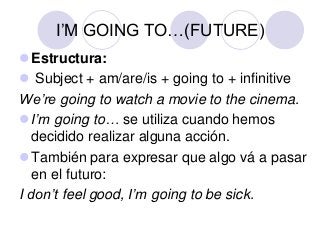
Estructura:
 Subject + am/are/is + going to + infinitive
We’re going to watch a movie to the cinema.
I’m going to… se utiliza cuando hemos
decidido realizar alguna acción.
También para expresar que algo vá a pasar
en el futuro:
I don’t feel good, I’m going to be sick.
I’M GOING TO…(FUTURE)
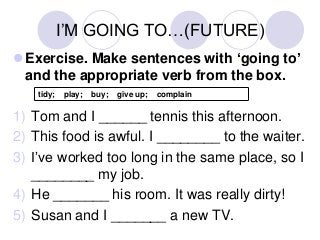
Exercise. Make sentences with ‘going to’
and the appropriate verb from the box.
tidy;

play;

buy;

give up;

complain

1) Tom and I ______ tennis this afternoon.
2) This food is awful. I ________ to the waiter.
3) I’ve worked too long in the same place, so I
________ my job.
4) He _______ his room. It was really dirty!
5) Susan and I _______ a new TV.
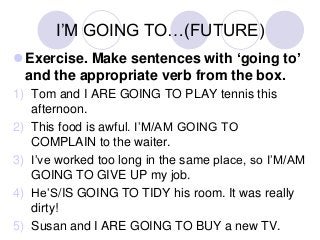
I’M GOING TO…(FUTURE)
Exercise. Make sentences with ‘going to’
and the appropriate verb from the box.
1) Tom and I ARE GOING TO PLAY tennis this
afternoon.
2) This food is awful. I’M/AM GOING TO
COMPLAIN to the waiter.
3) I’ve worked too long in the same place, so I’M/AM
GOING TO GIVE UP my job.
4) He’S/IS GOING TO TIDY his room. It was really
dirty!
5) Susan and I ARE GOING TO BUY a new TV.
Thank you for your attention!

English class 13(a)

  • 1.
    English class 13 Elementarylevel Juan José Simón Pérez learnenglishesol.weebly.com
  • 2.
    WILL for FUTURE En inglés podemos referirnos al futuro utilizando varias formas verbales:  Presente simple My bus goes at 16:00  Presente continuo o con ‘going to’ They’re coming tomorrow  Con el verbo auxiliar WILL We will go to London by plane
  • 3.
    WILL for FUTURE Utilizamos WILL para determinadas ocasiones:  Decisiones tomadas en el momento en que se habla: - Would you like to go out next Friday? - Of course, I will pass through your house, OK?  Predicciones tomadas sin tener en cuenta evidencias: - At the end of 2013 the economy will grow fastly.  Al ofrecer o prometer algo: - You have got a lot of bags, wait and I will bring them to your home.
  • 4.
    WILL for FUTURE Estructura:  Subject + WILL + infinitive + object… (+) He will go to your home tomorrow  Subject + WILL NOT + infinitive + object… (-) Will not = WON’T Susan won’t come tomorrow night  WILL + subject + infinitive + object...? (?)  Short answers: Yes, I will / No, I won’t Will you wait for me at the station?
  • 5.
    WILL for FUTURE Contracciones:  I will – I’ll  You will – You`ll  He will – He’ll  She will – She’ll  It will – It’ll  We will – We’ll  You will – You’ll  They will – They’ll
  • 6.
    WILL for FUTURE Exercise. Complete the sentences. Use WILL or the present simple in their correct form. 1) He ___ (go) to school from Monday to Friday. 2) I ___ (call) you back later. 3) I ___ (not/like) coffee, so I ___ (make) some tea. 4) It’s 17:55, I’m sure that Tom ___ (not/come) in time. 5) Who ___ (drive) on your way home? 6) ___ Sheila (brush) her teeth in the morning?
  • 7.
    WILL for FUTURE Answers. 1) He GOES to school from Monday to Friday. 2) I’LL CALL you back later. / I WILL CALL… 3) I DON’T LIKE coffee, so I’LL MAKE some tea. / I DO NOT LIKE…so I WILL MAKE… 4) It’s 17:55, I’m sure that Tom WON’T COME in time. / …Tom WILL NOT COME… 5) Who WILL DRIVE on your way home? 6) DOES Sheila BRUSH her teeth in the morning?
  • 8.
    SHALL  En ocasionesse utiliza SHALL en vez de WILL.  SHALL se utiliza normalmente en las mismas ocasiones que WILL.  En ocasiones se utiliza para sugerir algo: Shall I open the window? Shall I help you with your homework?  SHALL únicamente se utiliza con la 1ª persona, singular y plural: I y WE. We shall go out next Saturday.  La forma negativa de SHALL es SHAN’T.
  • 9.
    SHALL  Exercise. Makesentences. Use SHALL/SHAN’T when possible. Otherwise use WILL 1) We / come back / in time. 2) I think / he / not / work / much longer. 3) / I / switch on the TV? 4) They / understand / the situation. 5) We / not / stay / more than two days. 6) You / go / to sleep / early.
  • 10.
    SHALL  Exercise. Makesentences. Use SHALL/SHAN’T when possible. Otherwise use WILL 1) We SHALL come back in time. 2) I think he WILL NOT / WON’T work much longer. 3) SHALL I switch on the TV? 4) They WILL understand the situation. 5) We SHALL NOT / SHAN’T stay more than two days. 6) You WILL go to sleep early.
  • 11.
    PRESENT CONTINUOUS (FUTURE) El presentecontinuo se utiliza cuando hemos decidido y concretado alguna acción para el futuro. I’m flying to Berlin next week They’re visiting us tomorrow El presente continuo también se utiliza para acciones que se van a realizar enseguida. Wait a second, I’m coming!
  • 12.
    PRESENT CONTINUOUS (FUTURE)  Exercise.Put the more suitable form, present simple, present continuous or will. 1) The sky is grey, it _______ (go) to rain. 2) Although the sky is blue, I think it _____ (rain). 3) It always _____ (rain) a lot in April. 4) Tom ____ (travel) to Russia tomorrow. His plain ____ (leave) at 10:00, so I think I ____ (go) with him to the airport. 5) I’m tired, so I ____ (go) to bed right now. 6) What _______ (you/do) tonight?
  • 13.
    PRESENT CONTINUOUS (FUTURE)  Exercise.Put the more suitable form, present simple, present continuous or will. 1) The sky is grey, it IS GOING to rain. 2) Although the sky is blue, I think it WILL RAIN. 3) It always RAINS a lot in April. 4) Tom IS TRAVELLING to Russia tomorrow. His plain LEAVES at 10:00, so I think I WILL GO with him to the airport. 5) I’m tired, so I AM GOING to bed right now. 6) What ARE YOU DOING tonight?
  • 14.
    I’M GOING TO…(FUTURE) Utilizamos‘I’M GOING TO + INFINITIVE’ tal y como utilizamos el presente continuo para el futuro. El presente continuo es usado mayormente en inglés hablado. I’m travelling across Europe in holidays. I’m going to travel across Europe in holidays.
  • 15.
    I’M GOING TO…(FUTURE) Estructura: Subject + am/are/is + going to + infinitive We’re going to watch a movie to the cinema. I’m going to… se utiliza cuando hemos decidido realizar alguna acción. También para expresar que algo vá a pasar en el futuro: I don’t feel good, I’m going to be sick.
  • 16.
    I’M GOING TO…(FUTURE) Exercise.Make sentences with ‘going to’ and the appropriate verb from the box. tidy; play; buy; give up; complain 1) Tom and I ______ tennis this afternoon. 2) This food is awful. I ________ to the waiter. 3) I’ve worked too long in the same place, so I ________ my job. 4) He _______ his room. It was really dirty! 5) Susan and I _______ a new TV.
  • 17.
    I’M GOING TO…(FUTURE) Exercise.Make sentences with ‘going to’ and the appropriate verb from the box. 1) Tom and I ARE GOING TO PLAY tennis this afternoon. 2) This food is awful. I’M/AM GOING TO COMPLAIN to the waiter. 3) I’ve worked too long in the same place, so I’M/AM GOING TO GIVE UP my job. 4) He’S/IS GOING TO TIDY his room. It was really dirty! 5) Susan and I ARE GOING TO BUY a new TV.
  • 18.
    Thank you foryour attention!