English class 22
Elementary level
Juan José Simón Pérez
learnenglishesol.weebly.com
QUESTION TAGS
 Question tags (preguntas coletilla) son
preguntas cortas usadas en inglés con el fin de
provocar una respuesta en el oyente.
 En español solemos decir ¿no? ; ¿verdad?...
-You are tired, aren’t you?
-They weren’t at home last Sunday, were
they?
QUESTION TAGS
 El tipo mas común es el de signo contrario:
 En frases afirmativas la pregunta es negativa.
-It’s cold today, isn’t it?
-Your parents arrive this afternoon, don’t
they?
 En frases negativas la pregunta es afirmativa.
-You aren’t working tomorrow, are you?
-Paul didn’t go to the party, did he?
QUESTION TAGS
 El verbo que se usa en los question tags es el
auxiliar de la pregunta (ya sea to do, to have, to
be o modal), y cuando no hay auxiliar se utiliza
la forma adecuada de DO.
Tom doesn’t eat meat, do he?
They haven’t said anything yet, have they?
Your car isn’t broken, is it?
He shouldn’t be so rude, should he?
You went on a holiday, didn’t you?
QUESTION TAGS
En caso del imperativo (ordenes, peticiones,
instrucciones y sugerencias) se suele usar el
modal ‘will you?’ en los question tags.
Please turn down the volume, will you?
Don’t make so much noise, will you?
 Con frases que empiezan por Let’s… el
question tag utilizado es shall we?
Let’s go out tonight, shall we?
QUESTION TAGS
 Casos especiales:
 En frases afirmativas con el verbo TO BE en
primera persona (I) se usa ‘aren’t I?’
I am right, aren’t I? / I’m not right, am I?
 Con el verbo HAVE GOT se utiliza el question
tag correspondiente a la forma utilizada en la
frase.
You have got a pet, haven’t you?
You have a pet, don’t you?
QUESTION TAGS
 Exercise. Write the appropriate question tag
for each sentence.
1. They are coming. _______ ?
2. I’m wrong. ______?
3. They haven’t said anything yet. ______?
4. Let’s start working. _______ ?
5. She hasn’t got any brothers. _______ ?
6. You have some work to do. _______ ?
7. Peter won’t say a word. _______ ?
8. Please be quiet. _______ ?
QUESTION TAGS
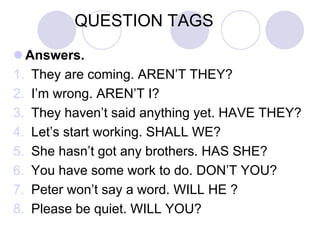
 Answers.
1. They are coming. AREN’T THEY?
2. I’m wrong. AREN’T I?
3. They haven’t said anything yet. HAVE THEY?
4. Let’s start working. SHALL WE?
5. She hasn’t got any brothers. HAS SHE?
6. You have some work to do. DON’T YOU?
7. Peter won’t say a word. WILL HE ?
8. Please be quiet. WILL YOU?
PASSIVE VOICE
 La ‘voz pasiva’ es una estructura utilizada para
dar importancia a lo que le sucede al ‘sujeto’.
Clark Ken is known as Superman.
 A menudo se desconoce quien o qué realiza la
acción en pasivo. Para decir quien realiza la
acción se usa BY.
These toys are made by Chinese workers.
PASSIVE VOICE
 La voz pasiva se puede utilizar en los mismos
tiempos verbales que ya conocemos (voz
activa).
 En todos los tiempos verbales la voz pasiva
tiene la misma estructura. Se forma poniendo el
verbo TO BE en el tiempo que se utilizaría en la
‘voz activa’
TO BE + past participle
Your order will be sent tomorrow
A bank was stolen last night
PASSIVE VOICE
 Estructura en presente simple
+ Subject + Present TO BE (am/is/are) + past
participle
This bar is known for its good food
- Subject + am / is / are not + past participle
This model of car isn’t made in America
? Am / Is / Are + subject + past participle…?
Is this song played by U2?
PASSIVE VOICE
 Estructura en pasado simple
+ Subject + Past TO BE (was / were) + past
participle
Guernika was painted by Picasso
- Sub + was / were not + past participle
Two wolves weren’t seen in the town
? Was / Were + subject + past participle…?
Was the report sent yesterday?
PASSIVE VOICE
 Estructura en futuro (con WILL)
+ Subject + WILL BE + past participle
The work will be finished next week
- Subject + WILL NOT BE + past participle
My computer won’t be repaired
? WILL + subject + BE + past participle
Will that book be known overseas?
PASSIVE VOICE
 Exercise. Write sentences in passive voice
with the wods given.
1. The house / build / the builders
2. A huge company / sell / next month
3. These toys / not / make / in Spain
4. I / not / informed /about the changes yesterday
5. What / this tool / use / for ?
6. The Poles / melt / in a hundred years’ time
7. They / not / invite / to the party of last Sunday
8. Lots of phones / make / in Japan
PASSIVE VOICE
 Exercise
1. THE HOUSE IS BUILT BY THE BUILDERS
2. A HUGE COMPANY WILL BE SOLD NEXT MONTH
3. THESE TOYS AREN’T MADE IN SPAIN
4. I WASN’T INFORMED ABOUT THE CHANGES
YESTERDAY
5. WHAT IS THIS TOOL USED FOR?
6. THE POLES WILL BE MELTED IN 100 YEARS’ TIME
7. THEY WEREN’T INVITED TO THE PARTY OF LAST
WEEK
8. LOTS OF PHONES ARE MADE IN JAPAN
Thank you for your attention!

English class 22 a

  • 1.
    English class 22 Elementarylevel Juan José Simón Pérez learnenglishesol.weebly.com
  • 2.
    QUESTION TAGS  Questiontags (preguntas coletilla) son preguntas cortas usadas en inglés con el fin de provocar una respuesta en el oyente.  En español solemos decir ¿no? ; ¿verdad?... -You are tired, aren’t you? -They weren’t at home last Sunday, were they?
  • 3.
    QUESTION TAGS  Eltipo mas común es el de signo contrario:  En frases afirmativas la pregunta es negativa. -It’s cold today, isn’t it? -Your parents arrive this afternoon, don’t they?  En frases negativas la pregunta es afirmativa. -You aren’t working tomorrow, are you? -Paul didn’t go to the party, did he?
  • 4.
    QUESTION TAGS  Elverbo que se usa en los question tags es el auxiliar de la pregunta (ya sea to do, to have, to be o modal), y cuando no hay auxiliar se utiliza la forma adecuada de DO. Tom doesn’t eat meat, do he? They haven’t said anything yet, have they? Your car isn’t broken, is it? He shouldn’t be so rude, should he? You went on a holiday, didn’t you?
  • 5.
    QUESTION TAGS En casodel imperativo (ordenes, peticiones, instrucciones y sugerencias) se suele usar el modal ‘will you?’ en los question tags. Please turn down the volume, will you? Don’t make so much noise, will you?  Con frases que empiezan por Let’s… el question tag utilizado es shall we? Let’s go out tonight, shall we?
  • 6.
    QUESTION TAGS  Casosespeciales:  En frases afirmativas con el verbo TO BE en primera persona (I) se usa ‘aren’t I?’ I am right, aren’t I? / I’m not right, am I?  Con el verbo HAVE GOT se utiliza el question tag correspondiente a la forma utilizada en la frase. You have got a pet, haven’t you? You have a pet, don’t you?
  • 7.
    QUESTION TAGS  Exercise.Write the appropriate question tag for each sentence. 1. They are coming. _______ ? 2. I’m wrong. ______? 3. They haven’t said anything yet. ______? 4. Let’s start working. _______ ? 5. She hasn’t got any brothers. _______ ? 6. You have some work to do. _______ ? 7. Peter won’t say a word. _______ ? 8. Please be quiet. _______ ?
  • 8.
    QUESTION TAGS  Answers. 1.They are coming. AREN’T THEY? 2. I’m wrong. AREN’T I? 3. They haven’t said anything yet. HAVE THEY? 4. Let’s start working. SHALL WE? 5. She hasn’t got any brothers. HAS SHE? 6. You have some work to do. DON’T YOU? 7. Peter won’t say a word. WILL HE ? 8. Please be quiet. WILL YOU?
  • 9.
    PASSIVE VOICE  La‘voz pasiva’ es una estructura utilizada para dar importancia a lo que le sucede al ‘sujeto’. Clark Ken is known as Superman.  A menudo se desconoce quien o qué realiza la acción en pasivo. Para decir quien realiza la acción se usa BY. These toys are made by Chinese workers.
  • 10.
    PASSIVE VOICE  Lavoz pasiva se puede utilizar en los mismos tiempos verbales que ya conocemos (voz activa).  En todos los tiempos verbales la voz pasiva tiene la misma estructura. Se forma poniendo el verbo TO BE en el tiempo que se utilizaría en la ‘voz activa’ TO BE + past participle Your order will be sent tomorrow A bank was stolen last night
  • 11.
    PASSIVE VOICE  Estructuraen presente simple + Subject + Present TO BE (am/is/are) + past participle This bar is known for its good food - Subject + am / is / are not + past participle This model of car isn’t made in America ? Am / Is / Are + subject + past participle…? Is this song played by U2?
  • 12.
    PASSIVE VOICE  Estructuraen pasado simple + Subject + Past TO BE (was / were) + past participle Guernika was painted by Picasso - Sub + was / were not + past participle Two wolves weren’t seen in the town ? Was / Were + subject + past participle…? Was the report sent yesterday?
  • 13.
    PASSIVE VOICE  Estructuraen futuro (con WILL) + Subject + WILL BE + past participle The work will be finished next week - Subject + WILL NOT BE + past participle My computer won’t be repaired ? WILL + subject + BE + past participle Will that book be known overseas?
  • 14.
    PASSIVE VOICE  Exercise.Write sentences in passive voice with the wods given. 1. The house / build / the builders 2. A huge company / sell / next month 3. These toys / not / make / in Spain 4. I / not / informed /about the changes yesterday 5. What / this tool / use / for ? 6. The Poles / melt / in a hundred years’ time 7. They / not / invite / to the party of last Sunday 8. Lots of phones / make / in Japan
  • 15.
    PASSIVE VOICE  Exercise 1.THE HOUSE IS BUILT BY THE BUILDERS 2. A HUGE COMPANY WILL BE SOLD NEXT MONTH 3. THESE TOYS AREN’T MADE IN SPAIN 4. I WASN’T INFORMED ABOUT THE CHANGES YESTERDAY 5. WHAT IS THIS TOOL USED FOR? 6. THE POLES WILL BE MELTED IN 100 YEARS’ TIME 7. THEY WEREN’T INVITED TO THE PARTY OF LAST WEEK 8. LOTS OF PHONES ARE MADE IN JAPAN
  • 16.
    Thank you foryour attention!