English class 20
Elementary level
Juan José Simón Pérez
learnenglishesol.weebly.com
WAIT, WISH, HOPE, EXPECT
Wait: Dejar que el tiempo pase en espera
de que suceda algo. Es un verbo ‘normal’:
vale para el pasado, presente y futuro; se
conjuga normalmente.
I’m waiting for the doctor
They’ll wait at the entrance
WAIT, WISH, HOPE, EXPECT
Expect: Pensar que algo va a suceder.
También se usa como sinónimo de ‘think o
‘suppose’ en cuyo caso no se utiliza en
presente continuo (verbo de estado).
Expect to + infinitive: I expect to finish
my job soon.
Expect + rel. clause with ‘that’: He
expects that you’ll solve the problem.
Expect + object: They’re expecting a
baby!
WAIT, WISH, HOPE, EXPECT
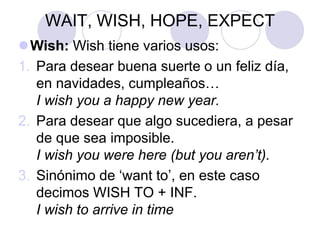
Wish: Wish tiene varios usos:
1. Para desear buena suerte o un feliz día,
en navidades, cumpleaños…
I wish you a happy new year.
2. Para desear que algo sucediera, a pesar
de que sea imposible.
I wish you were here (but you aren’t).
3. Sinónimo de ‘want to’, en este caso
decimos WISH TO + INF.
I wish to arrive in time
WAIT, WISH, HOPE, EXPECT
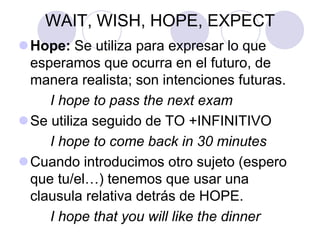
Hope: Se utiliza para expresar lo que
esperamos que ocurra en el futuro, de
manera realista; son intenciones futuras.
I hope to pass the next exam
Se utiliza seguido de TO +INFINITIVO
I hope to come back in 30 minutes
Cuando introducimos otro sujeto (espero
que tu/el…) tenemos que usar una
clausula relativa detrás de HOPE.
I hope that you will like the dinner
WAIT, WISH, HOPE, EXPECT
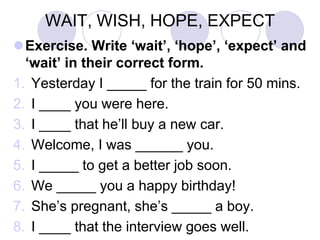
Exercise. Write ‘wait’, ‘hope’, ‘expect’ and
‘wait’ in their correct form.
1. Yesterday I _____ for the train for 50 mins.
2. I ____ you were here.
3. I ____ that he’ll buy a new car.
4. Welcome, I was ______ you.
5. I _____ to get a better job soon.
6. We _____ you a happy birthday!
7. She’s pregnant, she’s _____ a boy.
8. I ____ that the interview goes well.
WAIT, WISH, HOPE, EXPECT
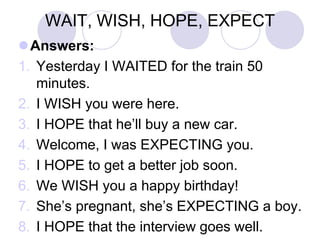
Answers:
1. Yesterday I WAITED for the train 50
minutes.
2. I WISH you were here.
3. I HOPE that he’ll buy a new car.
4. Welcome, I was EXPECTING you.
5. I HOPE to get a better job soon.
6. We WISH you a happy birthday!
7. She’s pregnant, she’s EXPECTING a boy.
8. I HOPE that the interview goes well.
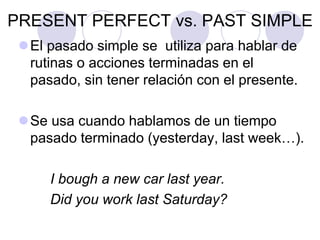
PRESENT PERFECT vs. PAST SIMPLE
El pasado simple se utiliza para hablar de
rutinas o acciones terminadas en el
pasado, sin tener relación con el presente.
Se usa cuando hablamos de un tiempo
pasado terminado (yesterday, last week…).
I bough a new car last year.
Did you work last Saturday?
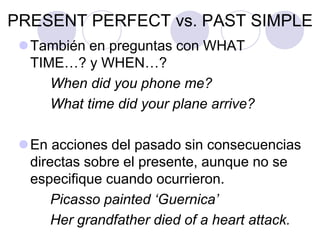
PRESENT PERFECT vs. PAST SIMPLE
También en preguntas con WHAT
TIME…? y WHEN…?
When did you phone me?
What time did your plane arrive?
En acciones del pasado sin consecuencias
directas sobre el presente, aunque no se
especifique cuando ocurrieron.
Picasso painted ‘Guernica’
Her grandfather died of a heart attack.
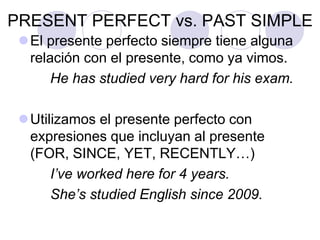
PRESENT PERFECT vs. PAST SIMPLE
El presente perfecto siempre tiene alguna
relación con el presente, como ya vimos.
He has studied very hard for his exam.
Utilizamos el presente perfecto con
expresiones que incluyan al presente
(FOR, SINCE, YET, RECENTLY…)
I’ve worked here for 4 years.
She’s studied English since 2009.
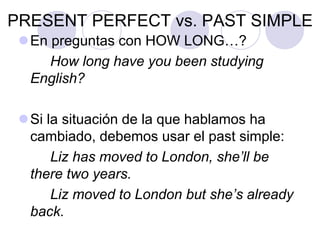
PRESENT PERFECT vs. PAST SIMPLE
En preguntas con HOW LONG…?
How long have you been studying
English?
Si la situación de la que hablamos ha
cambiado, debemos usar el past simple:
Liz has moved to London, she’ll be
there two years.
Liz moved to London but she’s already
back.
PRESENT PERFECT vs. PAST SIMPLE
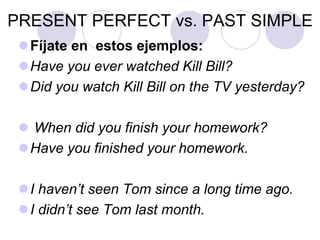
Fíjate en estos ejemplos:
Have you ever watched Kill Bill?
Did you watch Kill Bill on the TV yesterday?
 When did you finish your homework?
Have you finished your homework.
I haven’t seen Tom since a long time ago.
I didn’t see Tom last month.
PRESENT PERFECT vs. PAST SIMPLE
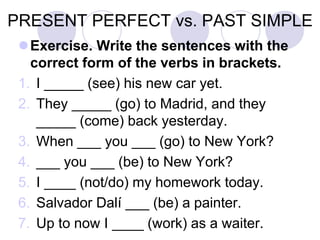
Exercise. Write the sentences with the
correct form of the verbs in brackets.
1. I _____ (see) his new car yet.
2. They _____ (go) to Madrid, and they
_____ (come) back yesterday.
3. When ___ you ___ (go) to New York?
4. ___ you ___ (be) to New York?
5. I ____ (not/do) my homework today.
6. Salvador Dalí ___ (be) a painter.
7. Up to now I ____ (work) as a waiter.
PRESENT PERFECT vs. PAST SIMPLE
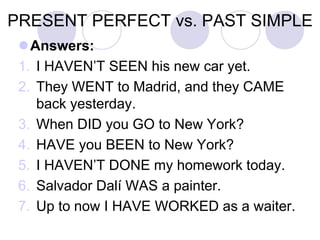
Answers:
1. I HAVEN’T SEEN his new car yet.
2. They WENT to Madrid, and they CAME
back yesterday.
3. When DID you GO to New York?
4. HAVE you BEEN to New York?
5. I HAVEN’T DONE my homework today.
6. Salvador Dalí WAS a painter.
7. Up to now I HAVE WORKED as a waiter.
Thank you for your attention!

English class 20 a

  • 1.
    English class 20 Elementarylevel Juan José Simón Pérez learnenglishesol.weebly.com
  • 2.
    WAIT, WISH, HOPE,EXPECT Wait: Dejar que el tiempo pase en espera de que suceda algo. Es un verbo ‘normal’: vale para el pasado, presente y futuro; se conjuga normalmente. I’m waiting for the doctor They’ll wait at the entrance
  • 3.
    WAIT, WISH, HOPE,EXPECT Expect: Pensar que algo va a suceder. También se usa como sinónimo de ‘think o ‘suppose’ en cuyo caso no se utiliza en presente continuo (verbo de estado). Expect to + infinitive: I expect to finish my job soon. Expect + rel. clause with ‘that’: He expects that you’ll solve the problem. Expect + object: They’re expecting a baby!
  • 4.
    WAIT, WISH, HOPE,EXPECT Wish: Wish tiene varios usos: 1. Para desear buena suerte o un feliz día, en navidades, cumpleaños… I wish you a happy new year. 2. Para desear que algo sucediera, a pesar de que sea imposible. I wish you were here (but you aren’t). 3. Sinónimo de ‘want to’, en este caso decimos WISH TO + INF. I wish to arrive in time
  • 5.
    WAIT, WISH, HOPE,EXPECT Hope: Se utiliza para expresar lo que esperamos que ocurra en el futuro, de manera realista; son intenciones futuras. I hope to pass the next exam Se utiliza seguido de TO +INFINITIVO I hope to come back in 30 minutes Cuando introducimos otro sujeto (espero que tu/el…) tenemos que usar una clausula relativa detrás de HOPE. I hope that you will like the dinner
  • 6.
    WAIT, WISH, HOPE,EXPECT Exercise. Write ‘wait’, ‘hope’, ‘expect’ and ‘wait’ in their correct form. 1. Yesterday I _____ for the train for 50 mins. 2. I ____ you were here. 3. I ____ that he’ll buy a new car. 4. Welcome, I was ______ you. 5. I _____ to get a better job soon. 6. We _____ you a happy birthday! 7. She’s pregnant, she’s _____ a boy. 8. I ____ that the interview goes well.
  • 7.
    WAIT, WISH, HOPE,EXPECT Answers: 1. Yesterday I WAITED for the train 50 minutes. 2. I WISH you were here. 3. I HOPE that he’ll buy a new car. 4. Welcome, I was EXPECTING you. 5. I HOPE to get a better job soon. 6. We WISH you a happy birthday! 7. She’s pregnant, she’s EXPECTING a boy. 8. I HOPE that the interview goes well.
  • 8.
    PRESENT PERFECT vs.PAST SIMPLE El pasado simple se utiliza para hablar de rutinas o acciones terminadas en el pasado, sin tener relación con el presente. Se usa cuando hablamos de un tiempo pasado terminado (yesterday, last week…). I bough a new car last year. Did you work last Saturday?
  • 9.
    PRESENT PERFECT vs.PAST SIMPLE También en preguntas con WHAT TIME…? y WHEN…? When did you phone me? What time did your plane arrive? En acciones del pasado sin consecuencias directas sobre el presente, aunque no se especifique cuando ocurrieron. Picasso painted ‘Guernica’ Her grandfather died of a heart attack.
  • 10.
    PRESENT PERFECT vs.PAST SIMPLE El presente perfecto siempre tiene alguna relación con el presente, como ya vimos. He has studied very hard for his exam. Utilizamos el presente perfecto con expresiones que incluyan al presente (FOR, SINCE, YET, RECENTLY…) I’ve worked here for 4 years. She’s studied English since 2009.
  • 11.
    PRESENT PERFECT vs.PAST SIMPLE En preguntas con HOW LONG…? How long have you been studying English? Si la situación de la que hablamos ha cambiado, debemos usar el past simple: Liz has moved to London, she’ll be there two years. Liz moved to London but she’s already back.
  • 12.
    PRESENT PERFECT vs.PAST SIMPLE Fíjate en estos ejemplos: Have you ever watched Kill Bill? Did you watch Kill Bill on the TV yesterday?  When did you finish your homework? Have you finished your homework. I haven’t seen Tom since a long time ago. I didn’t see Tom last month.
  • 13.
    PRESENT PERFECT vs.PAST SIMPLE Exercise. Write the sentences with the correct form of the verbs in brackets. 1. I _____ (see) his new car yet. 2. They _____ (go) to Madrid, and they _____ (come) back yesterday. 3. When ___ you ___ (go) to New York? 4. ___ you ___ (be) to New York? 5. I ____ (not/do) my homework today. 6. Salvador Dalí ___ (be) a painter. 7. Up to now I ____ (work) as a waiter.
  • 14.
    PRESENT PERFECT vs.PAST SIMPLE Answers: 1. I HAVEN’T SEEN his new car yet. 2. They WENT to Madrid, and they CAME back yesterday. 3. When DID you GO to New York? 4. HAVE you BEEN to New York? 5. I HAVEN’T DONE my homework today. 6. Salvador Dalí WAS a painter. 7. Up to now I HAVE WORKED as a waiter.
  • 15.
    Thank you foryour attention!