

English class 15

Elementary level

Juan José Simón Pérez
learnenglishesol.weebly.com
PRESENT PERFECT
 ‘I have done’ es el Presente Perfecto.
 El presente perfecto une el pasado y el
presente.

Past

Present

 Puede ser Presente Perfecto Simple o Continuo
I have done / I have been doing
PRESENT PERFECT
 Se utiliza para conectar el pasado con el
presente. Los hechos pasados tienen
consecuencias en el presente (y/o en el futuro)
I have lost my mobile phone!

 Para hablar de información ‘nueva’
The Prince has spoken with a journalist
 Para hablar de acciones pasadas sin decir
cuando ocurrieron.
I’ve finished my homework
PRESENT PERFECT
 Estructura en afirmación:
 Subject + have / has + past participle…
I have worked here six years.
It has rained a lot this winter.
 Estructura en negación:
 Subject + have / has not + past participle…
I have not (haven’t) read the newspaper.
He hasn’t come to visit us this year.
PRESENT PERFECT
 Estructura en preguntas:
 Have / has + Subject + past participle…
Have you seen Mike lately?
Has she told you anything?
 Respuestas cortas:
 Yes, I have / No, I haven’t (etc.)
 Yes, he has / No, he hasn’t (etc.)
PRESENT PERFECT
 Contracciones:
I have done = I’ve done
You have done = You’ve…
He has done = He’s…
She has done = She’s…
It has done = It’s …
We have done = We’ve…
You have done = You’ve…
They have done = They’ve…

I haven’t done
You haven’t done
He hasn’t done
She hasn’t done
It hasn’t done
We haven’t done
You haven’t done
They haven’t…
PRESENT PERFECT
 Exercise. Complete the sentences using the
Present Perfect Simple of the verb in
brackets.
1. He ___ ___ me the truth. (to tell)
2. I ___ never ____ to America. (to be)
3. We ___ ___ ___ since last month. (not/to work)
4. ___ it ____ in your town recently? (to snow)
5. ___ you ever ____ the Eiffel tower? (see)
6. Mary ___ ___ ___ home. (not/arrived)
7. It ___ ___ a long time since I last saw you! (to
be)
PRESENT PERFECT
 Answers.
1. He HAS TOLD me the truth.
2. I HAVE never BEEN to America.
3. We HAVE NOT WORKED since last month.
4. HAS it SNOWED in your town recently?
5. HAVE you ever SEEN the Eiffel tower?
6. Mary HAS NOT ARRIVED home.
7. It HAS BEEN a long time since I last saw you!
EVER / NEVER
 EVER significa ‘alguna vez’. Se utiliza en
preguntas, que pueden ser negativas o
afirmativas. Se coloca tras el sujeto.
Have you ever been to Australia?
Haven’t you ever eaten sushi?
 NEVER significa ‘nunca’. Nunca se utiliza
despues de ‘not’.
No, I’ve never been to Australia.
He’s never gone to the theatre.
EVER / NEVER
 Exercise. Make questions in Present Perfect
Simple using the words given. Use EVER.
1. Be in London
2. Climb a mountain
3. Go to a big festival
4. Watch a 3D movie in the cinema
5. Meet a celebrity
6. Work at night
 Exercise 2. Practice the questions and
answers with a partner.
EVER / NEVER
 Answers.
1.
2.
3.
4.

Have you ever been to London?
Have you ever climbed a mountain?
Have you ever gone to a big festival?
Have you ever watched a 3D movie in the
cinema?
5. Have you ever met a celebrity?
6. Have you ever worked at night?
ALREADY, YET, JUST
 Already, yet y just se utilizan casi siempre con el
presente perfecto.
 Already: Se usa comunmente en frases
afirmativas, significa ‘ya’, expresando que una
acción se a realizado antes de lo esperado. Se
coloca entre el auxiliar y el verbo principal.
I’ve already finished my homework!
She’s already had two kids.
ALREADY, YET, JUST
 Yet: Se utiliza en preguntas y negaciones,
siempre al final de la frase. El significado varía
según el caso:
1) PREGUNTAS: Significa ‘ya’ o ‘todavía’
Has Paul arrived yet?
Haven’t you seen that movie yet?
2) NEGACIONES: Significa ‘aún’ o ‘todavía’ (mas
tarde de lo esperado)
I haven’t phoned her yet.
She hasn’t sent the letter yet.
ALREADY, YET, JUST
 Just: Se utiliza para hablar de acciones o
situaciones recién ocurridas. Se pone entre el
auxiliar y el verbo principal.
-Has Toni called you back yet?
-Yes, he’s just phoned me five minutes ago.
 Significa ‘acabar de…’ y cambia la traducción
del verbo a infinitivo.
I’ve just lost my wallet = Acabo de perder my
cartera.
ALREADY, YET, JUST
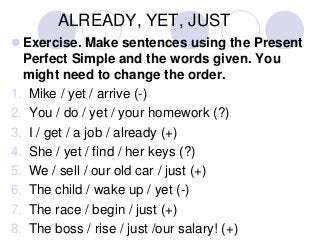
 Exercise. Make sentences using the Present
Perfect Simple and the words given. You
might need to change the order.
1. Mike / yet / arrive (-)
2. You / do / yet / your homework (?)
3. I / get / a job / already (+)
4. She / yet / find / her keys (?)
5. We / sell / our old car / just (+)
6. The child / wake up / yet (-)
7. The race / begin / just (+)
8. The boss / rise / just /our salary! (+)
ALREADY, YET, JUST
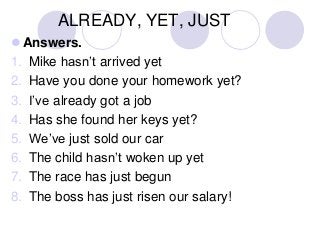
 Answers.
1. Mike hasn’t arrived yet
2. Have you done your homework yet?
3. I’ve already got a job
4. Has she found her keys yet?
5. We’ve just sold our car
6. The child hasn’t woken up yet
7. The race has just begun
8. The boss has just risen our salary!
Thank you for your attention!

English class 15 a

  • 1.
    English class 15 Elementarylevel Juan José Simón Pérez learnenglishesol.weebly.com
  • 2.
    PRESENT PERFECT  ‘Ihave done’ es el Presente Perfecto.  El presente perfecto une el pasado y el presente. Past Present  Puede ser Presente Perfecto Simple o Continuo I have done / I have been doing
  • 3.
    PRESENT PERFECT  Seutiliza para conectar el pasado con el presente. Los hechos pasados tienen consecuencias en el presente (y/o en el futuro) I have lost my mobile phone!  Para hablar de información ‘nueva’ The Prince has spoken with a journalist  Para hablar de acciones pasadas sin decir cuando ocurrieron. I’ve finished my homework
  • 4.
    PRESENT PERFECT  Estructuraen afirmación:  Subject + have / has + past participle… I have worked here six years. It has rained a lot this winter.  Estructura en negación:  Subject + have / has not + past participle… I have not (haven’t) read the newspaper. He hasn’t come to visit us this year.
  • 5.
    PRESENT PERFECT  Estructuraen preguntas:  Have / has + Subject + past participle… Have you seen Mike lately? Has she told you anything?  Respuestas cortas:  Yes, I have / No, I haven’t (etc.)  Yes, he has / No, he hasn’t (etc.)
  • 6.
    PRESENT PERFECT  Contracciones: Ihave done = I’ve done You have done = You’ve… He has done = He’s… She has done = She’s… It has done = It’s … We have done = We’ve… You have done = You’ve… They have done = They’ve… I haven’t done You haven’t done He hasn’t done She hasn’t done It hasn’t done We haven’t done You haven’t done They haven’t…
  • 7.
    PRESENT PERFECT  Exercise.Complete the sentences using the Present Perfect Simple of the verb in brackets. 1. He ___ ___ me the truth. (to tell) 2. I ___ never ____ to America. (to be) 3. We ___ ___ ___ since last month. (not/to work) 4. ___ it ____ in your town recently? (to snow) 5. ___ you ever ____ the Eiffel tower? (see) 6. Mary ___ ___ ___ home. (not/arrived) 7. It ___ ___ a long time since I last saw you! (to be)
  • 8.
    PRESENT PERFECT  Answers. 1.He HAS TOLD me the truth. 2. I HAVE never BEEN to America. 3. We HAVE NOT WORKED since last month. 4. HAS it SNOWED in your town recently? 5. HAVE you ever SEEN the Eiffel tower? 6. Mary HAS NOT ARRIVED home. 7. It HAS BEEN a long time since I last saw you!
  • 9.
    EVER / NEVER EVER significa ‘alguna vez’. Se utiliza en preguntas, que pueden ser negativas o afirmativas. Se coloca tras el sujeto. Have you ever been to Australia? Haven’t you ever eaten sushi?  NEVER significa ‘nunca’. Nunca se utiliza despues de ‘not’. No, I’ve never been to Australia. He’s never gone to the theatre.
  • 10.
    EVER / NEVER Exercise. Make questions in Present Perfect Simple using the words given. Use EVER. 1. Be in London 2. Climb a mountain 3. Go to a big festival 4. Watch a 3D movie in the cinema 5. Meet a celebrity 6. Work at night  Exercise 2. Practice the questions and answers with a partner.
  • 11.
    EVER / NEVER Answers. 1. 2. 3. 4. Have you ever been to London? Have you ever climbed a mountain? Have you ever gone to a big festival? Have you ever watched a 3D movie in the cinema? 5. Have you ever met a celebrity? 6. Have you ever worked at night?
  • 12.
    ALREADY, YET, JUST Already, yet y just se utilizan casi siempre con el presente perfecto.  Already: Se usa comunmente en frases afirmativas, significa ‘ya’, expresando que una acción se a realizado antes de lo esperado. Se coloca entre el auxiliar y el verbo principal. I’ve already finished my homework! She’s already had two kids.
  • 13.
    ALREADY, YET, JUST Yet: Se utiliza en preguntas y negaciones, siempre al final de la frase. El significado varía según el caso: 1) PREGUNTAS: Significa ‘ya’ o ‘todavía’ Has Paul arrived yet? Haven’t you seen that movie yet? 2) NEGACIONES: Significa ‘aún’ o ‘todavía’ (mas tarde de lo esperado) I haven’t phoned her yet. She hasn’t sent the letter yet.
  • 14.
    ALREADY, YET, JUST Just: Se utiliza para hablar de acciones o situaciones recién ocurridas. Se pone entre el auxiliar y el verbo principal. -Has Toni called you back yet? -Yes, he’s just phoned me five minutes ago.  Significa ‘acabar de…’ y cambia la traducción del verbo a infinitivo. I’ve just lost my wallet = Acabo de perder my cartera.
  • 15.
    ALREADY, YET, JUST Exercise. Make sentences using the Present Perfect Simple and the words given. You might need to change the order. 1. Mike / yet / arrive (-) 2. You / do / yet / your homework (?) 3. I / get / a job / already (+) 4. She / yet / find / her keys (?) 5. We / sell / our old car / just (+) 6. The child / wake up / yet (-) 7. The race / begin / just (+) 8. The boss / rise / just /our salary! (+)
  • 16.
    ALREADY, YET, JUST Answers. 1. Mike hasn’t arrived yet 2. Have you done your homework yet? 3. I’ve already got a job 4. Has she found her keys yet? 5. We’ve just sold our car 6. The child hasn’t woken up yet 7. The race has just begun 8. The boss has just risen our salary!
  • 17.
    Thank you foryour attention!