RELATIVE
CLAUSE
ADJECTIVE CLAUSE
By
Maryam
Mazaheri
DEFINITIONS
• Relative clause—also called an adjective or adjectival
clause
• It contains a subject and verb.
• It begins with a relative pronoun [who, whom, whose, that,
or which,…] .
• It functions as an adjective, answering the questions What
kind? How many? or Which one?
• We use who and whom for people, and which for things.
• We use that for people or things.
• We use relative pronouns to introduce relative clauses,
which tell us more about people and things.
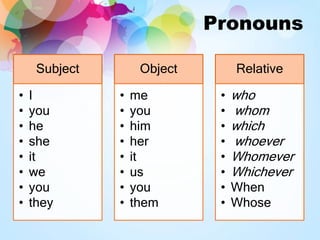
Pronouns
Subject
• I
• you
• he
• she
• it
• we
• you
• they
Object
• me
• you
• him
• her
• it
• us
• you
• them
Relative
• who
• whom
• which
• whoever
• Whomever
• Whichever
• When
• Whose
Relative
Clauses
Defining
gives detailed
information
Necessary
information
“That”
Non-Defining
gives
additional
information
Unnecessary
information
“Commas”
Relative
pronoun
Object Subject
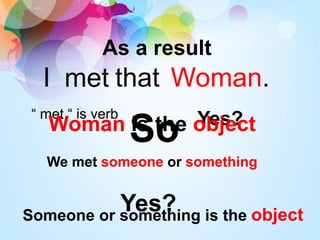
I met that Woman.
“ met “ is verb
So
We met someone or something
Yes?Someone or something is the object
Yes?
As a result
Woman is the object
across the road.She lives
She is the subject
Yes ?
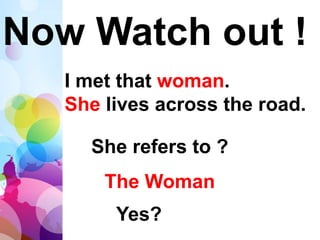
Now Watch out !
I met that woman.
She lives across the road.
Yes?
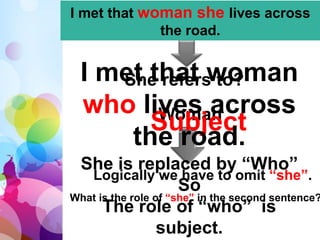
She refers to ?
The Woman
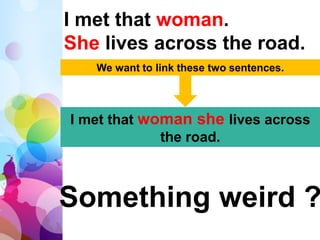
I met that woman.
She lives across the road.
We want to link these two sentences.
I met that woman she lives across
the road.
Something weird ?
I met that woman she lives across
the road.
She refers to?
Woman
Subject
Logically we have to omit “she”.
What is the role of “she” in the second sentence?
I met that woman
who lives across
the road.
She is replaced by “Who”
So
The role of “who” is
subject.
Same situation for the “Object”
I met that woman.
My boss invited her to the party.
Link two sentences:
I met that woman my boss invited her to the
party.
Her refers to the woman.
Logically we have to omit “her” and use“ who “
instead of “her”.
The role of “who” is Object.
Object pronoun
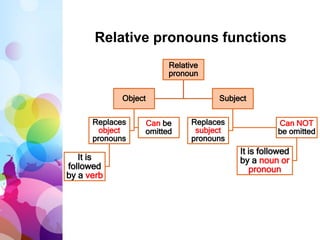
Relative
pronoun
Object
Replaces
object
pronouns
It is
followed
by a verb
Can be
omitted
Subject
Replaces
subject
pronouns
Can NOT
be omitted
It is followed
by a noun or
pronoun
Relative pronouns functions
• Examples
• Do you see the cat which is lying on the roof?
• (2nd sentence : It is lying on the roof. It subject)
• He couldn’t read the book which I bought last week.
• (2nd sentence : I bought it last week. It Object)
• I was invited by the professor whom I met at the
conference.
• (2nd sentence : I met him at the conference.
• It subject)
• I don’t like the table that stands in the kitchen.
• (2nd sentence : It stands in the kitchen. It subject)
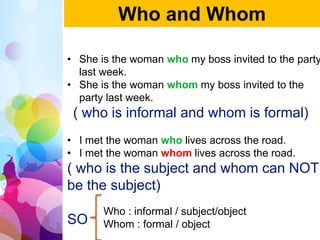
• She is the woman who my boss invited to the party
last week.
• She is the woman whom my boss invited to the
party last week.
( who is informal and whom is formal)
• I met the woman who lives across the road.
• I met the woman whom lives across the road.
( who is the subject and whom can NOT
be the subject)
SO
Who and Whom
Who : informal / subject/object
Whom : formal / object
Relative pronouns as the object
of a preposition
• She is the woman about whom I told you.
• The music to which we listened was good.
• She is the woman that I told you about.
• The music that we listened to was good.
• She is the woman I told you about.
• The music we listened to was good.
• She is the woman who I told you about .
• The music which we listened to was good.
NOTE : only which and whom are used after
preposition.
Whose
• I know the man.
• His bicycle was stolen.
• I know the man whose bicycle was stolen.
NOTE: whose can Not be omitted.
Where
The building where he lives is very old.
The building in which he lives is very old.
The building which he lives in is very old.
The building that he lives in is very old.
The building he lives in is very old.
NOTE : preposition is NOT used with
where.
When
• I will never forget the day when I met you.
• I will never forget the day on which I met you
• .
• I will never forget the day that I met you.
• I will never forget the day I met you.
NOTE: preposition is not used with
when.
To be continued…

Relative clauses

  • 1.
  • 2.
    DEFINITIONS • Relative clause—alsocalled an adjective or adjectival clause • It contains a subject and verb. • It begins with a relative pronoun [who, whom, whose, that, or which,…] . • It functions as an adjective, answering the questions What kind? How many? or Which one? • We use who and whom for people, and which for things. • We use that for people or things. • We use relative pronouns to introduce relative clauses, which tell us more about people and things.
  • 3.
    Pronouns Subject • I • you •he • she • it • we • you • they Object • me • you • him • her • it • us • you • them Relative • who • whom • which • whoever • Whomever • Whichever • When • Whose
  • 4.
  • 5.
  • 6.
    I met thatWoman. “ met “ is verb So We met someone or something Yes?Someone or something is the object Yes? As a result Woman is the object
  • 7.
    across the road.Shelives She is the subject Yes ?
  • 8.
    Now Watch out! I met that woman. She lives across the road. Yes? She refers to ? The Woman
  • 9.
    I met thatwoman. She lives across the road. We want to link these two sentences. I met that woman she lives across the road. Something weird ?
  • 10.
    I met thatwoman she lives across the road. She refers to? Woman Subject Logically we have to omit “she”. What is the role of “she” in the second sentence? I met that woman who lives across the road. She is replaced by “Who” So The role of “who” is subject.
  • 11.
    Same situation forthe “Object” I met that woman. My boss invited her to the party. Link two sentences: I met that woman my boss invited her to the party. Her refers to the woman. Logically we have to omit “her” and use“ who “ instead of “her”. The role of “who” is Object. Object pronoun
  • 12.
    Relative pronoun Object Replaces object pronouns It is followed by averb Can be omitted Subject Replaces subject pronouns Can NOT be omitted It is followed by a noun or pronoun Relative pronouns functions
  • 13.
    • Examples • Doyou see the cat which is lying on the roof? • (2nd sentence : It is lying on the roof. It subject) • He couldn’t read the book which I bought last week. • (2nd sentence : I bought it last week. It Object) • I was invited by the professor whom I met at the conference. • (2nd sentence : I met him at the conference. • It subject) • I don’t like the table that stands in the kitchen. • (2nd sentence : It stands in the kitchen. It subject)
  • 14.
    • She isthe woman who my boss invited to the party last week. • She is the woman whom my boss invited to the party last week. ( who is informal and whom is formal) • I met the woman who lives across the road. • I met the woman whom lives across the road. ( who is the subject and whom can NOT be the subject) SO Who and Whom Who : informal / subject/object Whom : formal / object
  • 15.
    Relative pronouns asthe object of a preposition • She is the woman about whom I told you. • The music to which we listened was good. • She is the woman that I told you about. • The music that we listened to was good. • She is the woman I told you about. • The music we listened to was good. • She is the woman who I told you about . • The music which we listened to was good. NOTE : only which and whom are used after preposition.
  • 16.
    Whose • I knowthe man. • His bicycle was stolen. • I know the man whose bicycle was stolen. NOTE: whose can Not be omitted. Where The building where he lives is very old. The building in which he lives is very old. The building which he lives in is very old. The building that he lives in is very old. The building he lives in is very old. NOTE : preposition is NOT used with where.
  • 17.
    When • I willnever forget the day when I met you. • I will never forget the day on which I met you • . • I will never forget the day that I met you. • I will never forget the day I met you. NOTE: preposition is not used with when.
  • 18.