English class 14

Elementary level

Juan José Simón Pérez
learnenglishesol.weebly.com
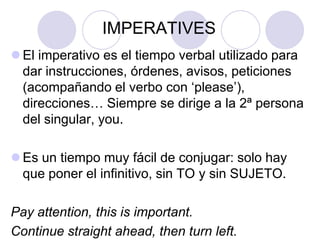
IMPERATIVES
 El imperativo es el tiempo verbal utilizado para
dar instrucciones, órdenes, avisos, peticiones
(acompañando el verbo con ‘please’),
direcciones… Siempre se dirige a la 2ª persona
del singular, you.

 Es un tiempo muy fácil de conjugar: solo hay
que poner el infinitivo, sin TO y sin SUJETO.
Pay attention, this is important.
Continue straight ahead, then turn left.
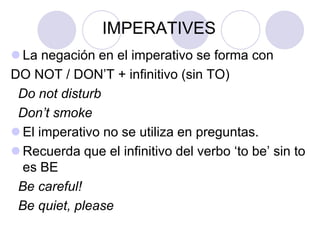
IMPERATIVES
 La negación en el imperativo se forma con
DO NOT / DON’T + infinitivo (sin TO)
Do not disturb
Don’t smoke
 El imperativo no se utiliza en preguntas.
 Recuerda que el infinitivo del verbo ‘to be’ sin to
es BE
Be careful!
Be quiet, please
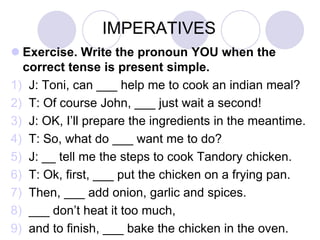
IMPERATIVES
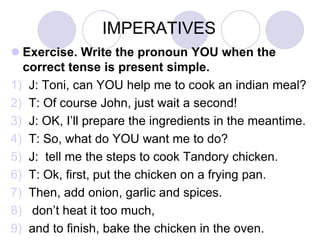
 Exercise. Write the pronoun YOU when the
correct tense is present simple.
1) J: Toni, can ___ help me to cook an indian meal?
2) T: Of course John, ___ just wait a second!
3) J: OK, I’ll prepare the ingredients in the meantime.
4) T: So, what do ___ want me to do?
5) J: __ tell me the steps to cook Tandory chicken.
6) T: Ok, first, ___ put the chicken on a frying pan.
7) Then, ___ add onion, garlic and spices.
8) ___ don’t heat it too much,
9) and to finish, ___ bake the chicken in the oven.
IMPERATIVES
 Exercise. Write the pronoun YOU when the
correct tense is present simple.
1) J: Toni, can YOU help me to cook an indian meal?
2) T: Of course John, just wait a second!
3) J: OK, I’ll prepare the ingredients in the meantime.
4) T: So, what do YOU want me to do?
5) J: tell me the steps to cook Tandory chicken.
6) T: Ok, first, put the chicken on a frying pan.
7) Then, add onion, garlic and spices.
8) don’t heat it too much,
9) and to finish, bake the chicken in the oven.
QUESTIONS
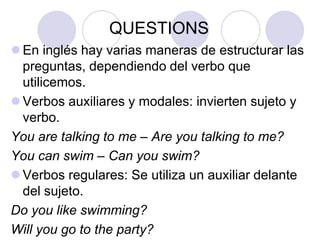
 En inglés hay varias maneras de estructurar las
preguntas, dependiendo del verbo que
utilicemos.
 Verbos auxiliares y modales: invierten sujeto y
verbo.
You are talking to me – Are you talking to me?
You can swim – Can you swim?
 Verbos regulares: Se utiliza un auxiliar delante
del sujeto.
Do you like swimming?
Will you go to the party?
QUESTIONS
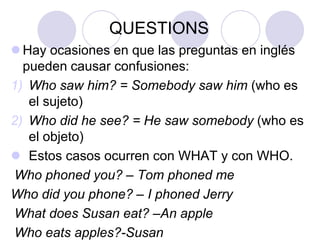
 Hay ocasiones en que las preguntas en inglés
pueden causar confusiones:
1) Who saw him? = Somebody saw him (who es
el sujeto)
2) Who did he see? = He saw somebody (who es
el objeto)
 Estos casos ocurren con WHAT y con WHO.
Who phoned you? – Tom phoned me
Who did you phone? – I phoned Jerry
What does Susan eat? –An apple
Who eats apples?-Susan
QUESTIONS
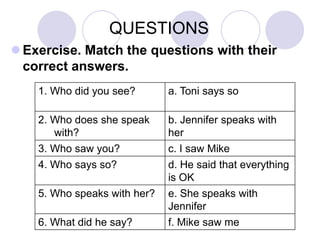
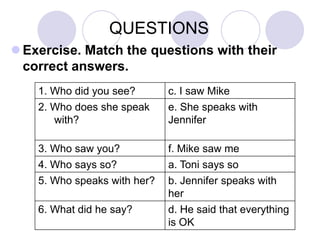
 Exercise. Match the questions with their
correct answers.
1. Who did you see?

a. Toni says so

2. Who does she speak
with?
3. Who saw you?
4. Who says so?

b. Jennifer speaks with
her
c. I saw Mike
d. He said that everything
is OK
e. She speaks with
Jennifer
f. Mike saw me

5. Who speaks with her?

6. What did he say?
QUESTIONS
 Exercise. Match the questions with their
correct answers.
1. Who did you see?
2. Who does she speak
with?

c. I saw Mike
e. She speaks with
Jennifer

3. Who saw you?
4. Who says so?

f. Mike saw me
a. Toni says so

5. Who speaks with her?

b. Jennifer speaks with
her
d. He said that everything
is OK

6. What did he say?
QUESTIONS
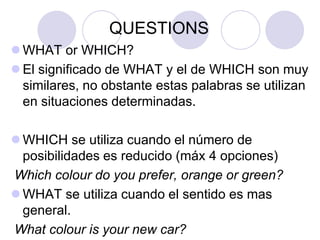
 WHAT or WHICH?
 El significado de WHAT y el de WHICH son muy
similares, no obstante estas palabras se utilizan
en situaciones determinadas.

 WHICH se utiliza cuando el número de
posibilidades es reducido (máx 4 opciones)
Which colour do you prefer, orange or green?
 WHAT se utiliza cuando el sentido es mas
general.
What colour is your new car?
QUESTIONS
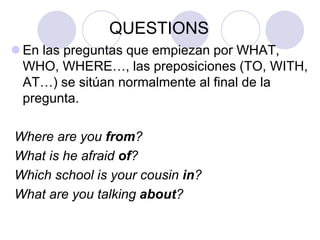
 En las preguntas que empiezan por WHAT,
WHO, WHERE…, las preposiciones (TO, WITH,
AT…) se sitúan normalmente al final de la
pregunta.
Where are you from?
What is he afraid of?
Which school is your cousin in?
What are you talking about?
QUESTIONS
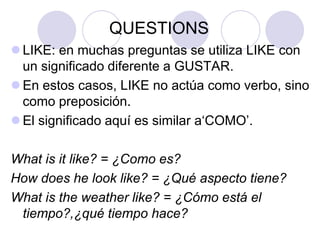
 LIKE: en muchas preguntas se utiliza LIKE con
un significado diferente a GUSTAR.
 En estos casos, LIKE no actúa como verbo, sino
como preposición.
 El significado aquí es similar a‘COMO’.
What is it like? = ¿Como es?
How does he look like? = ¿Qué aspecto tiene?
What is the weather like? = ¿Cómo está el
tiempo?,¿qué tiempo hace?
QUESTIONS
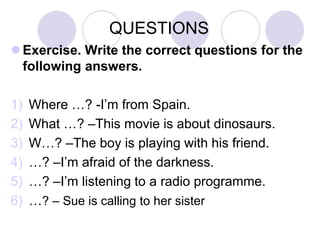
 Exercise. Write the correct questions for the
following answers.
1)
2)
3)
4)
5)
6)

Where …? -I’m from Spain.
What …? –This movie is about dinosaurs.
W…? –The boy is playing with his friend.
…? –I’m afraid of the darkness.
…? –I’m listening to a radio programme.
…? – Sue is calling to her sister
QUESTIONS
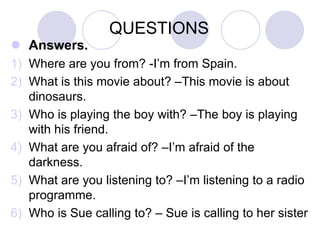
 Answers.
1) Where are you from? -I’m from Spain.
2) What is this movie about? –This movie is about
dinosaurs.
3) Who is playing the boy with? –The boy is playing
with his friend.
4) What are you afraid of? –I’m afraid of the
darkness.
5) What are you listening to? –I’m listening to a radio
programme.
6) Who is Sue calling to? – Sue is calling to her sister
Thank you for your attention!

English class 14 a

  • 1.
    English class 14 Elementarylevel Juan José Simón Pérez learnenglishesol.weebly.com
  • 2.
    IMPERATIVES  El imperativoes el tiempo verbal utilizado para dar instrucciones, órdenes, avisos, peticiones (acompañando el verbo con ‘please’), direcciones… Siempre se dirige a la 2ª persona del singular, you.  Es un tiempo muy fácil de conjugar: solo hay que poner el infinitivo, sin TO y sin SUJETO. Pay attention, this is important. Continue straight ahead, then turn left.
  • 3.
    IMPERATIVES  La negaciónen el imperativo se forma con DO NOT / DON’T + infinitivo (sin TO) Do not disturb Don’t smoke  El imperativo no se utiliza en preguntas.  Recuerda que el infinitivo del verbo ‘to be’ sin to es BE Be careful! Be quiet, please
  • 4.
    IMPERATIVES  Exercise. Writethe pronoun YOU when the correct tense is present simple. 1) J: Toni, can ___ help me to cook an indian meal? 2) T: Of course John, ___ just wait a second! 3) J: OK, I’ll prepare the ingredients in the meantime. 4) T: So, what do ___ want me to do? 5) J: __ tell me the steps to cook Tandory chicken. 6) T: Ok, first, ___ put the chicken on a frying pan. 7) Then, ___ add onion, garlic and spices. 8) ___ don’t heat it too much, 9) and to finish, ___ bake the chicken in the oven.
  • 5.
    IMPERATIVES  Exercise. Writethe pronoun YOU when the correct tense is present simple. 1) J: Toni, can YOU help me to cook an indian meal? 2) T: Of course John, just wait a second! 3) J: OK, I’ll prepare the ingredients in the meantime. 4) T: So, what do YOU want me to do? 5) J: tell me the steps to cook Tandory chicken. 6) T: Ok, first, put the chicken on a frying pan. 7) Then, add onion, garlic and spices. 8) don’t heat it too much, 9) and to finish, bake the chicken in the oven.
  • 6.
    QUESTIONS  En ingléshay varias maneras de estructurar las preguntas, dependiendo del verbo que utilicemos.  Verbos auxiliares y modales: invierten sujeto y verbo. You are talking to me – Are you talking to me? You can swim – Can you swim?  Verbos regulares: Se utiliza un auxiliar delante del sujeto. Do you like swimming? Will you go to the party?
  • 7.
    QUESTIONS  Hay ocasionesen que las preguntas en inglés pueden causar confusiones: 1) Who saw him? = Somebody saw him (who es el sujeto) 2) Who did he see? = He saw somebody (who es el objeto)  Estos casos ocurren con WHAT y con WHO. Who phoned you? – Tom phoned me Who did you phone? – I phoned Jerry What does Susan eat? –An apple Who eats apples?-Susan
  • 8.
    QUESTIONS  Exercise. Matchthe questions with their correct answers. 1. Who did you see? a. Toni says so 2. Who does she speak with? 3. Who saw you? 4. Who says so? b. Jennifer speaks with her c. I saw Mike d. He said that everything is OK e. She speaks with Jennifer f. Mike saw me 5. Who speaks with her? 6. What did he say?
  • 9.
    QUESTIONS  Exercise. Matchthe questions with their correct answers. 1. Who did you see? 2. Who does she speak with? c. I saw Mike e. She speaks with Jennifer 3. Who saw you? 4. Who says so? f. Mike saw me a. Toni says so 5. Who speaks with her? b. Jennifer speaks with her d. He said that everything is OK 6. What did he say?
  • 10.
    QUESTIONS  WHAT orWHICH?  El significado de WHAT y el de WHICH son muy similares, no obstante estas palabras se utilizan en situaciones determinadas.  WHICH se utiliza cuando el número de posibilidades es reducido (máx 4 opciones) Which colour do you prefer, orange or green?  WHAT se utiliza cuando el sentido es mas general. What colour is your new car?
  • 11.
    QUESTIONS  En laspreguntas que empiezan por WHAT, WHO, WHERE…, las preposiciones (TO, WITH, AT…) se sitúan normalmente al final de la pregunta. Where are you from? What is he afraid of? Which school is your cousin in? What are you talking about?
  • 12.
    QUESTIONS  LIKE: enmuchas preguntas se utiliza LIKE con un significado diferente a GUSTAR.  En estos casos, LIKE no actúa como verbo, sino como preposición.  El significado aquí es similar a‘COMO’. What is it like? = ¿Como es? How does he look like? = ¿Qué aspecto tiene? What is the weather like? = ¿Cómo está el tiempo?,¿qué tiempo hace?
  • 13.
    QUESTIONS  Exercise. Writethe correct questions for the following answers. 1) 2) 3) 4) 5) 6) Where …? -I’m from Spain. What …? –This movie is about dinosaurs. W…? –The boy is playing with his friend. …? –I’m afraid of the darkness. …? –I’m listening to a radio programme. …? – Sue is calling to her sister
  • 14.
    QUESTIONS  Answers. 1) Whereare you from? -I’m from Spain. 2) What is this movie about? –This movie is about dinosaurs. 3) Who is playing the boy with? –The boy is playing with his friend. 4) What are you afraid of? –I’m afraid of the darkness. 5) What are you listening to? –I’m listening to a radio programme. 6) Who is Sue calling to? – Sue is calling to her sister
  • 15.
    Thank you foryour attention!