
The Seven C’s ofThe Seven C’s of
CommunicationCommunication
By: Sambit BiswalBy: Sambit Biswal
The Seven C’s of CommunicationThe Seven C’s of Communication
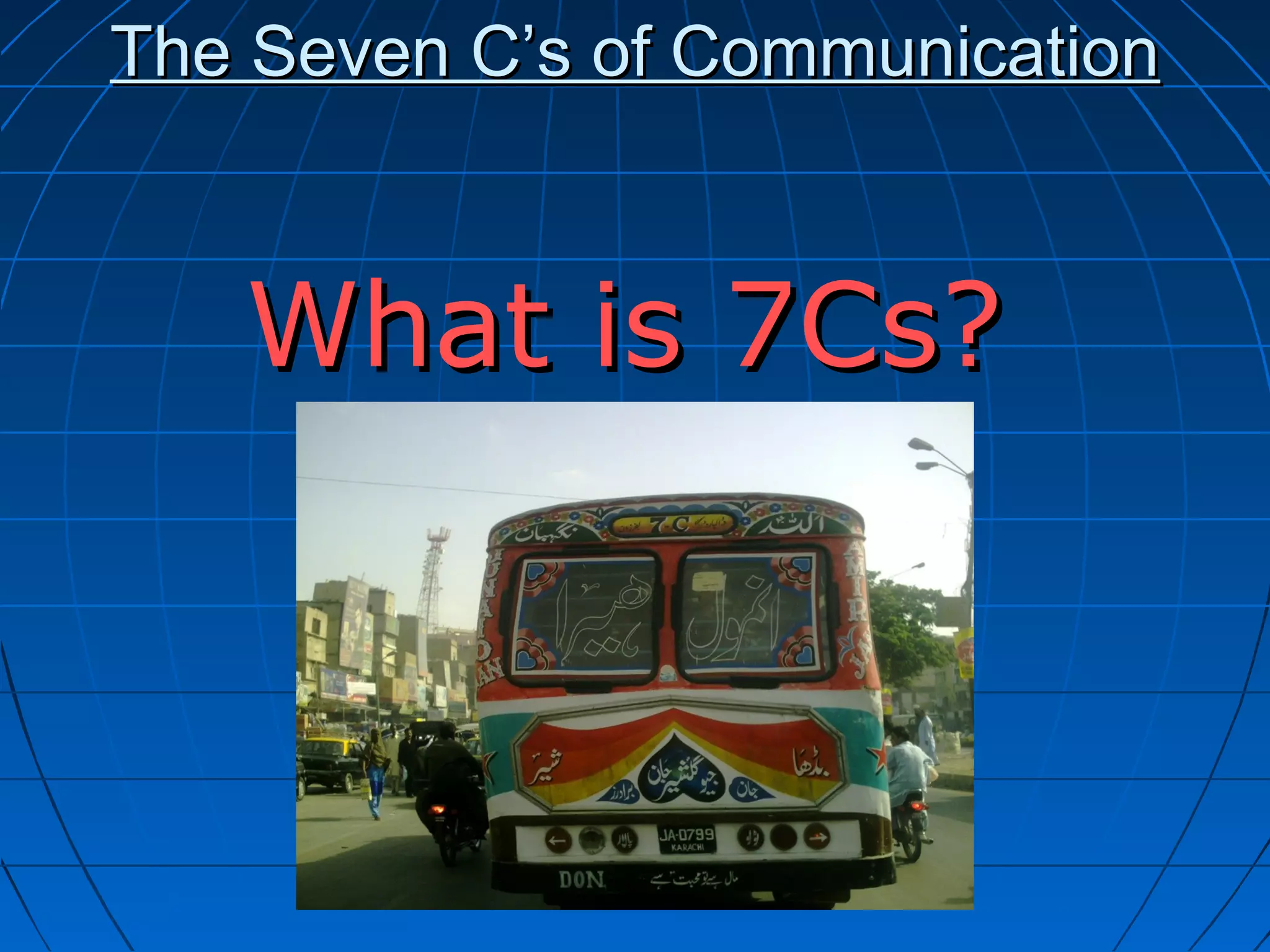
What is 7Cs?What is 7Cs?
The Seven C’s of CommunicationThe Seven C’s of Communication
7 Principles of effective7 Principles of effective
communicationcommunication..
1.1. CompletenessCompleteness
2.2. ConcisenessConciseness
3.3. ConsiderationConsideration
4.4. ConcretenessConcreteness
5.5. ClarityClarity
6.6. CourtesyCourtesy
7.7. CorrectnessCorrectness
The Seven C’s of CommunicationThe Seven C’s of Communication
7 C’s Can Be Applied for both7 C’s Can Be Applied for both
 OralOral
 WritingWriting
The Seven C’s of CommunicationThe Seven C’s of Communication
1.Completeness1.Completeness
 Provide all necessary information.Provide all necessary information.
 Answer all questions asked.Answer all questions asked.
 Give something extra, when desirable.Give something extra, when desirable.
The Seven C’s of CommunicationThe Seven C’s of Communication
Provide all necessary information.Provide all necessary information.
>.>. Accurate understanding.Accurate understanding.
>.>. W questions are useful.W questions are useful.
1.Completeness
The Seven C’s of CommunicationThe Seven C’s of Communication
Answer all Questions asked.Answer all Questions asked.
>.>. Replying inquiryReplying inquiry..
>.>. List the needed detailsList the needed details..
1.Completeness
The Seven C’s of CommunicationThe Seven C’s of Communication
Give something extra, whenGive something extra, when
desirable.desirable.
>.>. Answer in extraordinary way.Answer in extraordinary way.
1.Completeness
The Seven C’s of CommunicationThe Seven C’s of Communication
2. Conciseness.2. Conciseness.
 Wipe out wordy expression.Wipe out wordy expression.
 Add only relevant information.Add only relevant information.
 Avoid unnecessary repetition.Avoid unnecessary repetition.
The Seven C’s of CommunicationThe Seven C’s of Communication
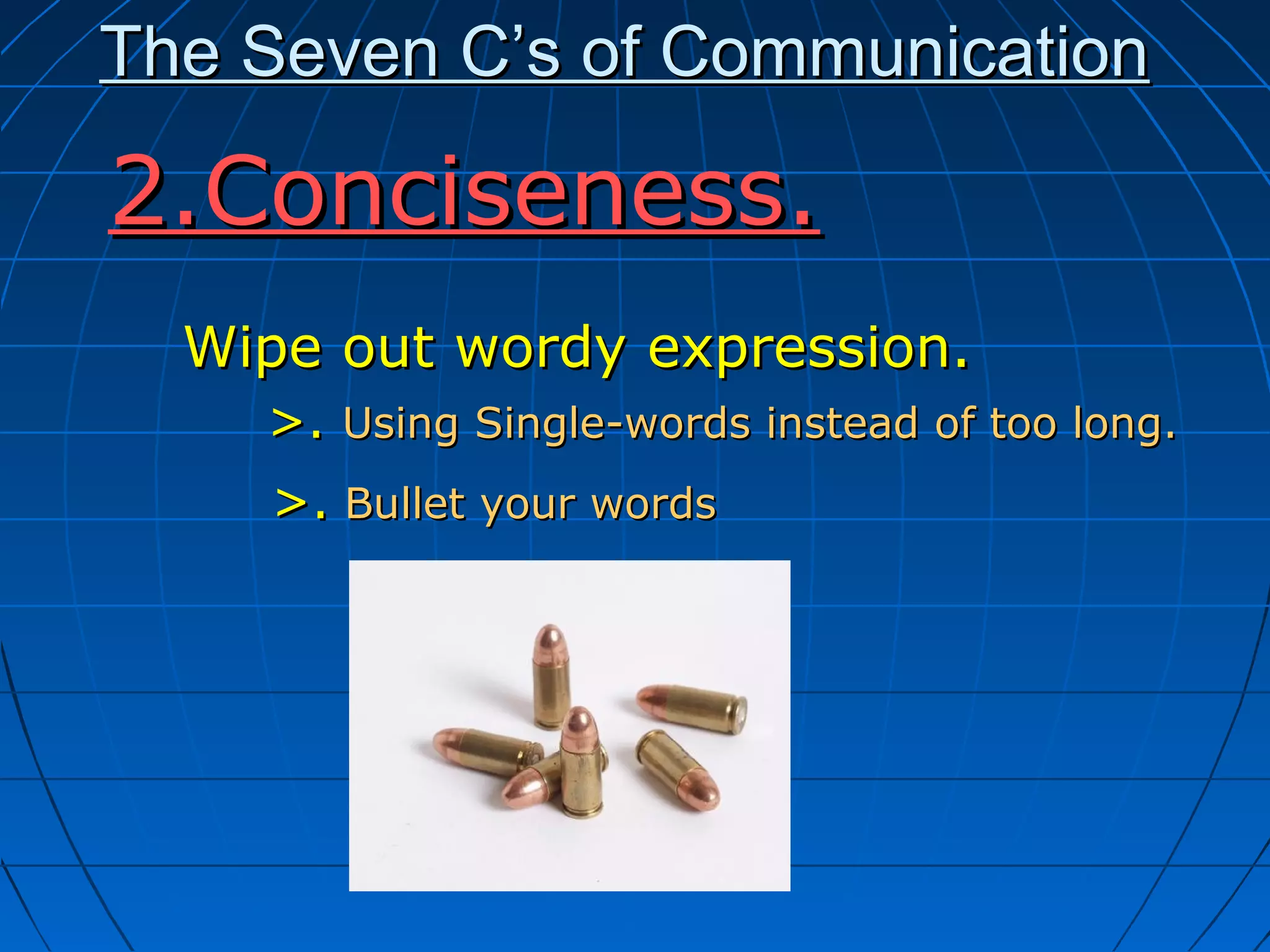
Wipe out wordy expression.Wipe out wordy expression.
>.>. Using Single-words instead of too long.Using Single-words instead of too long.
>.>. Bullet your wordsBullet your words
2.Conciseness.2.Conciseness.
The Seven C’s of CommunicationThe Seven C’s of Communication
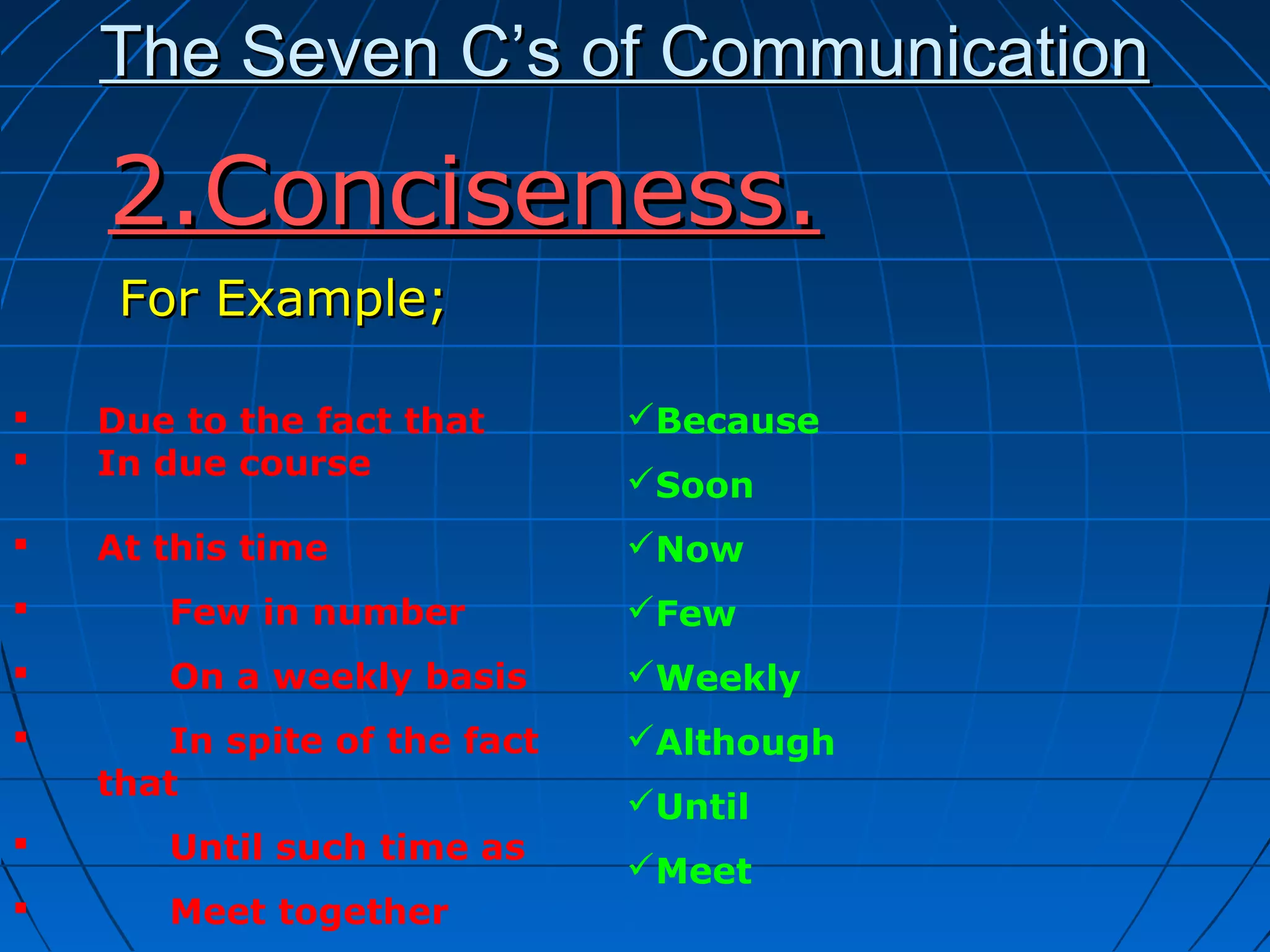
For Example;For Example;
2.Conciseness.2.Conciseness.
 Due to the fact that
 In due course
 At this time
 Few in number
 On a weekly basis
 In spite of the fact
that
 Until such time as
 Meet together
Because
Soon
Now
Few
Weekly
Although
Until
Meet
The Seven C’s of CommunicationThe Seven C’s of Communication
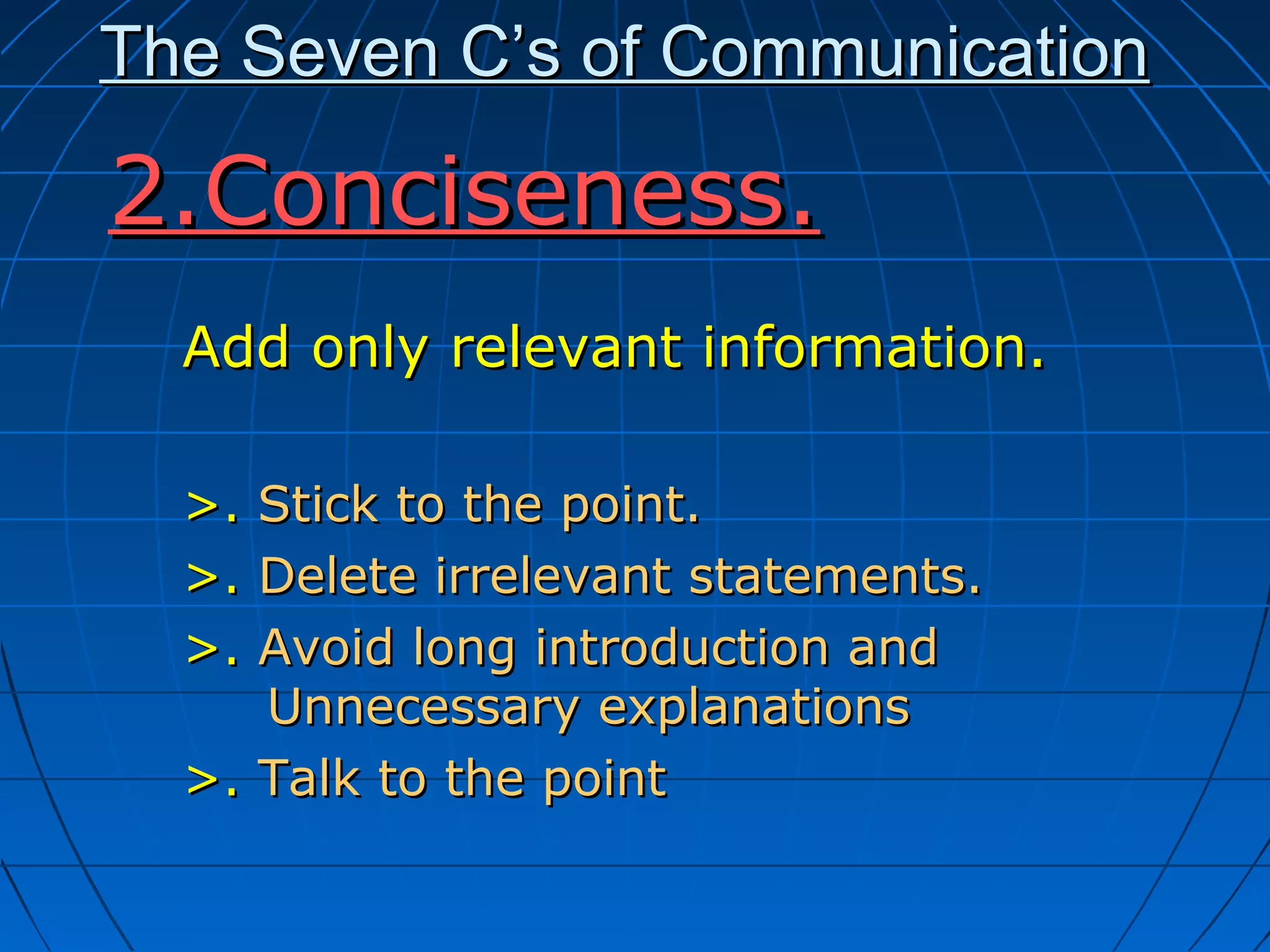
Add only relevant information.Add only relevant information.
>.>. Stick to the point.Stick to the point.
>.>. Delete irrelevant statements.Delete irrelevant statements.
>.>. Avoid long introduction andAvoid long introduction and
Unnecessary explanationsUnnecessary explanations
>.>. Talk to the pointTalk to the point
2.Conciseness.2.Conciseness.
The Seven C’s of CommunicationThe Seven C’s of Communication
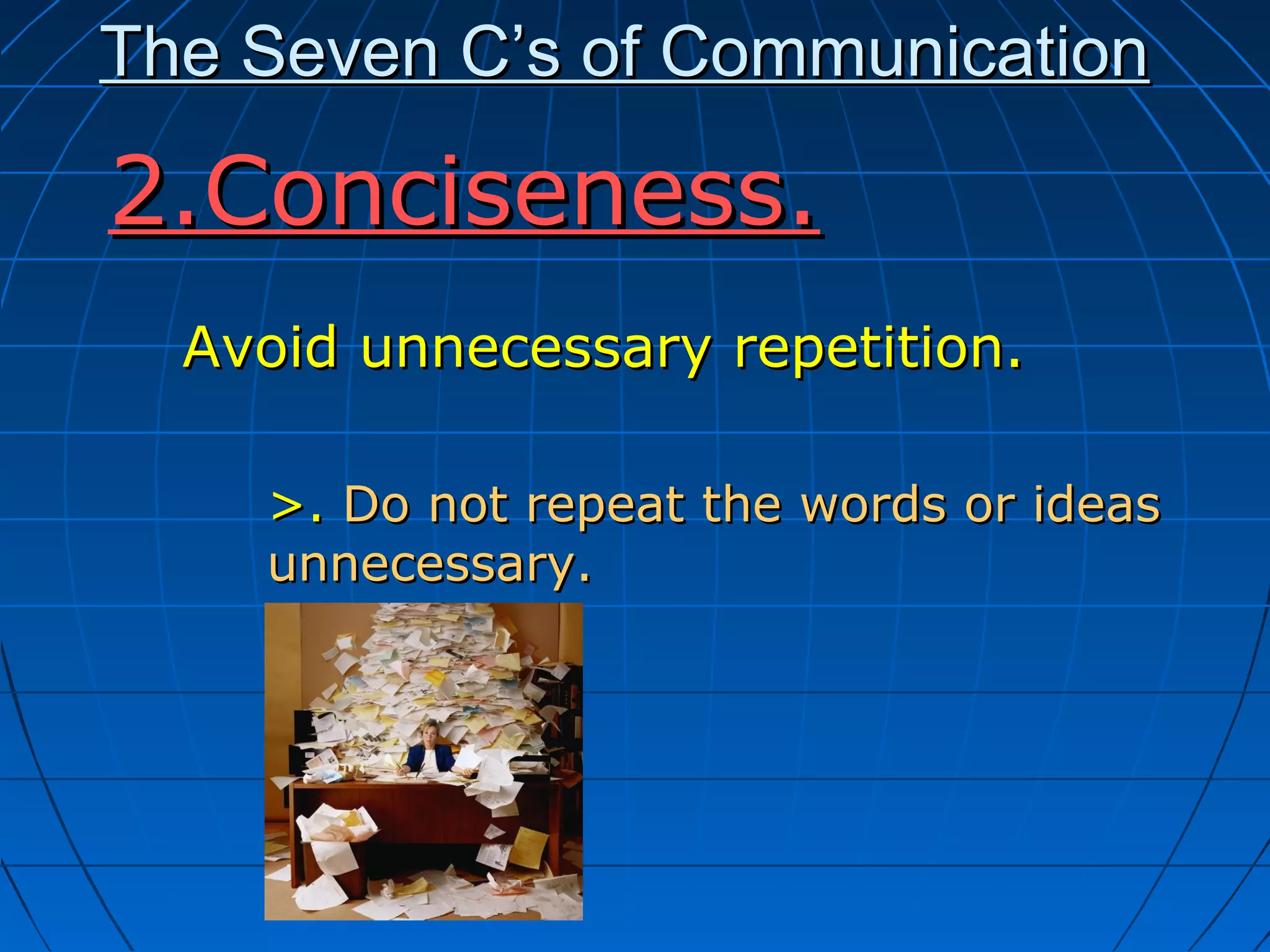
Avoid unnecessary repetition.Avoid unnecessary repetition.
>.>. Do not repeat the words or ideasDo not repeat the words or ideas
unnecessary.unnecessary.
2.Conciseness.2.Conciseness.
The Seven C’s of CommunicationThe Seven C’s of Communication
3.Consideration.3.Consideration.
 Focus on “you” instead of “I” and “we”.Focus on “you” instead of “I” and “we”.
 Show audience interest in the receiver.Show audience interest in the receiver.
 Emphasize positive, pleasant facts.Emphasize positive, pleasant facts.
The Seven C’s of CommunicationThe Seven C’s of Communication
Focus on “you” instead of “I” and “we”.Focus on “you” instead of “I” and “we”.
>.>. Creating a YOU attitude.Creating a YOU attitude.
>.>. Assume you know people needs.Assume you know people needs.
>.>. Do not use YOU in insensitive cases.Do not use YOU in insensitive cases.
3.Consideration.3.Consideration.
The Seven C’s of CommunicationThe Seven C’s of Communication
Show audience interest in the receiver.Show audience interest in the receiver.
>.>. Talk about receiver benefits.Talk about receiver benefits.
3.Consideration.3.Consideration.
The Seven C’s of CommunicationThe Seven C’s of Communication
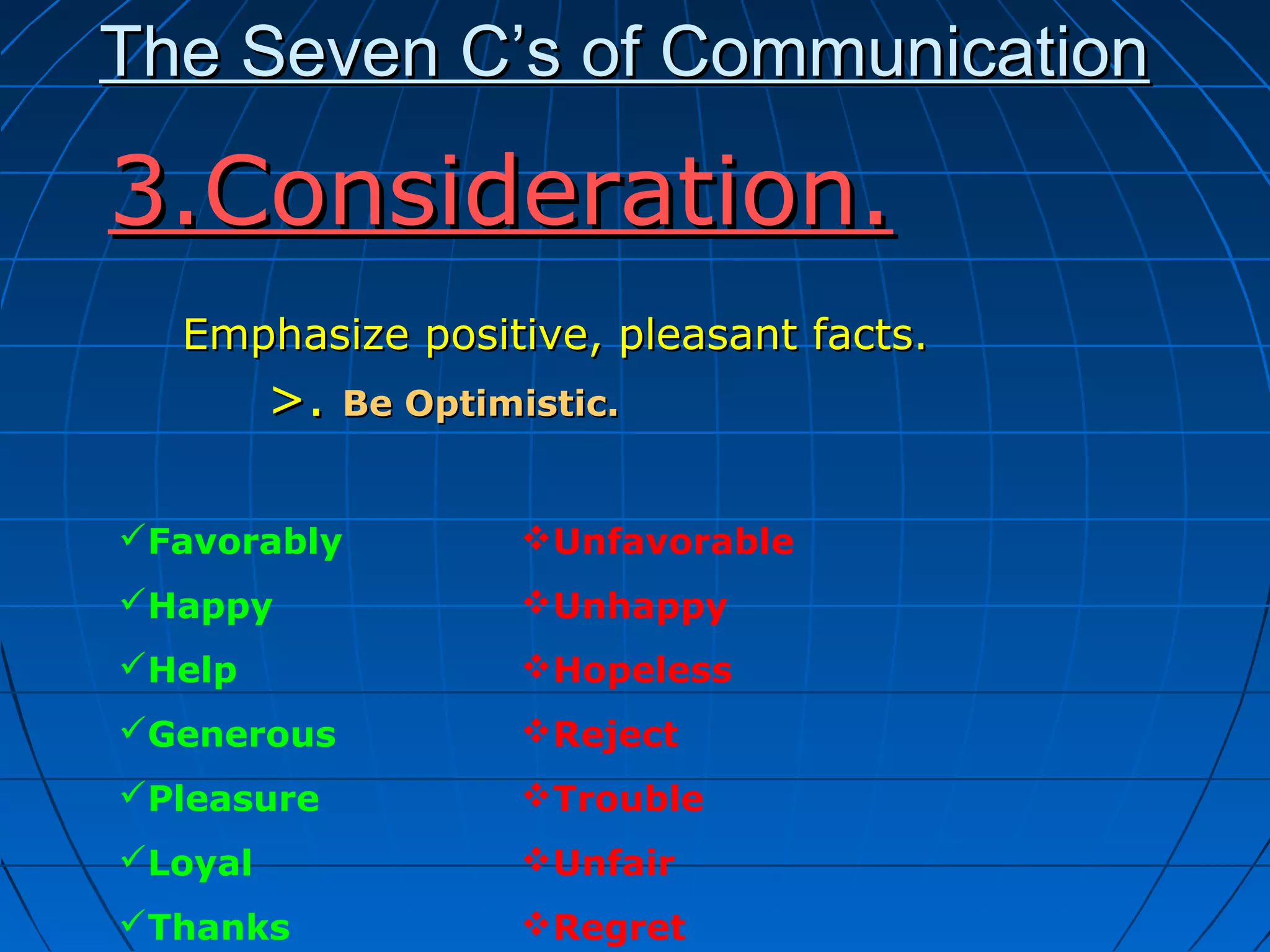
Emphasize positive, pleasant facts.Emphasize positive, pleasant facts.
>.>. Be Optimistic.Be Optimistic.
3.Consideration.3.Consideration.
Favorably
Happy
Help
Generous
Pleasure
Loyal
Thanks
Unfavorable
Unhappy
Hopeless
Reject
Trouble
Unfair
Regret
The Seven C’s of CommunicationThe Seven C’s of Communication
4.Concreteness.4.Concreteness.
 Use specific facts & figures.Use specific facts & figures.
 Put actions in your verbs.Put actions in your verbs.
 Choose vivid, image-building words.Choose vivid, image-building words.
The Seven C’s of CommunicationThe Seven C’s of Communication
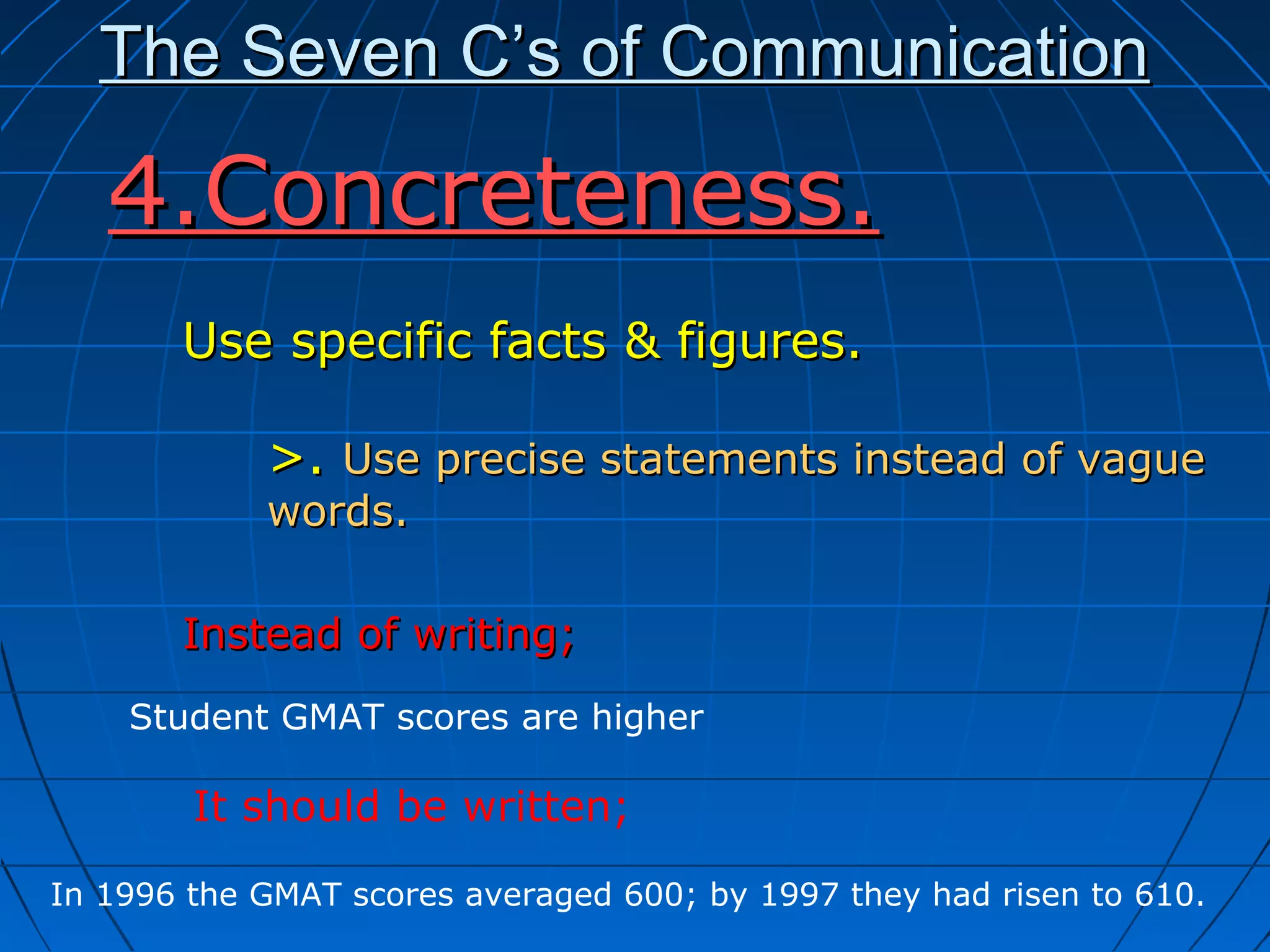
Use specific facts & figures.Use specific facts & figures.
>.>. Use precise statements instead of vagueUse precise statements instead of vague
words.words.
Instead of writing;Instead of writing;
4.Concreteness.4.Concreteness.
Student GMAT scores are higher
In 1996 the GMAT scores averaged 600; by 1997 they had risen to 610.
It should be written;
The Seven C’s of CommunicationThe Seven C’s of Communication
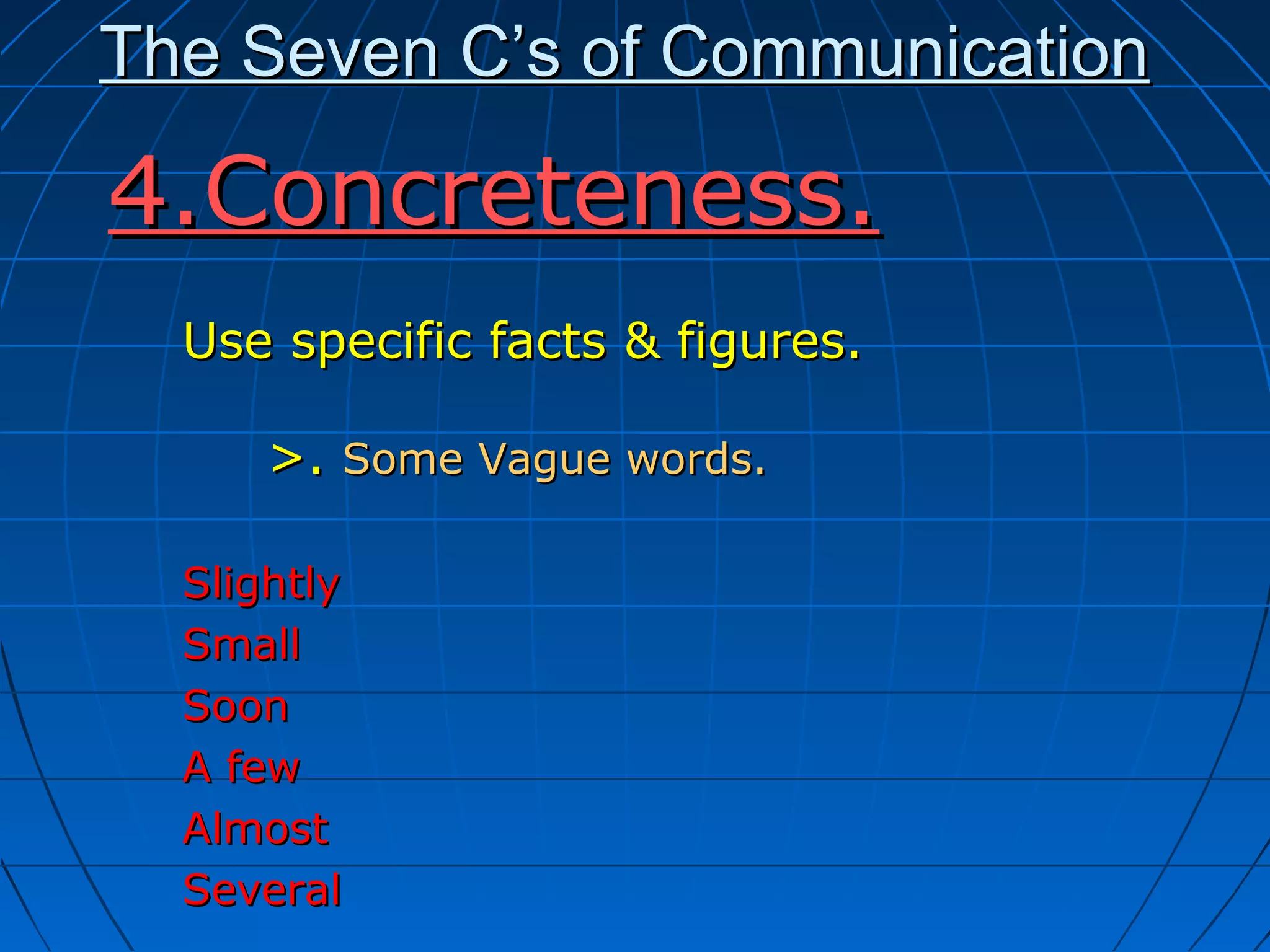
Use specific facts & figures.Use specific facts & figures.
>.>. Some Vague words.Some Vague words.
SlightlySlightly
SmallSmall
SoonSoon
A fewA few
AlmostAlmost
SeveralSeveral
4.Concreteness.4.Concreteness.
The Seven C’s of CommunicationThe Seven C’s of Communication
Put actions in your verbs.Put actions in your verbs.
>.>. Use active voice.Use active voice.
>.>. Use action in verbs, Not in nouns.Use action in verbs, Not in nouns.
4.Concreteness.4.Concreteness.
The Seven C’s of CommunicationThe Seven C’s of Communication
Choose vivid, image-building words.Choose vivid, image-building words.
>.>. Use impressive and appealing words.Use impressive and appealing words.
4.Concreteness.4.Concreteness.
The Seven C’s of CommunicationThe Seven C’s of Communication
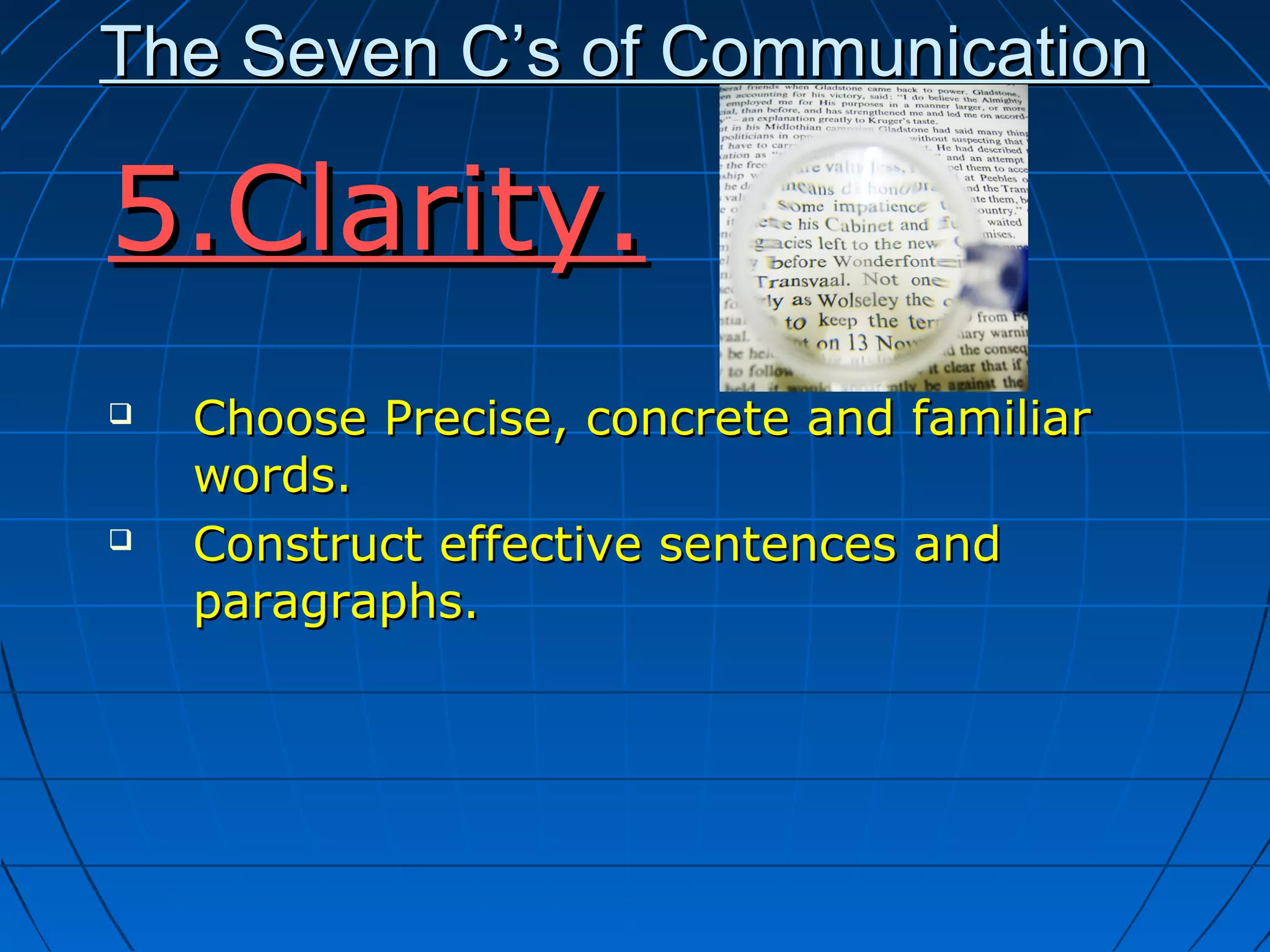
5.Clarity.5.Clarity.
 Choose Precise, concrete and familiarChoose Precise, concrete and familiar
words.words.
 Construct effective sentences andConstruct effective sentences and
paragraphs.paragraphs.
The Seven C’s of CommunicationThe Seven C’s of Communication
Choose Precise, concrete and familiarChoose Precise, concrete and familiar
words.words.
>.>. Use Simple & famous words.Use Simple & famous words.
>.>. Write your purpose clearly.Write your purpose clearly.
5.Clarity.5.Clarity.
The Seven C’s of CommunicationThe Seven C’s of Communication
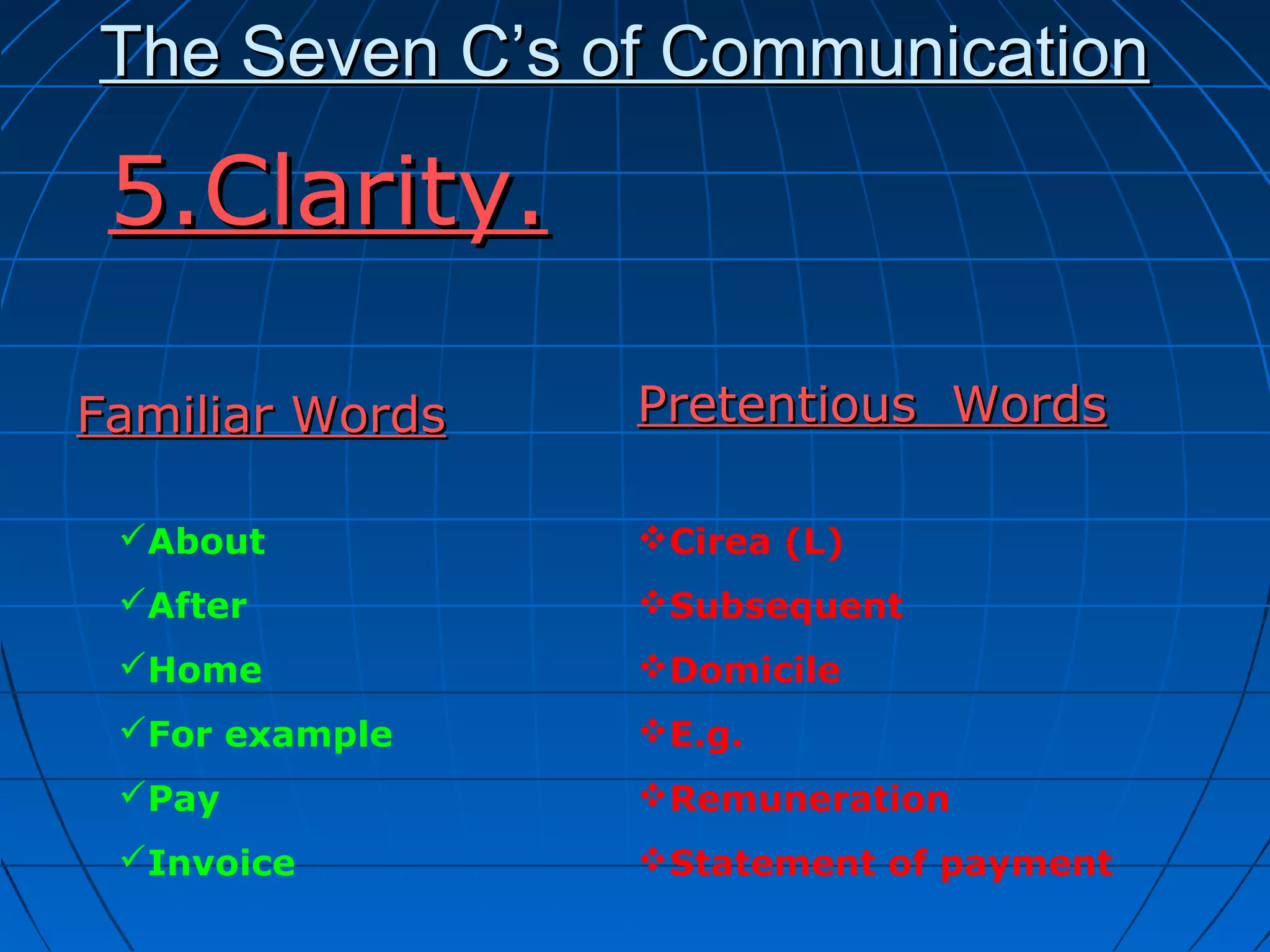
Familiar WordsFamiliar Words
5.Clarity.5.Clarity.
About
After
Home
For example
Pay
Invoice
Cirea (L)
Subsequent
Domicile
E.g.
Remuneration
Statement of payment
Pretentious WordsPretentious Words
The Seven C’s of CommunicationThe Seven C’s of Communication
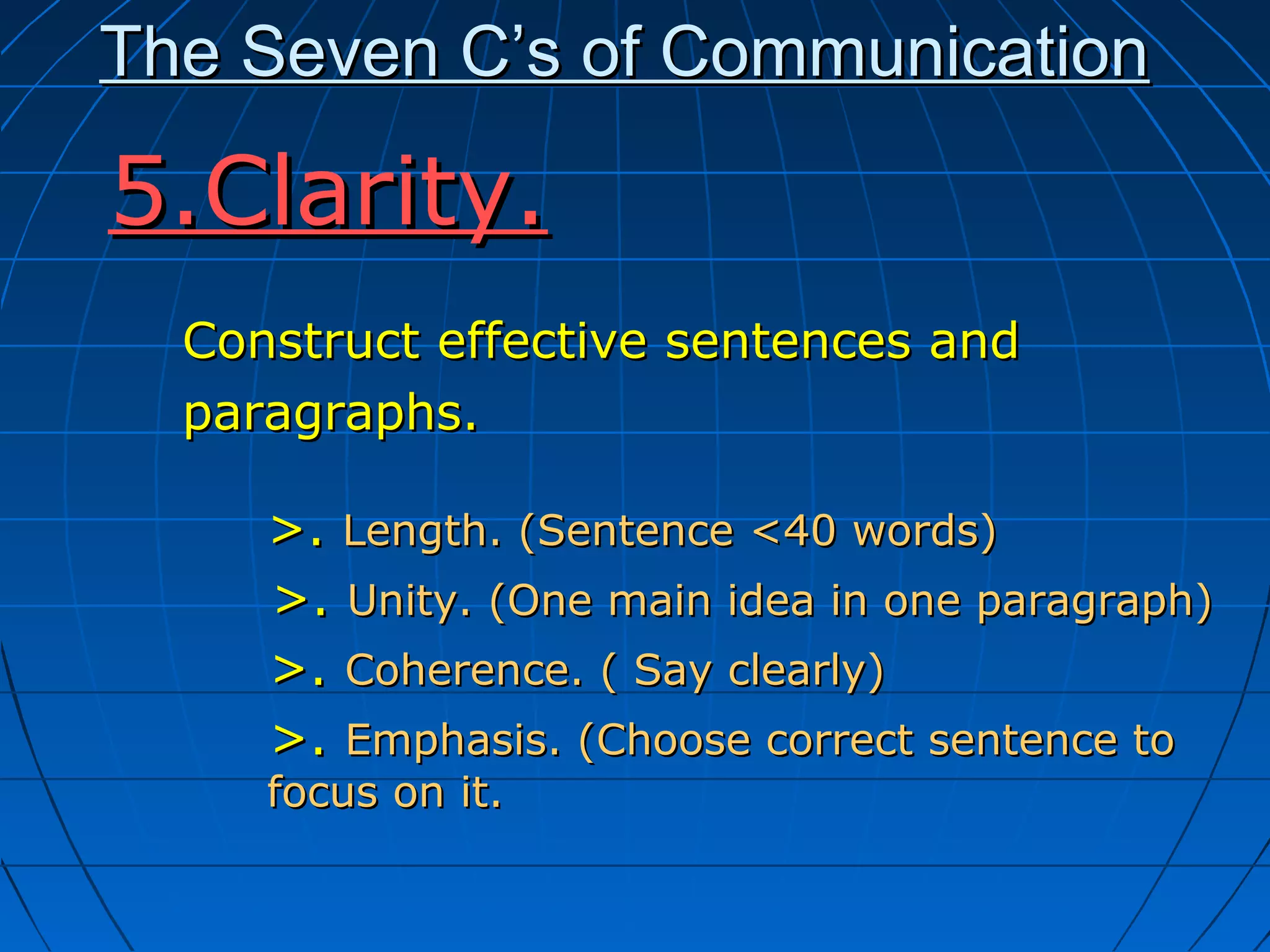
Construct effective sentences andConstruct effective sentences and
paragraphs.paragraphs.
>.>. Length. (Sentence <40 words)Length. (Sentence <40 words)
>.>. Unity. (One main idea in one paragraph)Unity. (One main idea in one paragraph)
>.>. Coherence. ( Say clearly)Coherence. ( Say clearly)
>.>. Emphasis. (Choose correct sentence toEmphasis. (Choose correct sentence to
focus on it.focus on it.
5.Clarity.5.Clarity.
The Seven C’s of CommunicationThe Seven C’s of Communication
6.Courtesy.6.Courtesy.
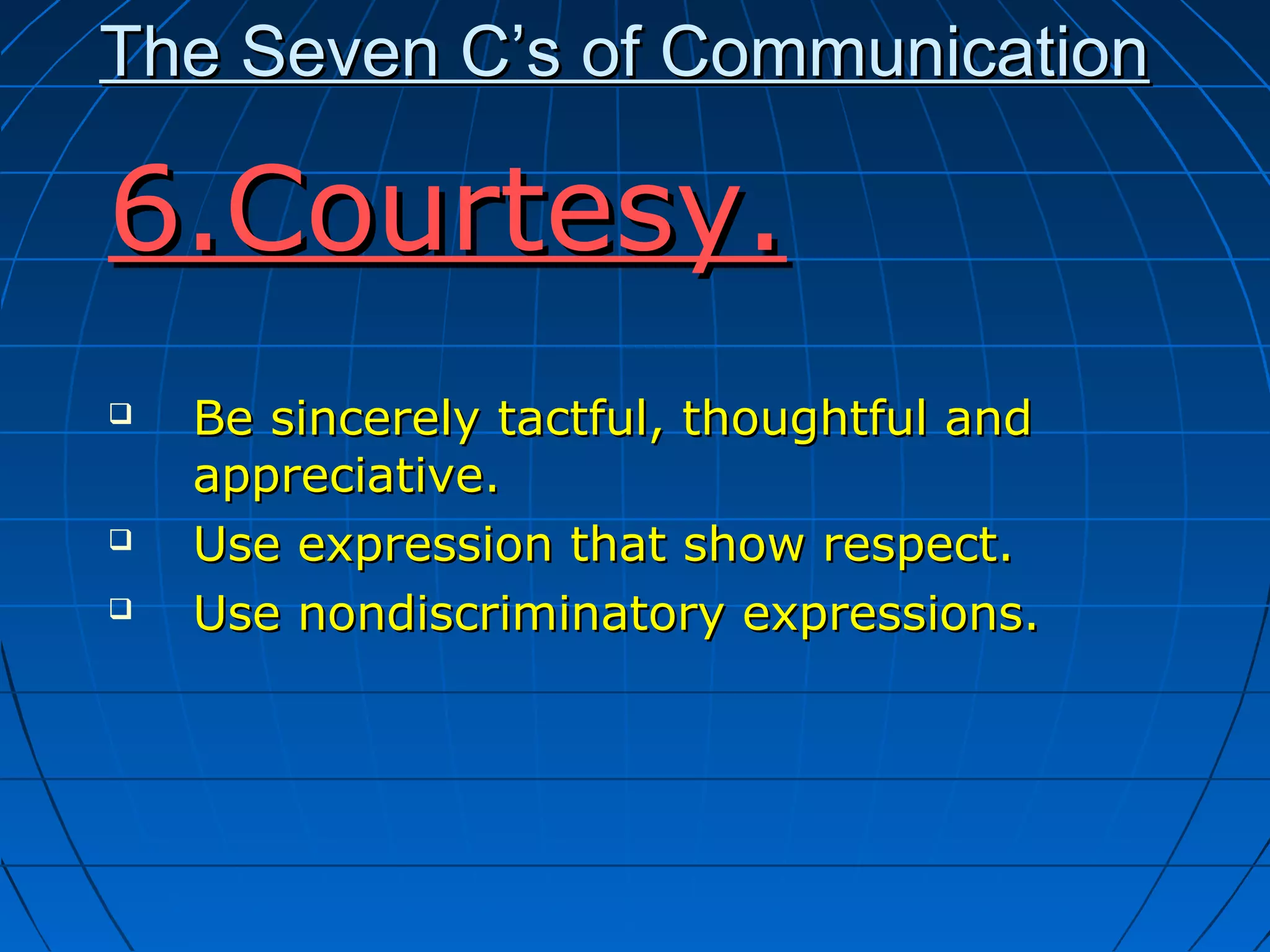
 Be sincerely tactful, thoughtful andBe sincerely tactful, thoughtful and
appreciative.appreciative.
 Use expression that show respect.Use expression that show respect.
 Use nondiscriminatory expressions.Use nondiscriminatory expressions.
The Seven C’s of CommunicationThe Seven C’s of Communication
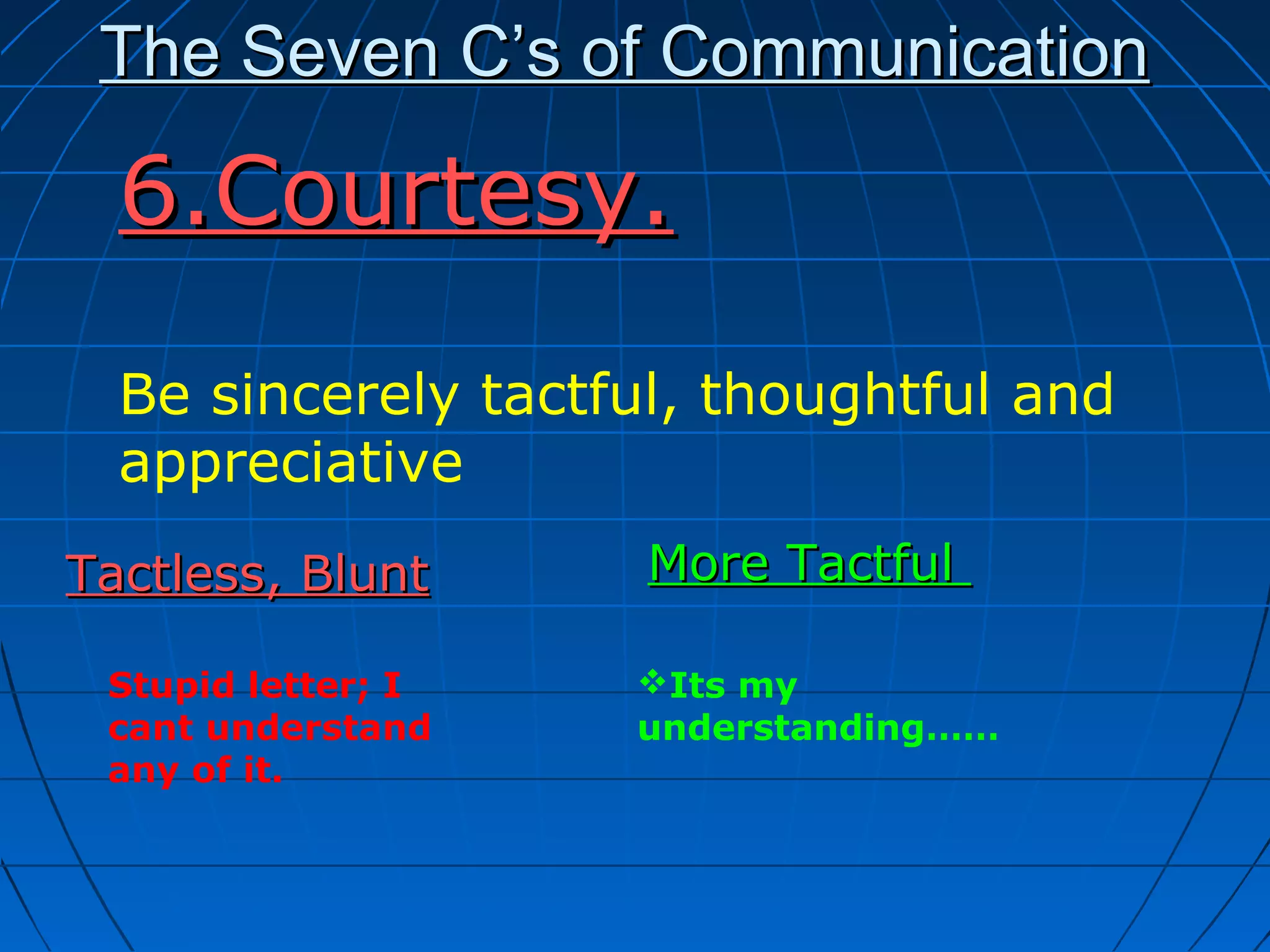
Tactless, BluntTactless, Blunt
6.Courtesy.6.Courtesy.
Be sincerely tactful, thoughtful and
appreciative
Stupid letter; I
cant understand
any of it.
Its my
understanding……
More TactfulMore Tactful
The Seven C’s of CommunicationThe Seven C’s of Communication
6.Courtesy.6.Courtesy.
Use expression that show respect.
>.>. Avoid irritating expressions.Avoid irritating expressions.
>.>.Avoid using questionable humor.Avoid using questionable humor.
The Seven C’s of CommunicationThe Seven C’s of Communication
6.Courtesy.6.Courtesy.
Use nondiscriminatory expressions.
>.>. Use language for all kind of people.Use language for all kind of people.
The Seven C’s of CommunicationThe Seven C’s of Communication
7.Correctness.7.Correctness.
 Use the right level of language.Use the right level of language.
 Check the accuracy of figures, factsCheck the accuracy of figures, facts
and words.and words.
The Seven C’s of CommunicationThe Seven C’s of Communication
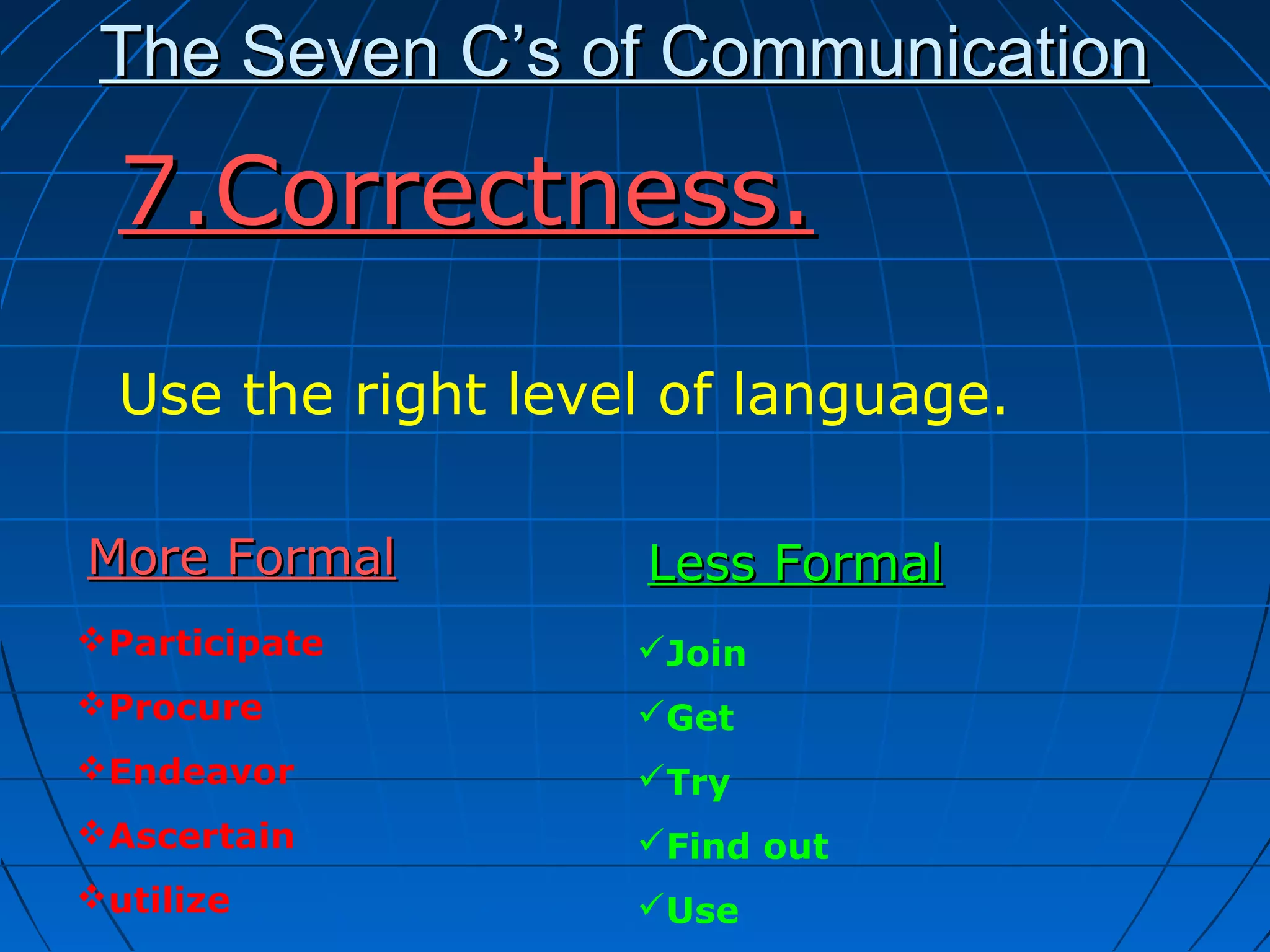
More FormalMore Formal
7.Correctness.7.Correctness.
Use the right level of language.
Participate
Procure
Endeavor
Ascertain
utilize
Join
Get
Try
Find out
Use
Less FormalLess Formal
The Seven C’s of CommunicationThe Seven C’s of Communication
7.Correctness.7.Correctness.
Check the accuracy of figures, facts
and words.
>.>. Verify your numerical data.Verify your numerical data.
>.>. Double check your totals.Double check your totals.
>.>. Ask someone else to read youAsk someone else to read you
message.message.
Thanks.Thanks.

The seven-cs-of-communication- By Sambit Biswal

  • 1.
    The Seven C’sofThe Seven C’s of CommunicationCommunication By: Sambit BiswalBy: Sambit Biswal
  • 2.
    The Seven C’sof CommunicationThe Seven C’s of Communication What is 7Cs?What is 7Cs?
  • 3.
    The Seven C’sof CommunicationThe Seven C’s of Communication 7 Principles of effective7 Principles of effective communicationcommunication.. 1.1. CompletenessCompleteness 2.2. ConcisenessConciseness 3.3. ConsiderationConsideration 4.4. ConcretenessConcreteness 5.5. ClarityClarity 6.6. CourtesyCourtesy 7.7. CorrectnessCorrectness
  • 4.
    The Seven C’sof CommunicationThe Seven C’s of Communication 7 C’s Can Be Applied for both7 C’s Can Be Applied for both  OralOral  WritingWriting
  • 5.
    The Seven C’sof CommunicationThe Seven C’s of Communication 1.Completeness1.Completeness  Provide all necessary information.Provide all necessary information.  Answer all questions asked.Answer all questions asked.  Give something extra, when desirable.Give something extra, when desirable.
  • 6.
    The Seven C’sof CommunicationThe Seven C’s of Communication Provide all necessary information.Provide all necessary information. >.>. Accurate understanding.Accurate understanding. >.>. W questions are useful.W questions are useful. 1.Completeness
  • 7.
    The Seven C’sof CommunicationThe Seven C’s of Communication Answer all Questions asked.Answer all Questions asked. >.>. Replying inquiryReplying inquiry.. >.>. List the needed detailsList the needed details.. 1.Completeness
  • 8.
    The Seven C’sof CommunicationThe Seven C’s of Communication Give something extra, whenGive something extra, when desirable.desirable. >.>. Answer in extraordinary way.Answer in extraordinary way. 1.Completeness
  • 9.
    The Seven C’sof CommunicationThe Seven C’s of Communication 2. Conciseness.2. Conciseness.  Wipe out wordy expression.Wipe out wordy expression.  Add only relevant information.Add only relevant information.  Avoid unnecessary repetition.Avoid unnecessary repetition.
  • 10.
    The Seven C’sof CommunicationThe Seven C’s of Communication Wipe out wordy expression.Wipe out wordy expression. >.>. Using Single-words instead of too long.Using Single-words instead of too long. >.>. Bullet your wordsBullet your words 2.Conciseness.2.Conciseness.
  • 11.
    The Seven C’sof CommunicationThe Seven C’s of Communication For Example;For Example; 2.Conciseness.2.Conciseness.  Due to the fact that  In due course  At this time  Few in number  On a weekly basis  In spite of the fact that  Until such time as  Meet together Because Soon Now Few Weekly Although Until Meet
  • 12.
    The Seven C’sof CommunicationThe Seven C’s of Communication Add only relevant information.Add only relevant information. >.>. Stick to the point.Stick to the point. >.>. Delete irrelevant statements.Delete irrelevant statements. >.>. Avoid long introduction andAvoid long introduction and Unnecessary explanationsUnnecessary explanations >.>. Talk to the pointTalk to the point 2.Conciseness.2.Conciseness.
  • 13.
    The Seven C’sof CommunicationThe Seven C’s of Communication Avoid unnecessary repetition.Avoid unnecessary repetition. >.>. Do not repeat the words or ideasDo not repeat the words or ideas unnecessary.unnecessary. 2.Conciseness.2.Conciseness.
  • 14.
    The Seven C’sof CommunicationThe Seven C’s of Communication 3.Consideration.3.Consideration.  Focus on “you” instead of “I” and “we”.Focus on “you” instead of “I” and “we”.  Show audience interest in the receiver.Show audience interest in the receiver.  Emphasize positive, pleasant facts.Emphasize positive, pleasant facts.
  • 15.
    The Seven C’sof CommunicationThe Seven C’s of Communication Focus on “you” instead of “I” and “we”.Focus on “you” instead of “I” and “we”. >.>. Creating a YOU attitude.Creating a YOU attitude. >.>. Assume you know people needs.Assume you know people needs. >.>. Do not use YOU in insensitive cases.Do not use YOU in insensitive cases. 3.Consideration.3.Consideration.
  • 16.
    The Seven C’sof CommunicationThe Seven C’s of Communication Show audience interest in the receiver.Show audience interest in the receiver. >.>. Talk about receiver benefits.Talk about receiver benefits. 3.Consideration.3.Consideration.
  • 17.
    The Seven C’sof CommunicationThe Seven C’s of Communication Emphasize positive, pleasant facts.Emphasize positive, pleasant facts. >.>. Be Optimistic.Be Optimistic. 3.Consideration.3.Consideration. Favorably Happy Help Generous Pleasure Loyal Thanks Unfavorable Unhappy Hopeless Reject Trouble Unfair Regret
  • 18.
    The Seven C’sof CommunicationThe Seven C’s of Communication 4.Concreteness.4.Concreteness.  Use specific facts & figures.Use specific facts & figures.  Put actions in your verbs.Put actions in your verbs.  Choose vivid, image-building words.Choose vivid, image-building words.
  • 19.
    The Seven C’sof CommunicationThe Seven C’s of Communication Use specific facts & figures.Use specific facts & figures. >.>. Use precise statements instead of vagueUse precise statements instead of vague words.words. Instead of writing;Instead of writing; 4.Concreteness.4.Concreteness. Student GMAT scores are higher In 1996 the GMAT scores averaged 600; by 1997 they had risen to 610. It should be written;
  • 20.
    The Seven C’sof CommunicationThe Seven C’s of Communication Use specific facts & figures.Use specific facts & figures. >.>. Some Vague words.Some Vague words. SlightlySlightly SmallSmall SoonSoon A fewA few AlmostAlmost SeveralSeveral 4.Concreteness.4.Concreteness.
  • 21.
    The Seven C’sof CommunicationThe Seven C’s of Communication Put actions in your verbs.Put actions in your verbs. >.>. Use active voice.Use active voice. >.>. Use action in verbs, Not in nouns.Use action in verbs, Not in nouns. 4.Concreteness.4.Concreteness.
  • 22.
    The Seven C’sof CommunicationThe Seven C’s of Communication Choose vivid, image-building words.Choose vivid, image-building words. >.>. Use impressive and appealing words.Use impressive and appealing words. 4.Concreteness.4.Concreteness.
  • 23.
    The Seven C’sof CommunicationThe Seven C’s of Communication 5.Clarity.5.Clarity.  Choose Precise, concrete and familiarChoose Precise, concrete and familiar words.words.  Construct effective sentences andConstruct effective sentences and paragraphs.paragraphs.
  • 24.
    The Seven C’sof CommunicationThe Seven C’s of Communication Choose Precise, concrete and familiarChoose Precise, concrete and familiar words.words. >.>. Use Simple & famous words.Use Simple & famous words. >.>. Write your purpose clearly.Write your purpose clearly. 5.Clarity.5.Clarity.
  • 25.
    The Seven C’sof CommunicationThe Seven C’s of Communication Familiar WordsFamiliar Words 5.Clarity.5.Clarity. About After Home For example Pay Invoice Cirea (L) Subsequent Domicile E.g. Remuneration Statement of payment Pretentious WordsPretentious Words
  • 26.
    The Seven C’sof CommunicationThe Seven C’s of Communication Construct effective sentences andConstruct effective sentences and paragraphs.paragraphs. >.>. Length. (Sentence <40 words)Length. (Sentence <40 words) >.>. Unity. (One main idea in one paragraph)Unity. (One main idea in one paragraph) >.>. Coherence. ( Say clearly)Coherence. ( Say clearly) >.>. Emphasis. (Choose correct sentence toEmphasis. (Choose correct sentence to focus on it.focus on it. 5.Clarity.5.Clarity.
  • 27.
    The Seven C’sof CommunicationThe Seven C’s of Communication 6.Courtesy.6.Courtesy.  Be sincerely tactful, thoughtful andBe sincerely tactful, thoughtful and appreciative.appreciative.  Use expression that show respect.Use expression that show respect.  Use nondiscriminatory expressions.Use nondiscriminatory expressions.
  • 28.
    The Seven C’sof CommunicationThe Seven C’s of Communication Tactless, BluntTactless, Blunt 6.Courtesy.6.Courtesy. Be sincerely tactful, thoughtful and appreciative Stupid letter; I cant understand any of it. Its my understanding…… More TactfulMore Tactful
  • 29.
    The Seven C’sof CommunicationThe Seven C’s of Communication 6.Courtesy.6.Courtesy. Use expression that show respect. >.>. Avoid irritating expressions.Avoid irritating expressions. >.>.Avoid using questionable humor.Avoid using questionable humor.
  • 30.
    The Seven C’sof CommunicationThe Seven C’s of Communication 6.Courtesy.6.Courtesy. Use nondiscriminatory expressions. >.>. Use language for all kind of people.Use language for all kind of people.
  • 31.
    The Seven C’sof CommunicationThe Seven C’s of Communication 7.Correctness.7.Correctness.  Use the right level of language.Use the right level of language.  Check the accuracy of figures, factsCheck the accuracy of figures, facts and words.and words.
  • 32.
    The Seven C’sof CommunicationThe Seven C’s of Communication More FormalMore Formal 7.Correctness.7.Correctness. Use the right level of language. Participate Procure Endeavor Ascertain utilize Join Get Try Find out Use Less FormalLess Formal
  • 33.
    The Seven C’sof CommunicationThe Seven C’s of Communication 7.Correctness.7.Correctness. Check the accuracy of figures, facts and words. >.>. Verify your numerical data.Verify your numerical data. >.>. Double check your totals.Double check your totals. >.>. Ask someone else to read youAsk someone else to read you message.message.
  • 34.