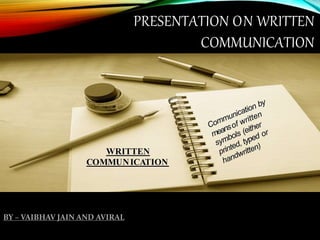
PRESENTATION ON WRITTEN
COMMUNICATION
WRITTEN
COMMUNICATION
BY – VAIBHAV JAIN AND AVIRAL
WRITING?
One of the best methods to communicate
Writing isone of the oldest known forms of
communication
In today’sageof information and technology,
writing has become alost art
GOALS &OBJECTIVES
1. Future reference
2. Record of evidence
3. Measurement of progress
4. Precedents
5. Avoiding mistakes
6. Effectivedecision-making
7. Organizational efficiency
8. Legal requirements
WHYWRITTEN COMMUNICATION?
Createsapermanent record
Allowsyou to store information for future
reference
Easily distributed
Allrecipients receivethe same information
Necessary for legaland binding documentation
Writing skillsare specificabilitieswhich help writers put
their thoughts into words in ameaningful form and to
mentally interact with the message.
DEFINITION
WRITING
SKILLS?
The abilityto writedoes not require aunique
talent or an outstanding mental ability
Everyone has the basicskillsnecessary to write well
Abasic understanding of writingand a
commitment to writingwellin allsituations is
needed asa professional
QUESTIONS A WRITER ASKS
How do I begin?
What ismy purpose?
How do I make mypoint clear?
How do I createalogical flow?
How do I saywhat I mean?
How do I avoid grammatical errors?
How can I make mymessage brief?
How can I createavisual effect?
Directives Forms
News bulletin
Proposals
Agreements
Handbook
Pamphlets Brochures
THE WRITINGPROCESS
Planning
Writing
Quality Control
THE WRITING
PROCESS
Planning
Keep objectives in mind and research the topic
Think about the audience
Outlining helps organize thoughts
THE WRITING
PROCESS
Writing
Follow your outline, use your handbook
Inspiration isacceptable but must be carefully
reviewed
Use the interview approach to supplement the
outline (who, what, where, when, how)
THE WRITING
PROCESS
QualityControl
Reread your work
Becritical of yourown
work
CONSIDERATIONS WHILE WRITING
Who?
What?
When?
Why?
Where?
How?
GOOD
WRITING
Completeness: all information needed is provided
Correctness: relevant and precise information
Credibility: support your argument
Clarity: should not be vague, confusing, ambiguous
Conciseness: to the point
Consideration: anticipate the reader’s reaction
Vitality: use the active voice rather than the passive
voice
Effective Writing Skills
DIFFERENT WRITING
STYLES
There are three types of writing styles:
Colloquial
Casual
Formal
SOME DOS AND
DO NOTS
Be Specific: Just like a reporter, communicate
the “who, what, where, why, when and how” of
what needs to done. Stay objective and specific.
Avoid the Passive Voice: Instead of writing
“The program was planned by Dane,” write,
“Dane planned the program.”
Be Concise :There’s no need to be long-winded.
Get to the point. You’ll lose readers if you spout
off too long!
Get Things Right :Take great care when spelling people’s
names,, and other specifics. And also make sure that you
do a careful proof of your work.
Know When Formal Language is Required: If you’re
writing an informal note to group members, it’s fine to
use contractions (“don’t” instead of “do not”).However,
if you’re writing for a formal audience, like a proposal to
the board of directors, be more formal with your
language.
Read It Out Loud :One very effective wayto self-proof
your work is to read it out loud. This willhelp you
determine if you’veused incorrect words, if your
sentences run on too long, if your tenses don’t match, and
more.
BUSINESS
DOCUMENTS
Agood business document should always answer the
following questions:
What is this document about?
Why has it come to be?
Who wrote it?
How is it organized?
What is it trying to accomplish?
What supports the conclusion?
What problem or opportunity does it address?
COMMON
ETIQUETTES
Focus on format
Ensuring connectivity
Structuring of the content
Tempering the content as per the level of formalities
Steering clear of short form
Importance of grammar, spelling and punctuation
Sensitivity to the audience
Importance of creativity
Avoiding excessive use of jargon
Awareness of the audience /medium
SPELLING AND
GRAMMAR
It is important in all business communications to
use propergrammarand correctspelling
What you write and how you write could reflect
a positive or negative image
Sloppy and/or poorly written communications
could be perceived as a lack of caring
SPELLING AND GRAMMAR
TIPS
Proofread communications before sending
Use spell and grammar check if available
Make sure to have subject, verb and tense
agreement
Ensure proper word usage:
affect/effect
among/between
can/may
there/their
shall/will
than/then
TYPES OF
WRITING
E-mails
Letters and Memos
Agendas
Reports
Promotional Material
Academic Documents
Research (scientific) manuscripts
Circulars
Notices
E-MAILS
E-mail is fast, convenient and easy
Email is now the dominant method of communicating
in business.
Convenient for communicating with people in different
places and different time zones
Easier to communicate with people who understand
written English but don’t speak it well
Excellent mechanism for follow-up or action items
after a meeting
Messages can be saved and retrieved easily
E-MAILS
(CHALLENGES)
WATCH
OUT!
E-MAILS
(CHALLENGES)
Email is often sent out without re-reading,
proof-reading and other standards applied to
written communications. We press the send
button too soon!
Emails can be forwarded and sent to others
without your approval or knowledge
E-MAILS
Many users do not realize the potential outcome
of what is being sent through e-mails
Business e-mails should be concise and to the
point
The language used in business e-mails should
not be overly informal
LETTERS AND
MEMOS
Letters and memos are the basic vehicles of
business communication
They should be brief and make a single point
Letters are for external communications
Memos are for internal communications
LETTERS AND
MEMOS
Heading or
Letterhead
Date
Inside address
Salutation
Subject line
Body
Closing and
Signature
Enclosures
Allbusiness letters should include:
Reference No. Ref:T/23/19
Date 31st December,2010
Sender’s Address GMR Builders
Inside Address Mr. G.Reddy, Ramco Tiles,
New Delhi.
Salutation Dear Sir,
Body Text We are pleased………..
Closing ‘callto Action’ Yours Sincerely
Signature Block Sd/-
Enclosures Carbon Copy Encl: cc to: bcc:
COMPLIMENTARY CLOSE
Dear Sir
Dear Sirs
Dear Madam
Dear Sir/Madam
Yours faithfully
Or
Yours truly
Dear Ms. Kranthi
Dear Mr. Kiran
Dear Kalyan
Yours sincerely
Dear Customer
Dear Reader
Dear Subscriber
Dear Shareholder
Dear Member
Yours sincerely
NAME ON THE LETTER HEAD
Ref: no. : Reg/01/002
21st October,2010
Mr. Ramesh Debraj
General Manager – Finance
The School Book Depot
Navi Mumbai – 400 707
Sub: Request for the rates
Dear Mr.Debraj,
We shall be reallypleased to establish business contacts with you for the purchase of some Publications
of Maharashtra. Kindly send the price list available with you and the terms and conditions of the
business at he earliest, so that we can immediately place the order.
We look forward for your immediate positive action.
Thanking you,
Yours sincerely,
Subhash Chandra
G M– Marketing
LETTERS AND
MEMOS
Allbusiness memos should include:
TO: (To whom is the memo directed?)
FROM: (Who wrote the memo?)
DATE:
SUBJECT:
TYPES OF LETTERS AND
MEMOS
Letters of request
Sales letters
Response letters
Cover letters, recommendations
Letters of collection
Letters to vendors and suppliers
Memos that deal with employee issues
Memos that make announcements
Memos for policies and procedures
HAVE YOU HIT YOUR
TARGET?
In written
communication most
confusion &frustration
are caused by failing to
be specific
Make it clear, brief and
concise
REPORTS
Define the main point
Define the goals and objectives
Collect the evidence needed to support the main
point
Organize the report
State the conclusions and recommendations
ORGANIZATION OF
REPORTS
• Introduction
• Materials and methods Results and discussions Conclusions
Recommendations
Title
Executive summary
COMMON
ERRORS & TIPS
Company name usage
Shortened words (thru, condn, mgmt, ref, lib)
Repetition of words
Example: file the file in the file folder.
Use of ampersand (&)
Use of bold
UPPER CASE
COMMON
ERRORS & TIPS
Punctuation
Use commas to separate elements in a series, and to
separate ideas or clauses.
Use correct punctuation in abbreviations; e.g., for
example i.e., that is etc., et cetera
Do not use multiple punctuation marks, for example: !!!
... ???, etc.
Punctuation of lists and tables
COMMON
ERRORS & TIPS
Hyphen and dash usage
Confusion between its and it's
Use of apostrophe
Abbreviations and acronyms
Use active voice
Proofread for accuracy
10
COMMANDMENTS
1. Know what you want to say before you say it.
2. Keep it simple.
3. Use bullet points.
4. WIIFM (What's in It For Me?)
5. Don't get bogged down
6. Call to action
7. Edit
8. Spell check
9. Take 5 before hitting send
10. Follow up
FIRST IMPRESSIONS
No matter what you are writing a few things can create
a negative first impression about your intelligence and
your level of care: misspellings grammatical mistakes
missed words messy delivery and incomplete work.
CONCLUSIONS
Utilize full potential of written communication
Use frequent e-mails as per your requirement
What you write willultimately define you as a
professional to your colleagues and superiors
Match the appropriate communication method
to the recipient
Eliminating excessive or unnecessary
communication willimprove your workflow
Mastering these skills willimprove your ability
and enhance your career
THANK YOU
Effective Writing Skills

web55.pptx

  • 1.
  • 2.
    WRITING? One of thebest methods to communicate Writing isone of the oldest known forms of communication In today’sageof information and technology, writing has become alost art
  • 3.
    GOALS &OBJECTIVES 1. Futurereference 2. Record of evidence 3. Measurement of progress 4. Precedents 5. Avoiding mistakes 6. Effectivedecision-making 7. Organizational efficiency 8. Legal requirements
  • 4.
    WHYWRITTEN COMMUNICATION? Createsapermanent record Allowsyouto store information for future reference Easily distributed Allrecipients receivethe same information Necessary for legaland binding documentation
  • 5.
    Writing skillsare specificabilitieswhichhelp writers put their thoughts into words in ameaningful form and to mentally interact with the message. DEFINITION
  • 6.
    WRITING SKILLS? The abilityto writedoesnot require aunique talent or an outstanding mental ability Everyone has the basicskillsnecessary to write well Abasic understanding of writingand a commitment to writingwellin allsituations is needed asa professional
  • 7.
    QUESTIONS A WRITERASKS How do I begin? What ismy purpose? How do I make mypoint clear? How do I createalogical flow? How do I saywhat I mean? How do I avoid grammatical errors? How can I make mymessage brief? How can I createavisual effect?
  • 8.
  • 9.
  • 10.
    THE WRITING PROCESS Planning Keep objectivesin mind and research the topic Think about the audience Outlining helps organize thoughts
  • 11.
    THE WRITING PROCESS Writing Follow youroutline, use your handbook Inspiration isacceptable but must be carefully reviewed Use the interview approach to supplement the outline (who, what, where, when, how)
  • 12.
    THE WRITING PROCESS QualityControl Reread yourwork Becritical of yourown work
  • 13.
  • 14.
    GOOD WRITING Completeness: all informationneeded is provided Correctness: relevant and precise information Credibility: support your argument Clarity: should not be vague, confusing, ambiguous Conciseness: to the point Consideration: anticipate the reader’s reaction Vitality: use the active voice rather than the passive voice
  • 15.
    Effective Writing Skills DIFFERENTWRITING STYLES There are three types of writing styles: Colloquial Casual Formal
  • 16.
    SOME DOS AND DONOTS Be Specific: Just like a reporter, communicate the “who, what, where, why, when and how” of what needs to done. Stay objective and specific. Avoid the Passive Voice: Instead of writing “The program was planned by Dane,” write, “Dane planned the program.” Be Concise :There’s no need to be long-winded. Get to the point. You’ll lose readers if you spout off too long!
  • 17.
    Get Things Right:Take great care when spelling people’s names,, and other specifics. And also make sure that you do a careful proof of your work. Know When Formal Language is Required: If you’re writing an informal note to group members, it’s fine to use contractions (“don’t” instead of “do not”).However, if you’re writing for a formal audience, like a proposal to the board of directors, be more formal with your language. Read It Out Loud :One very effective wayto self-proof your work is to read it out loud. This willhelp you determine if you’veused incorrect words, if your sentences run on too long, if your tenses don’t match, and more.
  • 18.
    BUSINESS DOCUMENTS Agood business documentshould always answer the following questions: What is this document about? Why has it come to be? Who wrote it? How is it organized? What is it trying to accomplish? What supports the conclusion? What problem or opportunity does it address?
  • 19.
    COMMON ETIQUETTES Focus on format Ensuringconnectivity Structuring of the content Tempering the content as per the level of formalities Steering clear of short form Importance of grammar, spelling and punctuation Sensitivity to the audience Importance of creativity Avoiding excessive use of jargon Awareness of the audience /medium
  • 20.
    SPELLING AND GRAMMAR It isimportant in all business communications to use propergrammarand correctspelling What you write and how you write could reflect a positive or negative image Sloppy and/or poorly written communications could be perceived as a lack of caring
  • 21.
    SPELLING AND GRAMMAR TIPS Proofreadcommunications before sending Use spell and grammar check if available Make sure to have subject, verb and tense agreement Ensure proper word usage: affect/effect among/between can/may there/their shall/will than/then
  • 22.
    TYPES OF WRITING E-mails Letters andMemos Agendas Reports Promotional Material Academic Documents Research (scientific) manuscripts Circulars Notices
  • 23.
    E-MAILS E-mail is fast,convenient and easy Email is now the dominant method of communicating in business. Convenient for communicating with people in different places and different time zones Easier to communicate with people who understand written English but don’t speak it well Excellent mechanism for follow-up or action items after a meeting Messages can be saved and retrieved easily
  • 24.
  • 25.
  • 26.
    E-MAILS (CHALLENGES) Email is oftensent out without re-reading, proof-reading and other standards applied to written communications. We press the send button too soon! Emails can be forwarded and sent to others without your approval or knowledge
  • 27.
    E-MAILS Many users donot realize the potential outcome of what is being sent through e-mails Business e-mails should be concise and to the point The language used in business e-mails should not be overly informal
  • 28.
    LETTERS AND MEMOS Letters andmemos are the basic vehicles of business communication They should be brief and make a single point Letters are for external communications Memos are for internal communications
  • 29.
    LETTERS AND MEMOS Heading or Letterhead Date Insideaddress Salutation Subject line Body Closing and Signature Enclosures Allbusiness letters should include:
  • 30.
    Reference No. Ref:T/23/19 Date31st December,2010 Sender’s Address GMR Builders Inside Address Mr. G.Reddy, Ramco Tiles, New Delhi. Salutation Dear Sir, Body Text We are pleased……….. Closing ‘callto Action’ Yours Sincerely Signature Block Sd/- Enclosures Carbon Copy Encl: cc to: bcc:
  • 31.
    COMPLIMENTARY CLOSE Dear Sir DearSirs Dear Madam Dear Sir/Madam Yours faithfully Or Yours truly Dear Ms. Kranthi Dear Mr. Kiran Dear Kalyan Yours sincerely Dear Customer Dear Reader Dear Subscriber Dear Shareholder Dear Member Yours sincerely
  • 32.
    NAME ON THELETTER HEAD Ref: no. : Reg/01/002 21st October,2010 Mr. Ramesh Debraj General Manager – Finance The School Book Depot Navi Mumbai – 400 707 Sub: Request for the rates Dear Mr.Debraj, We shall be reallypleased to establish business contacts with you for the purchase of some Publications of Maharashtra. Kindly send the price list available with you and the terms and conditions of the business at he earliest, so that we can immediately place the order. We look forward for your immediate positive action. Thanking you, Yours sincerely, Subhash Chandra G M– Marketing
  • 33.
    LETTERS AND MEMOS Allbusiness memosshould include: TO: (To whom is the memo directed?) FROM: (Who wrote the memo?) DATE: SUBJECT:
  • 34.
    TYPES OF LETTERSAND MEMOS Letters of request Sales letters Response letters Cover letters, recommendations Letters of collection Letters to vendors and suppliers Memos that deal with employee issues Memos that make announcements Memos for policies and procedures
  • 35.
    HAVE YOU HITYOUR TARGET? In written communication most confusion &frustration are caused by failing to be specific Make it clear, brief and concise
  • 36.
    REPORTS Define the mainpoint Define the goals and objectives Collect the evidence needed to support the main point Organize the report State the conclusions and recommendations
  • 37.
    ORGANIZATION OF REPORTS • Introduction •Materials and methods Results and discussions Conclusions Recommendations Title Executive summary
  • 38.
    COMMON ERRORS & TIPS Companyname usage Shortened words (thru, condn, mgmt, ref, lib) Repetition of words Example: file the file in the file folder. Use of ampersand (&) Use of bold UPPER CASE
  • 39.
    COMMON ERRORS & TIPS Punctuation Usecommas to separate elements in a series, and to separate ideas or clauses. Use correct punctuation in abbreviations; e.g., for example i.e., that is etc., et cetera Do not use multiple punctuation marks, for example: !!! ... ???, etc. Punctuation of lists and tables
  • 40.
    COMMON ERRORS & TIPS Hyphenand dash usage Confusion between its and it's Use of apostrophe Abbreviations and acronyms Use active voice Proofread for accuracy
  • 41.
    10 COMMANDMENTS 1. Know whatyou want to say before you say it. 2. Keep it simple. 3. Use bullet points. 4. WIIFM (What's in It For Me?) 5. Don't get bogged down 6. Call to action 7. Edit 8. Spell check 9. Take 5 before hitting send 10. Follow up
  • 42.
    FIRST IMPRESSIONS No matterwhat you are writing a few things can create a negative first impression about your intelligence and your level of care: misspellings grammatical mistakes missed words messy delivery and incomplete work.
  • 43.
    CONCLUSIONS Utilize full potentialof written communication Use frequent e-mails as per your requirement What you write willultimately define you as a professional to your colleagues and superiors Match the appropriate communication method to the recipient Eliminating excessive or unnecessary communication willimprove your workflow Mastering these skills willimprove your ability and enhance your career
  • 44.