TARIQ KHAN
By Tariq khan
TARIQ KHAN
• When We talk about “ Effective
Communication” one thing that comes in
mind, what are the basic principles of
“effective communication” .
• These principles tells us how your message
can becomes effective for your target group,
• These principles also tell about style and
importance of the message.
• These principles commonly known as 7 C’s of
effective communication.
TARIQ KHAN
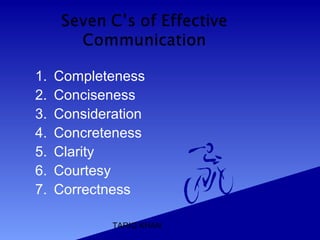
1. Completeness
2. Conciseness
3. Consideration
4. Concreteness
5. Clarity
6. Courtesy
7. Correctness
TARIQ KHAN
• Message Receiver- either listener or reader, desire
complete information to their question. e.g.
• suppose you are working with multinational company
who is engaging with engineering goods , like A.C.
Now let say one of your major customer wants some
technical information regarding “thermostat” (because
he wants to convey the same to the end users ). In
this case you have to provide him complete
information in a short span of time.
• If possible, provide him some extra information which
he does not know,.
• In this way you can maintain a good business relation
with him, otherwise he may switch to an other
company.
TARIQ KHAN
• One way to make your message complete is to
answer the five W’s.
• WHO?
• WHAT?
• WHEN?
• WHERE?
• WHY?
• The five question method is useful when you write
requests, announcements, or other informative
messages.
• For instance, to order (request) merchandise, make
clear WHAT you want, WHEN u need it, WHERE it is
to be sent.
TARIQ KHAN
At the end we can say that, you must
provide him:-
1. All necessary information as
requested by him.
2. Answers to his all questions carefully
3. Provide some more information,
which he is not requiring , just to
maintain good relations.
TARIQ KHAN
• Conciseness means “convey the
message by using fewest words”.
• “Conciseness is the prerequisite to
effective business communication.”
As you know that all businessmen
have very short time .
• Hence a concise message save the
time and expenses for both the
parties.
TARIQ KHAN
For achieving the conciseness
you have to consider the
following.
1.Avoid wordy expression
2.Include only relevant material
3.Avoid unnecessary repetition.
TARIQ KHAN
• E.g. Wordy:- at this time.
Instead of “at this time” you can just use
only a concise word:- NOW ,
Always try to use “ To the point
Approach” in business scenario
perspective.
TARIQ KHAN
• Always try to provide only relevant information to the
receiver of the message.
• Lets say one of your customer requested
 for clients of the company
 in reply you should provide simply list of clients at the panel of
your company.
 No need to provide detailed business information about client
at all.
• Observe the following suggestions to “ Include only
relevant information.”
– Stick to the purpose of message
– Delete irrelevant words
– Avoid long introduction, unnecessary explanation etc.
– Get to the important point concisely.
TARIQ KHAN
• Some times repetition is necessary for
focusing some special issue.
• But when the same thing is said with out
two or three reasons, the message
become wordy and boring.
• That’s why try to avoid Un-necessary
repetition.

TARIQ KHAN
• Use shorter name after you have mentioned the
long once. e.g.
• Spectrum communications Private limited use
spectrum.
• Use pronouns or initials E.g.
Instead of world trade organization use WTO or
You can use IT for Information Technology.
( keeping in views that receiver knows about
these terms)
TARIQ KHAN
• Consideration means – To consider the
receiver’s Interest/Intention.
• It is very important in effective
communication while writing a
message you should always keep in
mind your target group
consideration is very important “C”
among all the seven C’s.
TARIQ KHAN
i-Focus on “you” instead of “I” or “We”
ii-Show audience benefit or interest of the
receiver
iii-Emphasize positive, pleasant facts.
Using “you” help you, but over use lead a
negative reaction.
TARIQ KHAN
Always write a message in such a way how
audience should be benefited from it. e.g.
We attitude
I am delighted to announce that we will
extend to make shopping more.
TARIQ KHAN
You attitude
“You will be able to shop in the evening
with the extended hours.”
Readers may react positively when
benefit are shown to them.
Always try to address his/her need and
want.
TARIQ KHAN
• Always show/write to reader…………
what has been done so far as his/her
query is concerned.
• And always avoid that his/her need and
wants.
• Always avoid that has not been done
so far.
TARIQ KHAN
• It means that message should be
specific instead of general.
Misunderstanding of words creates
problems for both parties (sender and
receiver).
• when you talk to your client always use
facts and figures instead of generic or
irrelevant information.
TARIQ KHAN
The following guidelines should help you
to achieve the Concreteness.
i- use specific facts and figures
ii-choose image building words
e.g
General
He is very intelligent student of class and
stood first in the class.
TARIQ KHAN
Concrete
Ali’s GPA in B.Sc Electrical Engineering
2k3-f session was 3.95/4.0, he stood
first in his class.
Always write on a very solid ground. It
should definitely create good image as
well.
TARIQ KHAN
TARIQ KHAN
In effective business communication the
message should be very much clear.
So that reader can understand it easily.
You should always Choose precise
words.
Always choose familiar and easy words.
Construct effective sentences and
paragraphs.
TARIQ KHAN
In business communication always use
precise words rather longer statements.
If you have a choice between long words
and shorter one, always use shorter
one.
You should try your level best to use
familiar/easy to understand words so
that your reader will quickly under
stand it
TARIQ KHAN
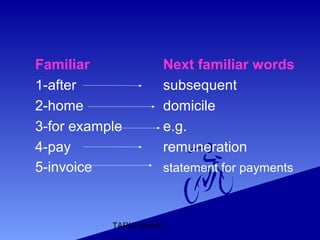
Familiar Next familiar words
1-after subsequent
2-home domicile
3-for example e.g.
4-pay remuneration
5-invoice statement for payments
TARIQ KHAN
6) Courtesy
TARIQ KHAN
• Knowing your audience allows you to use statements of
courtesy; be aware of your message receiver.
True courtesy involves being aware not only of the
perspective of others, but also their feelings. courtesy
stems from a sincere you-attitude.
• it is not merely politeness with mechanical insertions of
“please” and “Thank you” .
• Although Appling socially accepted manners is a form
of courtesy .
• rather, it is politeness that grow out respect and
concern for others.
Courteous communication generate a special tone in their
writing and speaking.
TARIQ KHAN
The following are suggestions for generating a courteous
tone:
• Be sincerely tactful, thoughtful and appreciative.
• Use expressions that show respect for the others
• Choose nondiscriminatory expressions
Be sincerely Tactful, Thoughtful and Appreciative
• Though few people are intentionally abrupt or blunt,
these negative traits are common cause of discourtesy.
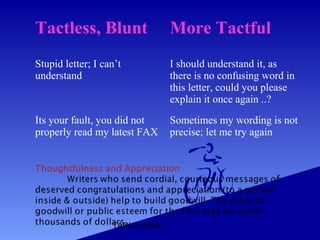
• avoid expression like those in the left hand column
below; rephrase them as shown in the right-hand
column
TARIQ KHAN
Tactless, Blunt More Tactful
Stupid letter; I can’t
understand
I should understand it, as
there is no confusing word in
this letter, could you please
explain it once again ..?
Its your fault, you did not
properly read my latest FAX
Sometimes my wording is not
precise; let me try again
TARIQ KHAN
7) Correctness
TARIQ KHAN
At the core of correctness is proper grammar,
punctuation and spelling.
however, message must be perfect
grammatically and mechanically
. The term correctness, as applied to business
messages also mean three characteristics
o Use the right level of language
o Check the accuracy of figures, facts and words
o Maintain acceptable writing mechanics
TARIQ KHAN
we suggest that there are three level of language
1. formal
2. informal
3. substandard.
Take a quick guess: what kind of writing is
associated with each level? What is the style
of each?
TARIQ KHAN
Formal writing is often associated with scholarly writing:
doctoral dissertations, scholarly, legal documents,
top-level government agreements and other material
where formality is demanded.
Informal writing is more characteristic of business
writing. Here you use words that are short, well-
known and conversational as in this comparison list:
More Formal less formal
Participate Join
Endeavor try
Ascertain find out
Utilize use
Interrogate question
TARIQ KHAN
Avoid substandard language. Using correct
words, incorrect grammar, faulty
pronunciation all suggest as inability to use
good English. Some examples follow:
Substandard More Acceptable
Ain’t isn’t,aren’t
Can’t hardly can hardly
Aim to proving aim to prove
Desirous to desirous of
Stoled stolen
TARIQ KHAN
Check Accuracy of Facts, Figures and words
It is impossible to convey meaning precisely, through words, from the
head of the sender to a receiver. Our goal is to be as precise as
possible, which means checking and double-checking and double-
checking to ensure that the figures, facts and words you use are
correct.
“A good check of your data is to have another person read and
comment on the validity of the material”
Figures and facts
 Verify your statistical data
 Double-check your totals
 Avoid guessing at laws that have an impact on you, the sender
and your
 Have someone else read your message if the topic involves data.
 Determine whether a “fact” has changed over time
TARIQ KHAN
Our Language (Any) is constantly changing. In fact,even
dictionaries can not keep up with rapid change in our language.
the following words often confusing in usage:
A, An use a before consonants and
consonants sounds or a long ” u”
sound. Use an before vowels.
Accept, except accept is a verb and means to
receive. except is a verb or a
preposition and relates to
omitting or leaving out.
Anxious, eager Anxious implies worry, eager
conveys keen desire
TARIQ KHAN
End

7 c`s of effactive comunication

  • 1.
  • 2.
    TARIQ KHAN • WhenWe talk about “ Effective Communication” one thing that comes in mind, what are the basic principles of “effective communication” . • These principles tells us how your message can becomes effective for your target group, • These principles also tell about style and importance of the message. • These principles commonly known as 7 C’s of effective communication.
  • 3.
    TARIQ KHAN 1. Completeness 2.Conciseness 3. Consideration 4. Concreteness 5. Clarity 6. Courtesy 7. Correctness
  • 4.
    TARIQ KHAN • MessageReceiver- either listener or reader, desire complete information to their question. e.g. • suppose you are working with multinational company who is engaging with engineering goods , like A.C. Now let say one of your major customer wants some technical information regarding “thermostat” (because he wants to convey the same to the end users ). In this case you have to provide him complete information in a short span of time. • If possible, provide him some extra information which he does not know,. • In this way you can maintain a good business relation with him, otherwise he may switch to an other company.
  • 5.
    TARIQ KHAN • Oneway to make your message complete is to answer the five W’s. • WHO? • WHAT? • WHEN? • WHERE? • WHY? • The five question method is useful when you write requests, announcements, or other informative messages. • For instance, to order (request) merchandise, make clear WHAT you want, WHEN u need it, WHERE it is to be sent.
  • 6.
    TARIQ KHAN At theend we can say that, you must provide him:- 1. All necessary information as requested by him. 2. Answers to his all questions carefully 3. Provide some more information, which he is not requiring , just to maintain good relations.
  • 7.
    TARIQ KHAN • Concisenessmeans “convey the message by using fewest words”. • “Conciseness is the prerequisite to effective business communication.” As you know that all businessmen have very short time . • Hence a concise message save the time and expenses for both the parties.
  • 8.
    TARIQ KHAN For achievingthe conciseness you have to consider the following. 1.Avoid wordy expression 2.Include only relevant material 3.Avoid unnecessary repetition.
  • 9.
    TARIQ KHAN • E.g.Wordy:- at this time. Instead of “at this time” you can just use only a concise word:- NOW , Always try to use “ To the point Approach” in business scenario perspective.
  • 10.
    TARIQ KHAN • Alwaystry to provide only relevant information to the receiver of the message. • Lets say one of your customer requested  for clients of the company  in reply you should provide simply list of clients at the panel of your company.  No need to provide detailed business information about client at all. • Observe the following suggestions to “ Include only relevant information.” – Stick to the purpose of message – Delete irrelevant words – Avoid long introduction, unnecessary explanation etc. – Get to the important point concisely.
  • 11.
    TARIQ KHAN • Sometimes repetition is necessary for focusing some special issue. • But when the same thing is said with out two or three reasons, the message become wordy and boring. • That’s why try to avoid Un-necessary repetition.
  • 12.
    TARIQ KHAN • Useshorter name after you have mentioned the long once. e.g. • Spectrum communications Private limited use spectrum. • Use pronouns or initials E.g. Instead of world trade organization use WTO or You can use IT for Information Technology. ( keeping in views that receiver knows about these terms)
  • 13.
    TARIQ KHAN • Considerationmeans – To consider the receiver’s Interest/Intention. • It is very important in effective communication while writing a message you should always keep in mind your target group consideration is very important “C” among all the seven C’s.
  • 14.
    TARIQ KHAN i-Focus on“you” instead of “I” or “We” ii-Show audience benefit or interest of the receiver iii-Emphasize positive, pleasant facts. Using “you” help you, but over use lead a negative reaction.
  • 15.
    TARIQ KHAN Always writea message in such a way how audience should be benefited from it. e.g. We attitude I am delighted to announce that we will extend to make shopping more.
  • 16.
    TARIQ KHAN You attitude “Youwill be able to shop in the evening with the extended hours.” Readers may react positively when benefit are shown to them. Always try to address his/her need and want.
  • 17.
    TARIQ KHAN • Alwaysshow/write to reader………… what has been done so far as his/her query is concerned. • And always avoid that his/her need and wants. • Always avoid that has not been done so far.
  • 18.
    TARIQ KHAN • Itmeans that message should be specific instead of general. Misunderstanding of words creates problems for both parties (sender and receiver). • when you talk to your client always use facts and figures instead of generic or irrelevant information.
  • 19.
    TARIQ KHAN The followingguidelines should help you to achieve the Concreteness. i- use specific facts and figures ii-choose image building words e.g General He is very intelligent student of class and stood first in the class.
  • 20.
    TARIQ KHAN Concrete Ali’s GPAin B.Sc Electrical Engineering 2k3-f session was 3.95/4.0, he stood first in his class. Always write on a very solid ground. It should definitely create good image as well.
  • 21.
  • 22.
    TARIQ KHAN In effectivebusiness communication the message should be very much clear. So that reader can understand it easily. You should always Choose precise words. Always choose familiar and easy words. Construct effective sentences and paragraphs.
  • 23.
    TARIQ KHAN In businesscommunication always use precise words rather longer statements. If you have a choice between long words and shorter one, always use shorter one. You should try your level best to use familiar/easy to understand words so that your reader will quickly under stand it
  • 24.
    TARIQ KHAN Familiar Nextfamiliar words 1-after subsequent 2-home domicile 3-for example e.g. 4-pay remuneration 5-invoice statement for payments
  • 25.
  • 26.
    TARIQ KHAN • Knowingyour audience allows you to use statements of courtesy; be aware of your message receiver. True courtesy involves being aware not only of the perspective of others, but also their feelings. courtesy stems from a sincere you-attitude. • it is not merely politeness with mechanical insertions of “please” and “Thank you” . • Although Appling socially accepted manners is a form of courtesy . • rather, it is politeness that grow out respect and concern for others. Courteous communication generate a special tone in their writing and speaking.
  • 27.
    TARIQ KHAN The followingare suggestions for generating a courteous tone: • Be sincerely tactful, thoughtful and appreciative. • Use expressions that show respect for the others • Choose nondiscriminatory expressions Be sincerely Tactful, Thoughtful and Appreciative • Though few people are intentionally abrupt or blunt, these negative traits are common cause of discourtesy. • avoid expression like those in the left hand column below; rephrase them as shown in the right-hand column
  • 28.
    TARIQ KHAN Tactless, BluntMore Tactful Stupid letter; I can’t understand I should understand it, as there is no confusing word in this letter, could you please explain it once again ..? Its your fault, you did not properly read my latest FAX Sometimes my wording is not precise; let me try again
  • 29.
  • 30.
    TARIQ KHAN At thecore of correctness is proper grammar, punctuation and spelling. however, message must be perfect grammatically and mechanically . The term correctness, as applied to business messages also mean three characteristics o Use the right level of language o Check the accuracy of figures, facts and words o Maintain acceptable writing mechanics
  • 31.
    TARIQ KHAN we suggestthat there are three level of language 1. formal 2. informal 3. substandard. Take a quick guess: what kind of writing is associated with each level? What is the style of each?
  • 32.
    TARIQ KHAN Formal writingis often associated with scholarly writing: doctoral dissertations, scholarly, legal documents, top-level government agreements and other material where formality is demanded. Informal writing is more characteristic of business writing. Here you use words that are short, well- known and conversational as in this comparison list: More Formal less formal Participate Join Endeavor try Ascertain find out Utilize use Interrogate question
  • 33.
    TARIQ KHAN Avoid substandardlanguage. Using correct words, incorrect grammar, faulty pronunciation all suggest as inability to use good English. Some examples follow: Substandard More Acceptable Ain’t isn’t,aren’t Can’t hardly can hardly Aim to proving aim to prove Desirous to desirous of Stoled stolen
  • 34.
    TARIQ KHAN Check Accuracyof Facts, Figures and words It is impossible to convey meaning precisely, through words, from the head of the sender to a receiver. Our goal is to be as precise as possible, which means checking and double-checking and double- checking to ensure that the figures, facts and words you use are correct. “A good check of your data is to have another person read and comment on the validity of the material” Figures and facts  Verify your statistical data  Double-check your totals  Avoid guessing at laws that have an impact on you, the sender and your  Have someone else read your message if the topic involves data.  Determine whether a “fact” has changed over time
  • 35.
    TARIQ KHAN Our Language(Any) is constantly changing. In fact,even dictionaries can not keep up with rapid change in our language. the following words often confusing in usage: A, An use a before consonants and consonants sounds or a long ” u” sound. Use an before vowels. Accept, except accept is a verb and means to receive. except is a verb or a preposition and relates to omitting or leaving out. Anxious, eager Anxious implies worry, eager conveys keen desire
  • 36.