INTRODUCTION TO BASIC ENGINEERING
DRAWING
BY
PURUSHOTHAM.L
WHAT IS ENGINEERING DRAWING ?
• A graphical representation of thoughts used to convey ideas and information
necessary for the construction of machines, structures, or systems by
geometric shapes lines and dimensions.
• It is a graphical language (language of lines).
WHY IS IT NEEDED ?
• Engineering drawings are said to be the language of engineers.
• It is the system of communication between engineering and fellow
technician.
• It represents an object on a plane surface that precisely and fully give its
shape, size and contain all the information that is needed for its manufacture
and inspection.
REQUIREMENTS:
• Ability to think in three dimension.
• Master in technique of projection.
• Good speed, correct usage of lines and forms.
• Rapid printing of proper dimensions of fig and written instruction in clear
block capitals.
• Knowledge of standards used.
TYPES OF DRAWING:
1. Free hand sketch.
2. Detailed drawing.
1. FREE HAND SKETCHING:
• It is an art of communicating engineering design ideas without the
using traditional mechanical tools like compass, scale, set square etc.
• Normally used tools used are pencil, eraser, and a plain or a grid
sheet.
• Basic Geometric shapes:
Lines (Straight or Curved).
Circles or Arcs.
Elliptical figures.
EXAMPLES OF FREE HAND SKETCHES:
2. DETAILED DRAWING/DRAFTING:
• A "detail drawing" is a drawing of a single component, assembly of multiple
parts, or an entire system of assemblies.
• It provides complete and precise descriptions of a part's dimensions, shape
and how it is manufactured.
• It conveys the information needed to create the part.
• Information such as the exact size, type of material, finish, tolerance and any
special shop instructions that are necessary to create the part are included its
detail drawing
INFORMATION TO BE PRESENT ON A DETAIL
DRAWING.
• Part Name
• Angle of projection.
• Material Type
• Drawing Scale
• Date And/or Revision
• Necessary Views (Front, Left Side, Right Side, Top, Bottom,
Back)
• Isometric View
• All Necessary Dimensions (Width, Depth, Height, Size, Etc.)
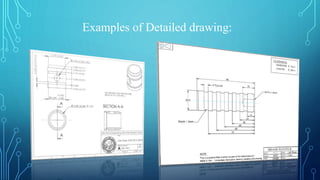
Examples of Detailed drawing:
TYPES:
1. Part Drawings:
• It is recommended that separate drawing has
to be prepared for each items which will be
assembled together to form final product.
• The drawing of these individual part is Part
drawing.
• A single part drawing should show all the
information
• Ex: dimensions, tolerances, materials,
treatment, finish etc.
2. Assembly Drawings:
• It must contain all the necessary information about assembly.
• The items that are to be assembled will be listed separately on part list.
• Items will be identified by item number or by item drawing number which
will be provided on assembly drawing.
3. Collective Drawings:
• A similar parts or assembly are collected together in one common document.
• Each item or assembly will be given with drawing number or code number
for identification.
Types
Collective single part drawing.
Collective assembly Drawings.
Collective single part drawing:
• This consist of a part drawings which are similar but differs with one or two
details from the rest.
Ex: Washer differing only in finish and material.
Rivets differing in shank length.
Collective assembly Drawings:
• It shows the products/items assembled together using similar parts such that the
resultant assembly differs slightly from each other.
Ex: Die of different size.
Gear box with different ratios.
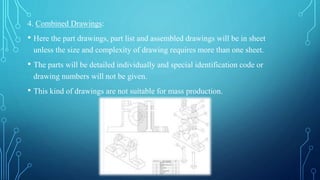
4. Combined Drawings:
• Here the part drawings, part list and assembled drawings will be in sheet
unless the size and complexity of drawing requires more than one sheet.
• The parts will be detailed individually and special identification code or
drawing numbers will not be given.
• This kind of drawings are not suitable for mass production.

Engineering drawing

  • 1.
    INTRODUCTION TO BASICENGINEERING DRAWING BY PURUSHOTHAM.L
  • 2.
    WHAT IS ENGINEERINGDRAWING ? • A graphical representation of thoughts used to convey ideas and information necessary for the construction of machines, structures, or systems by geometric shapes lines and dimensions. • It is a graphical language (language of lines).
  • 3.
    WHY IS ITNEEDED ? • Engineering drawings are said to be the language of engineers. • It is the system of communication between engineering and fellow technician. • It represents an object on a plane surface that precisely and fully give its shape, size and contain all the information that is needed for its manufacture and inspection.
  • 4.
    REQUIREMENTS: • Ability tothink in three dimension. • Master in technique of projection. • Good speed, correct usage of lines and forms. • Rapid printing of proper dimensions of fig and written instruction in clear block capitals. • Knowledge of standards used.
  • 5.
    TYPES OF DRAWING: 1.Free hand sketch. 2. Detailed drawing.
  • 6.
    1. FREE HANDSKETCHING: • It is an art of communicating engineering design ideas without the using traditional mechanical tools like compass, scale, set square etc. • Normally used tools used are pencil, eraser, and a plain or a grid sheet. • Basic Geometric shapes: Lines (Straight or Curved). Circles or Arcs. Elliptical figures.
  • 7.
    EXAMPLES OF FREEHAND SKETCHES:
  • 8.
    2. DETAILED DRAWING/DRAFTING: •A "detail drawing" is a drawing of a single component, assembly of multiple parts, or an entire system of assemblies. • It provides complete and precise descriptions of a part's dimensions, shape and how it is manufactured. • It conveys the information needed to create the part. • Information such as the exact size, type of material, finish, tolerance and any special shop instructions that are necessary to create the part are included its detail drawing
  • 9.
    INFORMATION TO BEPRESENT ON A DETAIL DRAWING. • Part Name • Angle of projection. • Material Type • Drawing Scale • Date And/or Revision • Necessary Views (Front, Left Side, Right Side, Top, Bottom, Back) • Isometric View • All Necessary Dimensions (Width, Depth, Height, Size, Etc.)
  • 10.
  • 11.
    TYPES: 1. Part Drawings: •It is recommended that separate drawing has to be prepared for each items which will be assembled together to form final product. • The drawing of these individual part is Part drawing. • A single part drawing should show all the information • Ex: dimensions, tolerances, materials, treatment, finish etc.
  • 12.
    2. Assembly Drawings: •It must contain all the necessary information about assembly. • The items that are to be assembled will be listed separately on part list. • Items will be identified by item number or by item drawing number which will be provided on assembly drawing.
  • 13.
    3. Collective Drawings: •A similar parts or assembly are collected together in one common document. • Each item or assembly will be given with drawing number or code number for identification. Types Collective single part drawing. Collective assembly Drawings.
  • 14.
    Collective single partdrawing: • This consist of a part drawings which are similar but differs with one or two details from the rest. Ex: Washer differing only in finish and material. Rivets differing in shank length. Collective assembly Drawings: • It shows the products/items assembled together using similar parts such that the resultant assembly differs slightly from each other. Ex: Die of different size. Gear box with different ratios.
  • 15.
    4. Combined Drawings: •Here the part drawings, part list and assembled drawings will be in sheet unless the size and complexity of drawing requires more than one sheet. • The parts will be detailed individually and special identification code or drawing numbers will not be given. • This kind of drawings are not suitable for mass production.