1
COMPOSITES
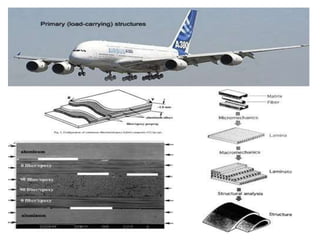
 Composite material- material system composed of two or more
macro constituents that differ in shape & chemical composition,
mutually insoluble
 It contains two or more physically distinct and mechanically
separable materials( metal, ceramic and polymer)
 It is made by dispersing one material in the other in a controlled
way to achieve optimum properties
2
Many composite materials are composed of two phases
 matrix phase and dispersed phase.
Matrix
It is a continuous phase in composite which completely surrounds the
other phase (or dispersed phase)
Ex: metal (MMC), polymer (PMC), ceramic (CMC)
Function of matrix phase:
 Binds dispersed phase
 Acts as medium to transport and distribute the load to dispersed
phase
 Protect the dispersed phase from chemical action and keep in
proper position and orientation along the direction of applied load
3
Dispersed phase or reinforcing phase
It is a discontinuous phase that is surrounded by the matrix
phase.
It is the structural constituent which determines the internal
structure of the composite
Ex: fibers (glass or carbon), particulates (small pieces of solid
material)
Function of dispersed phase:
 To enhance matrix properties
 Increases the strength, used at elevated temperature
4
Ex: i) Wood consists of strong and flexible cellulose fibers surrounded and
held together by a stiffer material called lignin
Synthetic composite: ii) fiberglass, in which small glass fibers are
embedded within a polymeric material (epoxy or polyester).
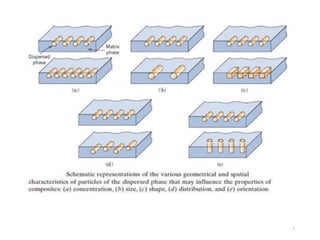
Properties of composite materials are determined by three
factors.
i) The materials used as component phases (property of two
phases)
ii) Geometry of dispersed phase (particle size, distribution,
orientation)
iii) The amount of phase and the way in which the phases interact
with one another.
5
Classification of composites
i) Particle reinforced:
Large particle
Dispersion strengthened
ii) Fiber reinforced:
Continuous (aligned)
Discontinuous(short)-Aligned and Randomly oriented
iii) Structural: Based on build-up of sandwiches in layered form
Laminates
Sandwich panels
6
Particle reinforced
Based on reinforcement and strengthening
mechanism
i) Large particle:
 The dispersion phase (particulate) should be harder and stiffer
than matrix phase
 The matrix transfer some stress to the particulate, which bears
the major portion of the applied load
 Particles can have quite a variety of geometries, but they should
be of approximately the same dimension in all direction.
 Particle size is large and present in large concentration.
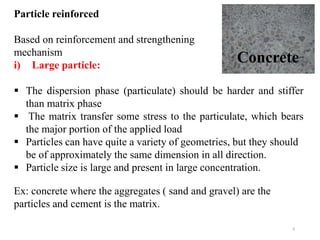
Ex: concrete where the aggregates ( sand and gravel) are the
particles and cement is the matrix.
Concrete
7
8
i) Dispersion strengthened
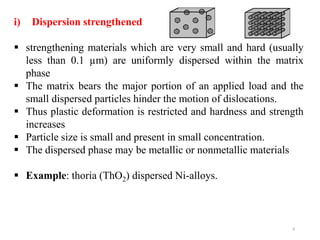
 strengthening materials which are very small and hard (usually
less than 0.1 µm) are uniformly dispersed within the matrix
phase
 The matrix bears the major portion of an applied load and the
small dispersed particles hinder the motion of dislocations.
 Thus plastic deformation is restricted and hardness and strength
increases
 Particle size is small and present in small concentration.
 The dispersed phase may be metallic or nonmetallic materials
 Example: thoria (ThO2) dispersed Ni-alloys.
9
Fiber-reinforced composites
Dispersed phase : fiber (long length to diameter ratio)
Matrix phase: metal, polymer or ceramic
 The primary functions of the matrix are to Transfer stresses
between the reinforcing fibers (hold fibers together)
 To protect the fibers from mechanical and/or environmental
damages.
Fibre phase:
On the basis of diameter and character, fibres are grouped into
three different classifications as
Whiskers
Fibres
Wires.
10
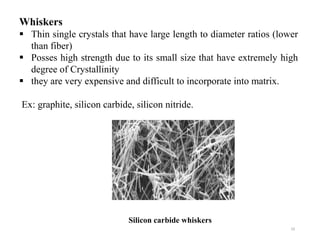
Whiskers
 Thin single crystals that have large length to diameter ratios (lower
than fiber)
 Posses high strength due to its small size that have extremely high
degree of Crystallinity
 they are very expensive and difficult to incorporate into matrix.
Ex: graphite, silicon carbide, silicon nitride.
Silicon carbide whiskers
11
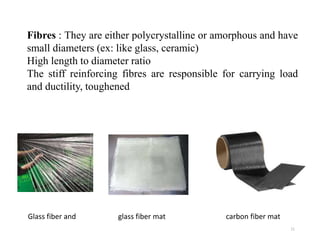
Fibres : They are either polycrystalline or amorphous and have
small diameters (ex: like glass, ceramic)
High length to diameter ratio
The stiff reinforcing fibres are responsible for carrying load
and ductility, toughened
Glass fiber and glass fiber mat carbon fiber mat
12
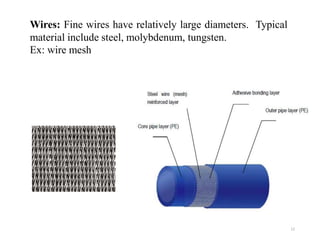
Wires: Fine wires have relatively large diameters. Typical
material include steel, molybdenum, tungsten.
Ex: wire mesh
13
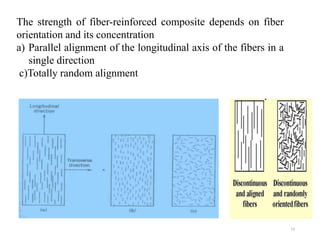
The strength of fiber-reinforced composite depends on fiber
orientation and its concentration
a) Parallel alignment of the longitudinal axis of the fibers in a
single direction
c)Totally random alignment
14
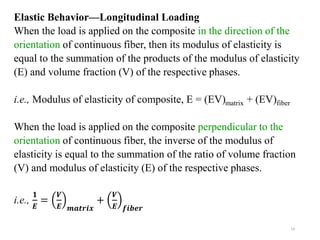
Elastic Behavior—Longitudinal Loading
When the load is applied on the composite in the direction of the
orientation of continuous fiber, then its modulus of elasticity is
equal to the summation of the products of the modulus of elasticity
(E) and volume fraction (V) of the respective phases.
i.e., Modulus of elasticity of composite, E = (EV)matrix + (EV)fiber
When the load is applied on the composite perpendicular to the
orientation of continuous fiber, the inverse of the modulus of
elasticity is equal to the summation of the ratio of volume fraction
(V) and modulus of elasticity (E) of the respective phases.
i.e.,
𝟏
𝑬
=
𝑽
𝑬 𝒎𝒂𝒕𝒓𝒊𝒙
+
𝑽
𝑬 𝒇𝒊𝒃𝒆𝒓
15
Structural composites
It composed of composite and homogenous materials.
The properties depend on properties of constituent materials and on
the geometrical design of various structural elements.
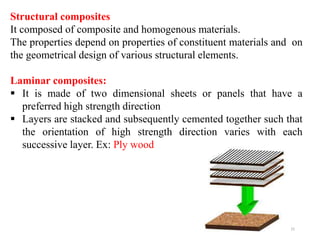
Laminar composites:
 It is made of two dimensional sheets or panels that have a
preferred high strength direction
 Layers are stacked and subsequently cemented together such that
the orientation of high strength direction varies with each
successive layer. Ex: Ply wood
16
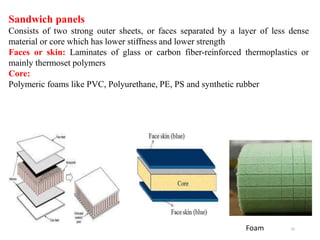
Sandwich panels
Consists of two strong outer sheets, or faces separated by a layer of less dense
material or core which has lower stiffness and lower strength
Faces or skin: Laminates of glass or carbon fiber-reinforced thermoplastics or
mainly thermoset polymers
Core:
Polymeric foams like PVC, Polyurethane, PE, PS and synthetic rubber
Foam
17
POLYMER COMPOSITES
Combination of two material- reinforcing material usually in the
form of fiber, sheet or particles,
Matrix is made of polymeric material
Materials used :Fiber- glass, carbon
Matrix: thermoplastic(polyolefines, vinylic polymers) and
thermosetting resines (polyester and epoxides)
18
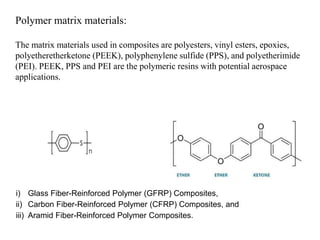
Polymer matrix materials:
The matrix materials used in composites are polyesters, vinyl esters, epoxies,
polyetheretherketone (PEEK), polyphenylene sulfide (PPS), and polyetherimide
(PEI). PEEK, PPS and PEI are the polymeric resins with potential aerospace
applications.
i) Glass Fiber-Reinforced Polymer (GFRP) Composites,
ii) Carbon Fiber-Reinforced Polymer (CFRP) Composites, and
iii) Aramid Fiber-Reinforced Polymer Composites.
20
Advantages of polymer composites:
-Light weight.
-High strength to weight ratio.
-More durable than conventional materials like steel and
aluminium.
-Good corrosion resistance.
-High fatigue strength.
-High temperature resistance.
Applications:
-Composites of phenolic resins and nylon are used in heat
shields for space crafts.
-Which are used in automotive and railway applications.
-As structural material in construction industries.
21
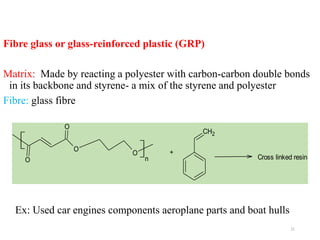
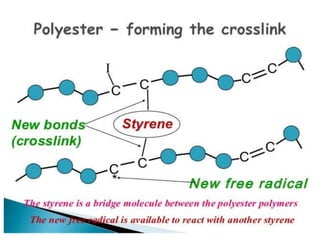
Fibre glass or glass-reinforced plastic (GRP)
Matrix: Made by reacting a polyester with carbon-carbon double bonds
in its backbone and styrene- a mix of the styrene and polyester
Fibre: glass fibre
O
O
O
O
n
+
CH2
Cross linked resin
Ex: Used car engines components aeroplane parts and boat hulls
Aramid Fiber-Reinforced Polymer Composite:
Aramid fibers - high-strength, high-modulus materials
desirable for their outstanding strength-to-weight ratios, which are
superior to metals.
Materials is known as poly(paraphenylene terephthalamide).
Most common are Kevlar™ and Nomex™.
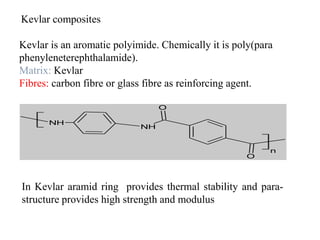
Kevlar composites
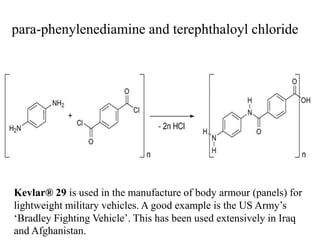
Kevlar is an aromatic polyimide. Chemically it is poly(para
phenyleneterephthalamide).
Matrix: Kevlar
Fibres: carbon fibre or glass fibre as reinforcing agent.
NH
NH
O
O
n
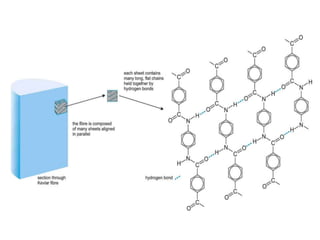
In Kevlar aramid ring provides thermal stability and para-
structure provides high strength and modulus
para-phenylenediamine and terephthaloyl chloride
Kevlar® 29 is used in the manufacture of body armour (panels) for
lightweight military vehicles. A good example is the US Army’s
‘Bradley Fighting Vehicle’. This has been used extensively in Iraq
and Afghanistan.
27
Advantages:
-Light weight, high strength, thermally stable
-Resistant to impact and abrasion damage. It can be used as
protective layer on graphite laminates.
-Can be mixed with graphite to provide damage resistance and to
prevent failure.
Disadvantages:
-Fibres themselves absorb moisture, so Kevlar composites are
more sensitive to the environment than glass or graphite
composites.
-Poor compression resistance.
28
ii) Carbon Fiber Reinforced Polymer (CFRP) Composite:
Carbon is a high-performance fiber material that is most commonly
used reinforcement in advanced polymer matrix composites. The
reasons for this are as follows:
1. Carbon fibers have the highest specific modulus and specific
strength of all reinforcing fiber materials.
2. They retain their high tensile modulus and high strength at elevated
temperatures; high-temperature oxidation, however, may be a
problem.
3. At room temperature, carbon fibers are not affected by moisture or
a wide variety of solvents, acids, and bases.
4. These fibers exhibit a diversity of physical and mechanical
characteristics, allowing composites incorporating these fibers to have
specific engineered properties.
5. Fiber and composite manufacturing processes have been developed
that are relatively inexpensive and cost-effective.
29
Carbon-reinforced polymer composites are currently being utilized
extensively in sports and recreational equipment (fishing rods, golf
clubs), filament-wound rocket motor cases, pressure vessels, and
aircraft structural components—both military and commercial,
fixed wing and helicopters (e.g., as a wing, body, stabilizer, and
rudder components).

Engineering Chemistry -Composites-slides - 20.pptx

  • 1.
    1 COMPOSITES  Composite material-material system composed of two or more macro constituents that differ in shape & chemical composition, mutually insoluble  It contains two or more physically distinct and mechanically separable materials( metal, ceramic and polymer)  It is made by dispersing one material in the other in a controlled way to achieve optimum properties
  • 2.
    2 Many composite materialsare composed of two phases  matrix phase and dispersed phase. Matrix It is a continuous phase in composite which completely surrounds the other phase (or dispersed phase) Ex: metal (MMC), polymer (PMC), ceramic (CMC) Function of matrix phase:  Binds dispersed phase  Acts as medium to transport and distribute the load to dispersed phase  Protect the dispersed phase from chemical action and keep in proper position and orientation along the direction of applied load
  • 3.
    3 Dispersed phase orreinforcing phase It is a discontinuous phase that is surrounded by the matrix phase. It is the structural constituent which determines the internal structure of the composite Ex: fibers (glass or carbon), particulates (small pieces of solid material) Function of dispersed phase:  To enhance matrix properties  Increases the strength, used at elevated temperature
  • 4.
    4 Ex: i) Woodconsists of strong and flexible cellulose fibers surrounded and held together by a stiffer material called lignin Synthetic composite: ii) fiberglass, in which small glass fibers are embedded within a polymeric material (epoxy or polyester). Properties of composite materials are determined by three factors. i) The materials used as component phases (property of two phases) ii) Geometry of dispersed phase (particle size, distribution, orientation) iii) The amount of phase and the way in which the phases interact with one another.
  • 5.
    5 Classification of composites i)Particle reinforced: Large particle Dispersion strengthened ii) Fiber reinforced: Continuous (aligned) Discontinuous(short)-Aligned and Randomly oriented iii) Structural: Based on build-up of sandwiches in layered form Laminates Sandwich panels
  • 6.
    6 Particle reinforced Based onreinforcement and strengthening mechanism i) Large particle:  The dispersion phase (particulate) should be harder and stiffer than matrix phase  The matrix transfer some stress to the particulate, which bears the major portion of the applied load  Particles can have quite a variety of geometries, but they should be of approximately the same dimension in all direction.  Particle size is large and present in large concentration. Ex: concrete where the aggregates ( sand and gravel) are the particles and cement is the matrix. Concrete
  • 7.
  • 8.
    8 i) Dispersion strengthened strengthening materials which are very small and hard (usually less than 0.1 µm) are uniformly dispersed within the matrix phase  The matrix bears the major portion of an applied load and the small dispersed particles hinder the motion of dislocations.  Thus plastic deformation is restricted and hardness and strength increases  Particle size is small and present in small concentration.  The dispersed phase may be metallic or nonmetallic materials  Example: thoria (ThO2) dispersed Ni-alloys.
  • 9.
    9 Fiber-reinforced composites Dispersed phase: fiber (long length to diameter ratio) Matrix phase: metal, polymer or ceramic  The primary functions of the matrix are to Transfer stresses between the reinforcing fibers (hold fibers together)  To protect the fibers from mechanical and/or environmental damages. Fibre phase: On the basis of diameter and character, fibres are grouped into three different classifications as Whiskers Fibres Wires.
  • 10.
    10 Whiskers  Thin singlecrystals that have large length to diameter ratios (lower than fiber)  Posses high strength due to its small size that have extremely high degree of Crystallinity  they are very expensive and difficult to incorporate into matrix. Ex: graphite, silicon carbide, silicon nitride. Silicon carbide whiskers
  • 11.
    11 Fibres : Theyare either polycrystalline or amorphous and have small diameters (ex: like glass, ceramic) High length to diameter ratio The stiff reinforcing fibres are responsible for carrying load and ductility, toughened Glass fiber and glass fiber mat carbon fiber mat
  • 12.
    12 Wires: Fine wireshave relatively large diameters. Typical material include steel, molybdenum, tungsten. Ex: wire mesh
  • 13.
    13 The strength offiber-reinforced composite depends on fiber orientation and its concentration a) Parallel alignment of the longitudinal axis of the fibers in a single direction c)Totally random alignment
  • 14.
    14 Elastic Behavior—Longitudinal Loading Whenthe load is applied on the composite in the direction of the orientation of continuous fiber, then its modulus of elasticity is equal to the summation of the products of the modulus of elasticity (E) and volume fraction (V) of the respective phases. i.e., Modulus of elasticity of composite, E = (EV)matrix + (EV)fiber When the load is applied on the composite perpendicular to the orientation of continuous fiber, the inverse of the modulus of elasticity is equal to the summation of the ratio of volume fraction (V) and modulus of elasticity (E) of the respective phases. i.e., 𝟏 𝑬 = 𝑽 𝑬 𝒎𝒂𝒕𝒓𝒊𝒙 + 𝑽 𝑬 𝒇𝒊𝒃𝒆𝒓
  • 15.
    15 Structural composites It composedof composite and homogenous materials. The properties depend on properties of constituent materials and on the geometrical design of various structural elements. Laminar composites:  It is made of two dimensional sheets or panels that have a preferred high strength direction  Layers are stacked and subsequently cemented together such that the orientation of high strength direction varies with each successive layer. Ex: Ply wood
  • 16.
    16 Sandwich panels Consists oftwo strong outer sheets, or faces separated by a layer of less dense material or core which has lower stiffness and lower strength Faces or skin: Laminates of glass or carbon fiber-reinforced thermoplastics or mainly thermoset polymers Core: Polymeric foams like PVC, Polyurethane, PE, PS and synthetic rubber Foam
  • 17.
  • 18.
    POLYMER COMPOSITES Combination oftwo material- reinforcing material usually in the form of fiber, sheet or particles, Matrix is made of polymeric material Materials used :Fiber- glass, carbon Matrix: thermoplastic(polyolefines, vinylic polymers) and thermosetting resines (polyester and epoxides) 18
  • 19.
    Polymer matrix materials: Thematrix materials used in composites are polyesters, vinyl esters, epoxies, polyetheretherketone (PEEK), polyphenylene sulfide (PPS), and polyetherimide (PEI). PEEK, PPS and PEI are the polymeric resins with potential aerospace applications. i) Glass Fiber-Reinforced Polymer (GFRP) Composites, ii) Carbon Fiber-Reinforced Polymer (CFRP) Composites, and iii) Aramid Fiber-Reinforced Polymer Composites.
  • 20.
    20 Advantages of polymercomposites: -Light weight. -High strength to weight ratio. -More durable than conventional materials like steel and aluminium. -Good corrosion resistance. -High fatigue strength. -High temperature resistance. Applications: -Composites of phenolic resins and nylon are used in heat shields for space crafts. -Which are used in automotive and railway applications. -As structural material in construction industries.
  • 21.
    21 Fibre glass orglass-reinforced plastic (GRP) Matrix: Made by reacting a polyester with carbon-carbon double bonds in its backbone and styrene- a mix of the styrene and polyester Fibre: glass fibre O O O O n + CH2 Cross linked resin Ex: Used car engines components aeroplane parts and boat hulls
  • 23.
    Aramid Fiber-Reinforced PolymerComposite: Aramid fibers - high-strength, high-modulus materials desirable for their outstanding strength-to-weight ratios, which are superior to metals. Materials is known as poly(paraphenylene terephthalamide). Most common are Kevlar™ and Nomex™.
  • 24.
    Kevlar composites Kevlar isan aromatic polyimide. Chemically it is poly(para phenyleneterephthalamide). Matrix: Kevlar Fibres: carbon fibre or glass fibre as reinforcing agent. NH NH O O n In Kevlar aramid ring provides thermal stability and para- structure provides high strength and modulus
  • 25.
    para-phenylenediamine and terephthaloylchloride Kevlar® 29 is used in the manufacture of body armour (panels) for lightweight military vehicles. A good example is the US Army’s ‘Bradley Fighting Vehicle’. This has been used extensively in Iraq and Afghanistan.
  • 27.
    27 Advantages: -Light weight, highstrength, thermally stable -Resistant to impact and abrasion damage. It can be used as protective layer on graphite laminates. -Can be mixed with graphite to provide damage resistance and to prevent failure. Disadvantages: -Fibres themselves absorb moisture, so Kevlar composites are more sensitive to the environment than glass or graphite composites. -Poor compression resistance.
  • 28.
    28 ii) Carbon FiberReinforced Polymer (CFRP) Composite: Carbon is a high-performance fiber material that is most commonly used reinforcement in advanced polymer matrix composites. The reasons for this are as follows: 1. Carbon fibers have the highest specific modulus and specific strength of all reinforcing fiber materials. 2. They retain their high tensile modulus and high strength at elevated temperatures; high-temperature oxidation, however, may be a problem. 3. At room temperature, carbon fibers are not affected by moisture or a wide variety of solvents, acids, and bases. 4. These fibers exhibit a diversity of physical and mechanical characteristics, allowing composites incorporating these fibers to have specific engineered properties. 5. Fiber and composite manufacturing processes have been developed that are relatively inexpensive and cost-effective.
  • 29.
    29 Carbon-reinforced polymer compositesare currently being utilized extensively in sports and recreational equipment (fishing rods, golf clubs), filament-wound rocket motor cases, pressure vessels, and aircraft structural components—both military and commercial, fixed wing and helicopters (e.g., as a wing, body, stabilizer, and rudder components).

Editor's Notes

  • #2 Introduction: Many of our modern technologies require materials with proper combinations of properties that cannot be met by the conventional metal alloys, ceramics and polymeric materials. This is especially true for structural materials that have low densities are strong, stiff and abrasion resistant and are needed for aerospace, under water and transport applications. Other applications of these materials involve automotive, home appliance and sporting goods, industries. Material property combinations and ranges have been extended by the development of composite materials. A composite is composed of two (or more) individual materials which come from the categories namely metals, ceramics & polymers. Thus Composites are artificially produced multiphase materials having a desirable combination of the best properties of the constituent phases Usually one phase (the matrix) is continuous and completely surrounds the other (the dispersed phase). The properties of composites are a function of the properties of the constituent phases, their relative amounts and the geometry of the dispersed phase. There are a number of composites that occur in nature. For example wood consists of strong and flexible cellulose fibres surrounded and held together by a stiffer material called lignin. However ,most are synthetic composites. One of the most common and familiar composites is fiberglass, in which small glass fibres are embedded within a polymeric material (epoxy or polyester). The glass fibres are relatively strong and stiff (but also brittle), whereas the polymer is ductile. The plastic matrix holds the glass fibres together and also protects them from damage by sharing out the forces acting on them. It is still widely used today for boat hulls, sports equipment, building panels and many car bodies. An optimum combination of properties is usually sought rather than one particular properties, in selecting a composite material. For example; wings of an aircraft must be light weight and be strong, stiff & tough. Several fiber-reinforced polymers possess this combination of properties. Adding significant amounts of carbon black to natural rubber increases its strength drastically The properties of composites are a function of the properties of the constituent phases, their relative amounts the geometry of the dispersed phase. Properties of composite materials are determined by three factors. i) The materials used as component phases in the composite ii) The geometric shapes of the constituents and the resulting strength of the composite system iii) The manner in which the phases interact with one another.
  • #19 Materials used in polymer composites Fibre : Glass, carbon fibre, or polyethylene. Matrix: Thermoset polymer like epoxy resin, polydicyclopentadiene, phenolics or a polyimide. Additives: Optionally added. Advantages Light weight. -High strength to weight ratio. -More durable than conventional materials. -Good corrosion resistance. -High fatigue strength. -High temperature resistance. Applications Composites of phenolic resins & nylon are used in heat shields for space crafts. Used in automotive & railway applications. As structural material in construction industries.
  • #22 The styrene & double bonds in the polyester react by free radical polymerization to form a cross linked resin. The glass fibre are trapped inside, where they act as a reinforcement. The matrix adds toughness to the composite, while fibres have good tensile strength. The matrix gives compressional strength to the composite. Fibre reinforced composites are used in applications like car engine components, aeroplane parts to boat hulls.