Silicon rubber
Submitted by:
Pankaj Kumar Das
(1308023)
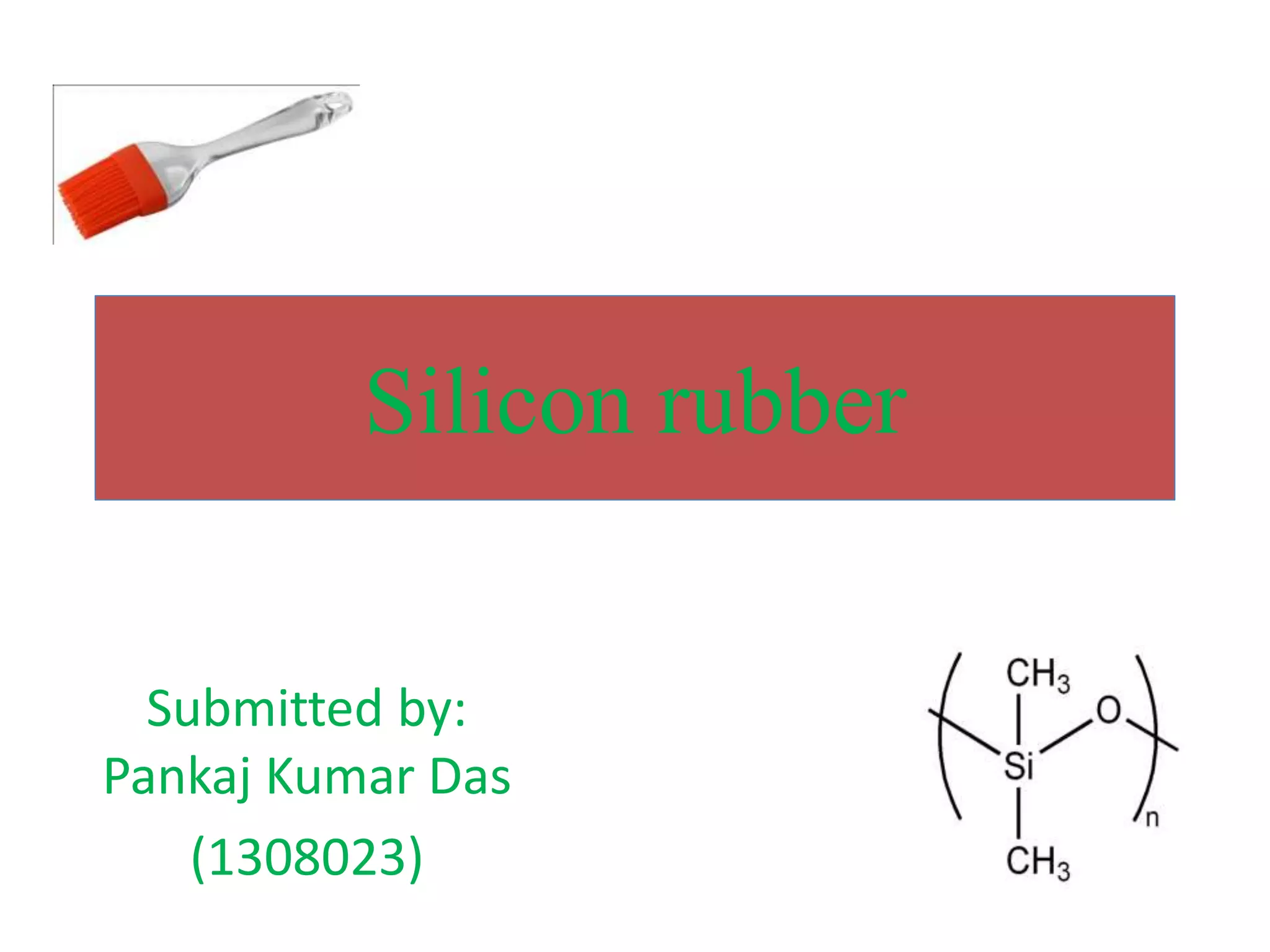
Silicon rubber
• It is an inorganic polymer consist of silicon and oxygen in its
main back bone chain.
• Belongs to the family of compounds known as “silicones”.
• It was first produced by General Electric and Dow Corning.
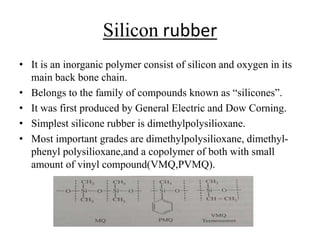
• Simplest silicone rubber is dimethylpolysilioxane.
• Most important grades are dimethylpolysilioxane, dimethyl-
phenyl polysilioxane,and a copolymer of both with small
amount of vinyl compound(VMQ,PVMQ).
Synthesis
• Most of the silicon rubbers are synthesized
from the dimethyldichlorosilane.
• It involves 2 important steps:
1. Hydrolysis
2. Condensation
Hydrolysis
• Polydimethylsiloxanes are obtained by the hydrolysis of
dimethyldichlorosilane in the presence of excess water.
• This heterogeneous and exothermic reaction gives formally a
disilanol “Me2Si(OH)2” which readily condenses, with HCl
acting as a catalyst, to give a mixture of linear [3] or cyclic [4]
oligomers.
• These oligomers are water-washed, neutralized and dried.
polycondensation
• The linear [3] and cyclic [4] oligomers obtained by hydrolysis of the
dimethyldichlorosilane have too short a chain for most applications.
They must be condensed (linear) or polymerized (cyclic) to give
macromolecules of sufficient length.
• Cyclics, (R2SiO)m, can be opened and polymerized to form long
linear chains, the reaction being catalyzed by many acid or base
compounds and giving at equilibrium a mixture of cyclic oligomers
plus a distribution of polymers.
• OH-terminated polymer, HO(Me2SiO)zH, can be isolated after
neutralizing and stripping the above mixture of the remaining
cyclics under vacuum at elevated temperature. In fact, distribution
of chains with different lengths is achieved.
x (Me2SiO)4 + KOH (Me2SiO)y + KO(Me2SiO)zH
Cross linking
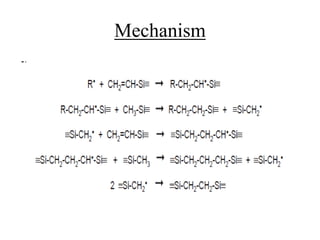
• Silicon rubbers are saturated , they can be only vulcanized by
peroxide cross linking agent such as dibenzoyl peroxide .
• In this the efficiency of peroxide cross linking can be
increased by incorporating small amount of co-monomer
containing vinyl group into the polymer.
Mechanism
Properties
Mechanical properties
• Poor tensile ,impact, abrasion resistance.
• Show good hardness properties(30-80 shore A).
• Hardness range from 50-80 have best mechanical
properties.
Low temperature flexibility
• Excellent low temperature flexibility(-50 degree Celsius)
• PVMQ grade have better than MQ and PMQ grade (-100
degree Celsius).
Thermal properties
• Excellent thermal stability
• Higher ozone and uv resistance than other rubbers
Resistance to chemicals
• Resistant to aliphatic motor and transmission oil
• But naphthenic oil, alkali acids also swells silicon rubber to
greater extent.
• Attacked by motor fuels, chlorinated hydrocarbon ,ketones
esters, ethers.
• Poor hydrolysis resistance at temperature 130-140
Other properties
• Adhesive and hydrophobic nature, do not adhere to ice
which makes them suitable for refrigerator profiles.
• good electrical insulator than other rubbers.
• Much higher liquid and gases permeation rate.
• Show good biocompatibility
Application
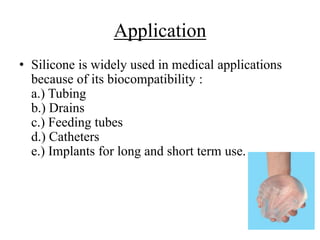
• Silicone is widely used in medical applications
because of its biocompatibility :
a.) Tubing
b.) Drains
c.) Feeding tubes
d.) Catheters
e.) Implants for long and short term use.
Mechanical Engineering
• Square, kink free tubing for furnace pressure
switches
• Sound and vibration dampening in automotive
drive shaft applications
• Shaft sealing rings
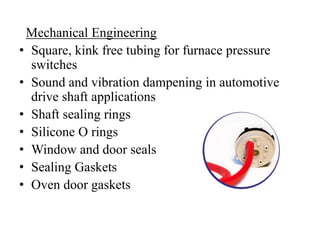
• Silicone O rings
• Window and door seals
• Sealing Gaskets
• Oven door gaskets
Electrical Engineering
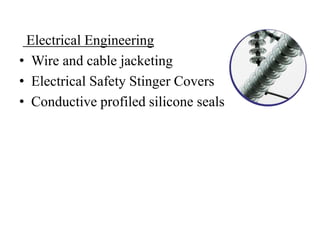
• Wire and cable jacketing
• Electrical Safety Stinger Covers
• Conductive profiled silicone seals

Silicon rubber pankaj kumar das

  • 1.
  • 2.
    Silicon rubber • Itis an inorganic polymer consist of silicon and oxygen in its main back bone chain. • Belongs to the family of compounds known as “silicones”. • It was first produced by General Electric and Dow Corning. • Simplest silicone rubber is dimethylpolysilioxane. • Most important grades are dimethylpolysilioxane, dimethyl- phenyl polysilioxane,and a copolymer of both with small amount of vinyl compound(VMQ,PVMQ).
  • 3.
    Synthesis • Most ofthe silicon rubbers are synthesized from the dimethyldichlorosilane. • It involves 2 important steps: 1. Hydrolysis 2. Condensation
  • 4.
    Hydrolysis • Polydimethylsiloxanes areobtained by the hydrolysis of dimethyldichlorosilane in the presence of excess water. • This heterogeneous and exothermic reaction gives formally a disilanol “Me2Si(OH)2” which readily condenses, with HCl acting as a catalyst, to give a mixture of linear [3] or cyclic [4] oligomers. • These oligomers are water-washed, neutralized and dried.
  • 5.
    polycondensation • The linear[3] and cyclic [4] oligomers obtained by hydrolysis of the dimethyldichlorosilane have too short a chain for most applications. They must be condensed (linear) or polymerized (cyclic) to give macromolecules of sufficient length. • Cyclics, (R2SiO)m, can be opened and polymerized to form long linear chains, the reaction being catalyzed by many acid or base compounds and giving at equilibrium a mixture of cyclic oligomers plus a distribution of polymers. • OH-terminated polymer, HO(Me2SiO)zH, can be isolated after neutralizing and stripping the above mixture of the remaining cyclics under vacuum at elevated temperature. In fact, distribution of chains with different lengths is achieved. x (Me2SiO)4 + KOH (Me2SiO)y + KO(Me2SiO)zH
  • 6.
    Cross linking • Siliconrubbers are saturated , they can be only vulcanized by peroxide cross linking agent such as dibenzoyl peroxide . • In this the efficiency of peroxide cross linking can be increased by incorporating small amount of co-monomer containing vinyl group into the polymer.
  • 7.
  • 8.
    Properties Mechanical properties • Poortensile ,impact, abrasion resistance. • Show good hardness properties(30-80 shore A). • Hardness range from 50-80 have best mechanical properties. Low temperature flexibility • Excellent low temperature flexibility(-50 degree Celsius) • PVMQ grade have better than MQ and PMQ grade (-100 degree Celsius). Thermal properties • Excellent thermal stability • Higher ozone and uv resistance than other rubbers
  • 9.
    Resistance to chemicals •Resistant to aliphatic motor and transmission oil • But naphthenic oil, alkali acids also swells silicon rubber to greater extent. • Attacked by motor fuels, chlorinated hydrocarbon ,ketones esters, ethers. • Poor hydrolysis resistance at temperature 130-140 Other properties • Adhesive and hydrophobic nature, do not adhere to ice which makes them suitable for refrigerator profiles. • good electrical insulator than other rubbers. • Much higher liquid and gases permeation rate. • Show good biocompatibility
  • 10.
    Application • Silicone iswidely used in medical applications because of its biocompatibility : a.) Tubing b.) Drains c.) Feeding tubes d.) Catheters e.) Implants for long and short term use.
  • 11.
    Mechanical Engineering • Square,kink free tubing for furnace pressure switches • Sound and vibration dampening in automotive drive shaft applications • Shaft sealing rings • Silicone O rings • Window and door seals • Sealing Gaskets • Oven door gaskets
  • 12.
    Electrical Engineering • Wireand cable jacketing • Electrical Safety Stinger Covers • Conductive profiled silicone seals