WHAT IS ISO
ISO means “International Organization for standardization”. It’s
Head Quarters is in GENEVA. 195 countries in the world are the
members of this organization.
WHAT IS ISO – 14001:2004
It is an International Standard for Environment. ISO 14001 was first
published in 1996 and specifies the actual requirements for an
environmental management system. It applies to those
environmental aspects which the organization has control and over
which it can be expected to have an influence.
WHAT IS ENVIRONMENT
Surroundings in which an organization operates, including air, water,
land, natural resources, flora, fauna, humans and their interrelation
note surroundings in this context extend from which an organization
to the global system
ENVIRONMENTAL ISSUESENVIRONMENTAL ISSUES
 Air Pollution-Air Pollution- from everyday activity, causes acid rain, carfrom everyday activity, causes acid rain, car
exhaust fumes, power stations, industrial processesexhaust fumes, power stations, industrial processes
 Ozone depletion-Ozone depletion- use of CFC’suse of CFC’s
 Greenhouse effect, Global warming, Climate changeGreenhouse effect, Global warming, Climate change
 Water pollution-Water pollution- pollution of water streams by factories,pollution of water streams by factories,
agriculture, chemical and oil spillageagriculture, chemical and oil spillage
 Ecosystem destructionEcosystem destruction
MAINLYMAINLY BECAUSE OFBECAUSE OF
 Population increase - larger consumption ofPopulation increase - larger consumption of
resources & more waste generationresources & more waste generation
SOME DEFINITIONSSOME DEFINITIONS
 Environmental AspectEnvironmental Aspect
Element of an organisation’s activities, products or servicesElement of an organisation’s activities, products or services
that can interact with the environment.that can interact with the environment.
 Environmental ImpactEnvironmental Impact
Any change to the environment, whether adverse or beneficial,Any change to the environment, whether adverse or beneficial,
wholly or partially resulting from an organisation’swholly or partially resulting from an organisation’s
environmental aspects.environmental aspects.
 Continual ImprovementContinual Improvement
Recurring process of enhancing the EMS in order to achieveRecurring process of enhancing the EMS in order to achieve
improvements in overall environmental performanceimprovements in overall environmental performance
consistent with the organisation’s environmental policy.consistent with the organisation’s environmental policy.
 Environmental objectiveEnvironmental objective
Overall environmental goal, consistent with the EnvironmentalOverall environmental goal, consistent with the Environmental
Policy, which an organization sets itself to achieve.Policy, which an organization sets itself to achieve.
SOME DEFINITIONSSOME DEFINITIONS
 Environmental targetEnvironmental target
Detailed performance requirement, applicable to theDetailed performance requirement, applicable to the
organization or parts thereof, that arises from theorganization or parts thereof, that arises from the
environmental objectives and that needs to be set and met inenvironmental objectives and that needs to be set and met in
order to achieve those objectives.order to achieve those objectives.
 Interested partyInterested party
Person or group concerned with or affected by thePerson or group concerned with or affected by the
environmental performance of an organization.environmental performance of an organization.
 Local residentsLocal residents
 Work forceWork force
 Customers and consumersCustomers and consumers
 Environmental support groupsEnvironmental support groups
 General publicGeneral public
ISO 14001- EMS REQUIREMENTSISO 14001- EMS REQUIREMENTS
 4.1 General Requirements:4.1 General Requirements:
 The organization shall establish, document, implement, maintain andThe organization shall establish, document, implement, maintain and
continually improve an EMS in accordance with the requirements ofcontinually improve an EMS in accordance with the requirements of
this international standard and determine how it will fulfill thesethis international standard and determine how it will fulfill these
requirements.requirements.
 The organization shall define and document the scope of itsThe organization shall define and document the scope of its
environmental system.environmental system.
 4.2 Environmental Policy:4.2 Environmental Policy:
 Appropriate to the nature, scale, and impacts of its activities, productsAppropriate to the nature, scale, and impacts of its activities, products
and servicesand services
 Commitment to continual improvement and prevention of pollutionCommitment to continual improvement and prevention of pollution
 Comply with applicable legal requirementsComply with applicable legal requirements
 Provide the framework for setting environmental objective and targetsProvide the framework for setting environmental objective and targets
 Documented, implemented and maintainedDocumented, implemented and maintained
 Communicated to all persons for or on behalf of the organizationCommunicated to all persons for or on behalf of the organization
 Is available to the public.Is available to the public.
ENVIRONMENTAL POLICY OF AENVIRONMENTAL POLICY OF A
MINING ORGANIZATION IN INDIAMINING ORGANIZATION IN INDIA
 The company adopts environmental management system in allThe company adopts environmental management system in all
its areas and is committed to:its areas and is committed to:
 Manage air, water & noise pollution in its surface operationsManage air, water & noise pollution in its surface operations
and air and noise pollutions in its underground mines.and air and noise pollutions in its underground mines.
 Continual improvement in environmental quality andContinual improvement in environmental quality and
prevention of pollution by applying best available practicesprevention of pollution by applying best available practices
and setting & reviewing objectives and targets.and setting & reviewing objectives and targets.
 Compliance with applicable environmental laws & otherCompliance with applicable environmental laws & other
requirements concerned with all its operations.requirements concerned with all its operations.
 Conservation of natural resources.Conservation of natural resources.
 Monitor the health of all its employees and to ensure theMonitor the health of all its employees and to ensure the
preventive & betterment measures.preventive & betterment measures.
 The policy will be made available to interested party wheneverThe policy will be made available to interested party whenever
asked for.asked for.
4.3 Planning:4.3 Planning:
 4.3.1 Environmental aspects4.3.1 Environmental aspects
 To identify all aspects within the defined scopeTo identify all aspects within the defined scope
 To identify significant aspects.To identify significant aspects.
 This information should be documented and kept up-to-This information should be documented and kept up-to-
date.date.
 4.3.2 Legal and other requirements4.3.2 Legal and other requirements
 To have access to applicable legal requirementsTo have access to applicable legal requirements
 To determine how these requirements apply to itsTo determine how these requirements apply to its
environmental aspectsenvironmental aspects
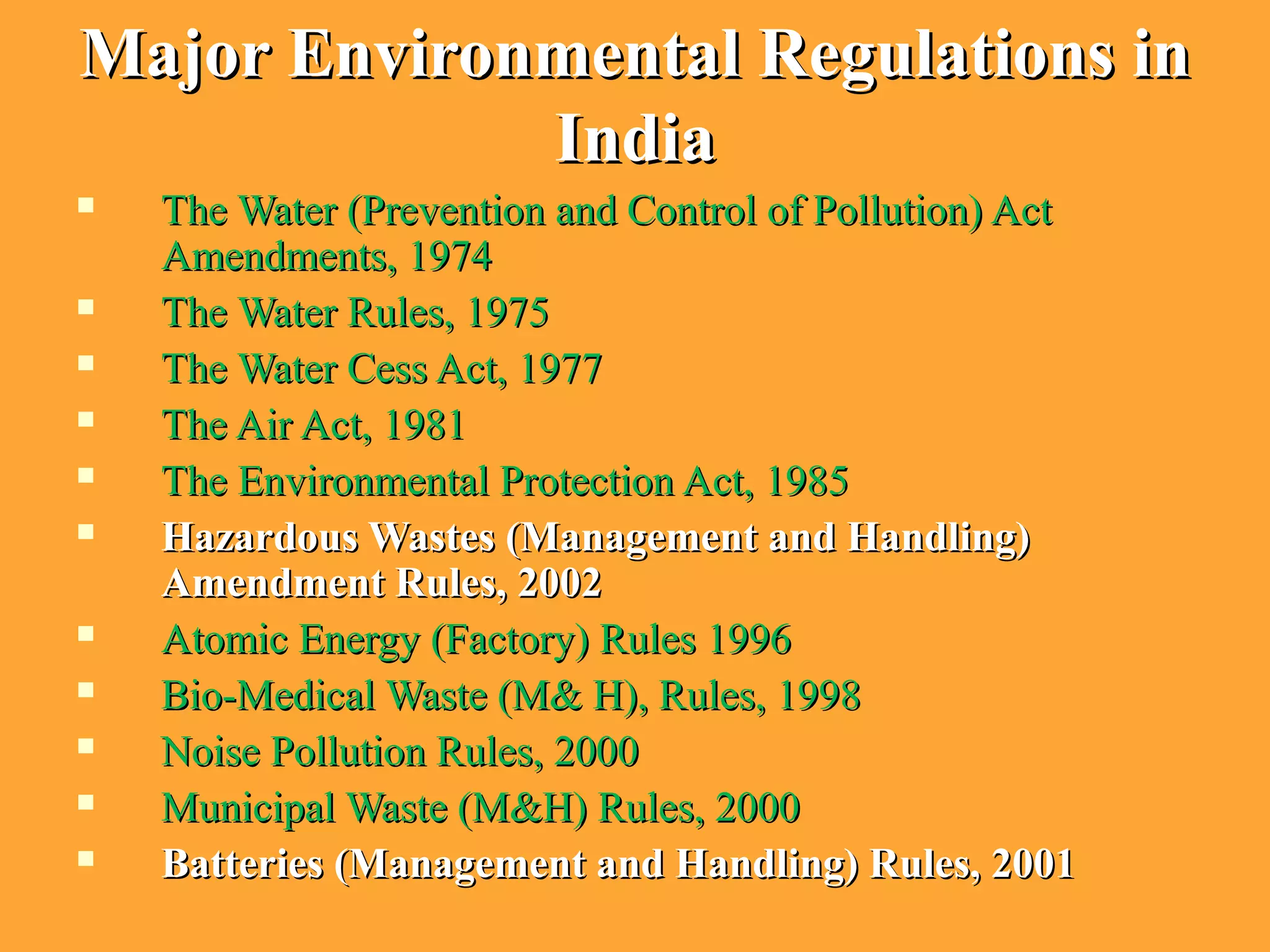
Major Environmental Regulations inMajor Environmental Regulations in
IndiaIndia
 The Water (Prevention and Control of Pollution) ActThe Water (Prevention and Control of Pollution) Act
Amendments, 1974Amendments, 1974
 The Water Rules, 1975The Water Rules, 1975
 The Water Cess Act, 1977The Water Cess Act, 1977
 The Air Act, 1981The Air Act, 1981
 The Environmental Protection Act, 1985The Environmental Protection Act, 1985
 Hazardous Wastes (Management and Handling)Hazardous Wastes (Management and Handling)
Amendment Rules, 2002Amendment Rules, 2002
 Atomic Energy (Factory) Rules 1996Atomic Energy (Factory) Rules 1996
 Bio-Medical Waste (M& H), Rules, 1998Bio-Medical Waste (M& H), Rules, 1998
 Noise Pollution Rules, 2000Noise Pollution Rules, 2000
 Municipal Waste (M&H) Rules, 2000Municipal Waste (M&H) Rules, 2000
 Batteries (Management and Handling) Rules, 2001Batteries (Management and Handling) Rules, 2001
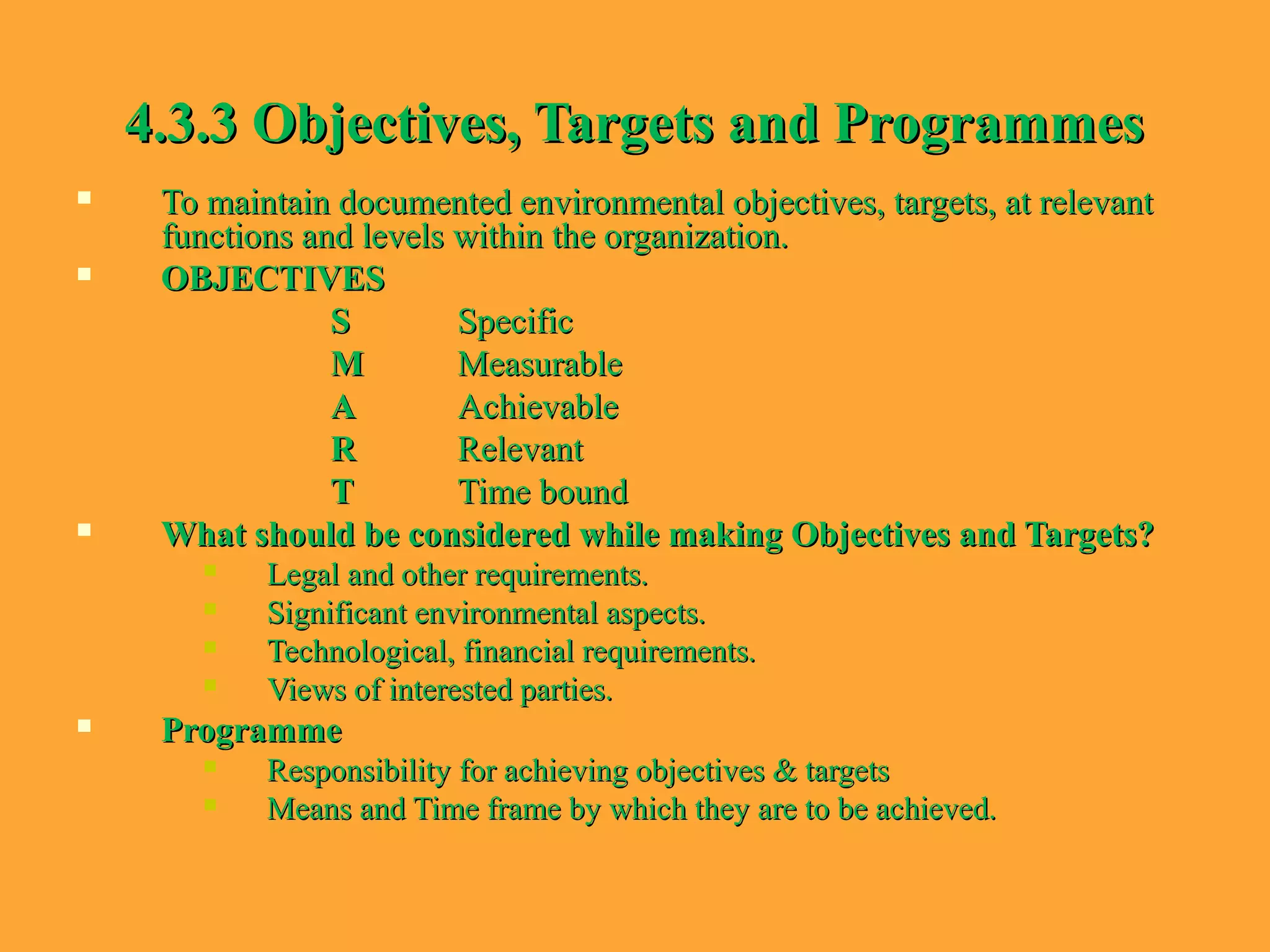
4.3.3 Objectives, Targets and Programmes4.3.3 Objectives, Targets and Programmes
 To maintain documented environmental objectives, targets, at relevantTo maintain documented environmental objectives, targets, at relevant
functions and levels within the organization.functions and levels within the organization.
 OBJECTIVESOBJECTIVES
SS SpecificSpecific
MM MeasurableMeasurable
AA AchievableAchievable
RR RelevantRelevant
TT Time boundTime bound
 What should be considered while making Objectives and Targets?What should be considered while making Objectives and Targets?
 Legal and other requirements.Legal and other requirements.
 Significant environmental aspects.Significant environmental aspects.
 Technological, financial requirements.Technological, financial requirements.
 Views of interested parties.Views of interested parties.
 ProgrammeProgramme
 Responsibility for achieving objectives & targetsResponsibility for achieving objectives & targets
 Means and Time frame by which they are to be achieved.Means and Time frame by which they are to be achieved.
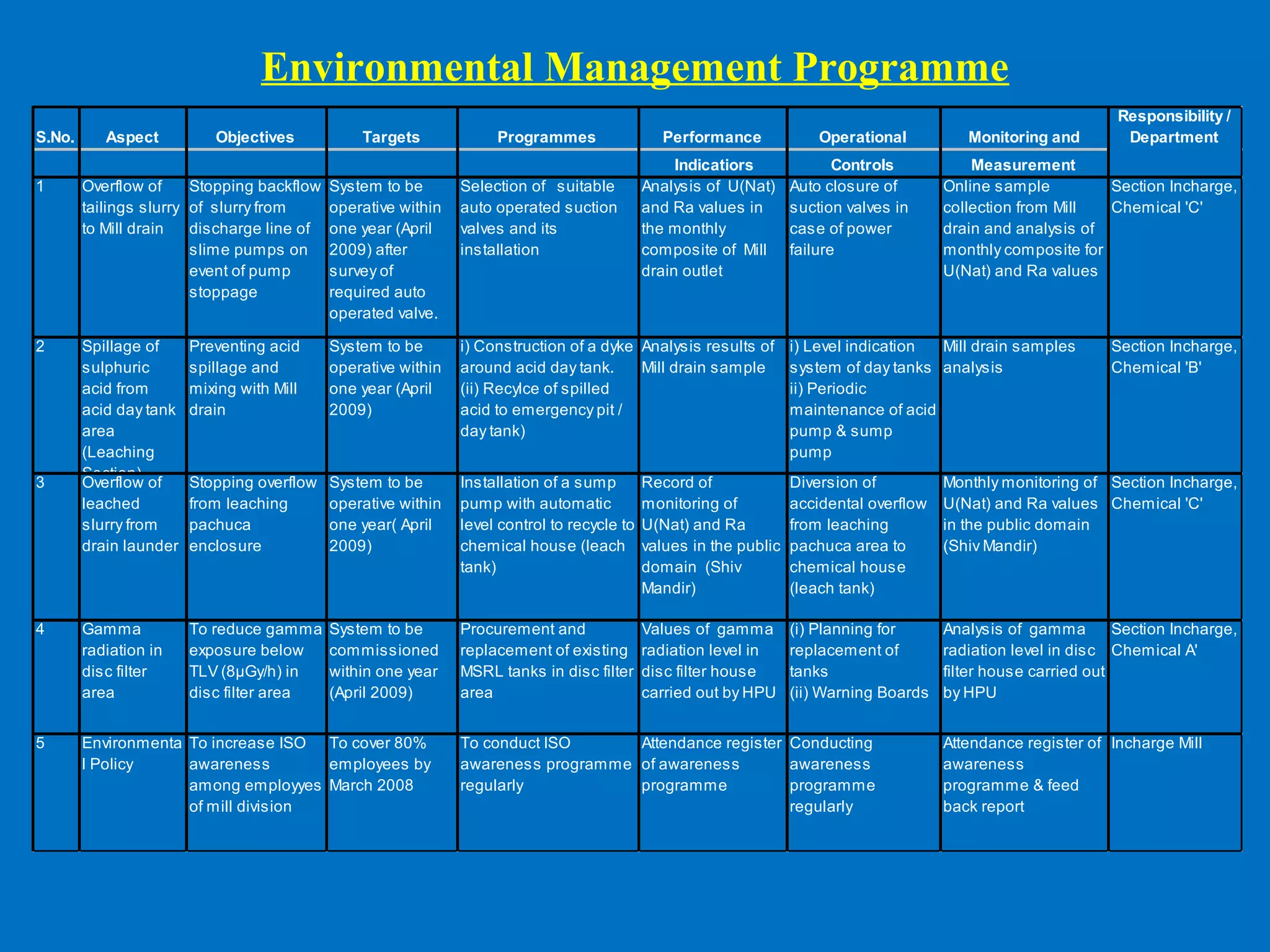
S.No. Aspect Objectives Targets Programmes Performance Operational Monitoring and
Indicatiors Controls Measurement
1 Overflow of
tailings slurry
to Mill drain
Stopping backflow
of slurry from
discharge line of
slime pumps on
event of pump
stoppage
System to be
operative within
one year (April
2009) after
survey of
required auto
operated valve.
Selection of suitable
auto operated suction
valves and its
installation
Analysis of U(Nat)
and Ra values in
the monthly
composite of Mill
drain outlet
Auto closure of
suction valves in
case of power
failure
Online sample
collection from Mill
drain and analysis of
monthly composite for
U(Nat) and Ra values
Section Incharge,
Chemical 'C'
2 Spillage of
sulphuric
acid from
acid day tank
area
(Leaching
Section)
Preventing acid
spillage and
mixing with Mill
drain
System to be
operative within
one year (April
2009)
i) Construction of a dyke
around acid day tank.
(ii) Recylce of spilled
acid to emergency pit /
day tank)
Analysis results of
Mill drain sample
i) Level indication
system of day tanks
ii) Periodic
maintenance of acid
pump & sump
pump
Mill drain samples
analysis
Section Incharge,
Chemical 'B'
3 Overflow of
leached
slurry from
drain launder
Stopping overflow
from leaching
pachuca
enclosure
System to be
operative within
one year( April
2009)
Installation of a sump
pump with automatic
level control to recycle to
chemical house (leach
tank)
Record of
monitoring of
U(Nat) and Ra
values in the public
domain (Shiv
Mandir)
Diversion of
accidental overflow
from leaching
pachuca area to
chemical house
(leach tank)
Monthly monitoring of
U(Nat) and Ra values
in the public domain
(Shiv Mandir)
Section Incharge,
Chemical 'C'
4 Gamma
radiation in
disc filter
area
To reduce gamma
exposure below
TLV (8µGy/h) in
disc filter area
System to be
commissioned
within one year
(April 2009)
Procurement and
replacement of existing
MSRL tanks in disc filter
area
Values of gamma
radiation level in
disc filter house
carried out by HPU
(i) Planning for
replacement of
tanks
(ii) Warning Boards
Analysis of gamma
radiation level in disc
filter house carried out
by HPU
Section Incharge,
Chemical A'
5 Environmenta
l Policy
To increase ISO
awareness
among employyes
of mill division
To cover 80%
employees by
March 2008
To conduct ISO
awareness programme
regularly
Attendance register
of awareness
programme
Conducting
awareness
programme
regularly
Attendance register of
awareness
programme & feed
back report
Incharge Mill
Responsibility /
Department
Environmental Management Programme
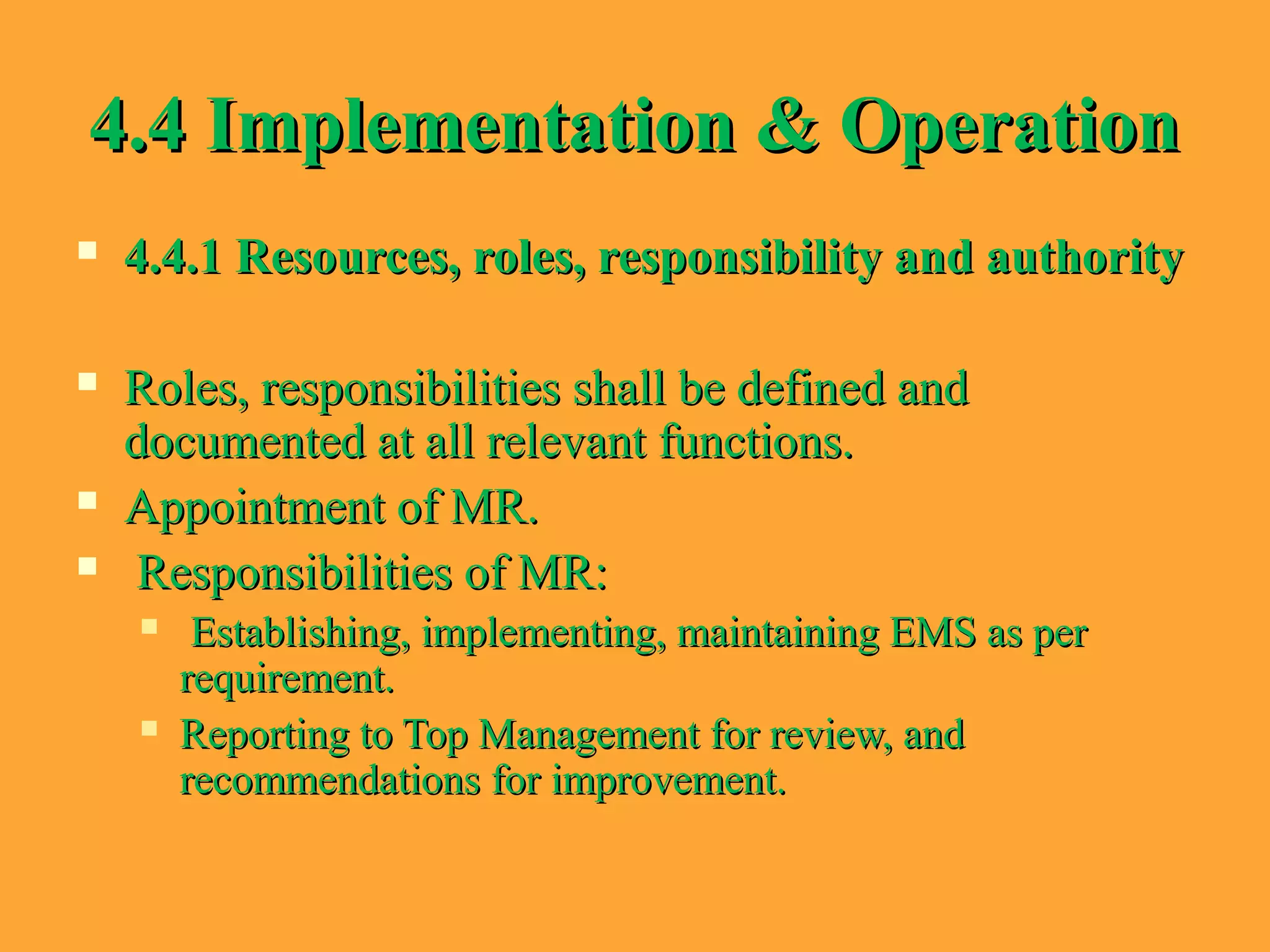
4.4 Implementation & Operation4.4 Implementation & Operation
 4.4.1 Resources, roles, responsibility and authority4.4.1 Resources, roles, responsibility and authority
 Roles, responsibilities shall be defined andRoles, responsibilities shall be defined and
documented at all relevant functions.documented at all relevant functions.
 Appointment of MR.Appointment of MR.
 Responsibilities of MR:Responsibilities of MR:
 Establishing, implementing, maintaining EMS as perEstablishing, implementing, maintaining EMS as per
requirement.requirement.
 Reporting to Top Management for review, andReporting to Top Management for review, and
recommendations for improvement.recommendations for improvement.
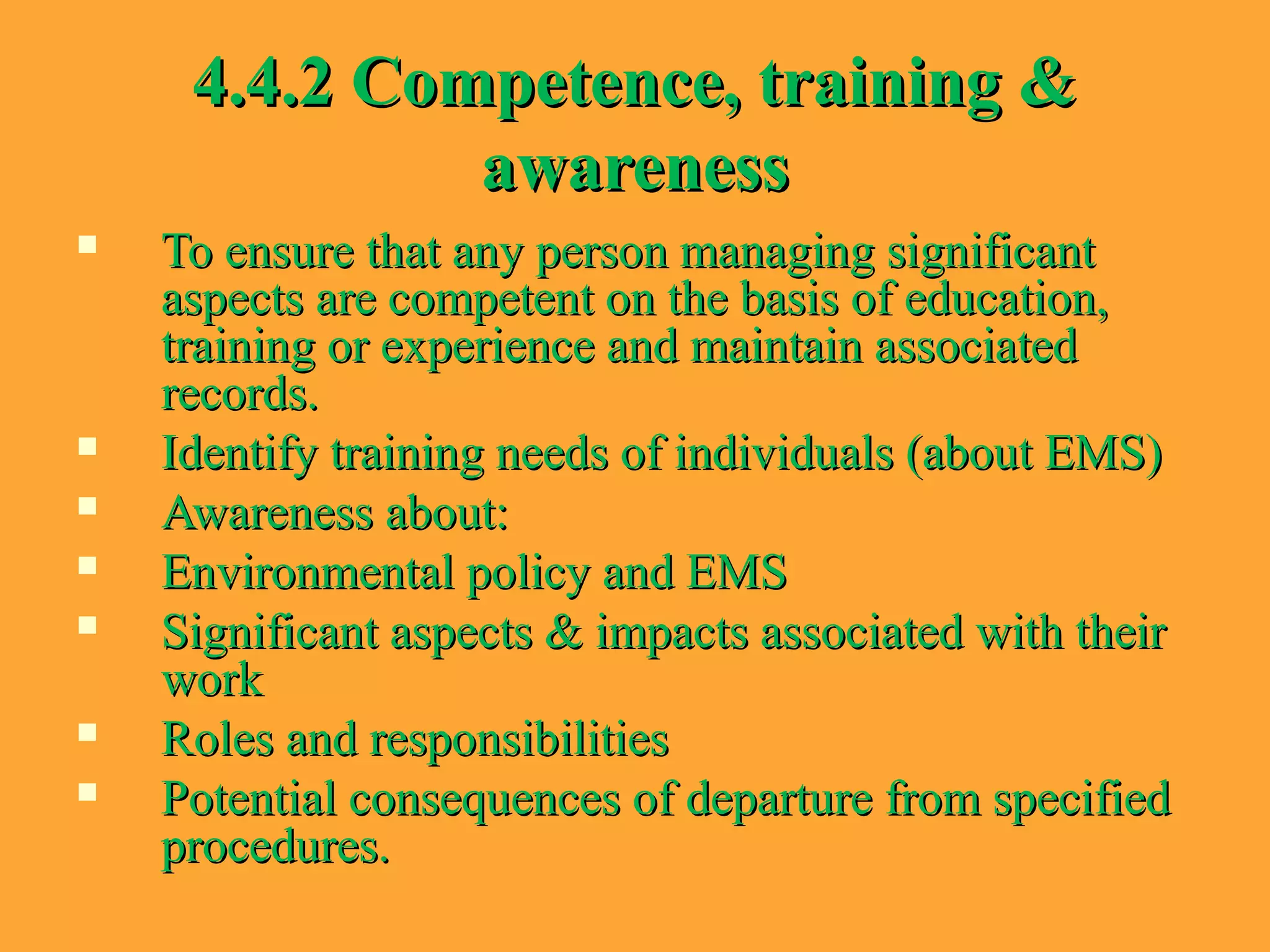
4.4.2 Competence, training &4.4.2 Competence, training &
awarenessawareness
 To ensure that any person managing significantTo ensure that any person managing significant
aspects are competent on the basis of education,aspects are competent on the basis of education,
training or experience and maintain associatedtraining or experience and maintain associated
records.records.
 Identify training needs of individuals (about EMS)Identify training needs of individuals (about EMS)
 Awareness about:Awareness about:
 Environmental policy and EMSEnvironmental policy and EMS
 Significant aspects & impacts associated with theirSignificant aspects & impacts associated with their
workwork
 Roles and responsibilitiesRoles and responsibilities
 Potential consequences of departure from specifiedPotential consequences of departure from specified
procedures.procedures.
4.4.3 Communication4.4.3 Communication
Procedure forProcedure for
 Internal communication among variousInternal communication among various
levels & functionslevels & functions
 External communication from interestedExternal communication from interested
partiesparties
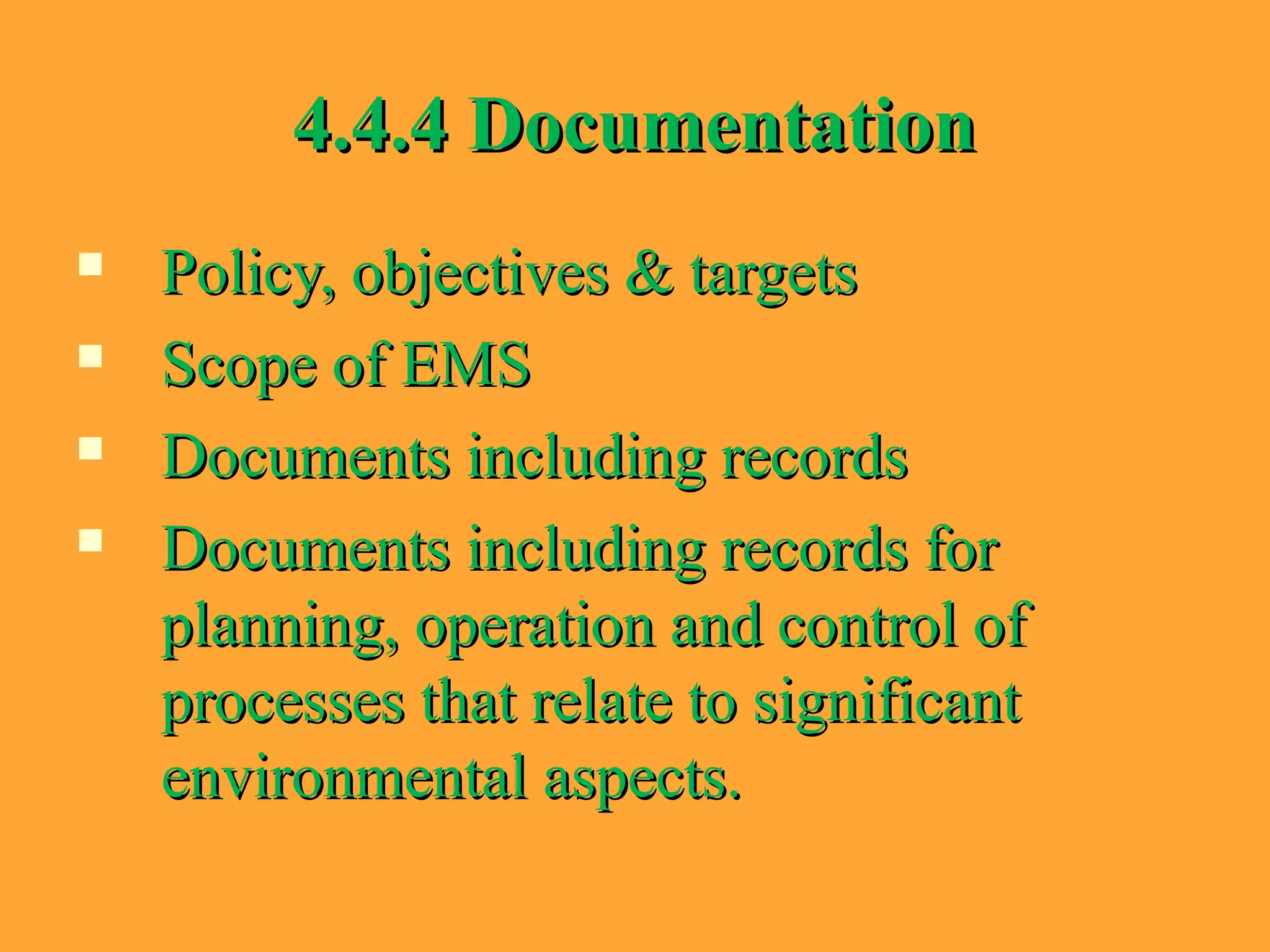
4.4.4 Documentation4.4.4 Documentation
 Policy, objectives & targetsPolicy, objectives & targets
 Scope of EMSScope of EMS
 Documents including recordsDocuments including records
 Documents including records forDocuments including records for
planning, operation and control ofplanning, operation and control of
processes that relate to significantprocesses that relate to significant
environmental aspects.environmental aspects.
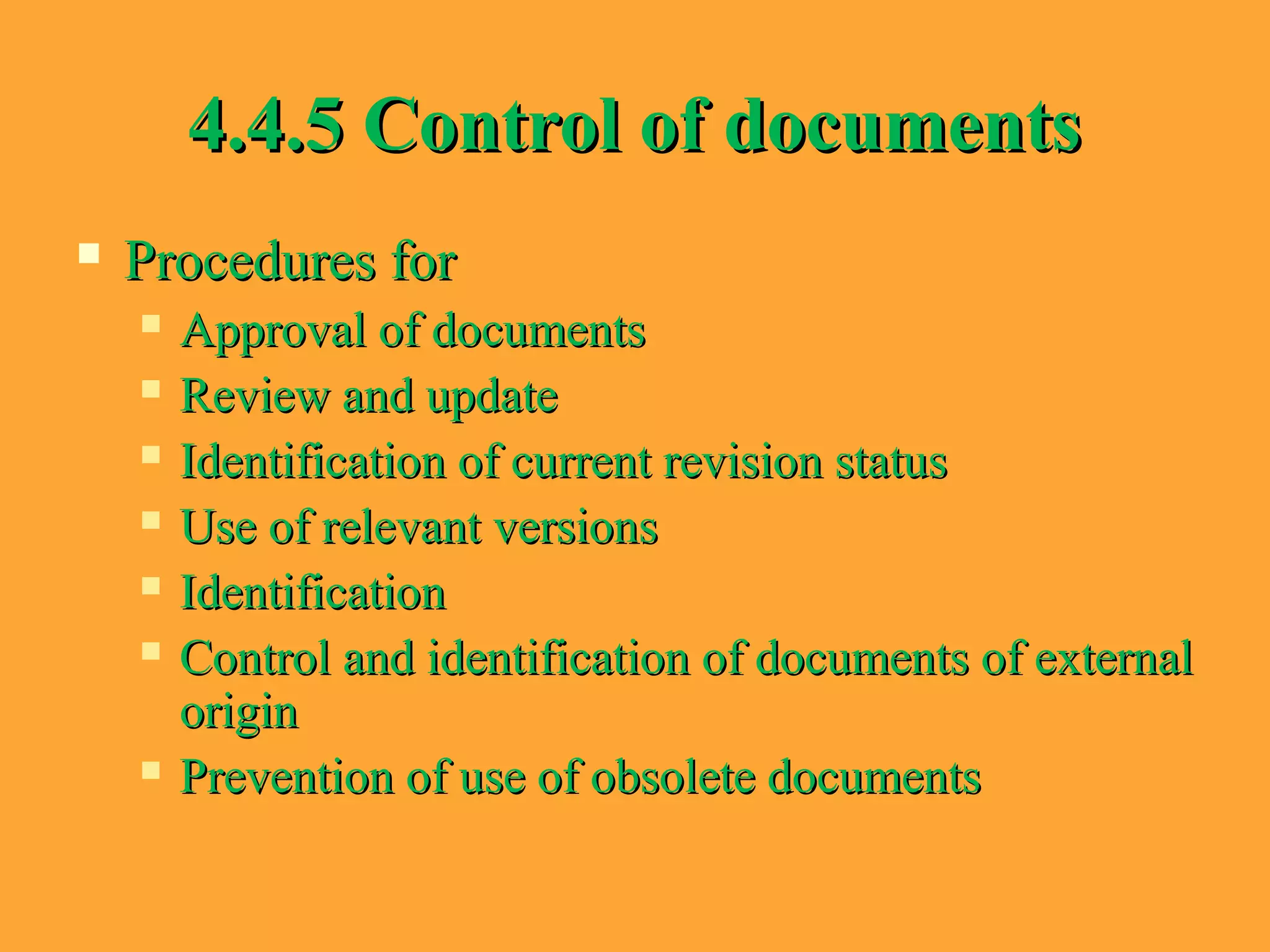
4.4.5 Control of documents4.4.5 Control of documents
 Procedures forProcedures for
 Approval of documentsApproval of documents
 Review and updateReview and update
 Identification of current revision statusIdentification of current revision status
 Use of relevant versionsUse of relevant versions
 IdentificationIdentification
 Control and identification of documents of externalControl and identification of documents of external
originorigin
 Prevention of use of obsolete documentsPrevention of use of obsolete documents
4.4.6 Operational Control4.4.6 Operational Control
 Plan processes for managing significantPlan processes for managing significant
environmental aspects:environmental aspects:
 Documented operational control procedureDocumented operational control procedure
 Fixing operating criteriaFixing operating criteria
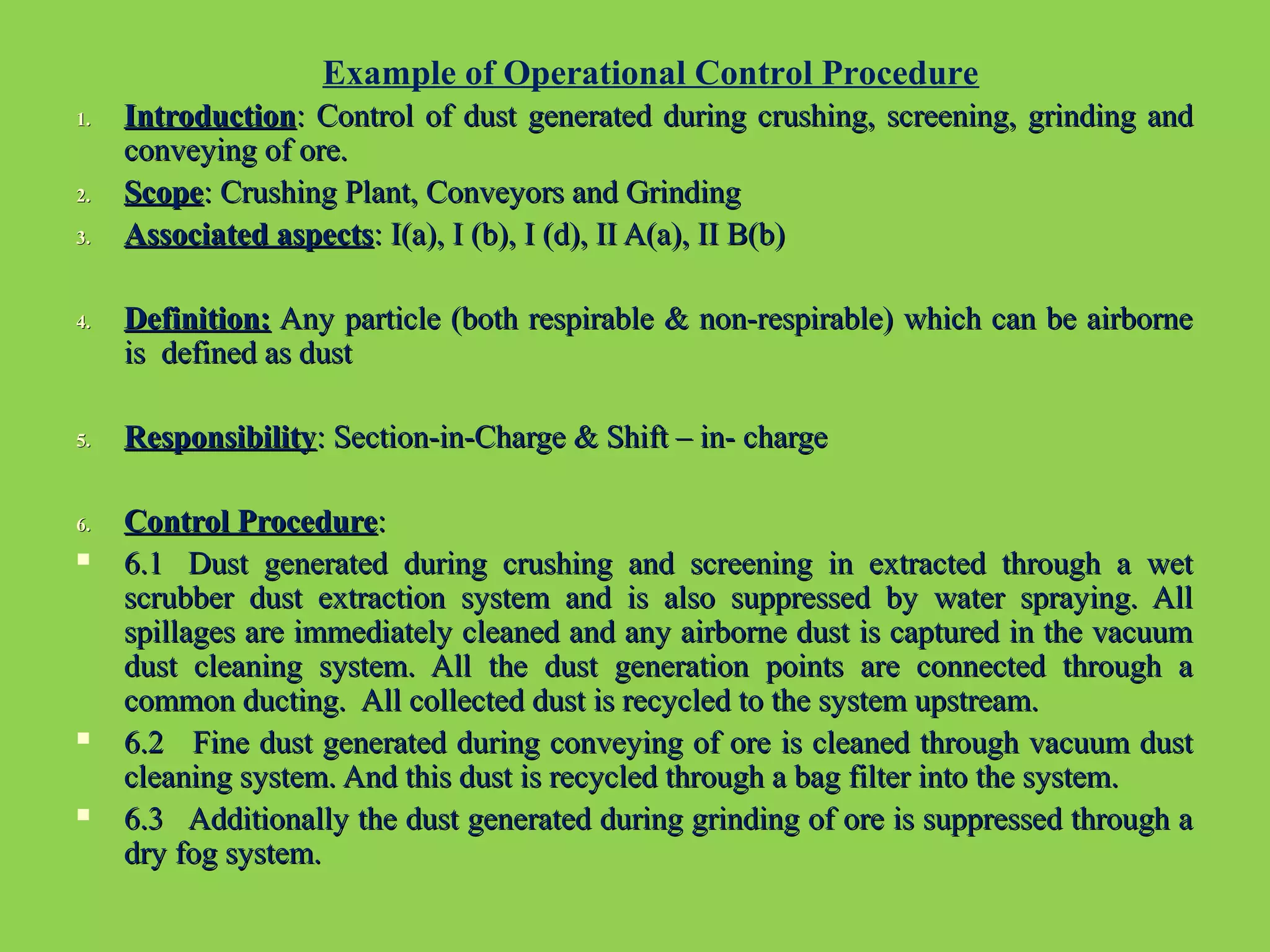
1.1. IntroductionIntroduction: Control of dust generated during crushing, screening, grinding and: Control of dust generated during crushing, screening, grinding and
conveying of ore.conveying of ore.
2.2. ScopeScope: Crushing Plant, Conveyors and Grinding: Crushing Plant, Conveyors and Grinding
3.3. Associated aspectsAssociated aspects: I(a), I (b), I (d), II A(a), II B(b): I(a), I (b), I (d), II A(a), II B(b)
4.4. Definition:Definition: Any particle (both respirable & non-respirable) which can be airborneAny particle (both respirable & non-respirable) which can be airborne
is defined as dustis defined as dust
5.5. ResponsibilityResponsibility: Section-in-Charge & Shift – in- charge: Section-in-Charge & Shift – in- charge
6.6. Control ProcedureControl Procedure::
 6.1 Dust generated during crushing and screening in extracted through a wet6.1 Dust generated during crushing and screening in extracted through a wet
scrubber dust extraction system and is also suppressed by water spraying. Allscrubber dust extraction system and is also suppressed by water spraying. All
spillages are immediately cleaned and any airborne dust is captured in the vacuumspillages are immediately cleaned and any airborne dust is captured in the vacuum
dust cleaning system. All the dust generation points are connected through adust cleaning system. All the dust generation points are connected through a
common ducting. All collected dust is recycled to the system upstream.common ducting. All collected dust is recycled to the system upstream.
 6.2 Fine dust generated during conveying of ore is cleaned through vacuum dust6.2 Fine dust generated during conveying of ore is cleaned through vacuum dust
cleaning system. And this dust is recycled through a bag filter into the system.cleaning system. And this dust is recycled through a bag filter into the system.
 6.3 Additionally the dust generated during grinding of ore is suppressed through a6.3 Additionally the dust generated during grinding of ore is suppressed through a
dry fog system.dry fog system.
Example of Operational Control Procedure
 
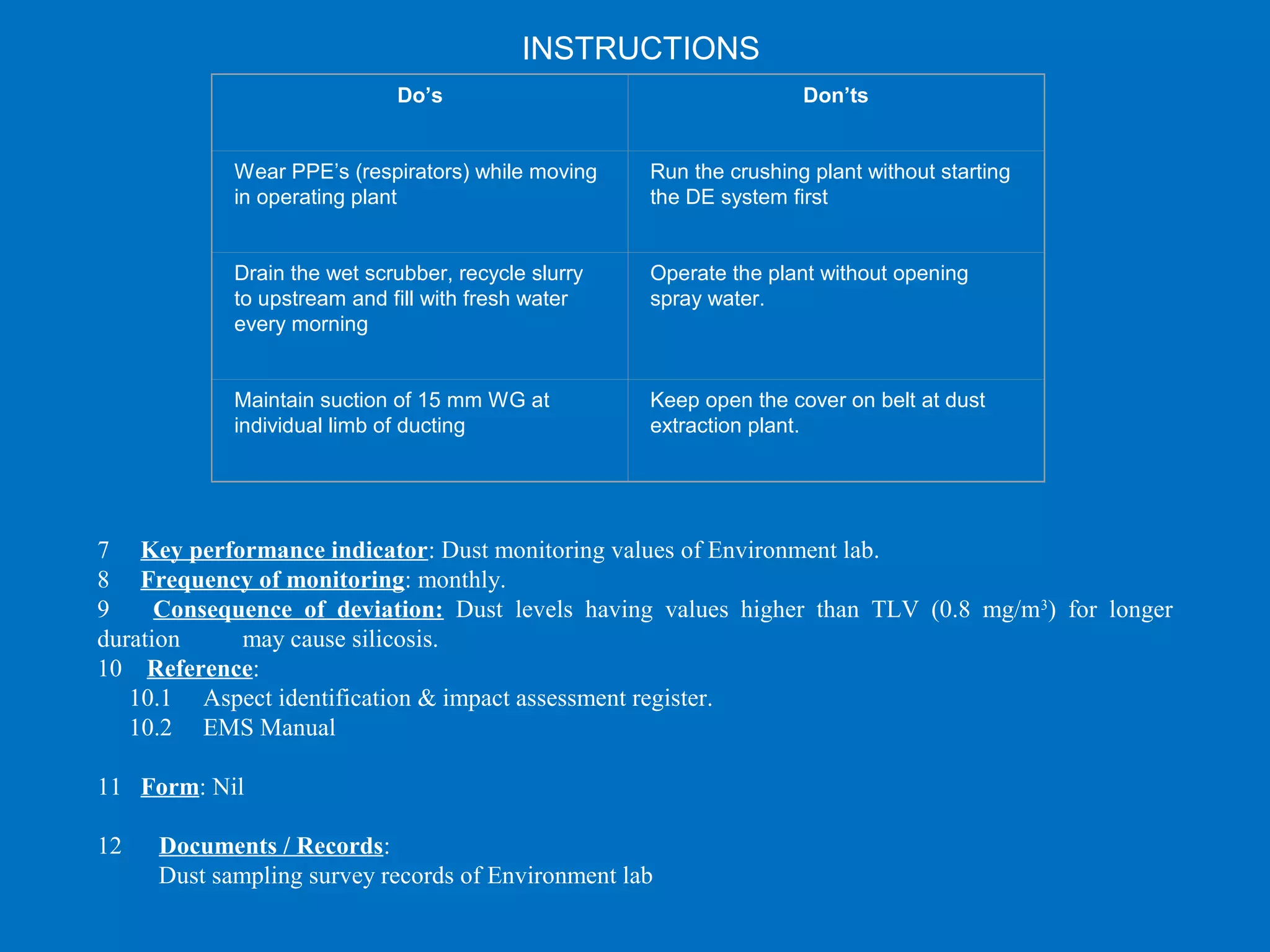
Do’s Don’ts
Wear PPE’s (respirators) while moving 
in operating plant 
Run the crushing plant without starting 
the DE system first
Drain the wet scrubber, recycle slurry 
to upstream and fill with fresh water 
every morning
Operate the plant without opening 
spray water.
Maintain suction of 15 mm WG at 
individual limb of ducting
Keep open the cover on belt at dust 
extraction plant.
 
7 Key performance indicator: Dust monitoring values of Environment lab.
8 Frequency of monitoring: monthly.
9 Consequence of deviation: Dust levels having values higher than TLV (0.8 mg/m3
) for longer
duration may cause silicosis.
10 Reference:
10.1 Aspect identification & impact assessment register.
10.2 EMS Manual
11 Form: Nil
12 Documents / Records:
Dust sampling survey records of Environment lab
INSTRUCTIONS
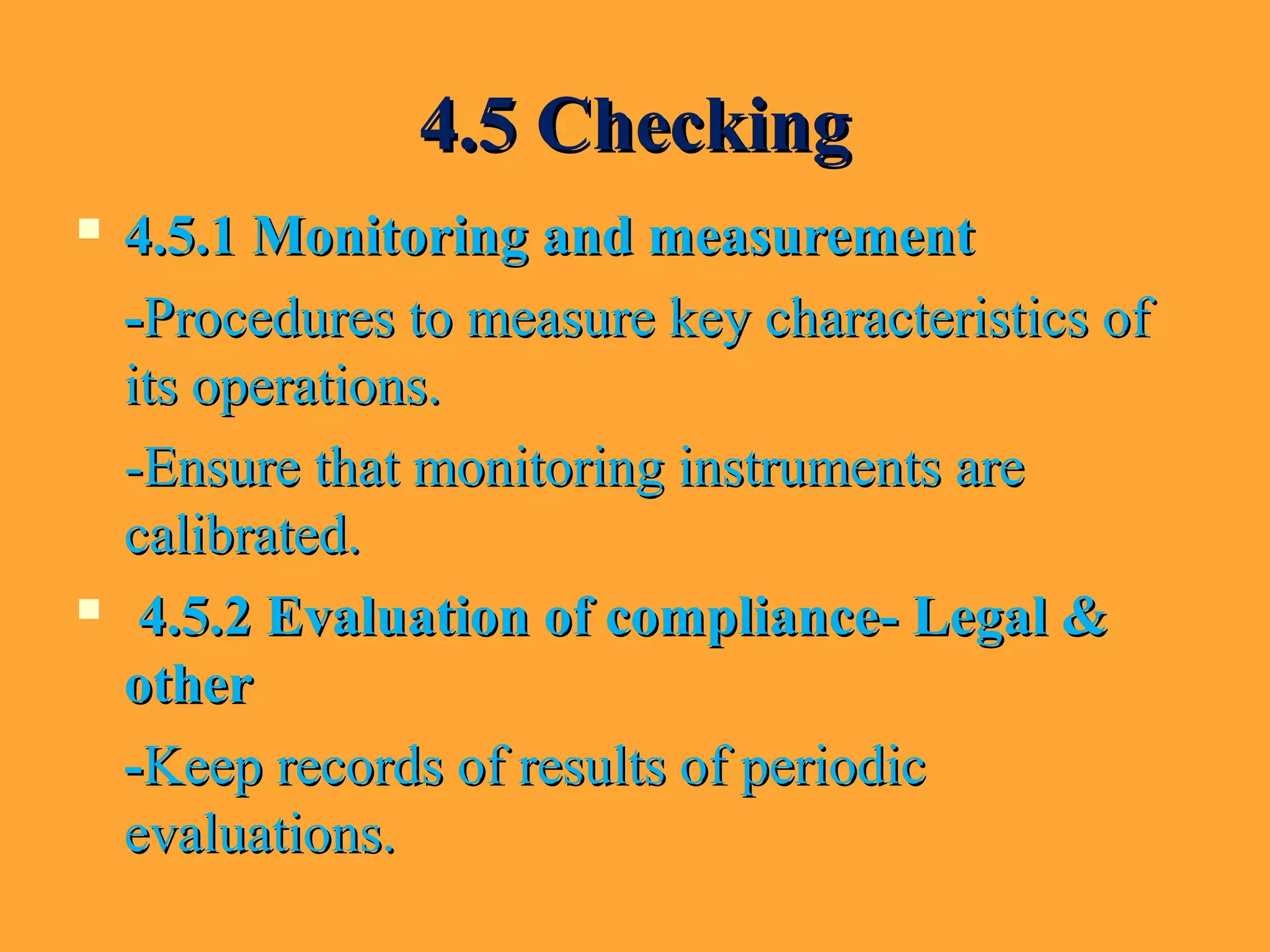
4.5 Checking4.5 Checking
 4.5.1 Monitoring and measurement4.5.1 Monitoring and measurement
--Procedures to measure key characteristics ofProcedures to measure key characteristics of
its operations.its operations.
-Ensure that monitoring instruments are-Ensure that monitoring instruments are
calibrated.calibrated.
 4.5.2 Evaluation of compliance- Legal &4.5.2 Evaluation of compliance- Legal &
otherother
--Keep records of results of periodicKeep records of results of periodic
evaluations.evaluations.
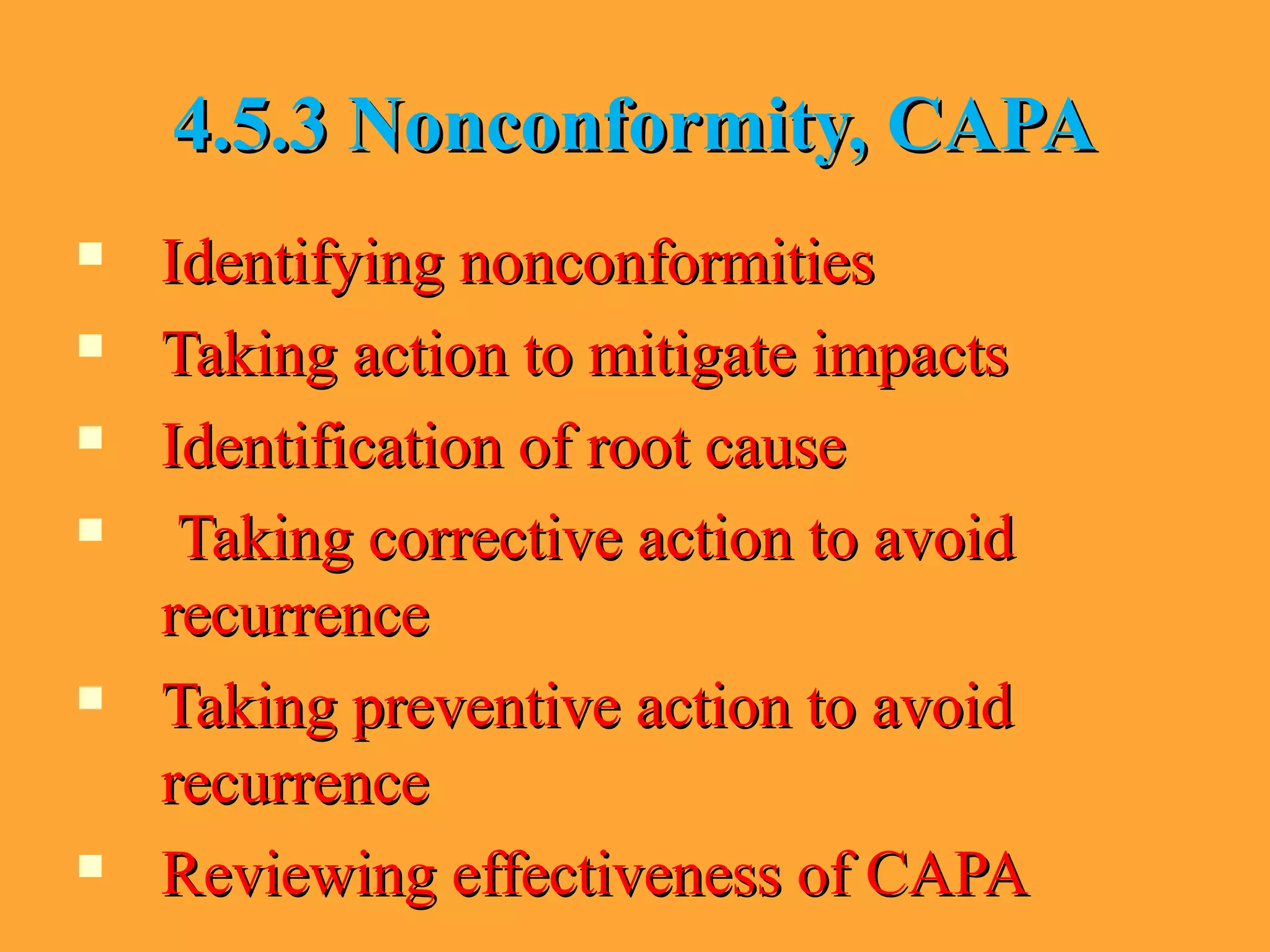
4.5.3 Nonconformity, CAPA4.5.3 Nonconformity, CAPA
 Identifying nonconformitiesIdentifying nonconformities
 Taking action to mitigate impactsTaking action to mitigate impacts
 Identification of root causeIdentification of root cause
 Taking corrective action to avoidTaking corrective action to avoid
recurrencerecurrence
 Taking preventive action to avoidTaking preventive action to avoid
recurrencerecurrence
 Reviewing effectiveness of CAPAReviewing effectiveness of CAPA
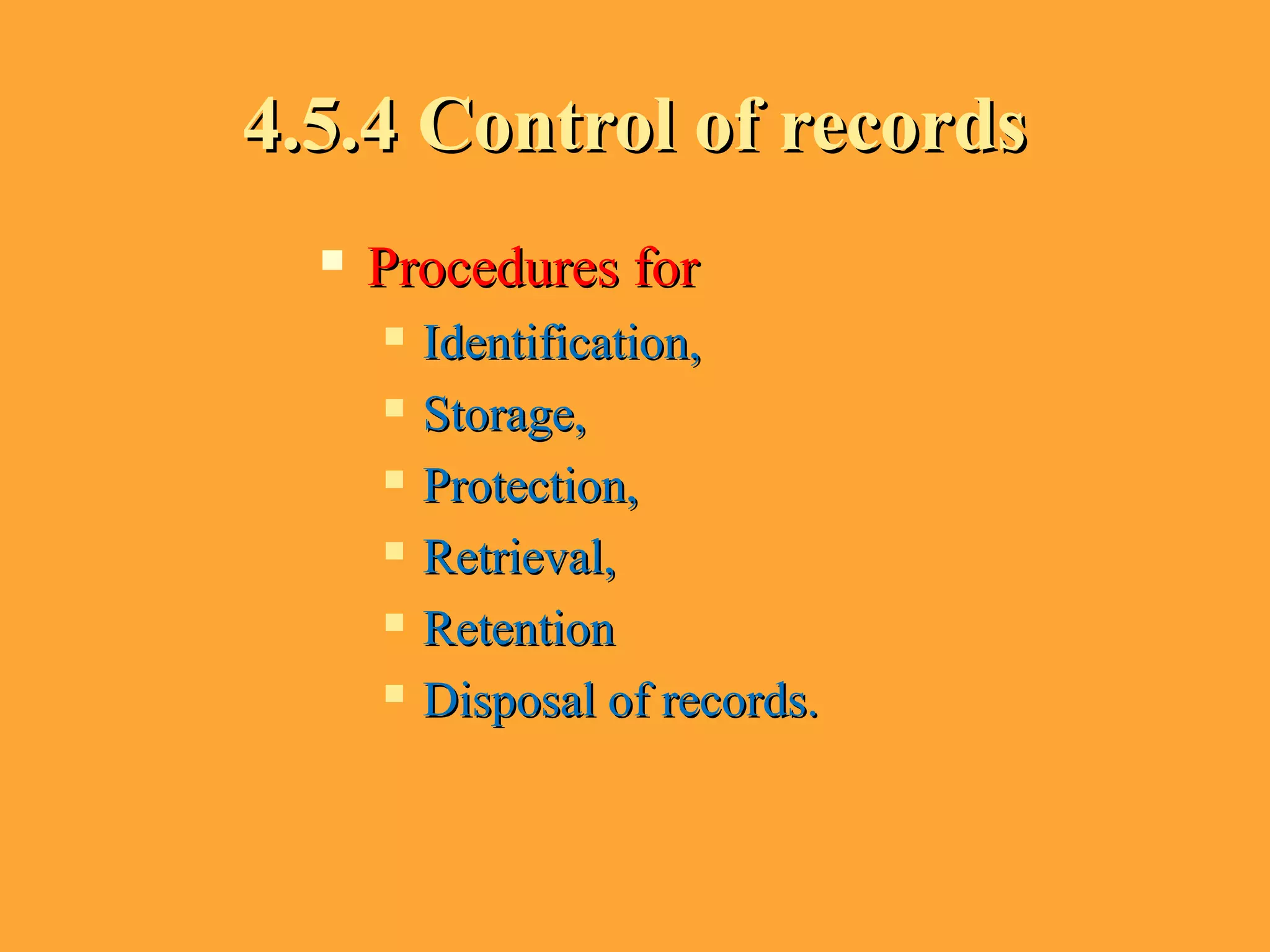
4.5.4 Control of records4.5.4 Control of records
 Procedures forProcedures for
 Identification,Identification,
 Storage,Storage,
 Protection,Protection,
 Retrieval,Retrieval,
 RetentionRetention
 Disposal of records.Disposal of records.
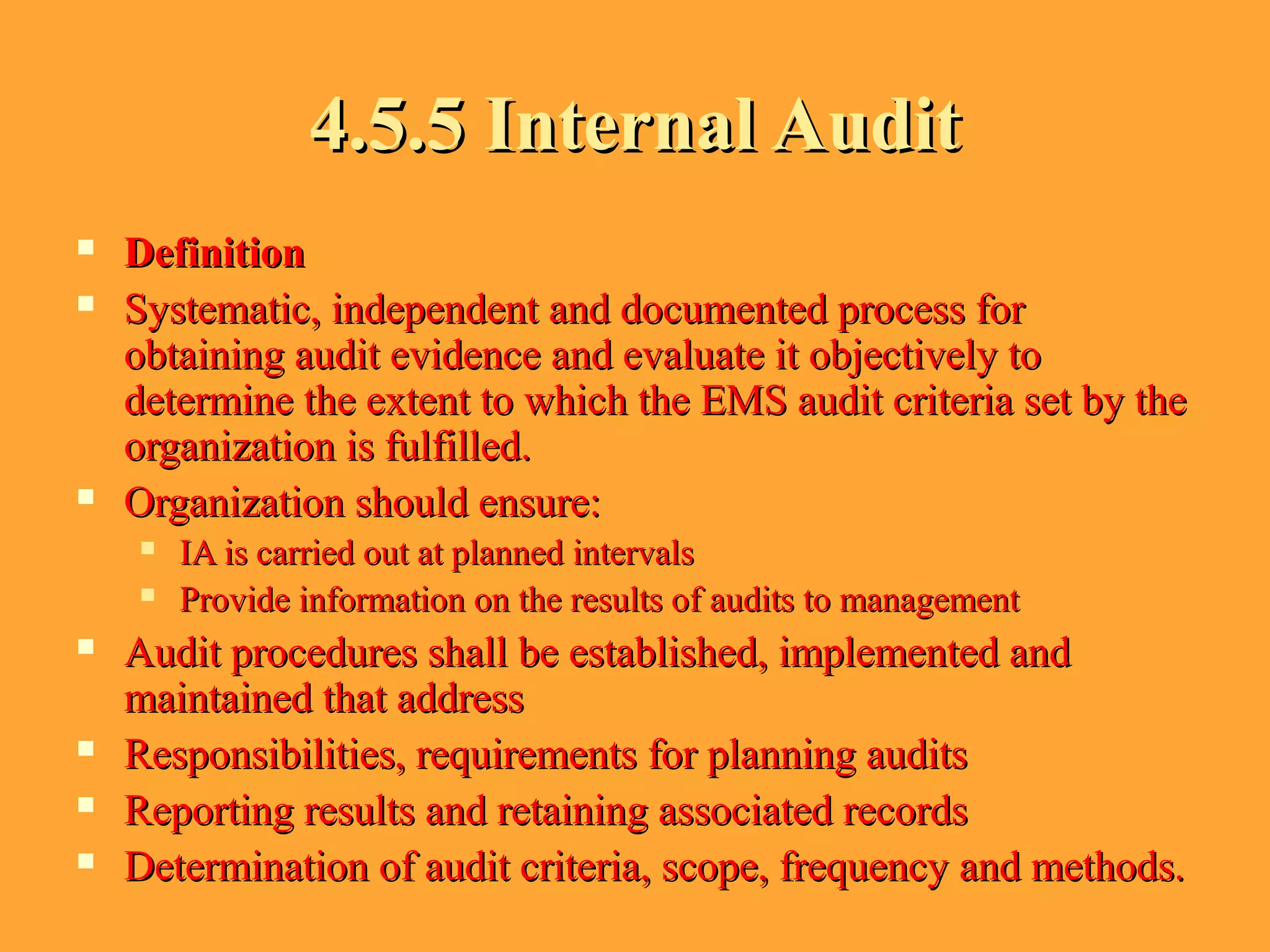
4.5.5 Internal Audit4.5.5 Internal Audit
 DefinitionDefinition
 Systematic, independent and documented process forSystematic, independent and documented process for
obtaining audit evidence and evaluate it objectively toobtaining audit evidence and evaluate it objectively to
determine the extent to which the EMS audit criteria set by thedetermine the extent to which the EMS audit criteria set by the
organization is fulfilled.organization is fulfilled.
 Organization should ensure:Organization should ensure:
 IA is carried out at planned intervalsIA is carried out at planned intervals
 Provide information on the results of audits to managementProvide information on the results of audits to management
 Audit procedures shall be established, implemented andAudit procedures shall be established, implemented and
maintained that addressmaintained that address
 Responsibilities, requirements for planning auditsResponsibilities, requirements for planning audits
 Reporting results and retaining associated recordsReporting results and retaining associated records
 Determination of audit criteria, scope, frequency and methods.Determination of audit criteria, scope, frequency and methods.
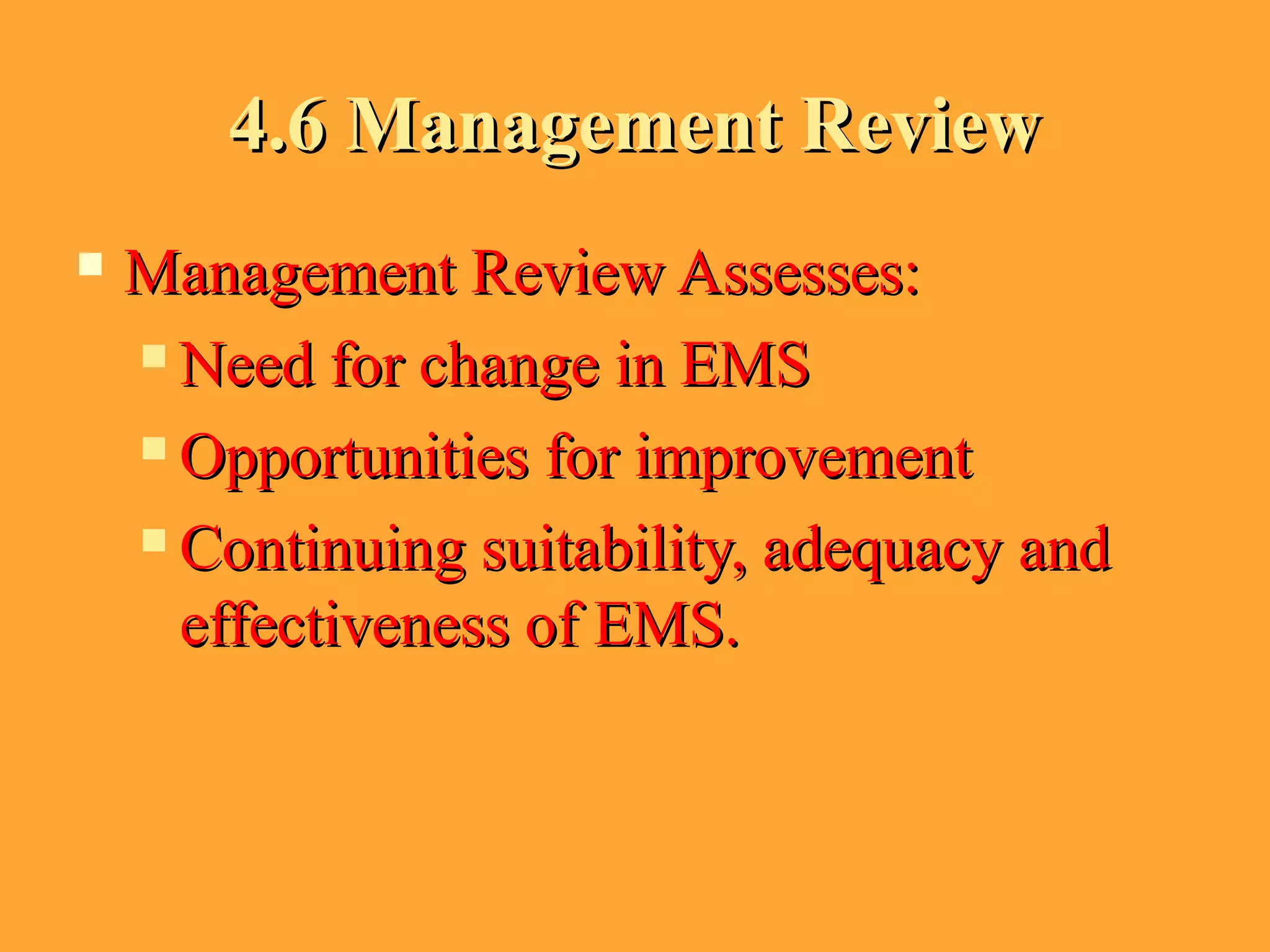
4.6 Management Review4.6 Management Review
 Management Review Assesses:Management Review Assesses:
 Need for change in EMSNeed for change in EMS
 Opportunities for improvementOpportunities for improvement
 Continuing suitability, adequacy andContinuing suitability, adequacy and
effectiveness of EMS.effectiveness of EMS.
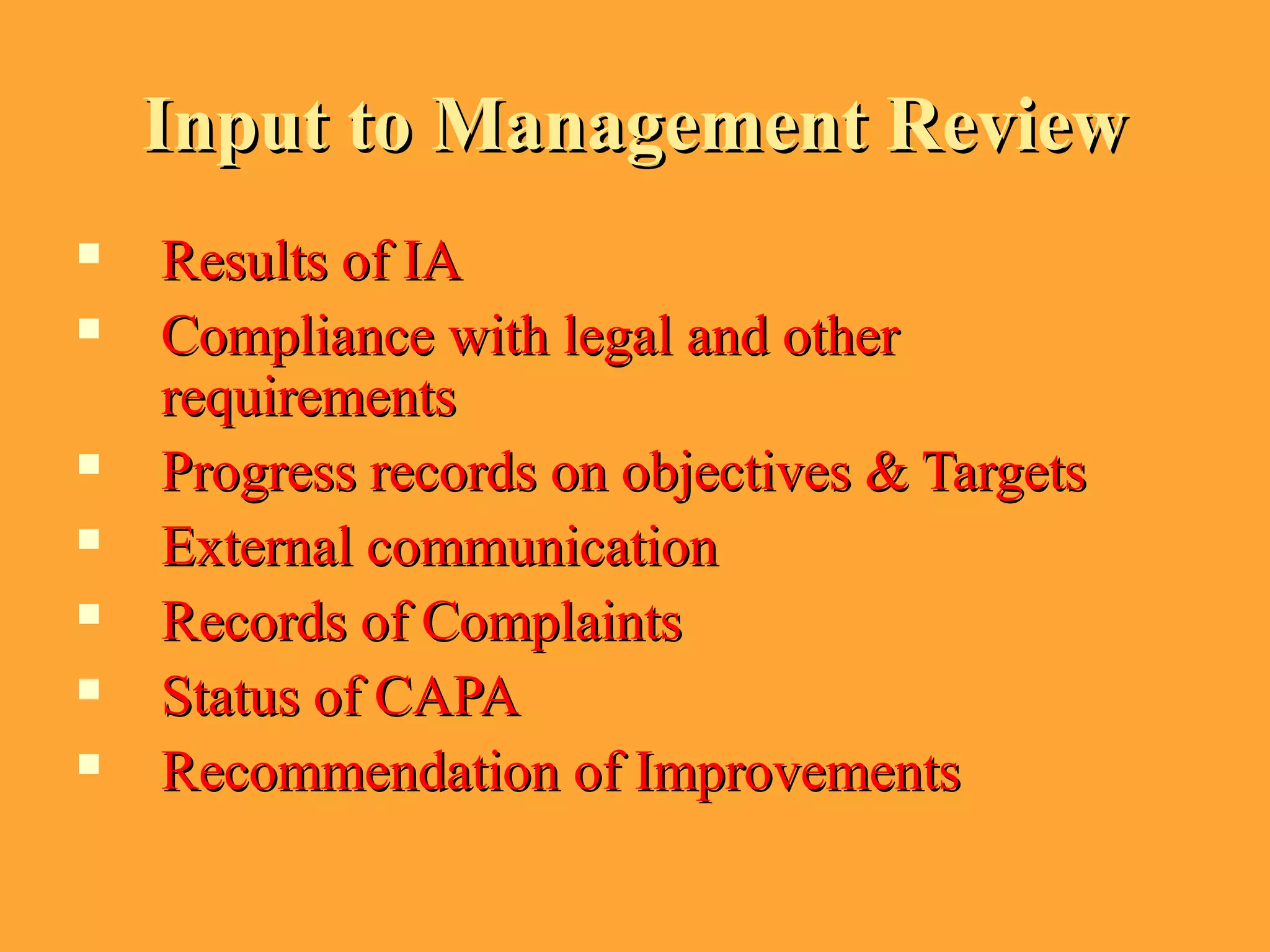
Input to Management ReviewInput to Management Review
 Results of IAResults of IA
 Compliance with legal and otherCompliance with legal and other
requirementsrequirements
 Progress records on objectives & TargetsProgress records on objectives & Targets
 External communicationExternal communication
 Records of ComplaintsRecords of Complaints
 Status of CAPAStatus of CAPA
 Recommendation of ImprovementsRecommendation of Improvements
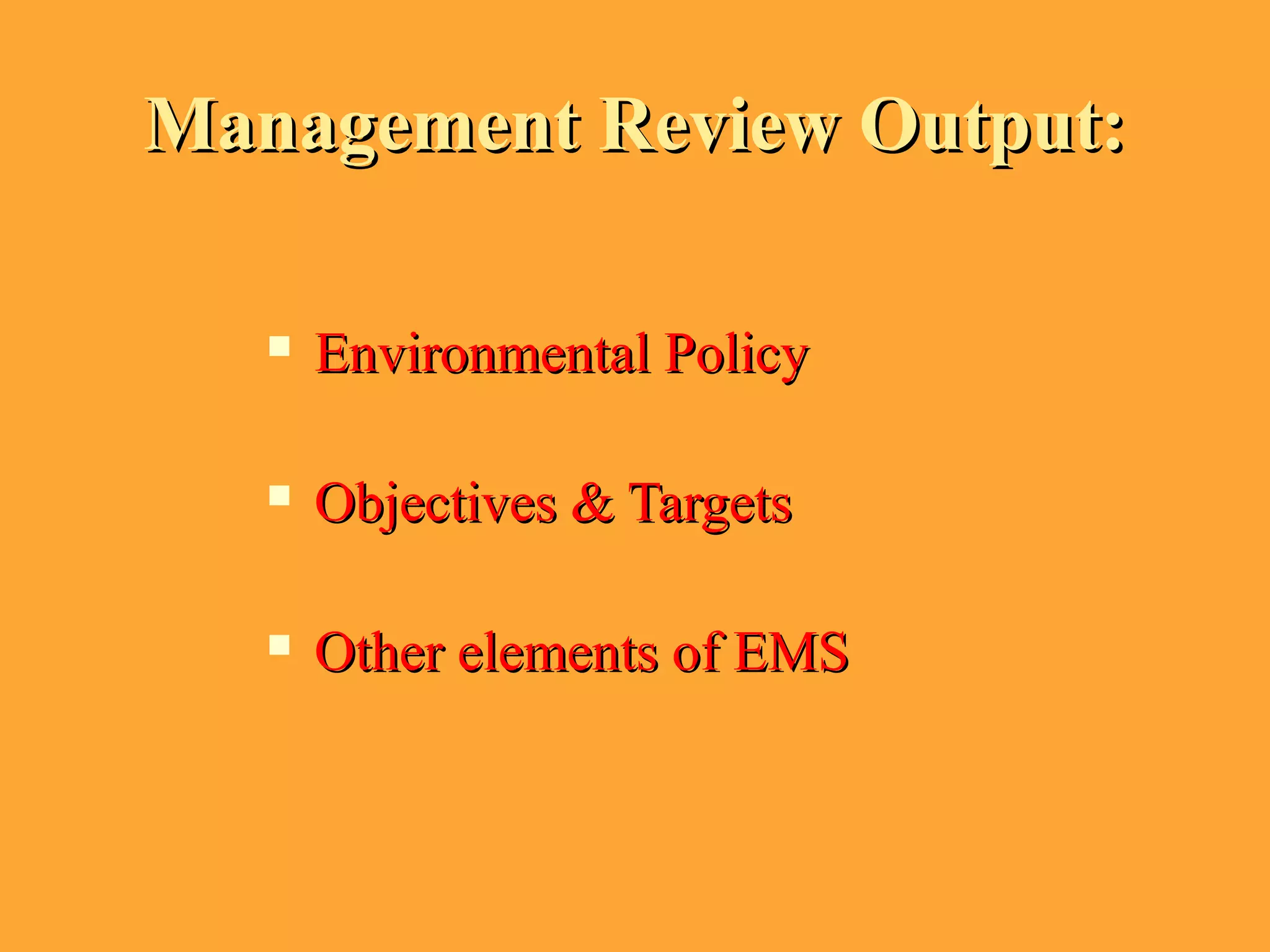
Management Review Output:Management Review Output:
 Environmental PolicyEnvironmental Policy
 Objectives & TargetsObjectives & Targets
 Other elements of EMSOther elements of EMS
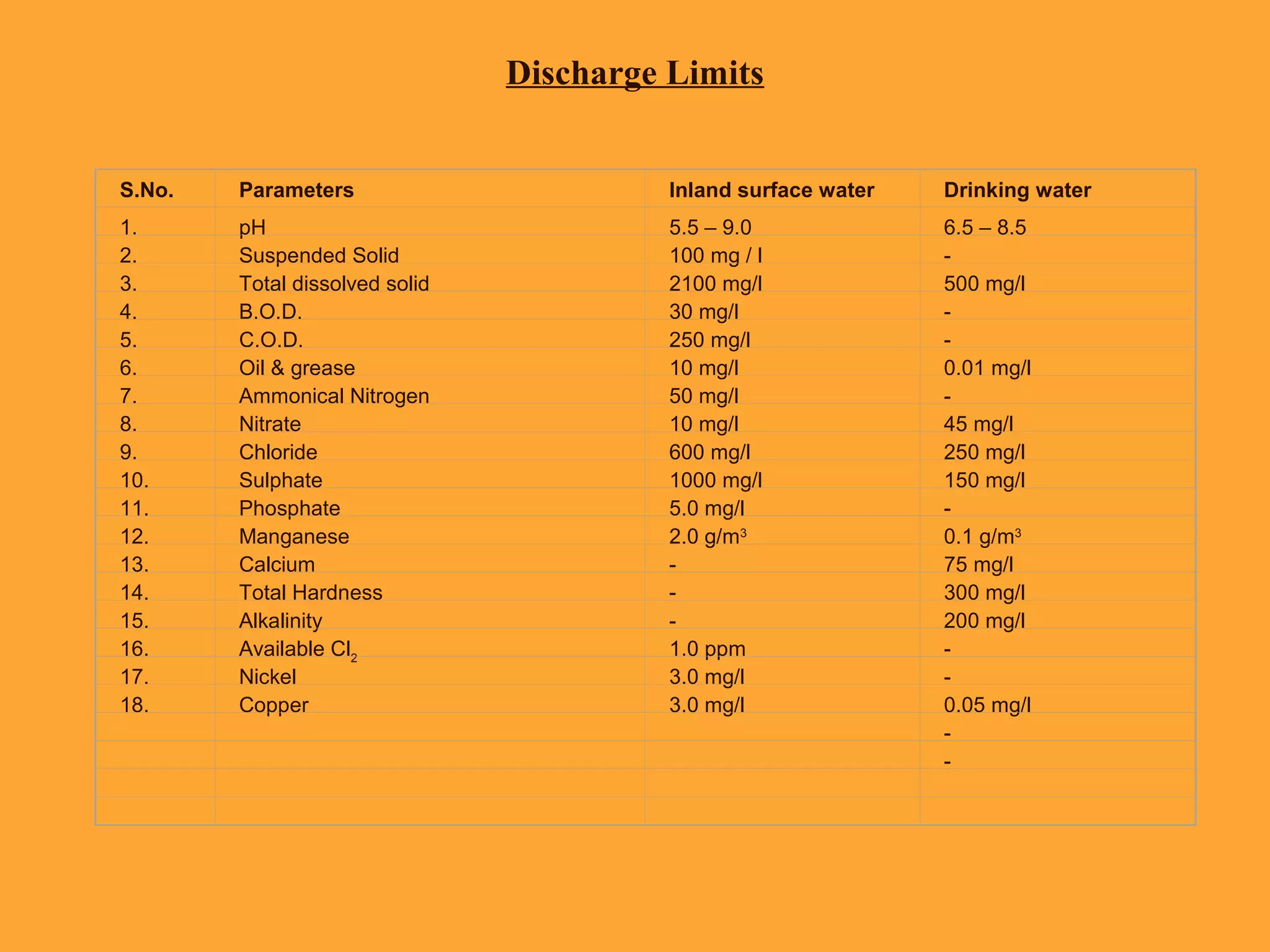
S.No. Parameters Inland surface water Drinking water
1. pH 5.5 – 9.0 6.5 – 8.5
2. Suspended Solid 100 mg / l -
3. Total dissolved solid 2100 mg/l 500 mg/l
4. B.O.D. 30 mg/l -
5. C.O.D. 250 mg/l -
6. Oil & grease 10 mg/l 0.01 mg/l
7. Ammonical Nitrogen 50 mg/l -
8. Nitrate 10 mg/l 45 mg/l
9. Chloride 600 mg/l 250 mg/l
10. Sulphate 1000 mg/l 150 mg/l
11. Phosphate 5.0 mg/l -
12. Manganese 2.0 g/m3
0.1 g/m3
13. Calcium - 75 mg/l
14. Total Hardness - 300 mg/l
15. Alkalinity - 200 mg/l
16. Available Cl2
1.0 ppm -
17. Nickel 3.0 mg/l -
18. Copper 3.0 mg/l 0.05 mg/l
-
-
Discharge Limits
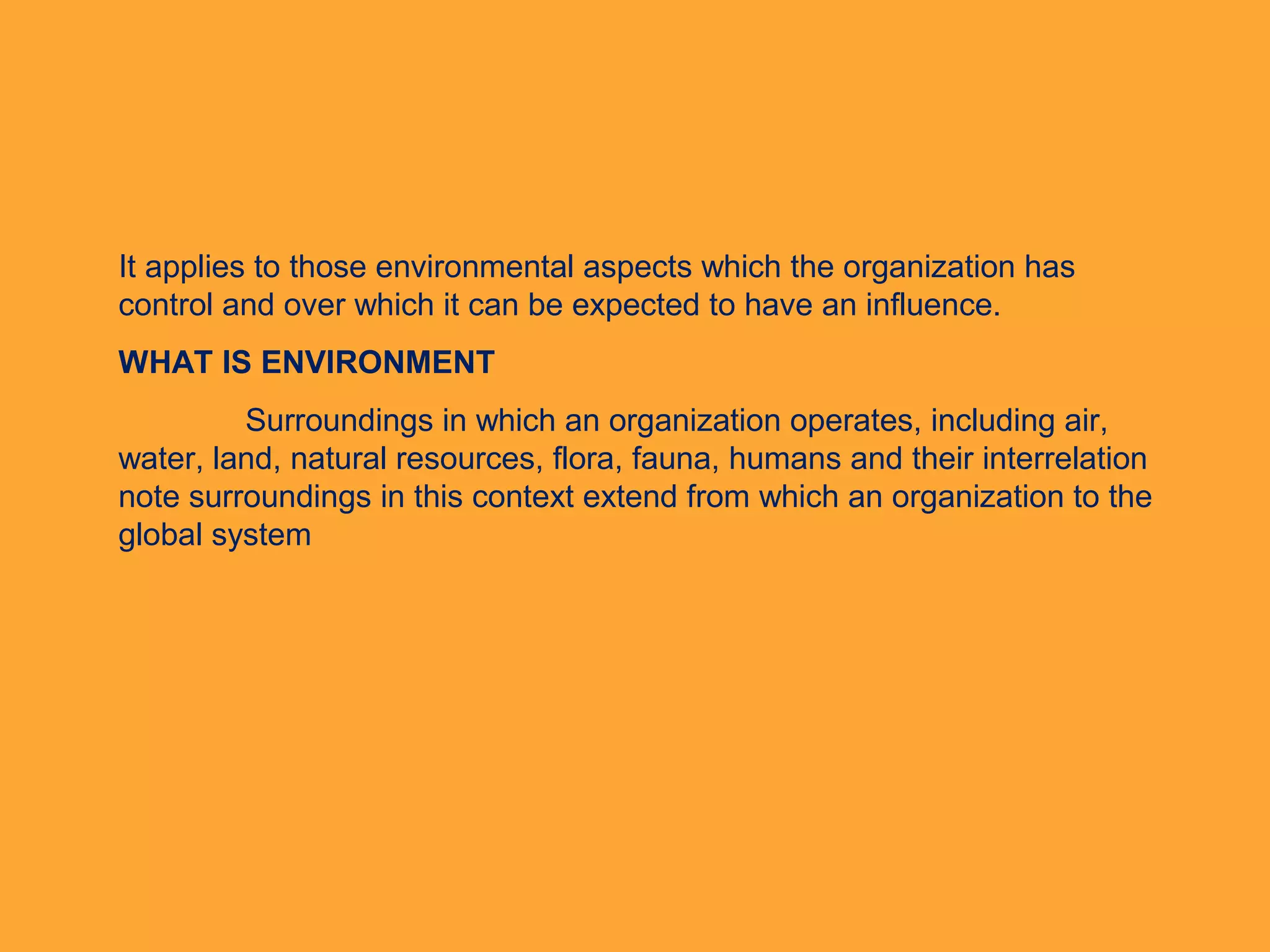
It applies to those environmental aspects which the organization has
control and over which it can be expected to have an influence.
WHAT IS ENVIRONMENT
Surroundings in which an organization operates, including air,
water, land, natural resources, flora, fauna, humans and their interrelation
note surroundings in this context extend from which an organization to the
global system
IN CONCLUSION…IN CONCLUSION…
 It may now be evident that ISO 14001 applies toIt may now be evident that ISO 14001 applies to
all those environmental aspects which anall those environmental aspects which an
organization has to control and over which it canorganization has to control and over which it can
be expected to have an influence.be expected to have an influence.
 But the main catch phrase in EMS is ‘to achieveBut the main catch phrase in EMS is ‘to achieve
continual improvements in overall environmentalcontinual improvements in overall environmental
performance consistent with the organisation’sperformance consistent with the organisation’s
environmental policy’.environmental policy’.
 So never consider the implementation as aSo never consider the implementation as a
chore – because that little extra may make the achore – because that little extra may make the a
significant dent in protecting the environment.significant dent in protecting the environment.
Presentation on ISO 14001

Presentation on ISO 14001

  • 2.
    WHAT IS ISO ISOmeans “International Organization for standardization”. It’s Head Quarters is in GENEVA. 195 countries in the world are the members of this organization. WHAT IS ISO – 14001:2004 It is an International Standard for Environment. ISO 14001 was first published in 1996 and specifies the actual requirements for an environmental management system. It applies to those environmental aspects which the organization has control and over which it can be expected to have an influence. WHAT IS ENVIRONMENT Surroundings in which an organization operates, including air, water, land, natural resources, flora, fauna, humans and their interrelation note surroundings in this context extend from which an organization to the global system
  • 3.
    ENVIRONMENTAL ISSUESENVIRONMENTAL ISSUES Air Pollution-Air Pollution- from everyday activity, causes acid rain, carfrom everyday activity, causes acid rain, car exhaust fumes, power stations, industrial processesexhaust fumes, power stations, industrial processes  Ozone depletion-Ozone depletion- use of CFC’suse of CFC’s  Greenhouse effect, Global warming, Climate changeGreenhouse effect, Global warming, Climate change  Water pollution-Water pollution- pollution of water streams by factories,pollution of water streams by factories, agriculture, chemical and oil spillageagriculture, chemical and oil spillage  Ecosystem destructionEcosystem destruction MAINLYMAINLY BECAUSE OFBECAUSE OF  Population increase - larger consumption ofPopulation increase - larger consumption of resources & more waste generationresources & more waste generation
  • 4.
    SOME DEFINITIONSSOME DEFINITIONS Environmental AspectEnvironmental Aspect Element of an organisation’s activities, products or servicesElement of an organisation’s activities, products or services that can interact with the environment.that can interact with the environment.  Environmental ImpactEnvironmental Impact Any change to the environment, whether adverse or beneficial,Any change to the environment, whether adverse or beneficial, wholly or partially resulting from an organisation’swholly or partially resulting from an organisation’s environmental aspects.environmental aspects.  Continual ImprovementContinual Improvement Recurring process of enhancing the EMS in order to achieveRecurring process of enhancing the EMS in order to achieve improvements in overall environmental performanceimprovements in overall environmental performance consistent with the organisation’s environmental policy.consistent with the organisation’s environmental policy.  Environmental objectiveEnvironmental objective Overall environmental goal, consistent with the EnvironmentalOverall environmental goal, consistent with the Environmental Policy, which an organization sets itself to achieve.Policy, which an organization sets itself to achieve.
  • 5.
    SOME DEFINITIONSSOME DEFINITIONS Environmental targetEnvironmental target Detailed performance requirement, applicable to theDetailed performance requirement, applicable to the organization or parts thereof, that arises from theorganization or parts thereof, that arises from the environmental objectives and that needs to be set and met inenvironmental objectives and that needs to be set and met in order to achieve those objectives.order to achieve those objectives.  Interested partyInterested party Person or group concerned with or affected by thePerson or group concerned with or affected by the environmental performance of an organization.environmental performance of an organization.  Local residentsLocal residents  Work forceWork force  Customers and consumersCustomers and consumers  Environmental support groupsEnvironmental support groups  General publicGeneral public
  • 6.
    ISO 14001- EMSREQUIREMENTSISO 14001- EMS REQUIREMENTS  4.1 General Requirements:4.1 General Requirements:  The organization shall establish, document, implement, maintain andThe organization shall establish, document, implement, maintain and continually improve an EMS in accordance with the requirements ofcontinually improve an EMS in accordance with the requirements of this international standard and determine how it will fulfill thesethis international standard and determine how it will fulfill these requirements.requirements.  The organization shall define and document the scope of itsThe organization shall define and document the scope of its environmental system.environmental system.  4.2 Environmental Policy:4.2 Environmental Policy:  Appropriate to the nature, scale, and impacts of its activities, productsAppropriate to the nature, scale, and impacts of its activities, products and servicesand services  Commitment to continual improvement and prevention of pollutionCommitment to continual improvement and prevention of pollution  Comply with applicable legal requirementsComply with applicable legal requirements  Provide the framework for setting environmental objective and targetsProvide the framework for setting environmental objective and targets  Documented, implemented and maintainedDocumented, implemented and maintained  Communicated to all persons for or on behalf of the organizationCommunicated to all persons for or on behalf of the organization  Is available to the public.Is available to the public.
  • 7.
    ENVIRONMENTAL POLICY OFAENVIRONMENTAL POLICY OF A MINING ORGANIZATION IN INDIAMINING ORGANIZATION IN INDIA  The company adopts environmental management system in allThe company adopts environmental management system in all its areas and is committed to:its areas and is committed to:  Manage air, water & noise pollution in its surface operationsManage air, water & noise pollution in its surface operations and air and noise pollutions in its underground mines.and air and noise pollutions in its underground mines.  Continual improvement in environmental quality andContinual improvement in environmental quality and prevention of pollution by applying best available practicesprevention of pollution by applying best available practices and setting & reviewing objectives and targets.and setting & reviewing objectives and targets.  Compliance with applicable environmental laws & otherCompliance with applicable environmental laws & other requirements concerned with all its operations.requirements concerned with all its operations.  Conservation of natural resources.Conservation of natural resources.  Monitor the health of all its employees and to ensure theMonitor the health of all its employees and to ensure the preventive & betterment measures.preventive & betterment measures.  The policy will be made available to interested party wheneverThe policy will be made available to interested party whenever asked for.asked for.
  • 8.
    4.3 Planning:4.3 Planning: 4.3.1 Environmental aspects4.3.1 Environmental aspects  To identify all aspects within the defined scopeTo identify all aspects within the defined scope  To identify significant aspects.To identify significant aspects.  This information should be documented and kept up-to-This information should be documented and kept up-to- date.date.  4.3.2 Legal and other requirements4.3.2 Legal and other requirements  To have access to applicable legal requirementsTo have access to applicable legal requirements  To determine how these requirements apply to itsTo determine how these requirements apply to its environmental aspectsenvironmental aspects
  • 9.
    Major Environmental RegulationsinMajor Environmental Regulations in IndiaIndia  The Water (Prevention and Control of Pollution) ActThe Water (Prevention and Control of Pollution) Act Amendments, 1974Amendments, 1974  The Water Rules, 1975The Water Rules, 1975  The Water Cess Act, 1977The Water Cess Act, 1977  The Air Act, 1981The Air Act, 1981  The Environmental Protection Act, 1985The Environmental Protection Act, 1985  Hazardous Wastes (Management and Handling)Hazardous Wastes (Management and Handling) Amendment Rules, 2002Amendment Rules, 2002  Atomic Energy (Factory) Rules 1996Atomic Energy (Factory) Rules 1996  Bio-Medical Waste (M& H), Rules, 1998Bio-Medical Waste (M& H), Rules, 1998  Noise Pollution Rules, 2000Noise Pollution Rules, 2000  Municipal Waste (M&H) Rules, 2000Municipal Waste (M&H) Rules, 2000  Batteries (Management and Handling) Rules, 2001Batteries (Management and Handling) Rules, 2001
  • 10.
    4.3.3 Objectives, Targetsand Programmes4.3.3 Objectives, Targets and Programmes  To maintain documented environmental objectives, targets, at relevantTo maintain documented environmental objectives, targets, at relevant functions and levels within the organization.functions and levels within the organization.  OBJECTIVESOBJECTIVES SS SpecificSpecific MM MeasurableMeasurable AA AchievableAchievable RR RelevantRelevant TT Time boundTime bound  What should be considered while making Objectives and Targets?What should be considered while making Objectives and Targets?  Legal and other requirements.Legal and other requirements.  Significant environmental aspects.Significant environmental aspects.  Technological, financial requirements.Technological, financial requirements.  Views of interested parties.Views of interested parties.  ProgrammeProgramme  Responsibility for achieving objectives & targetsResponsibility for achieving objectives & targets  Means and Time frame by which they are to be achieved.Means and Time frame by which they are to be achieved.
  • 11.
    S.No. Aspect ObjectivesTargets Programmes Performance Operational Monitoring and Indicatiors Controls Measurement 1 Overflow of tailings slurry to Mill drain Stopping backflow of slurry from discharge line of slime pumps on event of pump stoppage System to be operative within one year (April 2009) after survey of required auto operated valve. Selection of suitable auto operated suction valves and its installation Analysis of U(Nat) and Ra values in the monthly composite of Mill drain outlet Auto closure of suction valves in case of power failure Online sample collection from Mill drain and analysis of monthly composite for U(Nat) and Ra values Section Incharge, Chemical 'C' 2 Spillage of sulphuric acid from acid day tank area (Leaching Section) Preventing acid spillage and mixing with Mill drain System to be operative within one year (April 2009) i) Construction of a dyke around acid day tank. (ii) Recylce of spilled acid to emergency pit / day tank) Analysis results of Mill drain sample i) Level indication system of day tanks ii) Periodic maintenance of acid pump & sump pump Mill drain samples analysis Section Incharge, Chemical 'B' 3 Overflow of leached slurry from drain launder Stopping overflow from leaching pachuca enclosure System to be operative within one year( April 2009) Installation of a sump pump with automatic level control to recycle to chemical house (leach tank) Record of monitoring of U(Nat) and Ra values in the public domain (Shiv Mandir) Diversion of accidental overflow from leaching pachuca area to chemical house (leach tank) Monthly monitoring of U(Nat) and Ra values in the public domain (Shiv Mandir) Section Incharge, Chemical 'C' 4 Gamma radiation in disc filter area To reduce gamma exposure below TLV (8µGy/h) in disc filter area System to be commissioned within one year (April 2009) Procurement and replacement of existing MSRL tanks in disc filter area Values of gamma radiation level in disc filter house carried out by HPU (i) Planning for replacement of tanks (ii) Warning Boards Analysis of gamma radiation level in disc filter house carried out by HPU Section Incharge, Chemical A' 5 Environmenta l Policy To increase ISO awareness among employyes of mill division To cover 80% employees by March 2008 To conduct ISO awareness programme regularly Attendance register of awareness programme Conducting awareness programme regularly Attendance register of awareness programme & feed back report Incharge Mill Responsibility / Department Environmental Management Programme
  • 12.
    4.4 Implementation &Operation4.4 Implementation & Operation  4.4.1 Resources, roles, responsibility and authority4.4.1 Resources, roles, responsibility and authority  Roles, responsibilities shall be defined andRoles, responsibilities shall be defined and documented at all relevant functions.documented at all relevant functions.  Appointment of MR.Appointment of MR.  Responsibilities of MR:Responsibilities of MR:  Establishing, implementing, maintaining EMS as perEstablishing, implementing, maintaining EMS as per requirement.requirement.  Reporting to Top Management for review, andReporting to Top Management for review, and recommendations for improvement.recommendations for improvement.
  • 13.
    4.4.2 Competence, training&4.4.2 Competence, training & awarenessawareness  To ensure that any person managing significantTo ensure that any person managing significant aspects are competent on the basis of education,aspects are competent on the basis of education, training or experience and maintain associatedtraining or experience and maintain associated records.records.  Identify training needs of individuals (about EMS)Identify training needs of individuals (about EMS)  Awareness about:Awareness about:  Environmental policy and EMSEnvironmental policy and EMS  Significant aspects & impacts associated with theirSignificant aspects & impacts associated with their workwork  Roles and responsibilitiesRoles and responsibilities  Potential consequences of departure from specifiedPotential consequences of departure from specified procedures.procedures.
  • 14.
    4.4.3 Communication4.4.3 Communication ProcedureforProcedure for  Internal communication among variousInternal communication among various levels & functionslevels & functions  External communication from interestedExternal communication from interested partiesparties
  • 15.
    4.4.4 Documentation4.4.4 Documentation Policy, objectives & targetsPolicy, objectives & targets  Scope of EMSScope of EMS  Documents including recordsDocuments including records  Documents including records forDocuments including records for planning, operation and control ofplanning, operation and control of processes that relate to significantprocesses that relate to significant environmental aspects.environmental aspects.
  • 16.
    4.4.5 Control ofdocuments4.4.5 Control of documents  Procedures forProcedures for  Approval of documentsApproval of documents  Review and updateReview and update  Identification of current revision statusIdentification of current revision status  Use of relevant versionsUse of relevant versions  IdentificationIdentification  Control and identification of documents of externalControl and identification of documents of external originorigin  Prevention of use of obsolete documentsPrevention of use of obsolete documents
  • 17.
    4.4.6 Operational Control4.4.6Operational Control  Plan processes for managing significantPlan processes for managing significant environmental aspects:environmental aspects:  Documented operational control procedureDocumented operational control procedure  Fixing operating criteriaFixing operating criteria
  • 18.
    1.1. IntroductionIntroduction: Controlof dust generated during crushing, screening, grinding and: Control of dust generated during crushing, screening, grinding and conveying of ore.conveying of ore. 2.2. ScopeScope: Crushing Plant, Conveyors and Grinding: Crushing Plant, Conveyors and Grinding 3.3. Associated aspectsAssociated aspects: I(a), I (b), I (d), II A(a), II B(b): I(a), I (b), I (d), II A(a), II B(b) 4.4. Definition:Definition: Any particle (both respirable & non-respirable) which can be airborneAny particle (both respirable & non-respirable) which can be airborne is defined as dustis defined as dust 5.5. ResponsibilityResponsibility: Section-in-Charge & Shift – in- charge: Section-in-Charge & Shift – in- charge 6.6. Control ProcedureControl Procedure::  6.1 Dust generated during crushing and screening in extracted through a wet6.1 Dust generated during crushing and screening in extracted through a wet scrubber dust extraction system and is also suppressed by water spraying. Allscrubber dust extraction system and is also suppressed by water spraying. All spillages are immediately cleaned and any airborne dust is captured in the vacuumspillages are immediately cleaned and any airborne dust is captured in the vacuum dust cleaning system. All the dust generation points are connected through adust cleaning system. All the dust generation points are connected through a common ducting. All collected dust is recycled to the system upstream.common ducting. All collected dust is recycled to the system upstream.  6.2 Fine dust generated during conveying of ore is cleaned through vacuum dust6.2 Fine dust generated during conveying of ore is cleaned through vacuum dust cleaning system. And this dust is recycled through a bag filter into the system.cleaning system. And this dust is recycled through a bag filter into the system.  6.3 Additionally the dust generated during grinding of ore is suppressed through a6.3 Additionally the dust generated during grinding of ore is suppressed through a dry fog system.dry fog system. Example of Operational Control Procedure
  • 19.
      Do’s Don’ts Wear PPE’s (respirators) while moving  in operating plant  Run the crushing plant without starting  the DE system first Drain the wet scrubber, recycle slurry  to upstream and fill with fresh water  every morning Operate the plant without opening  spray water. Maintain suction of 15 mm WG at  individual limb of ducting Keep open the cover on belt at dust  extraction plant.   7 Keyperformance indicator: Dust monitoring values of Environment lab. 8 Frequency of monitoring: monthly. 9 Consequence of deviation: Dust levels having values higher than TLV (0.8 mg/m3 ) for longer duration may cause silicosis. 10 Reference: 10.1 Aspect identification & impact assessment register. 10.2 EMS Manual 11 Form: Nil 12 Documents / Records: Dust sampling survey records of Environment lab INSTRUCTIONS
  • 20.
    4.5 Checking4.5 Checking 4.5.1 Monitoring and measurement4.5.1 Monitoring and measurement --Procedures to measure key characteristics ofProcedures to measure key characteristics of its operations.its operations. -Ensure that monitoring instruments are-Ensure that monitoring instruments are calibrated.calibrated.  4.5.2 Evaluation of compliance- Legal &4.5.2 Evaluation of compliance- Legal & otherother --Keep records of results of periodicKeep records of results of periodic evaluations.evaluations.
  • 21.
    4.5.3 Nonconformity, CAPA4.5.3Nonconformity, CAPA  Identifying nonconformitiesIdentifying nonconformities  Taking action to mitigate impactsTaking action to mitigate impacts  Identification of root causeIdentification of root cause  Taking corrective action to avoidTaking corrective action to avoid recurrencerecurrence  Taking preventive action to avoidTaking preventive action to avoid recurrencerecurrence  Reviewing effectiveness of CAPAReviewing effectiveness of CAPA
  • 22.
    4.5.4 Control ofrecords4.5.4 Control of records  Procedures forProcedures for  Identification,Identification,  Storage,Storage,  Protection,Protection,  Retrieval,Retrieval,  RetentionRetention  Disposal of records.Disposal of records.
  • 23.
    4.5.5 Internal Audit4.5.5Internal Audit  DefinitionDefinition  Systematic, independent and documented process forSystematic, independent and documented process for obtaining audit evidence and evaluate it objectively toobtaining audit evidence and evaluate it objectively to determine the extent to which the EMS audit criteria set by thedetermine the extent to which the EMS audit criteria set by the organization is fulfilled.organization is fulfilled.  Organization should ensure:Organization should ensure:  IA is carried out at planned intervalsIA is carried out at planned intervals  Provide information on the results of audits to managementProvide information on the results of audits to management  Audit procedures shall be established, implemented andAudit procedures shall be established, implemented and maintained that addressmaintained that address  Responsibilities, requirements for planning auditsResponsibilities, requirements for planning audits  Reporting results and retaining associated recordsReporting results and retaining associated records  Determination of audit criteria, scope, frequency and methods.Determination of audit criteria, scope, frequency and methods.
  • 24.
    4.6 Management Review4.6Management Review  Management Review Assesses:Management Review Assesses:  Need for change in EMSNeed for change in EMS  Opportunities for improvementOpportunities for improvement  Continuing suitability, adequacy andContinuing suitability, adequacy and effectiveness of EMS.effectiveness of EMS.
  • 25.
    Input to ManagementReviewInput to Management Review  Results of IAResults of IA  Compliance with legal and otherCompliance with legal and other requirementsrequirements  Progress records on objectives & TargetsProgress records on objectives & Targets  External communicationExternal communication  Records of ComplaintsRecords of Complaints  Status of CAPAStatus of CAPA  Recommendation of ImprovementsRecommendation of Improvements
  • 26.
    Management Review Output:ManagementReview Output:  Environmental PolicyEnvironmental Policy  Objectives & TargetsObjectives & Targets  Other elements of EMSOther elements of EMS
  • 27.
    S.No. Parameters Inlandsurface water Drinking water 1. pH 5.5 – 9.0 6.5 – 8.5 2. Suspended Solid 100 mg / l - 3. Total dissolved solid 2100 mg/l 500 mg/l 4. B.O.D. 30 mg/l - 5. C.O.D. 250 mg/l - 6. Oil & grease 10 mg/l 0.01 mg/l 7. Ammonical Nitrogen 50 mg/l - 8. Nitrate 10 mg/l 45 mg/l 9. Chloride 600 mg/l 250 mg/l 10. Sulphate 1000 mg/l 150 mg/l 11. Phosphate 5.0 mg/l - 12. Manganese 2.0 g/m3 0.1 g/m3 13. Calcium - 75 mg/l 14. Total Hardness - 300 mg/l 15. Alkalinity - 200 mg/l 16. Available Cl2 1.0 ppm - 17. Nickel 3.0 mg/l - 18. Copper 3.0 mg/l 0.05 mg/l - - Discharge Limits
  • 28.
    It applies tothose environmental aspects which the organization has control and over which it can be expected to have an influence. WHAT IS ENVIRONMENT Surroundings in which an organization operates, including air, water, land, natural resources, flora, fauna, humans and their interrelation note surroundings in this context extend from which an organization to the global system
  • 29.
    IN CONCLUSION…IN CONCLUSION… It may now be evident that ISO 14001 applies toIt may now be evident that ISO 14001 applies to all those environmental aspects which anall those environmental aspects which an organization has to control and over which it canorganization has to control and over which it can be expected to have an influence.be expected to have an influence.  But the main catch phrase in EMS is ‘to achieveBut the main catch phrase in EMS is ‘to achieve continual improvements in overall environmentalcontinual improvements in overall environmental performance consistent with the organisation’sperformance consistent with the organisation’s environmental policy’.environmental policy’.  So never consider the implementation as aSo never consider the implementation as a chore – because that little extra may make the achore – because that little extra may make the a significant dent in protecting the environment.significant dent in protecting the environment.