“Kids need reading
     stamina”


Developing a reading culture at
  Thomas Deacon Academy
Why read?


            Why books?
"Reading is to the mind what exercise
is to the body."
Richard Steele
The ability to read is one of
the strongest predictors of
future success.


                              Although reading can be
                               taught in a classroom,
                                 it must be practised.
This slide and next: Are librarians really worth it? Available online at:
http://www.ccsd.net/schools/watson/libraryresearch.html
Michael Jordan can teach
you to how to throw the
perfect foul line shot, but
if you don't ever practise
the skill, his instruction
is worthless.


When students voluntarily
read, they practise and
enforce what is taught in the
classroom.
OECD “Reading for Change” 2002 found that
“Being more enthusiastic about reading
and a frequent reader was more of an
advantage, on its own, than having well-
educated parents in good jobs”
“Finding ways to
engage students in
reading may be one
of the most effective
ways to leverage
social change."


OECD (2002). Reading For Change:
Results from PISA 2000, published
by the Organisation For Economic
Co-operation and Development.
Cultural
Reading for
pleasure      =   heritage
                  Creativity and
                  imagination
                  Language
                  development
                  Increased self-
                  esteem
                  Emotional
                  development
                  Sustained
                  concentration
“There is a strong association
between the amount of reading for
pleasure children reported and their
reading achievement.”


Twist, L., Schagen, I. and Hodgson, C. (2007). Readers and Reading: National
Report for England 2006. Slough: NFER
Reading….


…doesn’t always
have to be from
books
MSN
            Bebo and
            Facebook


 Magazines
 and comics

            Websites


TXT messages


          Newspapers

E-books                …are all forms of reading!
Why books?
“Books rule! You don’t have pictures to
tell you how to imagine something, you
can do it yourself! Books can do what no
machines can, and probably never will. For
example, time travel and they can take
you to other dimensions! They are
somewhere to go when you just want to
escape the real world!” Dani, 13
"You don't have to burn books to
destroy a culture. Just get people to
stop reading them."
Ray Bradbury
“A significant number of boys would rather
chew off their own right leg than confess to
enjoying reading and writing.” Alan Gibbons
What does this mean?

      Impact on all subjects
          and exam courses

    Lack of engagement
    with culture

    Stalling of reading &
    literacy development

Problems with concentration
and attention span
“The research evidence
                          suggests that encouraging
                          reading for pleasure could
                          be a way of contributing
                          towards raising educational
                          standards and combating
                          social exclusion.”


Clark, C and Akerman, R (2006). Social inclusion and reading: an exploration.
National Literacy Trust
“Sustained reading to my mind is essential
 for developing a world they would want to
    live in. The reading does not need to be
       fiction but I do believe that kids need
      reading stamina. Just like you have to
   stick at anything and practice etc surely
    you need to do the same with reading.”
                    Ingrid Hopson SLYA 2007
So what could
we do?
We need time
for reading…
Suggestions for Parents
• Positive attitude to books
• Role models with reading
• Reading initiatives e.g. WBD Author
  Workshops
• Book experiment (encouraging use of
  MRC)
• Books & Reading material around the
  home
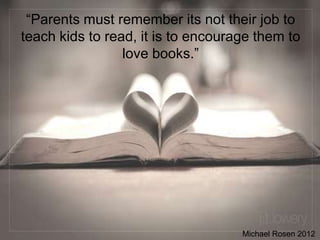
“Parents must remember its not their job to
teach kids to read, it is to encourage them to
                 love books.”


                                    Michael Rosen 2012
Becoming a reader requires
reading outside of school, in
         the home.
Children need to be reading
       for pleasure.
“Children moving
through primary school
   and into secondary
school without acquiring
  the habit of reading,
  may not develop the
   necessary reading
    stamina that is an
essential part of being a
  capable reader (and
         writer).”
 Stephen Rickard “Why Children Don’t
 Read”
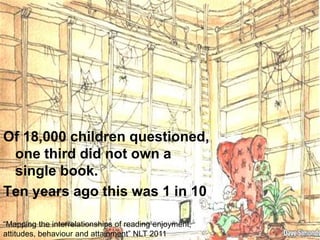
Of 18,000 children questioned,
 one third did not own a
 single book.
Ten years ago this was 1 in 10

“Mapping the interrelationships of reading enjoyment,
attitudes, behaviour and attainment” NLT 2011
A place to keep their books
A place to read?
Take an interest
in what they are
    reading and
  listen to them
       read.
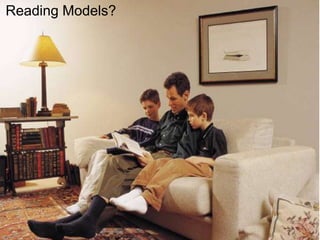
Reading Models?
Encourage
 them to read
something new.
Encourage
    them to
experiment by
using the MRC
Those that read a book a
week or more were likely
 to enjoy reading and do
     better in school

Parents reading workshop

  • 1.
    “Kids need reading stamina” Developing a reading culture at Thomas Deacon Academy
  • 2.
    Why read? Why books?
  • 3.
    "Reading is tothe mind what exercise is to the body." Richard Steele
  • 4.
    The ability toread is one of the strongest predictors of future success. Although reading can be taught in a classroom, it must be practised. This slide and next: Are librarians really worth it? Available online at: http://www.ccsd.net/schools/watson/libraryresearch.html
  • 5.
    Michael Jordan canteach you to how to throw the perfect foul line shot, but if you don't ever practise the skill, his instruction is worthless. When students voluntarily read, they practise and enforce what is taught in the classroom.
  • 6.
    OECD “Reading forChange” 2002 found that “Being more enthusiastic about reading and a frequent reader was more of an advantage, on its own, than having well- educated parents in good jobs”
  • 7.
    “Finding ways to engagestudents in reading may be one of the most effective ways to leverage social change." OECD (2002). Reading For Change: Results from PISA 2000, published by the Organisation For Economic Co-operation and Development.
  • 8.
    Cultural Reading for pleasure = heritage Creativity and imagination Language development Increased self- esteem Emotional development Sustained concentration
  • 9.
    “There is astrong association between the amount of reading for pleasure children reported and their reading achievement.” Twist, L., Schagen, I. and Hodgson, C. (2007). Readers and Reading: National Report for England 2006. Slough: NFER
  • 10.
  • 11.
    MSN Bebo and Facebook Magazines and comics Websites TXT messages Newspapers E-books …are all forms of reading!
  • 12.
  • 13.
    “Books rule! Youdon’t have pictures to tell you how to imagine something, you can do it yourself! Books can do what no machines can, and probably never will. For example, time travel and they can take you to other dimensions! They are somewhere to go when you just want to escape the real world!” Dani, 13
  • 14.
    "You don't haveto burn books to destroy a culture. Just get people to stop reading them." Ray Bradbury
  • 15.
    “A significant numberof boys would rather chew off their own right leg than confess to enjoying reading and writing.” Alan Gibbons
  • 16.
    What does thismean? Impact on all subjects and exam courses Lack of engagement with culture Stalling of reading & literacy development Problems with concentration and attention span
  • 17.
    “The research evidence suggests that encouraging reading for pleasure could be a way of contributing towards raising educational standards and combating social exclusion.” Clark, C and Akerman, R (2006). Social inclusion and reading: an exploration. National Literacy Trust
  • 18.
    “Sustained reading tomy mind is essential for developing a world they would want to live in. The reading does not need to be fiction but I do believe that kids need reading stamina. Just like you have to stick at anything and practice etc surely you need to do the same with reading.” Ingrid Hopson SLYA 2007
  • 19.
  • 20.
    We need time forreading…
  • 21.
    Suggestions for Parents •Positive attitude to books • Role models with reading • Reading initiatives e.g. WBD Author Workshops • Book experiment (encouraging use of MRC) • Books & Reading material around the home
  • 22.
    “Parents must rememberits not their job to teach kids to read, it is to encourage them to love books.” Michael Rosen 2012
  • 23.
    Becoming a readerrequires reading outside of school, in the home. Children need to be reading for pleasure.
  • 24.
    “Children moving through primaryschool and into secondary school without acquiring the habit of reading, may not develop the necessary reading stamina that is an essential part of being a capable reader (and writer).” Stephen Rickard “Why Children Don’t Read”
  • 25.
    Of 18,000 childrenquestioned, one third did not own a single book. Ten years ago this was 1 in 10 “Mapping the interrelationships of reading enjoyment, attitudes, behaviour and attainment” NLT 2011
  • 26.
    A place tokeep their books
  • 27.
  • 28.
    Take an interest inwhat they are reading and listen to them read.
  • 29.
  • 30.
    Encourage them toread something new.
  • 31.
    Encourage them to experiment by using the MRC
  • 32.
    Those that reada book a week or more were likely to enjoy reading and do better in school