Building an Independent Reading
Life in Upper Elementary Grades
LCCS Educator’s Institute March 2015
Maureen Nosal
Fasten Your Seat Belts! Here We GO,
Thinking Together About Kids and Books!!
Walter Dean Myers
National Ambassador for Young
People’s Literature 2012-2013
“When I began to read, I
began to exist”
RIP
The Power of Reading Volume
Reciprocal influences on the
cognitive domains of:
• vocabulary
• reading comprehension
• critical thinking
• general world knowledge
Cunningham
How children view themselves
as a reader
Children’s reading self-concept develops very
early and in response to initial reading
experiences
(Chapman & Tunmer, 2003; Lynch & Cunningham, 2005)
Research is consistent with
perspective arguing a child’s
reading self-concept is formed
as a consequence of patterns of
success or failure
(Corglioni & Cunningham, 2006; Pintrinch & Schunk, 2000)
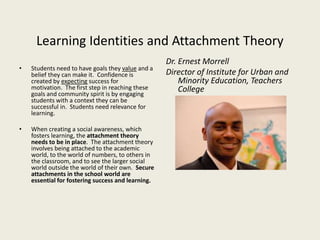
Learning Identities and Attachment Theory
• Students need to have goals they value and a
belief they can make it. Confidence is
created by expecting success for
motivation. The first step in reaching these
goals and community spirit is by engaging
students with a context they can be
successful in. Students need relevance for
learning.
• When creating a social awareness, which
fosters learning, the attachment theory
needs to be in place. The attachment theory
involves being attached to the academic
world, to the world of numbers, to others in
the classroom, and to see the larger social
world outside the world of their own. Secure
attachments in the school world are
essential for fostering success and learning.
Dr. Ernest Morrell
Director of Institute for Urban and
Minority Education, Teachers
College
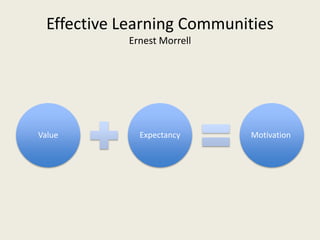
Effective Learning Communities
Ernest Morrell
Value Expectancy Motivation
Winning Back Reluctant Readers
• Know the students
• Know the books
• Seek creative ways to connect the two
Pat Scales
Be a Book Whisperer!
• According to the Kids and Family Reading
Report, the most likely reason our reluctant
readers avoid reading is that they have trouble
finding books they want to read.
The “Home Run” Book
• Jim Trelease has suggested that one very positive
experience can create a reader, one "home run"
book.
• Alfred Tatum writes that our textual lineage
includes the things we have read that have been
significant in shaping our identities
• Take a moment to recall an important reading
experience in your life. What was the book, and
what do you remember about both the book and
the experience that changed you as a reader?
On the Back
• Who is part of your reading community (as an
adult reader)?
• Who do you go to for book talks,
recommendations, social reading
experiences?
• Jot a list on the back of your “home run” book
paper and be ready to share
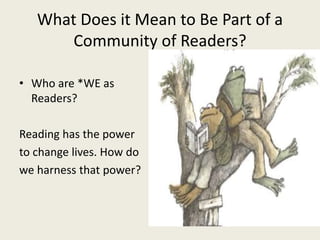
What Does it Mean to Be Part of a
Community of Readers?
• Who are *WE as
Readers?
Reading has the power
to change lives. How do
we harness that power?
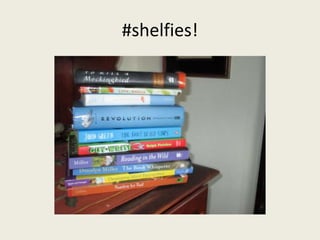
#shelfies!
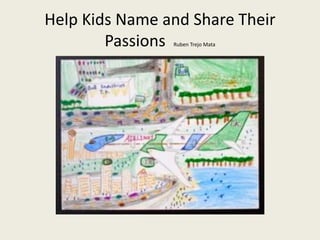
Help Kids Name and Share Their
Passions Ruben Trejo Mata
Why do reading habits matter?
We are creating school time readers rather
than lifetime readers. (Trelease)
• If children only see reading as something they
do in school, then they are vulnerable readers.
• Reading is a critically important life skill.
Leisure Reading
IRA Position Statement
• The position statement's recommendations are based
on these principles:
• Students should choose their own reading materials.
• Students are better able to choose engaging and
appropriate reading materials when teachers and
family members scaffold their selections.
• The benefits of leisure reading are increased when
teachers scaffold school-based leisure reading by
incorporating reflection, response, and sharing in a
wide range of ways that are not evaluated.
• Students should be encouraged to engage in self-
selected reading outside of school.
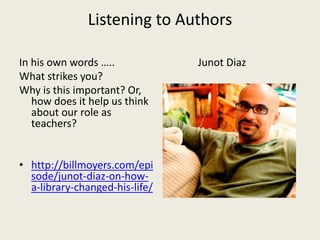
Listening to Authors
In his own words …..
What strikes you?
Why is this important? Or,
how does it help us think
about our role as
teachers?
• http://billmoyers.com/epi
sode/junot-diaz-on-how-
a-library-changed-his-life/
Junot Diaz
Invite the Ambassador into Your
Classroom
• http://digitalcampus.heinemann.com/referen
ce-library/resource-detail?rid=f0efc3ab-b295-
4b77-abca-02048e406c9b
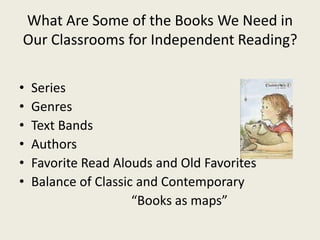
What Are Some of the Books We Need in
Our Classrooms for Independent Reading?
• Series
• Genres
• Text Bands
• Authors
• Favorite Read Alouds and Old Favorites
• Balance of Classic and Contemporary
“Books as maps”
Book Smarts
Five authors every child in
grade __________ should know
are__________, __________,
__________, ___________, and
_______________.
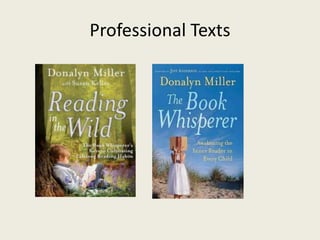
Professional Texts
Resources for Real Wild Readers
• Lists
• State Books
• Newbery, Caldecott, Pura Belpre and other
ALA Awards
• Blogs, websites, goodreads
• Author pages
• Friends, Book Clubs, Librarians
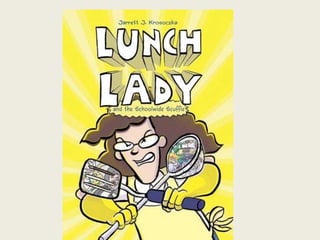
Consider the Place for Comics and Graphic
Novels in Your Library
Lunch!
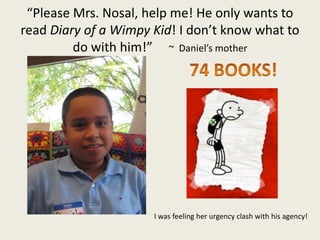
“Please Mrs. Nosal, help me! He only wants to
read Diary of a Wimpy Kid! I don’t know what to
do with him!” ~ Daniel’s mother
I was feeling her urgency clash with his agency!
Looking at Our Units with a Lens on
Texts
• Which texts feel important to our teaching?
• Which texts feel less relevant lately?
• Do we have books in our libraries to support
the range of readers in our
classrooms?
Read Alouds at the Center
Reading aloud with children is known to be the
single most important activity for building the
knowledge and skills they will eventually
require for learning to read.
~ Marilyn Jager Adams
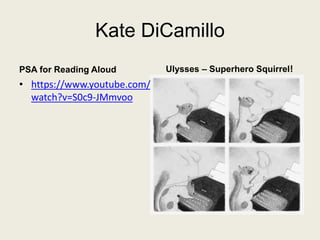
Kate DiCamillo
PSA for Reading Aloud
• https://www.youtube.com/
watch?v=S0c9-JMmvoo
Ulysses – Superhero Squirrel!
Benefits of Read Alouds
• They build community
• They expose children to books, authors, or
genres they might not discover on their own
• They provide prime opportunities to introduce
students to genres they often avoid
• They support developing readers
• They reinforce that reading is enjoyable
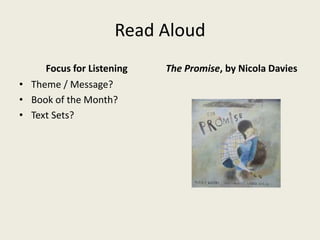
Read Aloud
Focus for Listening
• Theme / Message?
• Book of the Month?
• Text Sets?
The Promise, by Nicola Davies
Revisit Curriculum
• Talk with your colleagues at your tables about
your curriculum
• Are there books and/or authors with whom
our kids can “grow?”
Reading Tools
• What systems of accountability are working
for you?
• Which systems are working for your readers?
• Are the systems that work for you working
also for your readers? (and vice versa)
• What would you like to try with your
students?
Beyond Leveled Texts
• http://digitalcampus.heinemann.com/referen
ce-library/resource-detail?rid=769f6001-aeaf-
462b-9ac9-be1543fee652
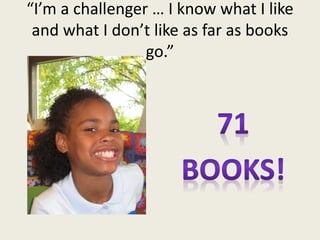
“I’m a challenger … I know what I like
and what I don’t like as far as books
go.”
Share Out
• What resonated with you today?
• What are you looking forward to trying with
your students?
Happy Reading!
The book to read is not the one which thinks
for you, but the one which makes you think …
Harper Lee

Eiri lccs 2015_rev

  • 1.
    Building an IndependentReading Life in Upper Elementary Grades LCCS Educator’s Institute March 2015 Maureen Nosal
  • 2.
    Fasten Your SeatBelts! Here We GO, Thinking Together About Kids and Books!!
  • 3.
    Walter Dean Myers NationalAmbassador for Young People’s Literature 2012-2013 “When I began to read, I began to exist” RIP
  • 4.
    The Power ofReading Volume Reciprocal influences on the cognitive domains of: • vocabulary • reading comprehension • critical thinking • general world knowledge Cunningham
  • 5.
    How children viewthemselves as a reader Children’s reading self-concept develops very early and in response to initial reading experiences (Chapman & Tunmer, 2003; Lynch & Cunningham, 2005) Research is consistent with perspective arguing a child’s reading self-concept is formed as a consequence of patterns of success or failure (Corglioni & Cunningham, 2006; Pintrinch & Schunk, 2000)
  • 6.
    Learning Identities andAttachment Theory • Students need to have goals they value and a belief they can make it. Confidence is created by expecting success for motivation. The first step in reaching these goals and community spirit is by engaging students with a context they can be successful in. Students need relevance for learning. • When creating a social awareness, which fosters learning, the attachment theory needs to be in place. The attachment theory involves being attached to the academic world, to the world of numbers, to others in the classroom, and to see the larger social world outside the world of their own. Secure attachments in the school world are essential for fostering success and learning. Dr. Ernest Morrell Director of Institute for Urban and Minority Education, Teachers College
  • 7.
    Effective Learning Communities ErnestMorrell Value Expectancy Motivation
  • 8.
    Winning Back ReluctantReaders • Know the students • Know the books • Seek creative ways to connect the two Pat Scales
  • 9.
    Be a BookWhisperer! • According to the Kids and Family Reading Report, the most likely reason our reluctant readers avoid reading is that they have trouble finding books they want to read.
  • 10.
    The “Home Run”Book • Jim Trelease has suggested that one very positive experience can create a reader, one "home run" book. • Alfred Tatum writes that our textual lineage includes the things we have read that have been significant in shaping our identities • Take a moment to recall an important reading experience in your life. What was the book, and what do you remember about both the book and the experience that changed you as a reader?
  • 11.
    On the Back •Who is part of your reading community (as an adult reader)? • Who do you go to for book talks, recommendations, social reading experiences? • Jot a list on the back of your “home run” book paper and be ready to share
  • 12.
    What Does itMean to Be Part of a Community of Readers? • Who are *WE as Readers? Reading has the power to change lives. How do we harness that power?
  • 13.
  • 14.
    Help Kids Nameand Share Their Passions Ruben Trejo Mata
  • 15.
    Why do readinghabits matter? We are creating school time readers rather than lifetime readers. (Trelease) • If children only see reading as something they do in school, then they are vulnerable readers. • Reading is a critically important life skill.
  • 16.
    Leisure Reading IRA PositionStatement • The position statement's recommendations are based on these principles: • Students should choose their own reading materials. • Students are better able to choose engaging and appropriate reading materials when teachers and family members scaffold their selections. • The benefits of leisure reading are increased when teachers scaffold school-based leisure reading by incorporating reflection, response, and sharing in a wide range of ways that are not evaluated. • Students should be encouraged to engage in self- selected reading outside of school.
  • 17.
    Listening to Authors Inhis own words ….. What strikes you? Why is this important? Or, how does it help us think about our role as teachers? • http://billmoyers.com/epi sode/junot-diaz-on-how- a-library-changed-his-life/ Junot Diaz
  • 18.
    Invite the Ambassadorinto Your Classroom • http://digitalcampus.heinemann.com/referen ce-library/resource-detail?rid=f0efc3ab-b295- 4b77-abca-02048e406c9b
  • 19.
    What Are Someof the Books We Need in Our Classrooms for Independent Reading? • Series • Genres • Text Bands • Authors • Favorite Read Alouds and Old Favorites • Balance of Classic and Contemporary “Books as maps”
  • 20.
    Book Smarts Five authorsevery child in grade __________ should know are__________, __________, __________, ___________, and _______________.
  • 21.
  • 22.
    Resources for RealWild Readers • Lists • State Books • Newbery, Caldecott, Pura Belpre and other ALA Awards • Blogs, websites, goodreads • Author pages • Friends, Book Clubs, Librarians
  • 23.
    Consider the Placefor Comics and Graphic Novels in Your Library
  • 24.
  • 25.
    “Please Mrs. Nosal,help me! He only wants to read Diary of a Wimpy Kid! I don’t know what to do with him!” ~ Daniel’s mother I was feeling her urgency clash with his agency!
  • 27.
    Looking at OurUnits with a Lens on Texts • Which texts feel important to our teaching? • Which texts feel less relevant lately? • Do we have books in our libraries to support the range of readers in our classrooms?
  • 28.
    Read Alouds atthe Center Reading aloud with children is known to be the single most important activity for building the knowledge and skills they will eventually require for learning to read. ~ Marilyn Jager Adams
  • 29.
    Kate DiCamillo PSA forReading Aloud • https://www.youtube.com/ watch?v=S0c9-JMmvoo Ulysses – Superhero Squirrel!
  • 30.
    Benefits of ReadAlouds • They build community • They expose children to books, authors, or genres they might not discover on their own • They provide prime opportunities to introduce students to genres they often avoid • They support developing readers • They reinforce that reading is enjoyable
  • 31.
    Read Aloud Focus forListening • Theme / Message? • Book of the Month? • Text Sets? The Promise, by Nicola Davies
  • 32.
    Revisit Curriculum • Talkwith your colleagues at your tables about your curriculum • Are there books and/or authors with whom our kids can “grow?”
  • 33.
    Reading Tools • Whatsystems of accountability are working for you? • Which systems are working for your readers? • Are the systems that work for you working also for your readers? (and vice versa) • What would you like to try with your students?
  • 34.
    Beyond Leveled Texts •http://digitalcampus.heinemann.com/referen ce-library/resource-detail?rid=769f6001-aeaf- 462b-9ac9-be1543fee652
  • 35.
    “I’m a challenger… I know what I like and what I don’t like as far as books go.”
  • 36.
    Share Out • Whatresonated with you today? • What are you looking forward to trying with your students?
  • 37.
    Happy Reading! The bookto read is not the one which thinks for you, but the one which makes you think … Harper Lee