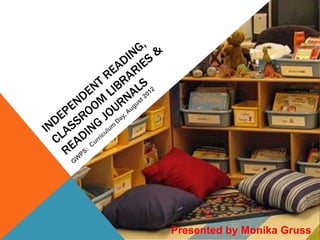
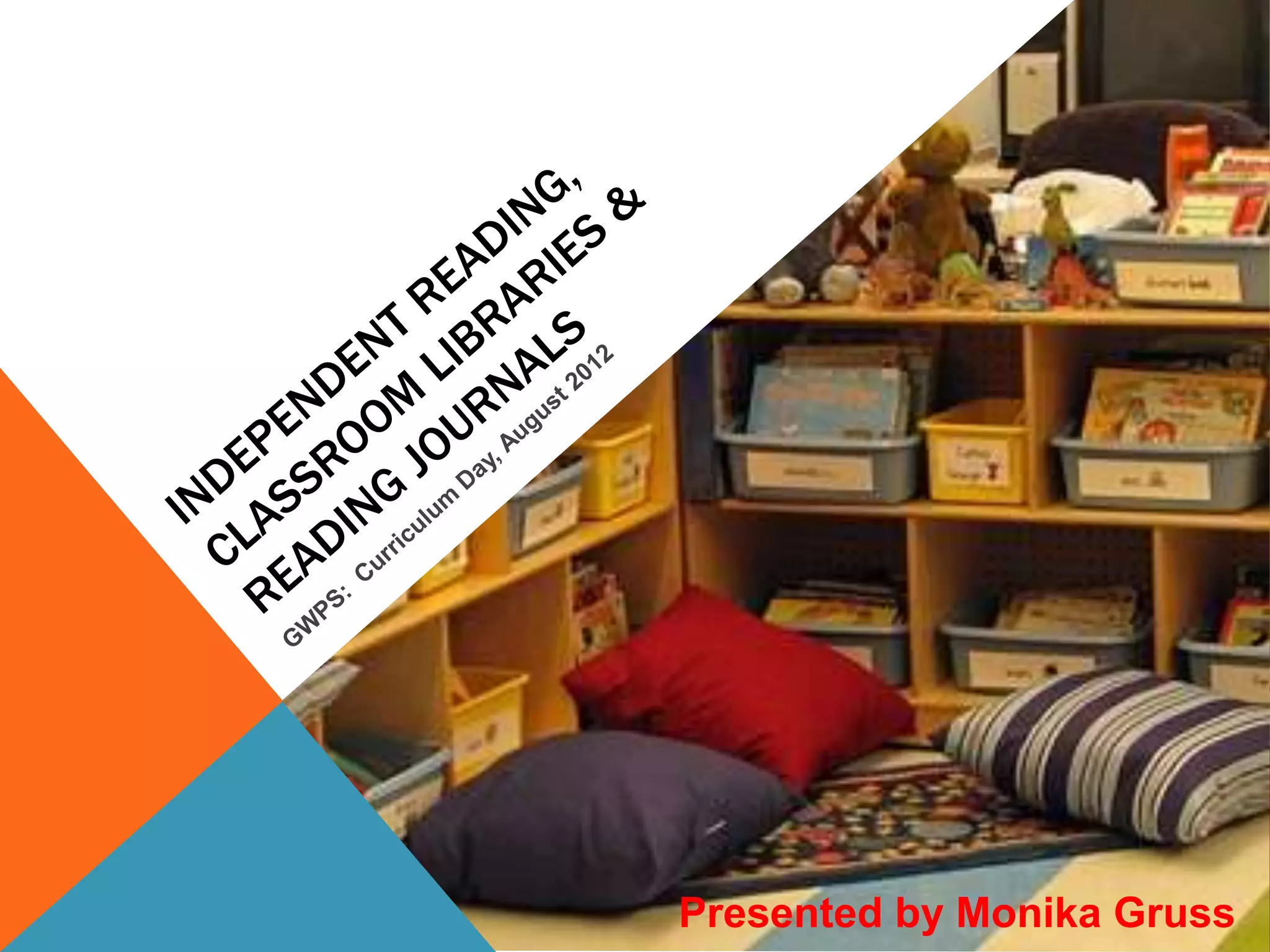


Presented by Monika Gruss
Reading is to the mind,
 what exercise is to the
         body!
Learning Intention


To have an understanding of…

… Independent Reading and reading journals and
how to implement them in your reading program


… what a classroom library is and how to create
one in your classroom
Success Criteria
Curiosity

Adopt Consistent Learning Protocols
THEORY OF ACTION FOR THE WHOLE
  SCHOOL
If we adopt consistent learning protocols in all
classes, then all students will experience an enhanced
capacity to learn, and to develop skills, confidence and
curiosity.


We believe that when learning strategies, and their
purposes, are clear and accessible to all our students,
                                 Curiosity and Powerful Learning
they are better positioned to become powerful
                                 NMR, 2012
learners.
What is Independent Reading?
Independent Reading


… Independent reading is when students take on the
  responsibility for their own reading.
Independent Reading


Reading with 95% or higher accuracy rate and
understanding what is being read. (It’s not likely that
understanding is occurring if there is less than 90%
accuracy.)

THOUGHTFUL readers know how to select „just right
books‟ to read for most of their reading. They also
know that easy reading and challenging reading
materials are OK for specific times and purposes.


                                            Diane Snowball, 2011
‘Just Right Books’


„Students are more likely to be able to choose an
appropriate text when they know a variety of ways to
evaluate it.‟


„Students who can effectively choose appropriate texts
will be less likely to abandon books they choose and
more likely to spend more time in engaged reading‟.


                                         Wutz & Wedwick, 2005
Choosing ‘Just Right Books’


Teaching children how to make thoughtful book
selection is hard work, but its not out of their reach, or
ours.


Early mini-lessons on book selection should focus on
the ways readers make good choices.


                   Debbie Miller, Reading With Meaning, 2002: page 40
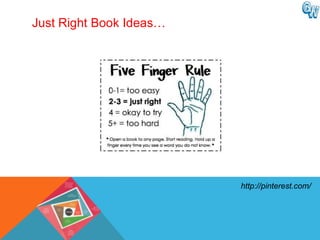
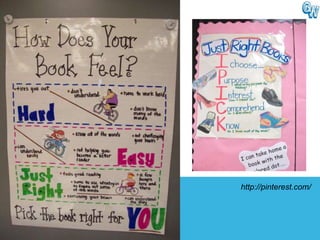
Just Right Book Ideas…


                         http://pinterest.com/
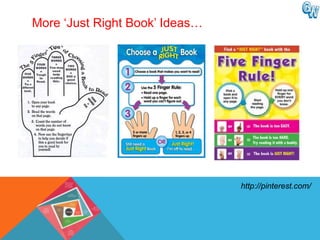
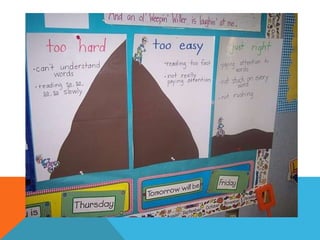
More ‘Just Right Book’ Ideas…


                                http://pinterest.com/
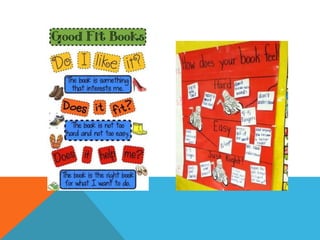
http://pinterest.com/
What does Independent Reading look like in
         the reading hour block?
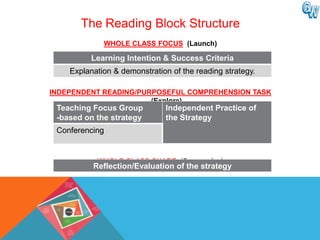
The Reading Block Structure
             WHOLE CLASS FOCUS (Launch)

          Learning Intention & Success Criteria
    Explanation & demonstration of the reading strategy.

INDEPENDENT READING/PURPOSEFUL COMPREHENSION TASK
                       (Explore)
 Teaching Focus Group         Independent Practice of
 -based on the strategy       the Strategy
 Conferencing


           WHOLE CLASS SHARE (Summarise)
          Reflection/Evaluation of the strategy
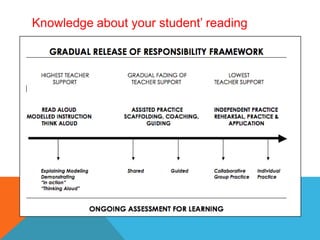
Knowledge about your student’ reading
Why Independent Reading?
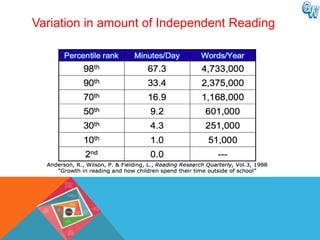
Variation in amount of Independent Reading
How can we support Independent Reading?
Essential supports for successful independent
reading
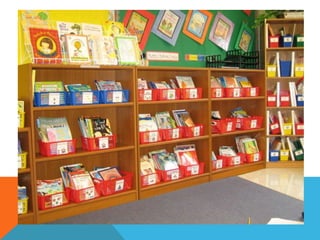
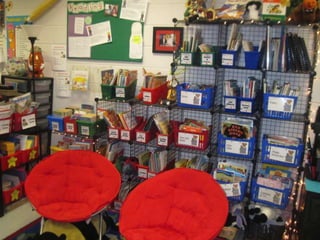
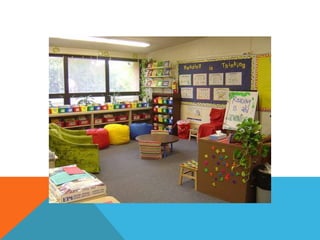
A CLASSROOM LIBRARY:

Range of factual and fiction material (books,
magazines, audio books, newspapers, digital texts,
reference material) at various levels of difficulty; range
of authors, genres, topics

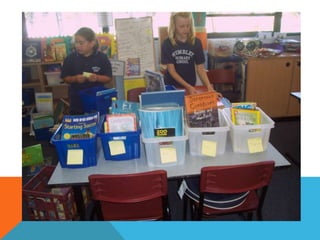
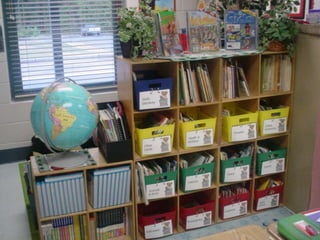
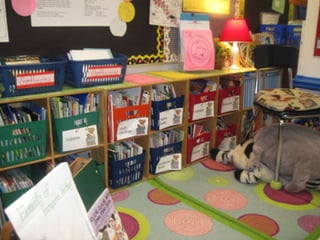
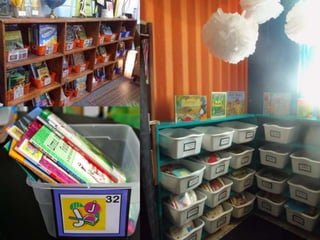
Resources attractively displayed (not a row of spines);
organised for easy access – by topics, authors, range
of difficulty (leveled – ½ of selection)

Students knowing how to choose appropriate books –
just right, easy, challenging
                                             Diane Snowball, 2011
Classroom Libraries

Students in classrooms with well-designed classroom
  libraries:


1) Interact more with books;
2) Spend more time reading;
3) Demonstrate more positive attitudes toward
   reading, and
4) Exhibit higher levels of reading achievement

                                National Assessment of Educational
                                             Progress Report, 2002
Classroom Libraries to support Independent
Reading

Collection for Independent Reading
• Minimum of 5 books per student
• Half to be factual
• Part of the collection is leveled or organised so that
  it‟s easier and faster for students to self-select
  easy/just right/challenging reading (remember
  independent reading is 95% + accuracy)


                                            Diane Snowball, 2011
What type of books to include in your
Classroom Library

“Be choosy. Build your collection slowly. Children
should be reading well-written books that promote
thinking and have believable, compelling characters
who talk the way real people talk and do the things real
people do.”


“Don‟t get into thinking all books are equal…. Quality
really is better than quantity!”


                                       Debbie Miller Reading With
                                             Meaning, 2002, p.47
Organisation of Classroom Libraries
Author collections - appropriate for age (also used for
author studies)


Genres - fact (procedures, recounts, arguments,
discussions, explanations, reports) and fiction
(fantasy, folk tales, myths, legends, realistic, historical,
science fiction; romance, adventure, horror, mystery...)


Topics of interest to students or curriculum related
Organisation of Classroom Librareis


Types – picture books, short stories, novels, poetry,
magazines, newspapers, plays, readers‟ theatre texts,
references, access to interesting websites, students‟
publications, comics


Series
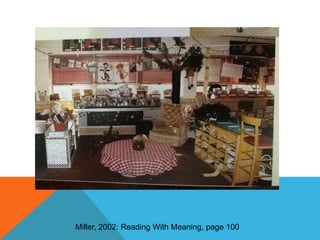
Miller, 2002: Reading With Meaning, page 100
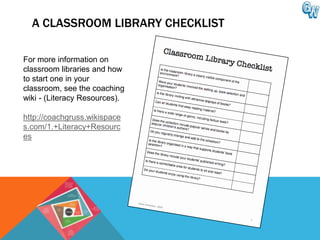
A CLASSROOM LIBRARY CHECKLIST

For more information on
classroom libraries and how
to start one in your
classroom, see the coaching
wiki - (Literacy Resources).

http://coachgruss.wikispace
s.com/1.+Literacy+Resourc
es
Essential supports for successful independent
reading

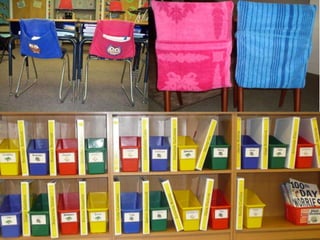
IN THE CLASSROOM:

Place for each student to keep their independent
reading material (e.g. box, chair bag)

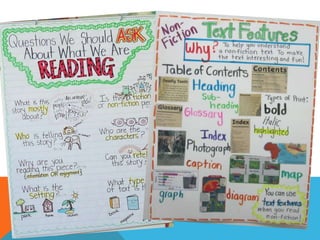
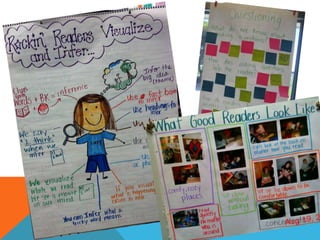
Anchor charts displaying reading strategies (success
criteria) for students to anchor their learning


                                          Diane Snowball, 2011
Let’s be creative!


Using your iPad, use the AP „Show Me‟ to design a
library that you would love to have in your classroom!
Essential supports for successful independent
reading

ASSESSMENT FOR LEARNING:

Reading Assessment/Conferencing Book:
Teacher confers with individuals during independent
reading(assessing, teaching, establishing goals) and
recording student‟s progress in a reading
assessment/conferencing book/folder

Reading Journal:
Record of reading assessment and goals for each
student
(a reading journal for each student)
                                          Diane Snowball, 2011
Reading Journals
Journals can take many different formats depending
on the age and experience of students.


Some students will manage a blank exercise book or
jotter and be able to organise their journals according
to personal preference.


Other children will need a more formal structure to
their journals that will help to prompt responses to
their reading.
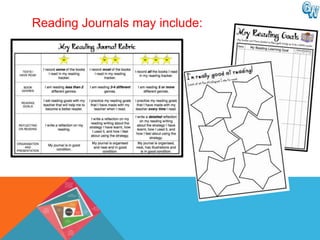
Reading Journals may include:
Keeping records of student’s goals/anecdotal
records
The Reading Conference


 „The Reading Conference is a brief discussion with an
  individual student or small group of students. The
     conference may occur before, during or after
          independent reading takes place.‟


                                           Morris School District
The Reading Conference

Teachers build valuable knowledge of their students
  through reading conferences.
They do this by:
• Gathering information about the student‟s progress
  and discussing this information with the student;
• Clarifying the strategies the student is using and
  ensuring that the student is becoming aware of how
  to control these strategies;


                                     Effective Literacy Practices,
                                           Learning Media, 2003
The Reading Conference


• Learning about the student‟s personal interests and
  their attitudes to literacy learning;
• Identifying and discussing problems or obstacles to
  literacy learning the the teacher may not have been
  aware of;
• Providing personalised, specific feedback;
• Agreeing on goals for further learning.


                                      Effective Literacy Practices,
                                            Learning Media, 2003
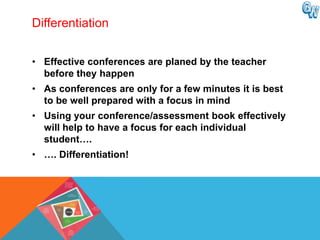
Differentiation


• Effective conferences are planed by the teacher
  before they happen
• As conferences are only for a few minutes it is best
  to be well prepared with a focus in mind
• Using your conference/assessment book effectively
  will help to have a focus for each individual
  student….
• …. Differentiation!
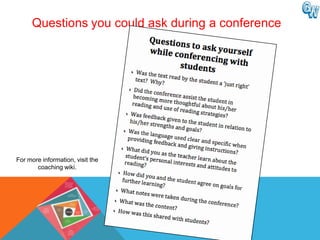
Questions you could ask during a conference


For more information, visit the
       coaching wiki.
Where to now?
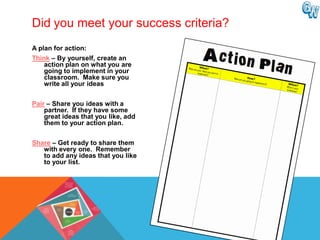
Did you meet your success criteria?
A plan for action:
Think – By yourself, create an
    action plan on what you are
    going to implement in your
    classroom. Make sure you
    write all your ideas

Pair – Share you ideas with a
    partner. If they have some
    great ideas that you like, add
    them to your action plan.

Share – Get ready to share them
   with every one. Remember
   to add any ideas that you like
   to your list.
References
Wutz, J.A., & Wedwick, L. (2005). BOOKMATCH: Scaffolding book selection for
   independent reading. The Reading Teacher, 59(1), 16–32.


“The Five Finger Tips of Choosing a Book to Read”
   http://pinterest.com


“Reading With Meaning”, Debbie Miller, 2002


Diane Snowball, Effective Literacy Teaching and Learning for All Students
   Presentation, 2011


Effective Literacy Practices, Yrs 5-8, Learning Media, 2003

Independent Reading, Reading Journals & Classroom Libraries

  • 1.
  • 2.
    Reading is tothe mind, what exercise is to the body!
  • 3.
    Learning Intention To havean understanding of… … Independent Reading and reading journals and how to implement them in your reading program … what a classroom library is and how to create one in your classroom
  • 4.
  • 5.
    Curiosity Adopt Consistent LearningProtocols THEORY OF ACTION FOR THE WHOLE SCHOOL If we adopt consistent learning protocols in all classes, then all students will experience an enhanced capacity to learn, and to develop skills, confidence and curiosity. We believe that when learning strategies, and their purposes, are clear and accessible to all our students, Curiosity and Powerful Learning they are better positioned to become powerful NMR, 2012 learners.
  • 6.
  • 7.
    Independent Reading … Independentreading is when students take on the responsibility for their own reading.
  • 8.
    Independent Reading Reading with95% or higher accuracy rate and understanding what is being read. (It’s not likely that understanding is occurring if there is less than 90% accuracy.) THOUGHTFUL readers know how to select „just right books‟ to read for most of their reading. They also know that easy reading and challenging reading materials are OK for specific times and purposes. Diane Snowball, 2011
  • 9.
    ‘Just Right Books’ „Studentsare more likely to be able to choose an appropriate text when they know a variety of ways to evaluate it.‟ „Students who can effectively choose appropriate texts will be less likely to abandon books they choose and more likely to spend more time in engaged reading‟. Wutz & Wedwick, 2005
  • 10.
    Choosing ‘Just RightBooks’ Teaching children how to make thoughtful book selection is hard work, but its not out of their reach, or ours. Early mini-lessons on book selection should focus on the ways readers make good choices. Debbie Miller, Reading With Meaning, 2002: page 40
  • 11.
    Just Right BookIdeas… http://pinterest.com/
  • 12.
    More ‘Just RightBook’ Ideas… http://pinterest.com/
  • 13.
  • 16.
    What does IndependentReading look like in the reading hour block?
  • 17.
    The Reading BlockStructure WHOLE CLASS FOCUS (Launch) Learning Intention & Success Criteria Explanation & demonstration of the reading strategy. INDEPENDENT READING/PURPOSEFUL COMPREHENSION TASK (Explore) Teaching Focus Group Independent Practice of -based on the strategy the Strategy Conferencing WHOLE CLASS SHARE (Summarise) Reflection/Evaluation of the strategy
  • 18.
    Knowledge about yourstudent’ reading
  • 19.
  • 20.
    Variation in amountof Independent Reading
  • 21.
    How can wesupport Independent Reading?
  • 22.
    Essential supports forsuccessful independent reading A CLASSROOM LIBRARY: Range of factual and fiction material (books, magazines, audio books, newspapers, digital texts, reference material) at various levels of difficulty; range of authors, genres, topics Resources attractively displayed (not a row of spines); organised for easy access – by topics, authors, range of difficulty (leveled – ½ of selection) Students knowing how to choose appropriate books – just right, easy, challenging Diane Snowball, 2011
  • 23.
    Classroom Libraries Students inclassrooms with well-designed classroom libraries: 1) Interact more with books; 2) Spend more time reading; 3) Demonstrate more positive attitudes toward reading, and 4) Exhibit higher levels of reading achievement National Assessment of Educational Progress Report, 2002
  • 24.
    Classroom Libraries tosupport Independent Reading Collection for Independent Reading • Minimum of 5 books per student • Half to be factual • Part of the collection is leveled or organised so that it‟s easier and faster for students to self-select easy/just right/challenging reading (remember independent reading is 95% + accuracy) Diane Snowball, 2011
  • 25.
    What type ofbooks to include in your Classroom Library “Be choosy. Build your collection slowly. Children should be reading well-written books that promote thinking and have believable, compelling characters who talk the way real people talk and do the things real people do.” “Don‟t get into thinking all books are equal…. Quality really is better than quantity!” Debbie Miller Reading With Meaning, 2002, p.47
  • 26.
    Organisation of ClassroomLibraries Author collections - appropriate for age (also used for author studies) Genres - fact (procedures, recounts, arguments, discussions, explanations, reports) and fiction (fantasy, folk tales, myths, legends, realistic, historical, science fiction; romance, adventure, horror, mystery...) Topics of interest to students or curriculum related
  • 27.
    Organisation of ClassroomLibrareis Types – picture books, short stories, novels, poetry, magazines, newspapers, plays, readers‟ theatre texts, references, access to interesting websites, students‟ publications, comics Series
  • 28.
    Miller, 2002: ReadingWith Meaning, page 100
  • 36.
    A CLASSROOM LIBRARYCHECKLIST For more information on classroom libraries and how to start one in your classroom, see the coaching wiki - (Literacy Resources). http://coachgruss.wikispace s.com/1.+Literacy+Resourc es
  • 37.
    Essential supports forsuccessful independent reading IN THE CLASSROOM: Place for each student to keep their independent reading material (e.g. box, chair bag) Anchor charts displaying reading strategies (success criteria) for students to anchor their learning Diane Snowball, 2011
  • 41.
    Let’s be creative! Usingyour iPad, use the AP „Show Me‟ to design a library that you would love to have in your classroom!
  • 42.
    Essential supports forsuccessful independent reading ASSESSMENT FOR LEARNING: Reading Assessment/Conferencing Book: Teacher confers with individuals during independent reading(assessing, teaching, establishing goals) and recording student‟s progress in a reading assessment/conferencing book/folder Reading Journal: Record of reading assessment and goals for each student (a reading journal for each student) Diane Snowball, 2011
  • 43.
    Reading Journals Journals cantake many different formats depending on the age and experience of students. Some students will manage a blank exercise book or jotter and be able to organise their journals according to personal preference. Other children will need a more formal structure to their journals that will help to prompt responses to their reading.
  • 44.
  • 45.
    Keeping records ofstudent’s goals/anecdotal records
  • 46.
    The Reading Conference „The Reading Conference is a brief discussion with an individual student or small group of students. The conference may occur before, during or after independent reading takes place.‟ Morris School District
  • 47.
    The Reading Conference Teachersbuild valuable knowledge of their students through reading conferences. They do this by: • Gathering information about the student‟s progress and discussing this information with the student; • Clarifying the strategies the student is using and ensuring that the student is becoming aware of how to control these strategies; Effective Literacy Practices, Learning Media, 2003
  • 48.
    The Reading Conference •Learning about the student‟s personal interests and their attitudes to literacy learning; • Identifying and discussing problems or obstacles to literacy learning the the teacher may not have been aware of; • Providing personalised, specific feedback; • Agreeing on goals for further learning. Effective Literacy Practices, Learning Media, 2003
  • 49.
    Differentiation • Effective conferencesare planed by the teacher before they happen • As conferences are only for a few minutes it is best to be well prepared with a focus in mind • Using your conference/assessment book effectively will help to have a focus for each individual student…. • …. Differentiation!
  • 50.
    Questions you couldask during a conference For more information, visit the coaching wiki.
  • 51.
  • 52.
    Did you meetyour success criteria? A plan for action: Think – By yourself, create an action plan on what you are going to implement in your classroom. Make sure you write all your ideas Pair – Share you ideas with a partner. If they have some great ideas that you like, add them to your action plan. Share – Get ready to share them with every one. Remember to add any ideas that you like to your list.
  • 53.
    References Wutz, J.A., &Wedwick, L. (2005). BOOKMATCH: Scaffolding book selection for independent reading. The Reading Teacher, 59(1), 16–32. “The Five Finger Tips of Choosing a Book to Read” http://pinterest.com “Reading With Meaning”, Debbie Miller, 2002 Diane Snowball, Effective Literacy Teaching and Learning for All Students Presentation, 2011 Effective Literacy Practices, Yrs 5-8, Learning Media, 2003

Editor's Notes

  • #5 Teachers to make the success criteria
  • #12 Karen can talk here about how to implement this idea. Bring in posters & IR rubric. Talk about process to staff
  • #18 Karen to talk about process link to success criteria
  • #38 Show book bag – made by my teacher aide. Ask for other ideas, parents, art project????
  • #39 Show my chair bag, made from left over material.
  • #40 Karen to share some of her anchor charts on comprehension.
  • #44 Rosemary to speak to staff about how we are implementing reading journals. How do the students feel about it. Karen might step in and say a few words. Talk about the need to teach students how to write a reflective journal in writing time (Rosemary to bring anchor chart).
  • #45 Rosemary to speak to staff about how we are implementing reading journals. How do the students feel about it. Karen might step in and say a few words. Talk about the need to teach students how to write a reflective journal in writing time (Rosemary to bring anchor chart).
  • #46 Shannon and Emma to share their record keeping book. Discuss how they think it will work/improve their students reading.Discuss how it is excellent for reports – Evidence based.
  • #49 A great way to start a conference in your classroom is to talk to your students about reading.My experience – identifies non readers – every child can learn to love to read – they need to find a just right book that interests them.
  • #50 A great way to start a conference in your classroom is to talk to your students about reading.My experience – identifies non readers – every child can learn to love to read – they need to find a just right book that interests them.
  • #53 Teachers get out their action plan