“Research shows that in the home, children initiate
significantly more than half of all questions. Though
school is supposedly designed to offer a rich
language and learning environment, Tizard and
Hughes showed that children ask less than 5% of the
questions at nursery school. This percentage doesn’t
improve much with time, with students in high
school asking less than 15% of all questions, most of
these being lower level questions.
How can teachers foster
a classroom culture
where student questions
guide inquiry and
learning?
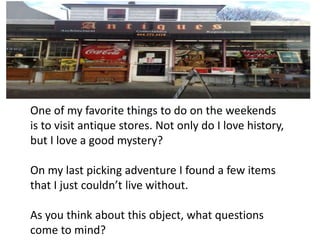
One of my favorite things to do on the weekends
is to visit antique stores. Not only do I love history,
but I love a good mystery?

On my last picking adventure I found a few items
that I just couldn’t live without.

As you think about this object, what questions
come to mind?
Closed or thin questions have a single correct
 answer. The answers can be found in text, or
 are fact-based answers.


When? Where? Who? How many?
Open or thick questions have no one right
answer. The answers cannot be readily found and
require some thinking.


   Why do you think…? What if…?
 How would you feel…? What might…?
Separate your questions into open and closed
                  questions.

If you only have one or two open questions, add
          more questions to your chart.
During and English Language Arts
lesson, Mrs. Jones had her students
read a printed version of the story
Goldilocks and the Three Bears.
When the students finished they
were guided to an online version so
they would have two different
accounts of the same event. To
guide student thinking , Mrs. Jones
asked the students to gather at the
front of the room for a discussion.
She posed the following questions
to guide their thinking.
• What was learned about Goldilocks?
• What are the key ideas in the story?
• What might have happened if the bears
  had not left their home?
• Is it ever OK to go into a stranger’s
  house?
• What did the bears have for breakfast?
• Who found Goldilocks in baby bear’s
  bed?
• How do you think it might feel to find a
  little girl in your house?
• What other stories have you read
  where the main characters act in
  unsafe ways?
What type of tasks promote…
                 Wonderment?

Questioning

  • 2.
    “Research shows thatin the home, children initiate significantly more than half of all questions. Though school is supposedly designed to offer a rich language and learning environment, Tizard and Hughes showed that children ask less than 5% of the questions at nursery school. This percentage doesn’t improve much with time, with students in high school asking less than 15% of all questions, most of these being lower level questions.
  • 3.
    How can teachersfoster a classroom culture where student questions guide inquiry and learning?
  • 4.
    One of myfavorite things to do on the weekends is to visit antique stores. Not only do I love history, but I love a good mystery? On my last picking adventure I found a few items that I just couldn’t live without. As you think about this object, what questions come to mind?
  • 5.
    Closed or thinquestions have a single correct answer. The answers can be found in text, or are fact-based answers. When? Where? Who? How many?
  • 6.
    Open or thickquestions have no one right answer. The answers cannot be readily found and require some thinking. Why do you think…? What if…? How would you feel…? What might…?
  • 7.
    Separate your questionsinto open and closed questions. If you only have one or two open questions, add more questions to your chart.
  • 9.
    During and EnglishLanguage Arts lesson, Mrs. Jones had her students read a printed version of the story Goldilocks and the Three Bears. When the students finished they were guided to an online version so they would have two different accounts of the same event. To guide student thinking , Mrs. Jones asked the students to gather at the front of the room for a discussion. She posed the following questions to guide their thinking.
  • 10.
    • What waslearned about Goldilocks? • What are the key ideas in the story? • What might have happened if the bears had not left their home? • Is it ever OK to go into a stranger’s house? • What did the bears have for breakfast? • Who found Goldilocks in baby bear’s bed? • How do you think it might feel to find a little girl in your house? • What other stories have you read where the main characters act in unsafe ways?
  • 11.
    What type oftasks promote… Wonderment?