Fostering Students’ Reading
Engagement
Teri Lesesne
Donalyn Miller
www.slideshare.net/professornana
@professornana
www. http://professornana.livejournal.com
www.slideshare.net/donalynm
@donalynbooks
www.bookwhisperer.com
“Becoming a reader and a writer has as
much to do with assuming an identity as
a reader and a writer as it does with
acquiring a set of predetermined
cognitive skills.”
(Serafini, 2013)
“Texts and the literate practices that
accompany them may not only reflect the
self, but may also produce the self.”
(Davies, 1989)
Our Reading
Lives
How we develop a reading identity
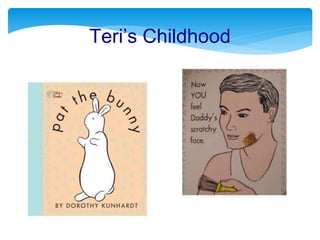
Teri’s Childhood
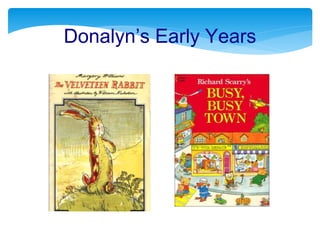
Donalyn’s Early Years
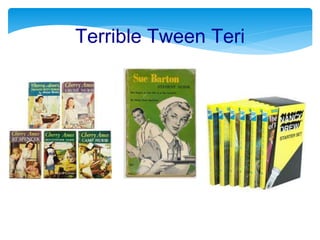
Terrible Tween Teri
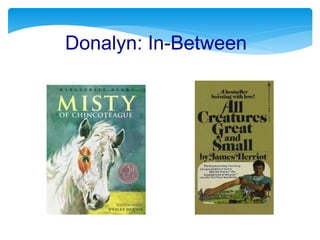
Donalyn: In-Between
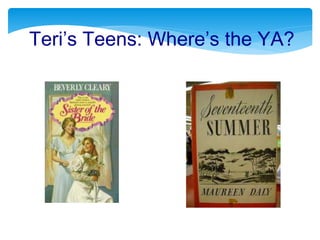
Teri’s Teens: Where’s the YA?
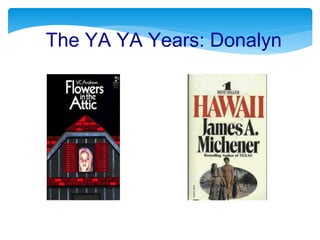
The YA YA Years: Donalyn
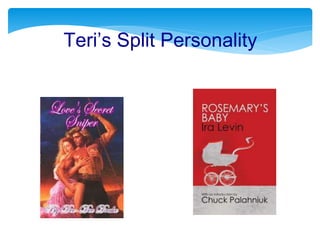
Teri’s Split Personality
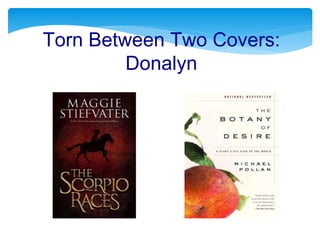
Torn Between Two Covers:
Donalyn
Your Reading Autobiography
 So, what are the highlights of your reading
life?
 What are the low points?
 Titles, series, authors, books you recall
strongly?
Turn and talk at your tables
about your reading memories.
Getting to Know Readers
 Ask them to create a reading autobiography
 Can be written
 Can use app such as
www.whenintime.com
 Here is Teri’s
 Collect them, analyze them for
commonalities
 Identify kids who are already engaged
readers and those who are not
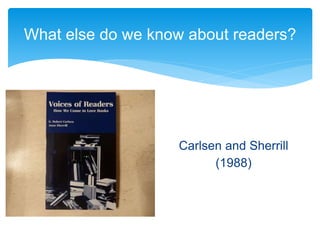
Carlsen and Sherrill
(1988)
What else do we know about readers?
 Setting aside for reading
 Having a teacher show in the individual's reading
 Having teachers
 Being exposed to a of reading fare
 Receiving help from
books
books with friends
 Participating in reader-centered of literature
 Being allowed freedom of in reading fare
Conclusions:
Carlsen and Sherrill
25 Years of Reading
Autobiographies
 Time
 Role models at home and school
 Access to books
 Choice of reading materials
 Stories as mirrors, windows, and doors
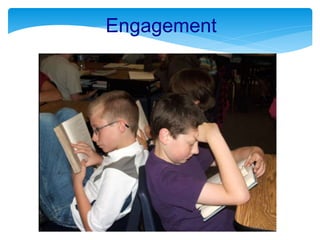
Engagement
 What engagement is NOT
 What engagement IS
 How can we tell?
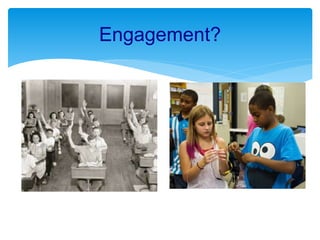
Engagement?
Cambourne’s Conditions of
Learning
(1995)
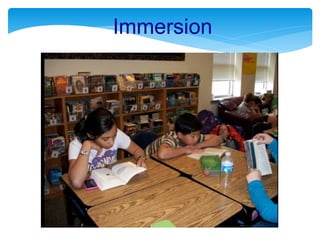
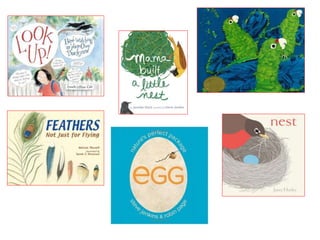
Immersion
Learners need to be immersed in
text of all kinds.
Learners’ interests are sparked
by what they see and hear so
that they want to learn the new
skill.
 Genre
 Form
 Format
 Length
Some Factors to Consider
 Historical Fiction
 Realistic Fiction
 Traditional Literature
 Science Fiction & Fantasy
Genres
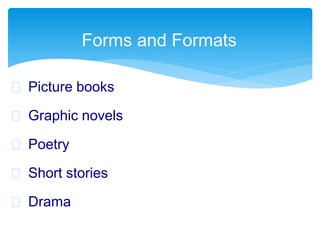
 Picture books
 Graphic novels
 Poetry
 Short stories
 Drama
Forms and Formats
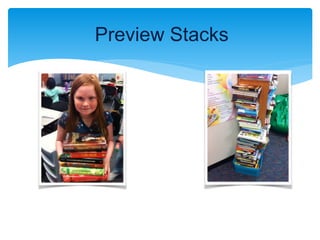
Preview Stacks
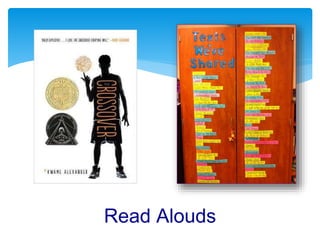
Read Alouds
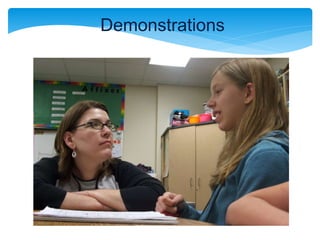
Demonstrations
Learners are shown numerous models
and given a lot of direct instruction.
Learners have plenty of opportunity to
practice new skills and strategies and try
to improve proficiency.
(demonstration/immersion)
Learners need to receive many
demonstrations of how texts are
constructed and used.
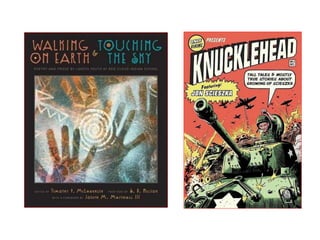
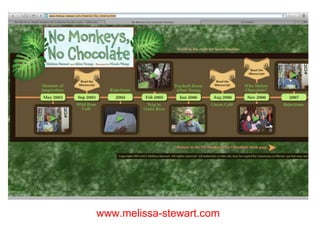
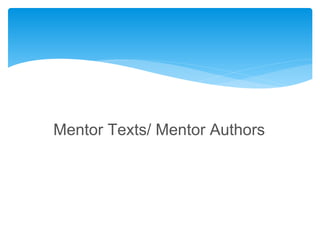
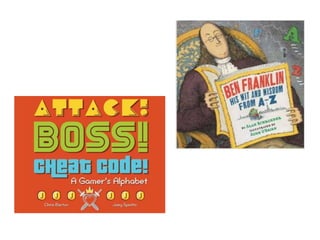
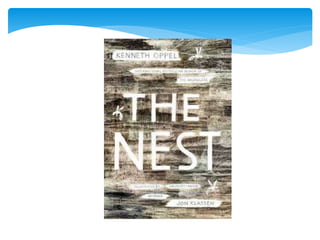
Mentor Texts/ Mentor Authors
www.melissa-stewart.com
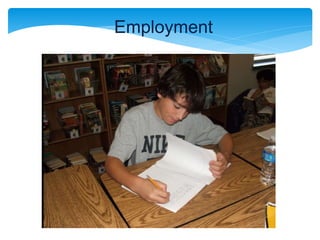
Employment
Learners need many opportunities to
engage in print.
Learners need time and opportunity to
use, employ, and practice their developing
control in functional, realistic, and non-
artificial ways.
How can students practice their
developing literacy skills in functional,
realistic, and non-artificial ways?
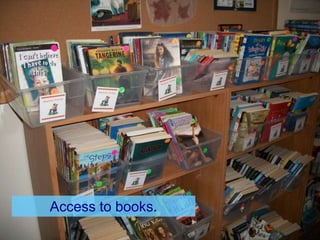
Access to books.
Access to a full-time school librarian
increases students' test scores, closes
the achievement gap, and improves
writing skills.
(Lance, 2012)
Students read 50-60% more in
classrooms with adequate
libraries.
(Allington, 2007; Morrow, 2003; Neuman, 1999)
Classroom Library Checklist
What would you look for when evaluating a
classroom library to determine if it was
adequate?
Diversity
Currency
Organization
In a 2013 Scholastic survey of 3,800
teachers, only 40% had at least 300
books in their classroom libraries.
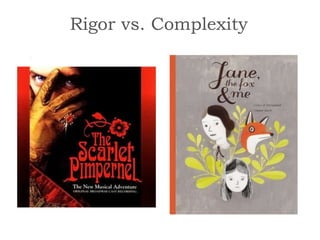
Rigor vs. Complexity
 Rigor
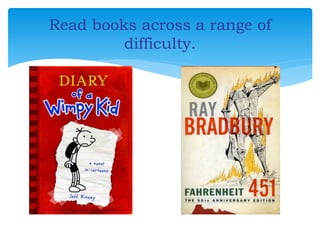
Read books across a range of
difficulty.
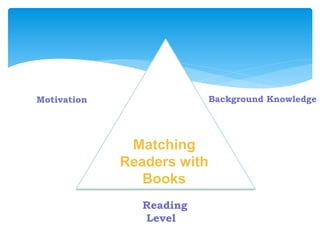
Motivation Background Knowledge
Reading
Level
Matching
Readers with
Books
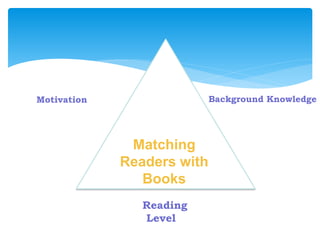
Motivation Background Knowledge
Reading
Level
Matching
Readers with
Books
 Graphic Novels and Illustrated Novels
 Picture Books
 Poetry and Novels in Verse
 Informational Books with Text Features
Lexile Accuracy Concerns
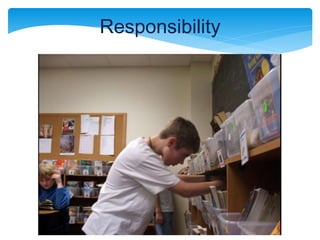
Responsibility
Learners are able to make
decisions about how much they
will attempt.
Learners need to make their own
decisions about when, how, and what
"bits" to learn in any learning task.
Learners who lose the ability to make
decisions are disempowered.
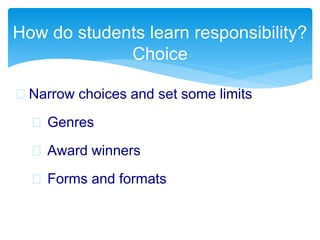
 Narrow choices and set some limits
 Genres
 Award winners
 Forms and formats
How do students learn responsibility?
Choice
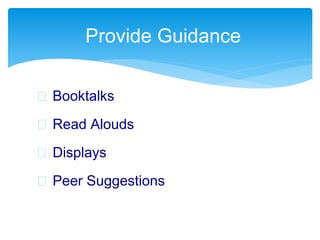
 Booktalks
 Read Alouds
 Displays
 Peer Suggestions
Provide Guidance
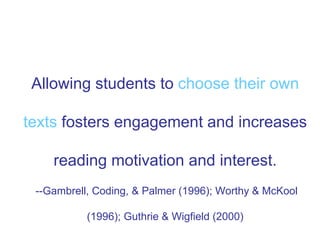
Allowing students to choose their own
texts fosters engagement and increases
reading motivation and interest.
--Gambrell, Coding, & Palmer (1996); Worthy & McKool
(1996); Guthrie & Wigfield (2000)
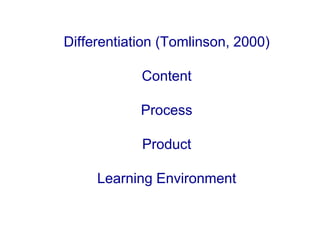
Differentiation (Tomlinson, 2000)
Content
Process
Product
Learning Environment
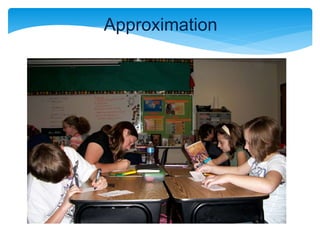
Approximation
Learners must be free to approximate
the desired model—"mistakes" are
essential for learning to occur.
Learners are safe from criticism
when they take risks.
Learners receive feedback in a timely manner.
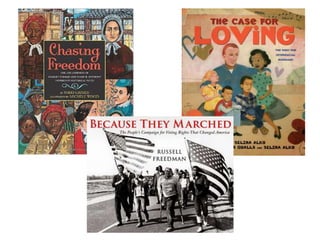
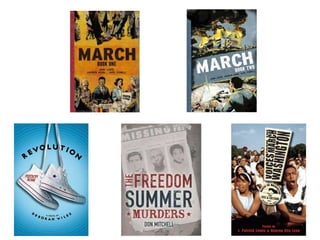
Paired Texts, Text
Sets, and Reading
Ladders
Wangari Maathai,
Environmentalist &
Political Activist
27
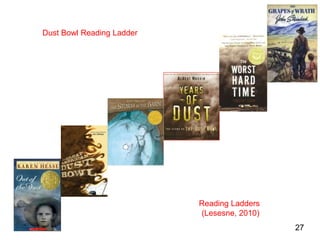
Dust Bowl Reading Ladder
Reading Ladders
(Lesesne, 2010)
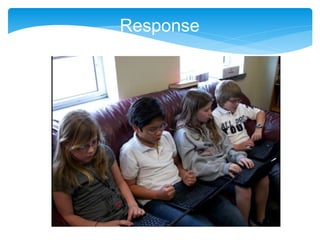
Response
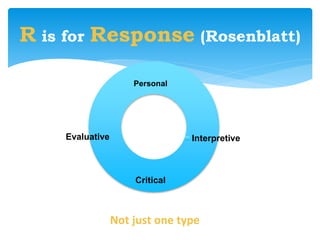
R is for Response (Rosenblatt)
Not just one type
Interpretive
Personal
Critical
Evaluative
Learners must receive feedback from
exchanges with more knowledgeable others.
Response must be relevant, appropriate,
timely, readily available, and non-
threatening, with no strings attached.
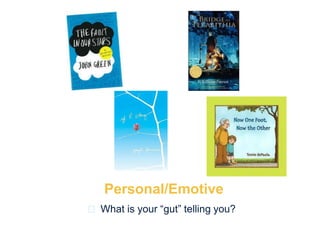
Personal/Emotive
 What is your “gut” telling you?
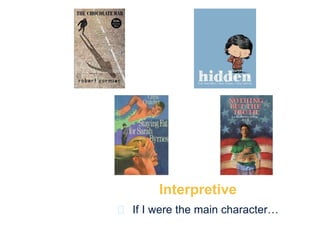
Interpretive
 If I were the main character…
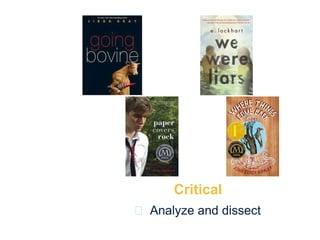
Critical
 Analyze and dissect
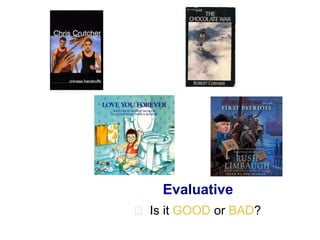
Evaluative
 Is it GOOD or BAD?
Reading and writing float on a sea of
talk.
–James Britton
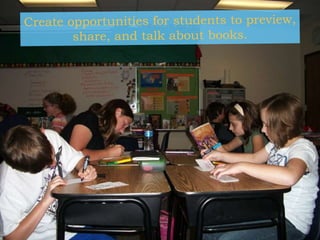
Literate conversations with peers
(as little as ten minutes a day)
improve students' reading motivation,
comprehension, and test scores.
( Cazden, 1988; Nystrand, 2006)
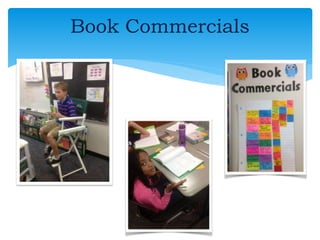
Book Commercials
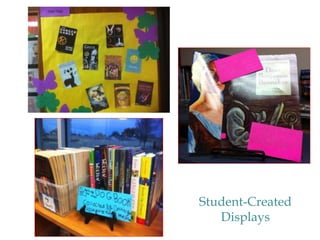
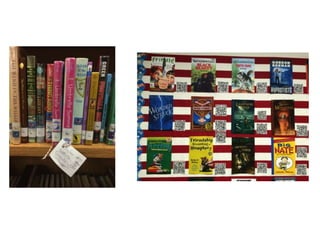
Student-Created
Displays
Books that Engage
“What we learn with pleasure we never forget.”
--Alfred Mercier

Keller I S D Presentation November 2015