Creating an Effective
Independent Reading
Program
LESLIE GABLE
LLED 6010E
What is Independent Reading?
 Regie Routman defines independent reading as “…the crucial
learning context in which the reader assumes responsibility
for applying smart reading behavior in order to gain and
maintain understanding. Independent reading provides the
indispensable practice that literacy learners require to
become successful, self-regulating, self-monitoring readers”
(Routman, 2002, p. 86-87).
What is Independent Reading?
 Independent reading is a component of a balanced literacy
program.
 It is a block of time set aside for students to read self-
selected books independently.
 Teachers observe, monitor and conference with students
during this time.
Advantages of Independent Reading
 “Research tells us that the time students spend in
independent reading is one of the best predictors of reading
achievement – in comprehension, decoding, fluency, and
vocabulary” (Oczkus, 2012, p. 2).
 Can produce higher test scores on standardized tests.
 Allows students to take ownership of their reading.
Advantages of Independent Reading
 It is a beneficial practice for all grade levels. In Linda Rief’s
book, Read Write Teach, we see that independent reading is
not just beneficial for elementary aged students.
 Encourages students to read outside of school and become
lifelong readers.
 Can help students become better writers.
Steps for Setting
Up a Successful
Program
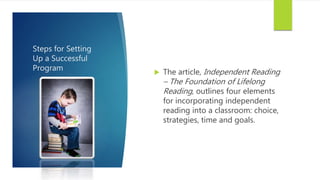
 The article, Independent Reading
– The Foundation of Lifelong
Reading, outlines four elements
for incorporating independent
reading into a classroom: choice,
strategies, time and goals.
Steps for Setting Up a Successful Program:
Choice
 Create an inviting and organized classroom library filled with a wide array of
reading materials. “You can group books by author, illustrator, series, genre, or
reading level” (Oczkus, 2012, p. 3). With guidance from the teacher, students will
be allowed to make a choice of which books they read independently.
 “The key to reading success during the independent reading block is providing
books that are at the students’ level and offering the right amount of support”
(Oczkus, 2012, p. 2).
 Allowing students choice is motivational and encourages engagement.
Steps for Setting Up a Successful Program:
Strategies
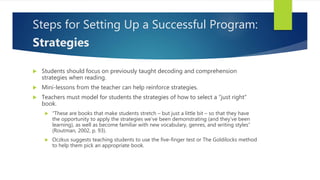
 Students should focus on previously taught decoding and comprehension
strategies when reading.
 Mini-lessons from the teacher can help reinforce strategies.
 Teachers must model for students the strategies of how to select a “just right”
book.
 “These are books that make students stretch – but just a little bit – so that they have
the opportunity to apply the strategies we’ve been demonstrating (and they’ve been
learning), as well as become familiar with new vocabulary, genres, and writing styles”
(Routman, 2002, p. 93).
 Oczkus suggests teaching students to use the five-finger test or The Goldilocks method
to help them pick an appropriate book.
Steps for Setting Up a Successful Program:
Time
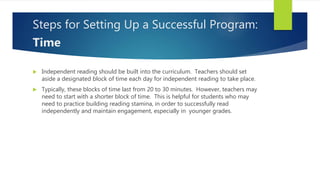
 Independent reading should be built into the curriculum. Teachers should set
aside a designated block of time each day for independent reading to take place.
 Typically, these blocks of time last from 20 to 30 minutes. However, teachers may
need to start with a shorter block of time. This is helpful for students who may
need to practice building reading stamina, in order to successfully read
independently and maintain engagement, especially in younger grades.
Steps for Setting Up a Successful Program:
Goals
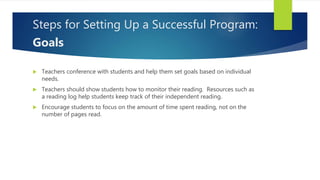
 Teachers conference with students and help them set goals based on individual
needs.
 Teachers should show students how to monitor their reading. Resources such as
a reading log help students keep track of their independent reading.
 Encourage students to focus on the amount of time spent reading, not on the
number of pages read.
Students’ and Teacher’s Role
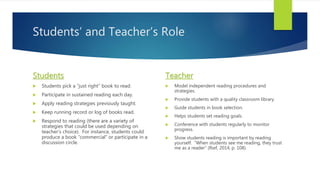
Students
 Students pick a “just right” book to read.
 Participate in sustained reading each day.
 Apply reading strategies previously taught.
 Keep running record or log of books read.
 Respond to reading (there are a variety of
strategies that could be used depending on
teacher’s choice). For instance, students could
produce a book “commercial” or participate in a
discussion circle.
Teacher
 Model independent reading procedures and
strategies.
 Provide students with a quality classroom library.
 Guide students in book selection.
 Helps students set reading goals.
 Conference with students regularly to monitor
progress.
 Show students reading is important by reading
yourself. “When students see me reading, they trust
me as a reader” (Rief, 2014, p. 108).
Tips for Working with Struggling or
Reluctant Readers
 “Load popular books onto MP3 players for struggling readers to listen
to” (Oczkus, 2012, p. 7).
 Pre-select books you think are appropriate for the student until you feel
they are able to select their own “just right” books.
 Allow for students to participate in partner reading.
 Have students fill out an interest inventory to help you recommend
books that appeal to the individual interests of a reluctant reader.
References
 Independent Reading – The Foundation of Lifelong Reading. (2010,
February 24). Retrieved June 22, 2015.
 Oczkus, L. (2012). Super Practical Ways to Build an Independent Reading
Program in Your Classroom: Guidelines and TOP 5 Independent
Reading Strategies. In Best ever literacy survival tips 72 lessons you
can't teach without. Newark, DE: International Reading Association.
 Rief, L. (2014). Read, write, teach: Choice and challenge in the reading-
writing workshop. Portsmouth, NH: Heinemann
 Routman, R. (2003). Plan for and Monitor Independent Reading. In
Reading essentials: The specifics you need to teach reading well (pp. 82-
97). Portsmouth, NH: Heinemann.

Creating an Effective Independent Reading Program

  • 1.
    Creating an Effective IndependentReading Program LESLIE GABLE LLED 6010E
  • 2.
    What is IndependentReading?  Regie Routman defines independent reading as “…the crucial learning context in which the reader assumes responsibility for applying smart reading behavior in order to gain and maintain understanding. Independent reading provides the indispensable practice that literacy learners require to become successful, self-regulating, self-monitoring readers” (Routman, 2002, p. 86-87).
  • 3.
    What is IndependentReading?  Independent reading is a component of a balanced literacy program.  It is a block of time set aside for students to read self- selected books independently.  Teachers observe, monitor and conference with students during this time.
  • 4.
    Advantages of IndependentReading  “Research tells us that the time students spend in independent reading is one of the best predictors of reading achievement – in comprehension, decoding, fluency, and vocabulary” (Oczkus, 2012, p. 2).  Can produce higher test scores on standardized tests.  Allows students to take ownership of their reading.
  • 5.
    Advantages of IndependentReading  It is a beneficial practice for all grade levels. In Linda Rief’s book, Read Write Teach, we see that independent reading is not just beneficial for elementary aged students.  Encourages students to read outside of school and become lifelong readers.  Can help students become better writers.
  • 6.
    Steps for Setting Upa Successful Program  The article, Independent Reading – The Foundation of Lifelong Reading, outlines four elements for incorporating independent reading into a classroom: choice, strategies, time and goals.
  • 7.
    Steps for SettingUp a Successful Program: Choice  Create an inviting and organized classroom library filled with a wide array of reading materials. “You can group books by author, illustrator, series, genre, or reading level” (Oczkus, 2012, p. 3). With guidance from the teacher, students will be allowed to make a choice of which books they read independently.  “The key to reading success during the independent reading block is providing books that are at the students’ level and offering the right amount of support” (Oczkus, 2012, p. 2).  Allowing students choice is motivational and encourages engagement.
  • 8.
    Steps for SettingUp a Successful Program: Strategies  Students should focus on previously taught decoding and comprehension strategies when reading.  Mini-lessons from the teacher can help reinforce strategies.  Teachers must model for students the strategies of how to select a “just right” book.  “These are books that make students stretch – but just a little bit – so that they have the opportunity to apply the strategies we’ve been demonstrating (and they’ve been learning), as well as become familiar with new vocabulary, genres, and writing styles” (Routman, 2002, p. 93).  Oczkus suggests teaching students to use the five-finger test or The Goldilocks method to help them pick an appropriate book.
  • 9.
    Steps for SettingUp a Successful Program: Time  Independent reading should be built into the curriculum. Teachers should set aside a designated block of time each day for independent reading to take place.  Typically, these blocks of time last from 20 to 30 minutes. However, teachers may need to start with a shorter block of time. This is helpful for students who may need to practice building reading stamina, in order to successfully read independently and maintain engagement, especially in younger grades.
  • 10.
    Steps for SettingUp a Successful Program: Goals  Teachers conference with students and help them set goals based on individual needs.  Teachers should show students how to monitor their reading. Resources such as a reading log help students keep track of their independent reading.  Encourage students to focus on the amount of time spent reading, not on the number of pages read.
  • 11.
    Students’ and Teacher’sRole Students  Students pick a “just right” book to read.  Participate in sustained reading each day.  Apply reading strategies previously taught.  Keep running record or log of books read.  Respond to reading (there are a variety of strategies that could be used depending on teacher’s choice). For instance, students could produce a book “commercial” or participate in a discussion circle. Teacher  Model independent reading procedures and strategies.  Provide students with a quality classroom library.  Guide students in book selection.  Helps students set reading goals.  Conference with students regularly to monitor progress.  Show students reading is important by reading yourself. “When students see me reading, they trust me as a reader” (Rief, 2014, p. 108).
  • 12.
    Tips for Workingwith Struggling or Reluctant Readers  “Load popular books onto MP3 players for struggling readers to listen to” (Oczkus, 2012, p. 7).  Pre-select books you think are appropriate for the student until you feel they are able to select their own “just right” books.  Allow for students to participate in partner reading.  Have students fill out an interest inventory to help you recommend books that appeal to the individual interests of a reluctant reader.
  • 13.
    References  Independent Reading– The Foundation of Lifelong Reading. (2010, February 24). Retrieved June 22, 2015.  Oczkus, L. (2012). Super Practical Ways to Build an Independent Reading Program in Your Classroom: Guidelines and TOP 5 Independent Reading Strategies. In Best ever literacy survival tips 72 lessons you can't teach without. Newark, DE: International Reading Association.  Rief, L. (2014). Read, write, teach: Choice and challenge in the reading- writing workshop. Portsmouth, NH: Heinemann  Routman, R. (2003). Plan for and Monitor Independent Reading. In Reading essentials: The specifics you need to teach reading well (pp. 82- 97). Portsmouth, NH: Heinemann.