
Food Preservation
ASTHA K. PATEL
ASTHA K. PATEL 1
Definition
• Food preservation can be
defined as the science that
deals with the process of
prevention of spoilage of
food, thus allowing it to be
stored in a fit condition for
future use.
ASTHA K. PATEL 2
• Preservation of food increase the shelf
life of the food.
• Foods are preserved at home or in
commercial settings to prolong their
shelf life and to use particular foods
like vegetables & fruits when not in
season.
ASTHA K. PATEL 3
Principles of food preservation
1. Prevention or delay microbial decomposition
• Keeping out microorganism or removing the
microorganisms already present. ( Asepsis)
• By removal of microorganism ( Filtration)
• By hindering the growth and activity of
microorganism ( Refrigeration ,
Dehydration and addition of chemical in
food ) ASTHA K. PATEL 4
• By killing microorganism ( Boiling &
Radiation)
2. Prevention or delay of self-decompoition of
food
• By destruction of enzymes
• By prevention or delay of chemical
reaction.
ASTHA K. PATEL 5
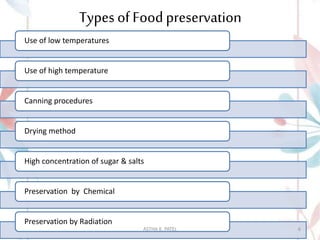
Types ofFoodpreservation
Use of low temperatures
Use of high temperature
Canning procedures
Drying method
High concentration of sugar & salts
Preservation by Chemical
Preservation by Radiation
ASTHA K. PATEL 6
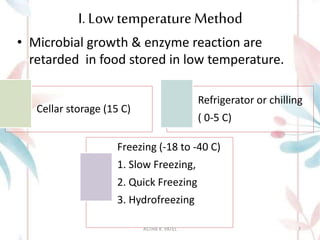
I. Low temperatureMethod
• Microbial growth & enzyme reaction are
retarded in food stored in low temperature.
Cellar storage (15 C)
Refrigerator or chilling
( 0-5 C)
Freezing (-18 to -40 C)
1. Slow Freezing,
2. Quick Freezing
3. Hydrofreezing
ASTHA K. PATEL 7
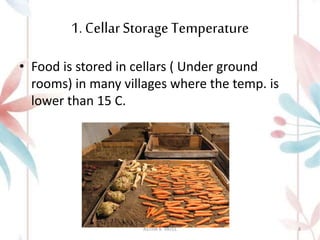
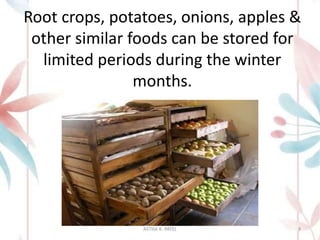
1. CellarStorageTemperature
• Food is stored in cellars ( Under ground
rooms) in many villages where the temp. is
lower than 15 C.
ASTHA K. PATEL 8
Root crops, potatoes, onions, apples &
other similar foods can be stored for
limited periods during the winter
months.
ASTHA K. PATEL 9
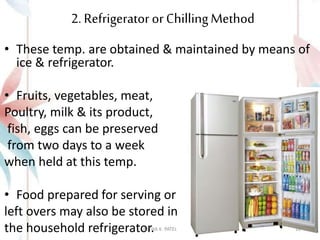
2. Refrigerator orChillingMethod
• These temp. are obtained & maintained by means of
ice & refrigerator.
• Fruits, vegetables, meat,
Poultry, milk & its product,
fish, eggs can be preserved
from two days to a week
when held at this temp.
• Food prepared for serving or
left overs may also be stored in
the household refrigerator.
ASTHA K. PATEL 10
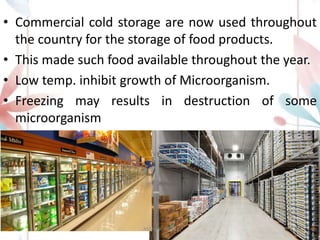
• Commercial cold storage are now used throughout
the country for the storage of food products.
• This made such food available throughout the year.
• Low temp. inhibit growth of Microorganism.
• Freezing may results in destruction of some
microorganism
ASTHA K. PATEL 11
3. Freezingmethod
• Freezing may preserve food for long periods of
time.
• Some microorganisms are destroyed during
freezing.
• The chief preservative effects of freezing
temperature is inability of Microorganisms to
grow at freezing temperature.
ASTHA K. PATEL 12
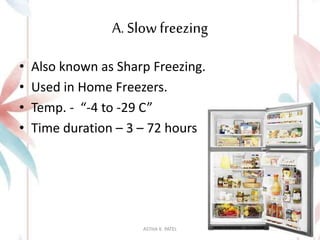
A. Slowfreezing
• Also known as Sharp Freezing.
• Used in Home Freezers.
• Temp. - “-4 to -29 C”
• Time duration – 3 – 72 hours
ASTHA K. PATEL 13
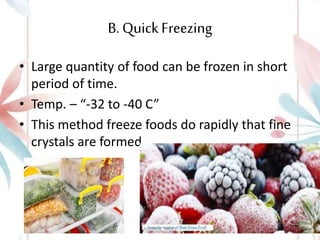
B. QuickFreezing
• Large quantity of food can be frozen in short
period of time.
• Temp. – “-32 to -40 C”
• This method freeze foods do rapidly that fine
crystals are formed.
ASTHA K. PATEL 14
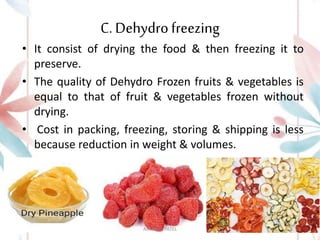
C.Dehydrofreezing
• It consist of drying the food & then freezing it to
preserve.
• The quality of Dehydro Frozen fruits & vegetables is
equal to that of fruit & vegetables frozen without
drying.
• Cost in packing, freezing, storing & shipping is less
because reduction in weight & volumes.
ASTHA K. PATEL 15
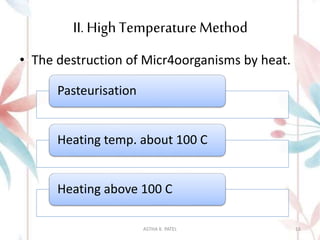
II. High TemperatureMethod
• The destruction of Micr4oorganisms by heat.
Pasteurisation
Heating temp. about 100 C
Heating above 100 C
ASTHA K. PATEL 16
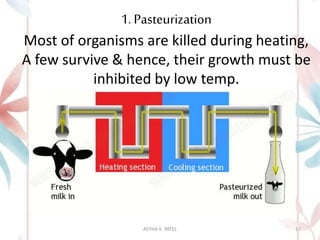
1. Pasteurization
Most of organisms are killed during heating,
A few survive & hence, their growth must be
inhibited by low temp.
ASTHA K. PATEL 17
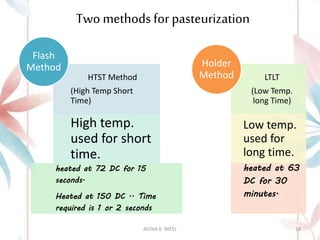
Two methods for pasteurization
HTST Method
(High Temp Short
Time)
High temp.
used for short
time.
heated at 72 DC for 15
seconds.
Heated at 150 DC .. Time
required is 1 or 2 seconds
Flash
Method
LTLT
(Low Temp.
long Time)
Low temp.
used for
long time.
heated at 63
DC for 30
minutes.
Holder
Method
ASTHA K. PATEL 18
2. Heating up to temp. about 100 C
• Most method of cooking under this.
• It temp. can be obtained by boiling any liquid
food.
• This method kills all bacteria except spores.
ASTHA K. PATEL 19
3. Heating above100 C
• Temp. above 100 C is obtained by means of
steam under pressure, as in a pressure cooker
or autoclave.
• Sterilization of foods can be brought about
121 C for 15 minutes.
ASTHA K. PATEL 20
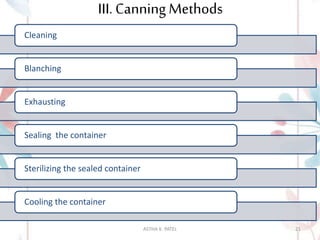
III. Canning Methods
Cleaning
Blanching
Exhausting
Sealing the container
Sterilizing the sealed container
Cooling the container
ASTHA K. PATEL 21
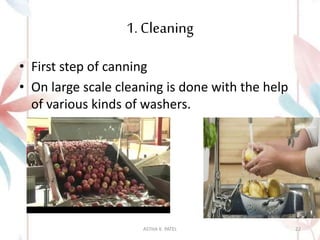
1. Cleaning
• First step of canning
• On large scale cleaning is done with the help
of various kinds of washers.
ASTHA K. PATEL 22
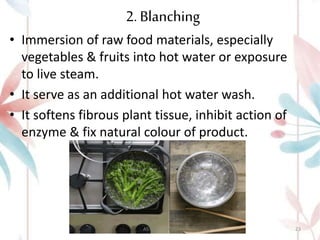
2. Blanching
• Immersion of raw food materials, especially
vegetables & fruits into hot water or exposure
to live steam.
• It serve as an additional hot water wash.
• It softens fibrous plant tissue, inhibit action of
enzyme & fix natural colour of product.
ASTHA K. PATEL 23
3. Exhausting
• Gases are expelled by passing the open can,
containing food through an exhaust box in
which hot water or steam is used to expand
the food & expel air & other gases from the
contents.
• After the gases are expelled, the can is
immediately sealed, heat processed & cooled.
ASTHA K. PATEL 24
4. Sealingthe container
• Each container must be sealed properly before
it is subjected to heat process.
ASTHA K. PATEL 25
5. Sterilizingthe sealed container
• To prevent spoilage of food by
microorganisms.
• Sterilized by steam under pressure.
ASTHA K. PATEL 26
6. Cooling the container
• Can should be cooled rapidly.
• Done by air or water.
ASTHA K. PATEL 27
IV. DryingMethod/Dehydration
• Microorganisms need moisture to grow.
• When exposed to sunlight or subjected to
dehydration, the moisture in the food is
removed.
• This prevents the growth of Microorganisms &
thereby prevent spoilage of food.
ASTHA K. PATEL 28
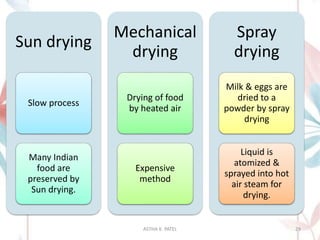
Sun drying
Slow process
Many Indian
food are
preserved by
Sun drying.
Mechanical
drying
Drying of food
by heated air
Expensive
method
Spray
drying
Milk & eggs are
dried to a
powder by spray
drying
Liquid is
atomized &
sprayed into hot
air steam for
drying.
ASTHA K. PATEL 29
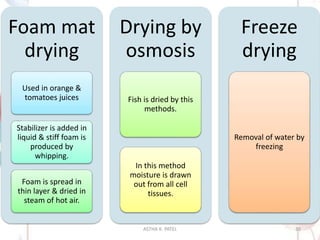
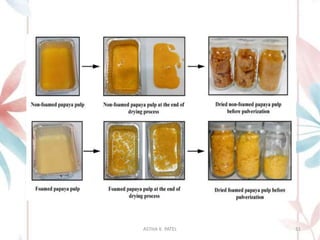
Foam mat
drying
Used in orange &
tomatoes juices
Stabilizer is added in
liquid & stiff foam is
produced by
whipping.
Foam is spread in
thin layer & dried in
steam of hot air.
Drying by
osmosis
Fish is dried by this
methods.
In this method
moisture is drawn
out from all cell
tissues.
Freeze
drying
Removal of water by
freezing
ASTHA K. PATEL 30
ASTHA K. PATEL 31
V. Highconcentration ofSugar & salt
• Sugar & salt aid in the preservation of food
products.
ASTHA K. PATEL 32
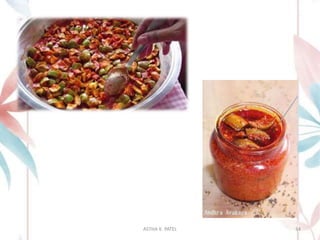
1. Salting& Pickling
• This method has been practiced since
ancient times.
• Salt is a good natural preservative, and
it is used with other spices in pickling,
ex. – mango, lemon, ginger, fish and
vegetables.
• The salt added to the vegetables draws
out water and sugar from the
vegetables. ASTHA K. PATEL 33
ASTHA K. PATEL 34
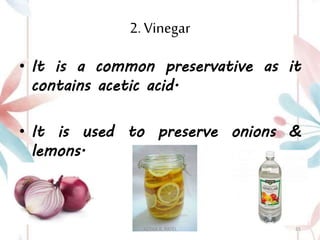
2. Vinegar
• It is a common preservative as it
contains acetic acid.
• It is used to preserve onions &
lemons.
ASTHA K. PATEL 35
3. Sugars
• Fruits are preserved
by placing them in sugar syrup.
• When bacteria, yeasts or moulds
are placed in heavy sugar syrup,
water in the cells move through
the membrane into the
concentrated syrup through
osmosis.
• Ex- jam, jelly, fruit juices.
ASTHA K. PATEL 36
VI. Chemicalpreservation
• Only a few chemical are permitted in
prescribed minimum levels for preserving
food.
• Ex. – sodium benzoate, sorbic acid,
sodium and calcium propionate &
sulphur dioxide.
• Sorbic acid is added to cheese.
ASTHA K. PATEL 37
Acid
• Citric acid and phosphoric acid is
added to soft drinks.
• Food such as tomatoes, citrus juices
and apples contain natural acidity.
ASTHA K. PATEL 38
VII. Preservationby Radiation
• Micro organism are inactivated by different
kinds of radiation.
• Foods are usually irradiated with iodizing
radiation.
• Spices, vegetables and fruits, pork and
poultry are all preserved by radiation.
• Irradiation cause changes in flavor, color,
texture and nutritive value.
ASTHA K. PATEL 39
Smoke
• Smoke contains preservative chemicals
such as formaldehyde and other
materials from burning wood.
• Smoke generates heat which kills
microorganism.
• The heat tends to dry out the food
which further helps in preservation
ASTHA K. PATEL 40
Asepsis
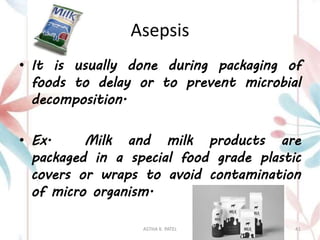
• It is usually done during packaging of
foods to delay or to prevent microbial
decomposition.
• Ex. Milk and milk products are
packaged in a special food grade plastic
covers or wraps to avoid contamination
of micro organism.
ASTHA K. PATEL 41
Freezing & Refrigeration
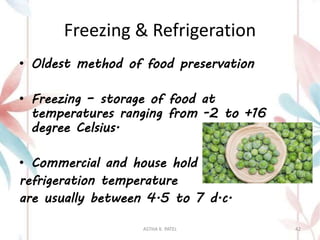
• Oldest method of food preservation
• Freezing – storage of food at
temperatures ranging from -2 to +16
degree Celsius.
• Commercial and house hold
refrigeration temperature
are usually between 4.5 to 7 d.c.
ASTHA K. PATEL 42
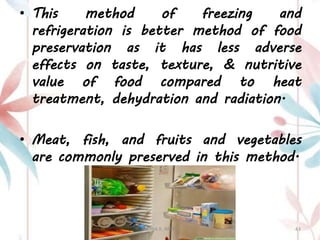
• This method of freezing and
refrigeration is better method of food
preservation as it has less adverse
effects on taste, texture, & nutritive
value of food compared to heat
treatment, dehydration and radiation.
• Meat, fish, and fruits and vegetables
are commonly preserved in this method.
ASTHA K. PATEL 43
Dehydration
• Water is removed from food for
preservation.
• The term food preservation refers to
artificial drying under controlled
conditions that cause minimum or no
other changes in food properties.
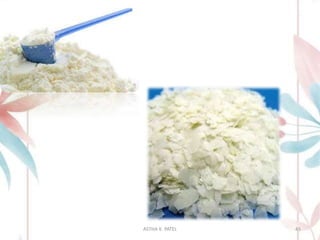
• Ex. – dried milk, potato flakes &
instant coffee. ASTHA K. PATEL 44
ASTHA K. PATEL 45
Heat
• Bacteria , yeast and moulds grow best
in temp. range of about 16-38 DC.
• At the temp. – 82-93 DC most
bacteria's killed.
• When food in high acid content, such as
tomato juices or orange juice, the heat
is only used for a shorter period of
time as the killing power of heat inn
ASTHA K. PATEL 46
ASTHA K. PATEL 47

Food preservation

  • 1.
    Food Preservation ASTHA K.PATEL ASTHA K. PATEL 1
  • 2.
    Definition • Food preservationcan be defined as the science that deals with the process of prevention of spoilage of food, thus allowing it to be stored in a fit condition for future use. ASTHA K. PATEL 2
  • 3.
    • Preservation offood increase the shelf life of the food. • Foods are preserved at home or in commercial settings to prolong their shelf life and to use particular foods like vegetables & fruits when not in season. ASTHA K. PATEL 3
  • 4.
    Principles of foodpreservation 1. Prevention or delay microbial decomposition • Keeping out microorganism or removing the microorganisms already present. ( Asepsis) • By removal of microorganism ( Filtration) • By hindering the growth and activity of microorganism ( Refrigeration , Dehydration and addition of chemical in food ) ASTHA K. PATEL 4
  • 5.
    • By killingmicroorganism ( Boiling & Radiation) 2. Prevention or delay of self-decompoition of food • By destruction of enzymes • By prevention or delay of chemical reaction. ASTHA K. PATEL 5
  • 6.
    Types ofFoodpreservation Use oflow temperatures Use of high temperature Canning procedures Drying method High concentration of sugar & salts Preservation by Chemical Preservation by Radiation ASTHA K. PATEL 6
  • 7.
    I. Low temperatureMethod •Microbial growth & enzyme reaction are retarded in food stored in low temperature. Cellar storage (15 C) Refrigerator or chilling ( 0-5 C) Freezing (-18 to -40 C) 1. Slow Freezing, 2. Quick Freezing 3. Hydrofreezing ASTHA K. PATEL 7
  • 8.
    1. CellarStorageTemperature • Foodis stored in cellars ( Under ground rooms) in many villages where the temp. is lower than 15 C. ASTHA K. PATEL 8
  • 9.
    Root crops, potatoes,onions, apples & other similar foods can be stored for limited periods during the winter months. ASTHA K. PATEL 9
  • 10.
    2. Refrigerator orChillingMethod •These temp. are obtained & maintained by means of ice & refrigerator. • Fruits, vegetables, meat, Poultry, milk & its product, fish, eggs can be preserved from two days to a week when held at this temp. • Food prepared for serving or left overs may also be stored in the household refrigerator. ASTHA K. PATEL 10
  • 11.
    • Commercial coldstorage are now used throughout the country for the storage of food products. • This made such food available throughout the year. • Low temp. inhibit growth of Microorganism. • Freezing may results in destruction of some microorganism ASTHA K. PATEL 11
  • 12.
    3. Freezingmethod • Freezingmay preserve food for long periods of time. • Some microorganisms are destroyed during freezing. • The chief preservative effects of freezing temperature is inability of Microorganisms to grow at freezing temperature. ASTHA K. PATEL 12
  • 13.
    A. Slowfreezing • Alsoknown as Sharp Freezing. • Used in Home Freezers. • Temp. - “-4 to -29 C” • Time duration – 3 – 72 hours ASTHA K. PATEL 13
  • 14.
    B. QuickFreezing • Largequantity of food can be frozen in short period of time. • Temp. – “-32 to -40 C” • This method freeze foods do rapidly that fine crystals are formed. ASTHA K. PATEL 14
  • 15.
    C.Dehydrofreezing • It consistof drying the food & then freezing it to preserve. • The quality of Dehydro Frozen fruits & vegetables is equal to that of fruit & vegetables frozen without drying. • Cost in packing, freezing, storing & shipping is less because reduction in weight & volumes. ASTHA K. PATEL 15
  • 16.
    II. High TemperatureMethod •The destruction of Micr4oorganisms by heat. Pasteurisation Heating temp. about 100 C Heating above 100 C ASTHA K. PATEL 16
  • 17.
    1. Pasteurization Most oforganisms are killed during heating, A few survive & hence, their growth must be inhibited by low temp. ASTHA K. PATEL 17
  • 18.
    Two methods forpasteurization HTST Method (High Temp Short Time) High temp. used for short time. heated at 72 DC for 15 seconds. Heated at 150 DC .. Time required is 1 or 2 seconds Flash Method LTLT (Low Temp. long Time) Low temp. used for long time. heated at 63 DC for 30 minutes. Holder Method ASTHA K. PATEL 18
  • 19.
    2. Heating upto temp. about 100 C • Most method of cooking under this. • It temp. can be obtained by boiling any liquid food. • This method kills all bacteria except spores. ASTHA K. PATEL 19
  • 20.
    3. Heating above100C • Temp. above 100 C is obtained by means of steam under pressure, as in a pressure cooker or autoclave. • Sterilization of foods can be brought about 121 C for 15 minutes. ASTHA K. PATEL 20
  • 21.
    III. Canning Methods Cleaning Blanching Exhausting Sealingthe container Sterilizing the sealed container Cooling the container ASTHA K. PATEL 21
  • 22.
    1. Cleaning • Firststep of canning • On large scale cleaning is done with the help of various kinds of washers. ASTHA K. PATEL 22
  • 23.
    2. Blanching • Immersionof raw food materials, especially vegetables & fruits into hot water or exposure to live steam. • It serve as an additional hot water wash. • It softens fibrous plant tissue, inhibit action of enzyme & fix natural colour of product. ASTHA K. PATEL 23
  • 24.
    3. Exhausting • Gasesare expelled by passing the open can, containing food through an exhaust box in which hot water or steam is used to expand the food & expel air & other gases from the contents. • After the gases are expelled, the can is immediately sealed, heat processed & cooled. ASTHA K. PATEL 24
  • 25.
    4. Sealingthe container •Each container must be sealed properly before it is subjected to heat process. ASTHA K. PATEL 25
  • 26.
    5. Sterilizingthe sealedcontainer • To prevent spoilage of food by microorganisms. • Sterilized by steam under pressure. ASTHA K. PATEL 26
  • 27.
    6. Cooling thecontainer • Can should be cooled rapidly. • Done by air or water. ASTHA K. PATEL 27
  • 28.
    IV. DryingMethod/Dehydration • Microorganismsneed moisture to grow. • When exposed to sunlight or subjected to dehydration, the moisture in the food is removed. • This prevents the growth of Microorganisms & thereby prevent spoilage of food. ASTHA K. PATEL 28
  • 29.
    Sun drying Slow process ManyIndian food are preserved by Sun drying. Mechanical drying Drying of food by heated air Expensive method Spray drying Milk & eggs are dried to a powder by spray drying Liquid is atomized & sprayed into hot air steam for drying. ASTHA K. PATEL 29
  • 30.
    Foam mat drying Used inorange & tomatoes juices Stabilizer is added in liquid & stiff foam is produced by whipping. Foam is spread in thin layer & dried in steam of hot air. Drying by osmosis Fish is dried by this methods. In this method moisture is drawn out from all cell tissues. Freeze drying Removal of water by freezing ASTHA K. PATEL 30
  • 31.
  • 32.
    V. Highconcentration ofSugar& salt • Sugar & salt aid in the preservation of food products. ASTHA K. PATEL 32
  • 33.
    1. Salting& Pickling •This method has been practiced since ancient times. • Salt is a good natural preservative, and it is used with other spices in pickling, ex. – mango, lemon, ginger, fish and vegetables. • The salt added to the vegetables draws out water and sugar from the vegetables. ASTHA K. PATEL 33
  • 34.
  • 35.
    2. Vinegar • Itis a common preservative as it contains acetic acid. • It is used to preserve onions & lemons. ASTHA K. PATEL 35
  • 36.
    3. Sugars • Fruitsare preserved by placing them in sugar syrup. • When bacteria, yeasts or moulds are placed in heavy sugar syrup, water in the cells move through the membrane into the concentrated syrup through osmosis. • Ex- jam, jelly, fruit juices. ASTHA K. PATEL 36
  • 37.
    VI. Chemicalpreservation • Onlya few chemical are permitted in prescribed minimum levels for preserving food. • Ex. – sodium benzoate, sorbic acid, sodium and calcium propionate & sulphur dioxide. • Sorbic acid is added to cheese. ASTHA K. PATEL 37
  • 38.
    Acid • Citric acidand phosphoric acid is added to soft drinks. • Food such as tomatoes, citrus juices and apples contain natural acidity. ASTHA K. PATEL 38
  • 39.
    VII. Preservationby Radiation •Micro organism are inactivated by different kinds of radiation. • Foods are usually irradiated with iodizing radiation. • Spices, vegetables and fruits, pork and poultry are all preserved by radiation. • Irradiation cause changes in flavor, color, texture and nutritive value. ASTHA K. PATEL 39
  • 40.
    Smoke • Smoke containspreservative chemicals such as formaldehyde and other materials from burning wood. • Smoke generates heat which kills microorganism. • The heat tends to dry out the food which further helps in preservation ASTHA K. PATEL 40
  • 41.
    Asepsis • It isusually done during packaging of foods to delay or to prevent microbial decomposition. • Ex. Milk and milk products are packaged in a special food grade plastic covers or wraps to avoid contamination of micro organism. ASTHA K. PATEL 41
  • 42.
    Freezing & Refrigeration •Oldest method of food preservation • Freezing – storage of food at temperatures ranging from -2 to +16 degree Celsius. • Commercial and house hold refrigeration temperature are usually between 4.5 to 7 d.c. ASTHA K. PATEL 42
  • 43.
    • This methodof freezing and refrigeration is better method of food preservation as it has less adverse effects on taste, texture, & nutritive value of food compared to heat treatment, dehydration and radiation. • Meat, fish, and fruits and vegetables are commonly preserved in this method. ASTHA K. PATEL 43
  • 44.
    Dehydration • Water isremoved from food for preservation. • The term food preservation refers to artificial drying under controlled conditions that cause minimum or no other changes in food properties. • Ex. – dried milk, potato flakes & instant coffee. ASTHA K. PATEL 44
  • 45.
  • 46.
    Heat • Bacteria ,yeast and moulds grow best in temp. range of about 16-38 DC. • At the temp. – 82-93 DC most bacteria's killed. • When food in high acid content, such as tomato juices or orange juice, the heat is only used for a shorter period of time as the killing power of heat inn ASTHA K. PATEL 46
  • 47.