
By- Astha K. Patel
ASTHA K. PATEL 1
Introduction
• Balanced diet is one which contains different types of
foods such as cereals, pulses & vegetables in such
quantities & proportions so that the need for calorie,
protein, fats, minerals & vitamins is adequately met.
• A balanced diet should provide
 60-70% of total calories from CHO
 10-12% of total Protein
 20-25% of from Fat.
ASTHA K. PATEL 2
DefinitionI
• A balanced diet is one that provides the body
with all the essential nutrients required to
maintain cells, tissues & organ as well as to
function correctly.
ASTHA K. PATEL 3
DefinitionII
• Balance diet is food preparation which
provides complete nutrients as well as
supplies CHO, Protein, fats, vitamins &
minerals & fiber in their normal proportions.
ASTHA K. PATEL 4
Goals ofBalanceddiet
• A well balanced diet provides enough energy
& nutrition for optimal growth &
development.
• When an individual chooses to eat a wide
variety of foods & drinks from all the food
groups, he/she is eating a balanced diet.
ASTHA K. PATEL 5
• The main goal of this dietary regimen is to
take nutrients that an individual needs for his
or her health.
ASTHA K. PATEL 6
Some tips ofbalanceddiet
Be sure to allot time for digestion.
Have at least 5 hours interval between
meals & the last meal of the day
should be taken at least 3 hours
before sleeping.
Avoid tea, coffee, carbonated
beverages ( soft drinks) &
alcoholic beverages.
Light dinner
Moderate lunch
Heavy breakfast are advisable
ASTHA K. PATEL 7
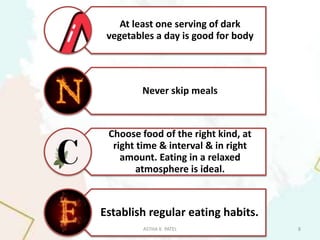
At least one serving of dark
vegetables a day is good for body
Never skip meals
Choose food of the right kind, at
right time & interval & in right
amount. Eating in a relaxed
atmosphere is ideal.
Establish regular eating habits.
ASTHA K. PATEL 8
Drink at least 8 glasses of
water in a day.
Do not hurry your meal. Take
time to enjoy your food.
Include variety of foods in
each meals.
Eat more fresh fruits
Take time to refer food intake
ASTHA K. PATEL 9
ASTHA K. PATEL 10
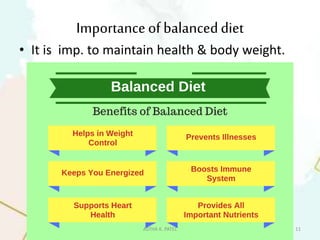
Importanceof balanceddiet
• It is imp. to maintain health & body weight.
ASTHA K. PATEL 11
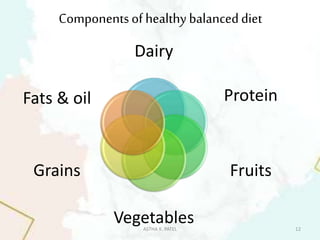
Componentsof healthy balanceddiet
Dairy
Protein
Fruits
Vegetables
Grains
Fats & oil
ASTHA K. PATEL 12
Dairy
• Dairy includes cheese, milk & yogurt.
• Dairy foods are usually high in saturated fats so to
reduce fat & calories it is best to choose low fat or
fat free variety.
• Dairy products provides calcium, protein & vitamin
D.
• For those who do not consume dairy products it is
essential to use a replacement such as soy milks or
calcium supplements in diet.
ASTHA K. PATEL 13
Protein
• It is main containing food group.
• Lean, meat, poultry, fish, beans, peas, nuts,
seeds, eggs are provide protein.
• Meat & poultry – High iron
• Legumes – fiber
• Eggs – Vitamins & minerals
• Fish – omega 3 fatty acids
ASTHA K. PATEL 14
• Cooking method should be low fat such as
grilling, poaching, steaming to minimize extra
fat added during cooking process.
ASTHA K. PATEL 15
Fruits
• They are fat free, low in calories, high in fiber
& very Nutritious.
• They provide bunch of vitamins & minerals.
• This also includes dried friuts
ASTHA K. PATEL 16
Vegetables
• They contain least calories & most vitamins &
minerals.
• Make sure to include wide variety if
vegetables in the meal.
ASTHA K. PATEL 17
Grains
• This is the major CHO source in a balanced
diet.
• Food includes – bread, roti, cereals, pasta &
rice.
• Try choose different variety of grains as they
are high in fibre & contain more vitamin B.
ASTHA K. PATEL 18
Fats & oil
• Some fats are necessary in our diet for the
body function correctly.
• It is imp. These are the right types of fat.
• Saturated & trans fat should be minimized as
these are unhealthy for heart.
ASTHA K. PATEL 19
• They are replace by vegetable fats such as
canola, olive & sun flower oil.
• All fats do contain high amount of calories so
it is imp. To keep added fats to minimum in
order to maintain healthy body weight.
ASTHA K. PATEL 20
Factors influencingbalanceddiet
• Religion/culture
• Social class
• Personal preferences
• Peer pressure
• Media
• Geographic location
• Availability of food
• Financial resources
ASTHA K. PATEL 21
Religion
• Various foods are prohibited in certain religion.
• Such as ----
Muslims do not eat pork
Hindus do not eat beef
Buddhist are vegetarian.
• Asian groups, particluarly teenage girls, may be
deficient in vitamin D ( Sunshine Vitamin) because
their religion requires them to cover most of the
body. So they do not get opportunity to expose in
sunlight.
• These can leads to Rickets & osteomalacia
ASTHA K. PATEL 22
Socialclass
• People in lower social classes generally earn
less money than those in the higher &
medium classes because of this are most likely
to have certain kinds of deficiency & diseases
related to unhealthy diet.
ASTHA K. PATEL 23
Personalpreference
• This may not just include like or dislikes, but
other factors.
• example – people who choose not to eat meat
because of religion & implications of killing
animals for food.
• Personal preference also influenced by taste,
texture, culture & social habits.
ASTHA K. PATEL 24
Peerpressure
• Peer pressure can have effects on food choices
that made especially by children & teenagers.
• Many young people choose food which is
eaten by their friends but those are mostly
unhealthy one.
ASTHA K. PATEL 25
Media
• Information published in the media can be
another factor that influences food choices.
ASTHA K. PATEL 26
Geographiclocation
• Althoghy there is enough food in the world, it is
not evenly distributed.
• More wealthy countries can afford to buy food &
so have greater variety of food than the poor
countries.
• Food that is grown in the poor soil will contain
fewer minerals & so quality of food is also poor.
ASTHA K. PATEL 27
Availabilityof food
• Many developing countries suffer from poor
soil conditions, flooding & droughts, which
results in repeated years of lost harvests.
• People have access to restricted diets that are
high in CHO & low in protein & fat.
• This can leads to under nutrition.
ASTHA K. PATEL 28
Financialresources
• The ability to afford food is linked to social
class.
• People who are in higher social class have
more money to spend on food & tends to
have better quality food.
• People who have low incomes are more likely
to buy food that is high in salt, fat & sugar.
ASTHA K. PATEL 29
Effects of unbalanceddiet
Under Nutrition
Insufficient intake can results in malnutrition
Over nutrition
There are some conditions that are related to
eating too much of a certain nutrients.
Ex. – Coronary artery disease
- Heart attack
- Obesity
- Type 2 diabetes
ASTHA K. PATEL 30
Specificnutritional deficiencies
• Iron deficiency – Anemia
• Vit D – Rickets & osteomalacia
• Vit A – Night Blindness
• Vit B1 – Beri Beri
• Vit B2 – arbiflavinosis
• Vit C – Scurvy
• Vit K – blood clotting problems
• Protein – Kwashiorkor & Marasmus
ASTHA K. PATEL 31
ASTHA K. PATEL 32

Balanced Diet

  • 1.
    By- Astha K.Patel ASTHA K. PATEL 1
  • 2.
    Introduction • Balanced dietis one which contains different types of foods such as cereals, pulses & vegetables in such quantities & proportions so that the need for calorie, protein, fats, minerals & vitamins is adequately met. • A balanced diet should provide  60-70% of total calories from CHO  10-12% of total Protein  20-25% of from Fat. ASTHA K. PATEL 2
  • 3.
    DefinitionI • A balanceddiet is one that provides the body with all the essential nutrients required to maintain cells, tissues & organ as well as to function correctly. ASTHA K. PATEL 3
  • 4.
    DefinitionII • Balance dietis food preparation which provides complete nutrients as well as supplies CHO, Protein, fats, vitamins & minerals & fiber in their normal proportions. ASTHA K. PATEL 4
  • 5.
    Goals ofBalanceddiet • Awell balanced diet provides enough energy & nutrition for optimal growth & development. • When an individual chooses to eat a wide variety of foods & drinks from all the food groups, he/she is eating a balanced diet. ASTHA K. PATEL 5
  • 6.
    • The maingoal of this dietary regimen is to take nutrients that an individual needs for his or her health. ASTHA K. PATEL 6
  • 7.
    Some tips ofbalanceddiet Besure to allot time for digestion. Have at least 5 hours interval between meals & the last meal of the day should be taken at least 3 hours before sleeping. Avoid tea, coffee, carbonated beverages ( soft drinks) & alcoholic beverages. Light dinner Moderate lunch Heavy breakfast are advisable ASTHA K. PATEL 7
  • 8.
    At least oneserving of dark vegetables a day is good for body Never skip meals Choose food of the right kind, at right time & interval & in right amount. Eating in a relaxed atmosphere is ideal. Establish regular eating habits. ASTHA K. PATEL 8
  • 9.
    Drink at least8 glasses of water in a day. Do not hurry your meal. Take time to enjoy your food. Include variety of foods in each meals. Eat more fresh fruits Take time to refer food intake ASTHA K. PATEL 9
  • 10.
  • 11.
    Importanceof balanceddiet • Itis imp. to maintain health & body weight. ASTHA K. PATEL 11
  • 12.
  • 13.
    Dairy • Dairy includescheese, milk & yogurt. • Dairy foods are usually high in saturated fats so to reduce fat & calories it is best to choose low fat or fat free variety. • Dairy products provides calcium, protein & vitamin D. • For those who do not consume dairy products it is essential to use a replacement such as soy milks or calcium supplements in diet. ASTHA K. PATEL 13
  • 14.
    Protein • It ismain containing food group. • Lean, meat, poultry, fish, beans, peas, nuts, seeds, eggs are provide protein. • Meat & poultry – High iron • Legumes – fiber • Eggs – Vitamins & minerals • Fish – omega 3 fatty acids ASTHA K. PATEL 14
  • 15.
    • Cooking methodshould be low fat such as grilling, poaching, steaming to minimize extra fat added during cooking process. ASTHA K. PATEL 15
  • 16.
    Fruits • They arefat free, low in calories, high in fiber & very Nutritious. • They provide bunch of vitamins & minerals. • This also includes dried friuts ASTHA K. PATEL 16
  • 17.
    Vegetables • They containleast calories & most vitamins & minerals. • Make sure to include wide variety if vegetables in the meal. ASTHA K. PATEL 17
  • 18.
    Grains • This isthe major CHO source in a balanced diet. • Food includes – bread, roti, cereals, pasta & rice. • Try choose different variety of grains as they are high in fibre & contain more vitamin B. ASTHA K. PATEL 18
  • 19.
    Fats & oil •Some fats are necessary in our diet for the body function correctly. • It is imp. These are the right types of fat. • Saturated & trans fat should be minimized as these are unhealthy for heart. ASTHA K. PATEL 19
  • 20.
    • They arereplace by vegetable fats such as canola, olive & sun flower oil. • All fats do contain high amount of calories so it is imp. To keep added fats to minimum in order to maintain healthy body weight. ASTHA K. PATEL 20
  • 21.
    Factors influencingbalanceddiet • Religion/culture •Social class • Personal preferences • Peer pressure • Media • Geographic location • Availability of food • Financial resources ASTHA K. PATEL 21
  • 22.
    Religion • Various foodsare prohibited in certain religion. • Such as ---- Muslims do not eat pork Hindus do not eat beef Buddhist are vegetarian. • Asian groups, particluarly teenage girls, may be deficient in vitamin D ( Sunshine Vitamin) because their religion requires them to cover most of the body. So they do not get opportunity to expose in sunlight. • These can leads to Rickets & osteomalacia ASTHA K. PATEL 22
  • 23.
    Socialclass • People inlower social classes generally earn less money than those in the higher & medium classes because of this are most likely to have certain kinds of deficiency & diseases related to unhealthy diet. ASTHA K. PATEL 23
  • 24.
    Personalpreference • This maynot just include like or dislikes, but other factors. • example – people who choose not to eat meat because of religion & implications of killing animals for food. • Personal preference also influenced by taste, texture, culture & social habits. ASTHA K. PATEL 24
  • 25.
    Peerpressure • Peer pressurecan have effects on food choices that made especially by children & teenagers. • Many young people choose food which is eaten by their friends but those are mostly unhealthy one. ASTHA K. PATEL 25
  • 26.
    Media • Information publishedin the media can be another factor that influences food choices. ASTHA K. PATEL 26
  • 27.
    Geographiclocation • Althoghy thereis enough food in the world, it is not evenly distributed. • More wealthy countries can afford to buy food & so have greater variety of food than the poor countries. • Food that is grown in the poor soil will contain fewer minerals & so quality of food is also poor. ASTHA K. PATEL 27
  • 28.
    Availabilityof food • Manydeveloping countries suffer from poor soil conditions, flooding & droughts, which results in repeated years of lost harvests. • People have access to restricted diets that are high in CHO & low in protein & fat. • This can leads to under nutrition. ASTHA K. PATEL 28
  • 29.
    Financialresources • The abilityto afford food is linked to social class. • People who are in higher social class have more money to spend on food & tends to have better quality food. • People who have low incomes are more likely to buy food that is high in salt, fat & sugar. ASTHA K. PATEL 29
  • 30.
    Effects of unbalanceddiet UnderNutrition Insufficient intake can results in malnutrition Over nutrition There are some conditions that are related to eating too much of a certain nutrients. Ex. – Coronary artery disease - Heart attack - Obesity - Type 2 diabetes ASTHA K. PATEL 30
  • 31.
    Specificnutritional deficiencies • Irondeficiency – Anemia • Vit D – Rickets & osteomalacia • Vit A – Night Blindness • Vit B1 – Beri Beri • Vit B2 – arbiflavinosis • Vit C – Scurvy • Vit K – blood clotting problems • Protein – Kwashiorkor & Marasmus ASTHA K. PATEL 31
  • 32.