NCM 105: NUTRITION AND DIET
THERAPY
Ken Ryan Dizon, MBA-HP, MN, RN
OBJECTIVES:
BY THE END OF THE MODULE, THE STUDENTS WILL:
 Be able to explain the value of food
 Calculate food value, BMR and BMI
PHYSIOLOGIC VALUE OF FOOD
FOOD compose of various compounds:
1. ORGANIC: PROTEIN, CARBOHYDRATES, LIPIDS
2. INORGANIC ELEMENTS: MINERALS, WATER
3. VITAMIN & MINERALS: Act as a catalysts which prompt the 3
major nutrients –carbohydrates , protein, fats.
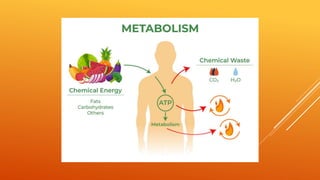
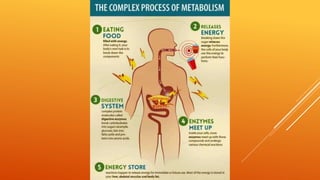
METABOLISM
To change or alter, Chemical process of transforming foods into complex
tissue elements and of transforming complex body substance into simpler
ones, along with the production of heat energy
Is the totality of the chemical processes in the body in which substance are
change in other substance to sustain life.
WHAT IS METABOLISM?
- From the Greek word matabolé or “change”
3 Major Functions:
1. the conversion of the energy in food to energy available to run
cellular processes
2. the conversion of food to building blocks for proteins, lipids, nucleic
acids, and some carbohydrates
3. the elimination of metabolic wastes
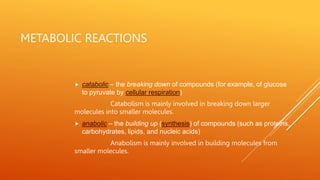
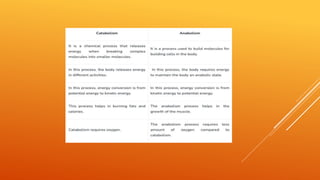
METABOLIC REACTIONS
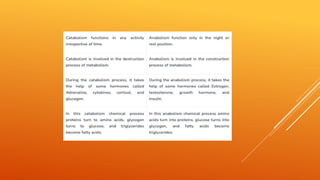
 catabolic – the breaking down of compounds (for example, of glucose
to pyruvate by cellular respiration)
Catabolism is mainly involved in breaking down larger
molecules into smaller molecules.
 anabolic – the building up (synthesis) of compounds (such as proteins,
carbohydrates, lipids, and nucleic acids)
Anabolism is mainly involved in building molecules from
smaller molecules.
 Energy is the force or power that enables the body to do its work.
Energy deals mostly In the chemical energy locked in the food stuff by
reason of chemical process.
THE ENERGY YIELDING FOOD FACTORS
 Human body utilizes potential energy in foods for maintaining life and
doing work.
 The energy yielding food factors are
 Carbohydrates
 Proteins
 Fats
 In cells, enzymes degrade these by oxidation yielding energy
 Carbs and fats give CO2 , water and heat while Proteins give urea along
with these
THE ENERGY FROM FOOD
CALORIE
A calorie is a unit of energy and a standard unit in measuring heat .
Historically, scientists have defined "calorie" to mean a unit of energy or
heat that could come from a variety of sources, whether they are fats,
proteins, carbohydrates or sugars these are important sources of
calories, which people need to live and function.
There are two types of calorie:
A small calorie (cal) is the amount of energy required to raise the
temperature of 1 gram (g) of water by 1º Celsius (º C).
A large calorie (kcal) is the amount of energy required to raise 1
kilogram (kg) of water by 1º C. It is also known as a kilocalorie.
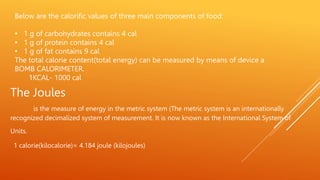
Below are the calorific values of three main components of food:
• 1 g of carbohydrates contains 4 cal
• 1 g of protein contains 4 cal
• 1 g of fat contains 9 cal
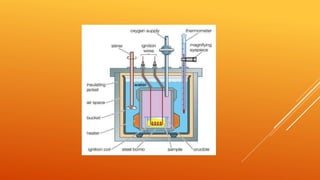
The total calorie content(total energy) can be measured by means of device a
BOMB CALORIMETER.
1KCAL- 1000 cal
The Joules
is the measure of energy in the metric system (The metric system is an internationally
recognized decimalized system of measurement. It is now known as the International System of
Units.
1 calorie(kilocalorie)= 4.184 joule (kilojoules)
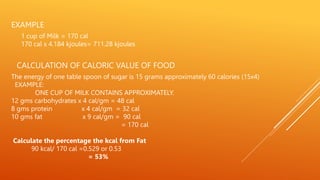
EXAMPLE
1 cup of Milk = 170 cal
170 cal x 4.184 kjoules= 711.28 kjoules
CALCULATION OF CALORIC VALUE OF FOOD
The energy of one table spoon of sugar is 15 grams approximately 60 calories (15x4)
EXAMPLE:
ONE CUP OF MILK CONTAINS APPROXIMATELY.
12 gms carbohydrates x 4 cal/gm = 48 cal
8 gms protein x 4 cal/gm = 32 cal
10 gms fat x 9 cal/gm = 90 cal
= 170 cal
Calculate the percentage the kcal from Fat
90 kcal/ 170 cal =0.529 or 0.53
= 53%
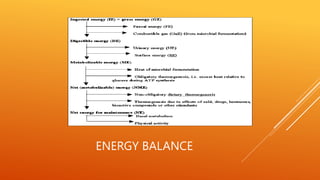
 Humans need food energy to cover the basal metabolic rate; the
metabolic response to food; the energy cost of physical activities; and
accretion of new tissue during growth and pregnancy, as well as the
production of milk during lactation.
 “Energy balance is achieved when input (or dietary energy intake) is
equal to output (or energy expenditure), plus the energy cost of growth
in childhood and pregnancy, or the energy cost to produce milk during
lactation” (FAO, 2004).
ENERGY BALANCE
ENERGY EXPENDITURE
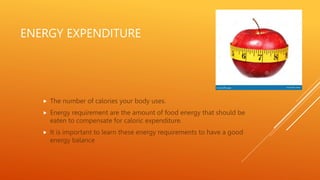
 The number of calories your body uses.
 Energy requirement are the amount of food energy that should be
eaten to compensate for caloric expenditure.
 It is important to learn these energy requirements to have a good
energy balance
 If you know a little bit about your energy expenditure and approximate
metabolic rate, you can give a picture of about how much you should
be eating in a day.
• It's important that the estimates of the energy requirements may be for
long periods of time. There's great variability among these needs every
day
COMPONENTS OF ENERGY
EXPENDITURE
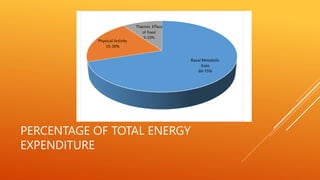
 There are 3 main components that make up your energy expenditure:
1. Basal metabolic rate (BMR): energy needed to maintain essential
physiological functions, including growth, pregnancy, lactation.
2. The thermic effect of food (TEF): Thermogenesis necessary for
digestive and metabolic utilization of nutrients.
3. Physical activity: energy for muscle contraction and movements
PERCENTAGE OF TOTAL ENERGY
EXPENDITURE
BASAL METABOLIC RATE (BMR)
 Amount of minimum energy needed to maintain essential physiological
functions and homeostasis.
• It would be equivalent to the energy expenditure that is during quiet sleep.
• Total energy expenditure is similar to the basal although somewhat higher
(approx. 10%).
• It represents 2/3 of the daily consumption of energy. It represents the 60-
70% of the energy expenditure.
This closely related to lean or fat-free mass. Adipose tissue is metabolically
active lo
FACTORS THAT AFFECT BMR
• Size and body surface, logically increases to larger size of organs.
• Sex and body composition: the man is metabolically more active. The
woman has approximately 10% of fat than man.
Age: every 10 years the basal metabolic rate decreases 3-5% from age
20.
• Pregnancy and lactation: in the last two trimesters of pregnancy, there
is an increase in metabolism (200-300 kcal / day)
• Other: Fever, Balance hormonal diseases, drugs, growt
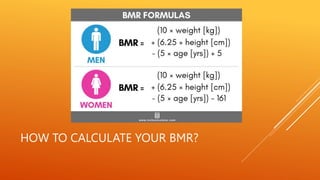
HOW TO CALCULATE YOUR BMR?
EXAMPLE
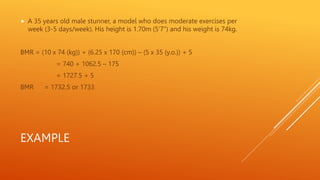
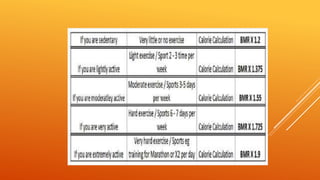
 A 35 years old male stunner, a model who does moderate exercises per
week (3-5 days/week). His height is 1.70m (5’7”) and his weight is 74kg.
BMR = (10 x 74 (kg)) + (6.25 x 170 (cm)) – (5 x 35 (y.o.)) + 5
= 740 + 1062.5 – 175
= 1727.5 + 5
BMR = 1732.5 or 1733
TRY…
https://www.inchcalculator.com/miffli
n-st-jeor-calculator/
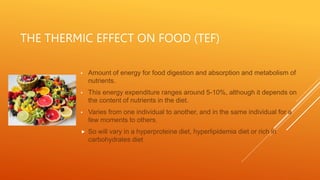
THE THERMIC EFFECT ON FOOD (TEF)
• Amount of energy for food digestion and absorption and metabolism of
nutrients.
• This energy expenditure ranges around 5-10%, although it depends on
the content of nutrients in the diet.
• Varies from one individual to another, and in the same individual for a
few moments to others.
 So will vary in a hyperproteine diet, hyperlipidemia diet or rich in
carbohydrates diet
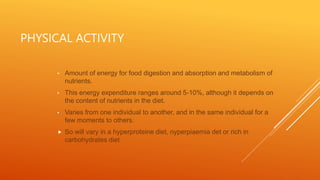
PHYSICAL ACTIVITY
• Amount of energy for food digestion and absorption and metabolism of
nutrients.
• This energy expenditure ranges around 5-10%, although it depends on
the content of nutrients in the diet.
• Varies from one individual to another, and in the same individual for a
few moments to others.
 So will vary in a hyperproteine diet, nyperpiaemia det or rich in
carbohydrates diet
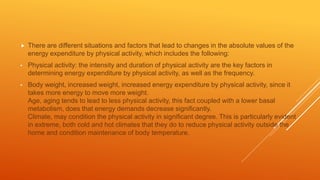
 There are different situations and factors that lead to changes in the absolute values of the
energy expenditure by physical activity, which includes the following:
• Physical activity: the intensity and duration of physical activity are the key factors in
determining energy expenditure by physical activity, as well as the frequency.
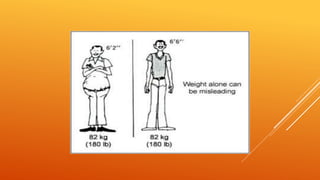
• Body weight, increased weight, increased energy expenditure by physical activity, since it
takes more energy to move more weight.
Age, aging tends to lead to less physical activity, this fact coupled with a lower basal
metabolism, does that energy demands decrease significantly.
Climate, may condition the physical activity in significant degree. This is particularly evident
in extreme, both cold and hot climates that they do to reduce physical activity outside the
home and condition maintenance of body temperature.
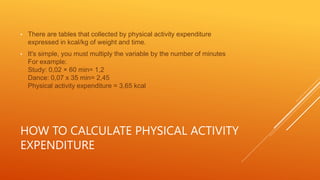
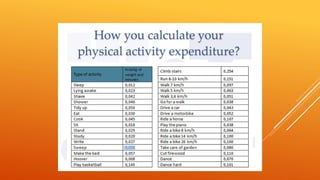
HOW TO CALCULATE PHYSICAL ACTIVITY
EXPENDITURE
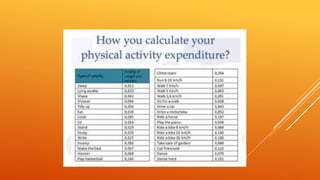
• There are tables that collected by physical activity expenditure
expressed in kcal/kg of weight and time.
• It's simple, you must multiply the variable by the number of minutes
For example:
Study: 0,02 × 60 min= 1,2
Dance: 0,07 x 35 min= 2,45
Physical activity expenditure = 3,65 kcal
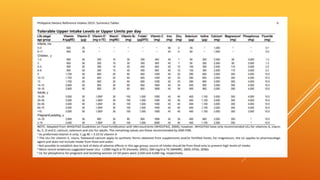
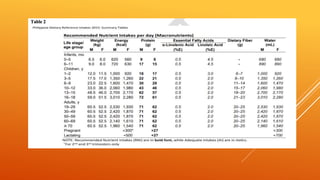
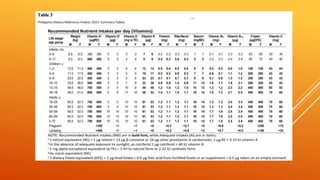
RECOMMENDED DIETARY ALLOWANCE
(RDA)
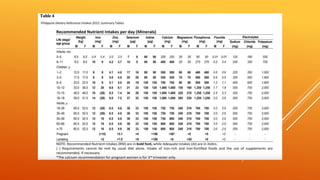
 RDA stands for Recommended Dietary Allowance, also commonly
known as Recommended Daily Allowances. It is the recommended daily
vitamins and mineral intake considered adequate for healthy people.
The RDA was last revised in 1989, and is rather outdated. Parts of it are
replaced by the Dietary Reference Intakes (DRI), the most recent dietary
guidelines by the Food and Nutrition Board of the
 Institute of Medicine, National Academy of Sciences, 1997-2001, in a
collaboration between the US and Canada.
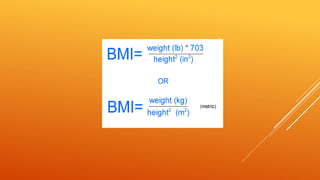
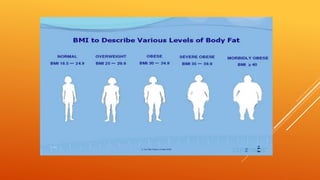
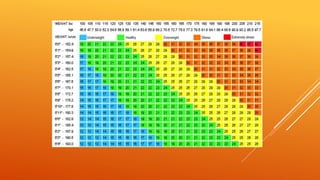
BODY MASS INDEX (BMI)
 Defined as the individual's body weight divided by the square of his or
her height
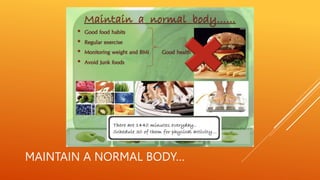
MAINTAIN A NORMAL BODY…
THANK YOU!

NCM 105 PART 2.pptx

  • 1.
    NCM 105: NUTRITIONAND DIET THERAPY Ken Ryan Dizon, MBA-HP, MN, RN
  • 2.
    OBJECTIVES: BY THE ENDOF THE MODULE, THE STUDENTS WILL:  Be able to explain the value of food  Calculate food value, BMR and BMI
  • 3.
    PHYSIOLOGIC VALUE OFFOOD FOOD compose of various compounds: 1. ORGANIC: PROTEIN, CARBOHYDRATES, LIPIDS 2. INORGANIC ELEMENTS: MINERALS, WATER 3. VITAMIN & MINERALS: Act as a catalysts which prompt the 3 major nutrients –carbohydrates , protein, fats.
  • 4.
    METABOLISM To change oralter, Chemical process of transforming foods into complex tissue elements and of transforming complex body substance into simpler ones, along with the production of heat energy Is the totality of the chemical processes in the body in which substance are change in other substance to sustain life.
  • 5.
    WHAT IS METABOLISM? -From the Greek word matabolé or “change” 3 Major Functions: 1. the conversion of the energy in food to energy available to run cellular processes 2. the conversion of food to building blocks for proteins, lipids, nucleic acids, and some carbohydrates 3. the elimination of metabolic wastes
  • 8.
    METABOLIC REACTIONS  catabolic– the breaking down of compounds (for example, of glucose to pyruvate by cellular respiration) Catabolism is mainly involved in breaking down larger molecules into smaller molecules.  anabolic – the building up (synthesis) of compounds (such as proteins, carbohydrates, lipids, and nucleic acids) Anabolism is mainly involved in building molecules from smaller molecules.
  • 11.
     Energy isthe force or power that enables the body to do its work. Energy deals mostly In the chemical energy locked in the food stuff by reason of chemical process.
  • 12.
    THE ENERGY YIELDINGFOOD FACTORS  Human body utilizes potential energy in foods for maintaining life and doing work.  The energy yielding food factors are  Carbohydrates  Proteins  Fats  In cells, enzymes degrade these by oxidation yielding energy  Carbs and fats give CO2 , water and heat while Proteins give urea along with these
  • 13.
    THE ENERGY FROMFOOD CALORIE A calorie is a unit of energy and a standard unit in measuring heat . Historically, scientists have defined "calorie" to mean a unit of energy or heat that could come from a variety of sources, whether they are fats, proteins, carbohydrates or sugars these are important sources of calories, which people need to live and function. There are two types of calorie: A small calorie (cal) is the amount of energy required to raise the temperature of 1 gram (g) of water by 1º Celsius (º C). A large calorie (kcal) is the amount of energy required to raise 1 kilogram (kg) of water by 1º C. It is also known as a kilocalorie.
  • 14.
    Below are thecalorific values of three main components of food: • 1 g of carbohydrates contains 4 cal • 1 g of protein contains 4 cal • 1 g of fat contains 9 cal The total calorie content(total energy) can be measured by means of device a BOMB CALORIMETER. 1KCAL- 1000 cal The Joules is the measure of energy in the metric system (The metric system is an internationally recognized decimalized system of measurement. It is now known as the International System of Units. 1 calorie(kilocalorie)= 4.184 joule (kilojoules)
  • 16.
    EXAMPLE 1 cup ofMilk = 170 cal 170 cal x 4.184 kjoules= 711.28 kjoules CALCULATION OF CALORIC VALUE OF FOOD The energy of one table spoon of sugar is 15 grams approximately 60 calories (15x4) EXAMPLE: ONE CUP OF MILK CONTAINS APPROXIMATELY. 12 gms carbohydrates x 4 cal/gm = 48 cal 8 gms protein x 4 cal/gm = 32 cal 10 gms fat x 9 cal/gm = 90 cal = 170 cal Calculate the percentage the kcal from Fat 90 kcal/ 170 cal =0.529 or 0.53 = 53%
  • 17.
     Humans needfood energy to cover the basal metabolic rate; the metabolic response to food; the energy cost of physical activities; and accretion of new tissue during growth and pregnancy, as well as the production of milk during lactation.  “Energy balance is achieved when input (or dietary energy intake) is equal to output (or energy expenditure), plus the energy cost of growth in childhood and pregnancy, or the energy cost to produce milk during lactation” (FAO, 2004).
  • 18.
  • 19.
    ENERGY EXPENDITURE  Thenumber of calories your body uses.  Energy requirement are the amount of food energy that should be eaten to compensate for caloric expenditure.  It is important to learn these energy requirements to have a good energy balance
  • 20.
     If youknow a little bit about your energy expenditure and approximate metabolic rate, you can give a picture of about how much you should be eating in a day. • It's important that the estimates of the energy requirements may be for long periods of time. There's great variability among these needs every day
  • 21.
    COMPONENTS OF ENERGY EXPENDITURE There are 3 main components that make up your energy expenditure: 1. Basal metabolic rate (BMR): energy needed to maintain essential physiological functions, including growth, pregnancy, lactation. 2. The thermic effect of food (TEF): Thermogenesis necessary for digestive and metabolic utilization of nutrients. 3. Physical activity: energy for muscle contraction and movements
  • 22.
    PERCENTAGE OF TOTALENERGY EXPENDITURE
  • 23.
    BASAL METABOLIC RATE(BMR)  Amount of minimum energy needed to maintain essential physiological functions and homeostasis. • It would be equivalent to the energy expenditure that is during quiet sleep. • Total energy expenditure is similar to the basal although somewhat higher (approx. 10%). • It represents 2/3 of the daily consumption of energy. It represents the 60- 70% of the energy expenditure. This closely related to lean or fat-free mass. Adipose tissue is metabolically active lo
  • 24.
    FACTORS THAT AFFECTBMR • Size and body surface, logically increases to larger size of organs. • Sex and body composition: the man is metabolically more active. The woman has approximately 10% of fat than man. Age: every 10 years the basal metabolic rate decreases 3-5% from age 20. • Pregnancy and lactation: in the last two trimesters of pregnancy, there is an increase in metabolism (200-300 kcal / day) • Other: Fever, Balance hormonal diseases, drugs, growt
  • 25.
  • 26.
    EXAMPLE  A 35years old male stunner, a model who does moderate exercises per week (3-5 days/week). His height is 1.70m (5’7”) and his weight is 74kg. BMR = (10 x 74 (kg)) + (6.25 x 170 (cm)) – (5 x 35 (y.o.)) + 5 = 740 + 1062.5 – 175 = 1727.5 + 5 BMR = 1732.5 or 1733
  • 27.
  • 29.
    THE THERMIC EFFECTON FOOD (TEF) • Amount of energy for food digestion and absorption and metabolism of nutrients. • This energy expenditure ranges around 5-10%, although it depends on the content of nutrients in the diet. • Varies from one individual to another, and in the same individual for a few moments to others.  So will vary in a hyperproteine diet, hyperlipidemia diet or rich in carbohydrates diet
  • 30.
    PHYSICAL ACTIVITY • Amountof energy for food digestion and absorption and metabolism of nutrients. • This energy expenditure ranges around 5-10%, although it depends on the content of nutrients in the diet. • Varies from one individual to another, and in the same individual for a few moments to others.  So will vary in a hyperproteine diet, nyperpiaemia det or rich in carbohydrates diet
  • 31.
     There aredifferent situations and factors that lead to changes in the absolute values of the energy expenditure by physical activity, which includes the following: • Physical activity: the intensity and duration of physical activity are the key factors in determining energy expenditure by physical activity, as well as the frequency. • Body weight, increased weight, increased energy expenditure by physical activity, since it takes more energy to move more weight. Age, aging tends to lead to less physical activity, this fact coupled with a lower basal metabolism, does that energy demands decrease significantly. Climate, may condition the physical activity in significant degree. This is particularly evident in extreme, both cold and hot climates that they do to reduce physical activity outside the home and condition maintenance of body temperature.
  • 32.
    HOW TO CALCULATEPHYSICAL ACTIVITY EXPENDITURE • There are tables that collected by physical activity expenditure expressed in kcal/kg of weight and time. • It's simple, you must multiply the variable by the number of minutes For example: Study: 0,02 × 60 min= 1,2 Dance: 0,07 x 35 min= 2,45 Physical activity expenditure = 3,65 kcal
  • 36.
    RECOMMENDED DIETARY ALLOWANCE (RDA) RDA stands for Recommended Dietary Allowance, also commonly known as Recommended Daily Allowances. It is the recommended daily vitamins and mineral intake considered adequate for healthy people. The RDA was last revised in 1989, and is rather outdated. Parts of it are replaced by the Dietary Reference Intakes (DRI), the most recent dietary guidelines by the Food and Nutrition Board of the  Institute of Medicine, National Academy of Sciences, 1997-2001, in a collaboration between the US and Canada.
  • 41.
    BODY MASS INDEX(BMI)  Defined as the individual's body weight divided by the square of his or her height
  • 45.
  • 46.

Editor's Notes

  • #6 he basic law of conservation of energy in Physics states that “energy can neither be created nor be destroyed; it can only be transformed from one form to another”.  Following this basic rule, we can explain that biologically-active chemical molecules, too, can’t be destroyed. It can only be transformed from one physical form to another. (Feynman, 1970). And the processes that endow this molecule with the capabilities of “form transformation” are studied under “Energy Metabolism”!!!
  • #7 One central coenzyme is adenosine triphosphate (ATP), the energy currency of cells. This nucleotide is used to transfer chemical energy between different chemical reactions. There is only a small amount of ATP in cells, but as it is continuously regenerated, the human body can use about its own weight in ATP per day. ATP acts as a bridge between catabolism and anabolism. Catabolism breaks down molecules, and anabolism puts them together. Catabolic reactions generate ATP, and anabolic reactions consume it. It also serves as a carrier of phosphate groups in phosphorylation reactions.
  • #9 In general, catabolism releases energy, and anabolism consumes energy.
  • #16 BOMB CALORIMETER – where calorie is measured
  • #25 Genes: Some individuals are born with a fast metabolism others with a slower metabolism. Exercise: Exercise helps raise your BMR by building extra lean tissue. Lean tissue is more metabolically demanding than fat tissue. Weight: The heavier you are, the higher your BMR.