
September 26, 2014
therapeutic diet 1
Therapeutic Diet
ASTHA K. PATEL
ASTHA K. PATEL
Therapeutic
Diets
ASTHA K. PATEL
2
What is Therapeutic diet
 Diet is as important as medicine in the treatment
of diseases.
 A modification in the diet or nutrients can cure
certain diseases.
 Nutrition during illness should be adequate to
prevent weight loss & weakness.
ASTHA K. PATEL
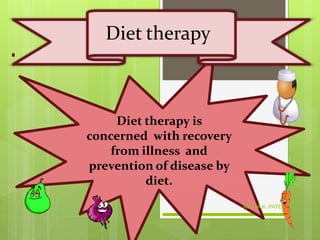
Diet therapy is
concerned with recovery
from illness and
prevention of disease by
diet.
Diet therapy
ASTHA K. PATEL
ASTHA K. PATEL
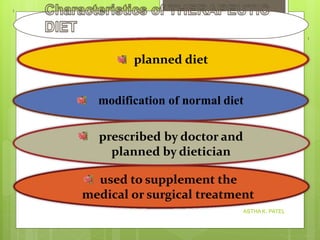
planned diet
modification of normal diet
prescribed by doctor and
planned by dietician
used to supplement the
medical or surgical treatment
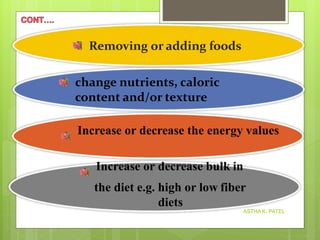
Removing or adding foods
ASTHA K. PATEL
change nutrients, caloric
content and/or texture
Increase or decrease the energy values
Increase or decrease bulk in
the diet e.g. high or low fiber
diets
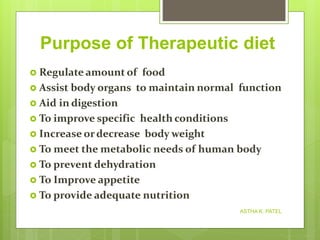
Purpose of Therapeutic diet
 Regulate amount of food
 Assist body organs to maintain normal function
 Aid in digestion
 To improve specific health conditions
 Increase ordecrease body weight
 To meet the metabolic needs of human body
 To prevent dehydration
 To Improve appetite
 To provide adequate nutrition
ASTHA K. PATEL
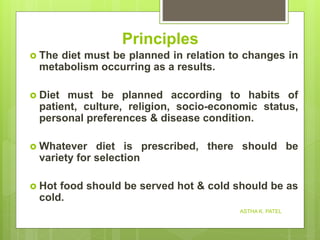
Principles
 The diet must be planned in relation to changes in
metabolism occurring as a results.
 Diet must be planned according to habits of
patient, culture, religion, socio-economic status,
personal preferences & disease condition.
 Whatever diet is prescribed, there should be
variety for selection
 Hot food should be served hot & cold should be as
cold.
ASTHA K. PATEL
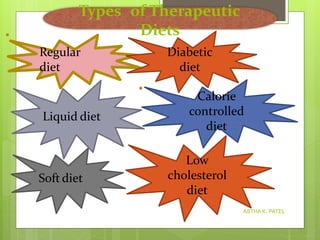
Types of Therapeutic
Diets
ASTHA K. PATEL
Regular
diet
Low
cholesterol
diet
Soft diet
Diabetic
diet
Calorie
controlled
diet
Liquid diet
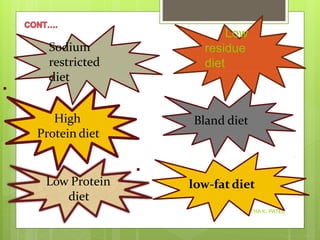
High
Protein diet
Bland diet
Low
residue
diet
ASTHA K. PATEL
Low Protein
diet
Sodium
restricted
diet
low-fat diet
Regular Diet
 Balanced diet usually used for ambulatory
patients
 At times is has a slightly reduced caloric
content
 Foods such as rich desserts, cream sauces,
salad dressings and fried foods may be
decreased or omitted
ASTHA K. PATEL
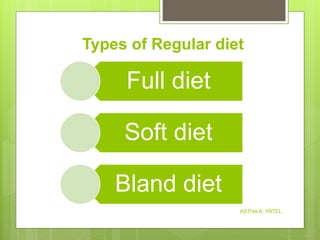
Types of Regular diet
Full diet
Soft diet
Bland diet
ASTHA K. PATEL
Full diet
 It is regular well balanced diet.
 It is vegetarian or non-vegetarian.
 Full diet is given to the patient who do not
need any special modification.
ASTHA K. PATEL
Soft diet
 It is given to provide light & easily digestible food
with minimum residue.
 It contains food, which requires little chewing &
contain no fiber.
ASTHA K. PATEL
Bland diet
 The foods are easily digestible, free from
substances, which might cause irritation
of GI tract & generally or low roughage
content, used mainly in GI conditions.
ASTHA K. PATEL
Liquid diet
 These must be used for patients who are
unable to take or tolerate solid food.
 This diet is given usually to patient with
hyperpyrexia, postoperative patients & GI
problems Patients.
ASTHA K. PATEL
Nutritionally inadequate and should only be
used for short periods of time
Uses:
• After surgery or a heart attack
• Pts with acute infections or digestive
problems
• To replace fluids lost by vomiting or
diarrhea
• Before some Xrays of digestive tract
liquid diet
ASTHA K. PATEL
Clean fluid diet/ Clear liquid diet
 These includes clear tea, black coffee,
clear soups, whey water, fruit juices etc.
 Clear liquid diet should be used only for a
short time.
ASTHA K. PATEL
Full liquid diet
 It is given as a total nutrition of the patient and
has to maintained by fluid for considerable
time.
 This is necessary when the patient is unable to
swallow solid food or if the patient is fed by
Nasogastric tube/Ryles tube.
ASTHA K. PATEL
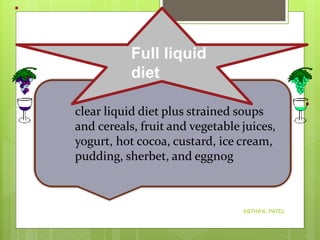
clear liquid diet plus strained soups
and cereals, fruit and vegetable juices,
yogurt, hot cocoa, custard, ice cream,
pudding, sherbet, and eggnog
Full liquid
diet
ASTHA K. PATEL
Low residue diet
 Used for pts with digestive and rectal diseases
such as colitis or diarrhea
 Eliminates or limits foods high in bulk or fiber
such as raw fruits and veggies, whole grains and
cereals, nuts, seeds, beans and peas, coconut,
and fried foods
ASTHA K. PATEL
Calorie controlled diet
 Low-Calorie Diet
 High-Calorie Diet
ASTHA K. PATEL
Low calorie Diet
 The total calorie intake is reduced to less than the
body’s requirements.
 Aim – to slow steady loss of weight over a period
of several weeks or even a month.
 This diet is advisable for the obesity patients.
 Use salads, fruits, boiled vegetables.
 The patient must have plenty of bulk in diet by
using high fibre foods.
ASTHA K. PATEL
Avoid or limit high calories foods such as:
Ghee,Butter, cream, sugar, whole milk, cream
soups or gravies, sweet soft drinks, alcoholic
beverages, salad dressings, fatty meats, candy
and rich desserts
Low-Calorie Diet
ASTHA K. PATEL
High Calorie diet
 These diet is Used for patients who are underweight, or
who have anorexia nervosa, hyperthyroidism, or cancer
 Extra proteins and CHO are included
 Avoid high-bulk foods such as green salads,
watermelon and fibrous fruits
 Avoid high-fat foods such as fried foods, rich pastries,
and cheese cake because they digest slowly and spoil
appetite
ASTHA K. PATEL
Protein Controlled diet
 High Protein diet
 Low protein diet
ASTHA K. PATEL
High Protein Diet
 The protein intake should be average from 75-
100 g/day for adults.
 In Protein energy malnutrition cases easily
digestible & high nutritive value proteins (milk
protein) should be given.
ASTHA K. PATEL
ASTHA K. PATEL
• High Protein diet is given to
• Cchildren and Aadolescents who need
additional growth
• Pregnant or lactating women,
• before and/or after surgery,
• Burns
• TB
Regular diet with added protein rich foods such as
meats, fish, milk, cheese, and eggs, dal, soyabeans,
ground nuts.
Low protein diet
 Low protein diet is advised in kidney diseases such
as Nephritis, uremia.
 In these disease protein is avoided or given in
moderate level.
 This type of diet is given to rest to kidneys because
excessive protein intake act as an additional load to
the kidneys.
 Food stuffs like milks, eggs, meat, nuts, beans are
avoided.
ASTHA K. PATEL
Diabetic diet
 In diabetes, the metabolism of CHO, fat & protein
are affected.
 Purpose – to keep patient in good health to keep
blood sugar level within normal level & to keep
urine free from sugar.
 The diet should be balanced. But restriction of CHO
like rice, biscuits, sugar, jams, sweets, honey,
carrots & sweet potatoes.
ASTHA K. PATEL
 The patient should take eggs, milk, raw
salads of all types of green leafy
vegetables.
 The total calorie required 20-25% should
be from protein & 40% from CHO & 40%
from fats.
ASTHA K. PATEL
Low cholesterol diet
 Restricts foods containing cholesterol
 Used for patients with atherosclerosis and
heart disease
 Limit foods high in saturated fats such as
beef, liver, pork, lamb, egg yolk, cream,
cheese, natural cheeses, shellfish, whole
milk, and coconut and palm oil products
ASTHA K. PATEL
Low fat diet / Fat restricted diet
 Low fat diet is restricted from the diet patient with liver
disease & gall bladder disease, obesity & heart
disease.
 CHO in diet should be increased to supply the liver
with glycogen to prevent ketosis.
 No fired foods – Ghee, butter, oil, is allowed in diet.
 Only Roti, rice, bread, fruits, dal, vegetables should be
taken.
ASTHA K. PATEL
Sodium restricted diet/ Low salt diet
 Sodium is totally or partially restricted.
 The restriction of sodium is depend on severity of
conditions.
 The patient with heart disease, kidney disease are
given salt restricted diet or low salt diet.
 The following food should be avoided – salt,
baking powder, papads, canned foods, cheese,
pickles, salted chips & biscuits.
ASTHA K. PATEL
Iron rich diet
 Patient with Anaemia required Iron rich diet.
 The diet should provide necessary nutrients for
the formation of new RBC or hemoglobin.
 Food recommended – liver, meat, eggs,spinach,
drumsticks, ragi, jaggery, dates, beet etc.
ASTHA K. PATEL
Types of diet used in hospitals
 Clear fluid diet
 Full liquid diet
 Soft diet
 Normal diet
ASTHA K. PATEL
Clear fluid diet
 Whenever an acute illness or surgery produces a
marked intolerance for food as may be evident by
nausea, vomiting, anorexia, diarrhea, it is
advisable to restrict the intake of food.
 Clear fluid diet is suggested when there is acute
infection, in acute inflammatory conditions of
intestinal tract, operation of rectum or colon.
 This diet is also given to relive the thirst, to
supply water to tissues & aid in removal of gas.
ASTHA K. PATEL
 This diet is made up of a clear liquids.
 It is deficient in protein, calories, vitamins
& minerals.
 It should not be continued for more than
24-48 hours.
 Diet is given at 1-2 hour interval.
ASTHA K. PATEL
Use of Clear liquid diet
 Preoperative period
 Prior to colonoscopic examination
 Post-operative period ( Abdominal surgery)
 Acute Gastroenteritis
 In temporary food intolerance.
ASTHA K. PATEL
Full liquid diet
 Full liquid diet is bridges the gap between the clear
fluid & soft diet.
 It is used following operations in acute gastritis,
infection & diarrhea.
 This diet is entirely adequate & may be used over
long period of time with out fear of deficiencies.
 Diet is given every 2-4 hour interval.
ASTHA K. PATEL
Use of Full liquid diet
 Post-operative period
 Acute gastritis
 Infections
 Oral surgery
 Plastic surgery of neck or face area
 Chewing & swallowing dysfunctions
 Intolerance to solid foods
ASTHA K. PATEL
Soft diet
 It may be used in acute infections,
following surgery & for patient who are
unable to chew.
 The soft diet is made up of simple, easily
digestible food & contain no more fibre.
 Patient with dental problems are given
mechanically soft diet.
ASTHA K. PATEL
Use of soft diet
 While processing to full liquid diet to general
diet
 Post-operative period
 Diarrhea
 Infections
ASTHA K. PATEL
Mechanical soft diet
 Many people require soft diet simply because
they have no teeth & such diet is known as
mechanical diet or dental soft diet.
ASTHA K. PATEL
Modification to normal diet
 Vegetables may be chopped before
cooking
 Hard raw vegetables & fruits are avoided.
 Tough skin & seeds are removed
 Nuts & dried fruits may be used in
powdered forms.
ASTHA K. PATEL
Normal diet
 Normal diet is used for ambulatory & bed
patients whose condition do not
necessitate a special diet as one of the
routine diet.
ASTHA K. PATEL
• High energy and high protein
Energy and nutrient dense foods
• Pick foods from the menu which can be
fortified
• Use of supplements
Recipe fortification
• Examine what a resident like to eat and
encourage those types of foods
Therapeutic diet for malnutrition
ASTHA K. PATEL
39
Dietary guidelines
ASTHA K. PATEL
• Also eat a variety of food. Maintain
ideal weight.
• Avoid excess fat (total and Unsaturated)
and cholesterol.
• Eat foods with adequate dietary fiber.
• Avoid excess sugar.
• Avoid excess salt.
ASTHA K. PATEL