Nutritional
Requirements
Nutrient: are theraw materials,
which provide the essential matter
and energy for life.
Nutrition: refers to all the processes
by which living organisms obtain
and use these nutrients.
Contents:
Contents:
• The Nutrient and Nutrition
• Classes of Nutrients
• Functions and source of all
nutrients.
• Food as Fuel: Calories Count
• Healthy weight/ Body Mass
Index(BMI)
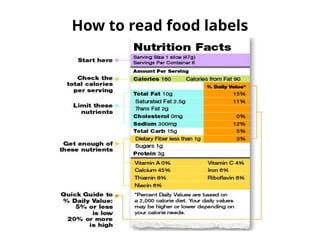
• Food label
• Malnutrition
• Plant nutrition
3.
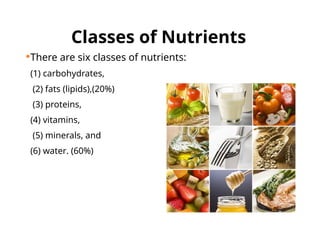
Classes of Nutrients
Thereare six classes of nutrients:
(1) carbohydrates,
(2) fats (lipids),(20%)
(3) proteins,
(4) vitamins,
(5) minerals, and
(6) water. (60%)
4.
Energy Nutrients: Carbohydrates,Lipids and
Proteins
• Used by body as source of energy.
•All these three nutrients are Carbon containing
compounds.
•Proteins are not preferred energy source. They are
building blocks to make our body.
•Body does not get energy from vitamins,
minerals, water.
5.
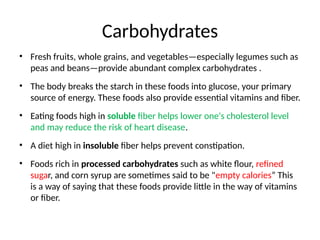
Carbohydrates
• Fresh fruits,whole grains, and vegetables—especially legumes such as
peas and beans—provide abundant complex carbohydrates .
• The body breaks the starch in these foods into glucose, your primary
source of energy. These foods also provide essential vitamins and fiber.
• Eating foods high in soluble fiber helps lower one's cholesterol level
and may reduce the risk of heart disease.
• A diet high in insoluble fiber helps prevent constipation.
• Foods rich in processed carbohydrates such as white flour, refined
sugar, and corn syrup are sometimes said to be "empty calories” This
is a way of saying that these foods provide little in the way of vitamins
or fiber.
6.
Lipids
• Body useslipids to build cell membranes, as energy stores, and
as a reservoir for fat-soluble vitamins.
• Linoleic acid and alpha-linolenic acid are essential fatty acids,
meaning the human body needs them but cannot make them.
• Mainly 2 types: saturated and unsaturated fatty acids.
• Dairy products and meats are rich in saturated fats and
cholesterol. Overindulging in these foods increases one's risk for
heart disease, stroke, and some cancers.
• Trans fatty acids, or trans fats, are manufactured from vegetable
oils.
– Worse for the heart than saturated fats.
7.
Proteins
Amino acids arebuilding blocks of proteins.
Your cells can make some amino acids but
you must get essential amino acids from food.
Most proteins in meat are "complete,"
meaning their amino acid ratios match a
human's nutritional needs.
By contrast, most plant proteins are
"incomplete," meaning they lack one or more
amino acids essential for the human diet.
8.
Vitamins
Vitamins are organicmolecules required by
the body in small amounts for metabolism, to
protect health, and for proper growth.
Many functions in body though required in
small amount.
Required in small amount. But there are 13
essential vitamins for human. Major ( A, B, C,
D, E and K)
They are differentiated according to their
absorbency in fat/water.
9.
Vitamins
1. Fat solubleVitamins: A, D, E and K
Taken with fat containing foods.
They can remain stored in body fats.
Not necessary to consume everyday.
2. Water soluble Vitamins: B and C.
Cannot be stored.
Need to take frequently/Everyday.
10.
Minerals
Minerals are inorganicsubstances and are
transported around the body as ions dissolved in
the blood and other body fluids.
Different minerals perform different role in human
body.
Example:
•Calcium: Make up different body structure, bones, teeth
etc. and help in blood clot.
•Sodium: maintains fluid balance.
•Magnesium: Helps in energy release from energy
nutrients.
11.
Water
• Water providesthe medium in which all the body’s reactions
take place.
• It aids in the digestion and absorption of food.
• It is a medium of transport, through arteries and veins, within
an organism.
• It even lubricates your joints and cushions organs such as the
brain and spinal cord.
• It helps in the excretion of harmful by-products of metabolic
processes.
• It aids in the regulation of heat loss.
• Key players when bonds are broken (by hydrolysis) or formed
(by dehydration synthesis) in these molecules.
12.
Food as Fuel:Calories Count
Food energy is usually measured in kilocalories (kcal), also called Calories
(Cal).
A large apple contains about 70 Cal worth of energy-producing compounds;
and jogging 1.6 km (1 mile) burns about 100 Cal of stored energy.
The food energy in a slice of bread could bring a liter of water to a boil, and
a pound of body fat has enough energy to bring 52 liters (13 gal) to a boil!
Each person has a minimum daily energy requirement that varies with age,
sex, body size, activity level, and other factors.
In general, a normally active female college student needs around
1,800-2,000 Cal a day to fuel her total metabolic needs;
a male college student needs about 2,200-2,500 Cal.
Carbohydrate and protein each provide about 4 Cal/g, while fat provides
more than twice as much, or 9 Cal/g.
A person would have to run for about 30 minutes, for example, to burn off
the calories in a cheeseburger.
13.
Calorie value offood :
a) Carbohydrate - 4.4 cal/g.
b) Fat - 9.3 cal/g.
c) Protein - 4.0 cal/g.
•A person would have to run for about 30
minutes, for example, to burn off the
calories in a cheeseburger.
Food as Fuel: Calories Count
14.
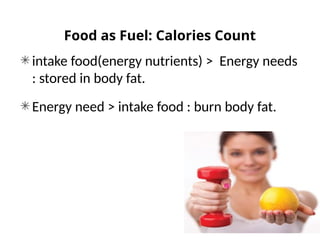
Food as Fuel:Calories Count
intake food(energy nutrients) > Energy needs
: stored in body fat.
Energy need > intake food : burn body fat.
15.
Balanced Diet
Balanced dietis a diet containing all the proximate
principles of food in adequate and proportionate
amounts; including essential amino acids and fatty
acids for normal growth, activity, reproduction.
•Adequate : Means the amount that supply the
exact calories.
•Proportionate amount : Means presence of
appropriate proportion of food stuffs.
16.
Criteria of abalanced diet
• Proximate principles of food in adequate and
proportionate amount.
• One third to half of protein
• Fat should come from animal sources.
• Sufficient fruits and vegetables.
• Easily digestible , absorbable and assailable food.
• Easily available food.
• Certain amount of cellulose to promote peristalsis.
17.
Factors considered toformulate a
balanced diet
• Age
• Sex, height, weight
• Quality and quantity of food.
• Socio-economical value
• Seasonal factor
• Geographical
• Allergic condition
18.
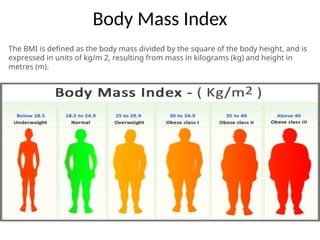
Body Mass Index
TheBMI is defined as the body mass divided by the square of the body height, and is
expressed in units of kg/m 2, resulting from mass in kilograms (kg) and height in
metres (m).
19.
Body Mass Index(BMI)
The body mass index (BMI) or Quetelet index
is a value derived from the mass (weight) and
height of an individual.
The BMI is defined as the body mass divided
by the square of the body height, and is
universally expressed in units of kg/m2
,
resulting from mass in Kilograms and height in
meters.
Body Mass Index(BMI)
count
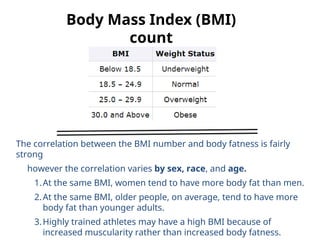
The correlation between the BMI number and body fatness is fairly
strong
however the correlation varies by sex, race, and age.
1.At the same BMI, women tend to have more body fat than men.
2.At the same BMI, older people, on average, tend to have more
body fat than younger adults.
3.Highly trained athletes may have a high BMI because of
increased muscularity rather than increased body fatness.
22.
Body Mass Index(BMI)count
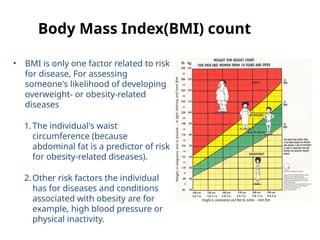
• BMI is only one factor related to risk
for disease, For assessing
someone's likelihood of developing
overweight- or obesity-related
diseases
1.The individual's waist
circumference (because
abdominal fat is a predictor of risk
for obesity-related diseases).
2.Other risk factors the individual
has for diseases and conditions
associated with obesity are for
example, high blood pressure or
physical inactivity.
23.
How To CalculateHow Many Kilocalories You
Need
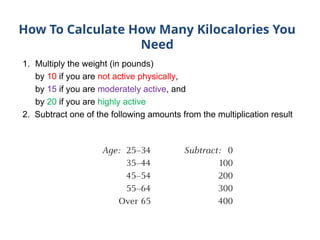
1. Multiply the weight (in pounds)
by 10 if you are not active physically,
by 15 if you are moderately active, and
by 20 if you are highly active
2. Subtract one of the following amounts from the multiplication result
24.
How To CalculateHow Many
Kilocalories You Need
For example, if you are 25 years old, are highly
active, and weigh 120 pounds, you will require
120 X 20 = 2,400 kilocalories daily to maintain
weight. If you want to gain weight you will
require more; to lose, you will require less. The
amount is only a rough estimate.
Other factors, such as height, must be
considered. A person 5 feet, 2 inches tall and
active does not require as much energy as an
active 6-footer whose body weight is the same.
Malnutrition
Malnutrition refers toinsufficient, excessive, or imbalanced
consumption of nutrients by an organism.
In developed countries, the diseases of malnutrition are most
often associated with nutritional imbalances or excessive
consumption.
Although there are more organisms in the world who are
malnourished due to insufficient consumption, increasingly more
organisms suffer from excessive over-nutrition; a problem caused by
an over abundance of sustenance coupled with the instinctual desire
(by animals in particular) to consume all that it can.
28.
1) Define nutrientsand nutrition.
2. What are the different classes of nutrients?
3. What is the role of carbohydrate
4. How we can get energy from lipids
5. How calories are counted in food
6. Define balanced diet. What are the criteria of a balanced died?
7. What is BMI? What is its significance?
8. How it can calculated (4
9. How to calculate how many kilocalories you need
Editor's Notes
#3 Define nutrients and nutrition. What are the different classes of nutrients?
#7 Pulses contain approximately 21–25% protein; however have limiting amount of essential amino acids such as methionine, tryptophan and cystine (Tiwari and Singh 2012 )
What is the role of protein?
#16 Proximate: নিকটবর্তী
What are the criteria of a balanced diet?
#18 You can calculate BMI yourself with these steps:
Multiply your weight in pounds by 703.
Divide that answer by your height in inches (there are 12 inches in 1 foot).
Divide that answer by your height in inches again.
For example, a person who weighs 180 lbs. and is 5 feet and 5 inches tall (65 inches total) would calculate their BMI in the following way:
180 x 703 = 126,540.
126,540 / 65 = 1,946.769.
1,946.769 / 65 = 29.95.
Their BMI would be 29.9.
#19 What is BMI? What is its significance? How it can calculated (4)
#23 For example, if you are 25 years old, are highly active, and weigh 120 pounds, you will require 120 X 20 = 2,400 kilocalories daily to maintain weight. If you want to gain weight you will require more; to lose, you will require less. The amount is only a rough estimate.
Other factors, such as height, must be considered. A person 5 feet, 2 inches tall and active does not require as much energy as an active 6-footer whose body weight is the same.
#24 How to calculate how many kilocalories you need?







![Hypothalamus short notes on location, function and disorders by Dr. Neha [PT]...](https://cdn.slidesharecdn.com/ss_thumbnails/hypothalamusbydr-260124142231-2b48143d-thumbnail.jpg?width=640&height=640&fit=bounds)


