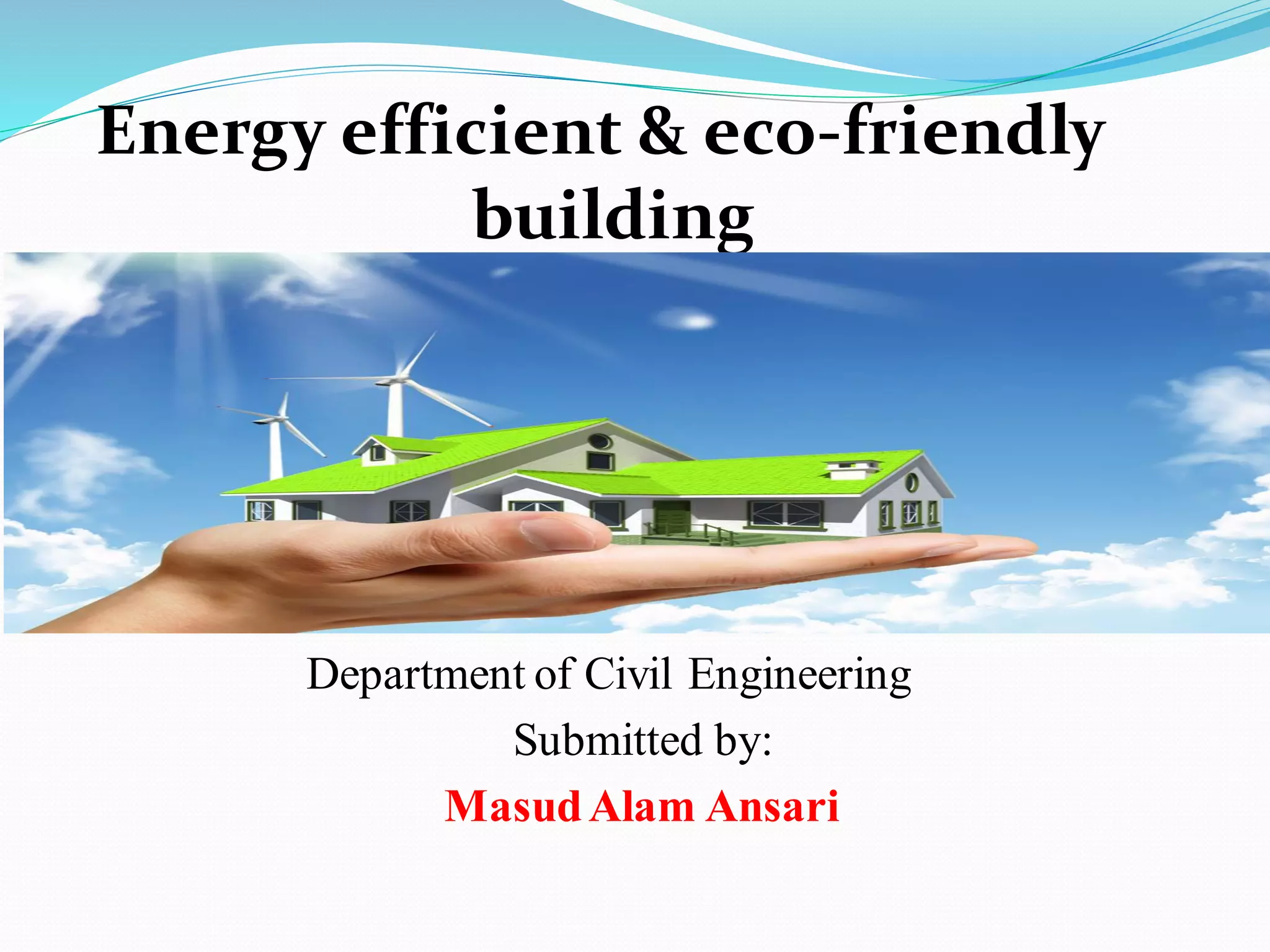
Energy efficient & eco-friendly
building
Department of Civil Engineering
Submitted by:
MasudAlam Ansari
Table of Content
• Introduction
• Building Materials
• Rain water harvesting
• Vermicomposting
• Solar Energy
• Drip Irrigation
• Conclusion
Current scenario
• Sustainable development has become a global issue.
• Global climate change has become an increasingly serious
concern for the future
• Concern over the impacts of built environment on natural
environment, economy, health, and productivity
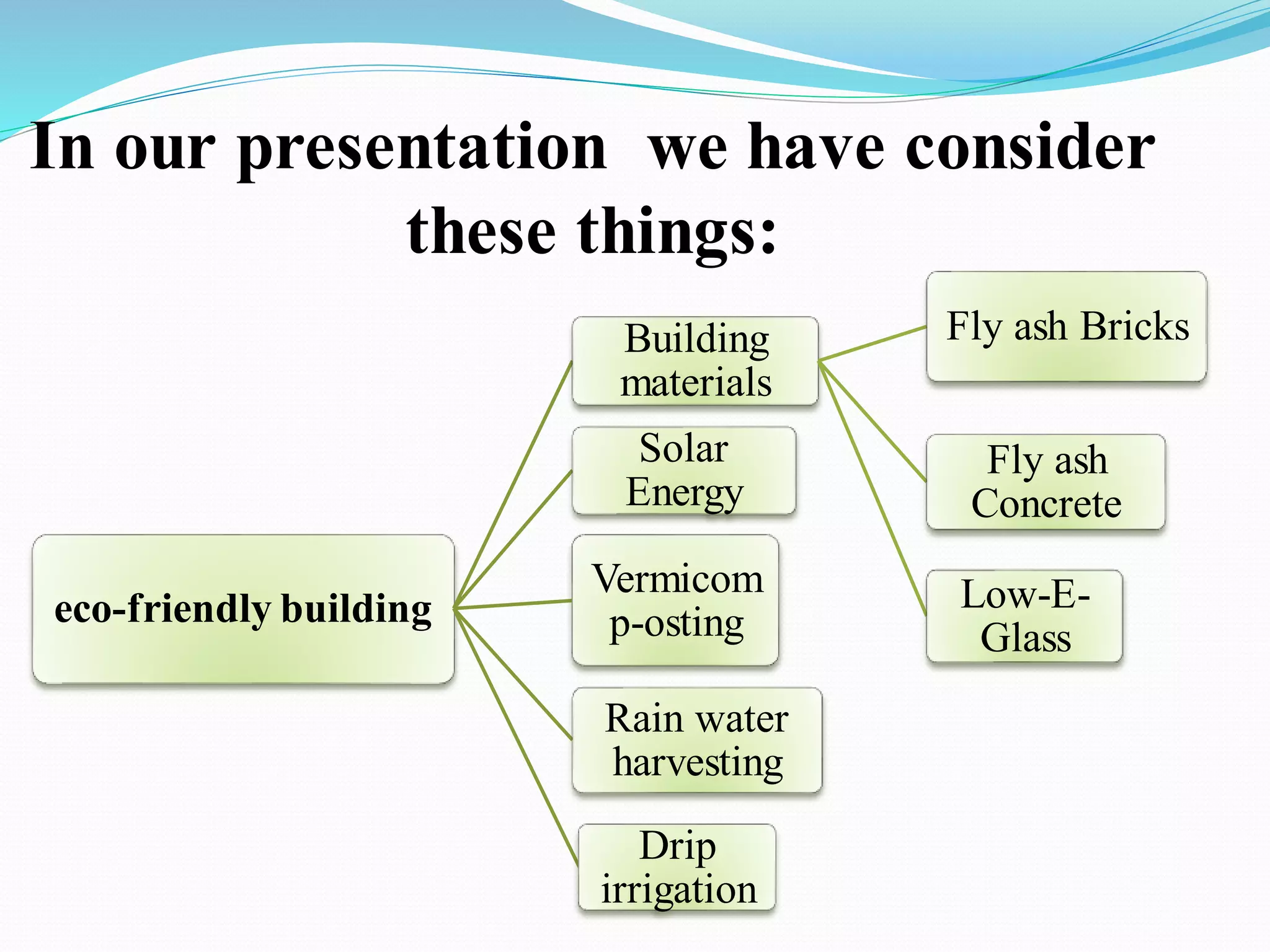
In our presentation we have consider
these things:
eco-friendly building
Building
materials
Fly ash Bricks
Fly ash
Concrete
Low-E-
Glass
Solar
Energy
Vermicom
p-osting
Rain water
harvesting
Drip
irrigation
Building materials
The building material are responsible for about 20% of
CO2 gases emitted by a building during its life time .
we have considered these three materials:
• Fly ash bricks
• Fly ash concrete
• Low-E-Glass
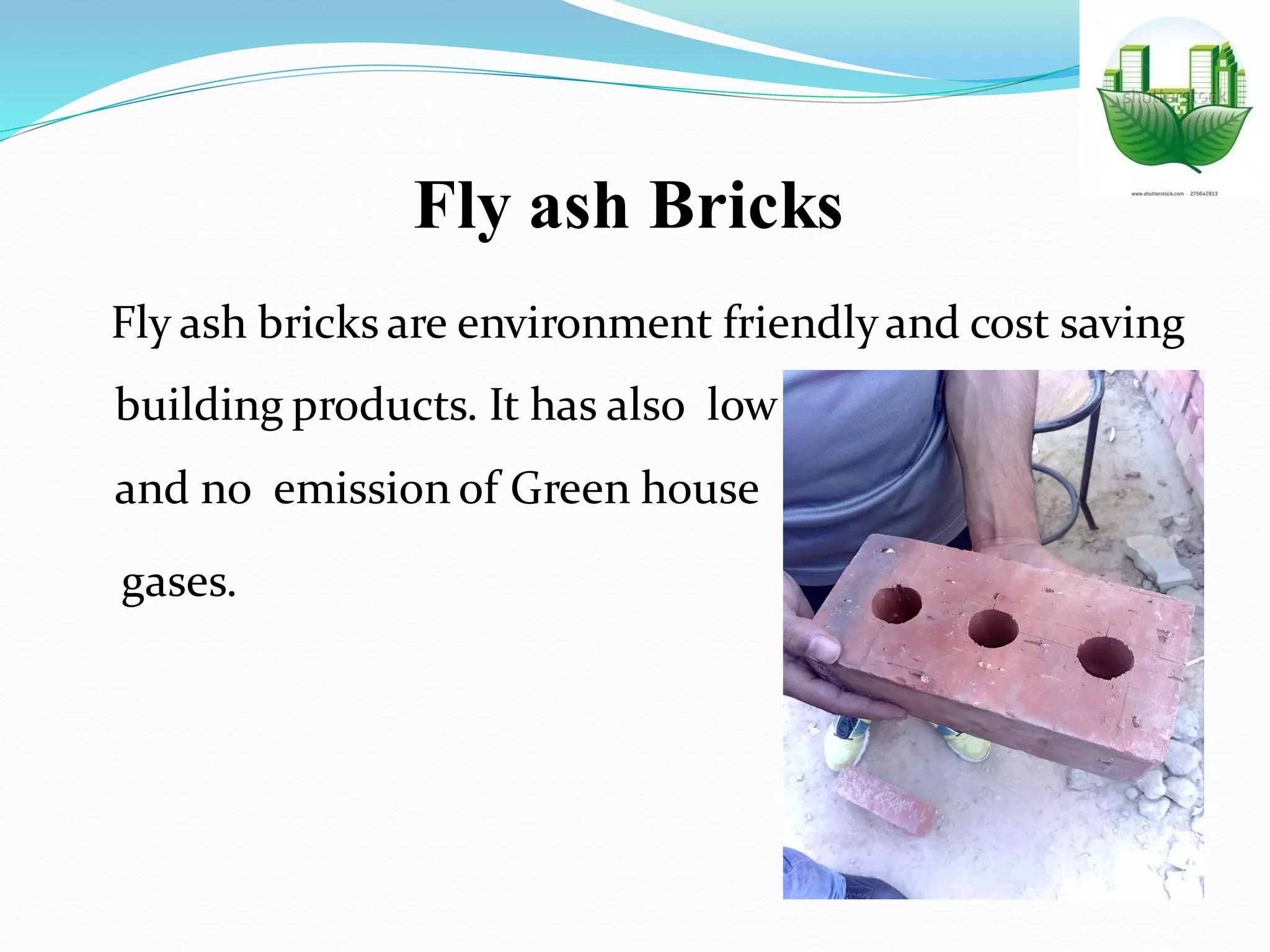
Fly ash Bricks
Fly ash bricks are environment friendlyand cost saving
building products. It has also low energy consumption
and no emission of Green house
gases.
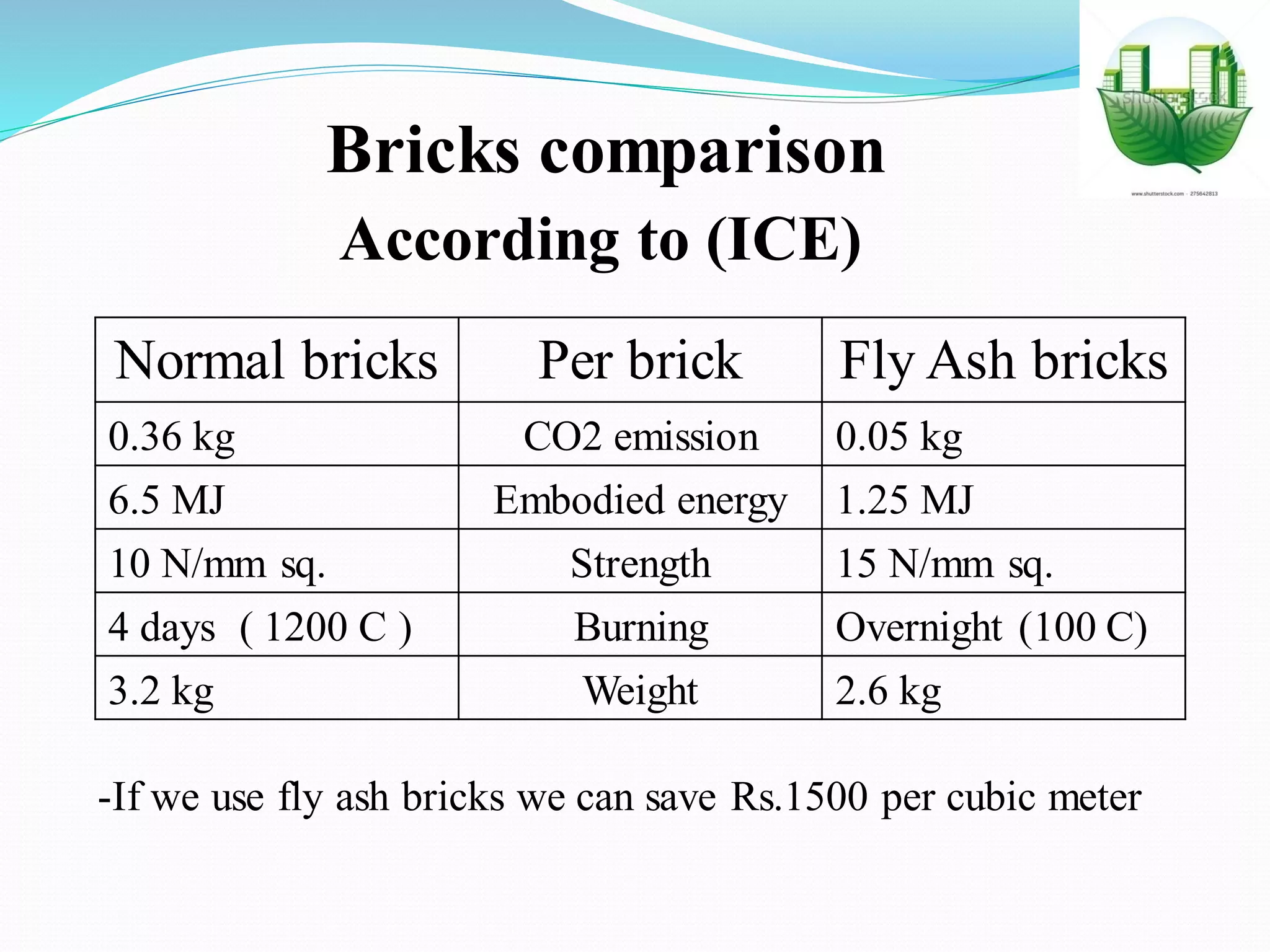
Bricks comparison
According to (ICE)
Normal bricks Per brick Fly Ash bricks
0.36 kg CO2 emission 0.05 kg
6.5 MJ Embodied energy 1.25 MJ
10 N/mm sq. Strength 15 N/mm sq.
4 days ( 1200 C ) Burning Overnight (100 C)
3.2 kg Weight 2.6 kg
-If we use fly ash bricks we can save Rs.1500 per cubic meter
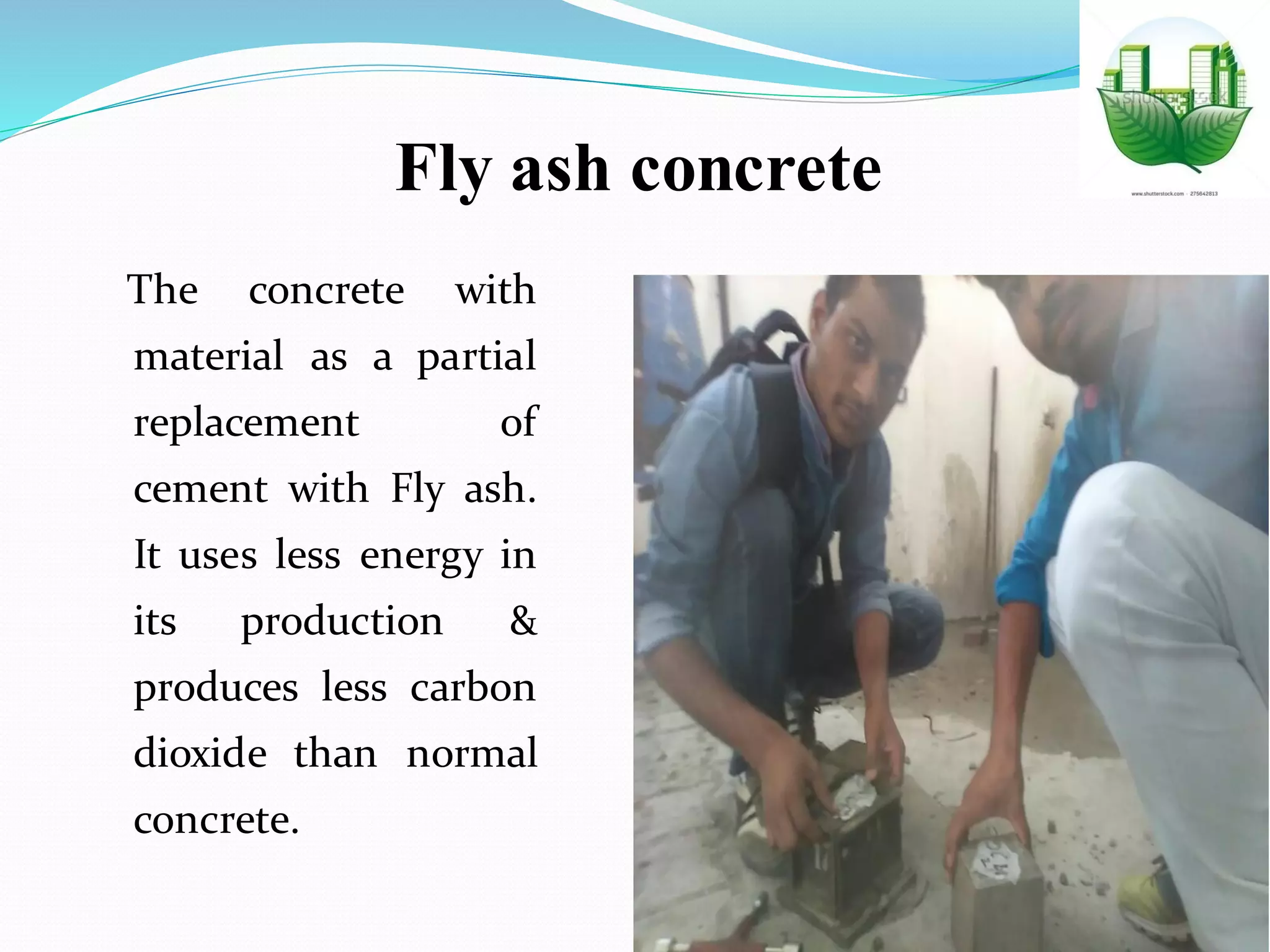
Fly ash concrete
The concrete with
material as a partial
replacement of
cement with Fly ash.
It uses less energy in
its production &
produces less carbon
dioxide than normal
concrete.
Cost analysis of Normal concrete &
Fly ash concrete .
M20
Normal concrete Fly ash concrete
1m3 = Rs. 6000/ m3
[Source : ACC RMC plant
in front of lpu gate ]
1m3 = Rs. 6000
= 6000- (7 * 100) + (0.18
*100)
=Rs. 5318 / m3
[Note : if we replace 25% cement
with Fly ash ]
Save Rs. 6000-5318=682 per m3
• Less emission of CO2
• Reduction in shrink and creep.
• Heat of hydration is lower than normal conc.
• Better workability.
Advantage of Fly ash concrete .
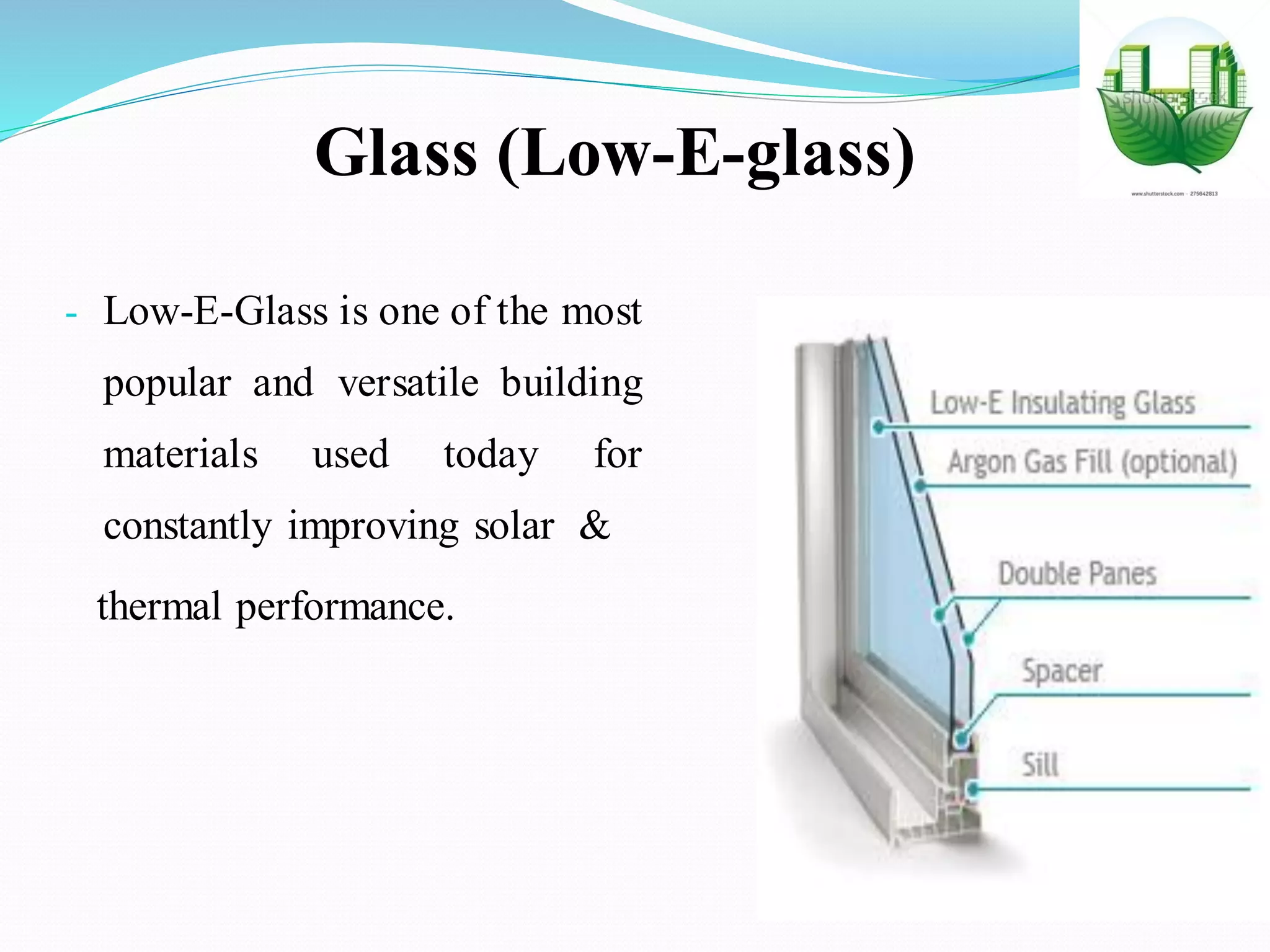
Glass (Low-E-glass)
- Low-E-Glass is one of the most
popular and versatile building
materials used today for
constantly improving solar &
thermal performance.
one of the panes of glass is coated with Zinc, copper,
silver etc.
Advantages of coating
On hot summer days On cold winter nights
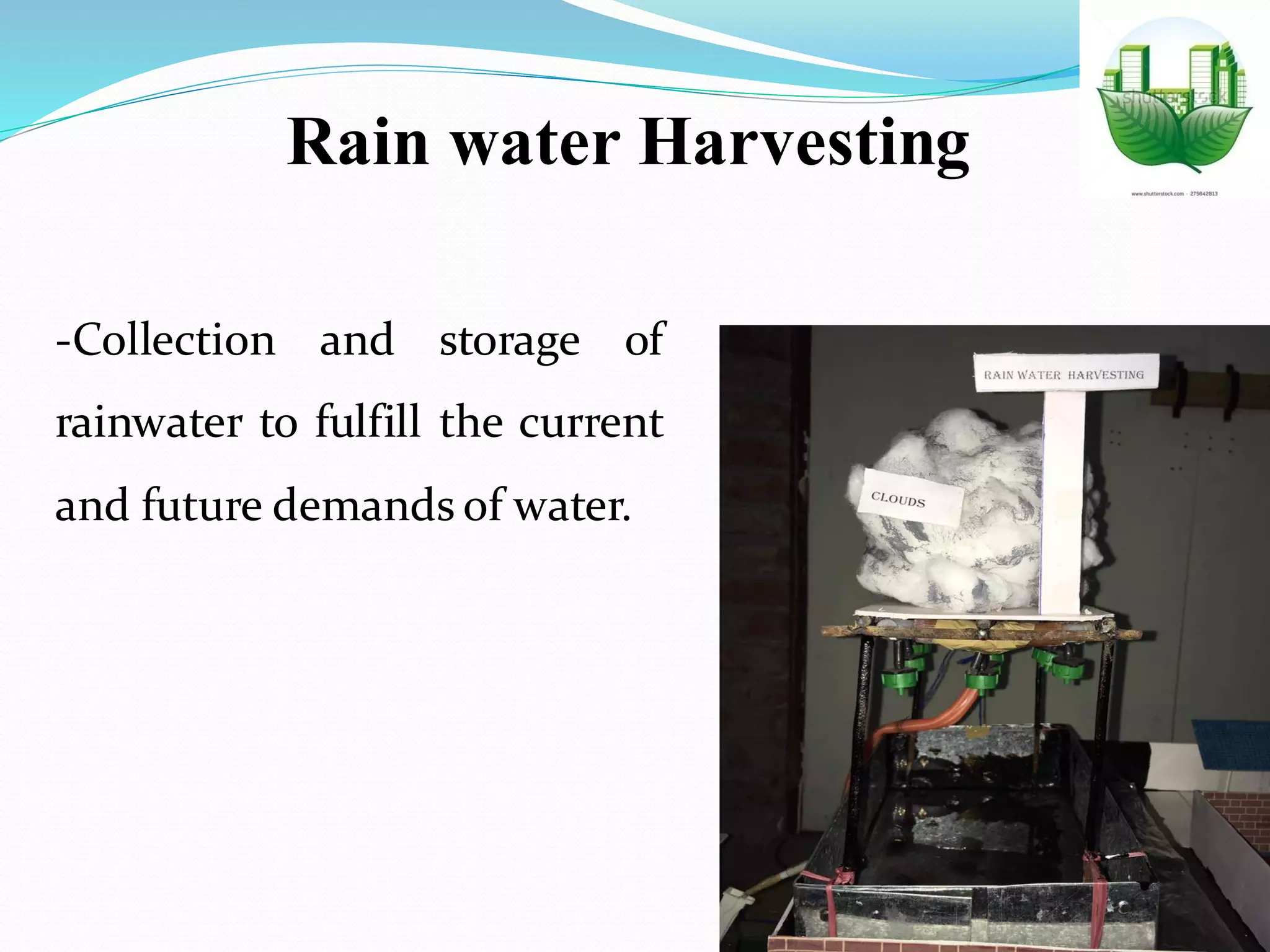
Rain water Harvesting
-Collection and storage of
rainwater to fulfill the current
and future demands of water.
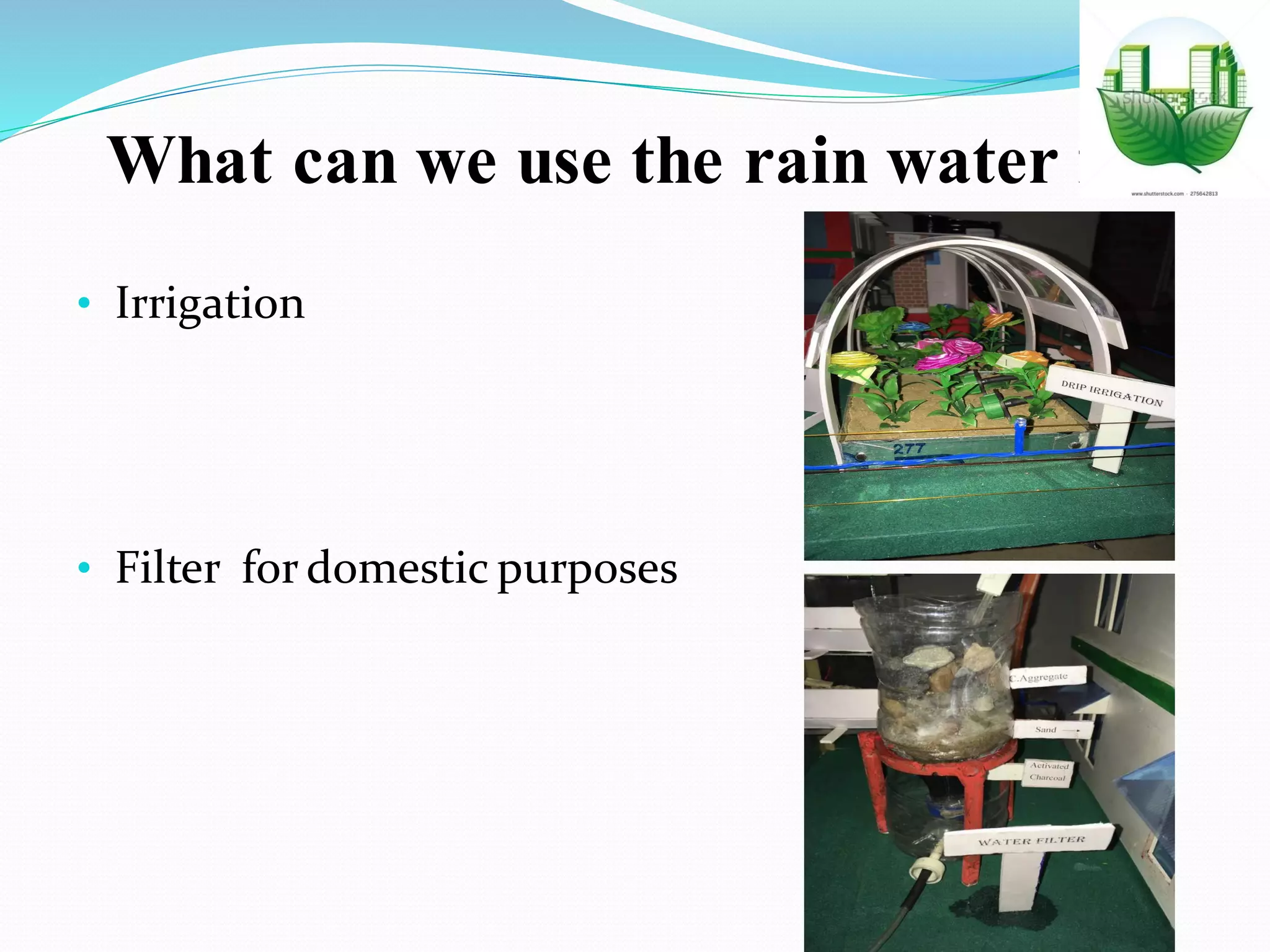
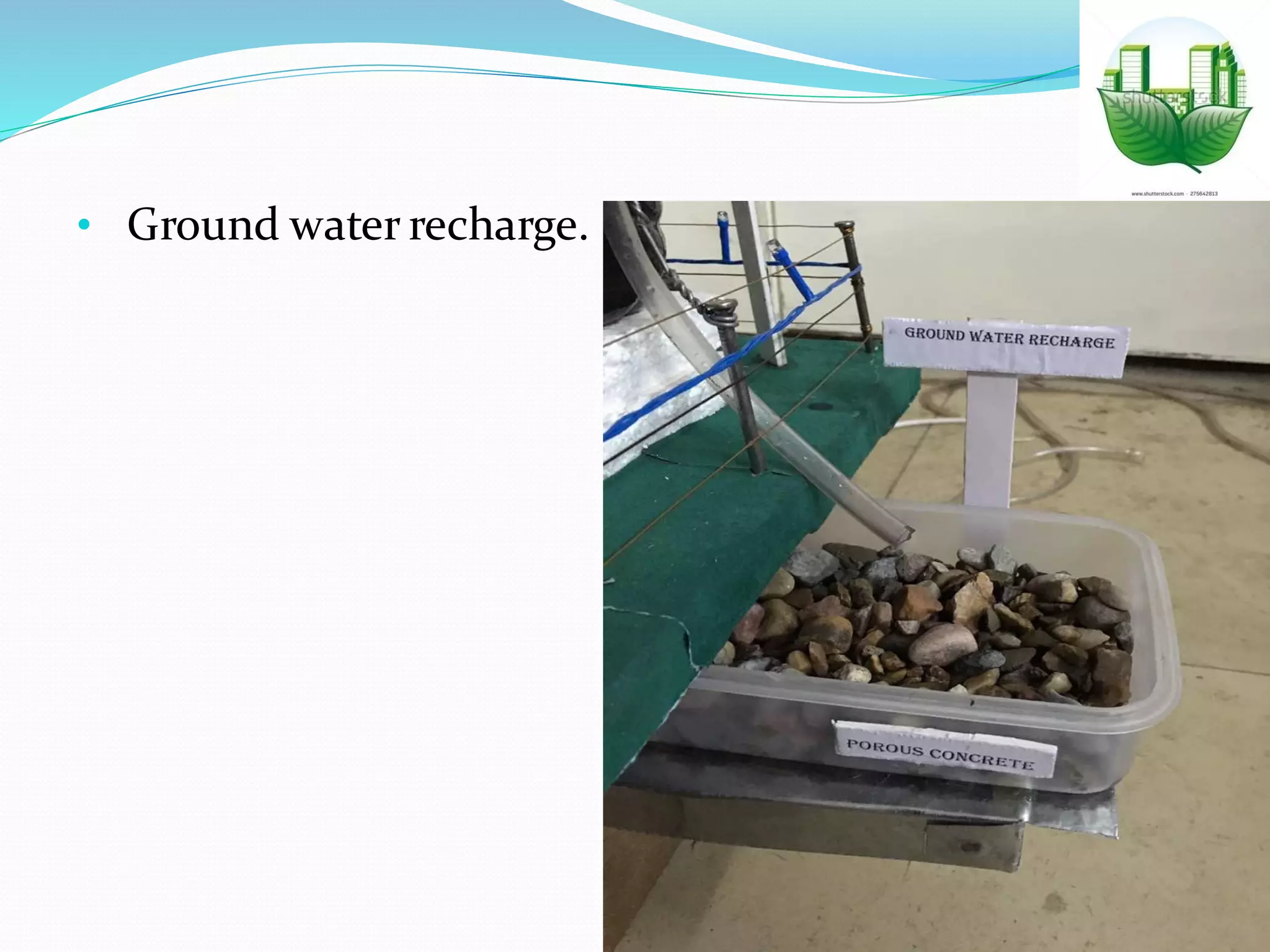
What can we use the rain water for?
• Irrigation
• Filter for domestic purposes
• Ground water recharge.
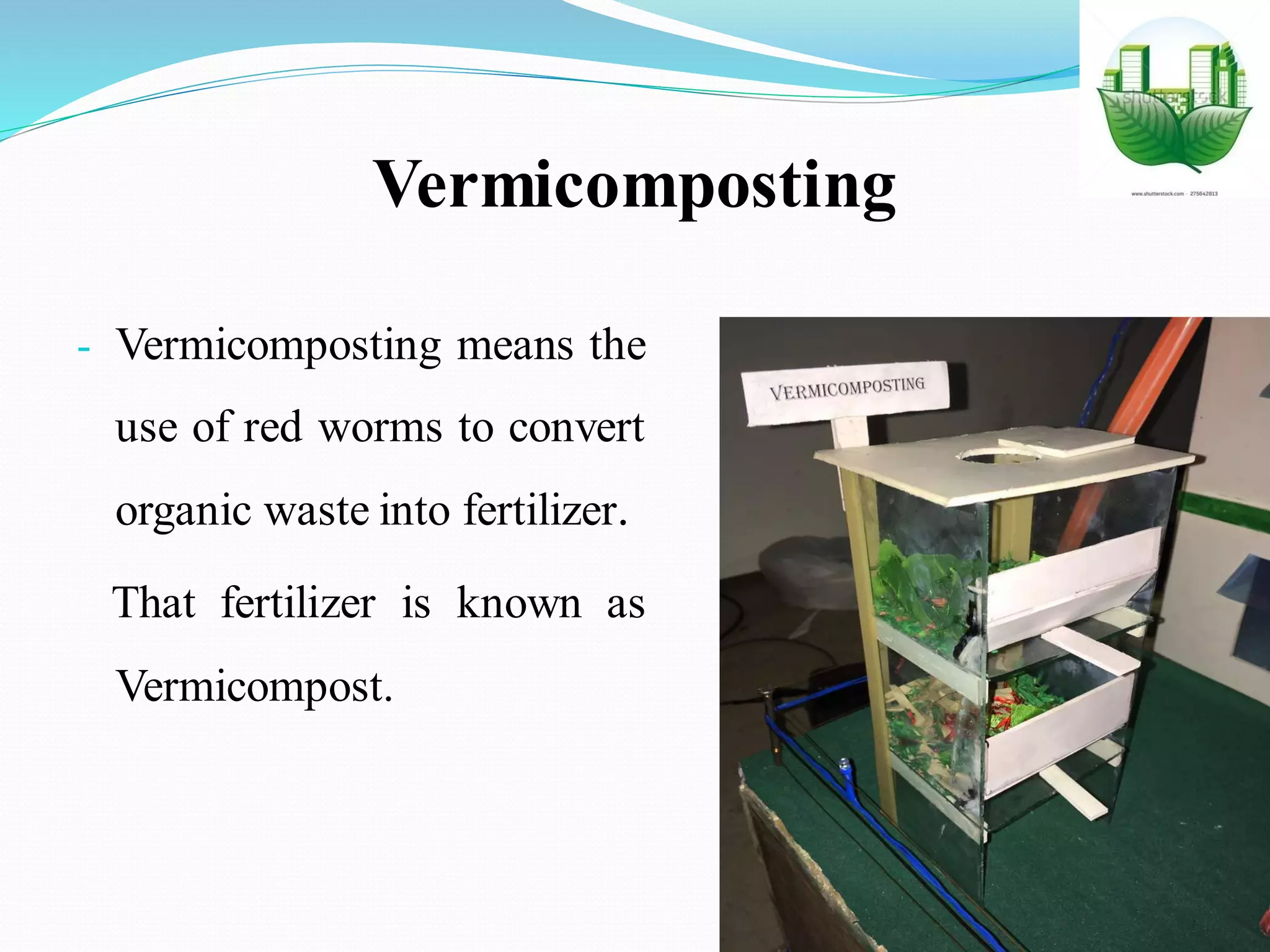
Vermicomposting
- Vermicomposting means the
use of red worms to convert
organic waste into fertilizer.
That fertilizer is known as
Vermicompost.
Vermicompost
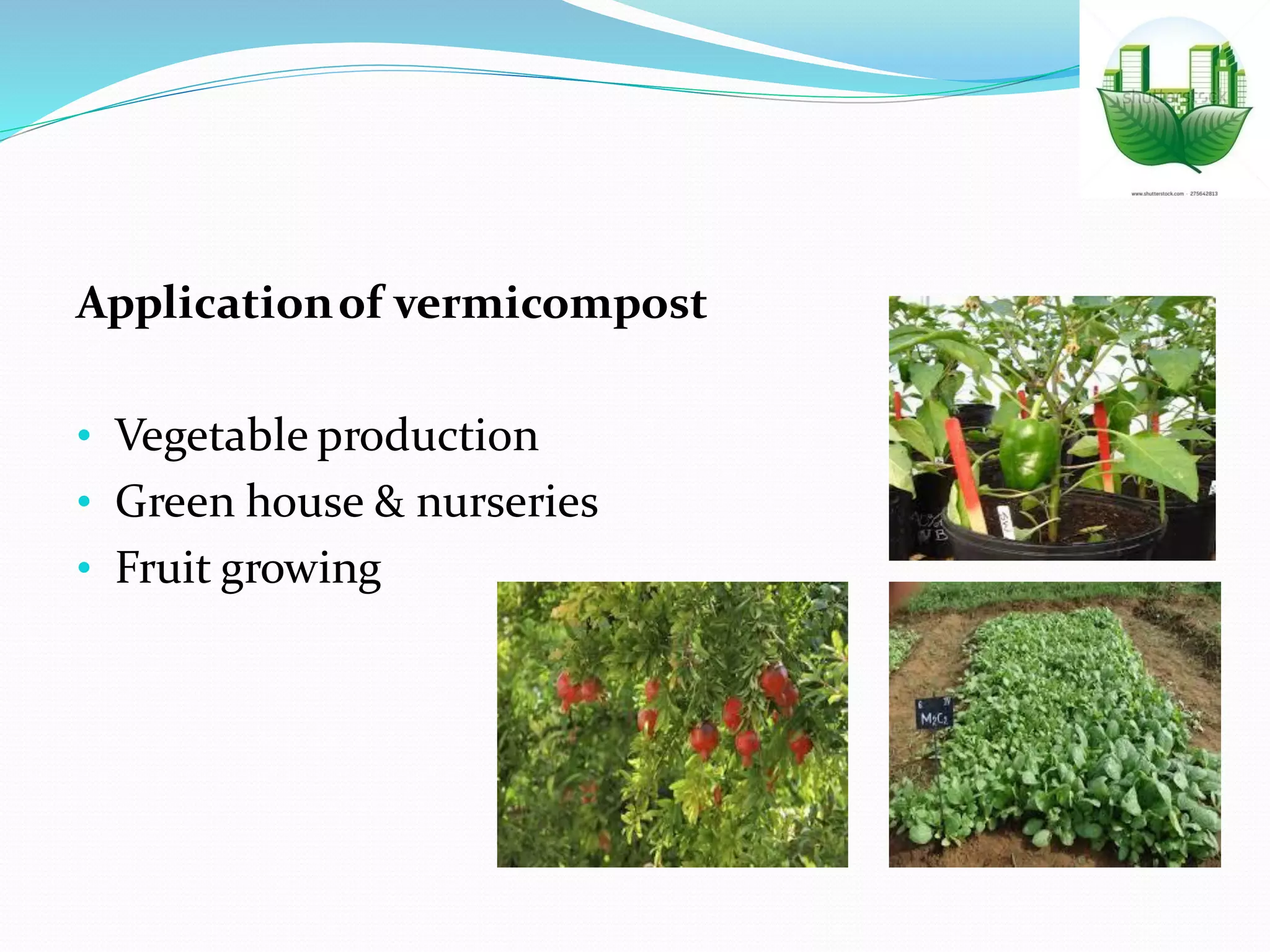
Applicationof vermicompost
• Vegetable production
• Green house & nurseries
• Fruit growing
- It is one of the easiest method of recycle of kitchen waste
and to produce quality manure ( vermicompost).
Advantage of vermicopost.
- Improve the physiochemical and biological properties of
the soil.
- Useful in raising seedling and for crop production.
Solar energy
Solar energy has the great potential of all the source of
renewable energy.
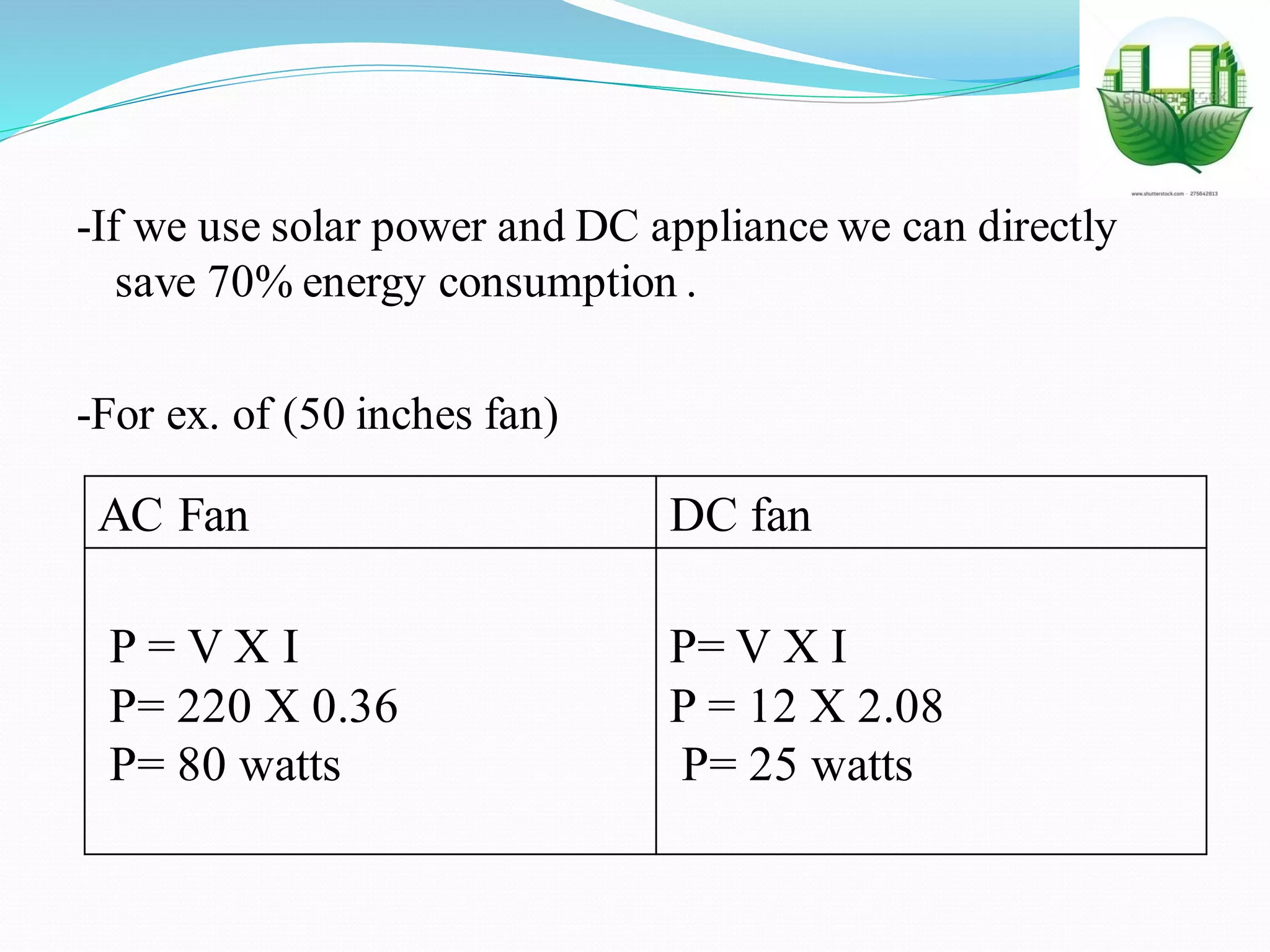
-If we use solar power and DC appliance we can directly
save 70% energy consumption .
-For ex. of (50 inches fan)
AC Fan DC fan
P = V X I
P= 220 X 0.36
P= 80 watts
P= V X I
P = 12 X 2.08
P= 25 watts
Drip irrigation
- Water is supplied to the root of the crops slowly drop by
drop.
Suitability of Drip irrigation
• Desert areas, small and narrow areas .
• Place where runoff can be a problem.
• Steeper slope.
• watering vegetable gardens, fruit trees and flowers.
Component of Drip irrigation
Advantage
• Preventing the runoff and evaporation.
• No problem of water logging.
• Leveling of field is not required.
• Feasible for the areas having scarcity of water.
Conclusion
To sum up, our project not only contributes towards a
sustainable construction and environment but it also brings lots
of benefits and advantages to building owners and users. Lower
development costs, lower operating costs, increased comforts,
healthier indoor environment quality, and enhanced durability
and less maintenance costs are hallmarks of a typical
Environment friendly building.
Energy Efficient and Eco-friendly Building

Energy Efficient and Eco-friendly Building

  • 1.
    Energy efficient &eco-friendly building Department of Civil Engineering Submitted by: MasudAlam Ansari
  • 2.
    Table of Content •Introduction • Building Materials • Rain water harvesting • Vermicomposting • Solar Energy • Drip Irrigation • Conclusion
  • 3.
    Current scenario • Sustainabledevelopment has become a global issue. • Global climate change has become an increasingly serious concern for the future • Concern over the impacts of built environment on natural environment, economy, health, and productivity
  • 4.
    In our presentationwe have consider these things: eco-friendly building Building materials Fly ash Bricks Fly ash Concrete Low-E- Glass Solar Energy Vermicom p-osting Rain water harvesting Drip irrigation
  • 5.
    Building materials The buildingmaterial are responsible for about 20% of CO2 gases emitted by a building during its life time . we have considered these three materials: • Fly ash bricks • Fly ash concrete • Low-E-Glass
  • 6.
    Fly ash Bricks Flyash bricks are environment friendlyand cost saving building products. It has also low energy consumption and no emission of Green house gases.
  • 7.
    Bricks comparison According to(ICE) Normal bricks Per brick Fly Ash bricks 0.36 kg CO2 emission 0.05 kg 6.5 MJ Embodied energy 1.25 MJ 10 N/mm sq. Strength 15 N/mm sq. 4 days ( 1200 C ) Burning Overnight (100 C) 3.2 kg Weight 2.6 kg -If we use fly ash bricks we can save Rs.1500 per cubic meter
  • 8.
    Fly ash concrete Theconcrete with material as a partial replacement of cement with Fly ash. It uses less energy in its production & produces less carbon dioxide than normal concrete.
  • 9.
    Cost analysis ofNormal concrete & Fly ash concrete . M20 Normal concrete Fly ash concrete 1m3 = Rs. 6000/ m3 [Source : ACC RMC plant in front of lpu gate ] 1m3 = Rs. 6000 = 6000- (7 * 100) + (0.18 *100) =Rs. 5318 / m3 [Note : if we replace 25% cement with Fly ash ] Save Rs. 6000-5318=682 per m3
  • 10.
    • Less emissionof CO2 • Reduction in shrink and creep. • Heat of hydration is lower than normal conc. • Better workability. Advantage of Fly ash concrete .
  • 11.
    Glass (Low-E-glass) - Low-E-Glassis one of the most popular and versatile building materials used today for constantly improving solar & thermal performance.
  • 12.
    one of thepanes of glass is coated with Zinc, copper, silver etc. Advantages of coating On hot summer days On cold winter nights
  • 13.
    Rain water Harvesting -Collectionand storage of rainwater to fulfill the current and future demands of water.
  • 14.
    What can weuse the rain water for? • Irrigation • Filter for domestic purposes
  • 15.
  • 16.
    Vermicomposting - Vermicomposting meansthe use of red worms to convert organic waste into fertilizer. That fertilizer is known as Vermicompost.
  • 17.
  • 18.
    Applicationof vermicompost • Vegetableproduction • Green house & nurseries • Fruit growing
  • 19.
    - It isone of the easiest method of recycle of kitchen waste and to produce quality manure ( vermicompost). Advantage of vermicopost. - Improve the physiochemical and biological properties of the soil. - Useful in raising seedling and for crop production.
  • 20.
    Solar energy Solar energyhas the great potential of all the source of renewable energy.
  • 22.
    -If we usesolar power and DC appliance we can directly save 70% energy consumption . -For ex. of (50 inches fan) AC Fan DC fan P = V X I P= 220 X 0.36 P= 80 watts P= V X I P = 12 X 2.08 P= 25 watts
  • 23.
    Drip irrigation - Wateris supplied to the root of the crops slowly drop by drop.
  • 24.
    Suitability of Dripirrigation • Desert areas, small and narrow areas . • Place where runoff can be a problem. • Steeper slope. • watering vegetable gardens, fruit trees and flowers.
  • 25.
  • 26.
    Advantage • Preventing therunoff and evaporation. • No problem of water logging. • Leveling of field is not required. • Feasible for the areas having scarcity of water.
  • 27.
    Conclusion To sum up,our project not only contributes towards a sustainable construction and environment but it also brings lots of benefits and advantages to building owners and users. Lower development costs, lower operating costs, increased comforts, healthier indoor environment quality, and enhanced durability and less maintenance costs are hallmarks of a typical Environment friendly building.