


CONSTRUCTIONS OF 5 STOREYS BLOCK A RAM RAJA
CAMPUS
KALAIYA SUB-METROPOLITAN CITY
A training report
Submitted in partial fulfillment of the requirements for the award of degree of
BACHELOR IN CIVIL ENGINEERING
Submitted to
LOVELY PROFESSIONAL UNIVERSITY
PHAGWARA, PUNJAB
From 01/01/2020 to 02/05/2020
SUBMITTED BY
Name of student: Masud Alam Ansari Submitted to:
Registration Number: 11716156 Harsimran Singh
Assistant professor
CERTIFICATE
Student Declaration
To whom so ever it may concern
I, Masud Alam Ansari Regd. No. 11716156 hereby declare that the work done by me on
“Construction of 5 Storeys Block A of Ram Raja Campus” from 01/01/2020 to 02/05/2020
under the supervision of RajKumar Sah on the post of Senior Engineer in Kalaiya Sub-
Metropolitan and internal supervisor Assistant professor Harsimran Singh, Lovely professional
University, Phagwara, Punjab, is a record of original work for the partial fulfillment of the
requirements for the award of the degree Bachelor in Civil Engineering.
Name of the Student: Masud Alam Ansari
Registration Number: 11716156
Content
1. Introduction of the company …………………………………………….1-2
1.1Number of Department ……………………………………………….. 2
1.2Number of Employees………………………………………………… 2
2. Introduction of the project……………………………………………….3-6
2.1 Types of Building……………………………………………………… 3
2.2 Safety Measure………………………………………………………… 4
2.3 Location of Construction site………………………………………….. 5
2.4Formwork………………………………………………………………. 5
3. Materials and Equipment used at site…………………………………...6-10
3.1 Materials used………………………………………………………… 6
3.2 Equipment used at site………………………………………………... 9
4. Steps involved in Construction of Building……………………………10-25
4.1 Site Clearance……………………………………………………….. 10
4.2 Survey and lying out of drawing…………………………………… 11
4.3 Excavation of soil for Footing……………………………………… 12
4.4 Foundation………………………………………………………….. 13
4.5 Concreting operations………………………………………………. 16
4.6 Wall construction…………………………………………………… 20
4.7 Beam and Column construction……………………………………. 22
4.8 Slab construction……………………………………………………. 23
5. Quality control…………………………………………………………… 26
5.1 Causes for poor quality…………………………………………… …... 26
5.2 Quality control in concrete works……………………………… …….. 26
5.3Quality control works in concreting at site ………………………….... 26
6. Conclusion………………………………………………………………... 27
1
1. INTRODUCTION OF THE COMPANY
It is a Kalaiya Sub Metropolitan City where the district headquarters of Bara district established
in B.S. 2039 and is located in the distance of 306 KM from Kathmandu and 12 KM East of
Birgunj. At the time of establishment, Sub Metropolitan Immediately Kalaiya, Bhaura,
Bhavanipur, Barewa, Baghavan and Rampur VDC were included. This is divided into Vada. Ma.
Np In the year 2047, the area was expanded to 14 wada by adding Bhatauda, Brahampuri,
Visrampur VDCs. Due to the closure of Gadhimai Temple, which climbed Asia's great fortune.
It is also being developed as a tourist area.
Kalaiya is a Sub Metropolitan City of Bara district, a rich municipality of cultural diversity.
According to the National Census 2068, according to the latest statistics from the total
population of 6,87,708 in the district, total 13,205 households have 86,318 population, which is
12.56 percent of the total population of the district.
There are 9 urban vessels and 18 rural vats. Ma. Np According to the data in the past, the road
has expanded even with 12 kilograms of land, 3 km slope and 34 km of gravel and remaining
roads have been expanded with 77 kilometer roads. From this, the city seems to have to pay
attention to physical development and physical development. Bara district and Kalaiya U. Me
Human development has shown that NP's lack of human and social development should be given
priority.
2
1.1 NUMBER OF DEPARTMENT
Kalaiya Sub Metropolitan City mainly includes these Three Department which are given below:-
i. Construction Department: - In this department manufacturing buildings differing by
construction and function specifications designed and mentioned by the Engineers who
are working in this organization.
ii. Environmental Department: - To carry out work related to the monitoring and
evaluation and testing of environmental impact assessment reports.
iii. Health Service Department: - The overall purpose of the Department of Health Services
is to deliver preventive, promotive and curative health services throughout Bara District.
The D(oHS) is one of three departments under the Ministry of Health (MoH).
1.2 NUMBER OF EMPLOYEES
S.N Name Designation Contact
1 Rajendra Pd. Ghimire Chief Administrative Officer 9855049111
2 Sunder kr. Thapa Section officer -
3 Mustak Ansari Chief Planning officer 9855045224
4 Raj kumar sah Engineer 9855045802
5 Anwar Ansari Engineer 9843715152
6 Dibya sarraf Accountant 053-550135
3
7 Chandra sekhar kumar Sub-Engineer 9814241130
2. INRODUCTION OF THE PROJECT UNDERTAKEN
The basics needs of human existences are food, clothing’s & shelter. From times immemorial
man has been making efforts in improving their standard of living. The point of his efforts has
been to provide an economic and efficient shelter. The possession of shelter besides being a
basic, used, gives a feeling of security, responsibility and shown the social status of man.
Every human being has an inherent liking for a peaceful environment needed for his pleasant
living, this object is achieved by having a place of living situated at the safe and convenient
location, such a place for comfortable and pleasant living requires considered and kept in view.
The engineer has to keep in mind the municipal conditions, building bye laws, environment,
financial capacity, water supply, sewage arrangement, provision of future, aeration, ventilation
etc., in suggestion a particular type of plan to any client.
2.1TYPES OF BUILDING
i. Residential Building: In such building sleeping accommodation is provided. IT
includes the living room, bed room, kitchen, hall, toilet and bath room. It may be a single
storey building or apartments.
ii. Institutional Building: These building are used for different purposes, such as medical or
other treatment or care of a person suffering from a physical or mental illnesses. These
building include hospital, sanatoria, jail etc.
iii. Industrial Building: These are buildings in which products or material s of all kind of
properties is fabricated, assembled, processed. For example refineries, gas plant, mills etc.
iv. Educational Building: This includes any building using for school, college, assembly
for instruction, education or recreation.
A Campus is a building or an institution designed for the teaching of students under the direction
of teachers. Similarly, a primary school is a school in which the children receive
primary/elementary education within the age group of 5-11years and pre-primary education
within the age group 1-5.A Campus is also an organized space purposed for teaching and
learning, meaning to say that campus does not only refer to the building consisting of classrooms
4
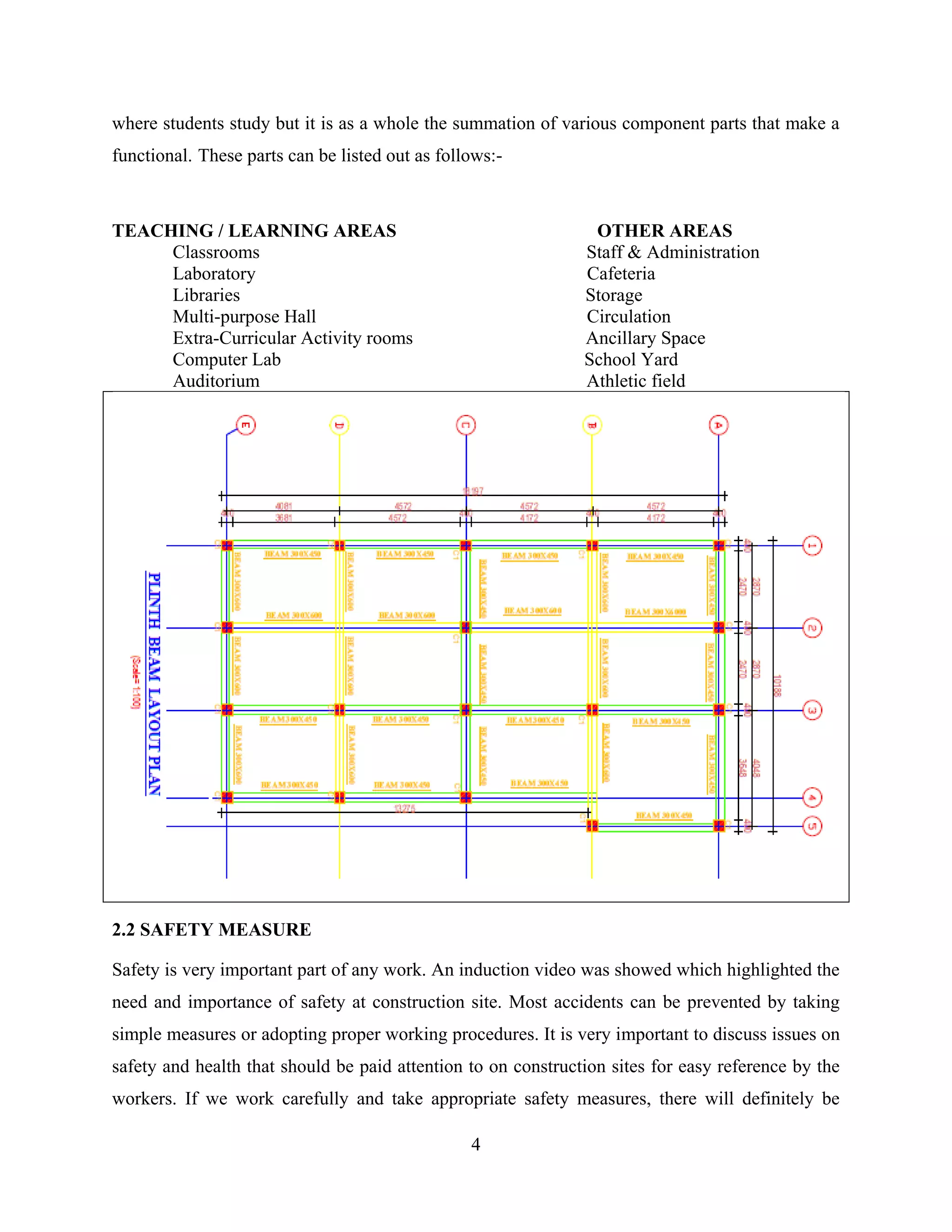
where students study but it is as a whole the summation of various component parts that make a
functional. These parts can be listed out as follows:-
TEACHING / LEARNING AREAS OTHER AREAS
Classrooms Staff & Administration
Laboratory Cafeteria
Libraries Storage
Multi-purpose Hall Circulation
Extra-Curricular Activity rooms Ancillary Space
Computer Lab School Yard
Auditorium Athletic field
2.2 SAFETY MEASURE
Safety is very important part of any work. An induction video was showed which highlighted the
need and importance of safety at construction site. Most accidents can be prevented by taking
simple measures or adopting proper working procedures. It is very important to discuss issues on
safety and health that should be paid attention to on construction sites for easy reference by the
workers. If we work carefully and take appropriate safety measures, there will definitely be
5
fewer work injury cases, and our sites will become a safe and secure place to work in. It is
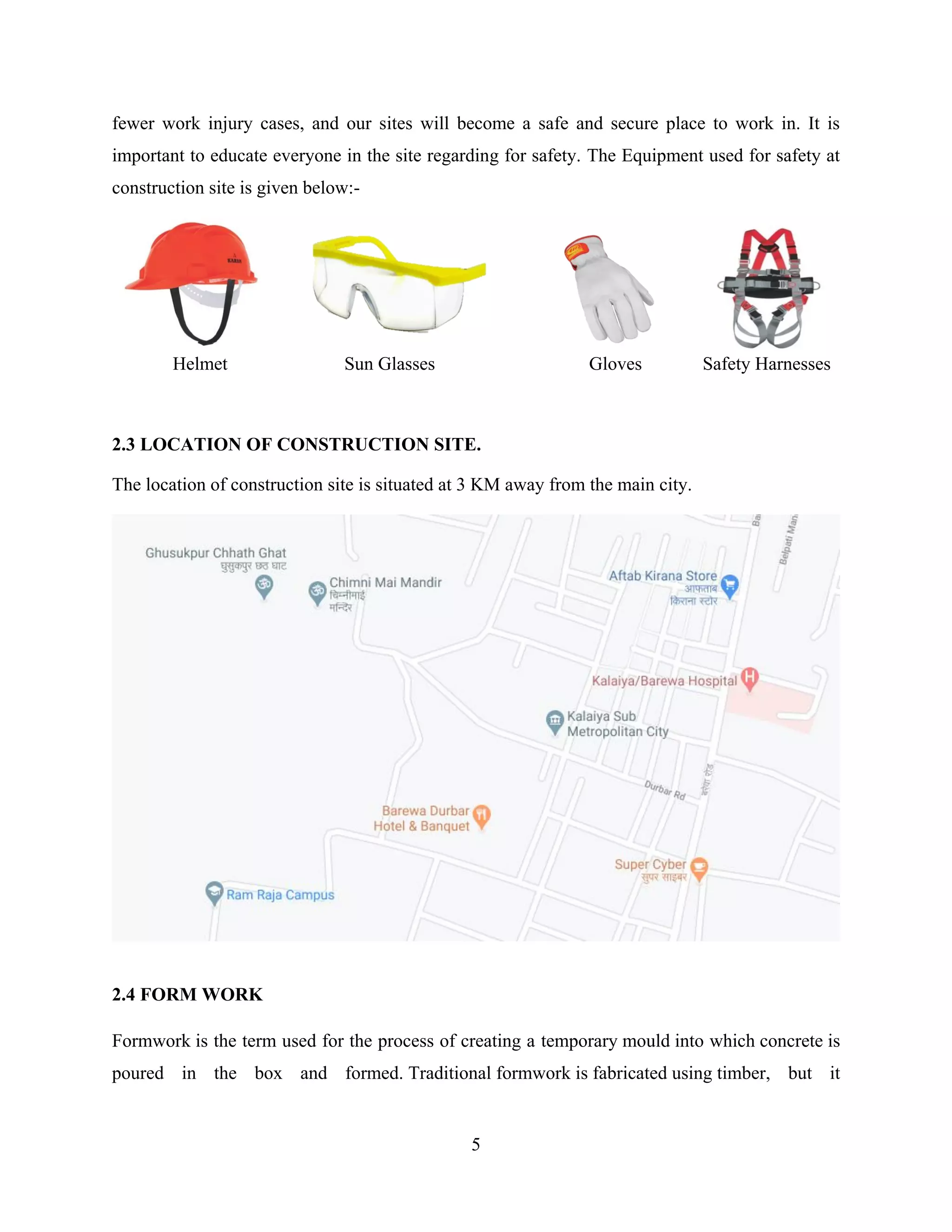
important to educate everyone in the site regarding for safety. The Equipment used for safety at
construction site is given below:-
Helmet Sun Glasses Gloves Safety Harnesses
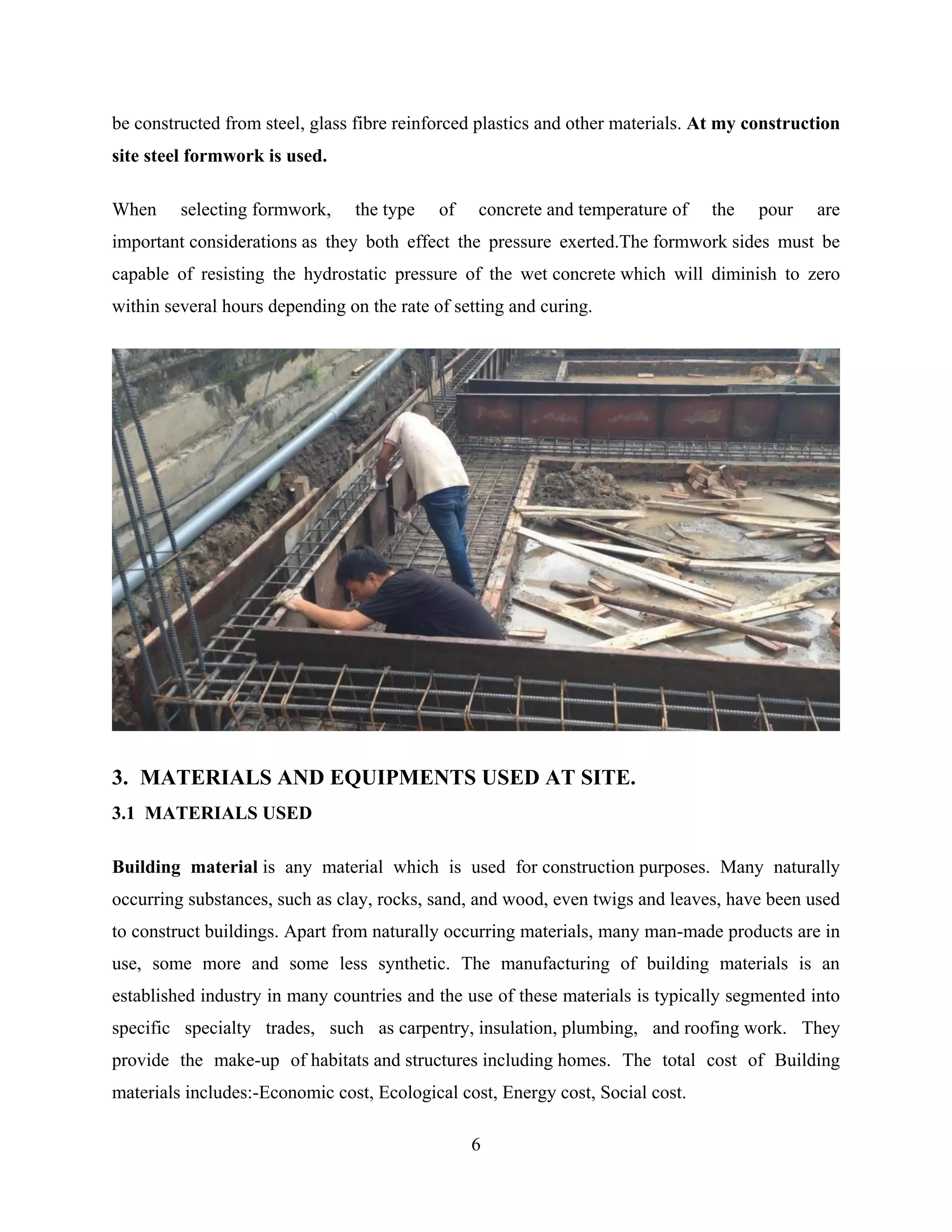
2.3 LOCATION OF CONSTRUCTION SITE.
The location of construction site is situated at 3 KM away from the main city.
2.4 FORM WORK
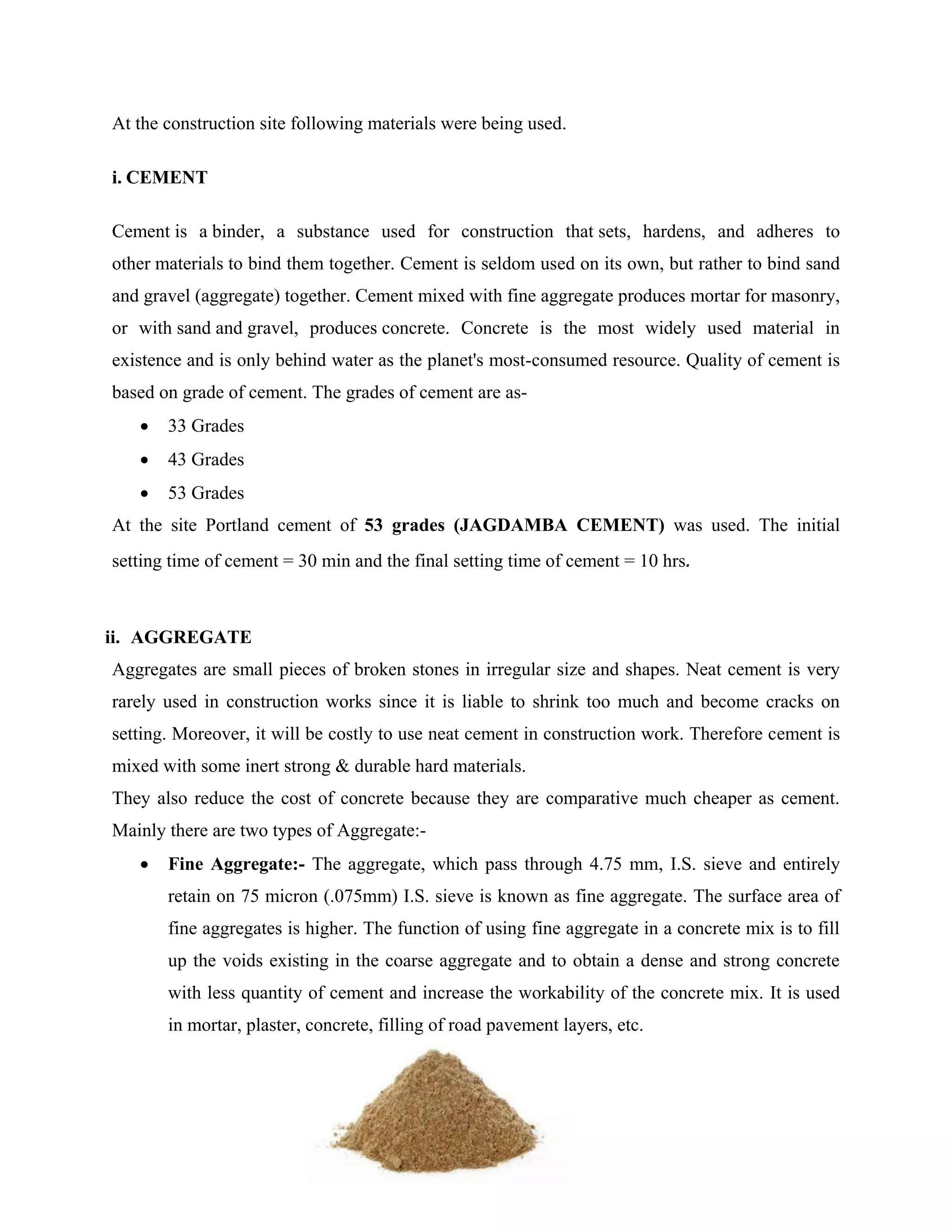
Formwork is the term used for the process of creating a temporary mould into which concrete is
poured in the box and formed. Traditional formwork is fabricated using timber, but it
6
be constructed from steel, glass fibre reinforced plastics and other materials. At my construction
site steel formwork is used.
When selecting formwork, the type of concrete and temperature of the pour are
important considerations as they both effect the pressure exerted.The formwork sides must be
capable of resisting the hydrostatic pressure of the wet concrete which will diminish to zero
within several hours depending on the rate of setting and curing.
3. MATERIALS AND EQUIPMENTS USED AT SITE.
3.1 MATERIALS USED
Building material is any material which is used for construction purposes. Many naturally
occurring substances, such as clay, rocks, sand, and wood, even twigs and leaves, have been used
to construct buildings. Apart from naturally occurring materials, many man-made products are in
use, some more and some less synthetic. The manufacturing of building materials is an
established industry in many countries and the use of these materials is typically segmented into
specific specialty trades, such as carpentry, insulation, plumbing, and roofing work. They
provide the make-up of habitats and structures including homes. The total cost of Building
materials includes:-Economic cost, Ecological cost, Energy cost, Social cost.
7
At the construction site following materials were being used.
i. CEMENT
Cement is a binder, a substance used for construction that sets, hardens, and adheres to
other materials to bind them together. Cement is seldom used on its own, but rather to bind sand
and gravel (aggregate) together. Cement mixed with fine aggregate produces mortar for masonry,
or with sand and gravel, produces concrete. Concrete is the most widely used material in
existence and is only behind water as the planet's most-consumed resource. Quality of cement is
based on grade of cement. The grades of cement are as-
 33 Grades
 43 Grades
 53 Grades
At the site Portland cement of 53 grades (JAGDAMBA CEMENT) was used. The initial
setting time of cement = 30 min and the final setting time of cement = 10 hrs.
ii. AGGREGATE
Aggregates are small pieces of broken stones in irregular size and shapes. Neat cement is very
rarely used in construction works since it is liable to shrink too much and become cracks on
setting. Moreover, it will be costly to use neat cement in construction work. Therefore cement is
mixed with some inert strong & durable hard materials.
They also reduce the cost of concrete because they are comparative much cheaper as cement.
Mainly there are two types of Aggregate:-
 Fine Aggregate:- The aggregate, which pass through 4.75 mm, I.S. sieve and entirely
retain on 75 micron (.075mm) I.S. sieve is known as fine aggregate. The surface area of
fine aggregates is higher. The function of using fine aggregate in a concrete mix is to fill
up the voids existing in the coarse aggregate and to obtain a dense and strong concrete
with less quantity of cement and increase the workability of the concrete mix. It is used
in mortar, plaster, concrete, filling of road pavement layers, etc.
8
 Coarse aggregate:-The aggregate, which pass through 75 mm I.S. sieve and entirely
retain on 4.75 mm I.S. sieve is known as coarse aggregates. Coarse aggregate acts as inert
filler material for concrete. The functions are almost same as that of fine aggregate.
[Note: - At construction site aggregate used are coarse aggregate of 20mm size. Coarse aggregate
of 12.5 mm size (As per concrete mix design). And River bank Fine aggregate.]
iii. REINFORCEMENT
The material that develops a good bond with concrete in order to increase its strength is called
reinforcement. Steel bars are highly strong in tension, shear, bending moment, torsion and
compression.
 Foundation Mess (Footing):- 12 mm Dia. Both Direction
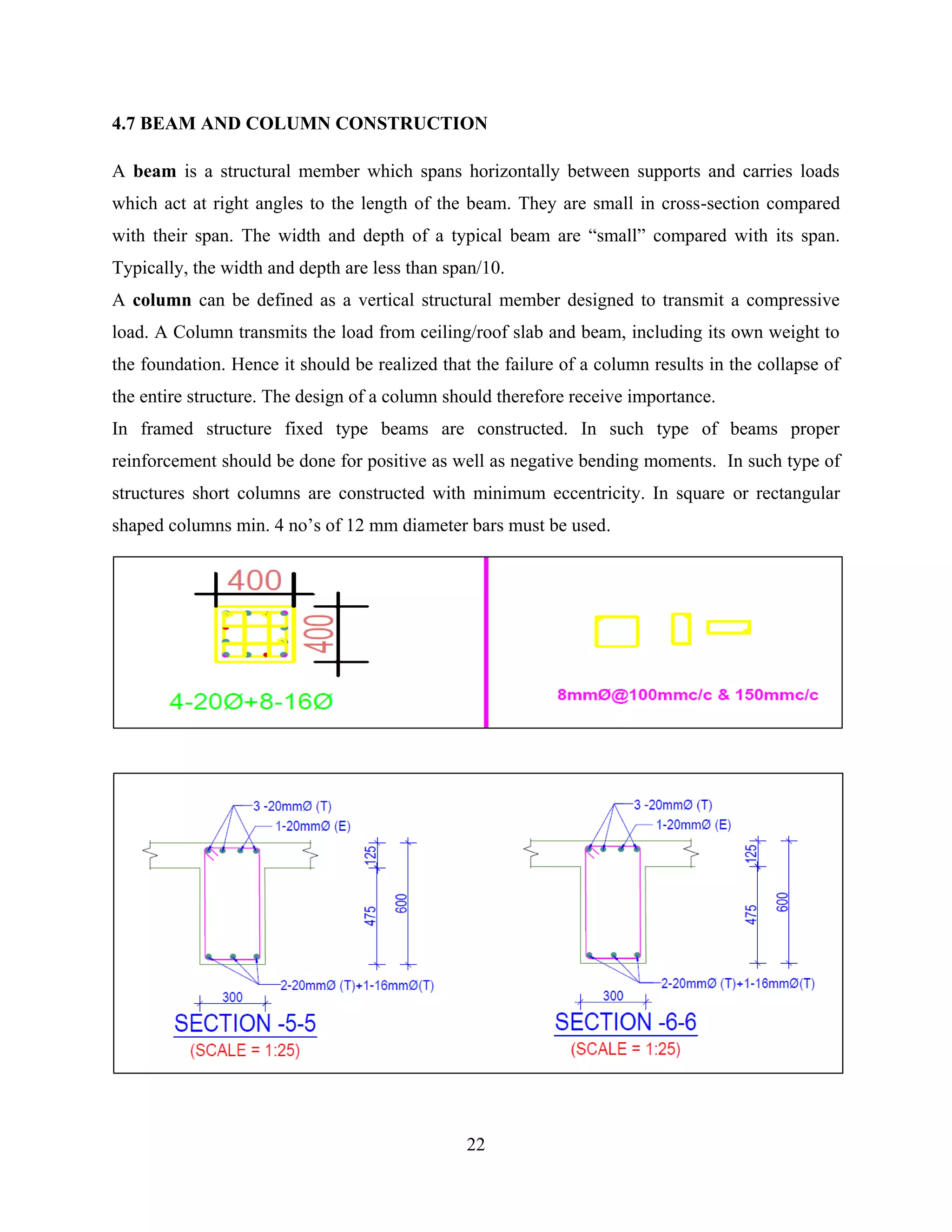
 Column: - Corner Bar: 20 mm Dia, Inner Bar: 16 mm Dia, Stirrups: 8 mm Dia.
9
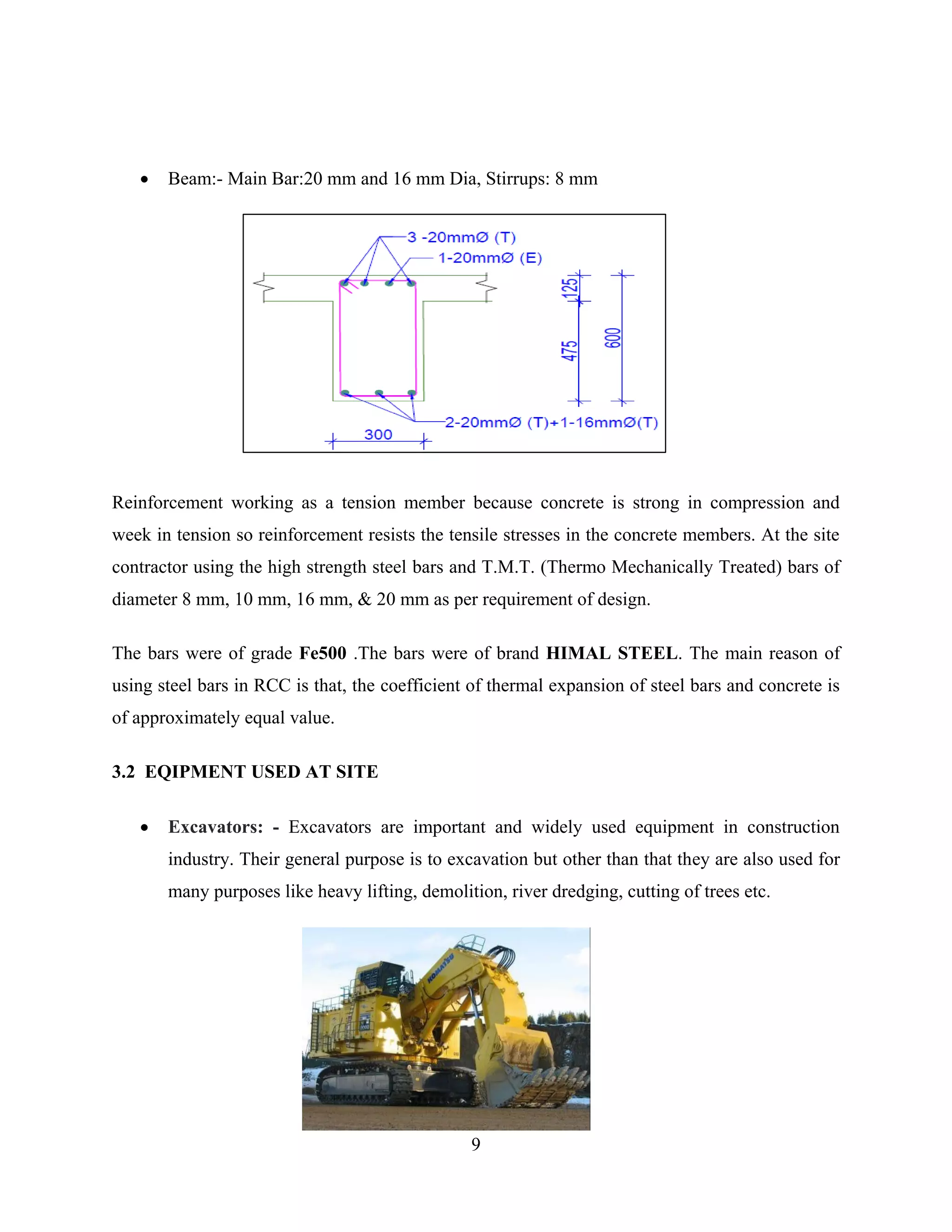
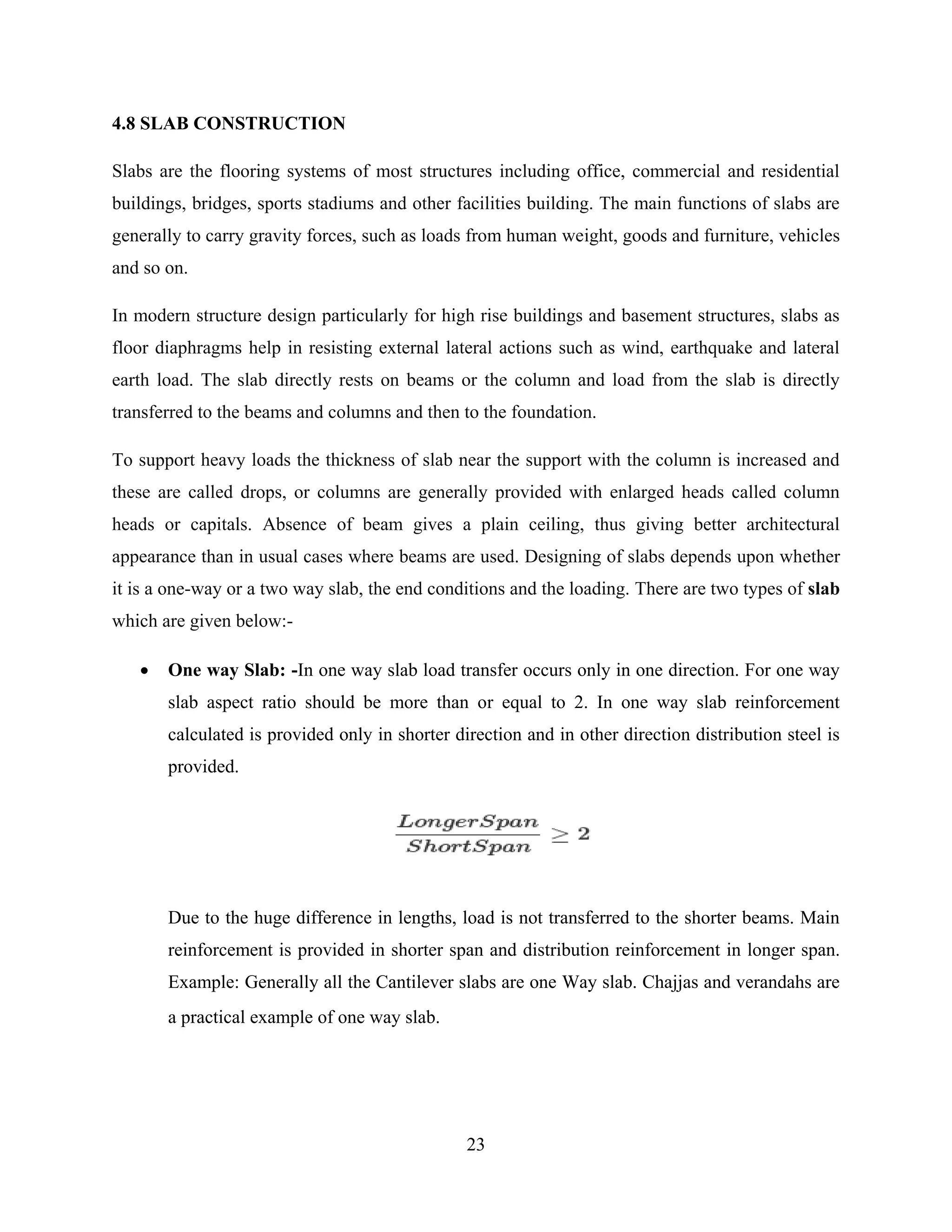
 Beam:- Main Bar:20 mm and 16 mm Dia, Stirrups: 8 mm
Reinforcement working as a tension member because concrete is strong in compression and
week in tension so reinforcement resists the tensile stresses in the concrete members. At the site
contractor using the high strength steel bars and T.M.T. (Thermo Mechanically Treated) bars of
diameter 8 mm, 10 mm, 16 mm, & 20 mm as per requirement of design.
The bars were of grade Fe500 .The bars were of brand HIMAL STEEL. The main reason of
using steel bars in RCC is that, the coefficient of thermal expansion of steel bars and concrete is
of approximately equal value.
3.2 EQIPMENT USED AT SITE
 Excavators: - Excavators are important and widely used equipment in construction
industry. Their general purpose is to excavation but other than that they are also used for
many purposes like heavy lifting, demolition, river dredging, cutting of trees etc.
10
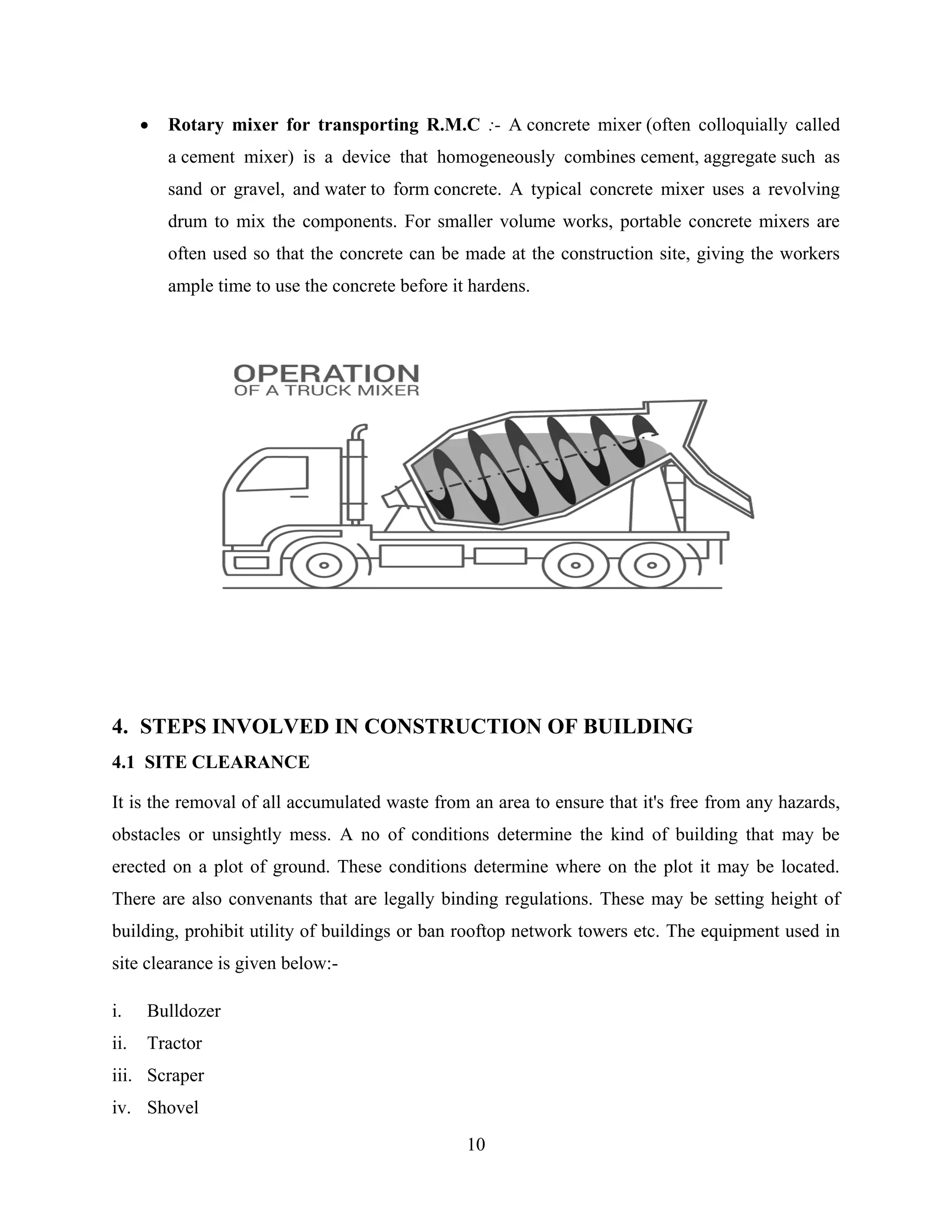
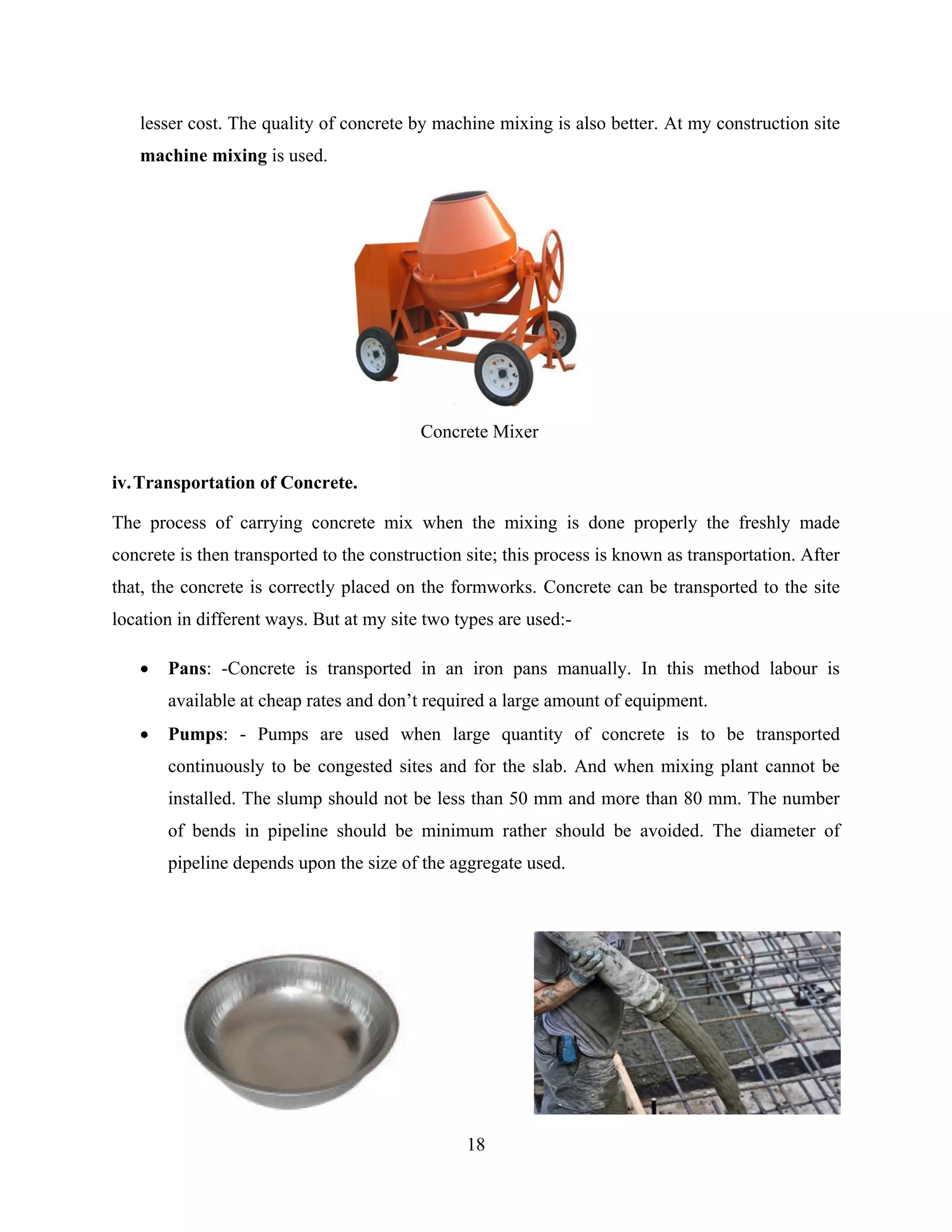
 Rotary mixer for transporting R.M.C :- A concrete mixer (often colloquially called
a cement mixer) is a device that homogeneously combines cement, aggregate such as
sand or gravel, and water to form concrete. A typical concrete mixer uses a revolving
drum to mix the components. For smaller volume works, portable concrete mixers are
often used so that the concrete can be made at the construction site, giving the workers
ample time to use the concrete before it hardens.
4. STEPS INVOLVED IN CONSTRUCTION OF BUILDING
4.1 SITE CLEARANCE
It is the removal of all accumulated waste from an area to ensure that it's free from any hazards,
obstacles or unsightly mess. A no of conditions determine the kind of building that may be
erected on a plot of ground. These conditions determine where on the plot it may be located.
There are also convenants that are legally binding regulations. These may be setting height of
building, prohibit utility of buildings or ban rooftop network towers etc. The equipment used in
site clearance is given below:-
i. Bulldozer
ii. Tractor
iii. Scraper
iv. Shovel
11
4.2 SURVEY AND LAYINGOUT OF DRAWING
Surveying is the process of determining relative positions of different objects on the surface of
the earth by measuring horizontal distances between them and preparing a map to any suitable
scale. Survey is the first step done in any construction site so as to get the required level of
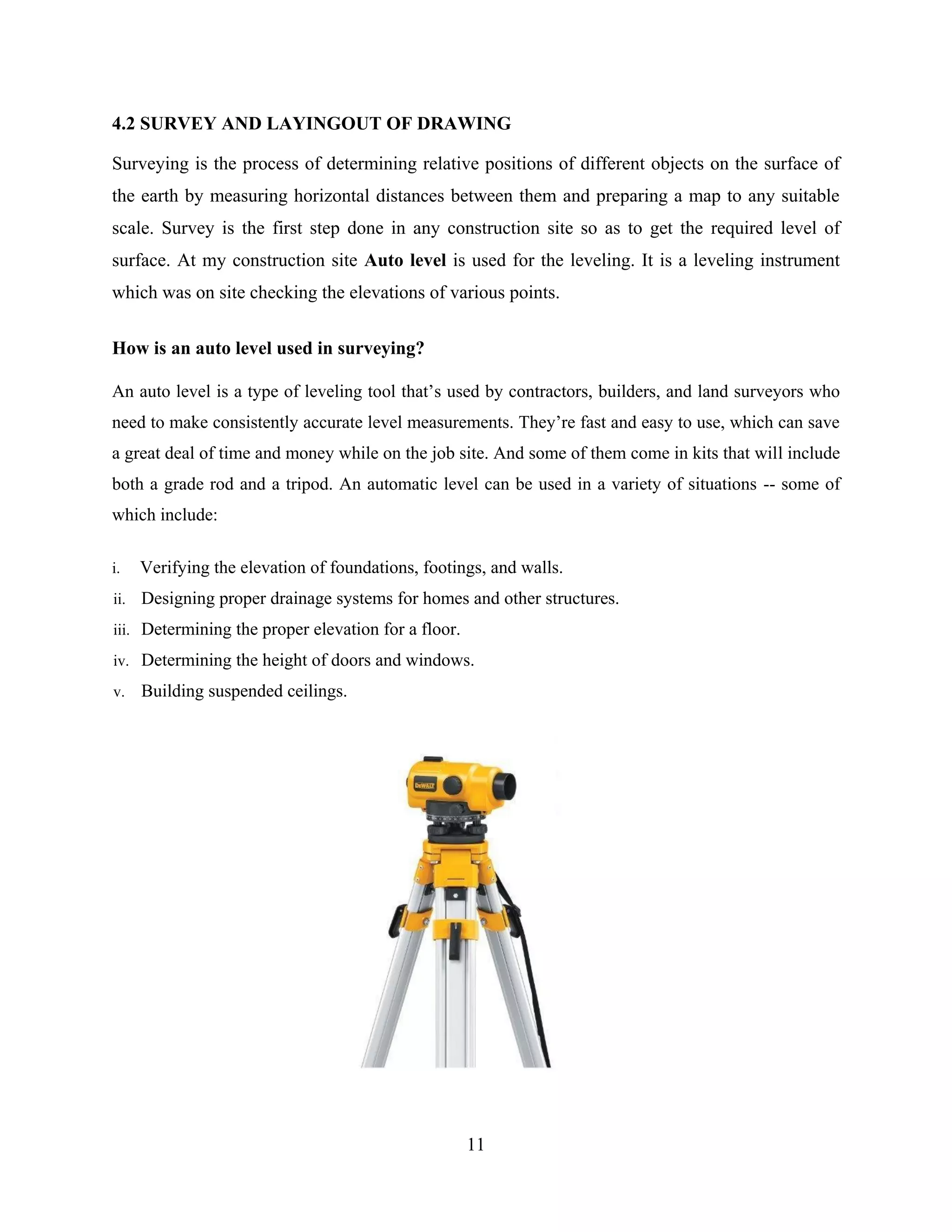
surface. At my construction site Auto level is used for the leveling. It is a leveling instrument
which was on site checking the elevations of various points.
How is an auto level used in surveying?
An auto level is a type of leveling tool that’s used by contractors, builders, and land surveyors who
need to make consistently accurate level measurements. They’re fast and easy to use, which can save
a great deal of time and money while on the job site. And some of them come in kits that will include
both a grade rod and a tripod. An automatic level can be used in a variety of situations -- some of
which include:
i. Verifying the elevation of foundations, footings, and walls.
ii. Designing proper drainage systems for homes and other structures.
iii. Determining the proper elevation for a floor.
iv. Determining the height of doors and windows.
v. Building suspended ceilings.
12
4.3 EXCAVATION OF SOIL FOR FOOTING
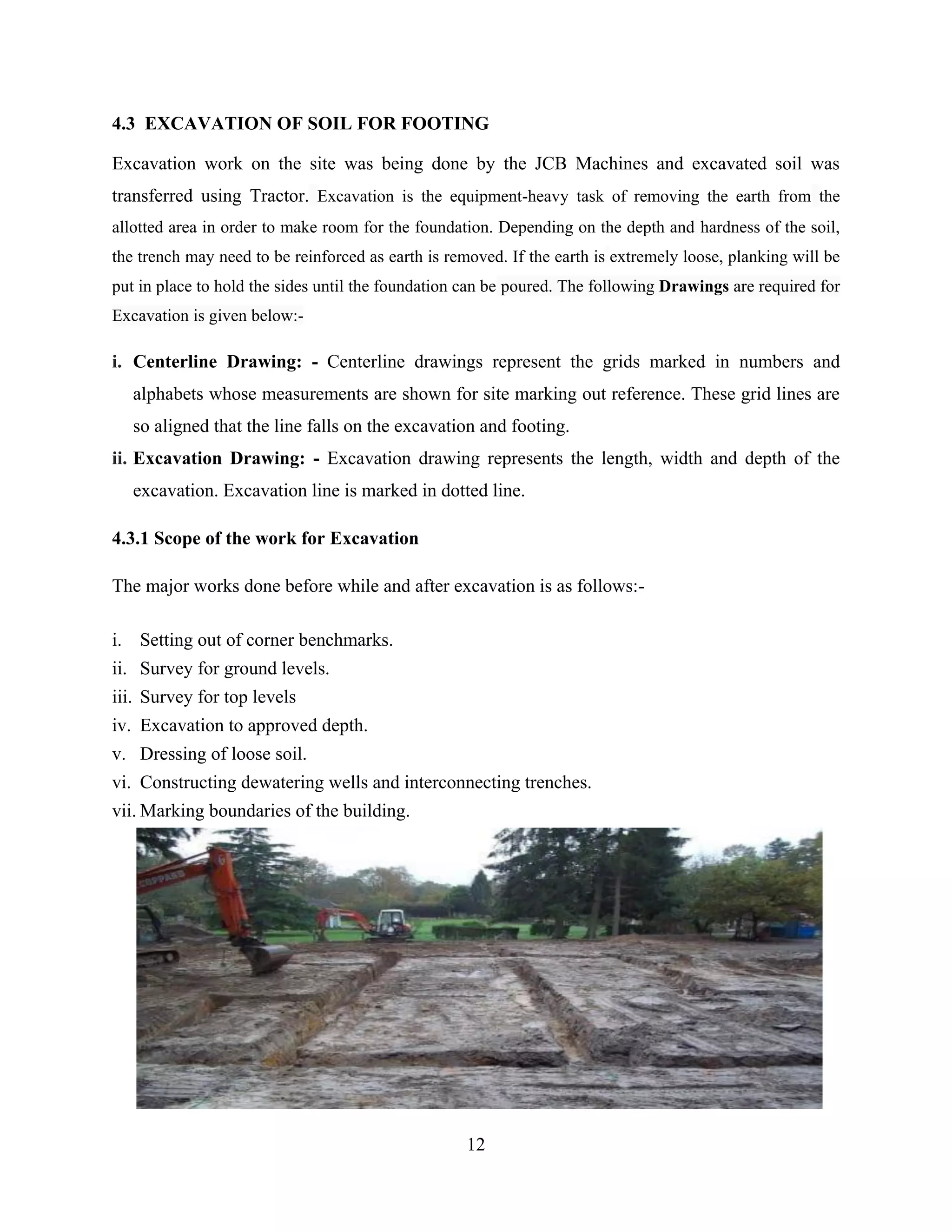
Excavation work on the site was being done by the JCB Machines and excavated soil was
transferred using Tractor. Excavation is the equipment-heavy task of removing the earth from the
allotted area in order to make room for the foundation. Depending on the depth and hardness of the soil,
the trench may need to be reinforced as earth is removed. If the earth is extremely loose, planking will be
put in place to hold the sides until the foundation can be poured. The following Drawings are required for
Excavation is given below:-
i. Centerline Drawing: - Centerline drawings represent the grids marked in numbers and
alphabets whose measurements are shown for site marking out reference. These grid lines are
so aligned that the line falls on the excavation and footing.
ii. Excavation Drawing: - Excavation drawing represents the length, width and depth of the
excavation. Excavation line is marked in dotted line.
4.3.1 Scope of the work for Excavation
The major works done before while and after excavation is as follows:-
i. Setting out of corner benchmarks.
ii. Survey for ground levels.
iii. Survey for top levels
iv. Excavation to approved depth.
v. Dressing of loose soil.
vi. Constructing dewatering wells and interconnecting trenches.
vii. Marking boundaries of the building.
13
4.4 FOUNDATION
The lowest part of a structure which transmits the weight of the structure together with
live loads, seismic and wind pressure to the ground surface on which the structure rests,
ensuring its safe bearing capacity, is called foundation. To increase the stability of the
structure, foundations are generally placed below the ground level.
4.4.1 Functions of Foundations
i. To transmit and distribute the total load of the structure to a larger area of
underlying support.
ii. To prevent differential settlement of the structure.
iii. To provide stability to the structure.
4.4.2 Types of Footing
The following two types of footing used at my construction site are given below:-
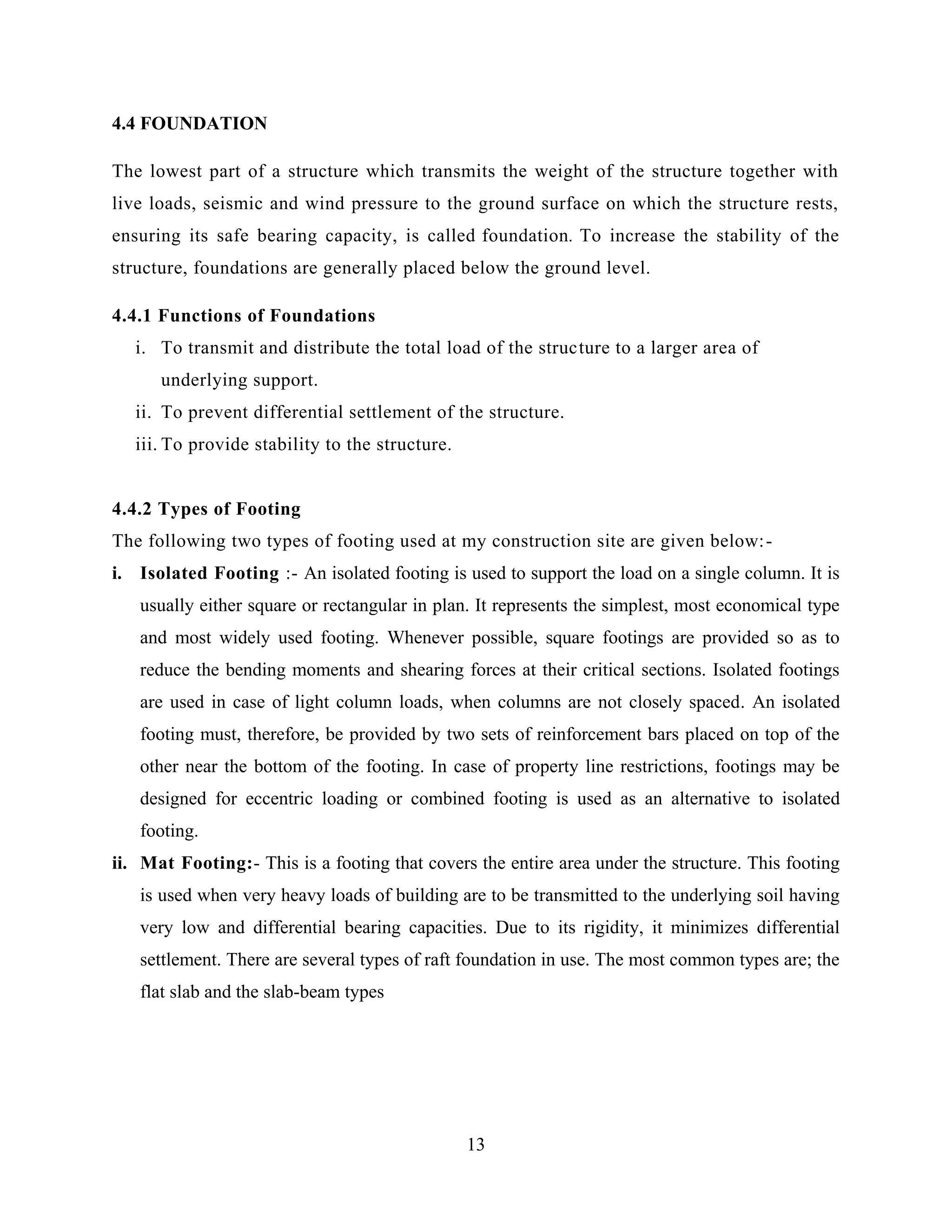
i. Isolated Footing :- An isolated footing is used to support the load on a single column. It is
usually either square or rectangular in plan. It represents the simplest, most economical type
and most widely used footing. Whenever possible, square footings are provided so as to
reduce the bending moments and shearing forces at their critical sections. Isolated footings
are used in case of light column loads, when columns are not closely spaced. An isolated
footing must, therefore, be provided by two sets of reinforcement bars placed on top of the
other near the bottom of the footing. In case of property line restrictions, footings may be
designed for eccentric loading or combined footing is used as an alternative to isolated
footing.
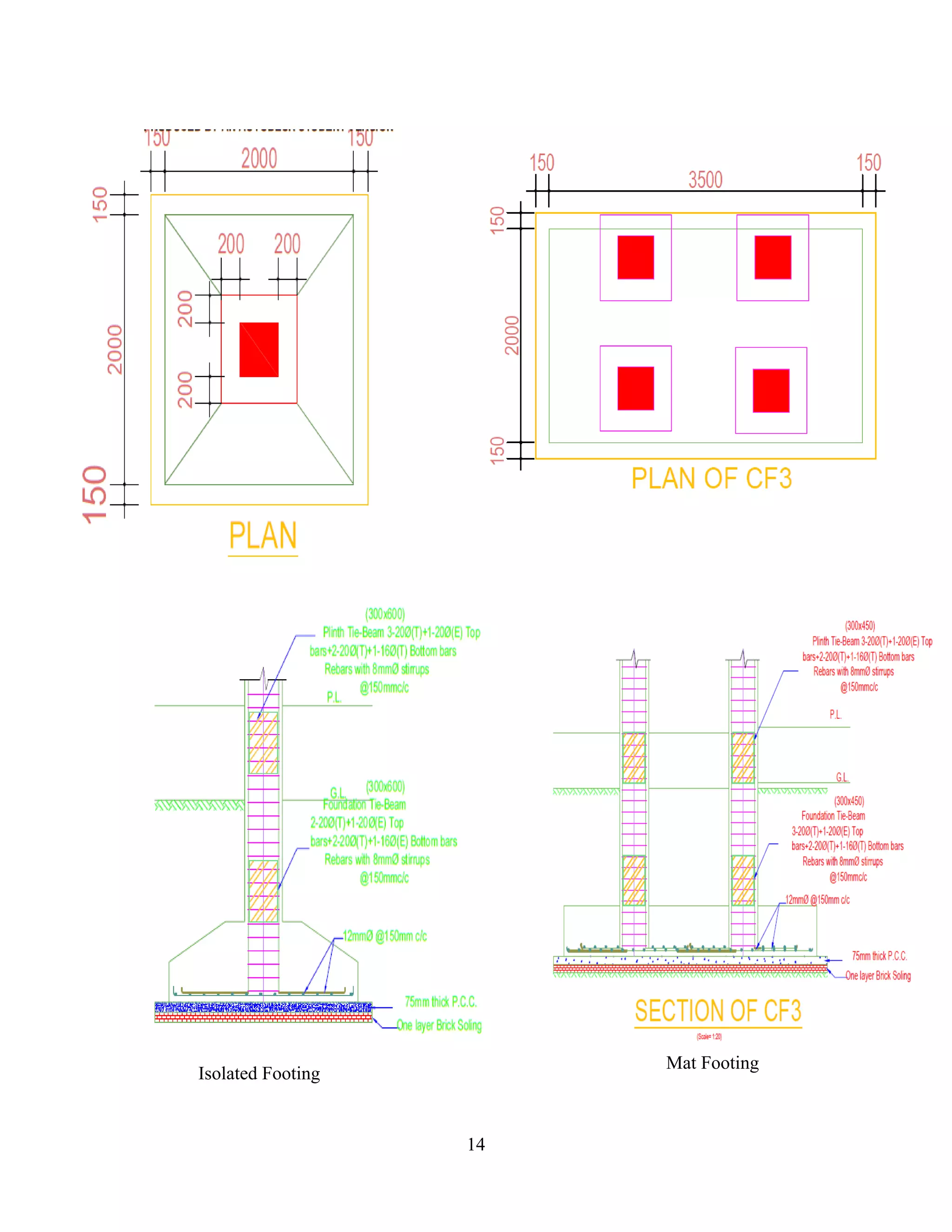
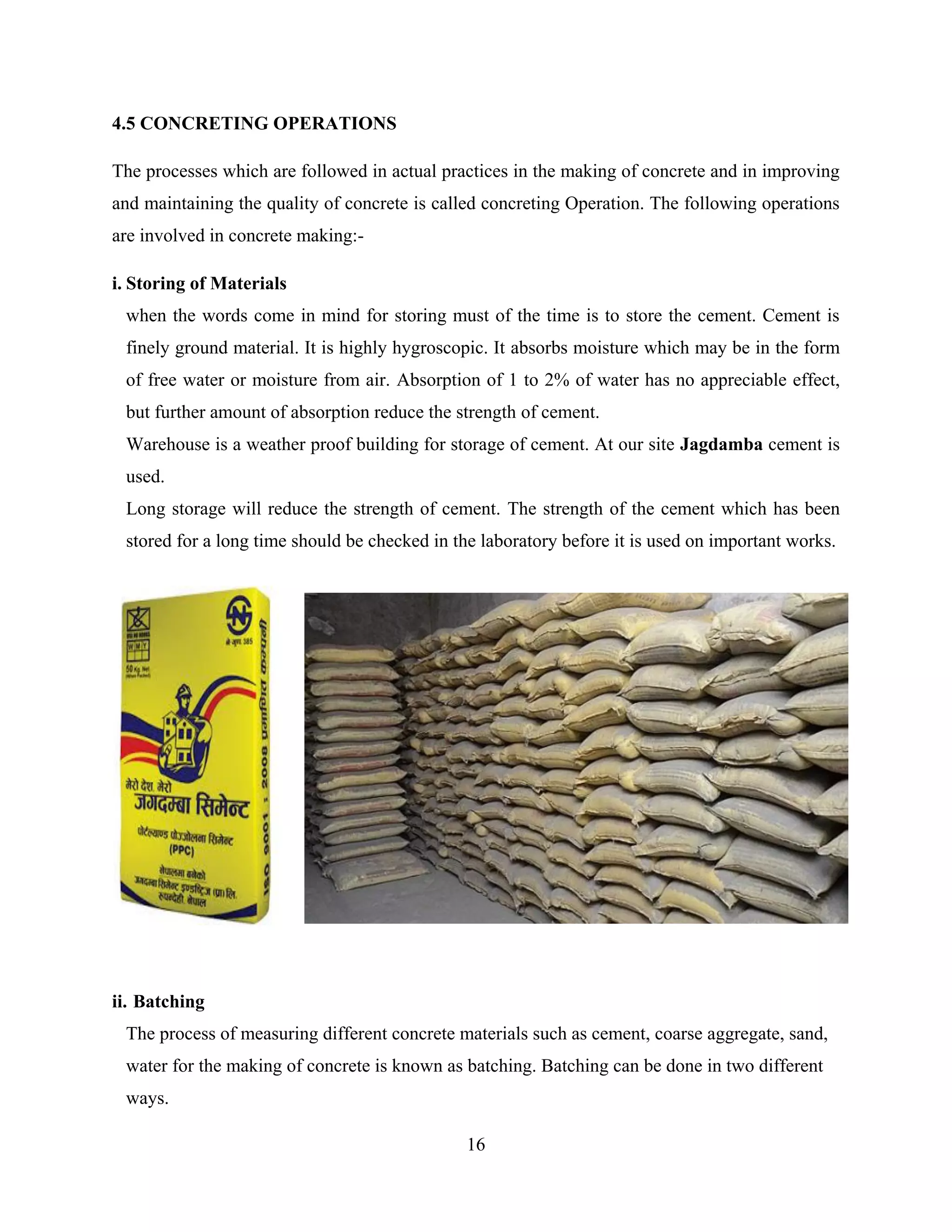
ii. Mat Footing:- This is a footing that covers the entire area under the structure. This footing
is used when very heavy loads of building are to be transmitted to the underlying soil having
very low and differential bearing capacities. Due to its rigidity, it minimizes differential
settlement. There are several types of raft foundation in use. The most common types are; the
flat slab and the slab-beam types
14
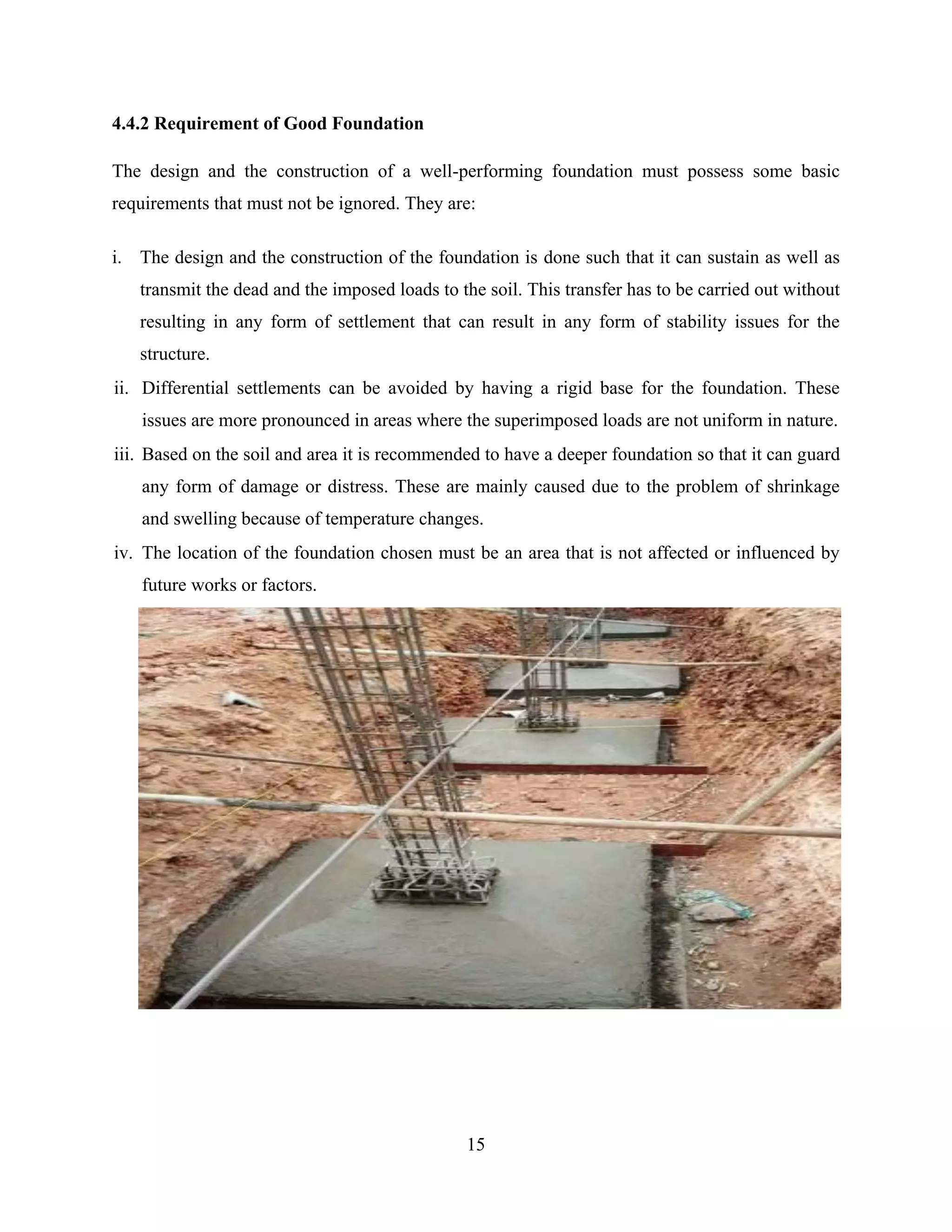
Isolated Footing
Mat Footing
15
4.4.2 Requirement of Good Foundation
The design and the construction of a well-performing foundation must possess some basic
requirements that must not be ignored. They are:
i. The design and the construction of the foundation is done such that it can sustain as well as
transmit the dead and the imposed loads to the soil. This transfer has to be carried out without
resulting in any form of settlement that can result in any form of stability issues for the
structure.
ii. Differential settlements can be avoided by having a rigid base for the foundation. These
issues are more pronounced in areas where the superimposed loads are not uniform in nature.
iii. Based on the soil and area it is recommended to have a deeper foundation so that it can guard
any form of damage or distress. These are mainly caused due to the problem of shrinkage
and swelling because of temperature changes.
iv. The location of the foundation chosen must be an area that is not affected or influenced by
future works or factors.
16
4.5 CONCRETING OPERATIONS
The processes which are followed in actual practices in the making of concrete and in improving
and maintaining the quality of concrete is called concreting Operation. The following operations
are involved in concrete making:-
i. Storing of Materials
when the words come in mind for storing must of the time is to store the cement. Cement is
finely ground material. It is highly hygroscopic. It absorbs moisture which may be in the form
of free water or moisture from air. Absorption of 1 to 2% of water has no appreciable effect,
but further amount of absorption reduce the strength of cement.
Warehouse is a weather proof building for storage of cement. At our site Jagdamba cement is
used.
Long storage will reduce the strength of cement. The strength of the cement which has been
stored for a long time should be checked in the laboratory before it is used on important works.
ii. Batching
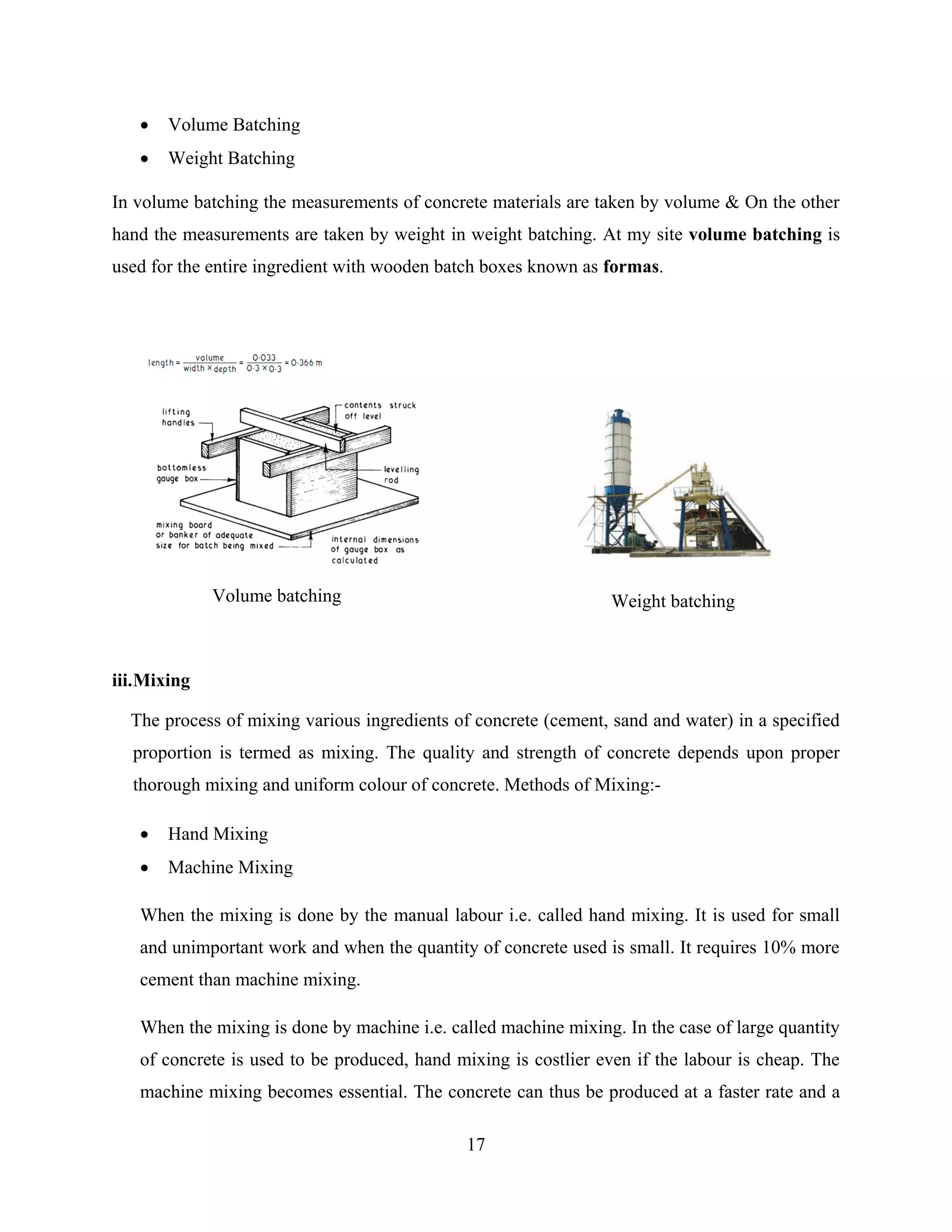
The process of measuring different concrete materials such as cement, coarse aggregate, sand,
water for the making of concrete is known as batching. Batching can be done in two different
ways.
17
 Volume Batching
 Weight Batching
In volume batching the measurements of concrete materials are taken by volume & On the other
hand the measurements are taken by weight in weight batching. At my site volume batching is
used for the entire ingredient with wooden batch boxes known as formas.
iii.Mixing
The process of mixing various ingredients of concrete (cement, sand and water) in a specified
proportion is termed as mixing. The quality and strength of concrete depends upon proper
thorough mixing and uniform colour of concrete. Methods of Mixing:-
 Hand Mixing
 Machine Mixing
When the mixing is done by the manual labour i.e. called hand mixing. It is used for small
and unimportant work and when the quantity of concrete used is small. It requires 10% more
cement than machine mixing.
When the mixing is done by machine i.e. called machine mixing. In the case of large quantity
of concrete is used to be produced, hand mixing is costlier even if the labour is cheap. The
machine mixing becomes essential. The concrete can thus be produced at a faster rate and a
Volume batching Weight batching
18
lesser cost. The quality of concrete by machine mixing is also better. At my construction site
machine mixing is used.
iv.Transportation of Concrete.
The process of carrying concrete mix when the mixing is done properly the freshly made
concrete is then transported to the construction site; this process is known as transportation. After
that, the concrete is correctly placed on the formworks. Concrete can be transported to the site
location in different ways. But at my site two types are used:-
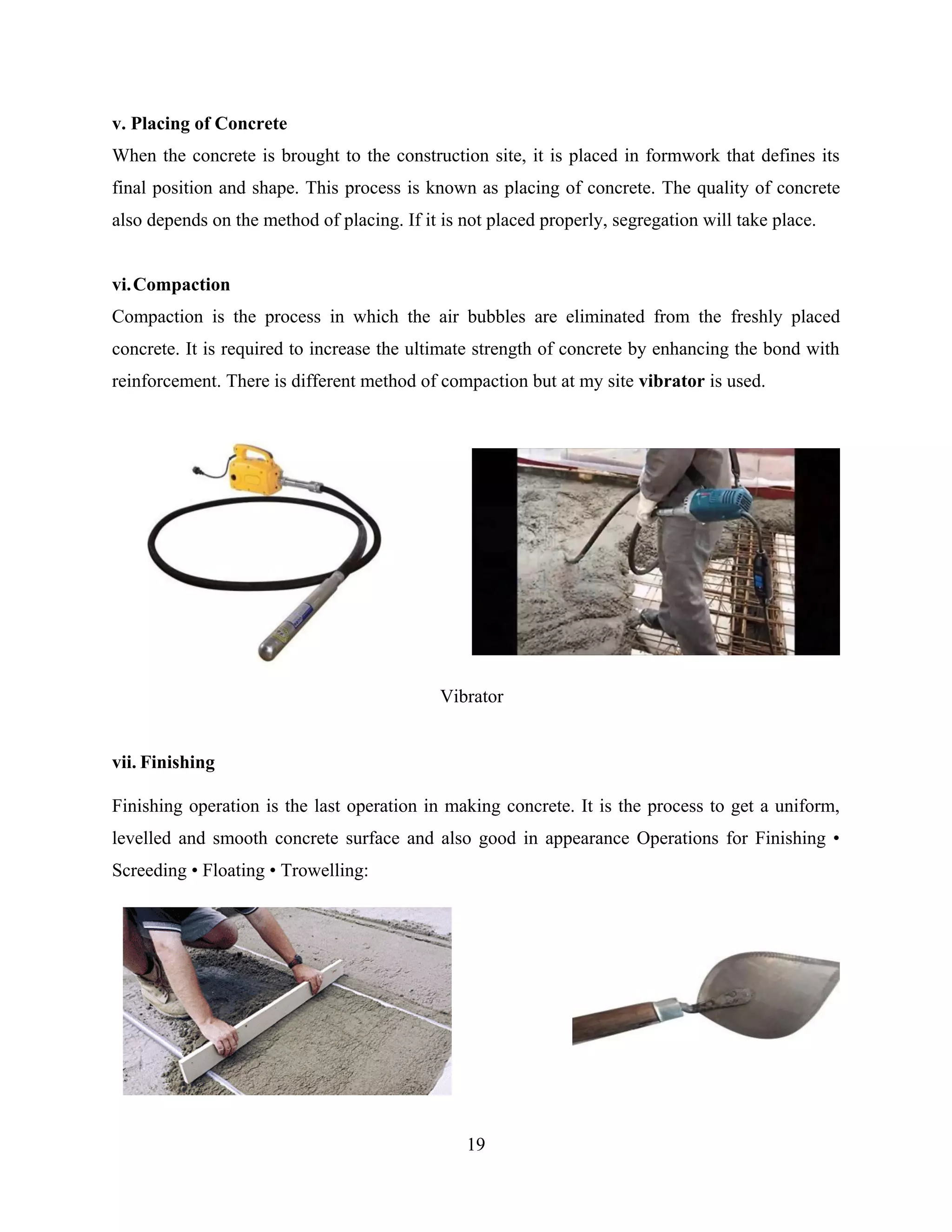
 Pans: -Concrete is transported in an iron pans manually. In this method labour is
available at cheap rates and don’t required a large amount of equipment.
 Pumps: - Pumps are used when large quantity of concrete is to be transported
continuously to be congested sites and for the slab. And when mixing plant cannot be
installed. The slump should not be less than 50 mm and more than 80 mm. The number
of bends in pipeline should be minimum rather should be avoided. The diameter of
pipeline depends upon the size of the aggregate used.
Concrete Mixer
19
v. Placing of Concrete
When the concrete is brought to the construction site, it is placed in formwork that defines its
final position and shape. This process is known as placing of concrete. The quality of concrete
also depends on the method of placing. If it is not placed properly, segregation will take place.
vi.Compaction
Compaction is the process in which the air bubbles are eliminated from the freshly placed
concrete. It is required to increase the ultimate strength of concrete by enhancing the bond with
reinforcement. There is different method of compaction but at my site vibrator is used.
vii. Finishing
Finishing operation is the last operation in making concrete. It is the process to get a uniform,
levelled and smooth concrete surface and also good in appearance Operations for Finishing •
Screeding • Floating • Trowelling:
Vibrator
20
viii. Curing
Curing may be defined as the operation of maintaining humidity and temperature of freshly
placed concrete during some definite period following placing, or finishing to assure satisfactory
hydration of the cement and proper hardening of the concrete. Or Curing may be defined as the
process of keeping the concrete moist and warm enough so that the complete hydration of the
cement can take place. Method of Curing: - i. Water curing iii. Application of heat ii. Membrane
curing iv. Miscellaneous methods
4.6 WALL CONSTRUCTION
The art of laying bricks in mortar in a proper systematic manner gives homogeneous mass which
can withstand forces without disintegration, called brick masonry. In framed structure generally
brick walls are constructed for partition purpose and half brick walls are made.
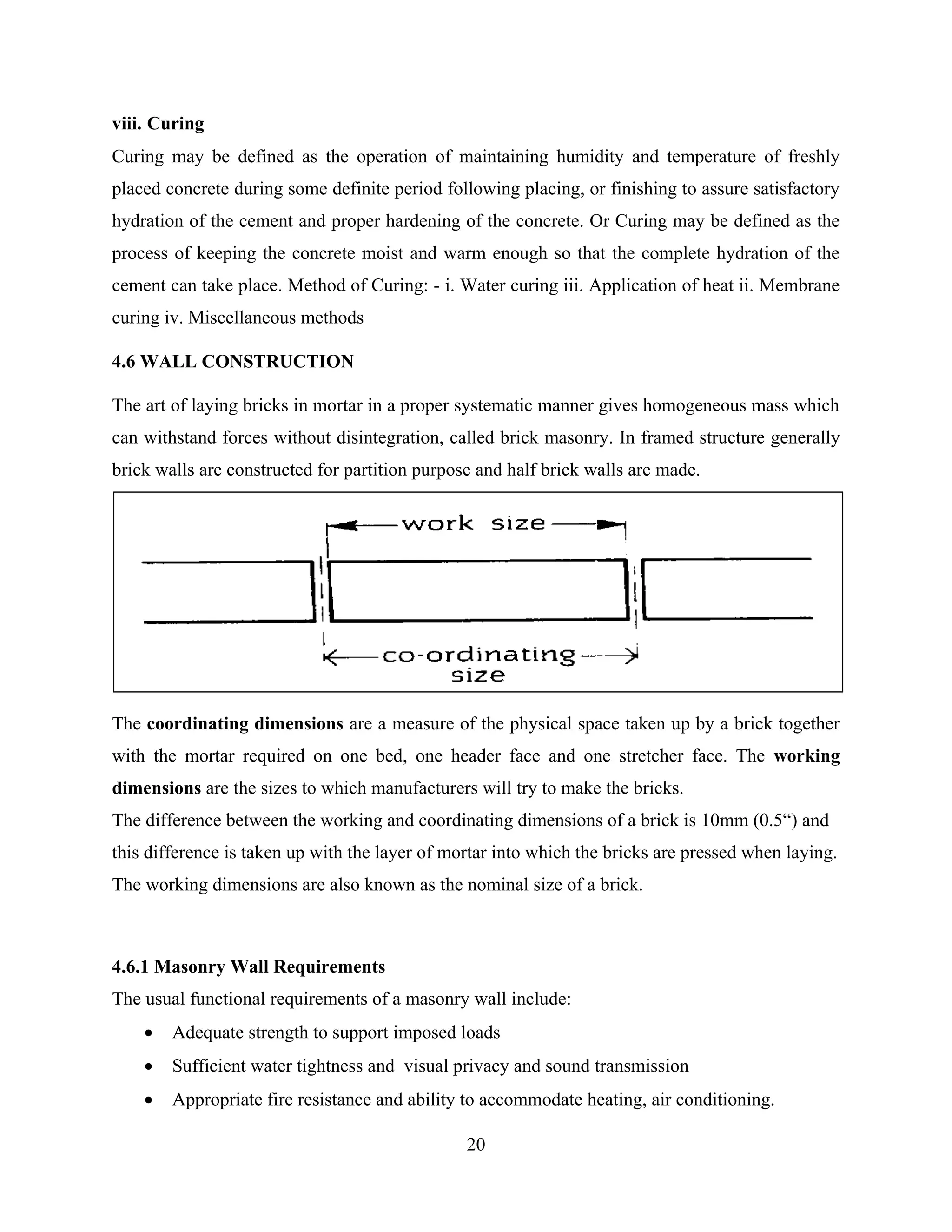
The coordinating dimensions are a measure of the physical space taken up by a brick together
with the mortar required on one bed, one header face and one stretcher face. The working
dimensions are the sizes to which manufacturers will try to make the bricks.
The difference between the working and coordinating dimensions of a brick is 10mm (0.5“) and
this difference is taken up with the layer of mortar into which the bricks are pressed when laying.
The working dimensions are also known as the nominal size of a brick.
4.6.1 Masonry Wall Requirements
The usual functional requirements of a masonry wall include:
 Adequate strength to support imposed loads
 Sufficient water tightness and visual privacy and sound transmission
 Appropriate fire resistance and ability to accommodate heating, air conditioning.
21
 Ability to receive various finish materials Cost and ability to provide openings such as
doors and window.
4.6.2 Bonds in Bricks
The arrangement of bricks in brick works so that the vertical joints don’t come over each other.
Bonds in brick work are provided to achieve a united mass as soon as practicable to suit the
length, height and thickness of brick work and stresses to which it is subjected. To break the
continuity of vertical joints and to provide proper bond in brick masonry portion of bricks are
provided in alternative courses.
[Note: At my Construction site 1st
class brick work is used and the ratio of mortar for brickwork
is 1:6 (Cement: sand)]
22
4.7 BEAM AND COLUMN CONSTRUCTION
A beam is a structural member which spans horizontally between supports and carries loads
which act at right angles to the length of the beam. They are small in cross-section compared
with their span. The width and depth of a typical beam are “small” compared with its span.
Typically, the width and depth are less than span/10.
A column can be defined as a vertical structural member designed to transmit a compressive
load. A Column transmits the load from ceiling/roof slab and beam, including its own weight to
the foundation. Hence it should be realized that the failure of a column results in the collapse of
the entire structure. The design of a column should therefore receive importance.
In framed structure fixed type beams are constructed. In such type of beams proper
reinforcement should be done for positive as well as negative bending moments. In such type of
structures short columns are constructed with minimum eccentricity. In square or rectangular
shaped columns min. 4 no’s of 12 mm diameter bars must be used.
23
4.8 SLAB CONSTRUCTION
Slabs are the flooring systems of most structures including office, commercial and residential
buildings, bridges, sports stadiums and other facilities building. The main functions of slabs are
generally to carry gravity forces, such as loads from human weight, goods and furniture, vehicles
and so on.
In modern structure design particularly for high rise buildings and basement structures, slabs as
floor diaphragms help in resisting external lateral actions such as wind, earthquake and lateral
earth load. The slab directly rests on beams or the column and load from the slab is directly
transferred to the beams and columns and then to the foundation.
To support heavy loads the thickness of slab near the support with the column is increased and
these are called drops, or columns are generally provided with enlarged heads called column
heads or capitals. Absence of beam gives a plain ceiling, thus giving better architectural
appearance than in usual cases where beams are used. Designing of slabs depends upon whether
it is a one-way or a two way slab, the end conditions and the loading. There are two types of slab
which are given below:-
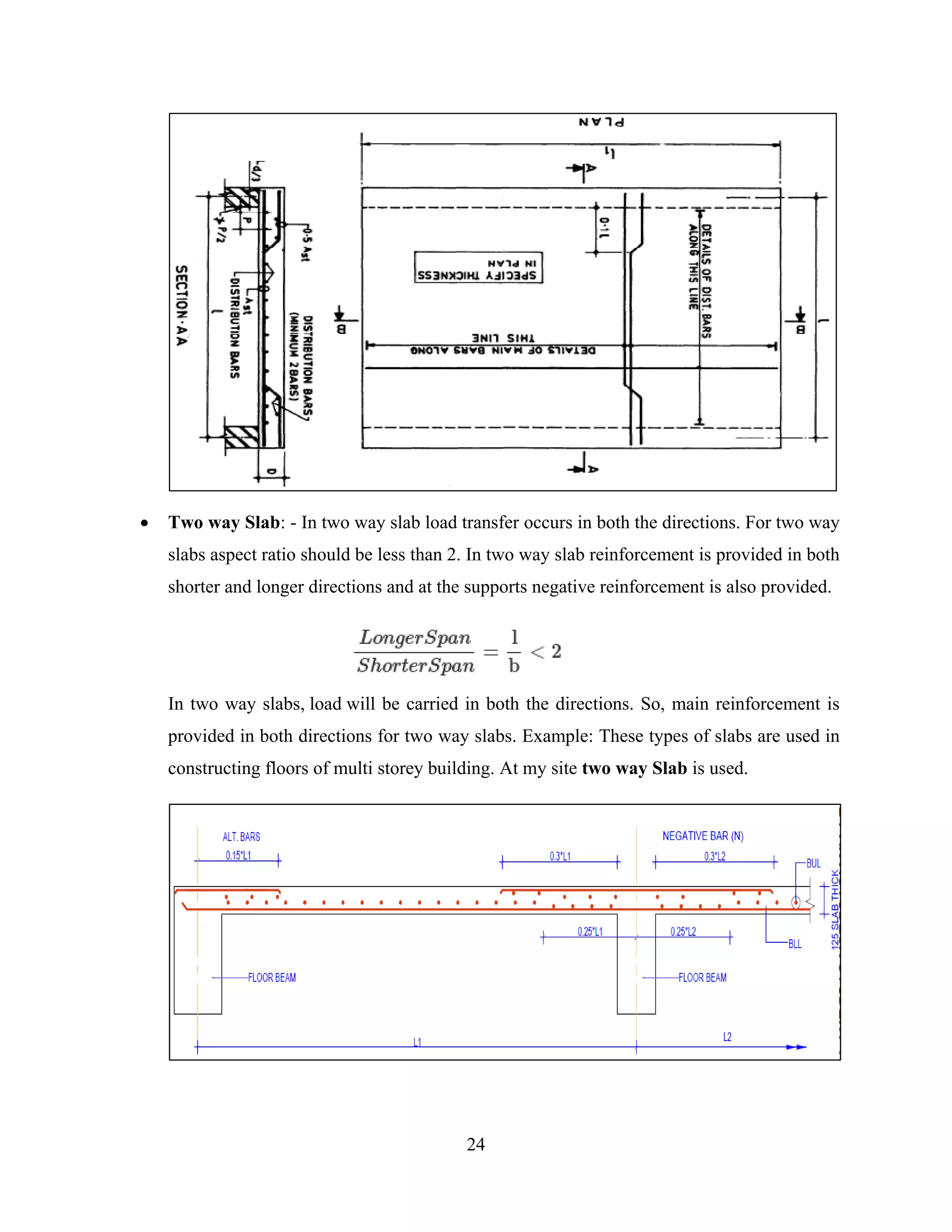
 One way Slab: -In one way slab load transfer occurs only in one direction. For one way
slab aspect ratio should be more than or equal to 2. In one way slab reinforcement
calculated is provided only in shorter direction and in other direction distribution steel is
provided.
Due to the huge difference in lengths, load is not transferred to the shorter beams. Main
reinforcement is provided in shorter span and distribution reinforcement in longer span.
Example: Generally all the Cantilever slabs are one Way slab. Chajjas and verandahs are
a practical example of one way slab.
24
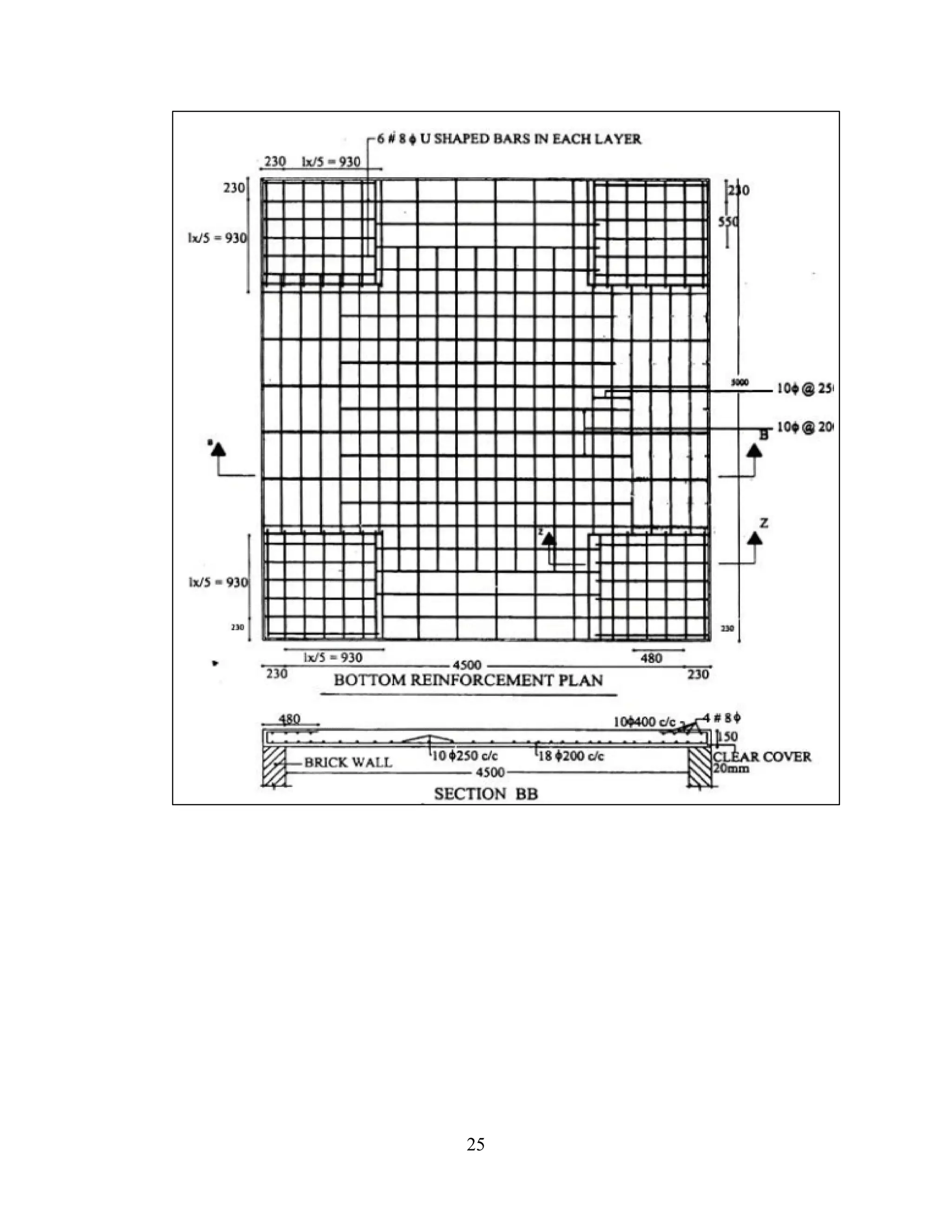
 Two way Slab: - In two way slab load transfer occurs in both the directions. For two way
slabs aspect ratio should be less than 2. In two way slab reinforcement is provided in both
shorter and longer directions and at the supports negative reinforcement is also provided.
In two way slabs, load will be carried in both the directions. So, main reinforcement is
provided in both directions for two way slabs. Example: These types of slabs are used in
constructing floors of multi storey building. At my site two way Slab is used.
25
26
5. QUALITY CONTROL
Quality control is the part of quality management that ensures products and service comply with
requirements. It is a work method that facilitates the measurement of the quality characteristics
of a unit, compares them with the established standards, and analyses the differences between the
results obtained and the desired results in order to make decisions which will correct any
differences.
5.1 Causes for poor quality: - These can be summarized as ignorance, poor materials, poor
design, poor detailing, and poor workmanship, improper quantity of cement, improper concrete
mix, excess water, inadequate compaction, substandard forms, inadequate curing, inadequate
cover, poor construction practices, poor supervision and above all lack of technical knowledge.
5.2 Quality control in concrete works.
Since concrete keeps a very important place in modern building construction works, so it is
necessary to test and inspection of concrete work at site. Following points should be kept in
mind while concreting.
 There should proper compacting of poured concrete because every 1% void reduces the
strength of concrete by 20%.
 There should be proper curing of concrete work for at least 7to10days because it helps in
gaining the strength.
 Level of formwork should be same throughout the building while casting the slab
 There should be a lab to test the properties of Green Concrete like slump, initial setting
time etc.
 There should be proper portioning of materials while preparing R.M.C.
5.3 Quality control works in concreting at site
 Needle vibrator was being used for compaction.
 RMC plant was being operated for concrete mixing.
 A lab was established for testing.
27
6. CONCLUSION
Under the guidance of Senior Er. Rajkumar Sah as a mentor, I have got opportunity to
understand the technical and managerial aspect of Institutional building project. The main aim of
studies within this project was to investigate how a structure is constructed within its desired
properties. We got to know about the basic & advanced techniques of building construction as
well as saw the challenges which a civil engineer have to face during construction i.e. labor
problems, cost management, environmental challenges etc. I cleared our many doubts regarding
building construction. Overall it must be said that the construction methods and quality control
on a Institutional project needs a very good coordination and large quantities of man power,
equipment and funds. During the period of 4 months all the site staff helped us a lot to provide
all the information about any query. So we are grateful to Kalaiya Sub-Metropolitan for giving
us the opportunity to learn and grow.

CIvil Engineering Training Report

  • 1.
    CONSTRUCTIONS OF 5STOREYS BLOCK A RAM RAJA CAMPUS KALAIYA SUB-METROPOLITAN CITY A training report Submitted in partial fulfillment of the requirements for the award of degree of BACHELOR IN CIVIL ENGINEERING Submitted to LOVELY PROFESSIONAL UNIVERSITY PHAGWARA, PUNJAB From 01/01/2020 to 02/05/2020 SUBMITTED BY Name of student: Masud Alam Ansari Submitted to: Registration Number: 11716156 Harsimran Singh Assistant professor
  • 2.
  • 3.
    Student Declaration To whomso ever it may concern I, Masud Alam Ansari Regd. No. 11716156 hereby declare that the work done by me on “Construction of 5 Storeys Block A of Ram Raja Campus” from 01/01/2020 to 02/05/2020 under the supervision of RajKumar Sah on the post of Senior Engineer in Kalaiya Sub- Metropolitan and internal supervisor Assistant professor Harsimran Singh, Lovely professional University, Phagwara, Punjab, is a record of original work for the partial fulfillment of the requirements for the award of the degree Bachelor in Civil Engineering. Name of the Student: Masud Alam Ansari Registration Number: 11716156
  • 5.
    Content 1. Introduction ofthe company …………………………………………….1-2 1.1Number of Department ……………………………………………….. 2 1.2Number of Employees………………………………………………… 2 2. Introduction of the project……………………………………………….3-6 2.1 Types of Building……………………………………………………… 3 2.2 Safety Measure………………………………………………………… 4 2.3 Location of Construction site………………………………………….. 5 2.4Formwork………………………………………………………………. 5 3. Materials and Equipment used at site…………………………………...6-10 3.1 Materials used………………………………………………………… 6 3.2 Equipment used at site………………………………………………... 9 4. Steps involved in Construction of Building……………………………10-25 4.1 Site Clearance……………………………………………………….. 10 4.2 Survey and lying out of drawing…………………………………… 11 4.3 Excavation of soil for Footing……………………………………… 12 4.4 Foundation………………………………………………………….. 13 4.5 Concreting operations………………………………………………. 16 4.6 Wall construction…………………………………………………… 20 4.7 Beam and Column construction……………………………………. 22 4.8 Slab construction……………………………………………………. 23 5. Quality control…………………………………………………………… 26 5.1 Causes for poor quality…………………………………………… …... 26 5.2 Quality control in concrete works……………………………… …….. 26 5.3Quality control works in concreting at site ………………………….... 26 6. Conclusion………………………………………………………………... 27
  • 6.
    1 1. INTRODUCTION OFTHE COMPANY It is a Kalaiya Sub Metropolitan City where the district headquarters of Bara district established in B.S. 2039 and is located in the distance of 306 KM from Kathmandu and 12 KM East of Birgunj. At the time of establishment, Sub Metropolitan Immediately Kalaiya, Bhaura, Bhavanipur, Barewa, Baghavan and Rampur VDC were included. This is divided into Vada. Ma. Np In the year 2047, the area was expanded to 14 wada by adding Bhatauda, Brahampuri, Visrampur VDCs. Due to the closure of Gadhimai Temple, which climbed Asia's great fortune. It is also being developed as a tourist area. Kalaiya is a Sub Metropolitan City of Bara district, a rich municipality of cultural diversity. According to the National Census 2068, according to the latest statistics from the total population of 6,87,708 in the district, total 13,205 households have 86,318 population, which is 12.56 percent of the total population of the district. There are 9 urban vessels and 18 rural vats. Ma. Np According to the data in the past, the road has expanded even with 12 kilograms of land, 3 km slope and 34 km of gravel and remaining roads have been expanded with 77 kilometer roads. From this, the city seems to have to pay attention to physical development and physical development. Bara district and Kalaiya U. Me Human development has shown that NP's lack of human and social development should be given priority.
  • 7.
    2 1.1 NUMBER OFDEPARTMENT Kalaiya Sub Metropolitan City mainly includes these Three Department which are given below:- i. Construction Department: - In this department manufacturing buildings differing by construction and function specifications designed and mentioned by the Engineers who are working in this organization. ii. Environmental Department: - To carry out work related to the monitoring and evaluation and testing of environmental impact assessment reports. iii. Health Service Department: - The overall purpose of the Department of Health Services is to deliver preventive, promotive and curative health services throughout Bara District. The D(oHS) is one of three departments under the Ministry of Health (MoH). 1.2 NUMBER OF EMPLOYEES S.N Name Designation Contact 1 Rajendra Pd. Ghimire Chief Administrative Officer 9855049111 2 Sunder kr. Thapa Section officer - 3 Mustak Ansari Chief Planning officer 9855045224 4 Raj kumar sah Engineer 9855045802 5 Anwar Ansari Engineer 9843715152 6 Dibya sarraf Accountant 053-550135
  • 8.
    3 7 Chandra sekharkumar Sub-Engineer 9814241130 2. INRODUCTION OF THE PROJECT UNDERTAKEN The basics needs of human existences are food, clothing’s & shelter. From times immemorial man has been making efforts in improving their standard of living. The point of his efforts has been to provide an economic and efficient shelter. The possession of shelter besides being a basic, used, gives a feeling of security, responsibility and shown the social status of man. Every human being has an inherent liking for a peaceful environment needed for his pleasant living, this object is achieved by having a place of living situated at the safe and convenient location, such a place for comfortable and pleasant living requires considered and kept in view. The engineer has to keep in mind the municipal conditions, building bye laws, environment, financial capacity, water supply, sewage arrangement, provision of future, aeration, ventilation etc., in suggestion a particular type of plan to any client. 2.1TYPES OF BUILDING i. Residential Building: In such building sleeping accommodation is provided. IT includes the living room, bed room, kitchen, hall, toilet and bath room. It may be a single storey building or apartments. ii. Institutional Building: These building are used for different purposes, such as medical or other treatment or care of a person suffering from a physical or mental illnesses. These building include hospital, sanatoria, jail etc. iii. Industrial Building: These are buildings in which products or material s of all kind of properties is fabricated, assembled, processed. For example refineries, gas plant, mills etc. iv. Educational Building: This includes any building using for school, college, assembly for instruction, education or recreation. A Campus is a building or an institution designed for the teaching of students under the direction of teachers. Similarly, a primary school is a school in which the children receive primary/elementary education within the age group of 5-11years and pre-primary education within the age group 1-5.A Campus is also an organized space purposed for teaching and learning, meaning to say that campus does not only refer to the building consisting of classrooms
  • 9.
    4 where students studybut it is as a whole the summation of various component parts that make a functional. These parts can be listed out as follows:- TEACHING / LEARNING AREAS OTHER AREAS Classrooms Staff & Administration Laboratory Cafeteria Libraries Storage Multi-purpose Hall Circulation Extra-Curricular Activity rooms Ancillary Space Computer Lab School Yard Auditorium Athletic field 2.2 SAFETY MEASURE Safety is very important part of any work. An induction video was showed which highlighted the need and importance of safety at construction site. Most accidents can be prevented by taking simple measures or adopting proper working procedures. It is very important to discuss issues on safety and health that should be paid attention to on construction sites for easy reference by the workers. If we work carefully and take appropriate safety measures, there will definitely be
  • 10.
    5 fewer work injurycases, and our sites will become a safe and secure place to work in. It is important to educate everyone in the site regarding for safety. The Equipment used for safety at construction site is given below:- Helmet Sun Glasses Gloves Safety Harnesses 2.3 LOCATION OF CONSTRUCTION SITE. The location of construction site is situated at 3 KM away from the main city. 2.4 FORM WORK Formwork is the term used for the process of creating a temporary mould into which concrete is poured in the box and formed. Traditional formwork is fabricated using timber, but it
  • 11.
    6 be constructed fromsteel, glass fibre reinforced plastics and other materials. At my construction site steel formwork is used. When selecting formwork, the type of concrete and temperature of the pour are important considerations as they both effect the pressure exerted.The formwork sides must be capable of resisting the hydrostatic pressure of the wet concrete which will diminish to zero within several hours depending on the rate of setting and curing. 3. MATERIALS AND EQUIPMENTS USED AT SITE. 3.1 MATERIALS USED Building material is any material which is used for construction purposes. Many naturally occurring substances, such as clay, rocks, sand, and wood, even twigs and leaves, have been used to construct buildings. Apart from naturally occurring materials, many man-made products are in use, some more and some less synthetic. The manufacturing of building materials is an established industry in many countries and the use of these materials is typically segmented into specific specialty trades, such as carpentry, insulation, plumbing, and roofing work. They provide the make-up of habitats and structures including homes. The total cost of Building materials includes:-Economic cost, Ecological cost, Energy cost, Social cost.
  • 12.
    7 At the constructionsite following materials were being used. i. CEMENT Cement is a binder, a substance used for construction that sets, hardens, and adheres to other materials to bind them together. Cement is seldom used on its own, but rather to bind sand and gravel (aggregate) together. Cement mixed with fine aggregate produces mortar for masonry, or with sand and gravel, produces concrete. Concrete is the most widely used material in existence and is only behind water as the planet's most-consumed resource. Quality of cement is based on grade of cement. The grades of cement are as-  33 Grades  43 Grades  53 Grades At the site Portland cement of 53 grades (JAGDAMBA CEMENT) was used. The initial setting time of cement = 30 min and the final setting time of cement = 10 hrs. ii. AGGREGATE Aggregates are small pieces of broken stones in irregular size and shapes. Neat cement is very rarely used in construction works since it is liable to shrink too much and become cracks on setting. Moreover, it will be costly to use neat cement in construction work. Therefore cement is mixed with some inert strong & durable hard materials. They also reduce the cost of concrete because they are comparative much cheaper as cement. Mainly there are two types of Aggregate:-  Fine Aggregate:- The aggregate, which pass through 4.75 mm, I.S. sieve and entirely retain on 75 micron (.075mm) I.S. sieve is known as fine aggregate. The surface area of fine aggregates is higher. The function of using fine aggregate in a concrete mix is to fill up the voids existing in the coarse aggregate and to obtain a dense and strong concrete with less quantity of cement and increase the workability of the concrete mix. It is used in mortar, plaster, concrete, filling of road pavement layers, etc.
  • 13.
    8  Coarse aggregate:-Theaggregate, which pass through 75 mm I.S. sieve and entirely retain on 4.75 mm I.S. sieve is known as coarse aggregates. Coarse aggregate acts as inert filler material for concrete. The functions are almost same as that of fine aggregate. [Note: - At construction site aggregate used are coarse aggregate of 20mm size. Coarse aggregate of 12.5 mm size (As per concrete mix design). And River bank Fine aggregate.] iii. REINFORCEMENT The material that develops a good bond with concrete in order to increase its strength is called reinforcement. Steel bars are highly strong in tension, shear, bending moment, torsion and compression.  Foundation Mess (Footing):- 12 mm Dia. Both Direction  Column: - Corner Bar: 20 mm Dia, Inner Bar: 16 mm Dia, Stirrups: 8 mm Dia.
  • 14.
    9  Beam:- MainBar:20 mm and 16 mm Dia, Stirrups: 8 mm Reinforcement working as a tension member because concrete is strong in compression and week in tension so reinforcement resists the tensile stresses in the concrete members. At the site contractor using the high strength steel bars and T.M.T. (Thermo Mechanically Treated) bars of diameter 8 mm, 10 mm, 16 mm, & 20 mm as per requirement of design. The bars were of grade Fe500 .The bars were of brand HIMAL STEEL. The main reason of using steel bars in RCC is that, the coefficient of thermal expansion of steel bars and concrete is of approximately equal value. 3.2 EQIPMENT USED AT SITE  Excavators: - Excavators are important and widely used equipment in construction industry. Their general purpose is to excavation but other than that they are also used for many purposes like heavy lifting, demolition, river dredging, cutting of trees etc.
  • 15.
    10  Rotary mixerfor transporting R.M.C :- A concrete mixer (often colloquially called a cement mixer) is a device that homogeneously combines cement, aggregate such as sand or gravel, and water to form concrete. A typical concrete mixer uses a revolving drum to mix the components. For smaller volume works, portable concrete mixers are often used so that the concrete can be made at the construction site, giving the workers ample time to use the concrete before it hardens. 4. STEPS INVOLVED IN CONSTRUCTION OF BUILDING 4.1 SITE CLEARANCE It is the removal of all accumulated waste from an area to ensure that it's free from any hazards, obstacles or unsightly mess. A no of conditions determine the kind of building that may be erected on a plot of ground. These conditions determine where on the plot it may be located. There are also convenants that are legally binding regulations. These may be setting height of building, prohibit utility of buildings or ban rooftop network towers etc. The equipment used in site clearance is given below:- i. Bulldozer ii. Tractor iii. Scraper iv. Shovel
  • 16.
    11 4.2 SURVEY ANDLAYINGOUT OF DRAWING Surveying is the process of determining relative positions of different objects on the surface of the earth by measuring horizontal distances between them and preparing a map to any suitable scale. Survey is the first step done in any construction site so as to get the required level of surface. At my construction site Auto level is used for the leveling. It is a leveling instrument which was on site checking the elevations of various points. How is an auto level used in surveying? An auto level is a type of leveling tool that’s used by contractors, builders, and land surveyors who need to make consistently accurate level measurements. They’re fast and easy to use, which can save a great deal of time and money while on the job site. And some of them come in kits that will include both a grade rod and a tripod. An automatic level can be used in a variety of situations -- some of which include: i. Verifying the elevation of foundations, footings, and walls. ii. Designing proper drainage systems for homes and other structures. iii. Determining the proper elevation for a floor. iv. Determining the height of doors and windows. v. Building suspended ceilings.
  • 17.
    12 4.3 EXCAVATION OFSOIL FOR FOOTING Excavation work on the site was being done by the JCB Machines and excavated soil was transferred using Tractor. Excavation is the equipment-heavy task of removing the earth from the allotted area in order to make room for the foundation. Depending on the depth and hardness of the soil, the trench may need to be reinforced as earth is removed. If the earth is extremely loose, planking will be put in place to hold the sides until the foundation can be poured. The following Drawings are required for Excavation is given below:- i. Centerline Drawing: - Centerline drawings represent the grids marked in numbers and alphabets whose measurements are shown for site marking out reference. These grid lines are so aligned that the line falls on the excavation and footing. ii. Excavation Drawing: - Excavation drawing represents the length, width and depth of the excavation. Excavation line is marked in dotted line. 4.3.1 Scope of the work for Excavation The major works done before while and after excavation is as follows:- i. Setting out of corner benchmarks. ii. Survey for ground levels. iii. Survey for top levels iv. Excavation to approved depth. v. Dressing of loose soil. vi. Constructing dewatering wells and interconnecting trenches. vii. Marking boundaries of the building.
  • 18.
    13 4.4 FOUNDATION The lowestpart of a structure which transmits the weight of the structure together with live loads, seismic and wind pressure to the ground surface on which the structure rests, ensuring its safe bearing capacity, is called foundation. To increase the stability of the structure, foundations are generally placed below the ground level. 4.4.1 Functions of Foundations i. To transmit and distribute the total load of the structure to a larger area of underlying support. ii. To prevent differential settlement of the structure. iii. To provide stability to the structure. 4.4.2 Types of Footing The following two types of footing used at my construction site are given below:- i. Isolated Footing :- An isolated footing is used to support the load on a single column. It is usually either square or rectangular in plan. It represents the simplest, most economical type and most widely used footing. Whenever possible, square footings are provided so as to reduce the bending moments and shearing forces at their critical sections. Isolated footings are used in case of light column loads, when columns are not closely spaced. An isolated footing must, therefore, be provided by two sets of reinforcement bars placed on top of the other near the bottom of the footing. In case of property line restrictions, footings may be designed for eccentric loading or combined footing is used as an alternative to isolated footing. ii. Mat Footing:- This is a footing that covers the entire area under the structure. This footing is used when very heavy loads of building are to be transmitted to the underlying soil having very low and differential bearing capacities. Due to its rigidity, it minimizes differential settlement. There are several types of raft foundation in use. The most common types are; the flat slab and the slab-beam types
  • 19.
  • 20.
    15 4.4.2 Requirement ofGood Foundation The design and the construction of a well-performing foundation must possess some basic requirements that must not be ignored. They are: i. The design and the construction of the foundation is done such that it can sustain as well as transmit the dead and the imposed loads to the soil. This transfer has to be carried out without resulting in any form of settlement that can result in any form of stability issues for the structure. ii. Differential settlements can be avoided by having a rigid base for the foundation. These issues are more pronounced in areas where the superimposed loads are not uniform in nature. iii. Based on the soil and area it is recommended to have a deeper foundation so that it can guard any form of damage or distress. These are mainly caused due to the problem of shrinkage and swelling because of temperature changes. iv. The location of the foundation chosen must be an area that is not affected or influenced by future works or factors.
  • 21.
    16 4.5 CONCRETING OPERATIONS Theprocesses which are followed in actual practices in the making of concrete and in improving and maintaining the quality of concrete is called concreting Operation. The following operations are involved in concrete making:- i. Storing of Materials when the words come in mind for storing must of the time is to store the cement. Cement is finely ground material. It is highly hygroscopic. It absorbs moisture which may be in the form of free water or moisture from air. Absorption of 1 to 2% of water has no appreciable effect, but further amount of absorption reduce the strength of cement. Warehouse is a weather proof building for storage of cement. At our site Jagdamba cement is used. Long storage will reduce the strength of cement. The strength of the cement which has been stored for a long time should be checked in the laboratory before it is used on important works. ii. Batching The process of measuring different concrete materials such as cement, coarse aggregate, sand, water for the making of concrete is known as batching. Batching can be done in two different ways.
  • 22.
    17  Volume Batching Weight Batching In volume batching the measurements of concrete materials are taken by volume & On the other hand the measurements are taken by weight in weight batching. At my site volume batching is used for the entire ingredient with wooden batch boxes known as formas. iii.Mixing The process of mixing various ingredients of concrete (cement, sand and water) in a specified proportion is termed as mixing. The quality and strength of concrete depends upon proper thorough mixing and uniform colour of concrete. Methods of Mixing:-  Hand Mixing  Machine Mixing When the mixing is done by the manual labour i.e. called hand mixing. It is used for small and unimportant work and when the quantity of concrete used is small. It requires 10% more cement than machine mixing. When the mixing is done by machine i.e. called machine mixing. In the case of large quantity of concrete is used to be produced, hand mixing is costlier even if the labour is cheap. The machine mixing becomes essential. The concrete can thus be produced at a faster rate and a Volume batching Weight batching
  • 23.
    18 lesser cost. Thequality of concrete by machine mixing is also better. At my construction site machine mixing is used. iv.Transportation of Concrete. The process of carrying concrete mix when the mixing is done properly the freshly made concrete is then transported to the construction site; this process is known as transportation. After that, the concrete is correctly placed on the formworks. Concrete can be transported to the site location in different ways. But at my site two types are used:-  Pans: -Concrete is transported in an iron pans manually. In this method labour is available at cheap rates and don’t required a large amount of equipment.  Pumps: - Pumps are used when large quantity of concrete is to be transported continuously to be congested sites and for the slab. And when mixing plant cannot be installed. The slump should not be less than 50 mm and more than 80 mm. The number of bends in pipeline should be minimum rather should be avoided. The diameter of pipeline depends upon the size of the aggregate used. Concrete Mixer
  • 24.
    19 v. Placing ofConcrete When the concrete is brought to the construction site, it is placed in formwork that defines its final position and shape. This process is known as placing of concrete. The quality of concrete also depends on the method of placing. If it is not placed properly, segregation will take place. vi.Compaction Compaction is the process in which the air bubbles are eliminated from the freshly placed concrete. It is required to increase the ultimate strength of concrete by enhancing the bond with reinforcement. There is different method of compaction but at my site vibrator is used. vii. Finishing Finishing operation is the last operation in making concrete. It is the process to get a uniform, levelled and smooth concrete surface and also good in appearance Operations for Finishing • Screeding • Floating • Trowelling: Vibrator
  • 25.
    20 viii. Curing Curing maybe defined as the operation of maintaining humidity and temperature of freshly placed concrete during some definite period following placing, or finishing to assure satisfactory hydration of the cement and proper hardening of the concrete. Or Curing may be defined as the process of keeping the concrete moist and warm enough so that the complete hydration of the cement can take place. Method of Curing: - i. Water curing iii. Application of heat ii. Membrane curing iv. Miscellaneous methods 4.6 WALL CONSTRUCTION The art of laying bricks in mortar in a proper systematic manner gives homogeneous mass which can withstand forces without disintegration, called brick masonry. In framed structure generally brick walls are constructed for partition purpose and half brick walls are made. The coordinating dimensions are a measure of the physical space taken up by a brick together with the mortar required on one bed, one header face and one stretcher face. The working dimensions are the sizes to which manufacturers will try to make the bricks. The difference between the working and coordinating dimensions of a brick is 10mm (0.5“) and this difference is taken up with the layer of mortar into which the bricks are pressed when laying. The working dimensions are also known as the nominal size of a brick. 4.6.1 Masonry Wall Requirements The usual functional requirements of a masonry wall include:  Adequate strength to support imposed loads  Sufficient water tightness and visual privacy and sound transmission  Appropriate fire resistance and ability to accommodate heating, air conditioning.
  • 26.
    21  Ability toreceive various finish materials Cost and ability to provide openings such as doors and window. 4.6.2 Bonds in Bricks The arrangement of bricks in brick works so that the vertical joints don’t come over each other. Bonds in brick work are provided to achieve a united mass as soon as practicable to suit the length, height and thickness of brick work and stresses to which it is subjected. To break the continuity of vertical joints and to provide proper bond in brick masonry portion of bricks are provided in alternative courses. [Note: At my Construction site 1st class brick work is used and the ratio of mortar for brickwork is 1:6 (Cement: sand)]
  • 27.
    22 4.7 BEAM ANDCOLUMN CONSTRUCTION A beam is a structural member which spans horizontally between supports and carries loads which act at right angles to the length of the beam. They are small in cross-section compared with their span. The width and depth of a typical beam are “small” compared with its span. Typically, the width and depth are less than span/10. A column can be defined as a vertical structural member designed to transmit a compressive load. A Column transmits the load from ceiling/roof slab and beam, including its own weight to the foundation. Hence it should be realized that the failure of a column results in the collapse of the entire structure. The design of a column should therefore receive importance. In framed structure fixed type beams are constructed. In such type of beams proper reinforcement should be done for positive as well as negative bending moments. In such type of structures short columns are constructed with minimum eccentricity. In square or rectangular shaped columns min. 4 no’s of 12 mm diameter bars must be used.
  • 28.
    23 4.8 SLAB CONSTRUCTION Slabsare the flooring systems of most structures including office, commercial and residential buildings, bridges, sports stadiums and other facilities building. The main functions of slabs are generally to carry gravity forces, such as loads from human weight, goods and furniture, vehicles and so on. In modern structure design particularly for high rise buildings and basement structures, slabs as floor diaphragms help in resisting external lateral actions such as wind, earthquake and lateral earth load. The slab directly rests on beams or the column and load from the slab is directly transferred to the beams and columns and then to the foundation. To support heavy loads the thickness of slab near the support with the column is increased and these are called drops, or columns are generally provided with enlarged heads called column heads or capitals. Absence of beam gives a plain ceiling, thus giving better architectural appearance than in usual cases where beams are used. Designing of slabs depends upon whether it is a one-way or a two way slab, the end conditions and the loading. There are two types of slab which are given below:-  One way Slab: -In one way slab load transfer occurs only in one direction. For one way slab aspect ratio should be more than or equal to 2. In one way slab reinforcement calculated is provided only in shorter direction and in other direction distribution steel is provided. Due to the huge difference in lengths, load is not transferred to the shorter beams. Main reinforcement is provided in shorter span and distribution reinforcement in longer span. Example: Generally all the Cantilever slabs are one Way slab. Chajjas and verandahs are a practical example of one way slab.
  • 29.
    24  Two waySlab: - In two way slab load transfer occurs in both the directions. For two way slabs aspect ratio should be less than 2. In two way slab reinforcement is provided in both shorter and longer directions and at the supports negative reinforcement is also provided. In two way slabs, load will be carried in both the directions. So, main reinforcement is provided in both directions for two way slabs. Example: These types of slabs are used in constructing floors of multi storey building. At my site two way Slab is used.
  • 30.
  • 31.
    26 5. QUALITY CONTROL Qualitycontrol is the part of quality management that ensures products and service comply with requirements. It is a work method that facilitates the measurement of the quality characteristics of a unit, compares them with the established standards, and analyses the differences between the results obtained and the desired results in order to make decisions which will correct any differences. 5.1 Causes for poor quality: - These can be summarized as ignorance, poor materials, poor design, poor detailing, and poor workmanship, improper quantity of cement, improper concrete mix, excess water, inadequate compaction, substandard forms, inadequate curing, inadequate cover, poor construction practices, poor supervision and above all lack of technical knowledge. 5.2 Quality control in concrete works. Since concrete keeps a very important place in modern building construction works, so it is necessary to test and inspection of concrete work at site. Following points should be kept in mind while concreting.  There should proper compacting of poured concrete because every 1% void reduces the strength of concrete by 20%.  There should be proper curing of concrete work for at least 7to10days because it helps in gaining the strength.  Level of formwork should be same throughout the building while casting the slab  There should be a lab to test the properties of Green Concrete like slump, initial setting time etc.  There should be proper portioning of materials while preparing R.M.C. 5.3 Quality control works in concreting at site  Needle vibrator was being used for compaction.  RMC plant was being operated for concrete mixing.  A lab was established for testing.
  • 32.
    27 6. CONCLUSION Under theguidance of Senior Er. Rajkumar Sah as a mentor, I have got opportunity to understand the technical and managerial aspect of Institutional building project. The main aim of studies within this project was to investigate how a structure is constructed within its desired properties. We got to know about the basic & advanced techniques of building construction as well as saw the challenges which a civil engineer have to face during construction i.e. labor problems, cost management, environmental challenges etc. I cleared our many doubts regarding building construction. Overall it must be said that the construction methods and quality control on a Institutional project needs a very good coordination and large quantities of man power, equipment and funds. During the period of 4 months all the site staff helped us a lot to provide all the information about any query. So we are grateful to Kalaiya Sub-Metropolitan for giving us the opportunity to learn and grow.