PASSIVE SOLAR BUILDINGS
ATHUL N T K
CE S3
RL NO. :48
PRN. NO:
WHAT IS A PASSIVE HOUSE?
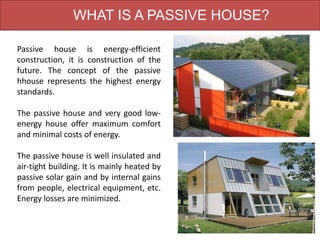
Passive house is energy-efficient
construction, it is construction of the
future. The concept of the passive
hhouse represents the highest energy
standards.
The passive house and very good low-
energy house offer maximum comfort
and minimal costs of energy.
The passive house is well insulated and
air-tight building. It is mainly heated by
passive solar gain and by internal gains
from people, electrical equipment, etc.
Energy losses are minimized.
WHAT IS A PASSIVE HOUSE?
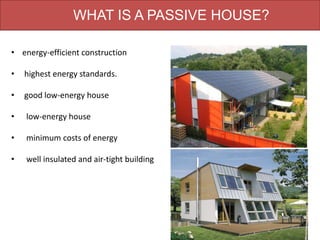
• energy-efficient construction
• highest energy standards.
• good low-energy house
• low-energy house
• minimum costs of energy
• well insulated and air-tight building
PASSIVE HOUSE
The Passive house is not an energy
performance standard, but a concept to
achive highest thermal comfort
conditions on low total costs. Passive
houses do not require active heating
system. In winter a comfortable
temperature is achieved without a
special system for central heating and
in summer without air-conditioning
systems.
Passive house is only low energy
building. In passive house we can live
as in any normal house. Higher living
standards are provided with technical
improvements in good thermal
insulation and in-house technique.
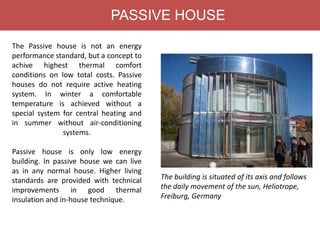
The building is situated of its axis and follows
the daily movement of the sun, Heliotrope,
Freiburg, Germany
MAJOR FEATURES OF ARCHITECTURE DESIGN
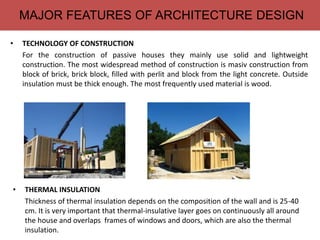
• THERMAL INSULATION
Thickness of thermal insulation depends on the composition of the wall and is 25-40
cm. It is very important that thermal-insulative layer goes on continuously all around
the house and overlaps frames of windows and doors, which are also the thermal
insulation.
• TECHNOLOGY OF CONSTRUCTION
For the construction of passive houses they mainly use solid and lightweight
construction. The most widespread method of construction is masiv construction from
block of brick, brick block, filled with perlit and block from the light concrete. Outside
insulation must be thick enough. The most frequently used material is wood.
MAJOR FEATURES OF ARCHITECTURE DESIGN
• SAVING OF SOLAR ENERGY
In the building the heat is stored in order to use it later, when solar irradiation is no
available. Because of this the need of heat is reduced.
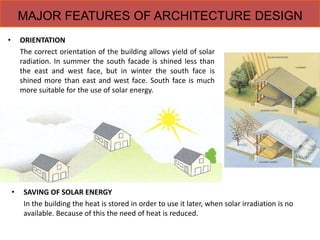
• ORIENTATION
The correct orientation of the building allows yield of solar
radiation. In summer the south facade is shined less than
the east and west face, but in winter the south face is
shined more than east and west face. South face is much
more suitable for the use of solar energy.
HEAT LOSSES = HEAT GAINS
HEAT RECOVERY OF PASSIVE HOUSE
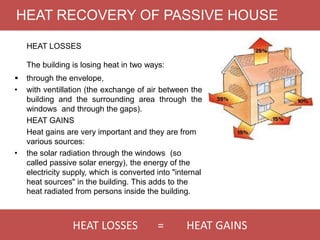
HEAT LOSSES
The building is losing heat in two ways:
 through the envelope,
• with ventillation (the exchange of air between the
building and the surrounding area through the
windows and through the gaps).
HEAT GAINS
Heat gains are very important and they are from
various sources:
• the solar radiation through the windows (so
called passive solar energy), the energy of the
electricity supply, which is converted into "internal
heat sources" in the building. This adds to the
heat radiated from persons inside the building.
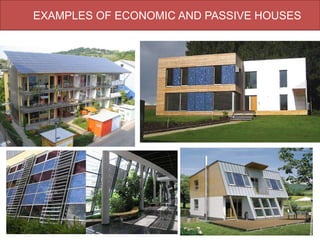
EXAMPLES OF ECONOMIC AND PASSIVE HOUSES
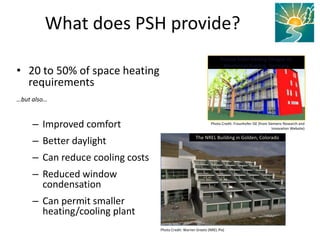
• 20 to 50% of space heating
requirements
…but also…
– Improved comfort
– Better daylight
– Can reduce cooling costs
– Reduced window
condensation
– Can permit smaller
heating/cooling plant
What does PSH provide?
Photo Credit: Fraunhofer ISE (from Siemens Research and
Innovation Website)
Passive Solari Healing Désigne on
Résidentiel Building, Germany
The NREL Building in Golden, Colorado
Photo Credit: Warren Greets (NREL Pix)
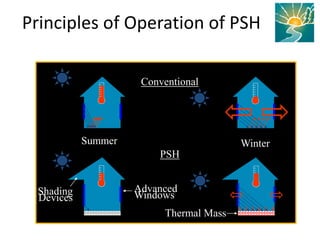
Principles of Operation of PSH
Conventional
Summer Winter
Shading
Devices
Advanced
Windows
Thermal Mass
PSH
The three principles of passive solar design are:
• Gain: Getting enough sunlight in at the right time
(and blocking it at the right time as well).
• Thermal Mass: Having enough thick masonry
surfaces to store the energy from sunlight to keep
the home warm at night, and from overheating
during the day.
• Insulation: Having good insulation (and low air
leakage) to keep the heat in during the winter, and
heat out during the summer.
Characteristics of a Passive Solar Building
• In the northern hemisphere most of its windows are
facing the south
• Ideally, the interior surfaces that the light strikes are
high density materials, such as concrete, brick, or
stone,
• West windows are a source of high heat gain during
the summer, and should be shaded.
Passive Solar Design
• Passive solar buildings often have "open floor plans"
to facilitate the movement of heat from the south
side through the rest of the spaces.
•
• Sometimes small fans are used to aid in warm air
distribution in spaces with "closed floor plans".
Passive Solar Techniques
1: Direct Gain
• There are two basic ways passive solar spaces gain
solar energy, direct and indirect gain.
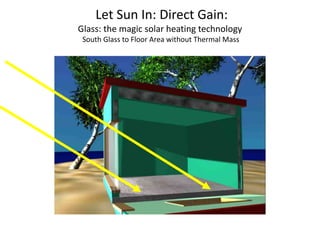
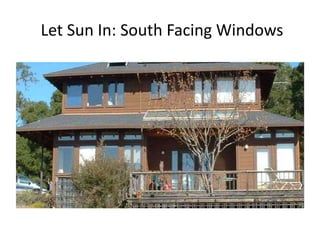
• Direct gain spaces, considered to be the simplest
type, rely on south-facing windows, called solar
windows. These can be conventionally manufactured
operable or fixed windows on the south wall of the
spaces.
• While some of the heat is used immediately, walls,
floors, ceilings, and furniture store the excess heat,
which radiates into the space throughout the day
and night.
• In all cases the performance and comfort of the
direct gain space will increase if the thermal mass
(concrete, concrete block, brick, or adobe) within the
space is increased.
Let Sun In: Direct Gain:
Glass: the magic solar heating technology
South Glass to Floor Area without Thermal Mass
2.2 Thermal Mass
• If solar heat is to be used when the sun is not
shining, excess heat must be stored. Thermal
mass, or materials used to store heat, is an
integral part of most passive solar design.
They are the materials with a high capacity for
absorbing and storing heat (e.g., brick,
concrete masonry, concrete slab, tile, adobe,
water) [13] as shown in the Figure 6.
Figure 6. Thermal Mass [14].
1.3 Insulation
• Materials that insulate well do so because
they are poor conductors of heat. Having a
home without insulation is doing just that -
leaving the house open year round. Ideally,
you should insulate every surface between
your house and the outside world. There are
lots of choices for insulation - from loose fill,
batts or rolls of the "pink stuff," to rigid boards
and foam-in-place products [4].
Let Sun In: South Facing Windows
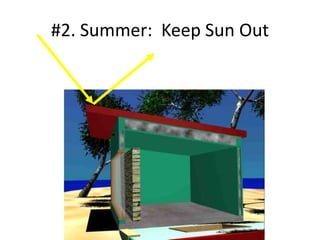
#2. Summer: Keep Sun Out
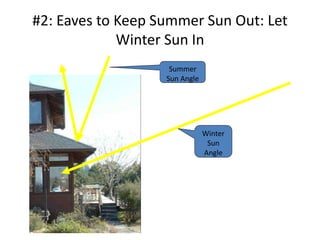
#2: Eaves to Keep Summer Sun Out: Let
Winter Sun In
Summer
Sun Angle
Winter
Sun
Angle
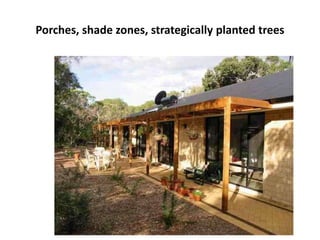
Porches, shade zones, strategically planted trees
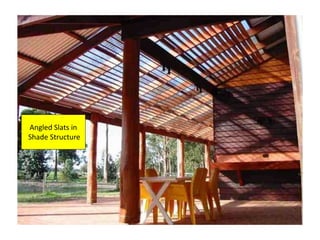
Angles slats let
winter sun in
Angled Slats in
Shade Structure
25
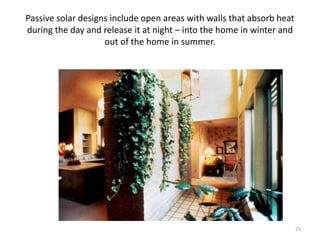
Passive solar designs include open areas with walls that absorb heat
during the day and release it at night – into the home in winter and
out of the home in summer.
26
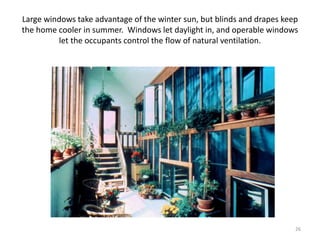
Large windows take advantage of the winter sun, but blinds and drapes keep
the home cooler in summer. Windows let daylight in, and operable windows
let the occupants control the flow of natural ventilation.
Shading and Thermal Mass
• Shading prevents overheating in summer
 Overhangs on equator-facing exposure for when sun is high
 Deciduous trees, nearby buildings and structures
 Screens, shutters, awnings, recessed windows, blinds, etc.
• Thermal mass stores heat, minimizing temperature swings
 If equator-facing window area exceeds 8 to 10% of heated floor area, traditional
light-weight construction house will overheat
 Use double gyproc walls, ceilings, ceramic floors, brick fireplace, etc.
• Active systems can be used to distribute heat through building
6. The Advantages of Passive Solar
Design
• High energy performance: lower energy bills all year round.
• Investment: independent from future rises in fuel costs,
continues to save money long after initial cost recovery.
• Value: high owner satisfaction, high resale value
• Attractive living environment: large windows and views, sunny
interiors, open floor plans
• Low Maintenance: durable, reduced operation and repair
• Unwavering comfort: quiet (no operating noise), warmer in
winter, cooler in summer (even during a power failure)
• Environmentally friendly: clean, renewable energy doesn't
contribute to global warming, acid rain or air pollution [1].
Conclusions
• PSH involves building orientation, energy efficient windows, shading, and
thermal mass to reduce space heating costs
• Minimal additional investment in windows can greatly improve performance
of building envelope with long term financial benefits
•
– Effect of window technology on heat losses
– Effect of shading on cooling load
– Effect of window orientation, size, and technology on solar gains
THANK YOU FOR
LISTERNING ….

passive solar buildings

  • 1.
    PASSIVE SOLAR BUILDINGS ATHULN T K CE S3 RL NO. :48 PRN. NO:
  • 2.
    WHAT IS APASSIVE HOUSE? Passive house is energy-efficient construction, it is construction of the future. The concept of the passive hhouse represents the highest energy standards. The passive house and very good low- energy house offer maximum comfort and minimal costs of energy. The passive house is well insulated and air-tight building. It is mainly heated by passive solar gain and by internal gains from people, electrical equipment, etc. Energy losses are minimized.
  • 3.
    WHAT IS APASSIVE HOUSE? • energy-efficient construction • highest energy standards. • good low-energy house • low-energy house • minimum costs of energy • well insulated and air-tight building
  • 4.
    PASSIVE HOUSE The Passivehouse is not an energy performance standard, but a concept to achive highest thermal comfort conditions on low total costs. Passive houses do not require active heating system. In winter a comfortable temperature is achieved without a special system for central heating and in summer without air-conditioning systems. Passive house is only low energy building. In passive house we can live as in any normal house. Higher living standards are provided with technical improvements in good thermal insulation and in-house technique. The building is situated of its axis and follows the daily movement of the sun, Heliotrope, Freiburg, Germany
  • 5.
    MAJOR FEATURES OFARCHITECTURE DESIGN • THERMAL INSULATION Thickness of thermal insulation depends on the composition of the wall and is 25-40 cm. It is very important that thermal-insulative layer goes on continuously all around the house and overlaps frames of windows and doors, which are also the thermal insulation. • TECHNOLOGY OF CONSTRUCTION For the construction of passive houses they mainly use solid and lightweight construction. The most widespread method of construction is masiv construction from block of brick, brick block, filled with perlit and block from the light concrete. Outside insulation must be thick enough. The most frequently used material is wood.
  • 6.
    MAJOR FEATURES OFARCHITECTURE DESIGN • SAVING OF SOLAR ENERGY In the building the heat is stored in order to use it later, when solar irradiation is no available. Because of this the need of heat is reduced. • ORIENTATION The correct orientation of the building allows yield of solar radiation. In summer the south facade is shined less than the east and west face, but in winter the south face is shined more than east and west face. South face is much more suitable for the use of solar energy.
  • 7.
    HEAT LOSSES =HEAT GAINS HEAT RECOVERY OF PASSIVE HOUSE HEAT LOSSES The building is losing heat in two ways:  through the envelope, • with ventillation (the exchange of air between the building and the surrounding area through the windows and through the gaps). HEAT GAINS Heat gains are very important and they are from various sources: • the solar radiation through the windows (so called passive solar energy), the energy of the electricity supply, which is converted into "internal heat sources" in the building. This adds to the heat radiated from persons inside the building.
  • 8.
    EXAMPLES OF ECONOMICAND PASSIVE HOUSES
  • 9.
    • 20 to50% of space heating requirements …but also… – Improved comfort – Better daylight – Can reduce cooling costs – Reduced window condensation – Can permit smaller heating/cooling plant What does PSH provide? Photo Credit: Fraunhofer ISE (from Siemens Research and Innovation Website) Passive Solari Healing Désigne on Résidentiel Building, Germany The NREL Building in Golden, Colorado Photo Credit: Warren Greets (NREL Pix)
  • 10.
    Principles of Operationof PSH Conventional Summer Winter Shading Devices Advanced Windows Thermal Mass PSH
  • 11.
    The three principlesof passive solar design are: • Gain: Getting enough sunlight in at the right time (and blocking it at the right time as well). • Thermal Mass: Having enough thick masonry surfaces to store the energy from sunlight to keep the home warm at night, and from overheating during the day. • Insulation: Having good insulation (and low air leakage) to keep the heat in during the winter, and heat out during the summer.
  • 12.
    Characteristics of aPassive Solar Building • In the northern hemisphere most of its windows are facing the south • Ideally, the interior surfaces that the light strikes are high density materials, such as concrete, brick, or stone, • West windows are a source of high heat gain during the summer, and should be shaded.
  • 13.
    Passive Solar Design •Passive solar buildings often have "open floor plans" to facilitate the movement of heat from the south side through the rest of the spaces. • • Sometimes small fans are used to aid in warm air distribution in spaces with "closed floor plans".
  • 14.
    Passive Solar Techniques 1:Direct Gain • There are two basic ways passive solar spaces gain solar energy, direct and indirect gain. • Direct gain spaces, considered to be the simplest type, rely on south-facing windows, called solar windows. These can be conventionally manufactured operable or fixed windows on the south wall of the spaces.
  • 15.
    • While someof the heat is used immediately, walls, floors, ceilings, and furniture store the excess heat, which radiates into the space throughout the day and night. • In all cases the performance and comfort of the direct gain space will increase if the thermal mass (concrete, concrete block, brick, or adobe) within the space is increased.
  • 16.
    Let Sun In:Direct Gain: Glass: the magic solar heating technology South Glass to Floor Area without Thermal Mass
  • 17.
    2.2 Thermal Mass •If solar heat is to be used when the sun is not shining, excess heat must be stored. Thermal mass, or materials used to store heat, is an integral part of most passive solar design. They are the materials with a high capacity for absorbing and storing heat (e.g., brick, concrete masonry, concrete slab, tile, adobe, water) [13] as shown in the Figure 6.
  • 18.
  • 19.
    1.3 Insulation • Materialsthat insulate well do so because they are poor conductors of heat. Having a home without insulation is doing just that - leaving the house open year round. Ideally, you should insulate every surface between your house and the outside world. There are lots of choices for insulation - from loose fill, batts or rolls of the "pink stuff," to rigid boards and foam-in-place products [4].
  • 20.
    Let Sun In:South Facing Windows
  • 21.
  • 22.
    #2: Eaves toKeep Summer Sun Out: Let Winter Sun In Summer Sun Angle Winter Sun Angle
  • 23.
    Porches, shade zones,strategically planted trees
  • 24.
    Angles slats let wintersun in Angled Slats in Shade Structure
  • 25.
    25 Passive solar designsinclude open areas with walls that absorb heat during the day and release it at night – into the home in winter and out of the home in summer.
  • 26.
    26 Large windows takeadvantage of the winter sun, but blinds and drapes keep the home cooler in summer. Windows let daylight in, and operable windows let the occupants control the flow of natural ventilation.
  • 27.
    Shading and ThermalMass • Shading prevents overheating in summer  Overhangs on equator-facing exposure for when sun is high  Deciduous trees, nearby buildings and structures  Screens, shutters, awnings, recessed windows, blinds, etc. • Thermal mass stores heat, minimizing temperature swings  If equator-facing window area exceeds 8 to 10% of heated floor area, traditional light-weight construction house will overheat  Use double gyproc walls, ceilings, ceramic floors, brick fireplace, etc. • Active systems can be used to distribute heat through building
  • 28.
    6. The Advantagesof Passive Solar Design • High energy performance: lower energy bills all year round. • Investment: independent from future rises in fuel costs, continues to save money long after initial cost recovery. • Value: high owner satisfaction, high resale value • Attractive living environment: large windows and views, sunny interiors, open floor plans • Low Maintenance: durable, reduced operation and repair • Unwavering comfort: quiet (no operating noise), warmer in winter, cooler in summer (even during a power failure) • Environmentally friendly: clean, renewable energy doesn't contribute to global warming, acid rain or air pollution [1].
  • 29.
    Conclusions • PSH involvesbuilding orientation, energy efficient windows, shading, and thermal mass to reduce space heating costs • Minimal additional investment in windows can greatly improve performance of building envelope with long term financial benefits • – Effect of window technology on heat losses – Effect of shading on cooling load – Effect of window orientation, size, and technology on solar gains
  • 30.