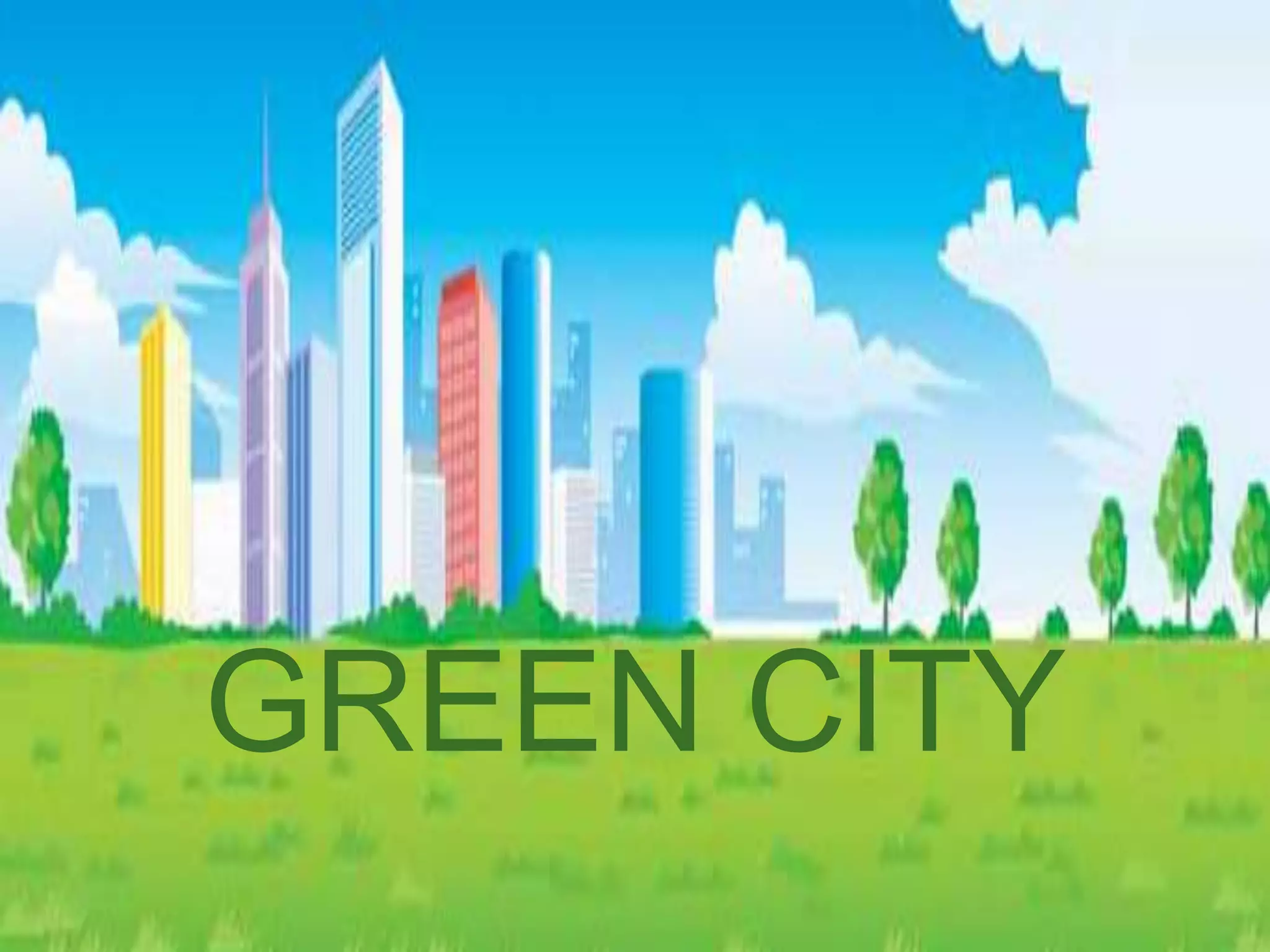



GREEN CITY
 WHAT IS GREEN CITY ????
 A green city is a city which possess
structure’s that uses processes that are
environmentally friendly and resource –
efficient throughout its life-cycle .
 This is done through the use of renewable
materials , internal recycling , biodegradable
construction materials and blending it with
local environment so as to reduce negative
impacts on the environment .
 They are extremely efficient when it
comes to gas , electricity and water
and will over all results in savings.
 The ‘Green city’ concept is gaining
importance in various countries,
including India.
 These are cities that ensure that
waste is minimized at every stage
during the construction and
operation of the building, resulting in
low costs, according to experts in the
technology.
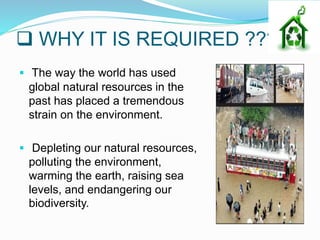
 WHY IT IS REQUIRED ???
 The way the world has used
global natural resources in the
past has placed a tremendous
strain on the environment.
 Depleting our natural resources,
polluting the environment,
warming the earth, raising sea
levels, and endangering our
biodiversity.
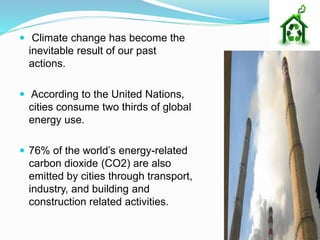
 Climate change has become the
inevitable result of our past
actions.
 According to the United Nations,
cities consume two thirds of global
energy use.
 76% of the world’s energy-related
carbon dioxide (CO2) are also
emitted by cities through transport,
industry, and building and
construction related activities.
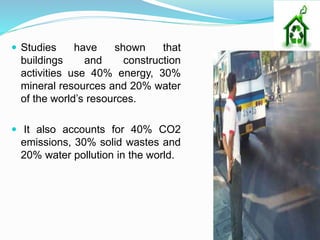
 Studies have shown that
buildings and construction
activities use 40% energy, 30%
mineral resources and 20% water
of the world’s resources.
 It also accounts for 40% CO2
emissions, 30% solid wastes and
20% water pollution in the world.
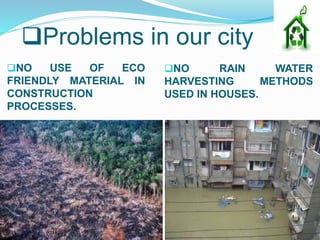
Problems in our city
NO USE OF ECO
FRIENDLY MATERIAL IN
CONSTRUCTION
PROCESSES.
NO RAIN WATER
HARVESTING METHODS
USED IN HOUSES.
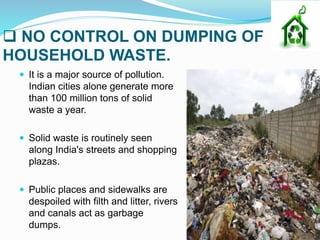
 NO CONTROL ON DUMPING OF
HOUSEHOLD WASTE.
 It is a major source of pollution.
Indian cities alone generate more
than 100 million tons of solid
waste a year.
 Solid waste is routinely seen
along India's streets and shopping
plazas.
 Public places and sidewalks are
despoiled with filth and litter, rivers
and canals act as garbage
dumps.
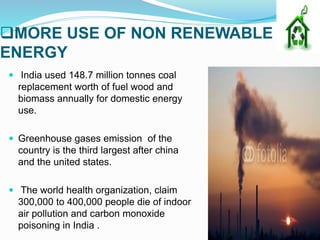
MORE USE OF NON RENEWABLE
ENERGY
 India used 148.7 million tonnes coal
replacement worth of fuel wood and
biomass annually for domestic energy
use.
 Greenhouse gases emission of the
country is the third largest after china
and the united states.
 The world health organization, claim
300,000 to 400,000 people die of indoor
air pollution and carbon monoxide
poisoning in India .
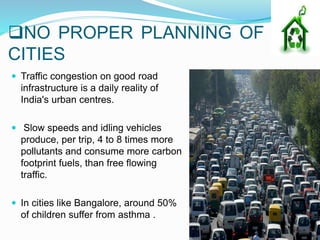
NO PROPER PLANNING OF
CITIES
 Traffic congestion on good road
infrastructure is a daily reality of
India's urban centres.
 Slow speeds and idling vehicles
produce, per trip, 4 to 8 times more
pollutants and consume more carbon
footprint fuels, than free flowing
traffic.
 In cities like Bangalore, around 50%
of children suffer from asthma .
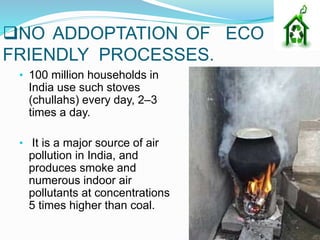
NO ADDOPTATION OF ECO
FRIENDLY PROCESSES.
• 100 million households in
India use such stoves
(chullahs) every day, 2–3
times a day.
• It is a major source of air
pollution in India, and
produces smoke and
numerous indoor air
pollutants at concentrations
5 times higher than coal.
 BENEFITS FROM GREEN
CITY ADOPTION
HEALTH BENEFITS
ENVIRONMENTAL BENEFITS
ECONOMICAL BENEFITS
ENVIRONMENT
BENEFITS
ECONOMICS
BENEFITS
 Emission reduction
 Water conservation
 Strom water management
 Temperature moderation
 Waste reduction
 Energy savings
 Water savings
 Increased property values
 Increased employee
productivity
 Sales improvements
HEALTH BENEFITS
 Improved health of
occupants.
 Healthier lifestyle and
recreations .
 Reduces weak days of
occupants .
 Enhance surrounding
environment .
 GREEN CITY PLANNING AND
MASSING
TRADITIONAL PLANNING
AND DESIGN APPROACH
INTEGRATED GREEN CITY
DESIGN APPROACH
 The focus is to reduce up-
front capital costs.
 Systems are considered in
isolation and often result in
over-designing / over-sizing.
 The project team aims towards
reducing long term operation and
maintenance costs by using
highly efficient systems.
 Total city performance is used to
assess how each system affects
one another to deliver the
optimum design.
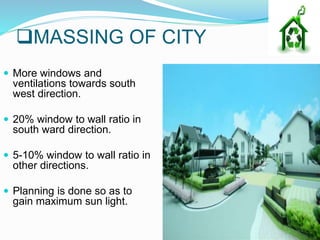
MASSING OF CITY
 More windows and
ventilations towards south
west direction.
 20% window to wall ratio in
south ward direction.
 5-10% window to wall ratio in
other directions.
 Planning is done so as to
gain maximum sun light.
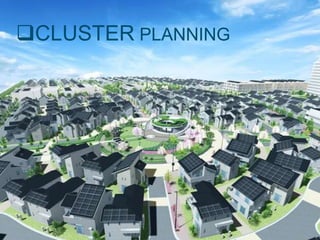
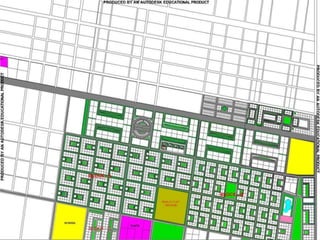
CLUSTER PLANNING
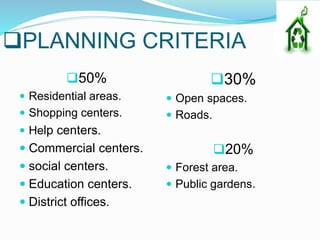
PLANNING CRITERIA
50%
 Residential areas.
 Shopping centers.
 Help centers.
 Commercial centers.
 social centers.
 Education centers.
 District offices.
30%
 Open spaces.
 Roads.
20%
 Forest area.
 Public gardens.
BUILDING ENVELOPE
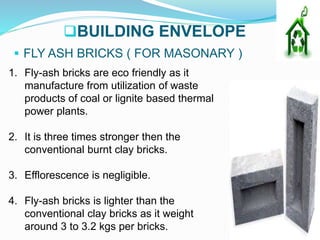
 FLY ASH BRICKS ( FOR MASONARY )
1. Fly-ash bricks are eco friendly as it
manufacture from utilization of waste
products of coal or lignite based thermal
power plants.
2. It is three times stronger then the
conventional burnt clay bricks.
3. Efflorescence is negligible.
4. Fly-ash bricks is lighter than the
conventional clay bricks as it weight
around 3 to 3.2 kgs per bricks.
AERATED CONCRETE BLOCKS
( FOR MASONRY )
 AAC its light weight (20% of
the weight of concrete).
 Up to 80% of the volume of an
AAC block is air.
 It can carry loads of up to 8
Mpa.
 Highly thermally insulating
concrete-based material.
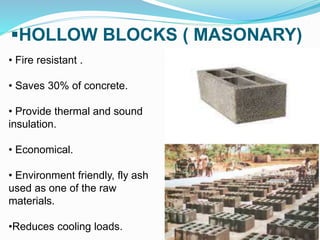
HOLLOW BLOCKS ( MASONARY)
• Fire resistant .
• Saves 30% of concrete.
• Provide thermal and sound
insulation.
• Economical.
• Environment friendly, fly ash
used as one of the raw
materials.
•Reduces cooling loads.
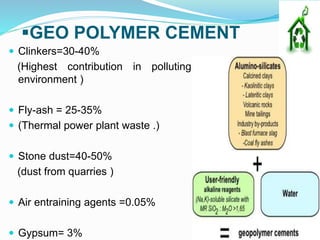
GEO POLYMER CEMENT
 Clinkers=30-40%
(Highest contribution in polluting
environment )
 Fly-ash = 25-35%
 (Thermal power plant waste .)
 Stone dust=40-50%
(dust from quarries )
 Air entraining agents =0.05%
 Gypsum= 3%
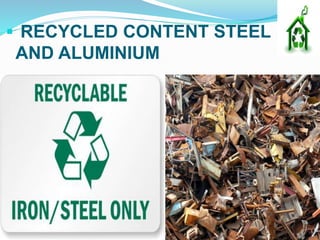
 RECYCLED CONTENT STEEL
AND ALUMINIUM
FSC CERTIFIED WOOD.
 UPVC DOORS AND WINDOW.
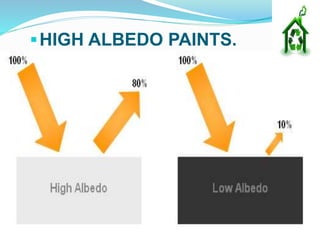
HIGH ALBEDO PAINTS.
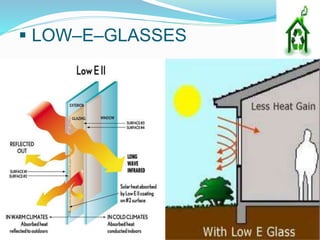
 LOW–E–GLASSES
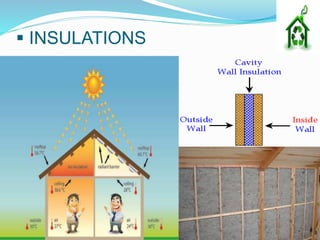
 INSULATIONS
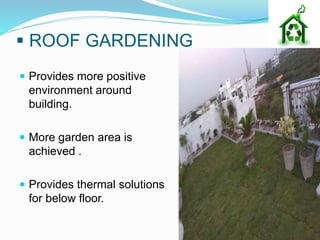
 ROOF GARDENING
 Provides more positive
environment around
building.
 More garden area is
achieved .
 Provides thermal solutions
for below floor.
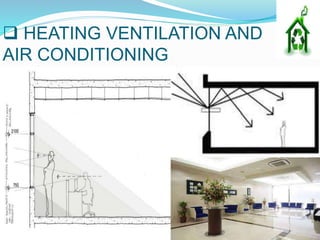
 HEATING VENTILATION AND
AIR CONDITIONING
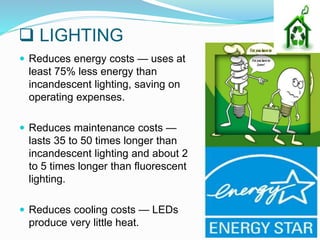
 LIGHTING
 Reduces energy costs — uses at
least 75% less energy than
incandescent lighting, saving on
operating expenses.
 Reduces maintenance costs —
lasts 35 to 50 times longer than
incandescent lighting and about 2
to 5 times longer than fluorescent
lighting.
 Reduces cooling costs — LEDs
produce very little heat.
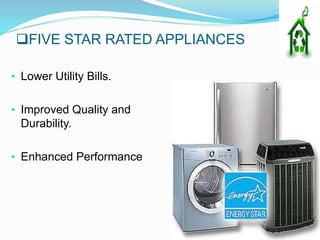
FIVE STAR RATED APPLIANCES
• Lower Utility Bills.
• Improved Quality and
Durability.
• Enhanced Performance
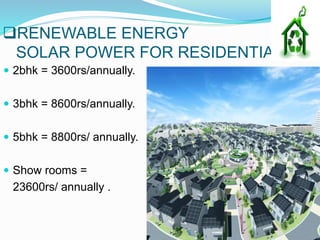
RENEWABLE ENERGY
SOLAR POWER FOR RESIDENTIAL
 2bhk = 3600rs/annually.
 3bhk = 8600rs/annually.
 5bhk = 8800rs/ annually.
 Show rooms =
23600rs/ annually .
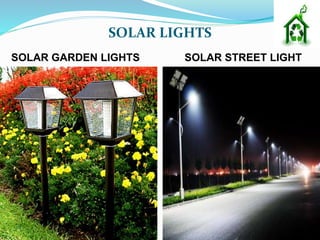
SOLAR LIGHTS
SOLAR GARDEN LIGHTS SOLAR STREET LIGHT
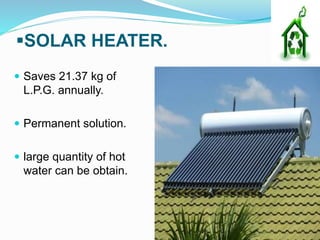
SOLAR HEATER.
 Saves 21.37 kg of
L.P.G. annually.
 Permanent solution.
 large quantity of hot
water can be obtain.
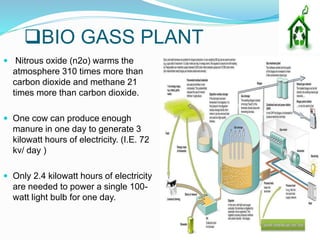
BIO GASS PLANT
 Nitrous oxide (n2o) warms the
atmosphere 310 times more than
carbon dioxide and methane 21
times more than carbon dioxide.
 One cow can produce enough
manure in one day to generate 3
kilowatt hours of electricity. (I.E. 72
kv/ day )
 Only 2.4 kilowatt hours of electricity
are needed to power a single 100-
watt light bulb for one day.
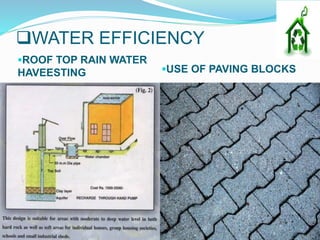
WATER EFFICIENCY
ROOF TOP RAIN WATER
HAVEESTING USE OF PAVING BLOCKS
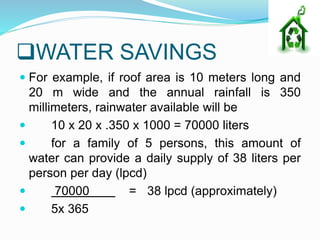
WATER SAVINGS
 For example, if roof area is 10 meters long and
20 m wide and the annual rainfall is 350
millimeters, rainwater available will be
 10 x 20 x .350 x 1000 = 70000 liters
 for a family of 5 persons, this amount of
water can provide a daily supply of 38 liters per
person per day (lpcd)
 70000 = 38 lpcd (approximately)
 5x 365
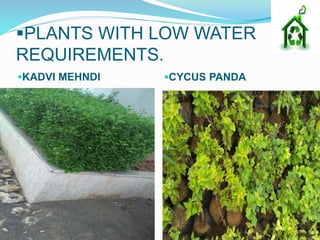
PLANTS WITH LOW WATER
REQUIREMENTS.
KADVI MEHNDI CYCUS PANDA
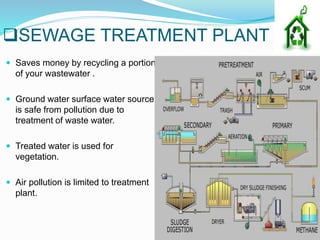
SEWAGE TREATMENT PLANT
 Saves money by recycling a portion
of your wastewater .
 Ground water surface water source
is safe from pollution due to
treatment of waste water.
 Treated water is used for
vegetation.
 Air pollution is limited to treatment
plant.
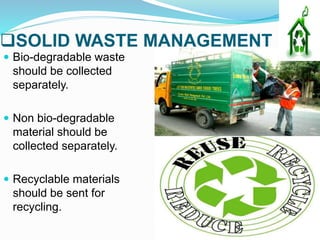
SOLID WASTE MANAGEMENT
 Bio-degradable waste
should be collected
separately.
 Non bio-degradable
material should be
collected separately.
 Recyclable materials
should be sent for
recycling.
H
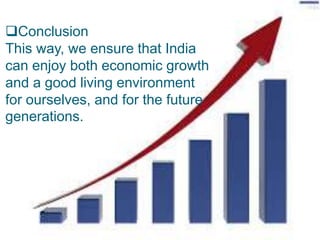
Conclusion
This way, we ensure that India
can enjoy both economic growth
and a good living environment
for ourselves, and for the future
generations.
THANK YOU
Special thanks
to T.F.G.P
GUIDED BY
 PROF. CHINTAN
BHATT

Green city

  • 1.
  • 2.
     WHAT ISGREEN CITY ????  A green city is a city which possess structure’s that uses processes that are environmentally friendly and resource – efficient throughout its life-cycle .  This is done through the use of renewable materials , internal recycling , biodegradable construction materials and blending it with local environment so as to reduce negative impacts on the environment .
  • 3.
     They areextremely efficient when it comes to gas , electricity and water and will over all results in savings.  The ‘Green city’ concept is gaining importance in various countries, including India.  These are cities that ensure that waste is minimized at every stage during the construction and operation of the building, resulting in low costs, according to experts in the technology.
  • 4.
     WHY ITIS REQUIRED ???  The way the world has used global natural resources in the past has placed a tremendous strain on the environment.  Depleting our natural resources, polluting the environment, warming the earth, raising sea levels, and endangering our biodiversity.
  • 5.
     Climate changehas become the inevitable result of our past actions.  According to the United Nations, cities consume two thirds of global energy use.  76% of the world’s energy-related carbon dioxide (CO2) are also emitted by cities through transport, industry, and building and construction related activities.
  • 6.
     Studies haveshown that buildings and construction activities use 40% energy, 30% mineral resources and 20% water of the world’s resources.  It also accounts for 40% CO2 emissions, 30% solid wastes and 20% water pollution in the world.
  • 7.
    Problems in ourcity NO USE OF ECO FRIENDLY MATERIAL IN CONSTRUCTION PROCESSES. NO RAIN WATER HARVESTING METHODS USED IN HOUSES.
  • 8.
     NO CONTROLON DUMPING OF HOUSEHOLD WASTE.  It is a major source of pollution. Indian cities alone generate more than 100 million tons of solid waste a year.  Solid waste is routinely seen along India's streets and shopping plazas.  Public places and sidewalks are despoiled with filth and litter, rivers and canals act as garbage dumps.
  • 9.
    MORE USE OFNON RENEWABLE ENERGY  India used 148.7 million tonnes coal replacement worth of fuel wood and biomass annually for domestic energy use.  Greenhouse gases emission of the country is the third largest after china and the united states.  The world health organization, claim 300,000 to 400,000 people die of indoor air pollution and carbon monoxide poisoning in India .
  • 10.
    NO PROPER PLANNINGOF CITIES  Traffic congestion on good road infrastructure is a daily reality of India's urban centres.  Slow speeds and idling vehicles produce, per trip, 4 to 8 times more pollutants and consume more carbon footprint fuels, than free flowing traffic.  In cities like Bangalore, around 50% of children suffer from asthma .
  • 11.
    NO ADDOPTATION OFECO FRIENDLY PROCESSES. • 100 million households in India use such stoves (chullahs) every day, 2–3 times a day. • It is a major source of air pollution in India, and produces smoke and numerous indoor air pollutants at concentrations 5 times higher than coal.
  • 12.
     BENEFITS FROMGREEN CITY ADOPTION HEALTH BENEFITS ENVIRONMENTAL BENEFITS ECONOMICAL BENEFITS
  • 13.
    ENVIRONMENT BENEFITS ECONOMICS BENEFITS  Emission reduction Water conservation  Strom water management  Temperature moderation  Waste reduction  Energy savings  Water savings  Increased property values  Increased employee productivity  Sales improvements
  • 14.
    HEALTH BENEFITS  Improvedhealth of occupants.  Healthier lifestyle and recreations .  Reduces weak days of occupants .  Enhance surrounding environment .
  • 15.
     GREEN CITYPLANNING AND MASSING TRADITIONAL PLANNING AND DESIGN APPROACH INTEGRATED GREEN CITY DESIGN APPROACH  The focus is to reduce up- front capital costs.  Systems are considered in isolation and often result in over-designing / over-sizing.  The project team aims towards reducing long term operation and maintenance costs by using highly efficient systems.  Total city performance is used to assess how each system affects one another to deliver the optimum design.
  • 16.
    MASSING OF CITY More windows and ventilations towards south west direction.  20% window to wall ratio in south ward direction.  5-10% window to wall ratio in other directions.  Planning is done so as to gain maximum sun light.
  • 17.
  • 18.
    PLANNING CRITERIA 50%  Residentialareas.  Shopping centers.  Help centers.  Commercial centers.  social centers.  Education centers.  District offices. 30%  Open spaces.  Roads. 20%  Forest area.  Public gardens.
  • 19.
    BUILDING ENVELOPE  FLYASH BRICKS ( FOR MASONARY ) 1. Fly-ash bricks are eco friendly as it manufacture from utilization of waste products of coal or lignite based thermal power plants. 2. It is three times stronger then the conventional burnt clay bricks. 3. Efflorescence is negligible. 4. Fly-ash bricks is lighter than the conventional clay bricks as it weight around 3 to 3.2 kgs per bricks.
  • 20.
    AERATED CONCRETE BLOCKS (FOR MASONRY )  AAC its light weight (20% of the weight of concrete).  Up to 80% of the volume of an AAC block is air.  It can carry loads of up to 8 Mpa.  Highly thermally insulating concrete-based material.
  • 21.
    HOLLOW BLOCKS (MASONARY) • Fire resistant . • Saves 30% of concrete. • Provide thermal and sound insulation. • Economical. • Environment friendly, fly ash used as one of the raw materials. •Reduces cooling loads.
  • 22.
    GEO POLYMER CEMENT Clinkers=30-40% (Highest contribution in polluting environment )  Fly-ash = 25-35%  (Thermal power plant waste .)  Stone dust=40-50% (dust from quarries )  Air entraining agents =0.05%  Gypsum= 3%
  • 23.
     RECYCLED CONTENTSTEEL AND ALUMINIUM
  • 24.
  • 25.
     UPVC DOORSAND WINDOW.
  • 26.
  • 27.
  • 28.
  • 29.
     ROOF GARDENING Provides more positive environment around building.  More garden area is achieved .  Provides thermal solutions for below floor.
  • 30.
     HEATING VENTILATIONAND AIR CONDITIONING
  • 31.
     LIGHTING  Reducesenergy costs — uses at least 75% less energy than incandescent lighting, saving on operating expenses.  Reduces maintenance costs — lasts 35 to 50 times longer than incandescent lighting and about 2 to 5 times longer than fluorescent lighting.  Reduces cooling costs — LEDs produce very little heat.
  • 32.
    FIVE STAR RATEDAPPLIANCES • Lower Utility Bills. • Improved Quality and Durability. • Enhanced Performance
  • 33.
    RENEWABLE ENERGY SOLAR POWERFOR RESIDENTIAL  2bhk = 3600rs/annually.  3bhk = 8600rs/annually.  5bhk = 8800rs/ annually.  Show rooms = 23600rs/ annually .
  • 34.
    SOLAR LIGHTS SOLAR GARDENLIGHTS SOLAR STREET LIGHT
  • 35.
    SOLAR HEATER.  Saves21.37 kg of L.P.G. annually.  Permanent solution.  large quantity of hot water can be obtain.
  • 36.
    BIO GASS PLANT Nitrous oxide (n2o) warms the atmosphere 310 times more than carbon dioxide and methane 21 times more than carbon dioxide.  One cow can produce enough manure in one day to generate 3 kilowatt hours of electricity. (I.E. 72 kv/ day )  Only 2.4 kilowatt hours of electricity are needed to power a single 100- watt light bulb for one day.
  • 37.
    WATER EFFICIENCY ROOF TOPRAIN WATER HAVEESTING USE OF PAVING BLOCKS
  • 38.
    WATER SAVINGS  Forexample, if roof area is 10 meters long and 20 m wide and the annual rainfall is 350 millimeters, rainwater available will be  10 x 20 x .350 x 1000 = 70000 liters  for a family of 5 persons, this amount of water can provide a daily supply of 38 liters per person per day (lpcd)  70000 = 38 lpcd (approximately)  5x 365
  • 39.
    PLANTS WITH LOWWATER REQUIREMENTS. KADVI MEHNDI CYCUS PANDA
  • 40.
    SEWAGE TREATMENT PLANT Saves money by recycling a portion of your wastewater .  Ground water surface water source is safe from pollution due to treatment of waste water.  Treated water is used for vegetation.  Air pollution is limited to treatment plant.
  • 41.
    SOLID WASTE MANAGEMENT Bio-degradable waste should be collected separately.  Non bio-degradable material should be collected separately.  Recyclable materials should be sent for recycling.
  • 42.
  • 43.
    Conclusion This way, weensure that India can enjoy both economic growth and a good living environment for ourselves, and for the future generations.
  • 45.
    THANK YOU Special thanks toT.F.G.P GUIDED BY  PROF. CHINTAN BHATT