Interactions Between Cells and the
    Extracellular Environment
                Compiled and Presented by
                 Marc Imhotep Cray, M.D.
              Basic Medical Sciences Professor


      Companion Notes
      http://www.slideshare.net/drimhotep/ivmsoverview-of-cell-biology
Extracellular Environment


   Includes all constituents of the body located
    outside the cell.
   Body fluids are divided into 2 compartments:
        Intracellular compartment:
             67% of total body H20.
   Extracellular compartment:
        33% total body H20.
             20% of ECF is blood plasma.
             80% is interstitial fluid contained in gel-like matrix.

                                                                        2
Extracellular Matrix

   Consists of collagen, elastin and gel-like ground
    substance.
       Interstitial fluid exists in the hydrated gel of the ground
        substance.
            Ground substance:
                   Complex organization of molecules chemically linked to
                    extracellular protein fibers of collagen and elastin, and
                    carbohydrates that cover the outside of the plasma membrane.
                   Collagen and elastin:
                        Provide structural strength to connective tissue.
            Gel:
                   Composed of glycoproteins and proteoglycans which have a high
                    content of bound H20 molecules.
                   Integrins are glycoproteins that serve as adhesion molecules
                    between cells and the extracellular matrix.


                                                                                    3
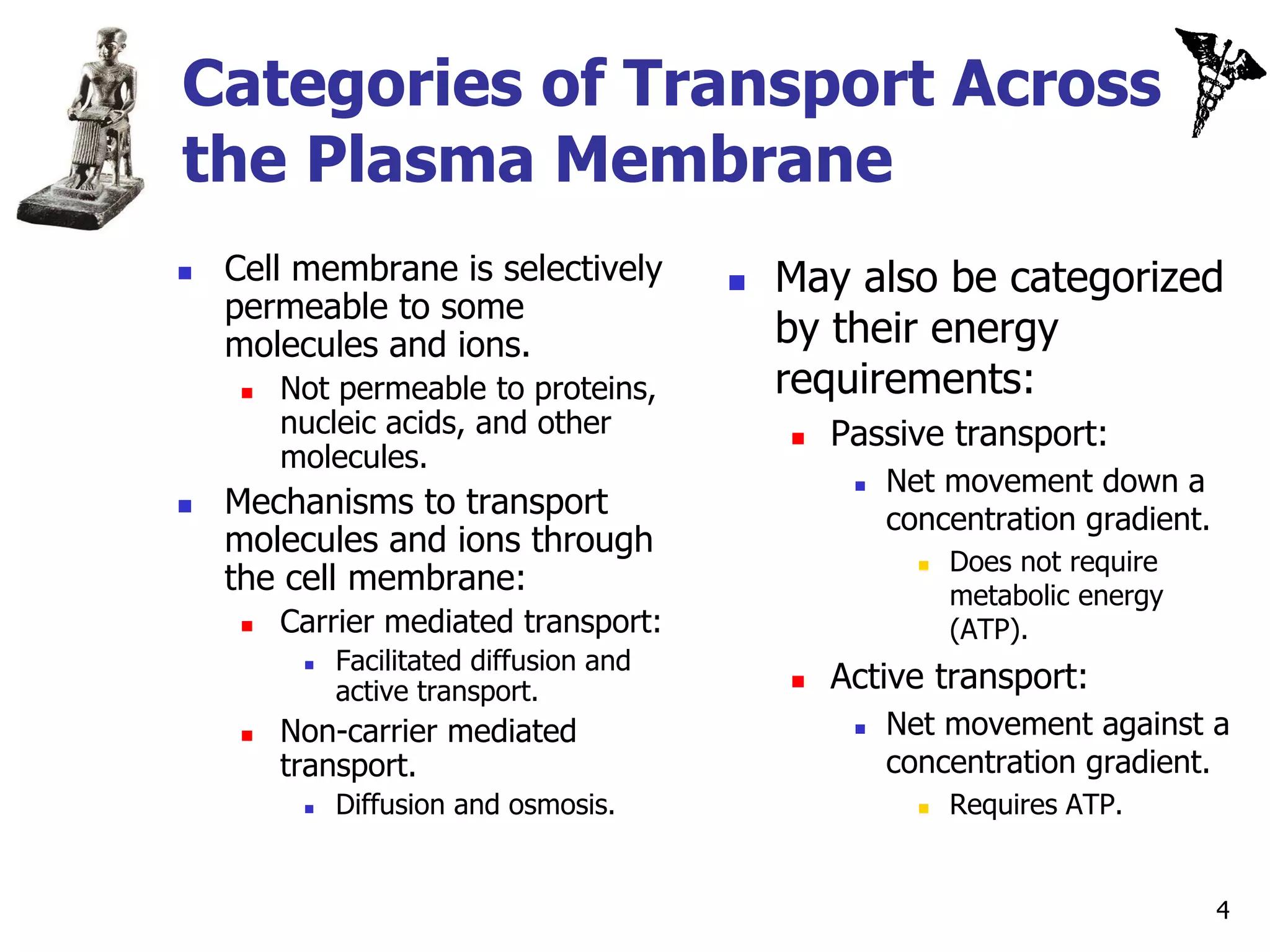
Categories of Transport Across
the Plasma Membrane
   Cell membrane is selectively             May also be categorized
    permeable to some
    molecules and ions.                       by their energy
        Not permeable to proteins,           requirements:
         nucleic acids, and other                Passive transport:
         molecules.
                                                      Net movement down a
   Mechanisms to transport                            concentration gradient.
    molecules and ions through
                                                             Does not require
    the cell membrane:
                                                         

                                                             metabolic energy
        Carrier mediated transport:                         (ATP).
              Facilitated diffusion and
                                                  Active transport:
          
                                              
              active transport.
        Non-carrier mediated                         Net movement against a
         transport.                                    concentration gradient.
             Diffusion and osmosis.                        Requires ATP.


                                                                                 4
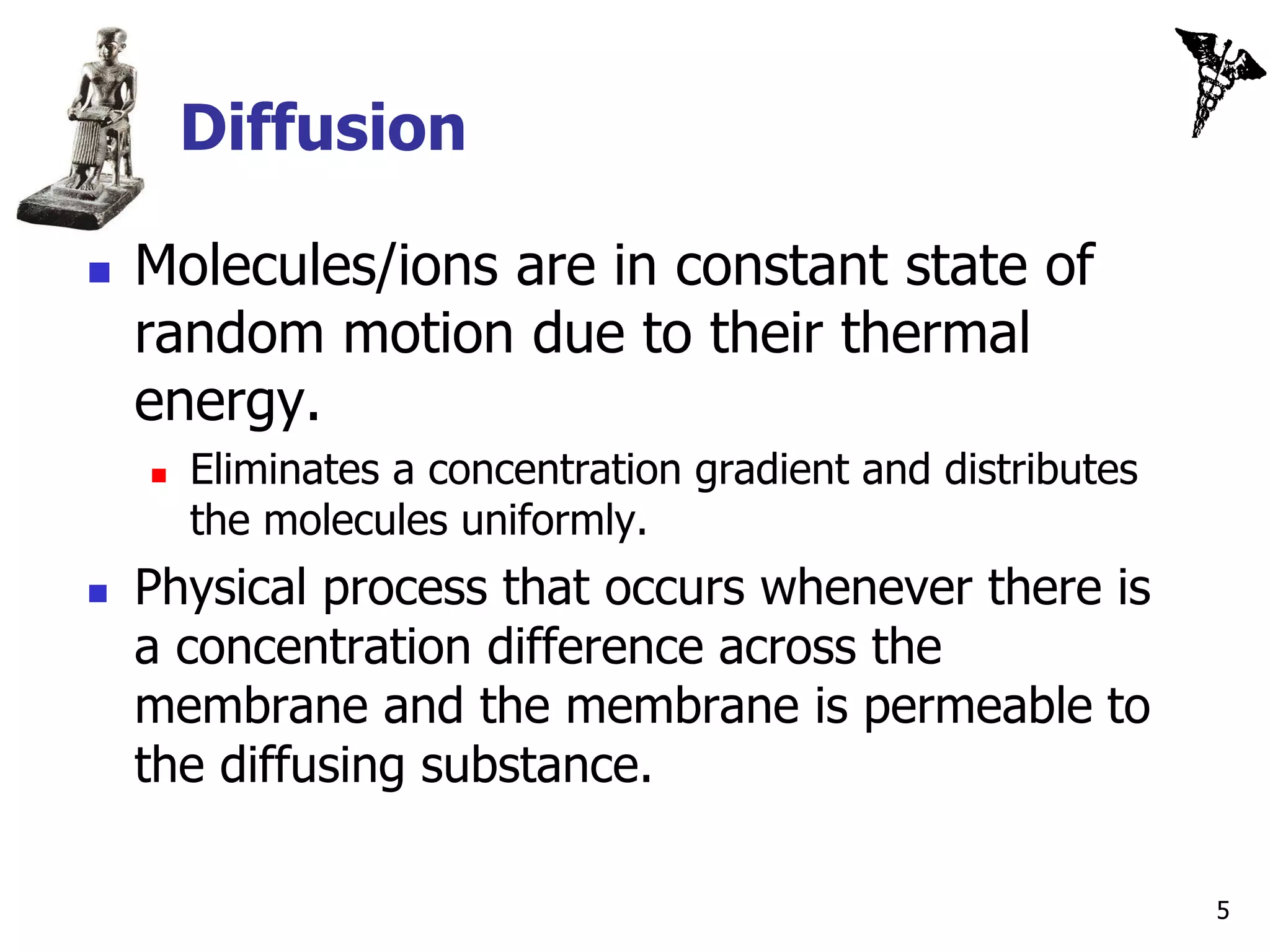
Diffusion

   Molecules/ions are in constant state of
    random motion due to their thermal
    energy.
       Eliminates a concentration gradient and distributes
        the molecules uniformly.
   Physical process that occurs whenever there is
    a concentration difference across the
    membrane and the membrane is permeable to
    the diffusing substance.

                                                              5
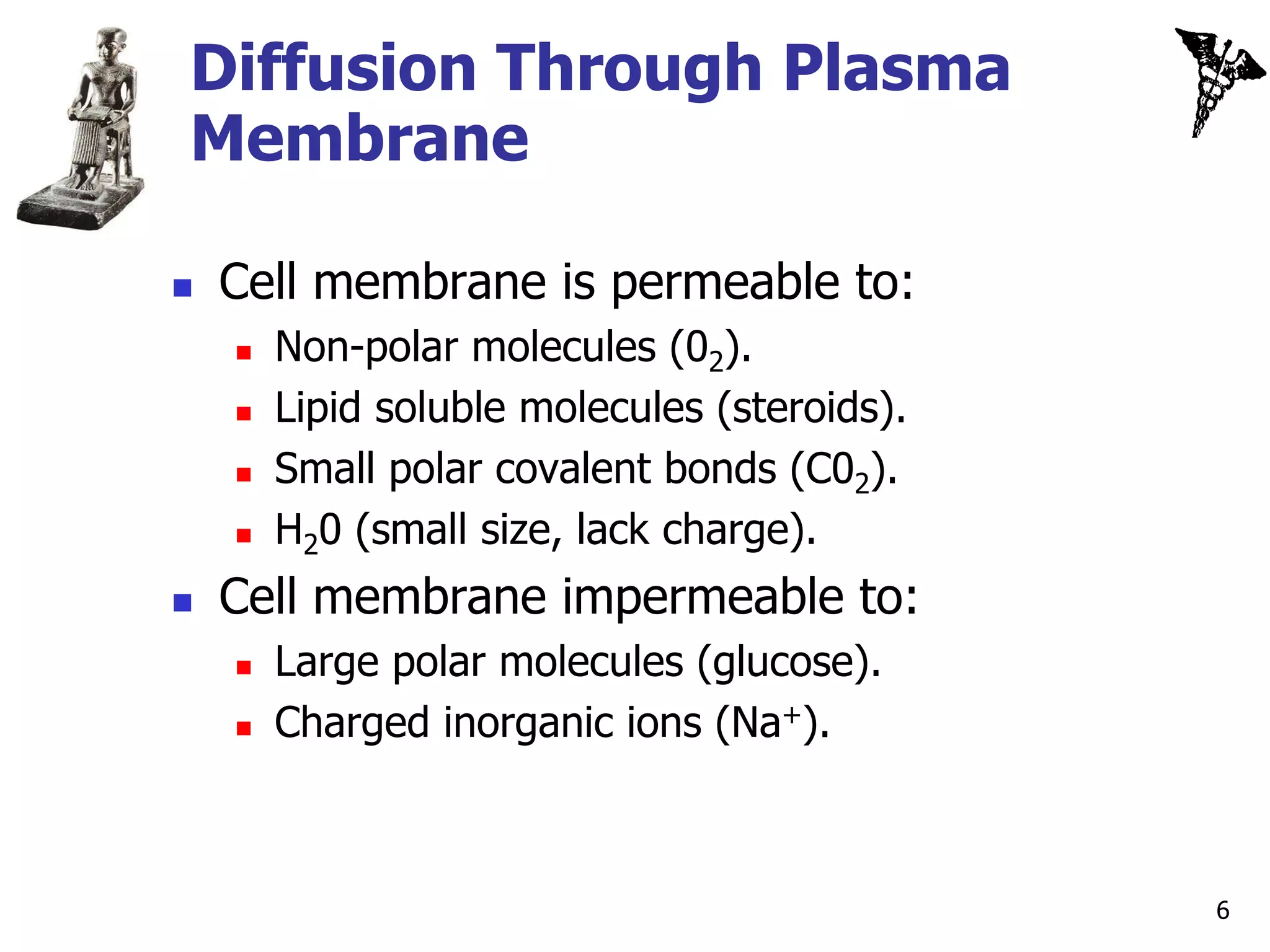
Diffusion Through Plasma
Membrane

   Cell membrane is permeable to:
       Non-polar molecules (02).
       Lipid soluble molecules (steroids).
       Small polar covalent bonds (C02).
       H20 (small size, lack charge).
   Cell membrane impermeable to:
       Large polar molecules (glucose).
       Charged inorganic ions (Na+).


                                              6
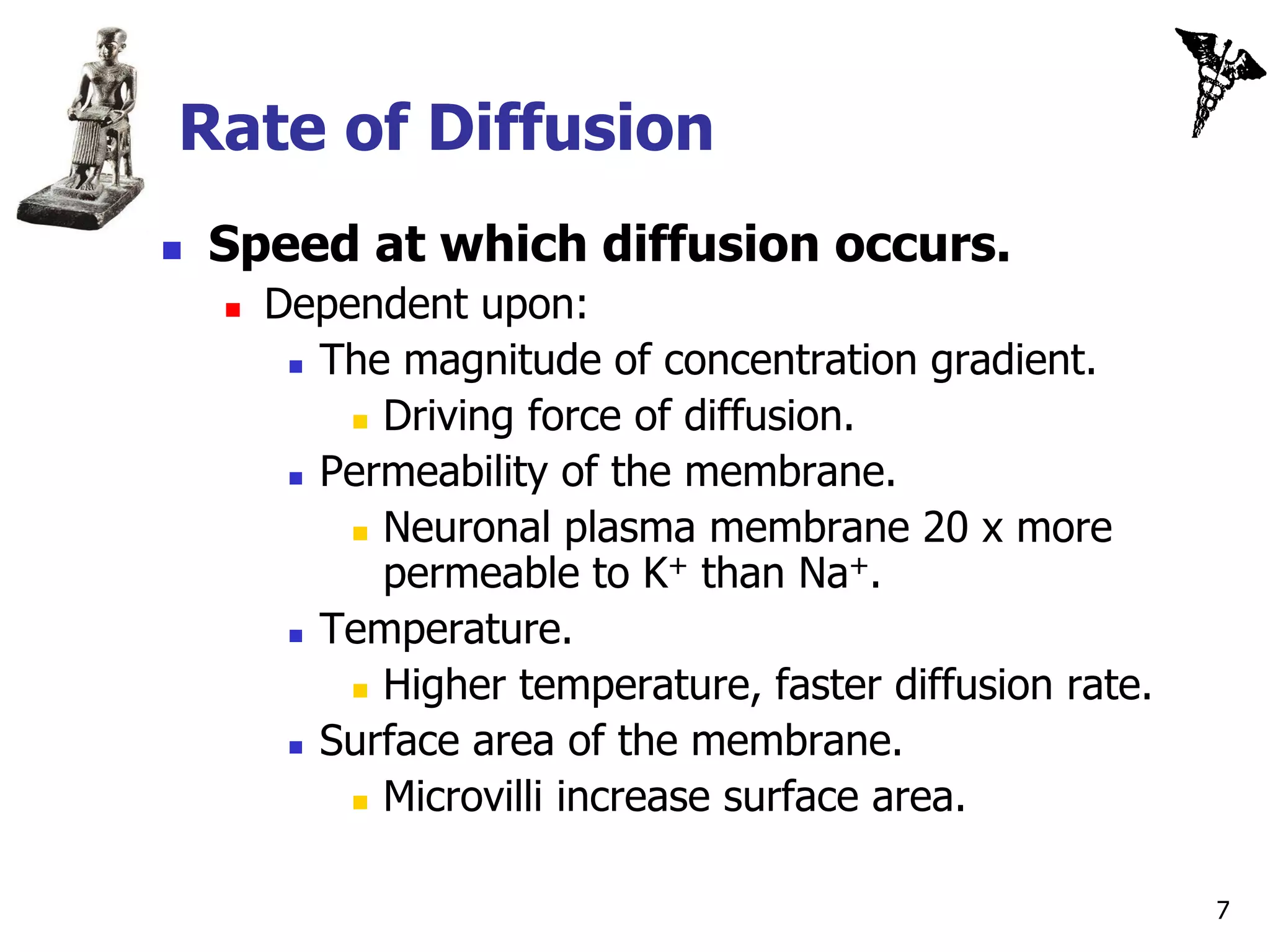
Rate of Diffusion
   Speed at which diffusion occurs.
       Dependent upon:
          The magnitude of concentration gradient.

             Driving force of diffusion.

          Permeability of the membrane.

             Neuronal plasma membrane 20 x more
              permeable to K+ than Na+.
          Temperature.

             Higher temperature, faster diffusion rate.

          Surface area of the membrane.

             Microvilli increase surface area.


                                                           7
Osmosis

   Net diffusion of H20 across a
    selectively permeable membrane.
   Movement of H20 from a high[H20]
    to lower [H20] until equilibrium is
    reached.
   2 requirements for osmosis:
        Must be difference in [solute] on the
         2 sides of the membrane.
        Membrane must be impermeable to
         the solute.
   Osmotically active solutes:
        Solutes that cannot pass freely
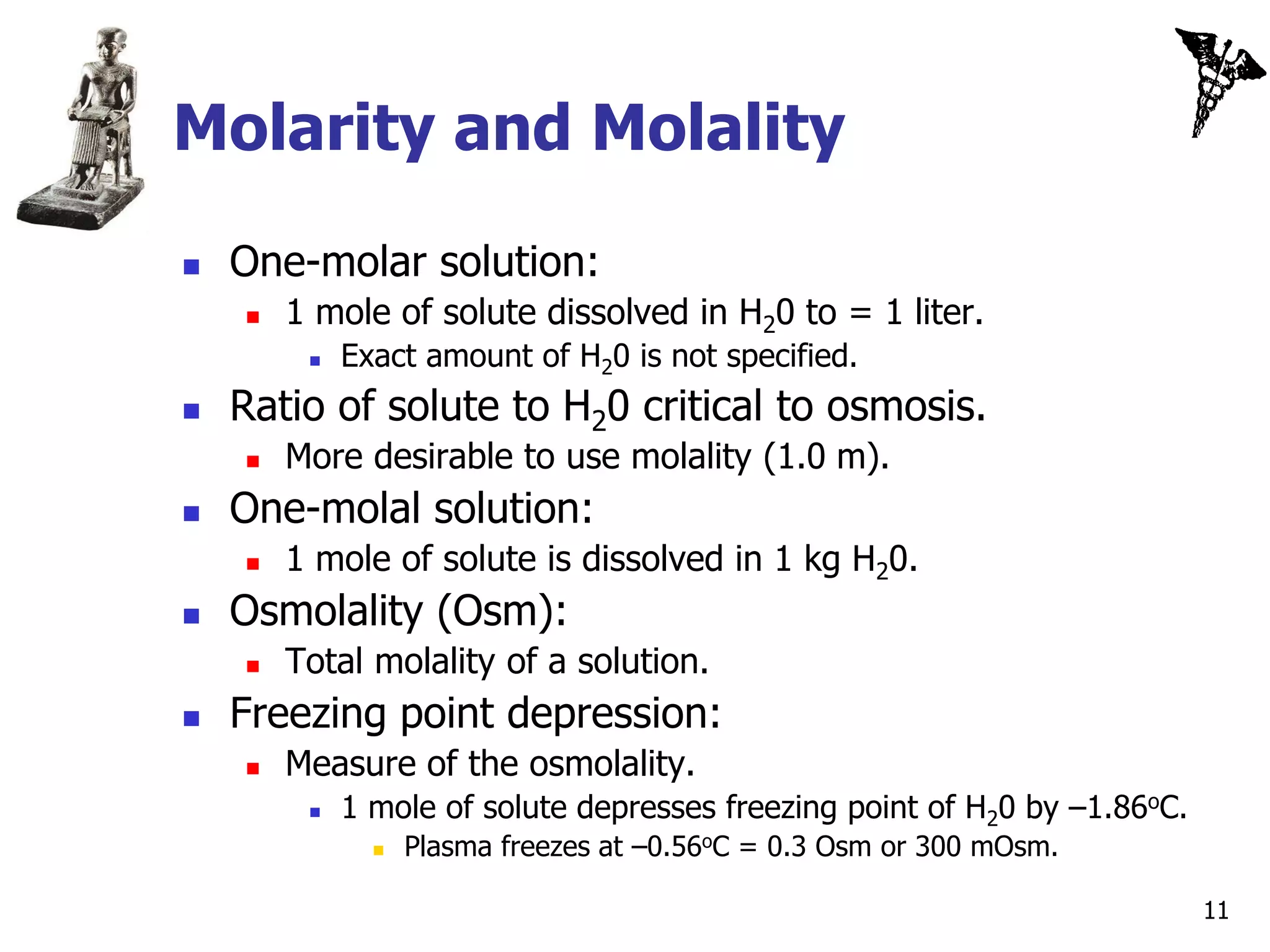
         through the membrane.


                                                 8
Effects of Osmosis


   H20 moves by osmosis into the lower [H20]
    until equilibrium is reached (270 g/l glucose).
   Osmosis ceases when concentrations are
    equal on both sides of the membrane.

                                                 9
Osmotic Pressure


   The force that would have to be exerted to prevent
    osmosis.
       The greater the [solute] of solution, the > the osmotic
        pressure.
       Indicates how strongly the solution “draws” H20 into it by
        osmosis.

                                                                 10
Molarity and Molality
   One-molar solution:
       1 mole of solute dissolved in H20 to = 1 liter.
            Exact amount of H20 is not specified.
   Ratio of solute to H20 critical to osmosis.
       More desirable to use molality (1.0 m).
   One-molal solution:
       1 mole of solute is dissolved in 1 kg H20.
   Osmolality (Osm):
       Total molality of a solution.
   Freezing point depression:
       Measure of the osmolality.
            1 mole of solute depresses freezing point of H20 by –1.86oC.
                  Plasma freezes at –0.56oC = 0.3 Osm or 300 mOsm.

                                                                            11
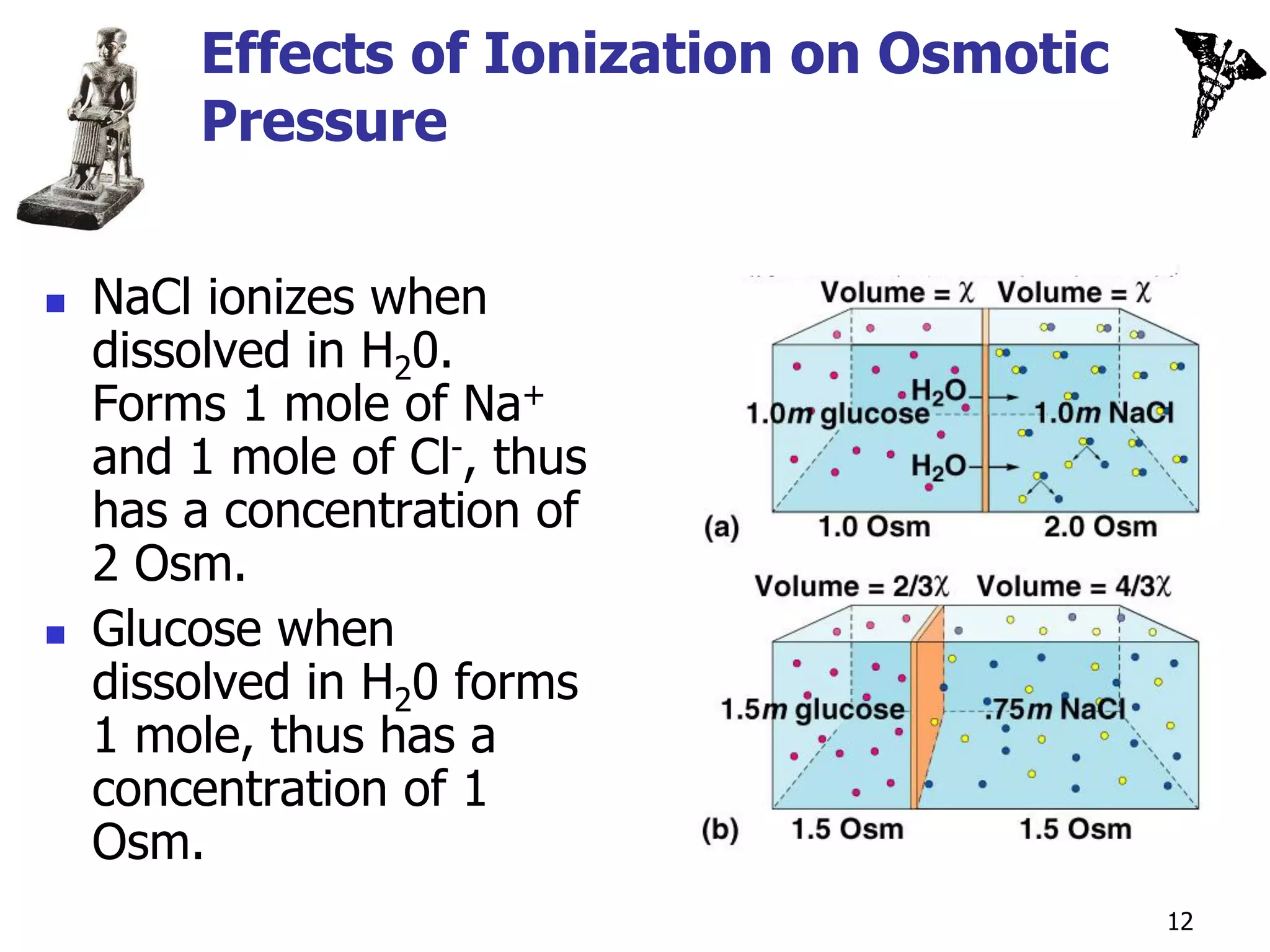
Effects of Ionization on Osmotic
         Pressure


   NaCl ionizes when
    dissolved in H20.
    Forms 1 mole of Na+
    and 1 mole of Cl-, thus
    has a concentration of
    2 Osm.
   Glucose when
    dissolved in H20 forms
    1 mole, thus has a
    concentration of 1
    Osm.
                                            12
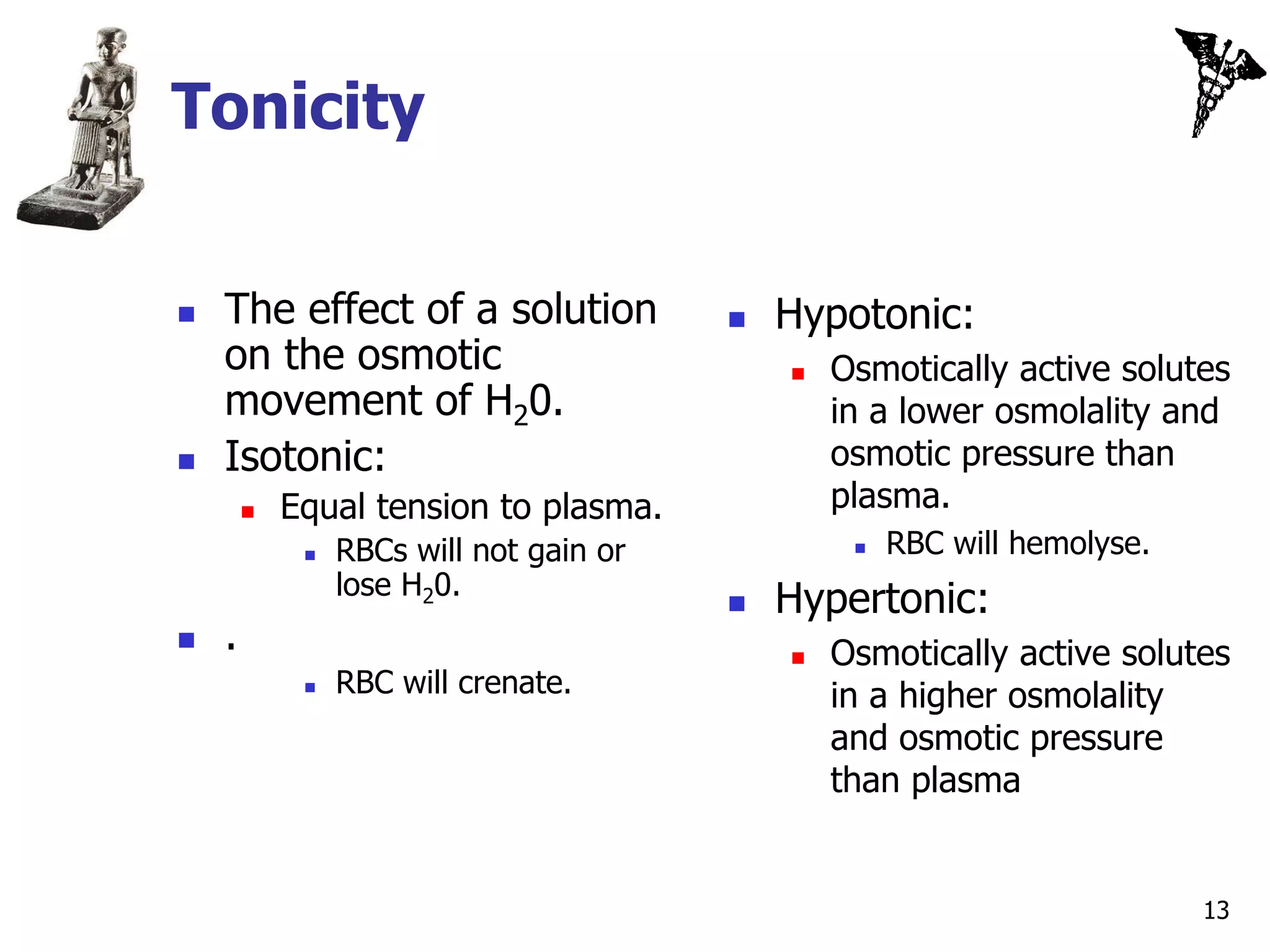
Tonicity


   The effect of a solution                Hypotonic:
    on the osmotic                              Osmotically active solutes
    movement of H20.                             in a lower osmolality and
   Isotonic:                                    osmotic pressure than
           Equal tension to plasma.             plasma.
                RBCs will not gain or               RBC will hemolyse.
                 lose H20.
                                            Hypertonic:
   .                                           Osmotically active solutes
                RBC will crenate.               in a higher osmolality
                                                 and osmotic pressure
                                                 than plasma


                                                                           13
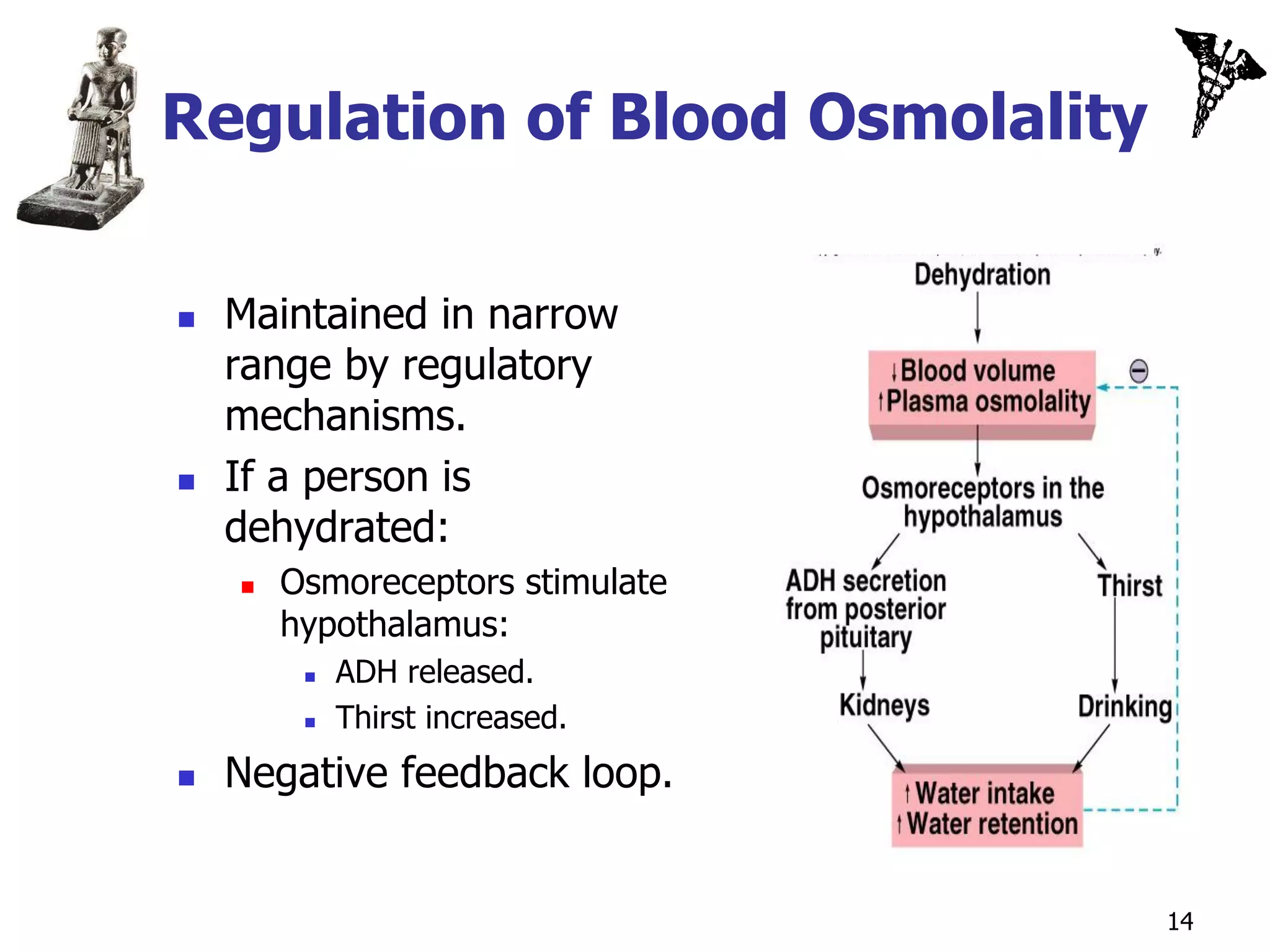
Regulation of Blood Osmolality

   Maintained in narrow
    range by regulatory
    mechanisms.
   If a person is
    dehydrated:
       Osmoreceptors stimulate
        hypothalamus:
            ADH released.
            Thirst increased.
   Negative feedback loop.


                                  14
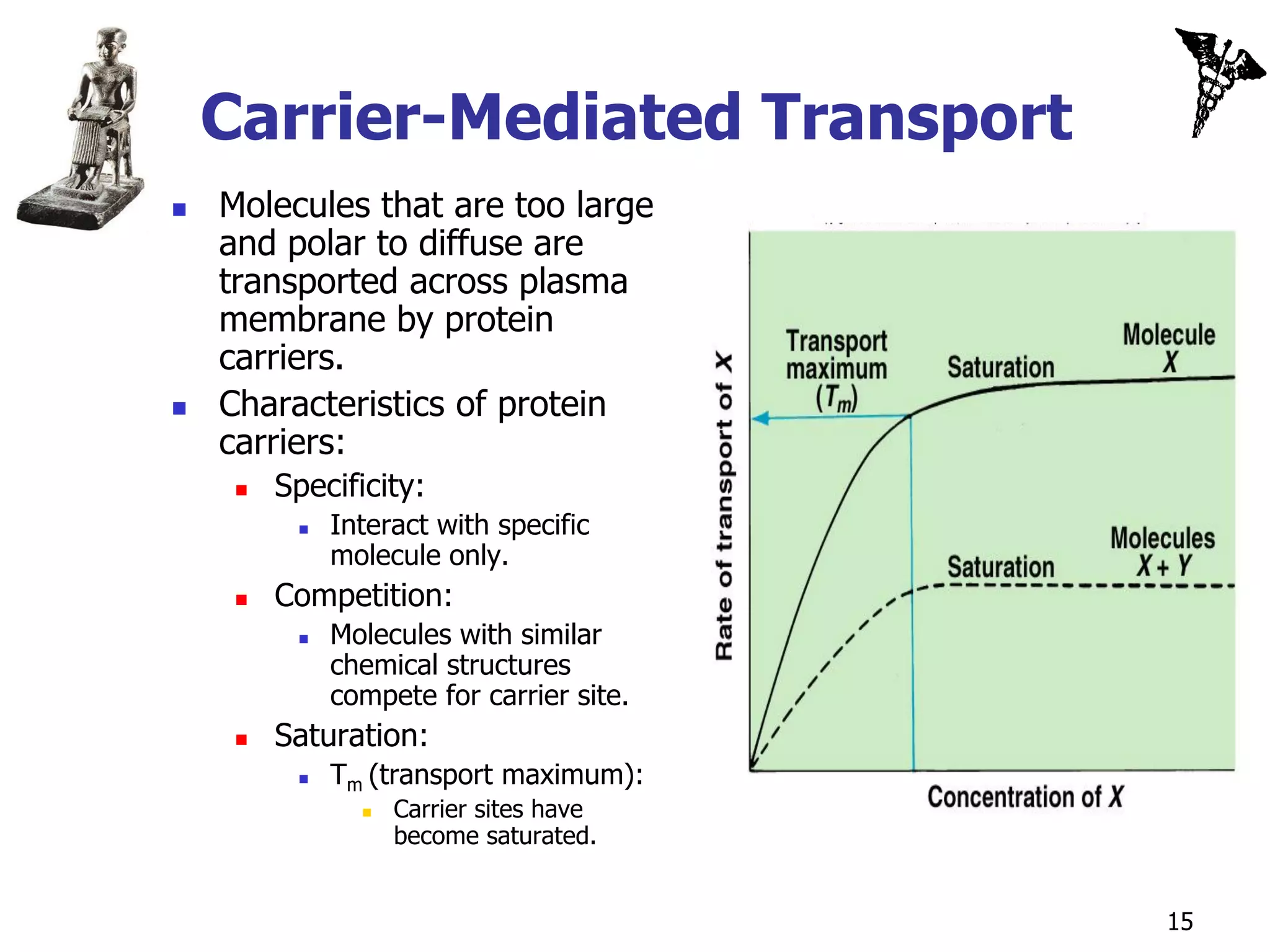
Carrier-Mediated Transport
   Molecules that are too large
    and polar to diffuse are
    transported across plasma
    membrane by protein
    carriers.
   Characteristics of protein
    carriers:
        Specificity:
             Interact with specific
              molecule only.
        Competition:
             Molecules with similar
              chemical structures
              compete for carrier site.
        Saturation:
             Tm (transport maximum):
                   Carrier sites have
                    become saturated.


                                          15
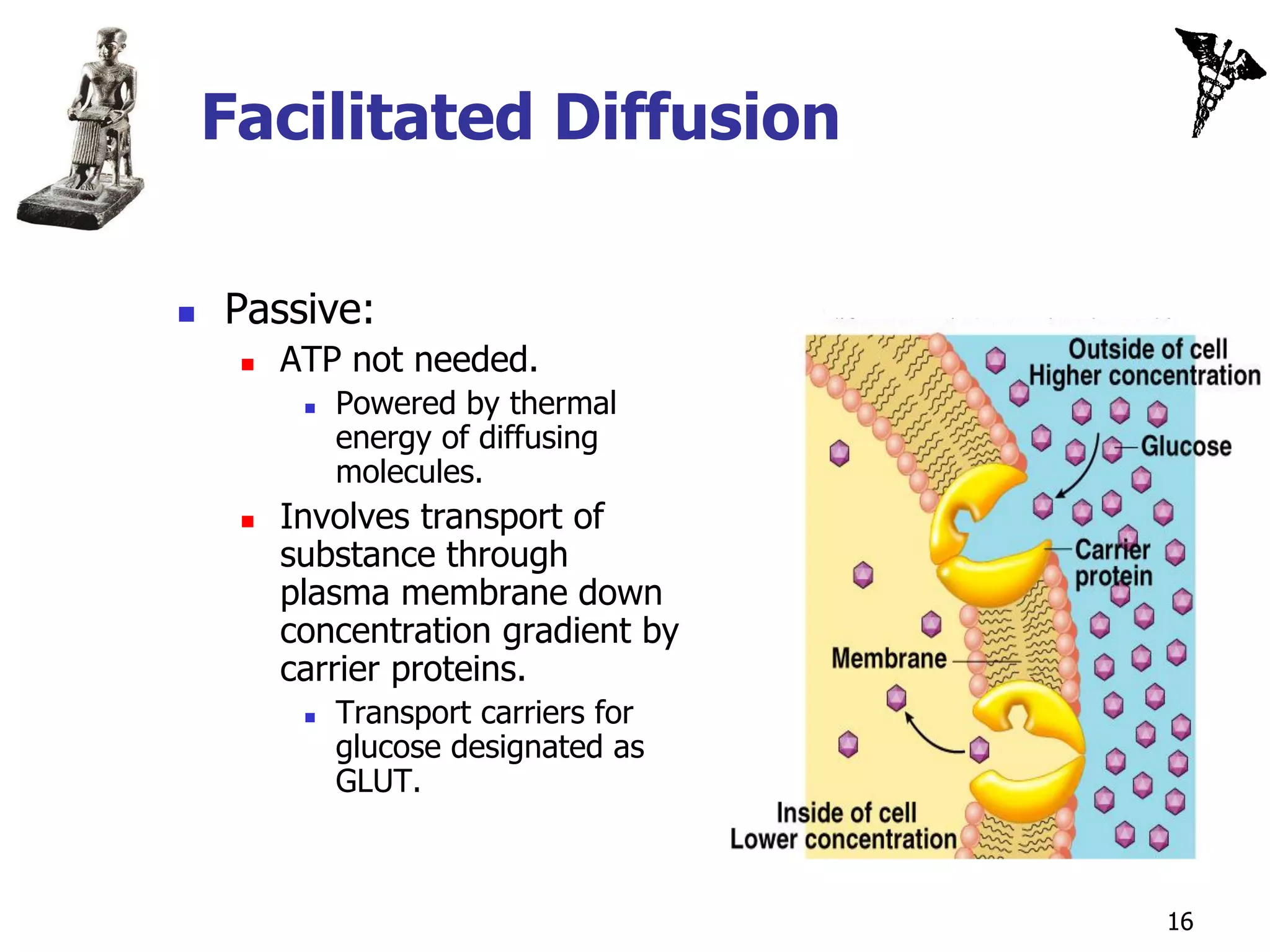
Facilitated Diffusion

   Passive:
        ATP not needed.
             Powered by thermal
              energy of diffusing
              molecules.
        Involves transport of
         substance through
         plasma membrane down
         concentration gradient by
         carrier proteins.
             Transport carriers for
              glucose designated as
              GLUT.


                                       16
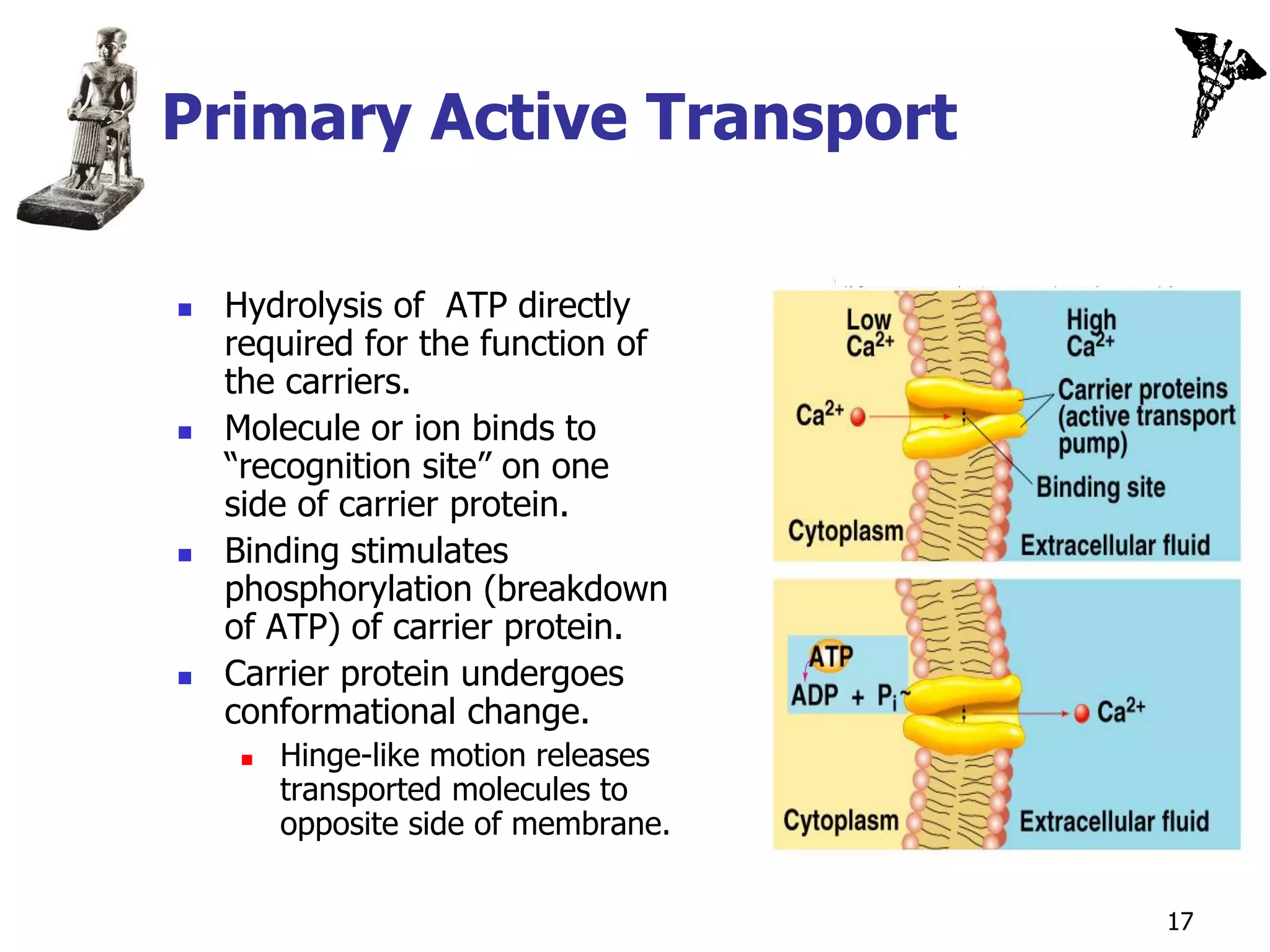
Primary Active Transport

   Hydrolysis of ATP directly
    required for the function of
    the carriers.
   Molecule or ion binds to
    “recognition site” on one
    side of carrier protein.
   Binding stimulates
    phosphorylation (breakdown
    of ATP) of carrier protein.
   Carrier protein undergoes
    conformational change.
        Hinge-like motion releases
         transported molecules to
         opposite side of membrane.


                                      17
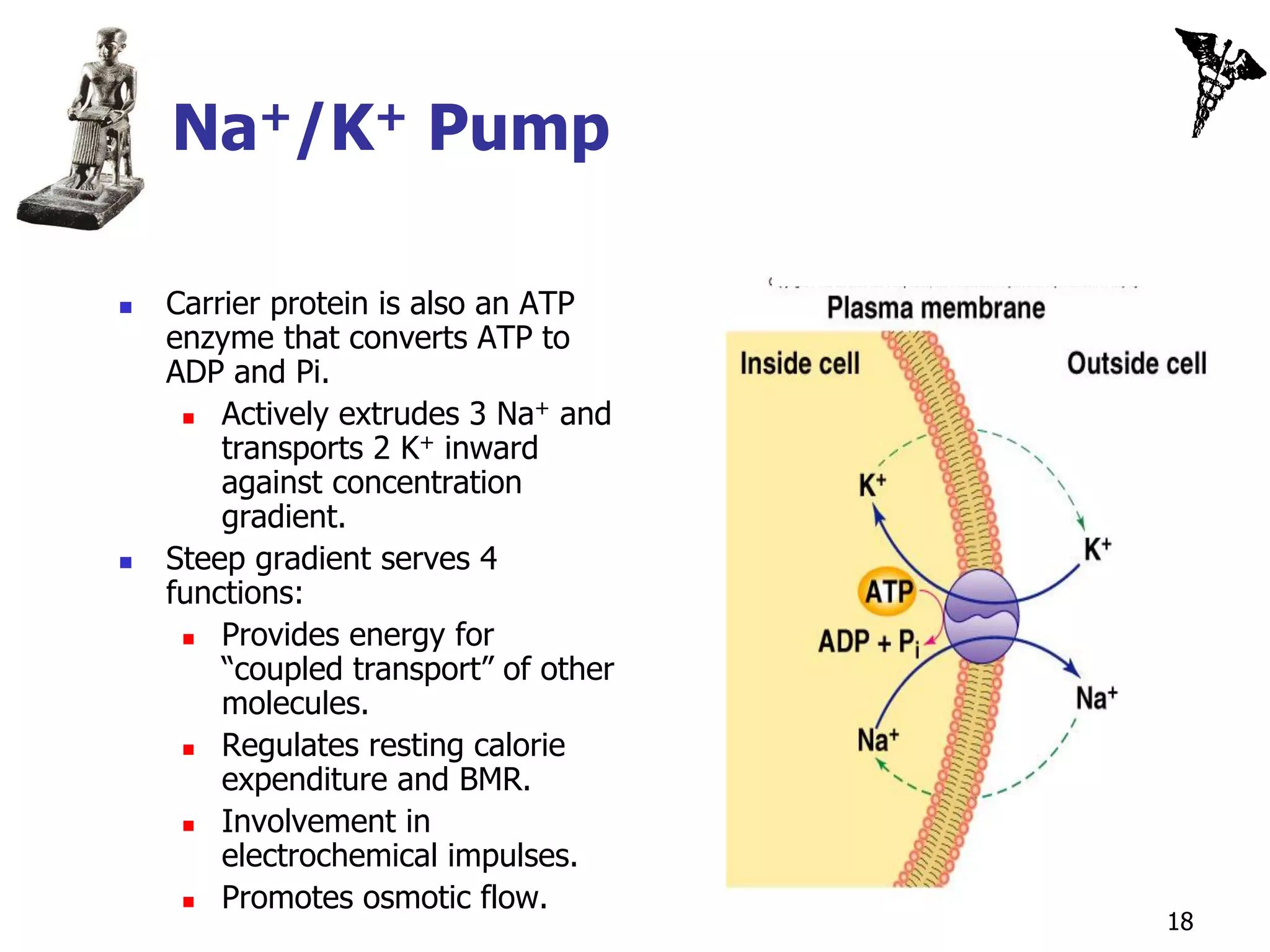
Na+/K+ Pump

   Carrier protein is also an ATP
    enzyme that converts ATP to
    ADP and Pi.
       Actively extrudes 3 Na+ and
        transports 2 K+ inward
        against concentration
        gradient.
   Steep gradient serves 4
    functions:
       Provides energy for
        “coupled transport” of other
        molecules.
       Regulates resting calorie
        expenditure and BMR.
       Involvement in
        electrochemical impulses.
       Promotes osmotic flow.
                                       18
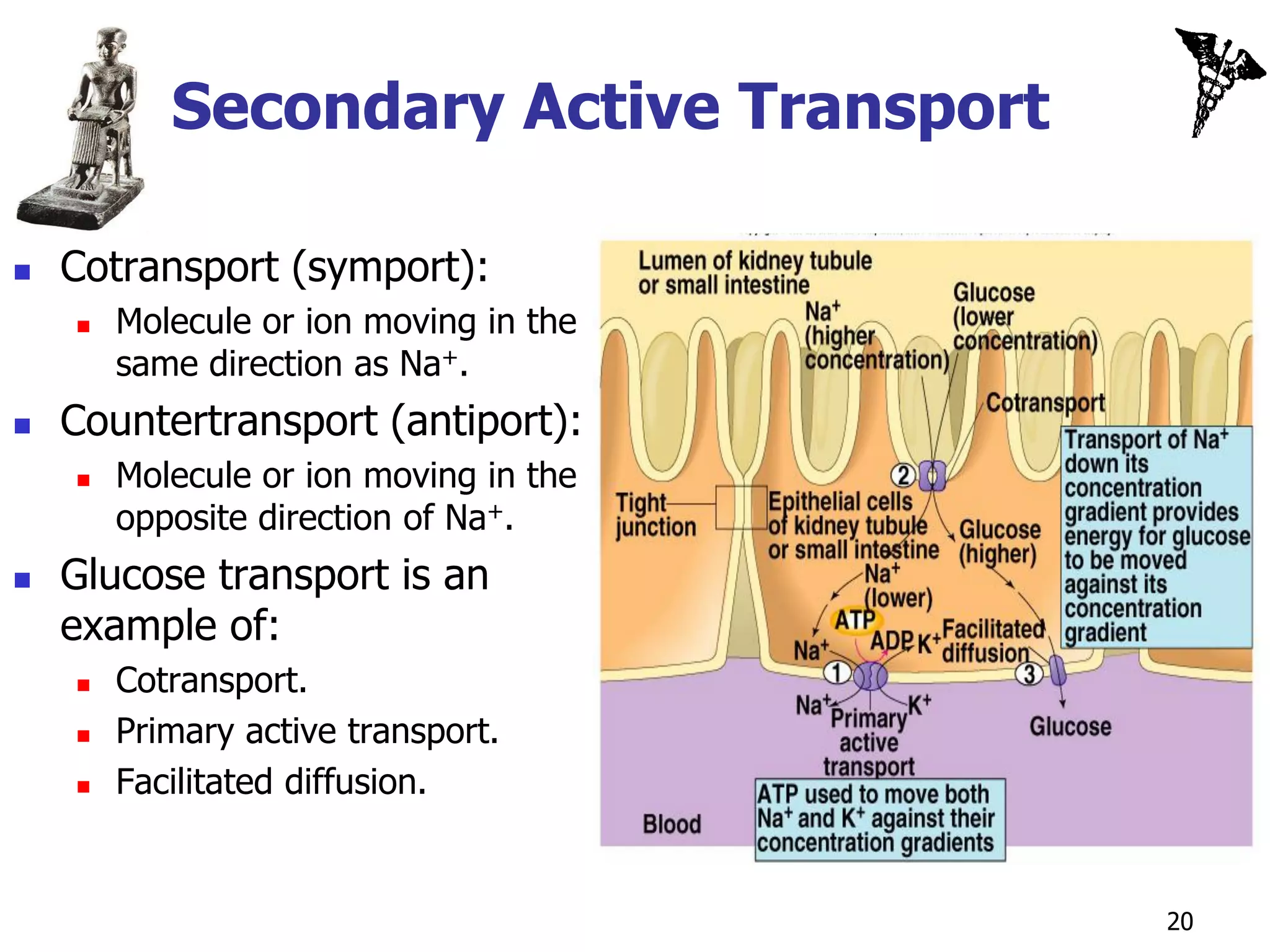
Secondary Active Transport

   Coupled transport.
   Energy needed for “uphill” movement obtained
    from “downhill” transport of Na+.
   Hydrolysis of ATP by Na+/K+ pump required
    indirectly to maintain [Na+] gradient.


                                                   19
Secondary Active Transport

   Cotransport (symport):
       Molecule or ion moving in the
        same direction as Na+.
   Countertransport (antiport):
       Molecule or ion moving in the
        opposite direction of Na+.
   Glucose transport is an
    example of:
       Cotransport.
       Primary active transport.
       Facilitated diffusion.


                                        20
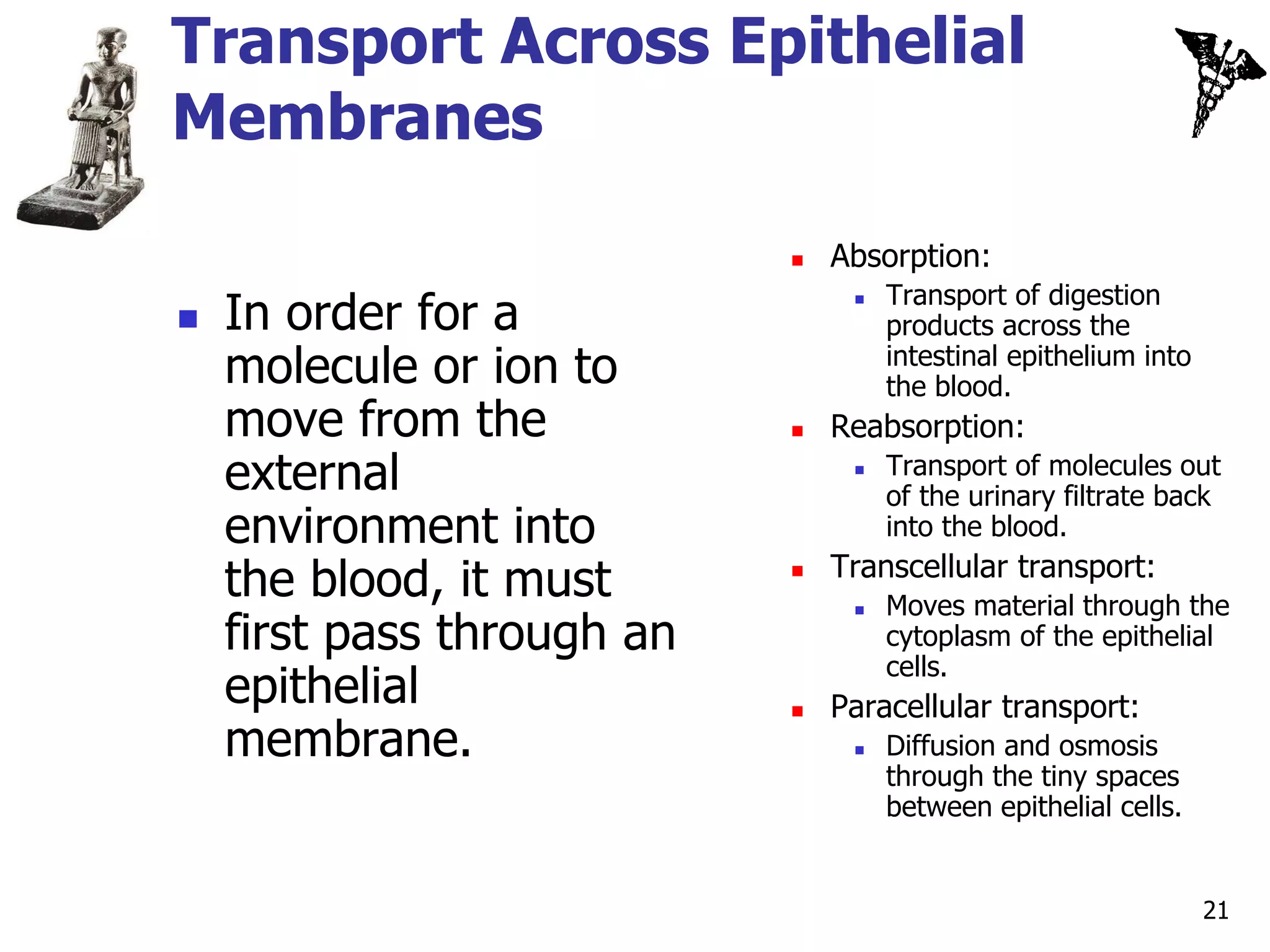
Transport Across Epithelial
Membranes

                               Absorption:
                                     Transport of digestion
    In order for a
                                 
                                    products across the
    molecule or ion to               intestinal epithelium into
                                     the blood.
    move from the              Reabsorption:
    external                        Transport of molecules out
                                     of the urinary filtrate back
    environment into                 into the blood.
                                Transcellular transport:
    the blood, it must      

                                     Moves material through the
    first pass through an
                                 

                                     cytoplasm of the epithelial
                                     cells.
    epithelial                 Paracellular transport:
    membrane.                       Diffusion and osmosis
                                     through the tiny spaces
                                     between epithelial cells.


                                                                  21
Bulk Transport

   Movement of many large molecules, that cannot be
    transported by carriers, at the same time.
   Exocytosis:
       Fusion of the membrane-bound vesicles that contains
        cellular products with the plasma membrane.
   Endocytosis:
       Exocytosis in reverse.
       Specific molecules can be taken into the cell because of the
        interaction of the molecule and protein receptor.


                                                                   22
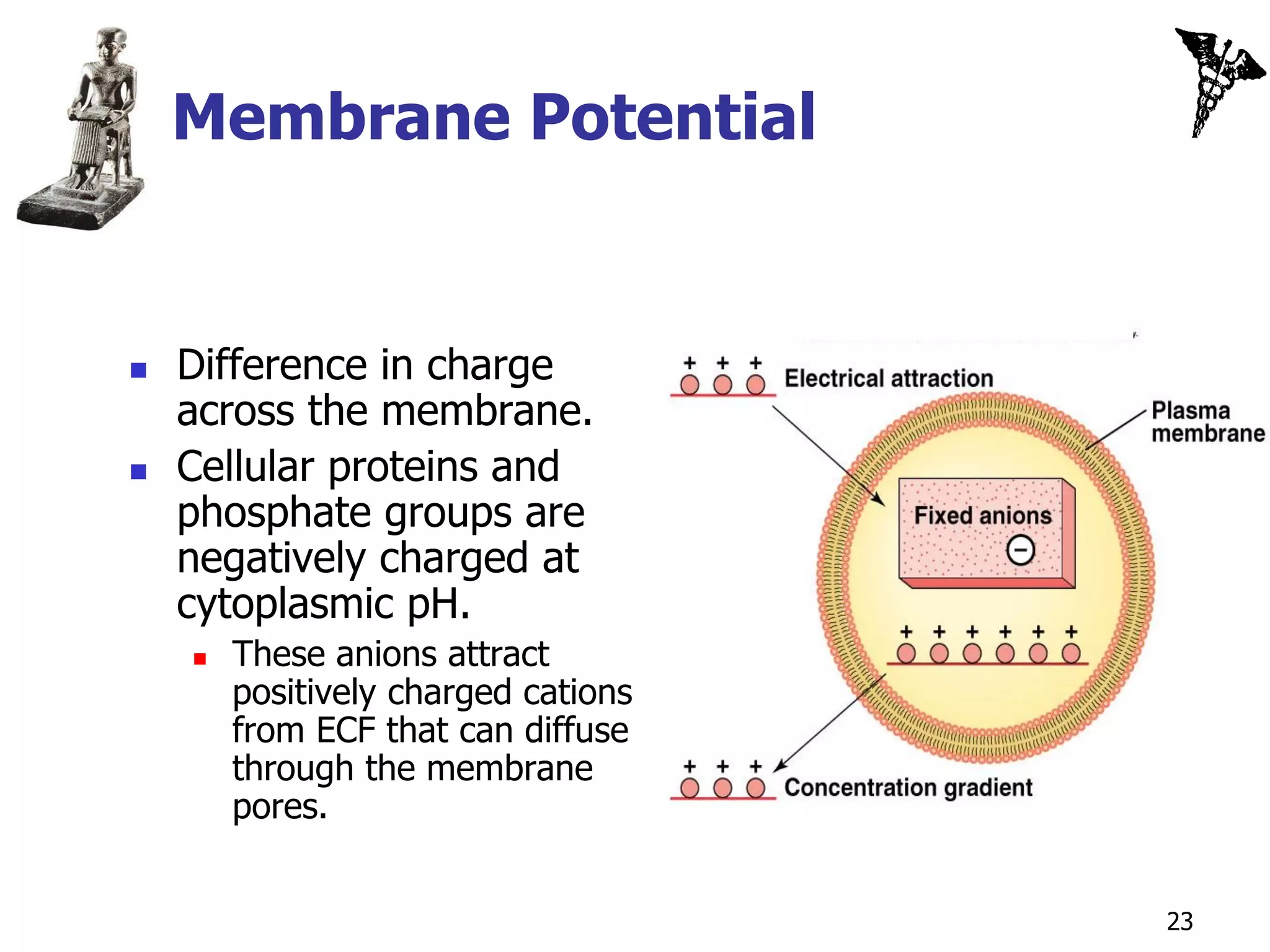
Membrane Potential


   Difference in charge
    across the membrane.
   Cellular proteins and
    phosphate groups are
    negatively charged at
    cytoplasmic pH.
       These anions attract
        positively charged cations
        from ECF that can diffuse
        through the membrane
        pores.


                                     23
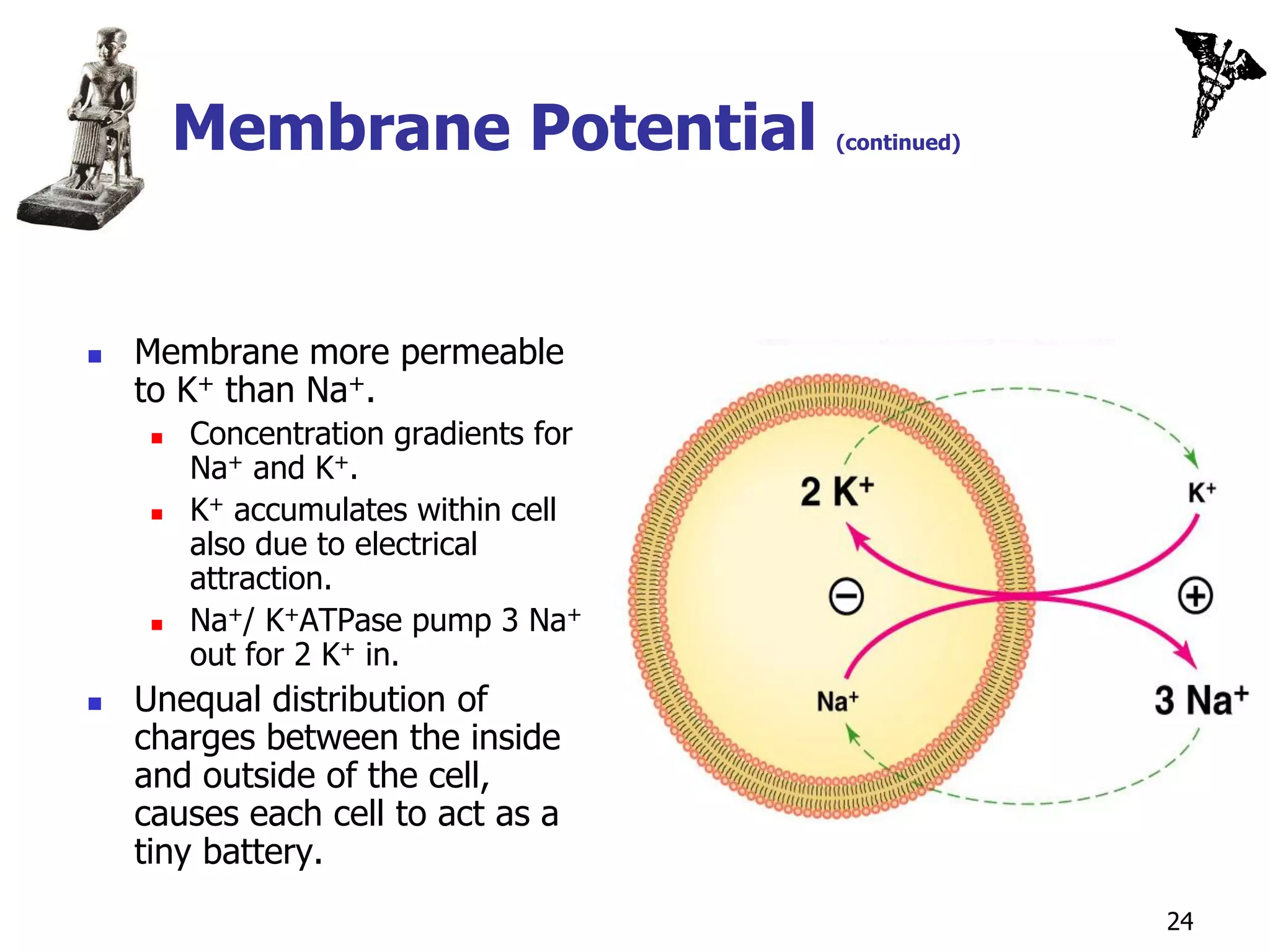
Membrane Potential            (continued)


   Membrane more permeable
    to K+ than Na+.
        Concentration gradients for
         Na+ and K+.
        K+ accumulates within cell
         also due to electrical
         attraction.
        Na+/ K+ATPase pump 3 Na+
         out for 2 K+ in.
   Unequal distribution of
    charges between the inside
    and outside of the cell,
    causes each cell to act as a
    tiny battery.
                                                     24
Equilibrium Potentials
   Theoretical voltage produced across
    the membrane if only 1 ion could
    diffuse through the membrane.
   If membrane only permeable to K+,
    K+ diffuses until [K+] is at
    equilibrium.
        Force of electrical attraction and
         diffusion are = and opposite.
   At equilibrium, inside of the cell
    membrane would have a higher
    [negative charges] than the
    outside.
   Potential difference:
        Magnitude of difference in charge
         on the 2 sides of the membrane.


                                              25
Nernst Equation
   Allows theoretical membrane potential to be
    calculated for particular ion.
       Membrane potential that would exactly balance the
        diffusion gradient and prevent the net movement
        of a particular ion.
       Value depends on the ratio of [ion] on the 2 sides
        of the membrane.
   Ex = 61 log [Xo]
          z     [Xi]
   Equilibrium potential for K+ = - 90 mV.
   Equilibrium potential for Na+ = + 60 mV.


                                                        26
Resting Membrane Potential

   Resting membrane potential is less than Ek
    because some Na+ can also enter the cell.
   The slow rate of Na+ efflux is accompanied
    by slow rate of K+ influx.
   Depends upon 2 factors:
        Ratio of the concentrations of each ion on the 2
         sides of the plasma membrane.
        Specific permeability of membrane to each
         different ion.
   Resting membrane potential of most cells
    ranges from - 65 to – 85 mV.
                                                            27
Cell Signaling
   How cells communicate with each other.
   Gap junctions:
       Signal can directly travel from 1 cell to the next through
        fused membrane channels.
   Paracrine signaling:
       Cells within an organ secrete regulatory molecules that
        diffuse through the extracellular matrix to nearby target
        cells.
   Synaptic signaling:
       Means by which neurons regulate their target cells.
   Endocrine signaling:
       Cells of endocrine glands secrete hormones into ECF.
   For a target cell to respond to a hormone, NT, or
    paracrine regulator; it must have specific receptor
    proteins for these molecules.
                                                                     28
Cellular Transport
 Diffusion, Dialysis and Osmosis Tutorial by RM Chute
 Osmosis - Examples Colorada State University
 Osmosis by Terry Brown
 Interactive Cellular Transport by Rodney F. Boyer
 Hypotonic, Isotonic, Hypertonic by June B. Steinberg
 Osmosis McGraw-Hill Companies, inc
 Symport, Anitport, Uniport by University of Wisconsin
 Facilitated Diffusion by University of Wisconsin
 Passive and Active Transport from Northland Community and
  Technical College
 The Plasma Membrane Dr JA Miyan at Department of
  Biomolecular Sciences, UMIST, UK
 Endocytosis of an LDL EarthLink
 Osmosis (thistle tube)


                                                              29
Cellular Structure and Function
 Comparison of Prokaryote, Animal and Plant Cells by Rodney F.
  Boyer
 Flash animations of Biological Processes by John L. Giannini
 Organize It by Leif Saul
 Stem Cells Sumanas Inc.
 Membrane Structure Tutorial
 Various Cellular Animations University of Alberta
 Cellular Receptor Animations University of Oklahoma
 Cell Tutorial from "Cells Alive!"
 Simple cell by Terry Brown
 Kinesin - Molecular Motor Sinauer Associates Inc., W. H. Freeman
  Co. and Sumanas Inc.
 Kinesin Movie RPI
 Cellular Animations by Donald F. Slish
 Flagella and Cilia from Northland Community and Technical College


                                                                      30

IVMS-Interactions Between Cells and the Extracellular Environment

  • 1.
    Interactions Between Cellsand the Extracellular Environment Compiled and Presented by Marc Imhotep Cray, M.D. Basic Medical Sciences Professor Companion Notes http://www.slideshare.net/drimhotep/ivmsoverview-of-cell-biology
  • 2.
    Extracellular Environment  Includes all constituents of the body located outside the cell.  Body fluids are divided into 2 compartments:  Intracellular compartment:  67% of total body H20.  Extracellular compartment:  33% total body H20.  20% of ECF is blood plasma.  80% is interstitial fluid contained in gel-like matrix. 2
  • 3.
    Extracellular Matrix  Consists of collagen, elastin and gel-like ground substance.  Interstitial fluid exists in the hydrated gel of the ground substance.  Ground substance:  Complex organization of molecules chemically linked to extracellular protein fibers of collagen and elastin, and carbohydrates that cover the outside of the plasma membrane.  Collagen and elastin:  Provide structural strength to connective tissue.  Gel:  Composed of glycoproteins and proteoglycans which have a high content of bound H20 molecules.  Integrins are glycoproteins that serve as adhesion molecules between cells and the extracellular matrix. 3
  • 4.
    Categories of TransportAcross the Plasma Membrane  Cell membrane is selectively  May also be categorized permeable to some molecules and ions. by their energy  Not permeable to proteins, requirements: nucleic acids, and other  Passive transport: molecules.  Net movement down a  Mechanisms to transport concentration gradient. molecules and ions through Does not require the cell membrane:  metabolic energy  Carrier mediated transport: (ATP). Facilitated diffusion and Active transport:   active transport.  Non-carrier mediated  Net movement against a transport. concentration gradient.  Diffusion and osmosis.  Requires ATP. 4
  • 5.
    Diffusion  Molecules/ions are in constant state of random motion due to their thermal energy.  Eliminates a concentration gradient and distributes the molecules uniformly.  Physical process that occurs whenever there is a concentration difference across the membrane and the membrane is permeable to the diffusing substance. 5
  • 6.
    Diffusion Through Plasma Membrane  Cell membrane is permeable to:  Non-polar molecules (02).  Lipid soluble molecules (steroids).  Small polar covalent bonds (C02).  H20 (small size, lack charge).  Cell membrane impermeable to:  Large polar molecules (glucose).  Charged inorganic ions (Na+). 6
  • 7.
    Rate of Diffusion  Speed at which diffusion occurs.  Dependent upon:  The magnitude of concentration gradient.  Driving force of diffusion.  Permeability of the membrane.  Neuronal plasma membrane 20 x more permeable to K+ than Na+.  Temperature.  Higher temperature, faster diffusion rate.  Surface area of the membrane.  Microvilli increase surface area. 7
  • 8.
    Osmosis  Net diffusion of H20 across a selectively permeable membrane.  Movement of H20 from a high[H20] to lower [H20] until equilibrium is reached.  2 requirements for osmosis:  Must be difference in [solute] on the 2 sides of the membrane.  Membrane must be impermeable to the solute.  Osmotically active solutes:  Solutes that cannot pass freely through the membrane. 8
  • 9.
    Effects of Osmosis  H20 moves by osmosis into the lower [H20] until equilibrium is reached (270 g/l glucose).  Osmosis ceases when concentrations are equal on both sides of the membrane. 9
  • 10.
    Osmotic Pressure  The force that would have to be exerted to prevent osmosis.  The greater the [solute] of solution, the > the osmotic pressure.  Indicates how strongly the solution “draws” H20 into it by osmosis. 10
  • 11.
    Molarity and Molality  One-molar solution:  1 mole of solute dissolved in H20 to = 1 liter.  Exact amount of H20 is not specified.  Ratio of solute to H20 critical to osmosis.  More desirable to use molality (1.0 m).  One-molal solution:  1 mole of solute is dissolved in 1 kg H20.  Osmolality (Osm):  Total molality of a solution.  Freezing point depression:  Measure of the osmolality.  1 mole of solute depresses freezing point of H20 by –1.86oC.  Plasma freezes at –0.56oC = 0.3 Osm or 300 mOsm. 11
  • 12.
    Effects of Ionizationon Osmotic Pressure  NaCl ionizes when dissolved in H20. Forms 1 mole of Na+ and 1 mole of Cl-, thus has a concentration of 2 Osm.  Glucose when dissolved in H20 forms 1 mole, thus has a concentration of 1 Osm. 12
  • 13.
    Tonicity  The effect of a solution  Hypotonic: on the osmotic  Osmotically active solutes movement of H20. in a lower osmolality and  Isotonic: osmotic pressure than  Equal tension to plasma. plasma.  RBCs will not gain or  RBC will hemolyse. lose H20.  Hypertonic:  .  Osmotically active solutes  RBC will crenate. in a higher osmolality and osmotic pressure than plasma 13
  • 14.
    Regulation of BloodOsmolality  Maintained in narrow range by regulatory mechanisms.  If a person is dehydrated:  Osmoreceptors stimulate hypothalamus:  ADH released.  Thirst increased.  Negative feedback loop. 14
  • 15.
    Carrier-Mediated Transport  Molecules that are too large and polar to diffuse are transported across plasma membrane by protein carriers.  Characteristics of protein carriers:  Specificity:  Interact with specific molecule only.  Competition:  Molecules with similar chemical structures compete for carrier site.  Saturation:  Tm (transport maximum):  Carrier sites have become saturated. 15
  • 16.
    Facilitated Diffusion  Passive:  ATP not needed.  Powered by thermal energy of diffusing molecules.  Involves transport of substance through plasma membrane down concentration gradient by carrier proteins.  Transport carriers for glucose designated as GLUT. 16
  • 17.
    Primary Active Transport  Hydrolysis of ATP directly required for the function of the carriers.  Molecule or ion binds to “recognition site” on one side of carrier protein.  Binding stimulates phosphorylation (breakdown of ATP) of carrier protein.  Carrier protein undergoes conformational change.  Hinge-like motion releases transported molecules to opposite side of membrane. 17
  • 18.
    Na+/K+ Pump  Carrier protein is also an ATP enzyme that converts ATP to ADP and Pi.  Actively extrudes 3 Na+ and transports 2 K+ inward against concentration gradient.  Steep gradient serves 4 functions:  Provides energy for “coupled transport” of other molecules.  Regulates resting calorie expenditure and BMR.  Involvement in electrochemical impulses.  Promotes osmotic flow. 18
  • 19.
    Secondary Active Transport  Coupled transport.  Energy needed for “uphill” movement obtained from “downhill” transport of Na+.  Hydrolysis of ATP by Na+/K+ pump required indirectly to maintain [Na+] gradient. 19
  • 20.
    Secondary Active Transport  Cotransport (symport):  Molecule or ion moving in the same direction as Na+.  Countertransport (antiport):  Molecule or ion moving in the opposite direction of Na+.  Glucose transport is an example of:  Cotransport.  Primary active transport.  Facilitated diffusion. 20
  • 21.
    Transport Across Epithelial Membranes  Absorption: Transport of digestion In order for a   products across the molecule or ion to intestinal epithelium into the blood. move from the  Reabsorption: external  Transport of molecules out of the urinary filtrate back environment into into the blood. Transcellular transport: the blood, it must  Moves material through the first pass through an  cytoplasm of the epithelial cells. epithelial  Paracellular transport: membrane.  Diffusion and osmosis through the tiny spaces between epithelial cells. 21
  • 22.
    Bulk Transport  Movement of many large molecules, that cannot be transported by carriers, at the same time.  Exocytosis:  Fusion of the membrane-bound vesicles that contains cellular products with the plasma membrane.  Endocytosis:  Exocytosis in reverse.  Specific molecules can be taken into the cell because of the interaction of the molecule and protein receptor. 22
  • 23.
    Membrane Potential  Difference in charge across the membrane.  Cellular proteins and phosphate groups are negatively charged at cytoplasmic pH.  These anions attract positively charged cations from ECF that can diffuse through the membrane pores. 23
  • 24.
    Membrane Potential (continued)  Membrane more permeable to K+ than Na+.  Concentration gradients for Na+ and K+.  K+ accumulates within cell also due to electrical attraction.  Na+/ K+ATPase pump 3 Na+ out for 2 K+ in.  Unequal distribution of charges between the inside and outside of the cell, causes each cell to act as a tiny battery. 24
  • 25.
    Equilibrium Potentials  Theoretical voltage produced across the membrane if only 1 ion could diffuse through the membrane.  If membrane only permeable to K+, K+ diffuses until [K+] is at equilibrium.  Force of electrical attraction and diffusion are = and opposite.  At equilibrium, inside of the cell membrane would have a higher [negative charges] than the outside.  Potential difference:  Magnitude of difference in charge on the 2 sides of the membrane. 25
  • 26.
    Nernst Equation  Allows theoretical membrane potential to be calculated for particular ion.  Membrane potential that would exactly balance the diffusion gradient and prevent the net movement of a particular ion.  Value depends on the ratio of [ion] on the 2 sides of the membrane.  Ex = 61 log [Xo] z [Xi]  Equilibrium potential for K+ = - 90 mV.  Equilibrium potential for Na+ = + 60 mV. 26
  • 27.
    Resting Membrane Potential  Resting membrane potential is less than Ek because some Na+ can also enter the cell.  The slow rate of Na+ efflux is accompanied by slow rate of K+ influx.  Depends upon 2 factors:  Ratio of the concentrations of each ion on the 2 sides of the plasma membrane.  Specific permeability of membrane to each different ion.  Resting membrane potential of most cells ranges from - 65 to – 85 mV. 27
  • 28.
    Cell Signaling  How cells communicate with each other.  Gap junctions:  Signal can directly travel from 1 cell to the next through fused membrane channels.  Paracrine signaling:  Cells within an organ secrete regulatory molecules that diffuse through the extracellular matrix to nearby target cells.  Synaptic signaling:  Means by which neurons regulate their target cells.  Endocrine signaling:  Cells of endocrine glands secrete hormones into ECF.  For a target cell to respond to a hormone, NT, or paracrine regulator; it must have specific receptor proteins for these molecules. 28
  • 29.
    Cellular Transport  Diffusion,Dialysis and Osmosis Tutorial by RM Chute  Osmosis - Examples Colorada State University  Osmosis by Terry Brown  Interactive Cellular Transport by Rodney F. Boyer  Hypotonic, Isotonic, Hypertonic by June B. Steinberg  Osmosis McGraw-Hill Companies, inc  Symport, Anitport, Uniport by University of Wisconsin  Facilitated Diffusion by University of Wisconsin  Passive and Active Transport from Northland Community and Technical College  The Plasma Membrane Dr JA Miyan at Department of Biomolecular Sciences, UMIST, UK  Endocytosis of an LDL EarthLink  Osmosis (thistle tube) 29
  • 30.
    Cellular Structure andFunction  Comparison of Prokaryote, Animal and Plant Cells by Rodney F. Boyer  Flash animations of Biological Processes by John L. Giannini  Organize It by Leif Saul  Stem Cells Sumanas Inc.  Membrane Structure Tutorial  Various Cellular Animations University of Alberta  Cellular Receptor Animations University of Oklahoma  Cell Tutorial from "Cells Alive!"  Simple cell by Terry Brown  Kinesin - Molecular Motor Sinauer Associates Inc., W. H. Freeman Co. and Sumanas Inc.  Kinesin Movie RPI  Cellular Animations by Donald F. Slish  Flagella and Cilia from Northland Community and Technical College 30