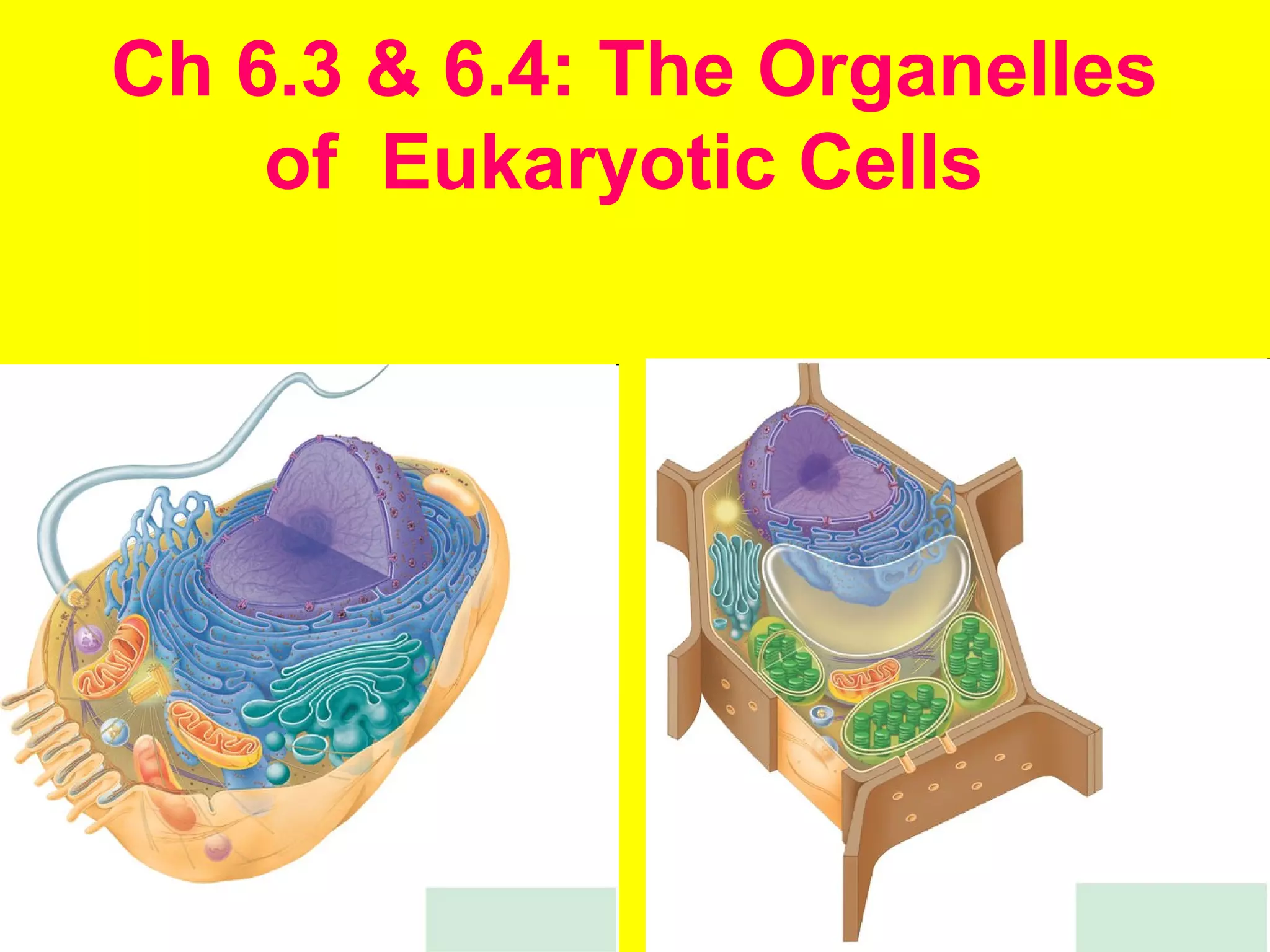
Ch 6.3 & 6.4: The Organelles
of Eukaryotic Cells
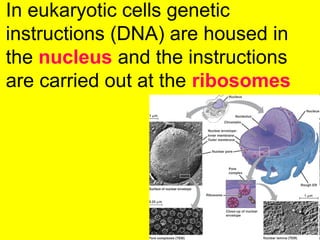
In eukaryotic cells genetic
instructions (DNA) are housed in
the nucleus and the instructions
are carried out at the ribosomes
The Nucleus
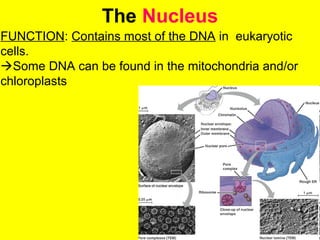
FUNCTION: Contains most of the DNA in eukaryotic
cells.
Some DNA can be found in the mitochondria and/or
chloroplasts
The Nucleus
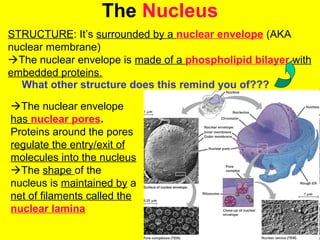
STRUCTURE: It’s surrounded by a nuclear envelope (AKA
nuclear membrane)
The nuclear envelope is made of a phospholipid bilayer with
embedded proteins.
What other structure does this remind you of???
The nuclear envelope
has nuclear pores.
Proteins around the pores
regulate the entry/exit of
molecules into the nucleus
The shape of the
nucleus is maintained by a
net of filaments called the
nuclear lamina
The Nucleus
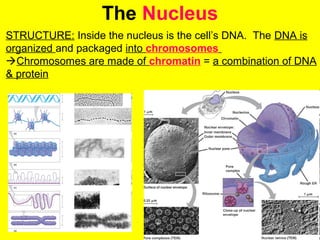
STRUCTURE: Inside the nucleus is the cell’s DNA. The DNA is
organized and packaged into chromosomes
Chromosomes are made of chromatin = a combination of DNA
& protein
The Nucleus
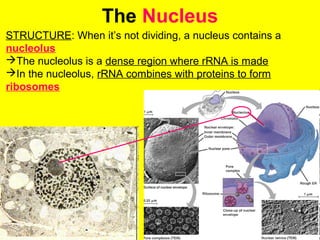
STRUCTURE: When it’s not dividing, a nucleus contains a
nucleolus
The nucleolus is a dense region where rRNA is made
In the nucleolus, rRNA combines with proteins to form
ribosomes
Quick Think
The nuclear pores of the nuclear
envelope allow molecules into and out
of the nucleus. Think of specific
molecules that would need to get into
and out of the nucleus
Cells will have more of 1 kind of
ribosome than the other
depending on the function of the
cell
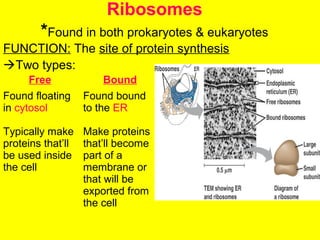
Ribosomes
*Found in both prokaryotes & eukaryotes
FUNCTION: The site of protein synthesis
Two types:
Free Bound
Found floating
in cytosol
Found bound
to the ER
Typically make
proteins that’ll
be used inside
the cell
Make proteins
that’ll become
part of a
membrane or
that will be
exported from
the cell
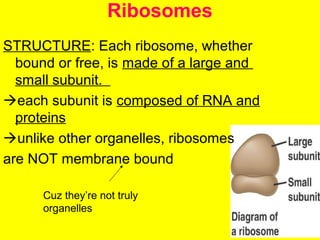
Ribosomes
STRUCTURE: Each ribosome, whether
bound or free, is made of a large and
small subunit.
each subunit is composed of RNA and
proteins
unlike other organelles, ribosomes
are NOT membrane bound
Cuz they’re not truly
organelles
Quick Think
Suppose you observe a cell with a
BUNCH of bound ribosomes. What
could you deduce from this
observation?
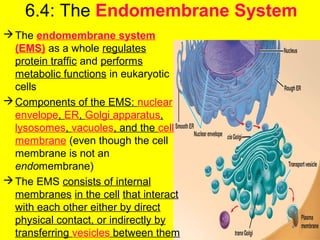
6.4: The Endomembrane System
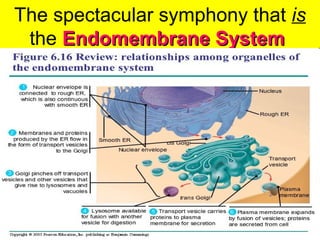
The endomembrane system
(EMS) as a whole regulates
protein traffic and performs
metabolic functions in eukaryotic
cells
Components of the EMS: nuclear
envelope, ER, Golgi apparatus,
lysosomes, vacuoles, and the cell
membrane (even though the cell
membrane is not an
endomembrane)
The EMS consists of internal
membranes in the cell that interact
with each other either by direct
physical contact, or indirectly by
transferring vesicles between them
Parts of the
endomembrane
system…
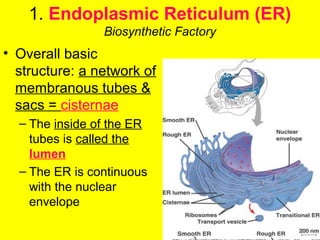
1. Endoplasmic Reticulum (ER)
Biosynthetic Factory
• Overall basic
structure: a network of
membranous tubes &
sacs = cisternae
– The inside of the ER
tubes is called the
lumen
– The ER is continuous
with the nuclear
envelope
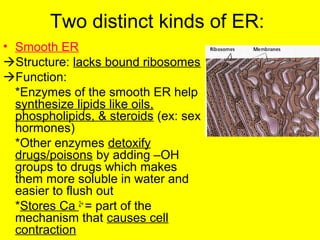
Two distinct kinds of ER:
• Smooth ER
Structure: lacks bound ribosomes
Function:
*Enzymes of the smooth ER help
synthesize lipids like oils,
phospholipids, & steroids (ex: sex
hormones)
*Other enzymes detoxify
drugs/poisons by adding –OH
groups to drugs which makes
them more soluble in water and
easier to flush out
*Stores Ca 2+
= part of the
mechanism that causes cell
contraction
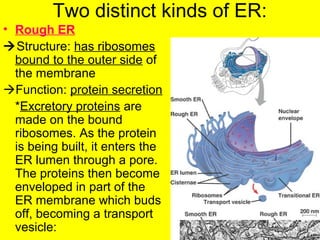
Two distinct kinds of ER:
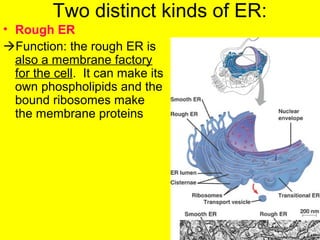
• Rough ER
Structure: has ribosomes
bound to the outer side of
the membrane
Function: protein secretion
*Excretory proteins are
made on the bound
ribosomes. As the protein
is being built, it enters the
ER lumen through a pore.
The proteins then become
enveloped in part of the
ER membrane which buds
off, becoming a transport
vesicle:
Two distinct kinds of ER:
• Rough ER
Function: the rough ER is
also a membrane factory
for the cell. It can make its
own phospholipids and the
bound ribosomes make
the membrane proteins
Parts of the
endomembrane
system…
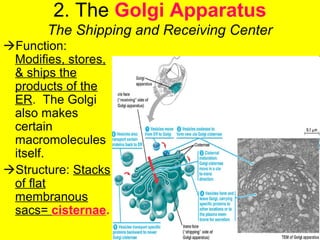
2. The Golgi Apparatus
The Shipping and Receiving Center
Function:
Modifies, stores,
& ships the
products of the
ER. The Golgi
also makes
certain
macromolecules
itself.
Structure: Stacks
of flat
membranous
sacs= cisternae.
2. The Golgi Apparatus
The Shipping and Receiving Center
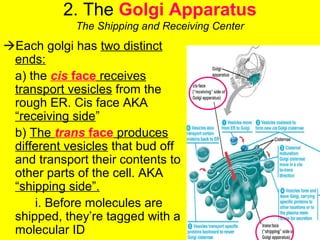
Each golgi has two distinct
ends:
a) the cis face receives
transport vesicles from the
rough ER. Cis face AKA
“receiving side”
b) The trans face produces
different vesicles that bud off
and transport their contents to
other parts of the cell. AKA
“shipping side”.
i. Before molecules are
shipped, they’re tagged with a
molecular ID
Parts of the
endomembrane system…
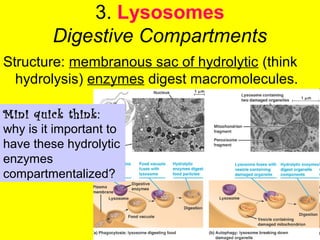
3. Lysosomes
Digestive Compartments
Structure: membranous sac of hydrolytic (think
hydrolysis) enzymes digest macromolecules.
Mini quick think:
why is it important to
have these hydrolytic
enzymes
compartmentalized?
3. Lysosomes
Digestive Compartments
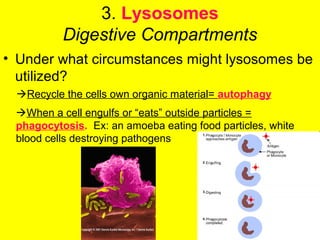
• Under what circumstances might lysosomes be
utilized?
Recycle the cells own organic material= autophagy
When a cell engulfs or “eats” outside particles =
phagocytosis. Ex: an amoeba eating food particles, white
blood cells destroying pathogens
Parts of the
endomembrane system…
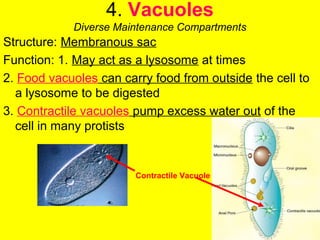
4. Vacuoles
Diverse Maintenance Compartments
Structure: Membranous sac
Function: 1. May act as a lysosome at times
2. Food vacuoles can carry food from outside the cell to
a lysosome to be digested
3. Contractile vacuoles pump excess water out of the
cell in many protists
Contractile Vacuole
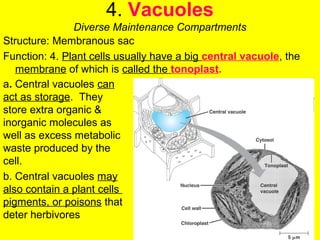
4. Vacuoles
Diverse Maintenance Compartments
Structure: Membranous sac
Function: 4. Plant cells usually have a big central vacuole, the
membrane of which is called the tonoplast.
a. Central vacuoles can
act as storage. They
store extra organic &
inorganic molecules as
well as excess metabolic
waste produced by the
cell.
b. Central vacuoles may
also contain a plant cells
pigments, or poisons that
deter herbivores
The spectacular symphony that is
the Endomembrane SystemEndomembrane System
Quick Think
• Think of the function of each of the
following cells. For each cell type, tell
me which organelle would be relatively
more abundant and WHY…
– Thyroid cells (producing proteins to be
released into the bloodstream)
– Liver cells
– Heart muscle cells
– Leaf cells

AP Bio Ch. 6.3 - 6.4 organelles

  • 1.
    Ch 6.3 &6.4: The Organelles of Eukaryotic Cells
  • 2.
    In eukaryotic cellsgenetic instructions (DNA) are housed in the nucleus and the instructions are carried out at the ribosomes
  • 3.
    The Nucleus FUNCTION: Containsmost of the DNA in eukaryotic cells. Some DNA can be found in the mitochondria and/or chloroplasts
  • 4.
    The Nucleus STRUCTURE: It’ssurrounded by a nuclear envelope (AKA nuclear membrane) The nuclear envelope is made of a phospholipid bilayer with embedded proteins. What other structure does this remind you of??? The nuclear envelope has nuclear pores. Proteins around the pores regulate the entry/exit of molecules into the nucleus The shape of the nucleus is maintained by a net of filaments called the nuclear lamina
  • 5.
    The Nucleus STRUCTURE: Insidethe nucleus is the cell’s DNA. The DNA is organized and packaged into chromosomes Chromosomes are made of chromatin = a combination of DNA & protein
  • 6.
    The Nucleus STRUCTURE: Whenit’s not dividing, a nucleus contains a nucleolus The nucleolus is a dense region where rRNA is made In the nucleolus, rRNA combines with proteins to form ribosomes
  • 7.
    Quick Think The nuclearpores of the nuclear envelope allow molecules into and out of the nucleus. Think of specific molecules that would need to get into and out of the nucleus
  • 8.
    Cells will havemore of 1 kind of ribosome than the other depending on the function of the cell Ribosomes *Found in both prokaryotes & eukaryotes FUNCTION: The site of protein synthesis Two types: Free Bound Found floating in cytosol Found bound to the ER Typically make proteins that’ll be used inside the cell Make proteins that’ll become part of a membrane or that will be exported from the cell
  • 9.
    Ribosomes STRUCTURE: Each ribosome,whether bound or free, is made of a large and small subunit. each subunit is composed of RNA and proteins unlike other organelles, ribosomes are NOT membrane bound Cuz they’re not truly organelles
  • 10.
    Quick Think Suppose youobserve a cell with a BUNCH of bound ribosomes. What could you deduce from this observation?
  • 11.
    6.4: The EndomembraneSystem The endomembrane system (EMS) as a whole regulates protein traffic and performs metabolic functions in eukaryotic cells Components of the EMS: nuclear envelope, ER, Golgi apparatus, lysosomes, vacuoles, and the cell membrane (even though the cell membrane is not an endomembrane) The EMS consists of internal membranes in the cell that interact with each other either by direct physical contact, or indirectly by transferring vesicles between them
  • 12.
  • 13.
    1. Endoplasmic Reticulum(ER) Biosynthetic Factory • Overall basic structure: a network of membranous tubes & sacs = cisternae – The inside of the ER tubes is called the lumen – The ER is continuous with the nuclear envelope
  • 14.
    Two distinct kindsof ER: • Smooth ER Structure: lacks bound ribosomes Function: *Enzymes of the smooth ER help synthesize lipids like oils, phospholipids, & steroids (ex: sex hormones) *Other enzymes detoxify drugs/poisons by adding –OH groups to drugs which makes them more soluble in water and easier to flush out *Stores Ca 2+ = part of the mechanism that causes cell contraction
  • 15.
    Two distinct kindsof ER: • Rough ER Structure: has ribosomes bound to the outer side of the membrane Function: protein secretion *Excretory proteins are made on the bound ribosomes. As the protein is being built, it enters the ER lumen through a pore. The proteins then become enveloped in part of the ER membrane which buds off, becoming a transport vesicle:
  • 16.
    Two distinct kindsof ER: • Rough ER Function: the rough ER is also a membrane factory for the cell. It can make its own phospholipids and the bound ribosomes make the membrane proteins
  • 17.
  • 18.
    2. The GolgiApparatus The Shipping and Receiving Center Function: Modifies, stores, & ships the products of the ER. The Golgi also makes certain macromolecules itself. Structure: Stacks of flat membranous sacs= cisternae.
  • 19.
    2. The GolgiApparatus The Shipping and Receiving Center Each golgi has two distinct ends: a) the cis face receives transport vesicles from the rough ER. Cis face AKA “receiving side” b) The trans face produces different vesicles that bud off and transport their contents to other parts of the cell. AKA “shipping side”. i. Before molecules are shipped, they’re tagged with a molecular ID
  • 20.
  • 21.
    3. Lysosomes Digestive Compartments Structure:membranous sac of hydrolytic (think hydrolysis) enzymes digest macromolecules. Mini quick think: why is it important to have these hydrolytic enzymes compartmentalized?
  • 22.
    3. Lysosomes Digestive Compartments •Under what circumstances might lysosomes be utilized? Recycle the cells own organic material= autophagy When a cell engulfs or “eats” outside particles = phagocytosis. Ex: an amoeba eating food particles, white blood cells destroying pathogens
  • 23.
  • 24.
    4. Vacuoles Diverse MaintenanceCompartments Structure: Membranous sac Function: 1. May act as a lysosome at times 2. Food vacuoles can carry food from outside the cell to a lysosome to be digested 3. Contractile vacuoles pump excess water out of the cell in many protists Contractile Vacuole
  • 25.
    4. Vacuoles Diverse MaintenanceCompartments Structure: Membranous sac Function: 4. Plant cells usually have a big central vacuole, the membrane of which is called the tonoplast. a. Central vacuoles can act as storage. They store extra organic & inorganic molecules as well as excess metabolic waste produced by the cell. b. Central vacuoles may also contain a plant cells pigments, or poisons that deter herbivores
  • 26.
    The spectacular symphonythat is the Endomembrane SystemEndomembrane System
  • 27.
    Quick Think • Thinkof the function of each of the following cells. For each cell type, tell me which organelle would be relatively more abundant and WHY… – Thyroid cells (producing proteins to be released into the bloodstream) – Liver cells – Heart muscle cells – Leaf cells