
Science
Indicators 1– Third Term, 2017
Seventh grade
Boston International School
RESPIRATORY SYSTEM
• Objective:To recognize the importance of the Respiratory
System in living things and the necessary cares for its
well function.
• Learning Objective:Identifying the parts of the Human
Respiratory system and their functions.
Biblical Principle
• Psalm 150:6
“Everything that breathes, praise the LORD!
Praise the LORD!”
• Quiz: August 8th , 2017
• Respiratory System Project.
• Students will work on a Respiratory System model made up with a
plastic bottle, straws and balloons.
• They will work in class, they have to write a report about how they
made the model, and how the Respiratory System works.
• One person from the group is going to present the model in front of
the class. Another one has to establish the connection between the
topic and the biblical principle.
• Group: 3 people
• We will work in class August 15th, 2017
RESPIRATORY SYSTEM
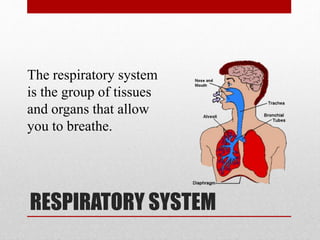
The respiratory system
is the group of tissues
and organs that allow
you to breathe.
PARTS OF THE
RESPIRATORY SYSTEM
• Nose and mouth: Airways. The air goes in and out of the
body.
• Trachea: (windpipe) this is the tube which carries air
from the throat into the lungs.
• Lungs: the lungs are not the same size, the lung on the
left side is smaller than the lung on the right. This extra
space leaves room for your heart. They allow you to take
in fresh air, get rid of bad air.
• Bronchial tubes: The trachea divides into two tubes
called bronchi or bronchial tubes, one entering the left
and one entering the right lung
• Bronchioles: very narrow tubes and they lead to alveolar
sacs.
• Alveoli: have very thin walls which permit the exchange
of gases Oxygen and Carbon Dioxide.
• Diaphragm : is a broad band of muscle which sits
underneath the lungs. It works with your lungs to allow
you to inhale and exhale air.
FUNCTION OF THE
RESPIRATORY SYSTEM
• The job of the respiratory system is very simple: to bring
OXYGEN into your body and to remove the CARBON
DIOXIDE from your body. Your body needs oxygen to
survive.
HOW DOES BREATHING
WORK?
• Breathing in is called inhale and breathing out is called
exhale. Your chest muscles and Diaphragm help you to
breathe in by expanding your chest. This creates
pressure so that air rushes down to the bottom of the
lungs. Breathing out is easy your muscles relax and the
air is squeezed out.
7th science third term respiratory system 2017

7th science third term respiratory system 2017

  • 1.
    Science Indicators 1– ThirdTerm, 2017 Seventh grade Boston International School
  • 2.
    RESPIRATORY SYSTEM • Objective:Torecognize the importance of the Respiratory System in living things and the necessary cares for its well function. • Learning Objective:Identifying the parts of the Human Respiratory system and their functions.
  • 3.
    Biblical Principle • Psalm150:6 “Everything that breathes, praise the LORD! Praise the LORD!”
  • 4.
    • Quiz: August8th , 2017 • Respiratory System Project. • Students will work on a Respiratory System model made up with a plastic bottle, straws and balloons. • They will work in class, they have to write a report about how they made the model, and how the Respiratory System works. • One person from the group is going to present the model in front of the class. Another one has to establish the connection between the topic and the biblical principle. • Group: 3 people • We will work in class August 15th, 2017
  • 5.
    RESPIRATORY SYSTEM The respiratorysystem is the group of tissues and organs that allow you to breathe.
  • 6.
    PARTS OF THE RESPIRATORYSYSTEM • Nose and mouth: Airways. The air goes in and out of the body. • Trachea: (windpipe) this is the tube which carries air from the throat into the lungs. • Lungs: the lungs are not the same size, the lung on the left side is smaller than the lung on the right. This extra space leaves room for your heart. They allow you to take in fresh air, get rid of bad air.
  • 7.
    • Bronchial tubes:The trachea divides into two tubes called bronchi or bronchial tubes, one entering the left and one entering the right lung • Bronchioles: very narrow tubes and they lead to alveolar sacs. • Alveoli: have very thin walls which permit the exchange of gases Oxygen and Carbon Dioxide. • Diaphragm : is a broad band of muscle which sits underneath the lungs. It works with your lungs to allow you to inhale and exhale air.
  • 8.
    FUNCTION OF THE RESPIRATORYSYSTEM • The job of the respiratory system is very simple: to bring OXYGEN into your body and to remove the CARBON DIOXIDE from your body. Your body needs oxygen to survive.
  • 9.
    HOW DOES BREATHING WORK? •Breathing in is called inhale and breathing out is called exhale. Your chest muscles and Diaphragm help you to breathe in by expanding your chest. This creates pressure so that air rushes down to the bottom of the lungs. Breathing out is easy your muscles relax and the air is squeezed out.