Endo – Perio lesions:
An enigma to the clinician?
Dr. Nikhat Fatima
Rama Dental College, Hospital
Research center
• It’s the spread of inflammation and
infection from one component to the
other.
First described by Simring and Goldberg in 1964
Pulpal and Periodontal problems are responsible
for more than 50% of tooth mortality.
Chen SY,Wang HI,Clickman GN. The influence of
endodontic treatment upon periodontal wound
healing. J Clin periodontal24;449-456,1997
Bender IB. Factors influencing radiographic
appearance of bony lesions. J Endod 8;161-
170,1982
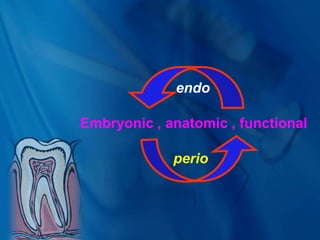
• The periodontium and the pulp have
embryonic, anatomic and functional
interrelationship.
• They are ectomesenchymal in origin,
from which the cells proliferate to
form the dental papilla and follicle,
which are the precursors of the pulp
and the periodontium respectively.
perio
endo
Embryonic , anatomic , functional
• Pathways are developed that provide
means by which pathological agents pass
between the pulp and the periodontium,
thereby creating the perio – endo lesion.
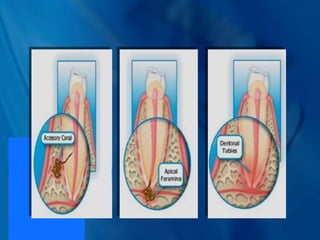
• Three main avenues for communication
are,
• 1) Dentinal tubules.
• 2) Lateral and accessory canals and
• 3) The apical foramen
“The endo-perio lesion: a critical appraisal
of the disease condition”
ILAN ROTSTEIN & JAMES H. SIMON
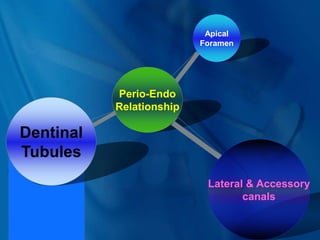
Perio-Endo
Relationship
Dentinal
Tubules
Lateral & Accessory
canals
Apical
Foramen
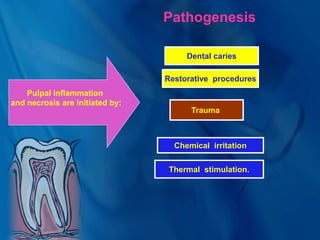
Pathogenesis
Dental caries
Restorative procedures
Trauma
Chemical irritation
Thermal stimulation.
Pulpal inflammation
and necrosis are initiated by:
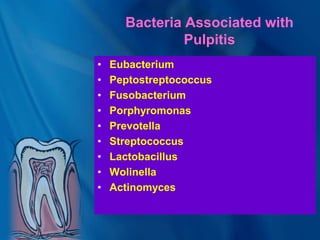
Bacteria Associated with
Pulpitis
• Eubacterium
• Peptostreptococcus
• Fusobacterium
• Porphyromonas
• Prevotella
• Streptococcus
• Lactobacillus
• Wolinella
• Actinomyces
• These inflammatory lesions
cause localized oedema and
a resulting increase in intra-
pulpal pressure and cell
death.
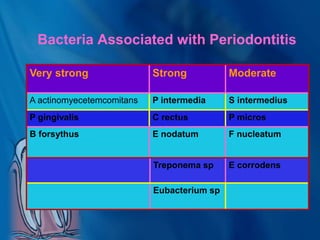
Bacteria Associated with Periodontitis
Very strong Strong Moderate
A actinomyecetemcomitans P intermedia S intermedius
P gingivalis C rectus P micros
B forsythus E nodatum F nucleatum
Treponema sp E corrodens
Eubacterium sp
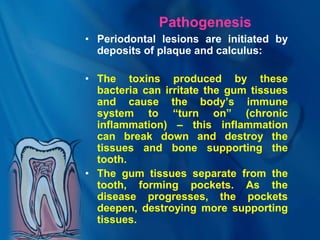
Pathogenesis
• Periodontal lesions are initiated by
deposits of plaque and calculus:
• The toxins produced by these
bacteria can irritate the gum tissues
and cause the body’s immune
system to “turn on” (chronic
inflammation) – this inflammation
can break down and destroy the
tissues and bone supporting the
tooth.
• The gum tissues separate from the
tooth, forming pockets. As the
disease progresses, the pockets
deepen, destroying more supporting
tissues.
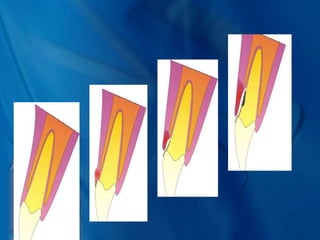
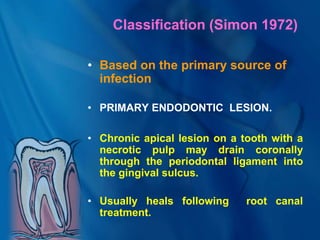
Classification (Simon 1972)
• Based on the primary source of
infection
• PRIMARY ENDODONTIC LESION.
• Chronic apical lesion on a tooth with a
necrotic pulp may drain coronally
through the periodontal ligament into
the gingival sulcus.
• Usually heals following root canal
treatment.
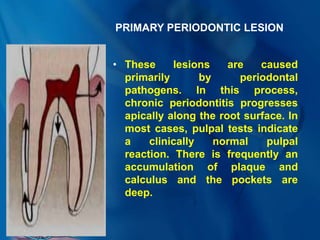
• These lesions are caused
primarily by periodontal
pathogens. In this process,
chronic periodontitis progresses
apically along the root surface. In
most cases, pulpal tests indicate
a clinically normal pulpal
reaction. There is frequently an
accumulation of plaque and
calculus and the pockets are
deep.
PRIMARY PERIODONTIC LESION
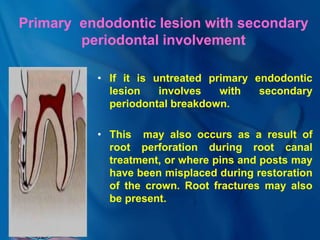
Primary endodontic lesion with secondary
periodontal involvement
• If it is untreated primary endodontic
lesion involves with secondary
periodontal breakdown.
• This may also occurs as a result of
root perforation during root canal
treatment, or where pins and posts may
have been misplaced during restoration
of the crown. Root fractures may also
be present.
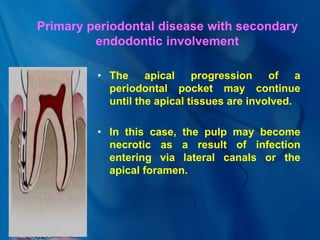
Primary periodontal disease with secondary
endodontic involvement
• The apical progression of a
periodontal pocket may continue
until the apical tissues are involved.
• In this case, the pulp may become
necrotic as a result of infection
entering via lateral canals or the
apical foramen.
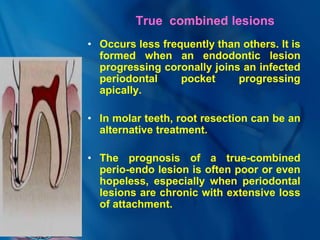
True combined lesions
• Occurs less frequently than others. It is
formed when an endodontic lesion
progressing coronally joins an infected
periodontal pocket progressing
apically.
• In molar teeth, root resection can be an
alternative treatment.
• The prognosis of a true-combined
perio-endo lesion is often poor or even
hopeless, especially when periodontal
lesions are chronic with extensive loss
of attachment.
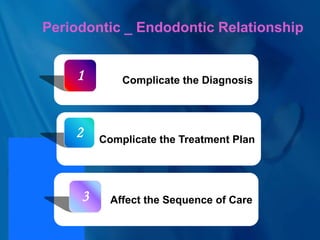
Complicate the Diagnosis
1
Affect the Sequence of Care
3
Complicate the Treatment Plan
2
Periodontic _ Endodontic Relationship
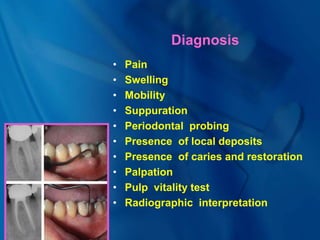
Diagnosis
• Pain
• Swelling
• Mobility
• Suppuration
• Periodontal probing
• Presence of local deposits
• Presence of caries and restoration
• Palpation
• Pulp vitality test
• Radiographic interpretation
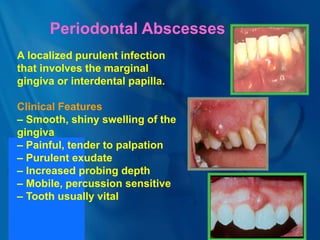
Periodontal Abscesses
A localized purulent infection
that involves the marginal
gingiva or interdental papilla.
Clinical Features
– Smooth, shiny swelling of the
gingiva
– Painful, tender to palpation
– Purulent exudate
– Increased probing depth
– Mobile, percussion sensitive
– Tooth usually vital
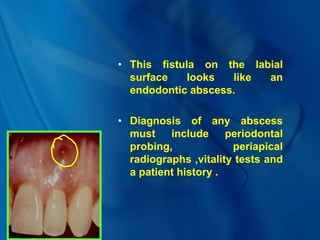
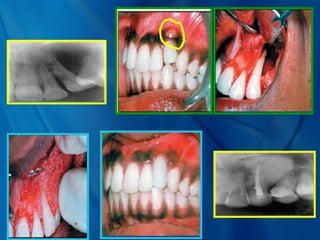
• This fistula on the labial
surface looks like an
endodontic abscess.
• Diagnosis of any abscess
must include periodontal
probing, periapical
radiographs ,vitality tests and
a patient history .
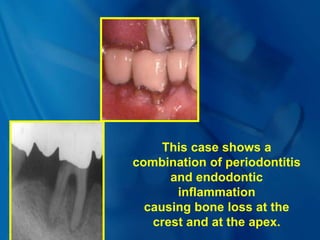
This case shows a
combination of periodontitis
and endodontic
inflammation
causing bone loss at the
crest and at the apex.
• As long as the pulp remains
vital, it is unlikely that
significant changes will occur
in the periodontium.
• The ability of inflammatory
periodontal disease to affect
the pulp is much less certain.
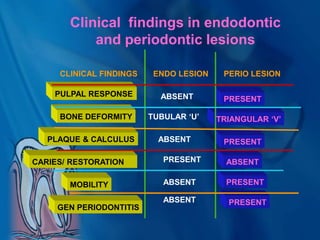
Clinical findings in endodontic
and periodontic lesions
CLINICAL FINDINGS ENDO LESION PERIO LESION
PULPAL RESPONSE ABSENT PRESENT
BONE DEFORMITY TUBULAR ‘U’ TRIANGULAR ‘V’
PLAQUE & CALCULUS ABSENT PRESENT
CARIES/ RESTORATION PRESENT ABSENT
MOBILITY ABSENT PRESENT
GEN PERIODONTITIS
ABSENT PRESENT
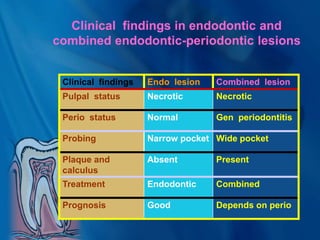
Clinical findings in endodontic and
combined endodontic-periodontic lesions
Clinical findings Endo lesion Combined lesion
Pulpal status Necrotic Necrotic
Perio status Normal Gen periodontitis
Probing Narrow pocket Wide pocket
Plaque and
calculus
Absent Present
Treatment Endodontic Combined
Prognosis Good Depends on perio
Treatment
• Primary endodontic lesion
Conventional endodontic therapy
• Primary endodontic lesion with secondary
periodontal involvement –
Endo - perio therapy
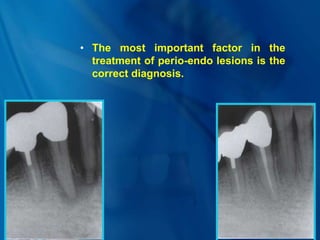
• The most important factor in the
treatment of perio-endo lesions is the
correct diagnosis.
Treatment
• Primary periodontal lesion
1-Periodontal therapy
2-Guided tissue regeneration
3-Root amputation & hemisection
4-Pulp therapy
Treatment
• Primary periodontal lesion with
secondary endo lesion
1-Pulp therapy
2-Periodontal therapy
3-Root amputation
4-GTR
• In combined endodontic-periodontic
lesions, it is generally wise to treat
the Endodontic component first,
because in many cases this will lead
to complete resolution of the
problem.
• The location, extension, severity of
inflammation and the degree of
tissue involvement helps the dentist
to select the proper treatment.
Conclusion
• The clinical course of the disease
involving the pulpo- periodontal
complex is dictated by the bacterial
aetiology and thereby the treatment
plan is decided.
• Other factors such as patient co-
operation, restorability and economics
will influence the treatment decisions.
However the primary goal of all
treatment efforts must be to rid the
patient of the infection.
Endo – Perio lesions.ppt

Endo – Perio lesions.ppt

  • 1.
    Endo – Periolesions: An enigma to the clinician? Dr. Nikhat Fatima Rama Dental College, Hospital Research center
  • 2.
    • It’s thespread of inflammation and infection from one component to the other. First described by Simring and Goldberg in 1964
  • 3.
    Pulpal and Periodontalproblems are responsible for more than 50% of tooth mortality. Chen SY,Wang HI,Clickman GN. The influence of endodontic treatment upon periodontal wound healing. J Clin periodontal24;449-456,1997 Bender IB. Factors influencing radiographic appearance of bony lesions. J Endod 8;161- 170,1982
  • 4.
    • The periodontiumand the pulp have embryonic, anatomic and functional interrelationship. • They are ectomesenchymal in origin, from which the cells proliferate to form the dental papilla and follicle, which are the precursors of the pulp and the periodontium respectively.
  • 5.
  • 6.
    • Pathways aredeveloped that provide means by which pathological agents pass between the pulp and the periodontium, thereby creating the perio – endo lesion.
  • 7.
    • Three mainavenues for communication are, • 1) Dentinal tubules. • 2) Lateral and accessory canals and • 3) The apical foramen “The endo-perio lesion: a critical appraisal of the disease condition” ILAN ROTSTEIN & JAMES H. SIMON
  • 8.
  • 10.
    Pathogenesis Dental caries Restorative procedures Trauma Chemicalirritation Thermal stimulation. Pulpal inflammation and necrosis are initiated by:
  • 11.
    Bacteria Associated with Pulpitis •Eubacterium • Peptostreptococcus • Fusobacterium • Porphyromonas • Prevotella • Streptococcus • Lactobacillus • Wolinella • Actinomyces
  • 12.
    • These inflammatorylesions cause localized oedema and a resulting increase in intra- pulpal pressure and cell death.
  • 13.
    Bacteria Associated withPeriodontitis Very strong Strong Moderate A actinomyecetemcomitans P intermedia S intermedius P gingivalis C rectus P micros B forsythus E nodatum F nucleatum Treponema sp E corrodens Eubacterium sp
  • 14.
    Pathogenesis • Periodontal lesionsare initiated by deposits of plaque and calculus: • The toxins produced by these bacteria can irritate the gum tissues and cause the body’s immune system to “turn on” (chronic inflammation) – this inflammation can break down and destroy the tissues and bone supporting the tooth. • The gum tissues separate from the tooth, forming pockets. As the disease progresses, the pockets deepen, destroying more supporting tissues.
  • 16.
    Classification (Simon 1972) •Based on the primary source of infection • PRIMARY ENDODONTIC LESION. • Chronic apical lesion on a tooth with a necrotic pulp may drain coronally through the periodontal ligament into the gingival sulcus. • Usually heals following root canal treatment.
  • 17.
    • These lesionsare caused primarily by periodontal pathogens. In this process, chronic periodontitis progresses apically along the root surface. In most cases, pulpal tests indicate a clinically normal pulpal reaction. There is frequently an accumulation of plaque and calculus and the pockets are deep. PRIMARY PERIODONTIC LESION
  • 18.
    Primary endodontic lesionwith secondary periodontal involvement • If it is untreated primary endodontic lesion involves with secondary periodontal breakdown. • This may also occurs as a result of root perforation during root canal treatment, or where pins and posts may have been misplaced during restoration of the crown. Root fractures may also be present.
  • 19.
    Primary periodontal diseasewith secondary endodontic involvement • The apical progression of a periodontal pocket may continue until the apical tissues are involved. • In this case, the pulp may become necrotic as a result of infection entering via lateral canals or the apical foramen.
  • 20.
    True combined lesions •Occurs less frequently than others. It is formed when an endodontic lesion progressing coronally joins an infected periodontal pocket progressing apically. • In molar teeth, root resection can be an alternative treatment. • The prognosis of a true-combined perio-endo lesion is often poor or even hopeless, especially when periodontal lesions are chronic with extensive loss of attachment.
  • 21.
    Complicate the Diagnosis 1 Affectthe Sequence of Care 3 Complicate the Treatment Plan 2 Periodontic _ Endodontic Relationship
  • 22.
    Diagnosis • Pain • Swelling •Mobility • Suppuration • Periodontal probing • Presence of local deposits • Presence of caries and restoration • Palpation • Pulp vitality test • Radiographic interpretation
  • 23.
    Periodontal Abscesses A localizedpurulent infection that involves the marginal gingiva or interdental papilla. Clinical Features – Smooth, shiny swelling of the gingiva – Painful, tender to palpation – Purulent exudate – Increased probing depth – Mobile, percussion sensitive – Tooth usually vital
  • 24.
    • This fistulaon the labial surface looks like an endodontic abscess. • Diagnosis of any abscess must include periodontal probing, periapical radiographs ,vitality tests and a patient history .
  • 25.
    This case showsa combination of periodontitis and endodontic inflammation causing bone loss at the crest and at the apex.
  • 26.
    • As longas the pulp remains vital, it is unlikely that significant changes will occur in the periodontium. • The ability of inflammatory periodontal disease to affect the pulp is much less certain.
  • 27.
    Clinical findings inendodontic and periodontic lesions CLINICAL FINDINGS ENDO LESION PERIO LESION PULPAL RESPONSE ABSENT PRESENT BONE DEFORMITY TUBULAR ‘U’ TRIANGULAR ‘V’ PLAQUE & CALCULUS ABSENT PRESENT CARIES/ RESTORATION PRESENT ABSENT MOBILITY ABSENT PRESENT GEN PERIODONTITIS ABSENT PRESENT
  • 28.
    Clinical findings inendodontic and combined endodontic-periodontic lesions Clinical findings Endo lesion Combined lesion Pulpal status Necrotic Necrotic Perio status Normal Gen periodontitis Probing Narrow pocket Wide pocket Plaque and calculus Absent Present Treatment Endodontic Combined Prognosis Good Depends on perio
  • 29.
    Treatment • Primary endodonticlesion Conventional endodontic therapy • Primary endodontic lesion with secondary periodontal involvement – Endo - perio therapy
  • 30.
    • The mostimportant factor in the treatment of perio-endo lesions is the correct diagnosis.
  • 31.
    Treatment • Primary periodontallesion 1-Periodontal therapy 2-Guided tissue regeneration 3-Root amputation & hemisection 4-Pulp therapy
  • 32.
    Treatment • Primary periodontallesion with secondary endo lesion 1-Pulp therapy 2-Periodontal therapy 3-Root amputation 4-GTR
  • 34.
    • In combinedendodontic-periodontic lesions, it is generally wise to treat the Endodontic component first, because in many cases this will lead to complete resolution of the problem.
  • 35.
    • The location,extension, severity of inflammation and the degree of tissue involvement helps the dentist to select the proper treatment.
  • 36.
    Conclusion • The clinicalcourse of the disease involving the pulpo- periodontal complex is dictated by the bacterial aetiology and thereby the treatment plan is decided. • Other factors such as patient co- operation, restorability and economics will influence the treatment decisions. However the primary goal of all treatment efforts must be to rid the patient of the infection.