Artificial Intelligence
in Periodontics
Uploaded by-
Dr. Neelam Das
READER
DEPT OF PERIODONTOLOGY
RAMA DENTAL COLLEGE HOSPITAL &
RESEARCH CENTRE, KANPUR (UP)
Introduction to
Periodontics
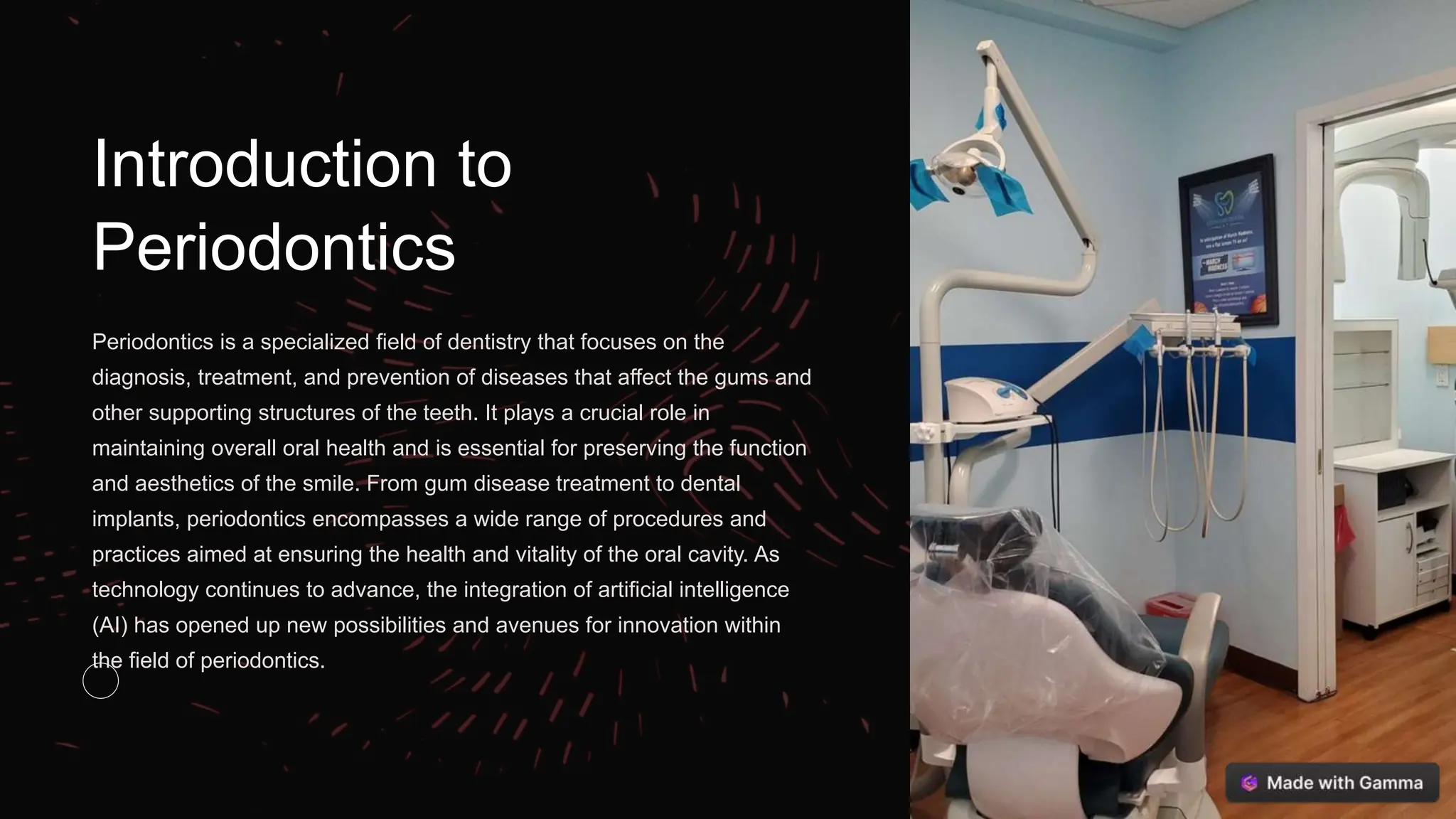
Periodontics is a specialized field of dentistry that focuses on the
diagnosis, treatment, and prevention of diseases that affect the gums and
other supporting structures of the teeth. It plays a crucial role in
maintaining overall oral health and is essential for preserving the function
and aesthetics of the smile. From gum disease treatment to dental
implants, periodontics encompasses a wide range of procedures and
practices aimed at ensuring the health and vitality of the oral cavity. As
technology continues to advance, the integration of artificial intelligence
(AI) has opened up new possibilities and avenues for innovation within
the field of periodontics.
What is Artificial Intelligence (AI)?
1 Definition
Artificial Intelligence
(AI) refers to the
simulation of human
intelligence
processes by
machines,
especially computer
systems. It involves
the use of
algorithms and data
to enable machines
to perform tasks
that typically require
human intelligence.
2 Capabilities
AI systems can
analyze,
comprehend, learn,
and adapt to
provide actionable
insights, make
decisions, and
automate complex
tasks. They can
process large
volumes of data and
identify patterns that
may not be
apparent to human
observers.
3 Applications
The applications of
AI are diverse,
ranging from natural
language
processing and
image recognition to
autonomous
vehicles and
medical diagnostics.
In the context of
periodontics, AI has
the potential to
revolutionize
various aspects of
diagnosis,
treatment, and
Applications of AI in Periodontics
Diagnostic Assistance
AI-powered software can
assist periodontists in
accurately diagnosing
dental conditions through
the analysis of clinical
data, images, and patient
records. This can lead to
more precise and timely
treatment plans.
Image processing
algorithms can detect
subtle changes in
periodontal tissues,
aiding in the early
detection of potential
issues.
Treatment
Optimization
AI can help in optimizing
treatment plans by
analyzing patient data
and recommending
personalized approaches
based on the specific
needs and conditions of
each individual.
By incorporating AI,
periodontists can
leverage predictive
modeling to anticipate
potential treatment
outcomes and adjust
strategies accordingly.
Patient Care
Enhancement
AI-based systems can
enhance patient care by
providing personalized
recommendations,
monitoring oral health
metrics remotely, and
facilitating real-time
communication between
clinicians and patients.
Virtual assistants and
chatbots using AI can
offer valuable support
and guidance to patients,
improving overall
engagement and
compliance with
treatment plans.
AI-assisted diagnosis and
treatment planning
1 Data Analysis
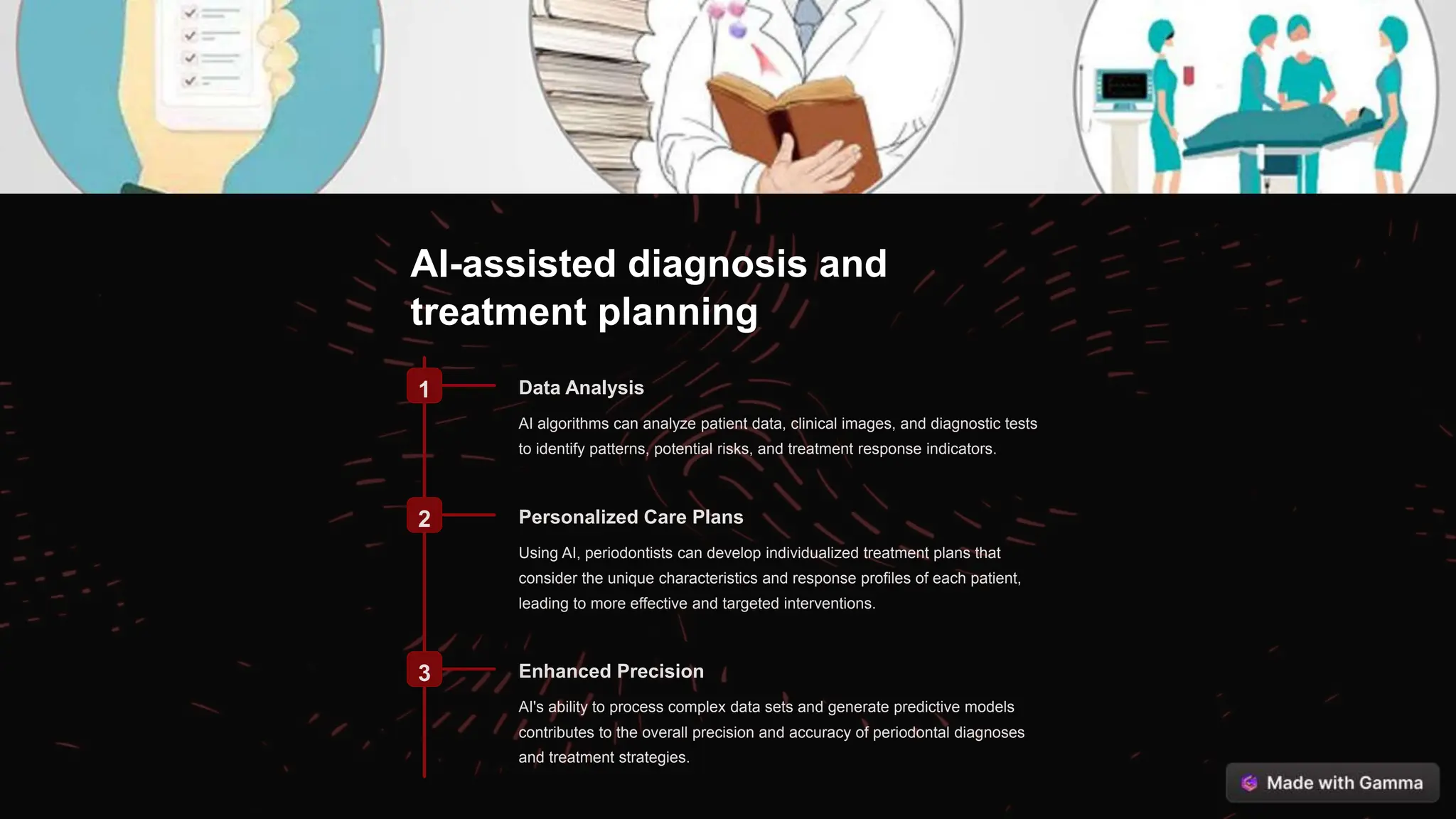
AI algorithms can analyze patient data, clinical images, and diagnostic tests
to identify patterns, potential risks, and treatment response indicators.
2 Personalized Care Plans
Using AI, periodontists can develop individualized treatment plans that
consider the unique characteristics and response profiles of each patient,
leading to more effective and targeted interventions.
3 Enhanced Precision
AI's ability to process complex data sets and generate predictive models
contributes to the overall precision and accuracy of periodontal diagnoses
and treatment strategies.
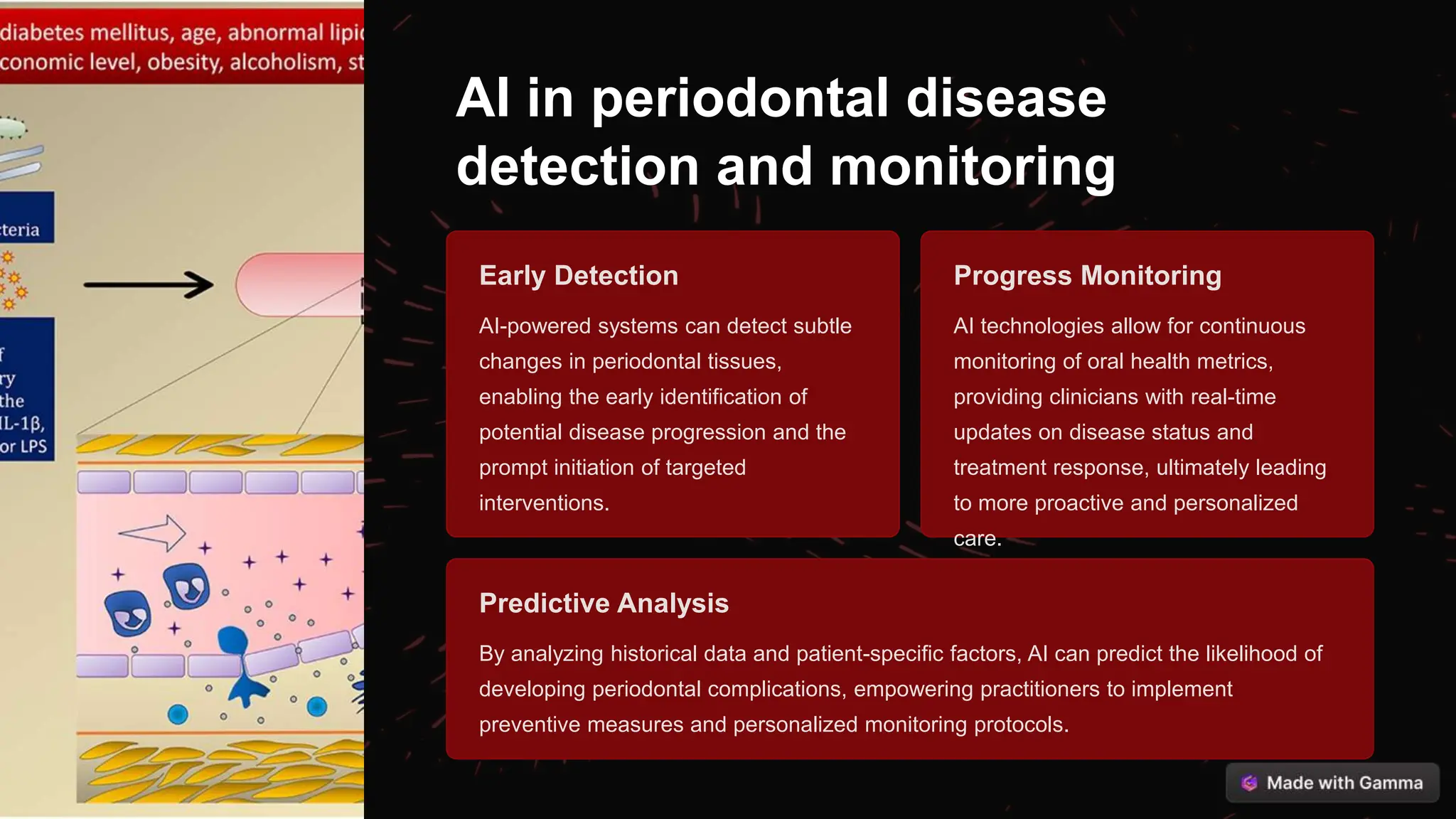
AI in periodontal disease
detection and monitoring
Early Detection
AI-powered systems can detect subtle
changes in periodontal tissues,
enabling the early identification of
potential disease progression and the
prompt initiation of targeted
interventions.
Progress Monitoring
AI technologies allow for continuous
monitoring of oral health metrics,
providing clinicians with real-time
updates on disease status and
treatment response, ultimately leading
to more proactive and personalized
care.
Predictive Analysis
By analyzing historical data and patient-specific factors, AI can predict the likelihood of
developing periodontal complications, empowering practitioners to implement
preventive measures and personalized monitoring protocols.
AI-powered robotic surgery in
Periodontics
Precision
Instruments
AI-integrated robotic
systems provide
periodontists with
precision tools for
performing minimally
invasive surgeries,
reducing the risk of
errors and improving
overall surgical
outcomes.
Enhanced
Visualization
Robotic surgery
platforms equipped with
AI capabilities offer
enhanced visualization
and control, allowing for
precise tissue
manipulation and
intricate procedures with
improved ergonomics for
the clinician.
Remote Collaboration
AI-powered robotic
platforms enable remote
collaboration, allowing
expert periodontists to
provide guidance and
support for complex
procedures, regardless
of geographical
constraints.
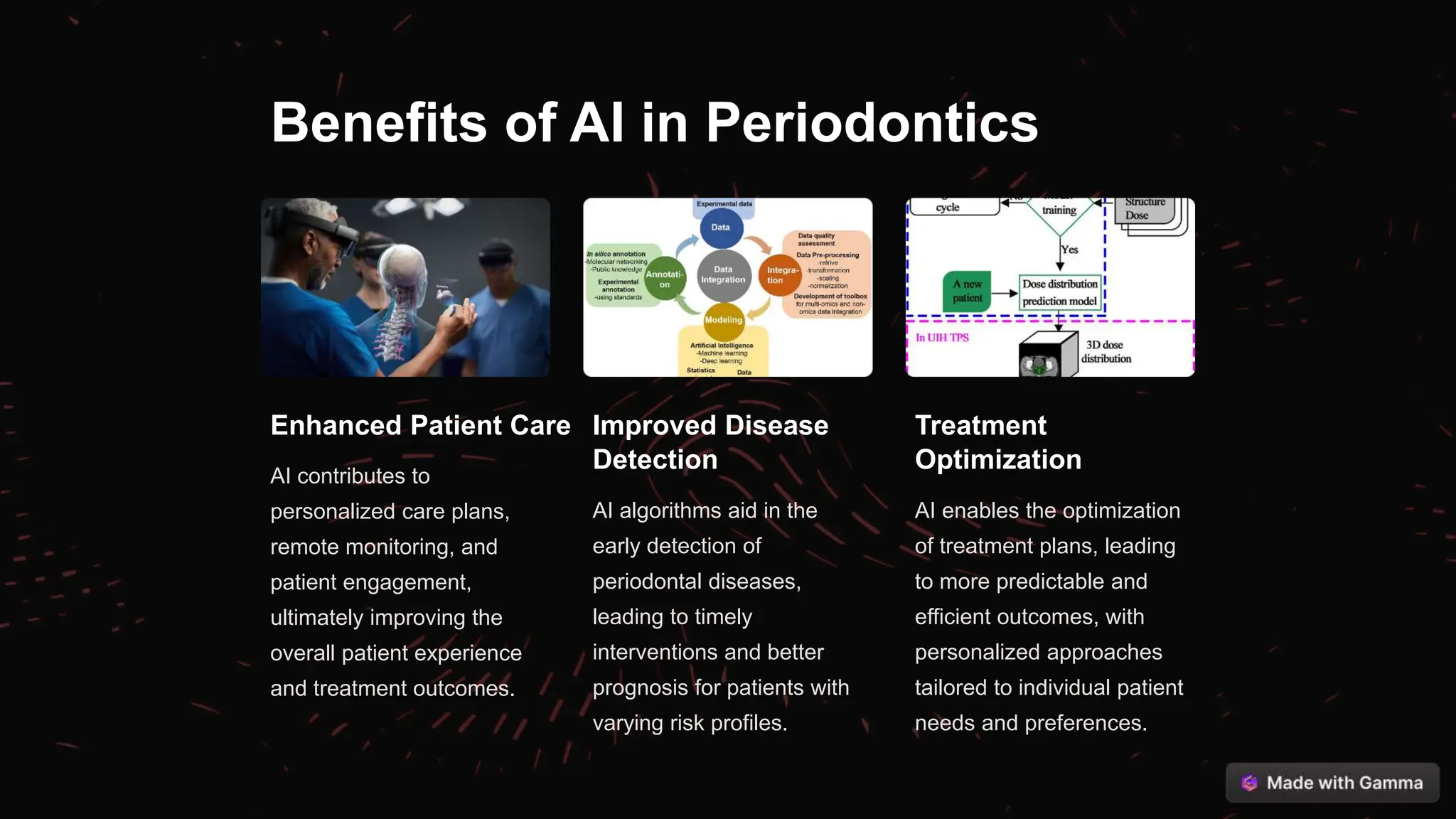
Benefits of AI in Periodontics
Enhanced Patient Care
AI contributes to
personalized care plans,
remote monitoring, and
patient engagement,
ultimately improving the
overall patient experience
and treatment outcomes.
Improved Disease
Detection
AI algorithms aid in the
early detection of
periodontal diseases,
leading to timely
interventions and better
prognosis for patients with
varying risk profiles.
Treatment
Optimization
AI enables the optimization
of treatment plans, leading
to more predictable and
efficient outcomes, with
personalized approaches
tailored to individual patient
needs and preferences.
Challenges and limitations of AI in
Periodontics
1 Data Privacy
Concerns
The extensive use of
AI in periodontics
raises concerns
about patient data
privacy, security, and
ethical
considerations,
necessitating robust
frameworks for data
governance and
protection.
2 Clinical
Integration
Integrating AI
solutions into
existing clinical
workflows may pose
challenges in terms
of interoperability,
clinician training,
and the seamless
assimilation of AI-
driven insights into
practice.
3 Evidence-
Based
Validation
Developing robust
evidence to validate
the efficacy and
safety of AI-driven
technologies in the
context of
periodontics
represents a critical
challenge that
requires extensive
clinical studies and
regulatory oversight.
Future prospects of AI in Periodontics
Advancements in
Predictive
Analytics
Future developments in
AI are poised to enhance
predictive analytics and
machine learning models,
enabling more accurate
risk assessment,
treatment planning, and
long-term outcomes
prediction in periodontal
care.
Telemedicine and
Remote Monitoring
AI-driven telemedicine
platforms and remote
monitoring solutions are
expected to expand,
offering enhanced
accessibility to
periodontal care,
personalized guidance,
and continuous patient
engagement irrespective
of geographic barriers.
Interdisciplinary
Collaboration
The future of AI in
periodontics involves
extensive interdisciplinary
collaborations, with AI
serving as a catalyst for
integrating data-driven
insights from various
sources, including
genetics, microbiomics,
and systemic health, to
revolutionize holistic
periodontal care.
Conclusion
1 Transformative Potential
The integration of AI in periodontics presents transformative potential,
offering opportunities to enhance diagnostic precision, treatment efficacy, and
patient experience, marking a new era of innovation and personalized care in
oral health.
2 Continual Evolution
As AI technologies continue to advance, the future of periodontics holds the
promise of continual evolution, with novel AI-driven tools and approaches
reshaping the landscape of preventive, diagnostic, and therapeutic strategies
for periodontal conditions.
3 Ethical Imperatives
The ethical imperatives surrounding the responsible and equitable integration
of AI into periodontics underscore the need for ongoing ethical frameworks,
regulatory oversight, and stakeholder engagement to ensure the responsible
use of AI in clinical practice and research.

AI in Periodontics by Dr. Neelam Das.pptx

  • 1.
    Artificial Intelligence in Periodontics Uploadedby- Dr. Neelam Das READER DEPT OF PERIODONTOLOGY RAMA DENTAL COLLEGE HOSPITAL & RESEARCH CENTRE, KANPUR (UP)
  • 2.
    Introduction to Periodontics Periodontics isa specialized field of dentistry that focuses on the diagnosis, treatment, and prevention of diseases that affect the gums and other supporting structures of the teeth. It plays a crucial role in maintaining overall oral health and is essential for preserving the function and aesthetics of the smile. From gum disease treatment to dental implants, periodontics encompasses a wide range of procedures and practices aimed at ensuring the health and vitality of the oral cavity. As technology continues to advance, the integration of artificial intelligence (AI) has opened up new possibilities and avenues for innovation within the field of periodontics.
  • 3.
    What is ArtificialIntelligence (AI)? 1 Definition Artificial Intelligence (AI) refers to the simulation of human intelligence processes by machines, especially computer systems. It involves the use of algorithms and data to enable machines to perform tasks that typically require human intelligence. 2 Capabilities AI systems can analyze, comprehend, learn, and adapt to provide actionable insights, make decisions, and automate complex tasks. They can process large volumes of data and identify patterns that may not be apparent to human observers. 3 Applications The applications of AI are diverse, ranging from natural language processing and image recognition to autonomous vehicles and medical diagnostics. In the context of periodontics, AI has the potential to revolutionize various aspects of diagnosis, treatment, and
  • 4.
    Applications of AIin Periodontics Diagnostic Assistance AI-powered software can assist periodontists in accurately diagnosing dental conditions through the analysis of clinical data, images, and patient records. This can lead to more precise and timely treatment plans. Image processing algorithms can detect subtle changes in periodontal tissues, aiding in the early detection of potential issues. Treatment Optimization AI can help in optimizing treatment plans by analyzing patient data and recommending personalized approaches based on the specific needs and conditions of each individual. By incorporating AI, periodontists can leverage predictive modeling to anticipate potential treatment outcomes and adjust strategies accordingly. Patient Care Enhancement AI-based systems can enhance patient care by providing personalized recommendations, monitoring oral health metrics remotely, and facilitating real-time communication between clinicians and patients. Virtual assistants and chatbots using AI can offer valuable support and guidance to patients, improving overall engagement and compliance with treatment plans.
  • 5.
    AI-assisted diagnosis and treatmentplanning 1 Data Analysis AI algorithms can analyze patient data, clinical images, and diagnostic tests to identify patterns, potential risks, and treatment response indicators. 2 Personalized Care Plans Using AI, periodontists can develop individualized treatment plans that consider the unique characteristics and response profiles of each patient, leading to more effective and targeted interventions. 3 Enhanced Precision AI's ability to process complex data sets and generate predictive models contributes to the overall precision and accuracy of periodontal diagnoses and treatment strategies.
  • 6.
    AI in periodontaldisease detection and monitoring Early Detection AI-powered systems can detect subtle changes in periodontal tissues, enabling the early identification of potential disease progression and the prompt initiation of targeted interventions. Progress Monitoring AI technologies allow for continuous monitoring of oral health metrics, providing clinicians with real-time updates on disease status and treatment response, ultimately leading to more proactive and personalized care. Predictive Analysis By analyzing historical data and patient-specific factors, AI can predict the likelihood of developing periodontal complications, empowering practitioners to implement preventive measures and personalized monitoring protocols.
  • 7.
    AI-powered robotic surgeryin Periodontics Precision Instruments AI-integrated robotic systems provide periodontists with precision tools for performing minimally invasive surgeries, reducing the risk of errors and improving overall surgical outcomes. Enhanced Visualization Robotic surgery platforms equipped with AI capabilities offer enhanced visualization and control, allowing for precise tissue manipulation and intricate procedures with improved ergonomics for the clinician. Remote Collaboration AI-powered robotic platforms enable remote collaboration, allowing expert periodontists to provide guidance and support for complex procedures, regardless of geographical constraints.
  • 8.
    Benefits of AIin Periodontics Enhanced Patient Care AI contributes to personalized care plans, remote monitoring, and patient engagement, ultimately improving the overall patient experience and treatment outcomes. Improved Disease Detection AI algorithms aid in the early detection of periodontal diseases, leading to timely interventions and better prognosis for patients with varying risk profiles. Treatment Optimization AI enables the optimization of treatment plans, leading to more predictable and efficient outcomes, with personalized approaches tailored to individual patient needs and preferences.
  • 9.
    Challenges and limitationsof AI in Periodontics 1 Data Privacy Concerns The extensive use of AI in periodontics raises concerns about patient data privacy, security, and ethical considerations, necessitating robust frameworks for data governance and protection. 2 Clinical Integration Integrating AI solutions into existing clinical workflows may pose challenges in terms of interoperability, clinician training, and the seamless assimilation of AI- driven insights into practice. 3 Evidence- Based Validation Developing robust evidence to validate the efficacy and safety of AI-driven technologies in the context of periodontics represents a critical challenge that requires extensive clinical studies and regulatory oversight.
  • 10.
    Future prospects ofAI in Periodontics Advancements in Predictive Analytics Future developments in AI are poised to enhance predictive analytics and machine learning models, enabling more accurate risk assessment, treatment planning, and long-term outcomes prediction in periodontal care. Telemedicine and Remote Monitoring AI-driven telemedicine platforms and remote monitoring solutions are expected to expand, offering enhanced accessibility to periodontal care, personalized guidance, and continuous patient engagement irrespective of geographic barriers. Interdisciplinary Collaboration The future of AI in periodontics involves extensive interdisciplinary collaborations, with AI serving as a catalyst for integrating data-driven insights from various sources, including genetics, microbiomics, and systemic health, to revolutionize holistic periodontal care.
  • 11.
    Conclusion 1 Transformative Potential Theintegration of AI in periodontics presents transformative potential, offering opportunities to enhance diagnostic precision, treatment efficacy, and patient experience, marking a new era of innovation and personalized care in oral health. 2 Continual Evolution As AI technologies continue to advance, the future of periodontics holds the promise of continual evolution, with novel AI-driven tools and approaches reshaping the landscape of preventive, diagnostic, and therapeutic strategies for periodontal conditions. 3 Ethical Imperatives The ethical imperatives surrounding the responsible and equitable integration of AI into periodontics underscore the need for ongoing ethical frameworks, regulatory oversight, and stakeholder engagement to ensure the responsible use of AI in clinical practice and research.