PERIODONTAL- ENDODONTIC LESIONS
OJUOLA G.T
FATODU A.A
Outline
 Introduction.
 Pathways of communication.
 The dilemma.
 Classification.
 Diagnosis.
 Treatment.
 Conclusion.
 References.
Introduction
 The pulp and periodontium are interrelated in several
ways
 The relationship between the periodontium and the
pulp was first discovered by Simring and Goldberg in
1964
 The periodontium and pulp have embryonic, anatomic
and functional interrelationship.
Introduction
 Ectomesenchymal cells proliferate to form the dental
papilla and follicle, which are the precursors of the
periodontium and the pulp respectively.
 Pulpal and periodontal problems are responsible for
more than 50% of tooth mortality.(Simring M,
Goldberg M 1964)
Pathways of communication.
 Anatomical
 Non physiological pathways
Anatomical pathways
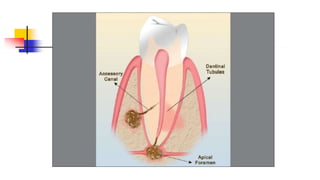
 Apical foramen:
 The apical foramen is the principal and most direct route of
communication between the periodontium and the pulp.
 accessory canals
 multitude of branches connecting the main root canal
system with the periodontal ligament.
 The frequency of these canals on the root surface are as
follows: apical third 17%, coronal third 1.6% and body of
the root 8.8% (DeDeus QD, J Endod. 1975)
Anatomical pathways
 Accessory canals cont’d
 periodontal endodontic problems were much more frequent
in the molars than in the anterior teeth because of the
greater number of accessory canals present in the molars.
(Bender et al)
 Dentine tubules
 It contains the odontoblastic process that extends from the
odontoblast at the pulpal dentin border to the dentino-
enamel junction or the cement-dentinal junction
Nonphysiological pathways
 Root perforations
 During access cavity preparation using powered rotary
instruments or preparation for post
 Improper manipulation of endodontic instrument.
 Vertical root fracture
 Chemicals used in dentistry.
 Agents, such as 30–35% hydrogen peroxide used in intracoronal
bleaching can diffuse through dentine tubules to cause necrosis
of the cementum, inflammation of the periodontal ligament, and
subsequently root resorption (S. Madison and R. Walton, Journal
The Dilemma: the effect of periodontal
lesions on pulp
 Periodontal disease or sequelae of periodontal
treatment does not affect the pulp(Jaoui L. et al 1995;
Torabinejad M, Kiger RD 1985; Bergenholtz G, Nyman
S. 1984).
 The effect of periodontal disease on the pulp is
atrophic and degenerative in nature (Petka K 2001,
Langeland K. et al 1974, Mandi FA 1972).
The Dilemma: the effect of periodontal
lesions on pulp
 Periodontal disease and periodontal treatments should
be regarded as potential causes of pulpitis and pulpal
necrosis (Wang HL, Glickman GN 2002)
The Dilemma: the effect of periodontal
lesions on pulp
 It has been advocated that periodontal disease has no
effect on the pulp, unless it extends all the way to the
tooth apex, the dental pulp is capable of surviving
significant insults and that the effect of periodontal
disease as well as periodontal treatment on the dental
pulp is negligible. (Czarnecki RT, Schilder H, 1979,
Zender et al 2002)
Classification
 By Simon et al 1972
 primary endodontic lesions,
 primary endodontic lesions with secondary periodontal
involvement,
 primary periodontal lesions,
 primary periodontal lesions with secondary endodontic
involvement,
 true combined lesions.
Classification
 By Torabinejad and Trope in 1996, based on the
origin of the periodontal pocket:
 endodontic origin,
 periodontal origin,
 combined endo-perio lesion,
 separate endodontic and periodontal lesions,
 lesions with communication,
 lesions with no communication.
Classification
 world workshop for classification of periodontal
diseases (1999) Periodontitis Associated with
Endodontic Disease
 endodontic-periodontal lesion,
 periodontal-endodontic lesion,
 combined lesion.
Classification
 A new endodontic-periodontal interrelationship
classification, based on the primary disease with its
secondary effect, was suggested by Khalid S. Al-
Fouzan in International Journal of Dentistry
Volume 2014 (2014)
 He classified it into:
Classification
 retrograde periodontal disease:
 primary endodontic lesion with drainage through the
periodontal ligament,
 primary endodontic lesion with secondary periodontal
involvement;
 primary periodontal lesion;
 primary periodontal lesion with secondary endodontic
involvement;
 combined endodontic-periodontal lesion;
 iatrogenic periodontal lesions.
Primary endodontic lesion
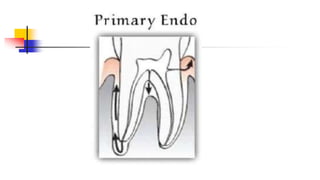
 Acute exacerbation of a chronic apical lesion on a
tooth with a necrotic pulp may drain coronally through
the periodontal ligament into the gingival sulcus.
 This condition may mimic, clinically, the presence of a
periodontal abscess.
 When the pocket is probed, it is narrow and lacks
width. Primary endodontic diseases usually heal
following root canal treatment.
Primary endodontic lesions with
secondary periodontal involvement.
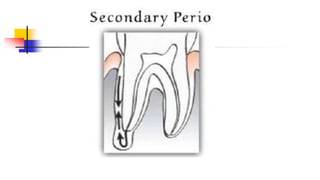
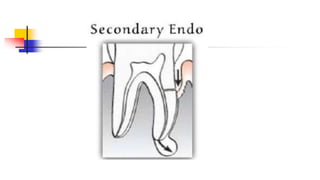
 If a primary endodontic lesion remains untreated, it
may become secondarily involved with periodontal
breakdown.
 Plaque accumulation at the gingival margin of the
sinus tract leads to plaque induced periodontitis in this
area
 It can also be as a result of non physiologic pathways
of communication which can be associated with pain,
swelling, pus or exudates, pocket formation and tooth
mobility
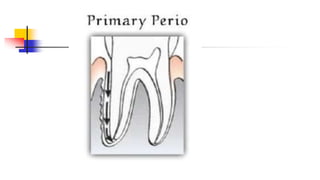
Primary periodontal lesion
 The periodontal disease has gradually spread along
the root surface towards the apex.
 The pulp may remain vital but may show some
degenerative changes over time.
Primary periodontal lesion with
secondary endodontic involvement
 Progression of the periodontal disease and the pocket
leads to pulpal involvement via either a lateral canal
foramen or the main apical foramen
 Unless periodontal disease has progressed to involve
the tooth apex, the effect of periodontal disease on
the pulp appears to be negligible. Zender et al 2002
 Prognosis better in multi rooted tooth than single
tooth. (principles and practice of endodontics,Richard
Walton and Mahmoud Torabinejad)
True combined lesions
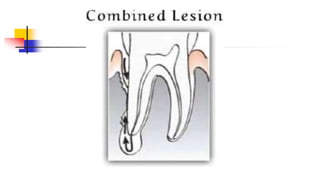
 These lesions occur when an endodontically induced
periapical lesion exists at a tooth that is also affected
by marginal periodontitis
 The tooth has a pulpless, infected root canal system
and a coexisting periodontal defect.
 It can be merged or exist seperately
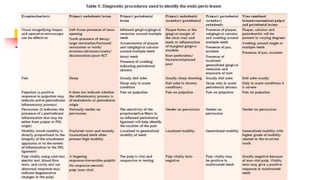
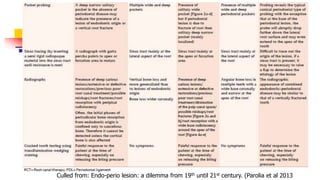
DIAGNOSIS
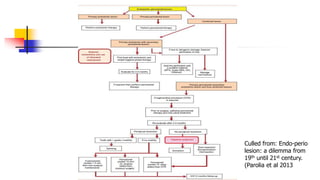
Culled from: Endo-perio lesion: a dilemma from 19th until 21st century. (Parolia et al 2013
Treatment
Treatment of Periodontal-Endodontic
Lesions
 Conventional endodontic therapy is indicated when
pulp is nonvital and infected.
 Surgical endodontic treatment is not necessary, even
in the presence of large periradicular radiolucencies
and periodontal abscesses.
 If primary endodontic lesions persist, despite
endodontic treatment, the lesion may have secondary
periodontal involvement or it may be a true combined
lesion.
Treatment of Periodontal-Endodontic
Lesions
 In Cases of primary endo with secondary perio,
 start RCT and dress canal with CaOH before obturation
 Review treatment in a few weeks
 If perio lesion is not resolve, do periodontal treatment
 Prognosis of primary endodontic disease with
secondary periodontal involvement depends on
periodontal treatment and patient response
Treatment of Periodontal-Endodontic
Lesions
 In cases of primary perio with secondary endo lesion:
 If sign of reversible pulpitis is present, periodontal
treatment only will resolve the condition
 If pulp is irreversible inflamed or nonvital, start with RCT
followed by appropriate periodontal treatment
 Prognosis of periodontal lesions is poorer than
endodontic lesions and is dependent on the apical
extensions of the lesion
Treatment of Periodontal-Endodontic
Lesions
 In cases of true combined lesions:
 Treat initially as primary endo with secondary perio lesion
 The prognosis is often poor or even hopeless, especially
when periodontal lesions are chronic, with extensive loss of
attachment.
 Root amputation, hemisection or bicuspidization maybe
done to save part of the tooth
Culled from: Endo-perio
lesion: a dilemma from
19th until 21st century.
(Parolia et al 2013
Conclusion
 Periodontitis Associated with Endodontic Disease may
be difficult to diagnose, but an understanding of the
the lesions help in diagnosis, proper treatment and
better prognosis.
 Treatment is often multidisciplinary.
References
 Parolia A, Gait TC, Porto IC, Mala K. Endo-perio lesion:
A dilemma from 19th until 21st century. J Interdiscip
Dentistry 2013;3:2-11
 Raja Sunitha V et al. The periodontal – endodontic
continuum: A review. J Conservatory Dent. 2008 Apr-
Jun; 11(2): 54–62.
 Khalid S. Al-Fouzan. A New Classification of
Endodontic-Periodontal Lesions. International Journal
of Dentistry Volume 2014 (2014)
References.
 Shenoy N, Shenoy A. Endo-perio lesions: Diagnosis
and clinical considerations. Indian J Dent Res
2010;21:579-85
Perio endo lesion ojus

Perio endo lesion ojus

  • 1.
  • 2.
    Outline  Introduction.  Pathwaysof communication.  The dilemma.  Classification.  Diagnosis.  Treatment.  Conclusion.  References.
  • 3.
    Introduction  The pulpand periodontium are interrelated in several ways  The relationship between the periodontium and the pulp was first discovered by Simring and Goldberg in 1964  The periodontium and pulp have embryonic, anatomic and functional interrelationship.
  • 4.
    Introduction  Ectomesenchymal cellsproliferate to form the dental papilla and follicle, which are the precursors of the periodontium and the pulp respectively.  Pulpal and periodontal problems are responsible for more than 50% of tooth mortality.(Simring M, Goldberg M 1964)
  • 5.
    Pathways of communication. Anatomical  Non physiological pathways
  • 6.
    Anatomical pathways  Apicalforamen:  The apical foramen is the principal and most direct route of communication between the periodontium and the pulp.  accessory canals  multitude of branches connecting the main root canal system with the periodontal ligament.  The frequency of these canals on the root surface are as follows: apical third 17%, coronal third 1.6% and body of the root 8.8% (DeDeus QD, J Endod. 1975)
  • 7.
    Anatomical pathways  Accessorycanals cont’d  periodontal endodontic problems were much more frequent in the molars than in the anterior teeth because of the greater number of accessory canals present in the molars. (Bender et al)  Dentine tubules  It contains the odontoblastic process that extends from the odontoblast at the pulpal dentin border to the dentino- enamel junction or the cement-dentinal junction
  • 9.
    Nonphysiological pathways  Rootperforations  During access cavity preparation using powered rotary instruments or preparation for post  Improper manipulation of endodontic instrument.  Vertical root fracture  Chemicals used in dentistry.  Agents, such as 30–35% hydrogen peroxide used in intracoronal bleaching can diffuse through dentine tubules to cause necrosis of the cementum, inflammation of the periodontal ligament, and subsequently root resorption (S. Madison and R. Walton, Journal
  • 10.
    The Dilemma: theeffect of periodontal lesions on pulp  Periodontal disease or sequelae of periodontal treatment does not affect the pulp(Jaoui L. et al 1995; Torabinejad M, Kiger RD 1985; Bergenholtz G, Nyman S. 1984).  The effect of periodontal disease on the pulp is atrophic and degenerative in nature (Petka K 2001, Langeland K. et al 1974, Mandi FA 1972).
  • 11.
    The Dilemma: theeffect of periodontal lesions on pulp  Periodontal disease and periodontal treatments should be regarded as potential causes of pulpitis and pulpal necrosis (Wang HL, Glickman GN 2002)
  • 12.
    The Dilemma: theeffect of periodontal lesions on pulp  It has been advocated that periodontal disease has no effect on the pulp, unless it extends all the way to the tooth apex, the dental pulp is capable of surviving significant insults and that the effect of periodontal disease as well as periodontal treatment on the dental pulp is negligible. (Czarnecki RT, Schilder H, 1979, Zender et al 2002)
  • 13.
    Classification  By Simonet al 1972  primary endodontic lesions,  primary endodontic lesions with secondary periodontal involvement,  primary periodontal lesions,  primary periodontal lesions with secondary endodontic involvement,  true combined lesions.
  • 14.
    Classification  By Torabinejadand Trope in 1996, based on the origin of the periodontal pocket:  endodontic origin,  periodontal origin,  combined endo-perio lesion,  separate endodontic and periodontal lesions,  lesions with communication,  lesions with no communication.
  • 15.
    Classification  world workshopfor classification of periodontal diseases (1999) Periodontitis Associated with Endodontic Disease  endodontic-periodontal lesion,  periodontal-endodontic lesion,  combined lesion.
  • 16.
    Classification  A newendodontic-periodontal interrelationship classification, based on the primary disease with its secondary effect, was suggested by Khalid S. Al- Fouzan in International Journal of Dentistry Volume 2014 (2014)  He classified it into:
  • 17.
    Classification  retrograde periodontaldisease:  primary endodontic lesion with drainage through the periodontal ligament,  primary endodontic lesion with secondary periodontal involvement;  primary periodontal lesion;  primary periodontal lesion with secondary endodontic involvement;  combined endodontic-periodontal lesion;  iatrogenic periodontal lesions.
  • 18.
    Primary endodontic lesion Acute exacerbation of a chronic apical lesion on a tooth with a necrotic pulp may drain coronally through the periodontal ligament into the gingival sulcus.  This condition may mimic, clinically, the presence of a periodontal abscess.  When the pocket is probed, it is narrow and lacks width. Primary endodontic diseases usually heal following root canal treatment.
  • 20.
    Primary endodontic lesionswith secondary periodontal involvement.  If a primary endodontic lesion remains untreated, it may become secondarily involved with periodontal breakdown.  Plaque accumulation at the gingival margin of the sinus tract leads to plaque induced periodontitis in this area  It can also be as a result of non physiologic pathways of communication which can be associated with pain, swelling, pus or exudates, pocket formation and tooth mobility
  • 22.
    Primary periodontal lesion The periodontal disease has gradually spread along the root surface towards the apex.  The pulp may remain vital but may show some degenerative changes over time.
  • 24.
    Primary periodontal lesionwith secondary endodontic involvement  Progression of the periodontal disease and the pocket leads to pulpal involvement via either a lateral canal foramen or the main apical foramen  Unless periodontal disease has progressed to involve the tooth apex, the effect of periodontal disease on the pulp appears to be negligible. Zender et al 2002  Prognosis better in multi rooted tooth than single tooth. (principles and practice of endodontics,Richard Walton and Mahmoud Torabinejad)
  • 26.
    True combined lesions These lesions occur when an endodontically induced periapical lesion exists at a tooth that is also affected by marginal periodontitis  The tooth has a pulpless, infected root canal system and a coexisting periodontal defect.  It can be merged or exist seperately
  • 28.
  • 30.
    Culled from: Endo-periolesion: a dilemma from 19th until 21st century. (Parolia et al 2013
  • 31.
  • 32.
    Treatment of Periodontal-Endodontic Lesions Conventional endodontic therapy is indicated when pulp is nonvital and infected.  Surgical endodontic treatment is not necessary, even in the presence of large periradicular radiolucencies and periodontal abscesses.  If primary endodontic lesions persist, despite endodontic treatment, the lesion may have secondary periodontal involvement or it may be a true combined lesion.
  • 33.
    Treatment of Periodontal-Endodontic Lesions In Cases of primary endo with secondary perio,  start RCT and dress canal with CaOH before obturation  Review treatment in a few weeks  If perio lesion is not resolve, do periodontal treatment  Prognosis of primary endodontic disease with secondary periodontal involvement depends on periodontal treatment and patient response
  • 34.
    Treatment of Periodontal-Endodontic Lesions In cases of primary perio with secondary endo lesion:  If sign of reversible pulpitis is present, periodontal treatment only will resolve the condition  If pulp is irreversible inflamed or nonvital, start with RCT followed by appropriate periodontal treatment  Prognosis of periodontal lesions is poorer than endodontic lesions and is dependent on the apical extensions of the lesion
  • 35.
    Treatment of Periodontal-Endodontic Lesions In cases of true combined lesions:  Treat initially as primary endo with secondary perio lesion  The prognosis is often poor or even hopeless, especially when periodontal lesions are chronic, with extensive loss of attachment.  Root amputation, hemisection or bicuspidization maybe done to save part of the tooth
  • 36.
    Culled from: Endo-perio lesion:a dilemma from 19th until 21st century. (Parolia et al 2013
  • 37.
    Conclusion  Periodontitis Associatedwith Endodontic Disease may be difficult to diagnose, but an understanding of the the lesions help in diagnosis, proper treatment and better prognosis.  Treatment is often multidisciplinary.
  • 38.
    References  Parolia A,Gait TC, Porto IC, Mala K. Endo-perio lesion: A dilemma from 19th until 21st century. J Interdiscip Dentistry 2013;3:2-11  Raja Sunitha V et al. The periodontal – endodontic continuum: A review. J Conservatory Dent. 2008 Apr- Jun; 11(2): 54–62.  Khalid S. Al-Fouzan. A New Classification of Endodontic-Periodontal Lesions. International Journal of Dentistry Volume 2014 (2014)
  • 39.
    References.  Shenoy N,Shenoy A. Endo-perio lesions: Diagnosis and clinical considerations. Indian J Dent Res 2010;21:579-85