Note
• Range of motion: 0º to 90º Pronation from
midposition
• Factors Limiting Motion:
1-Tension of dorsal radioulnar, ulnar collateral and
dorsal radiocarpal ligaments.
2-Tension of lowest fibers of interosseous membrane.
• Fixation:
• Weight of arm
Normal & Good
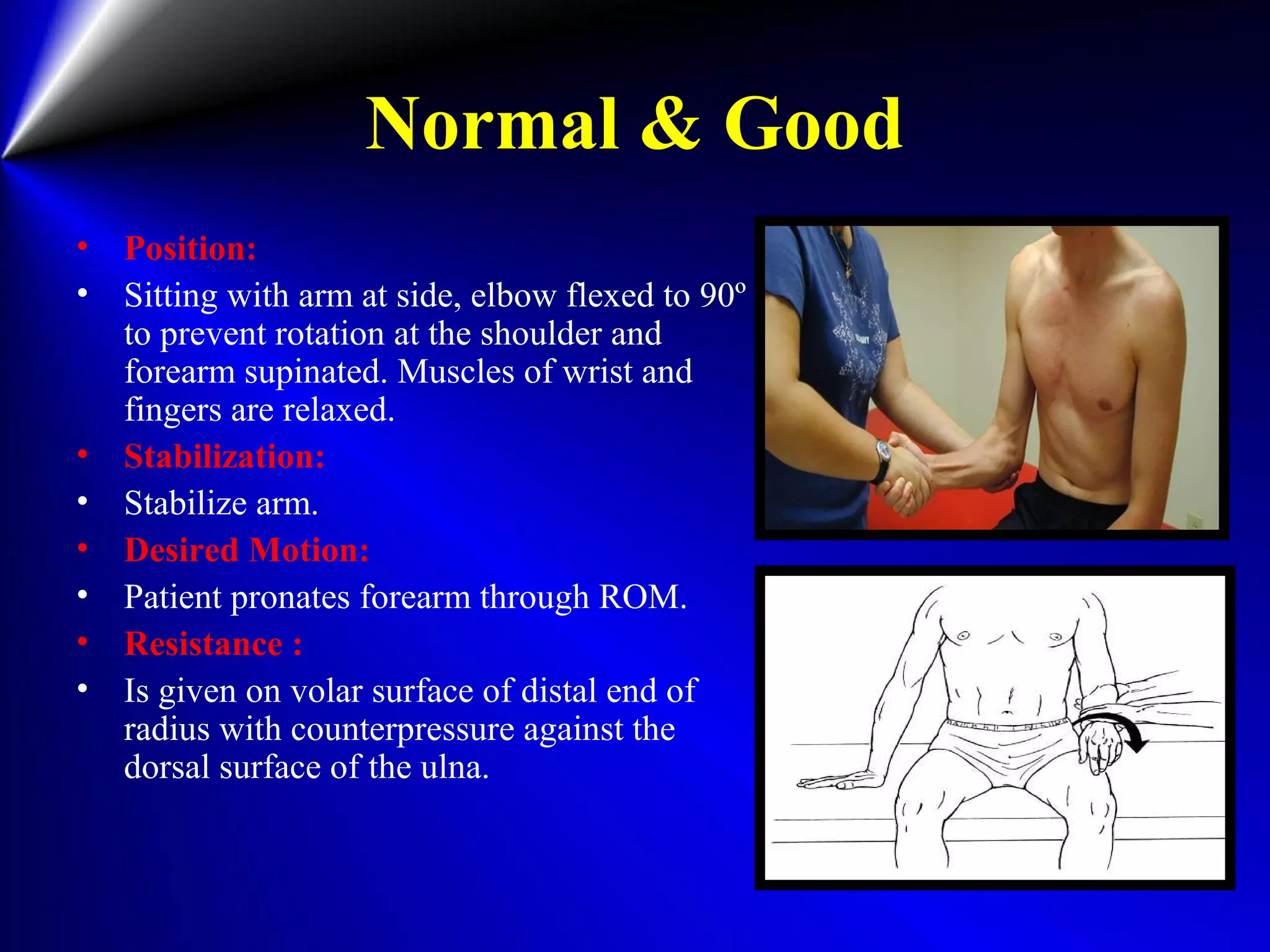
• Position:
• Sitting with arm at side, elbow flexed to 90º
to prevent rotation at the shoulder and
forearm supinated. Muscles of wrist and
fingers are relaxed.
• Stabilization:
• Stabilize arm.
• Desired Motion:
• Patient pronates forearm through ROM.
• Resistance :
• Is given on volar surface of distal end of
radius with counterpressure against the
dorsal surface of the ulna.
Fair & Poor
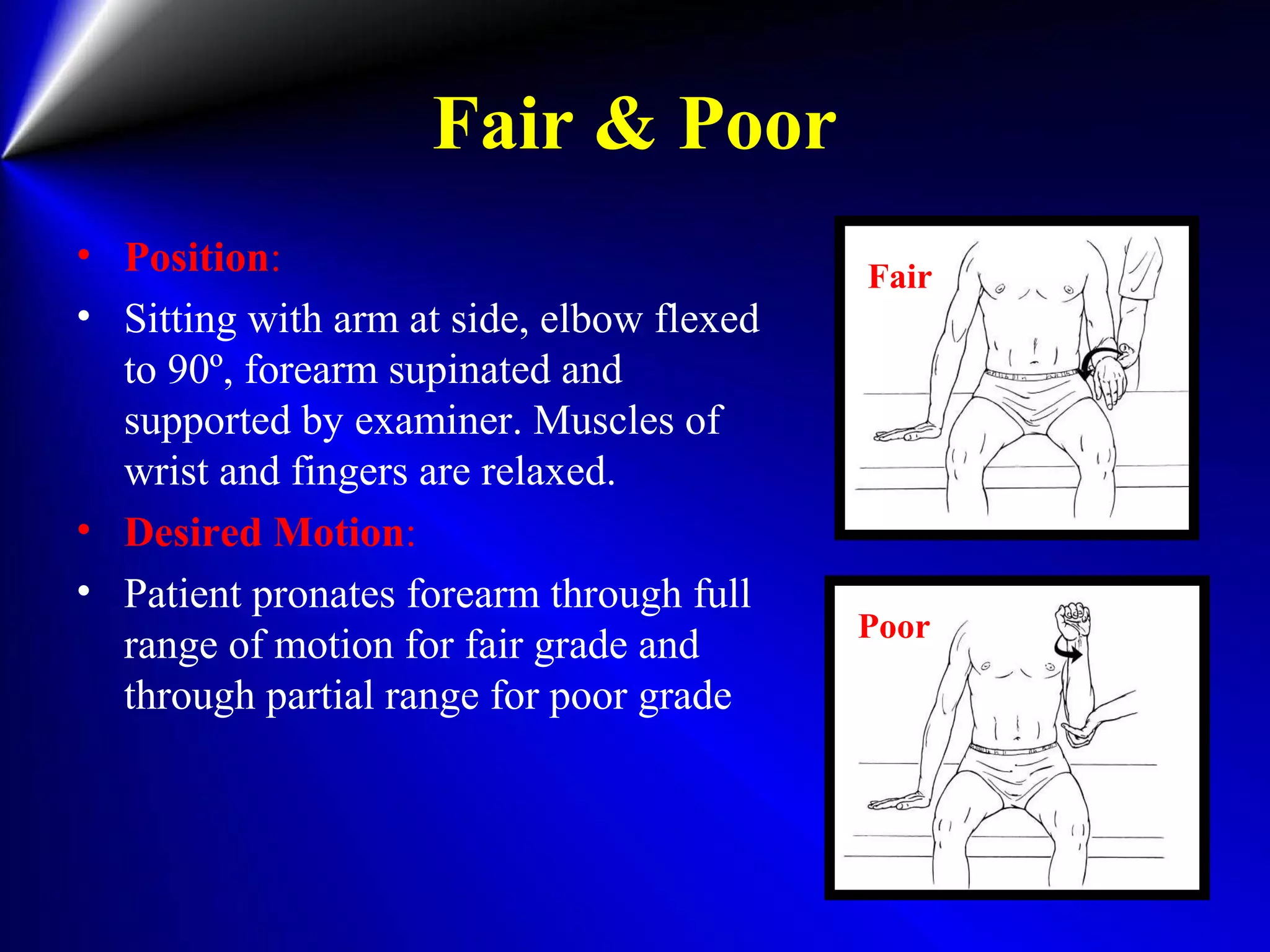
• Position:
• Sitting with arm at side, elbow flexed
to 90º, forearm supinated and
supported by examiner. Muscles of
wrist and fingers are relaxed.
• Desired Motion:
• Patient pronates forearm through full
range of motion for fair grade and
through partial range for poor grade
Fair
Poor
Trace & Zero
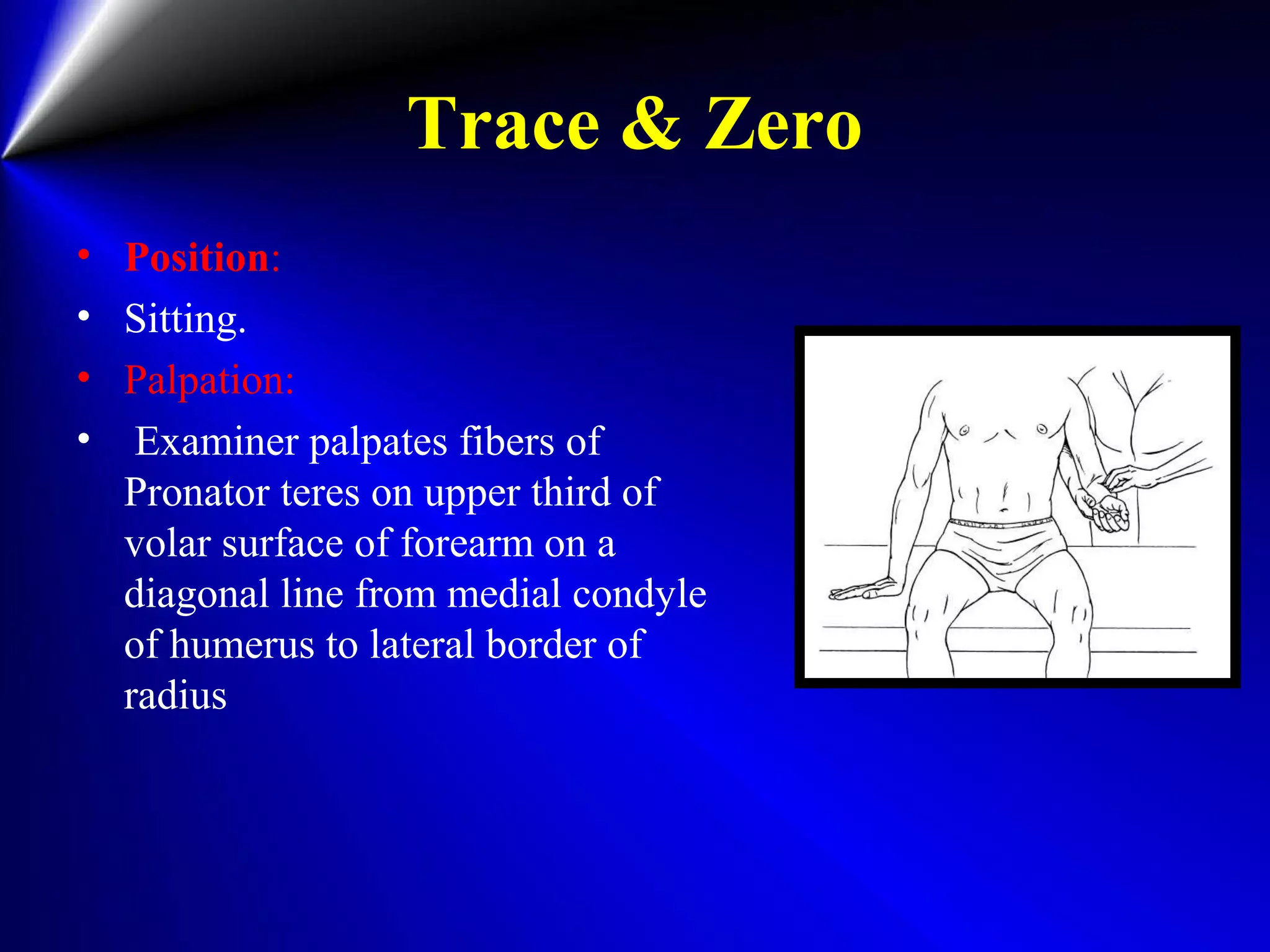
• Position:
• Sitting.
• Palpation:
• Examiner palpates fibers of
Pronator teres on upper third of
volar surface of forearm on a
diagonal line from medial condyle
of humerus to lateral border of
radius
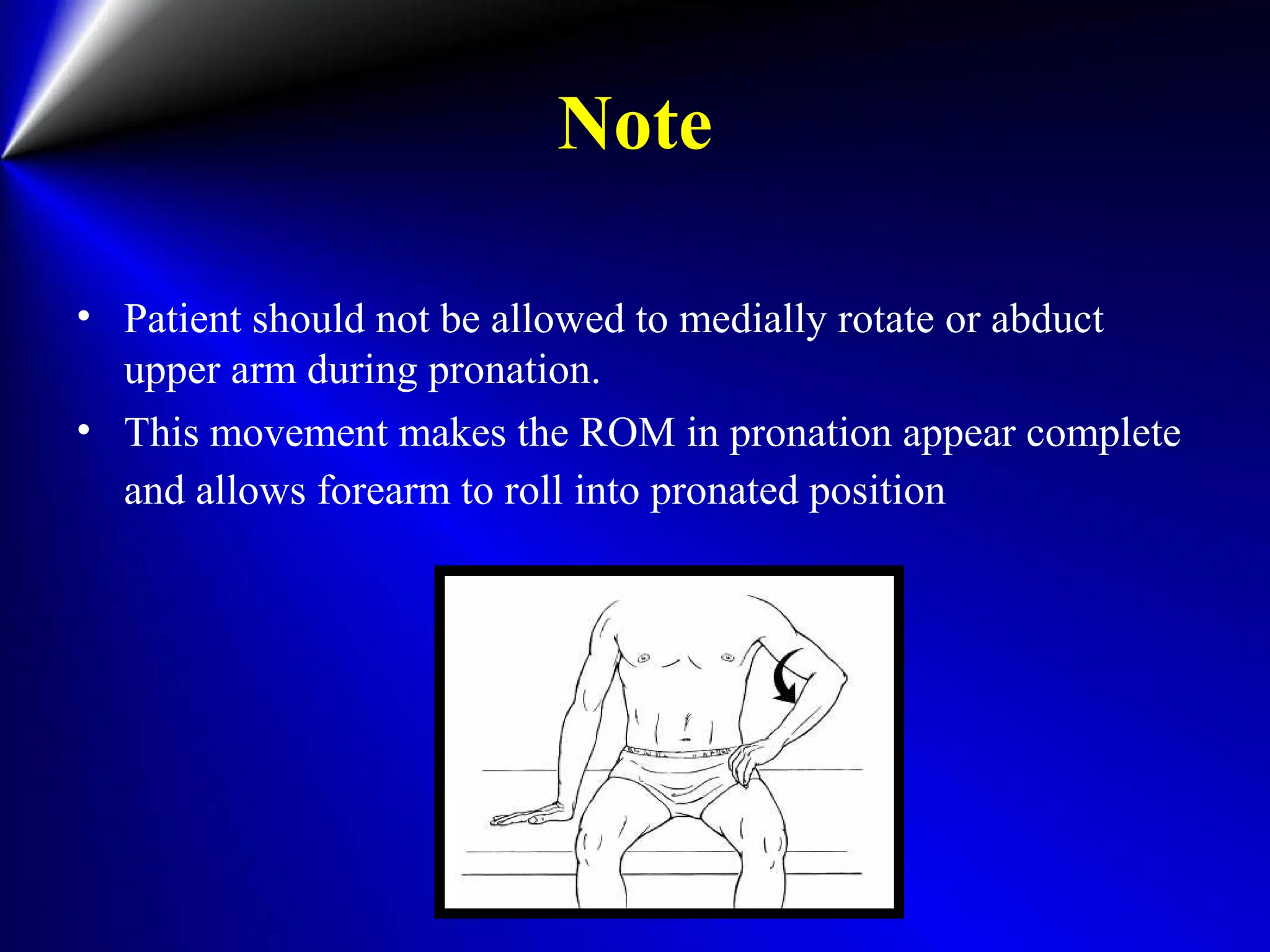
Note
• Patient should not be allowed to medially rotate or abduct
upper arm during pronation.
• This movement makes the ROM in pronation appear complete
and allows forearm to roll into pronated position
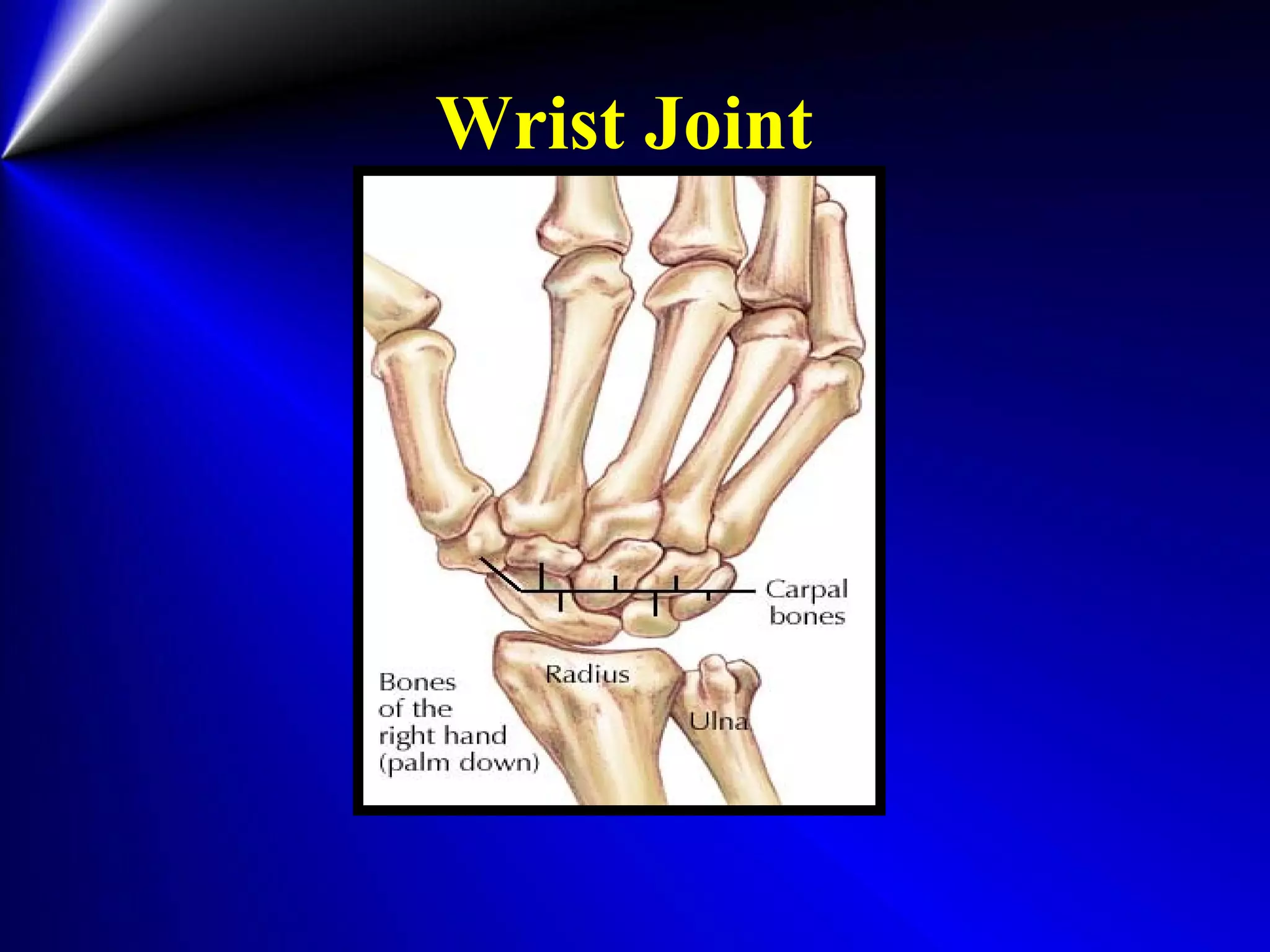
Wrist Joint
Painful Wrist
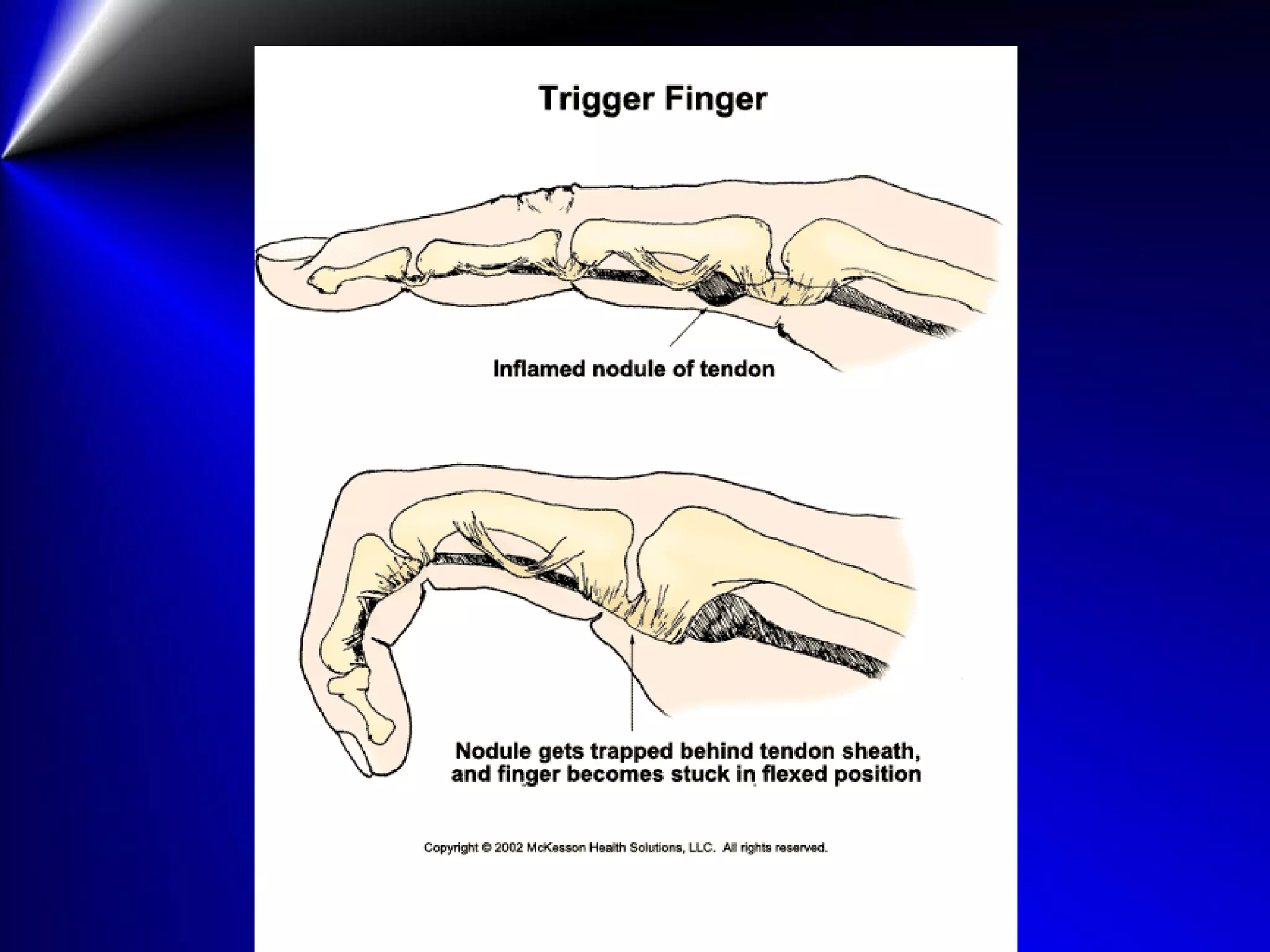
• Trigger finger
• De Quvarian syndrome
• Fractures
• Arthritis
• Tendonitis
• Peripheral nerve Injuries
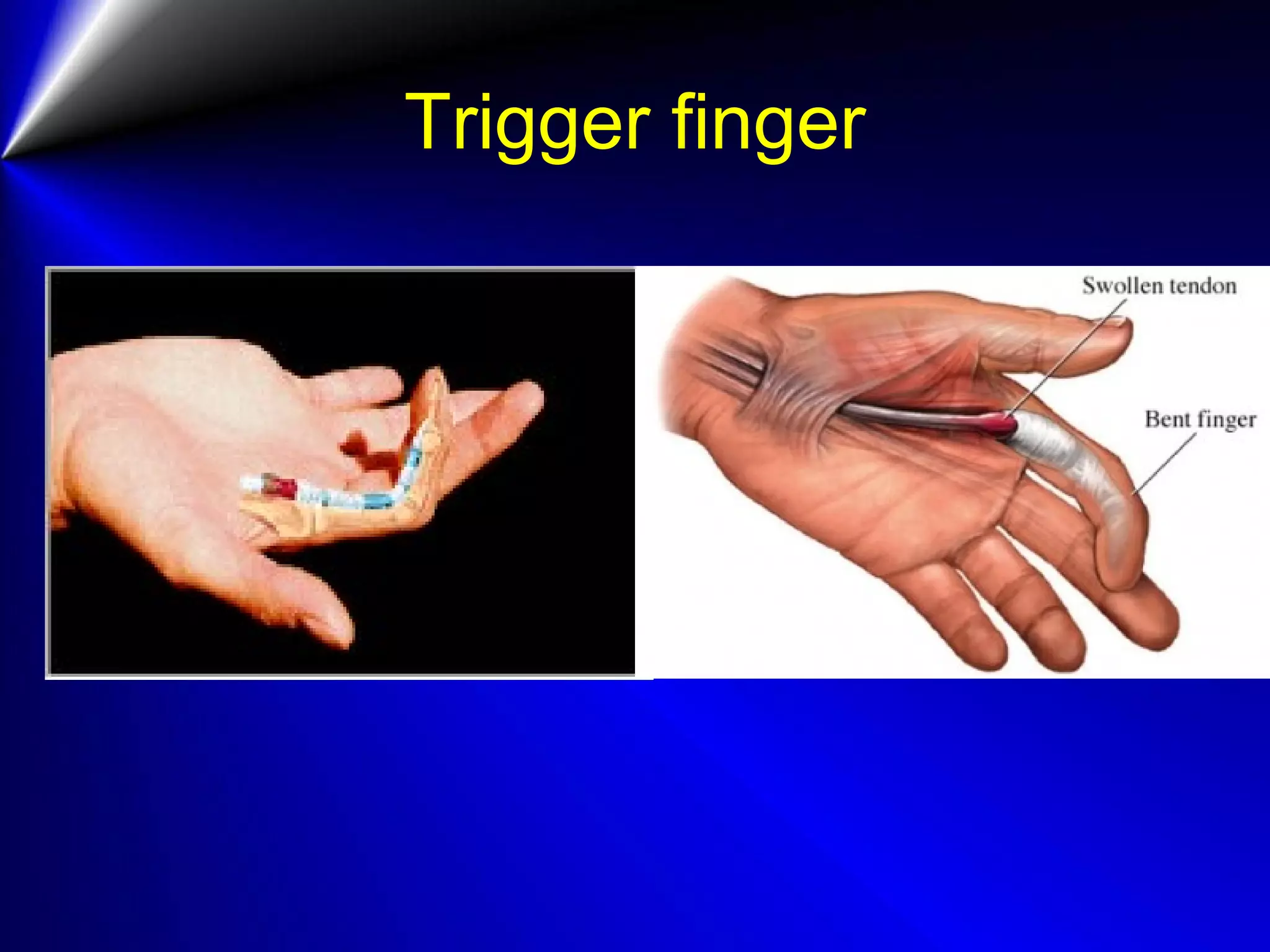
Trigger finger
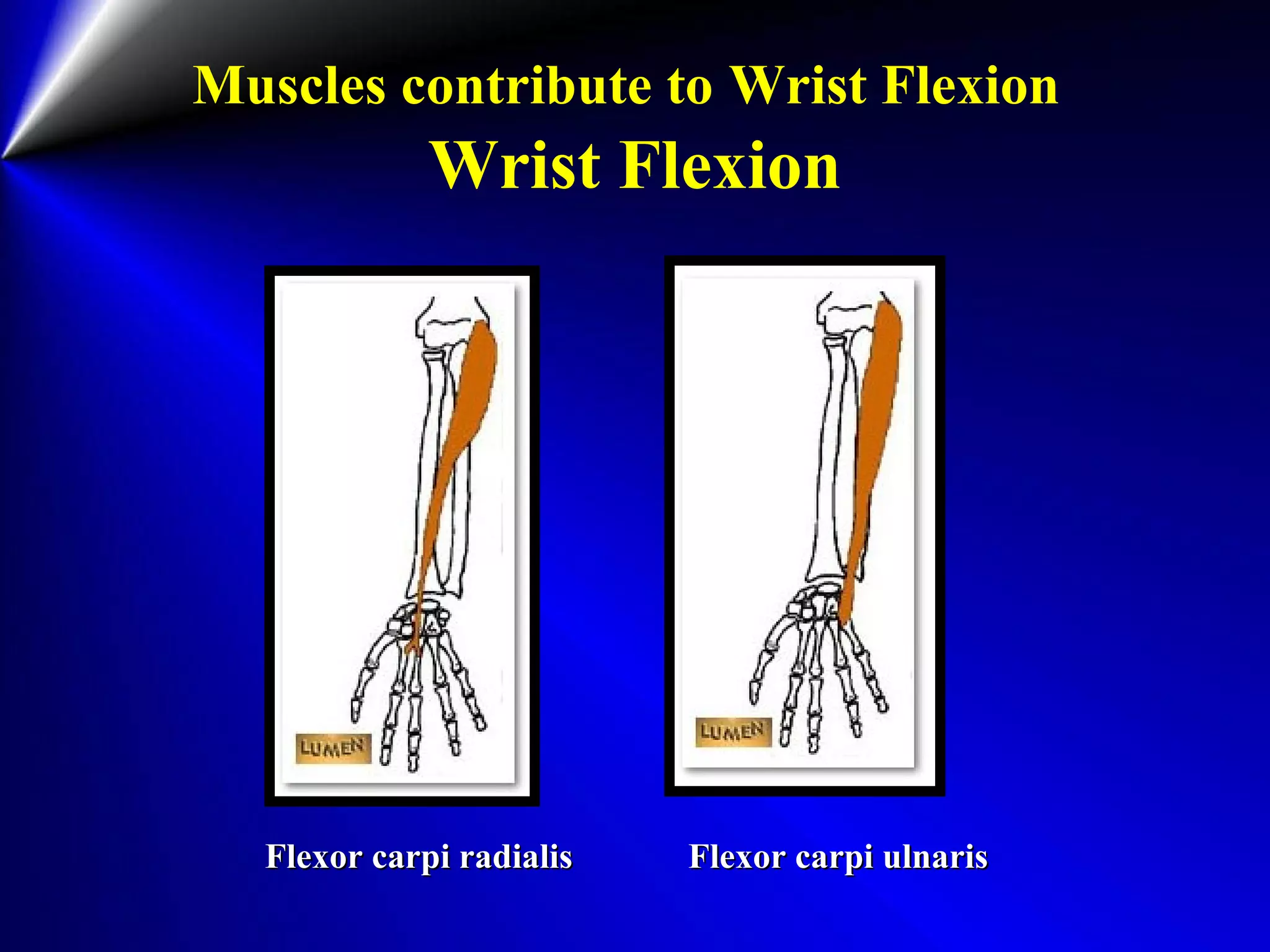
Muscles contribute to Wrist Flexion
Wrist Flexion
Flexor carpi radialis Flexor carpi ulnarisFlexor carpi radialis Flexor carpi ulnaris
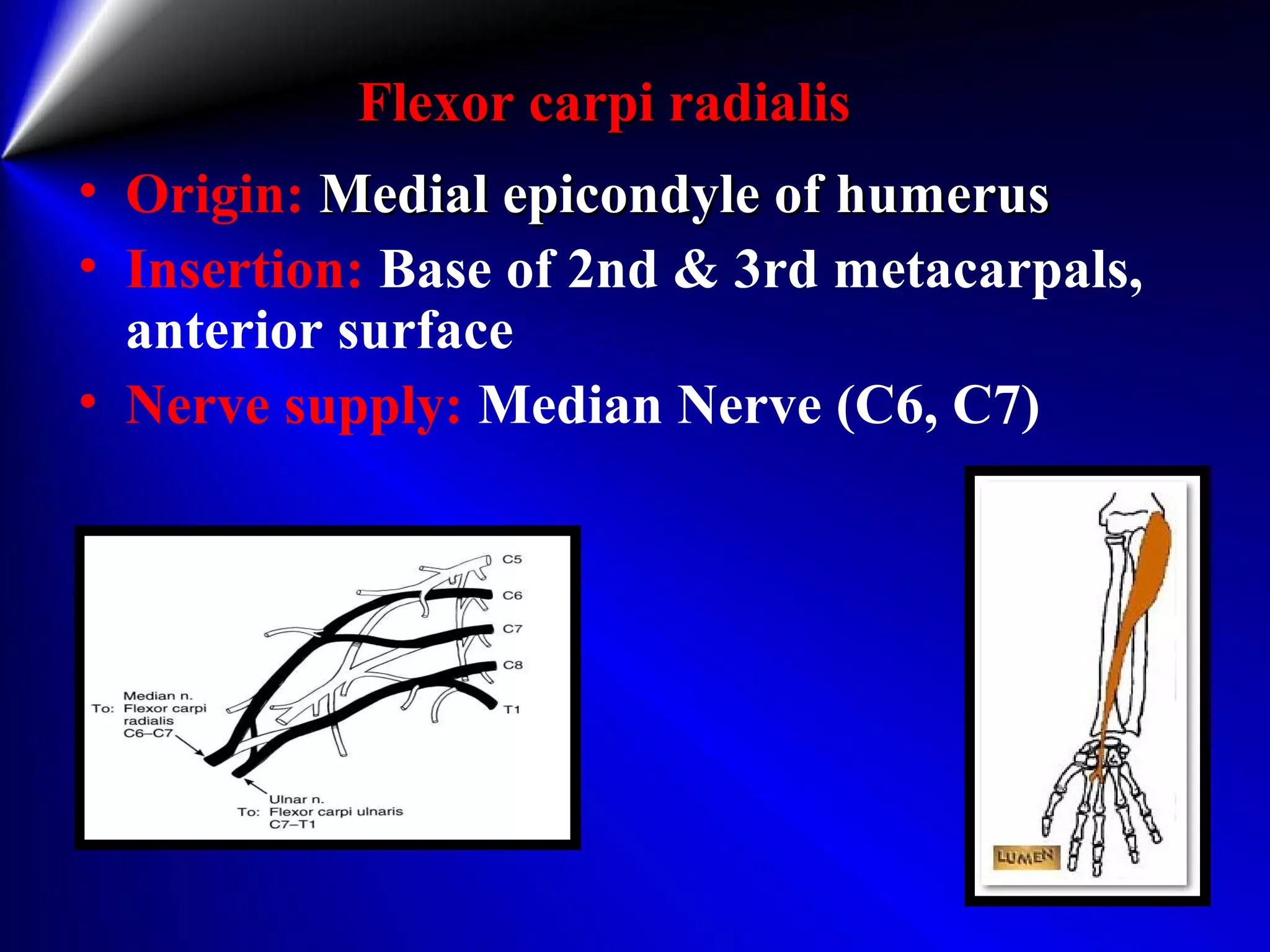
Flexor carpi radialisFlexor carpi radialis
• Origin: Medial epicondyle of humerusMedial epicondyle of humerus
• Insertion: Base of 2nd & 3rd metacarpals,
anterior surface
• Nerve supply: Median Nerve (C6, C7)
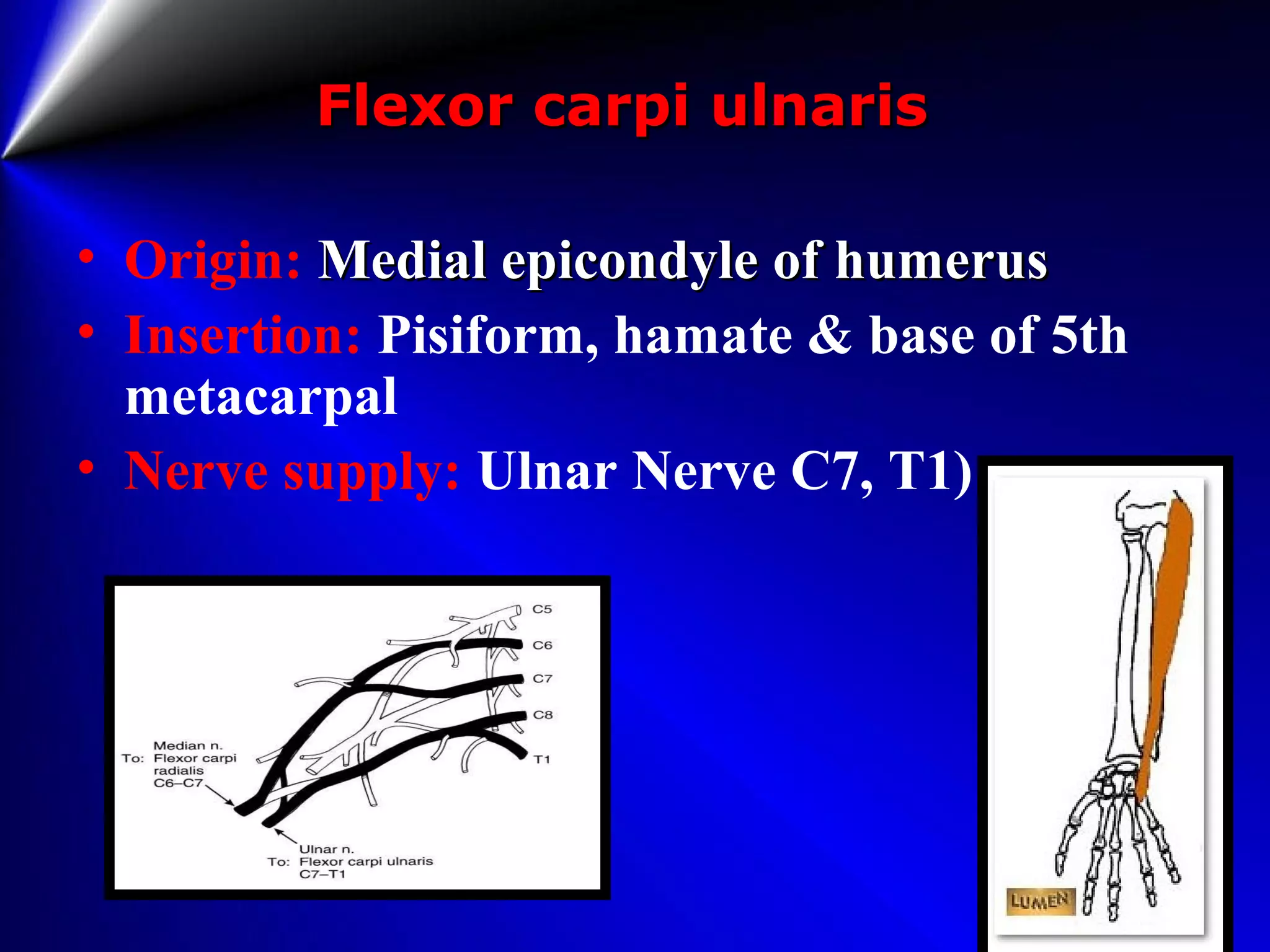
Flexor carpi ulnarisFlexor carpi ulnaris
• Origin: Medial epicondyle of humerusMedial epicondyle of humerus
• Insertion: Pisiform, hamate & base of 5th
metacarpal
• Nerve supply: Ulnar Nerve C7, T1)
Note
• Range of Motion: Wrist flexion: 0 to 90 ْ
• Factors Limiting Motion:
• Tension of dorsal radiocarpal ligament
• Fixation:
• Weight of arm
Normal & Good
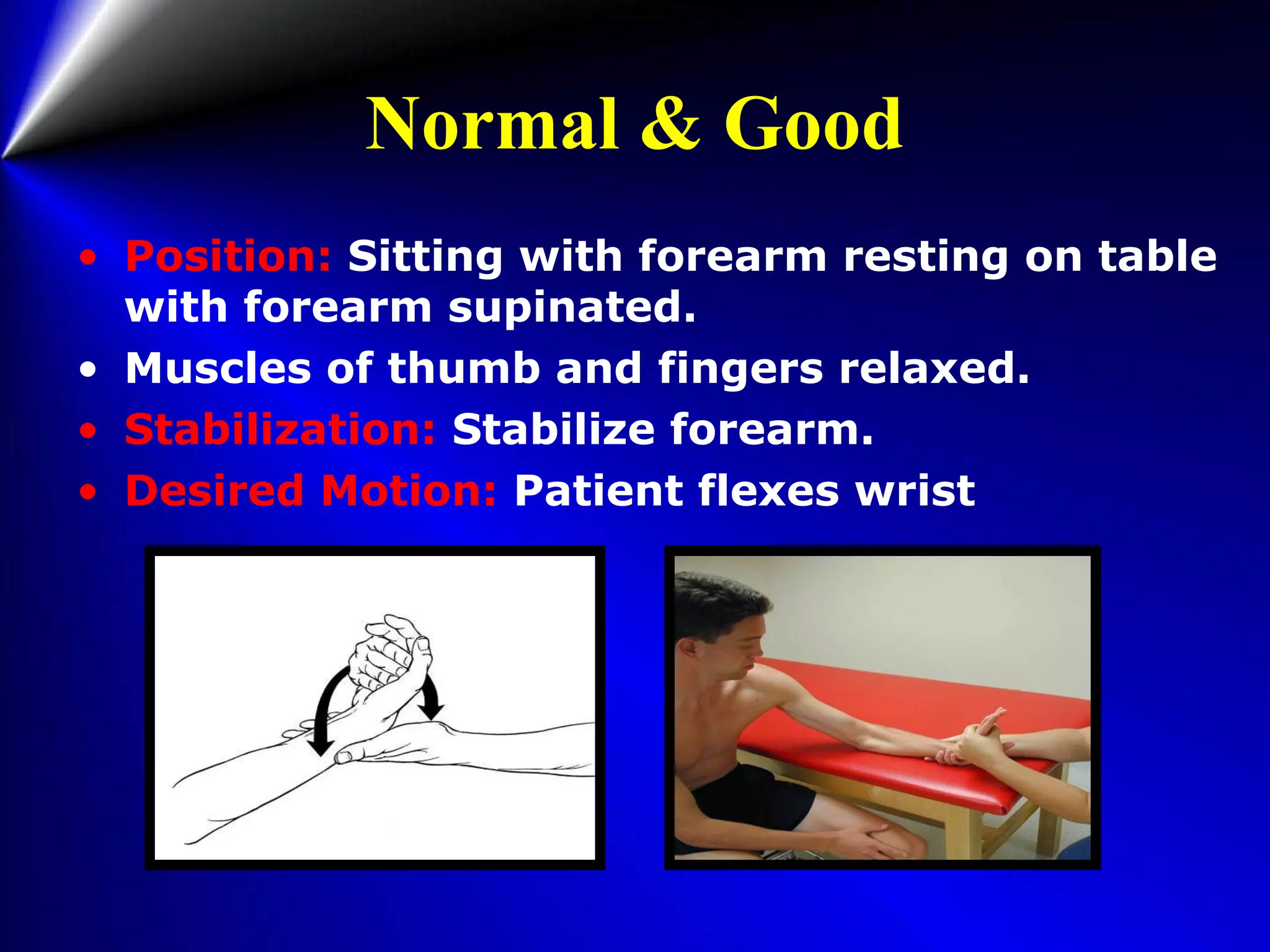
• Position: Sitting with forearm resting on table
with forearm supinated.
• Muscles of thumb and fingers relaxed.
• Stabilization: Stabilize forearm.
• Desired Motion: Patient flexes wrist
Note
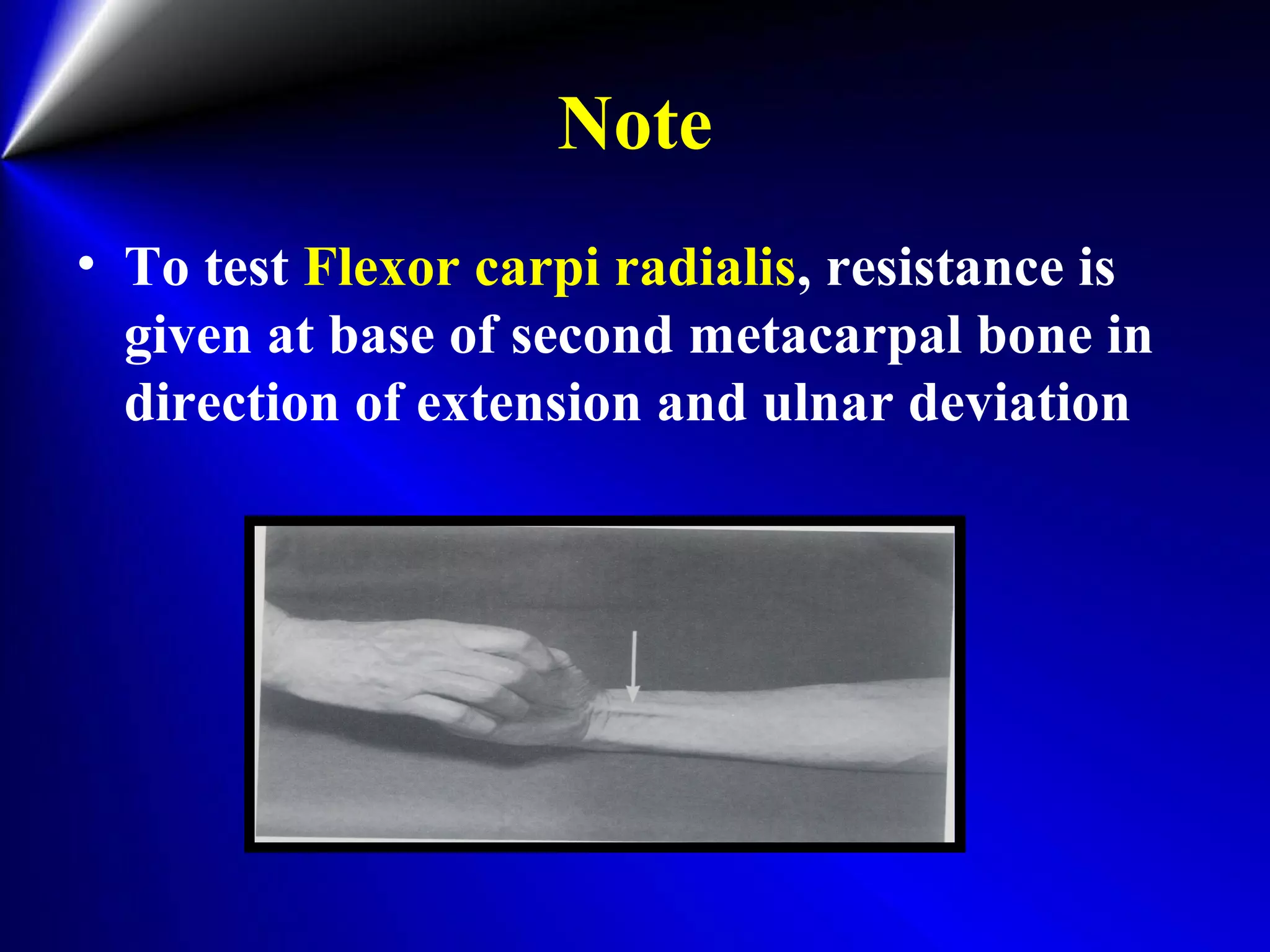
• To test Flexor carpi radialis, resistance is
given at base of second metacarpal bone in
direction of extension and ulnar deviation
Note
• To test Flexor carpi ulnaris, resistance is given
at base of fifth metacarpal bone in direction of
extension and radial deviation
Fair
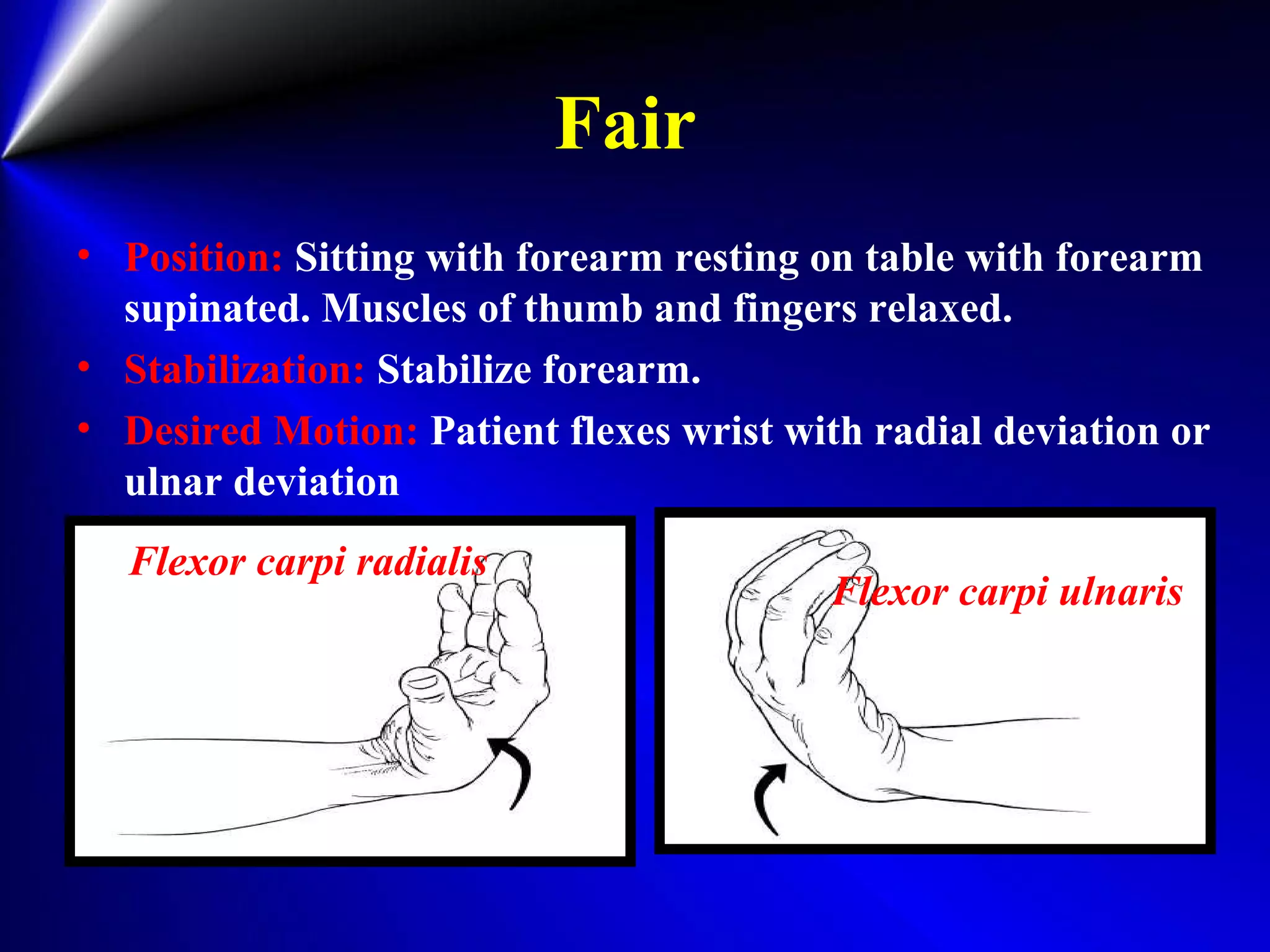
• Position: Sitting with forearm resting on table with forearm
supinated. Muscles of thumb and fingers relaxed.
• Stabilization: Stabilize forearm.
• Desired Motion: Patient flexes wrist with radial deviation or
ulnar deviation
Flexor carpi radialis
Flexor carpi ulnaris
Poor
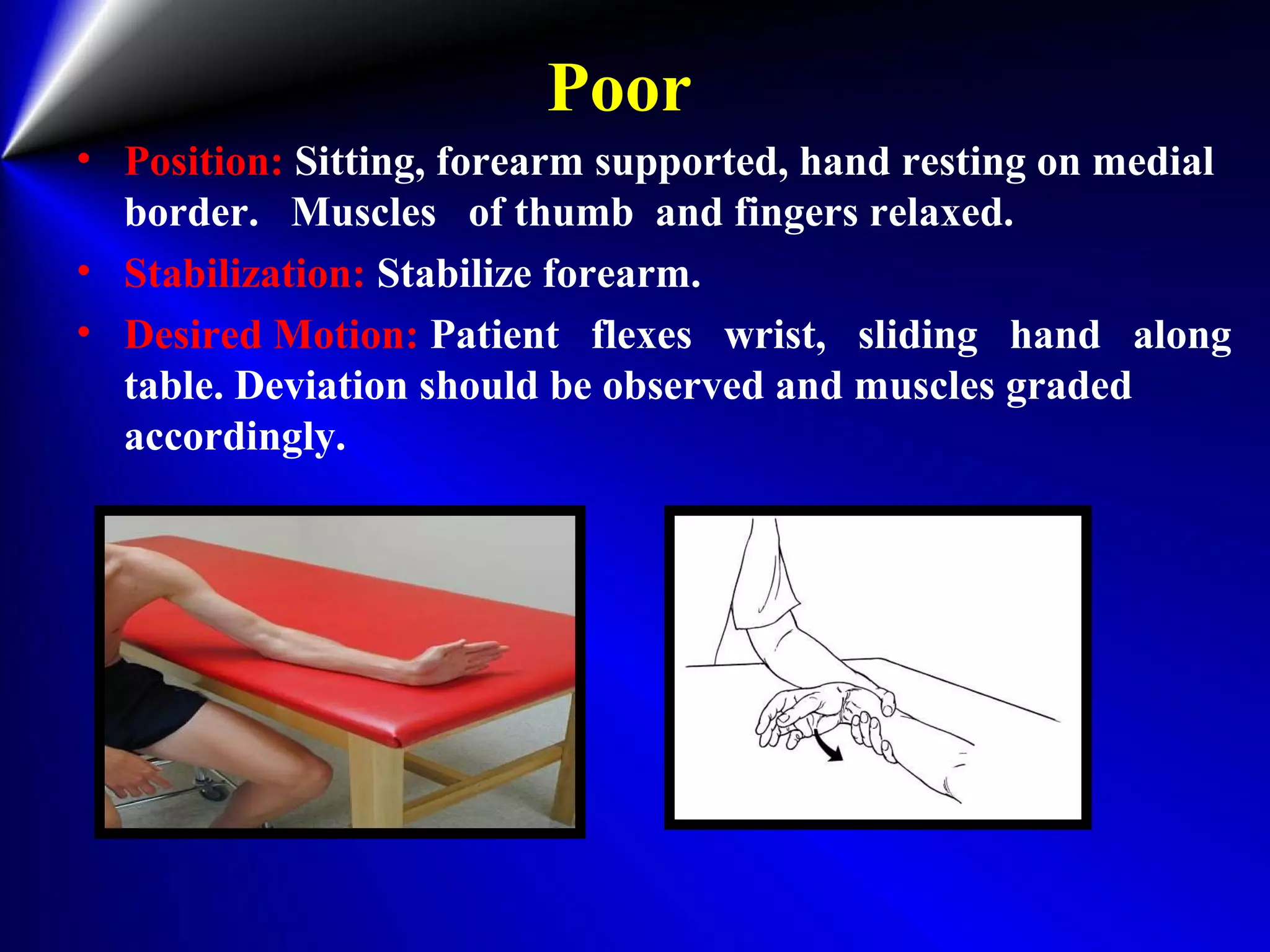
• Position: Sitting, forearm supported, hand resting on medial
border. Muscles of thumb and fingers relaxed.
• Stabilization: Stabilize forearm.
• Desired Motion: Patient flexes wrist, sliding hand along
table. Deviation should be observed and muscles graded
accordingly.
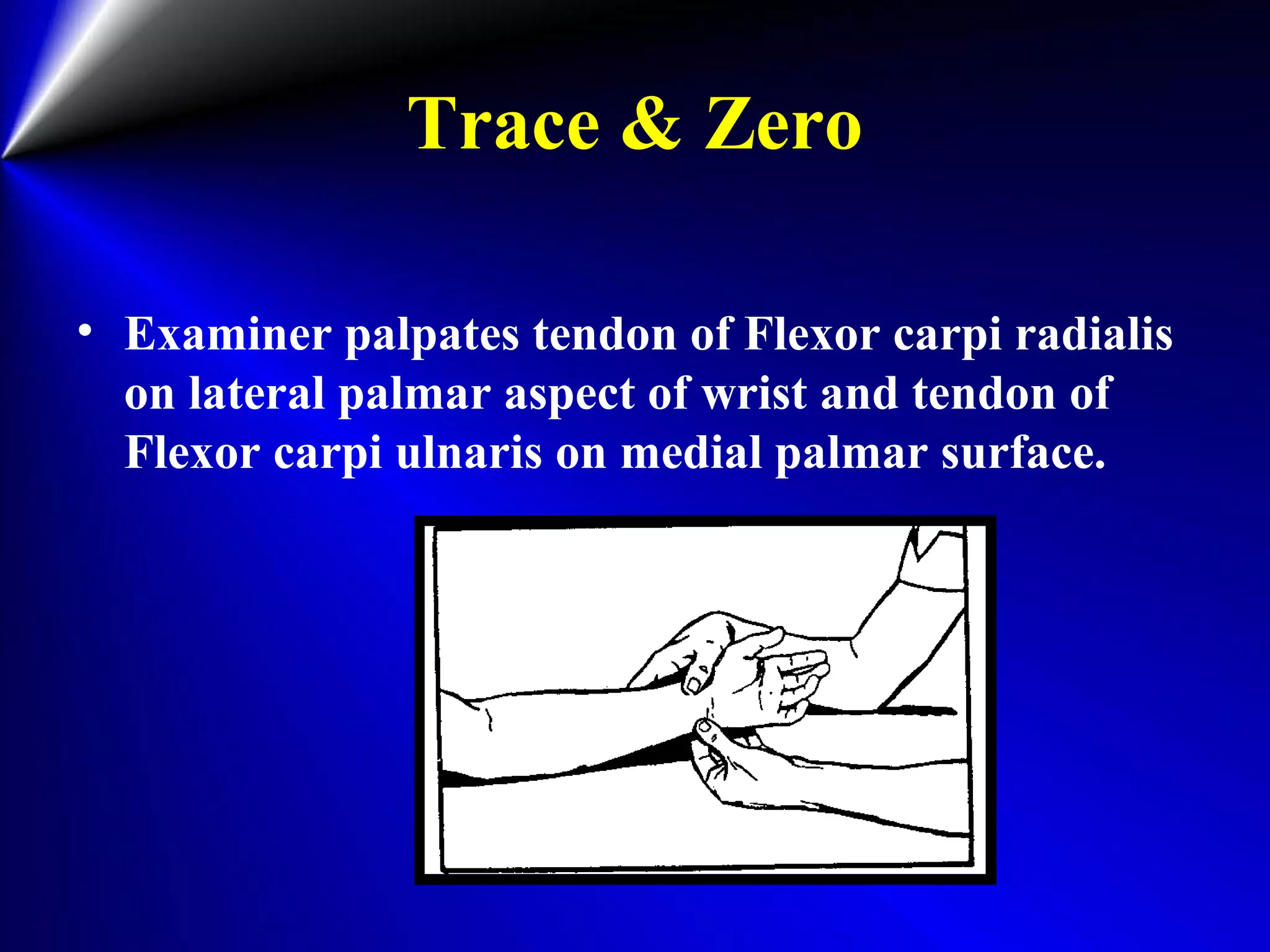
Trace & Zero
• Examiner palpates tendon of Flexor carpi radialis
on lateral palmar aspect of wrist and tendon of
Flexor carpi ulnaris on medial palmar surface.
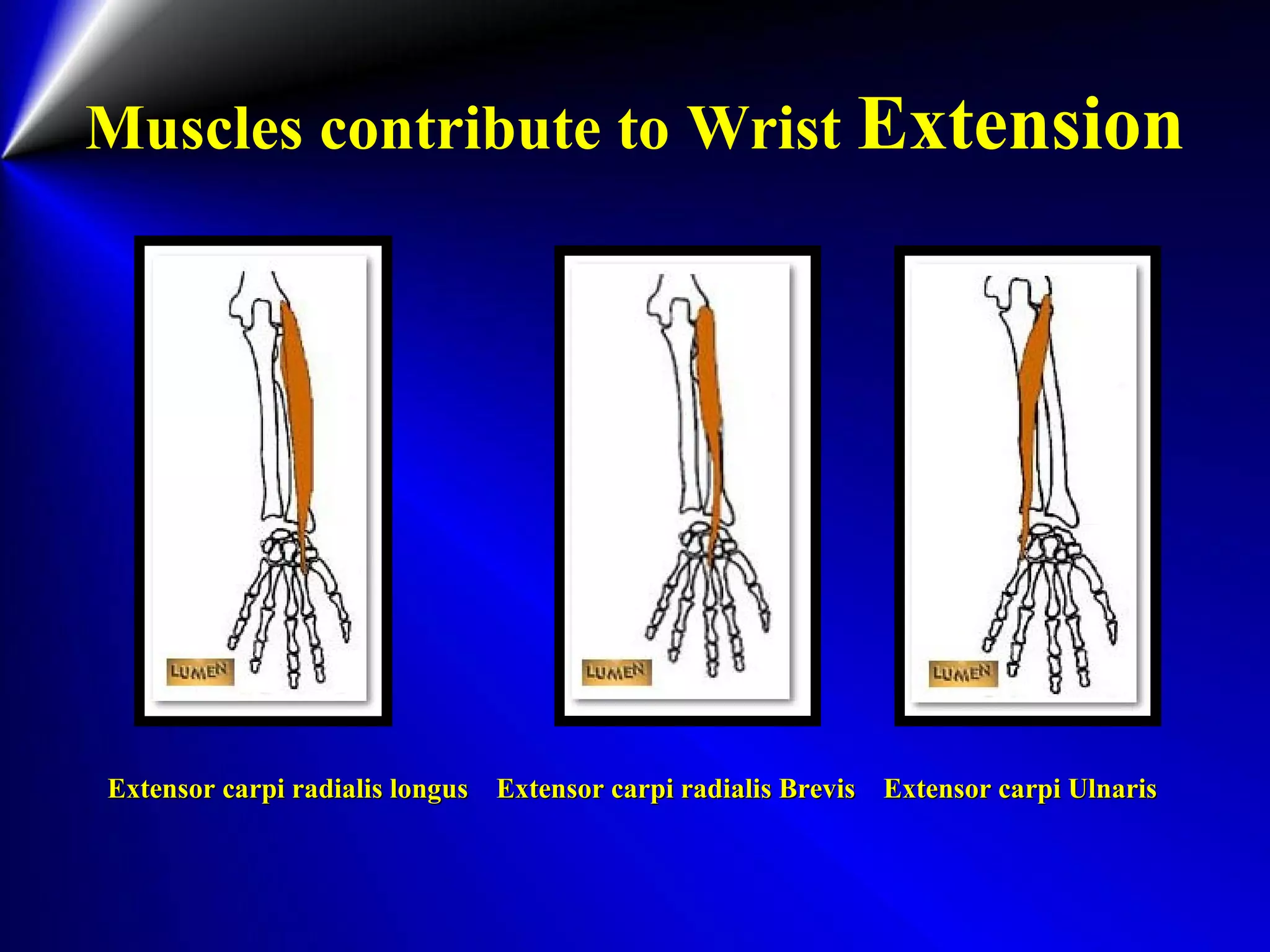
Muscles contribute to Wrist Extension
Extensor carpi radialis longus Extensor carpi radialis Brevis Extensor carpi UlnarisExtensor carpi radialis longus Extensor carpi radialis Brevis Extensor carpi Ulnaris
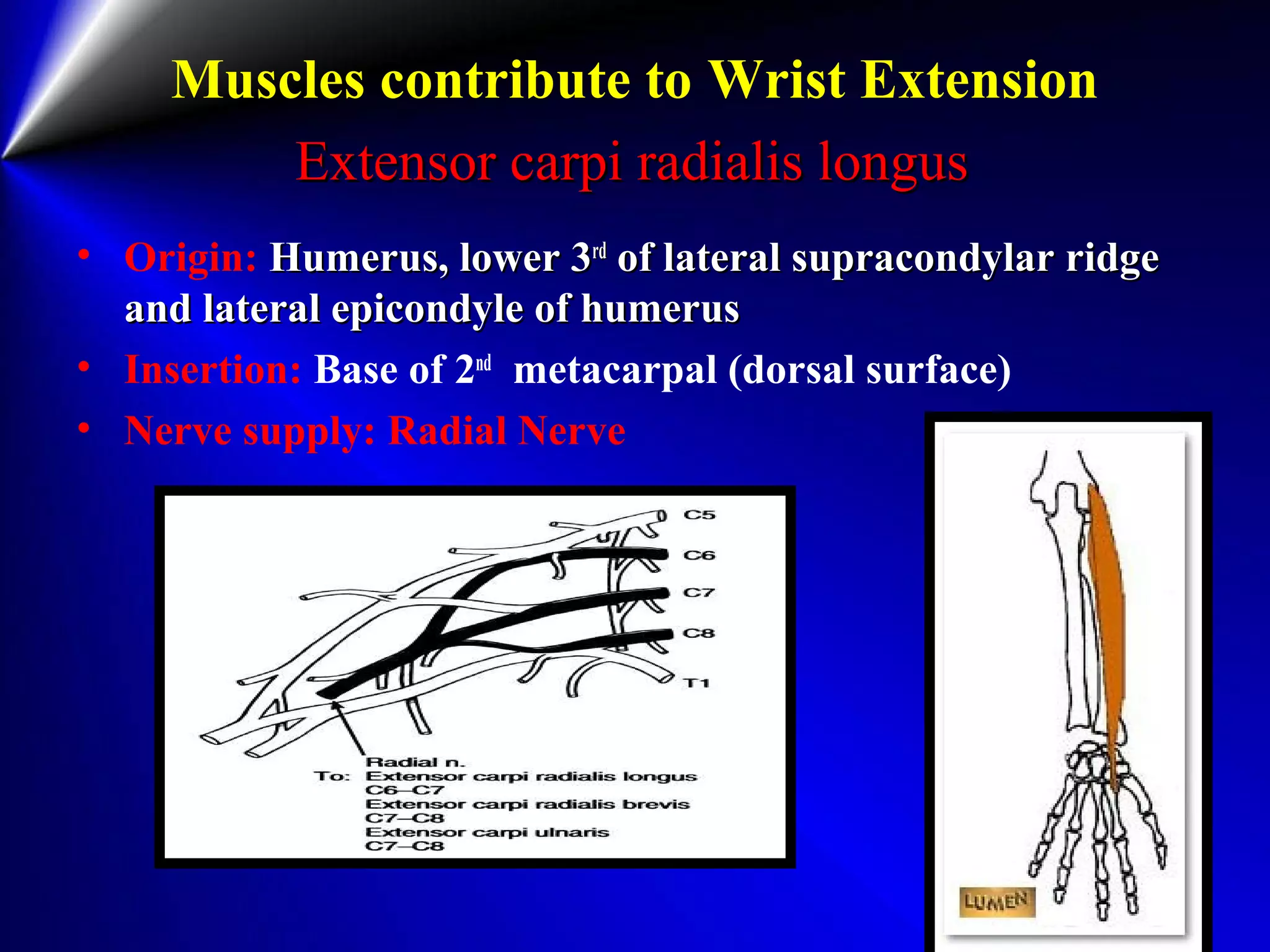
Muscles contribute to Wrist Extension
Extensor carpi radialis longusExtensor carpi radialis longus
• Origin: Humerus, lower 3Humerus, lower 3rdrd
of lateral supracondylar ridgeof lateral supracondylar ridge
and lateral epicondyle of humerusand lateral epicondyle of humerus
• Insertion: Base of 2nd
metacarpal (dorsal surface)
• Nerve supply: Radial Nerve
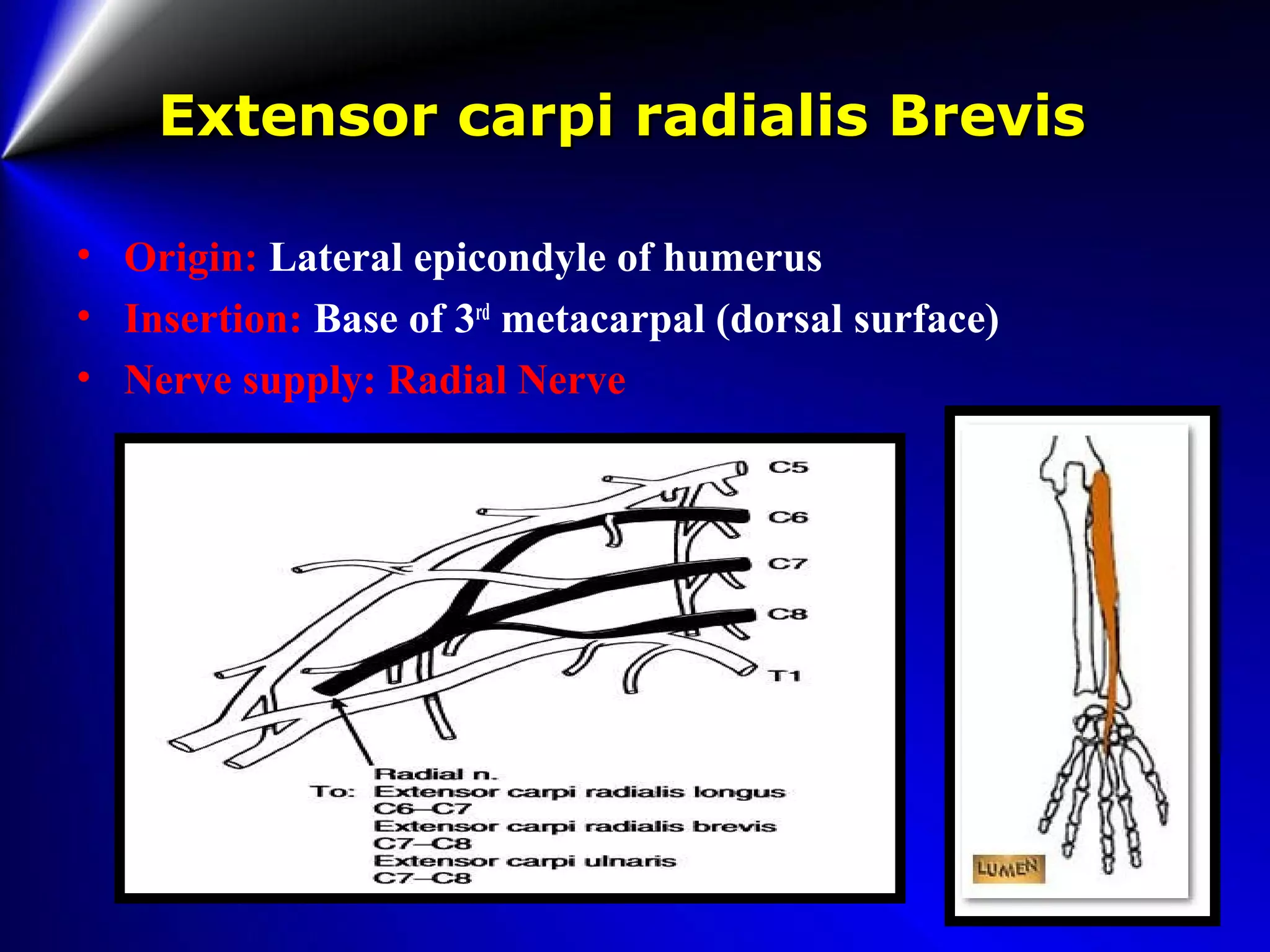
Extensor carpi radialis BrevisExtensor carpi radialis Brevis
• Origin: Lateral epicondyle of humerus
• Insertion: Base of 3rd
metacarpal (dorsal surface)
• Nerve supply: Radial Nerve
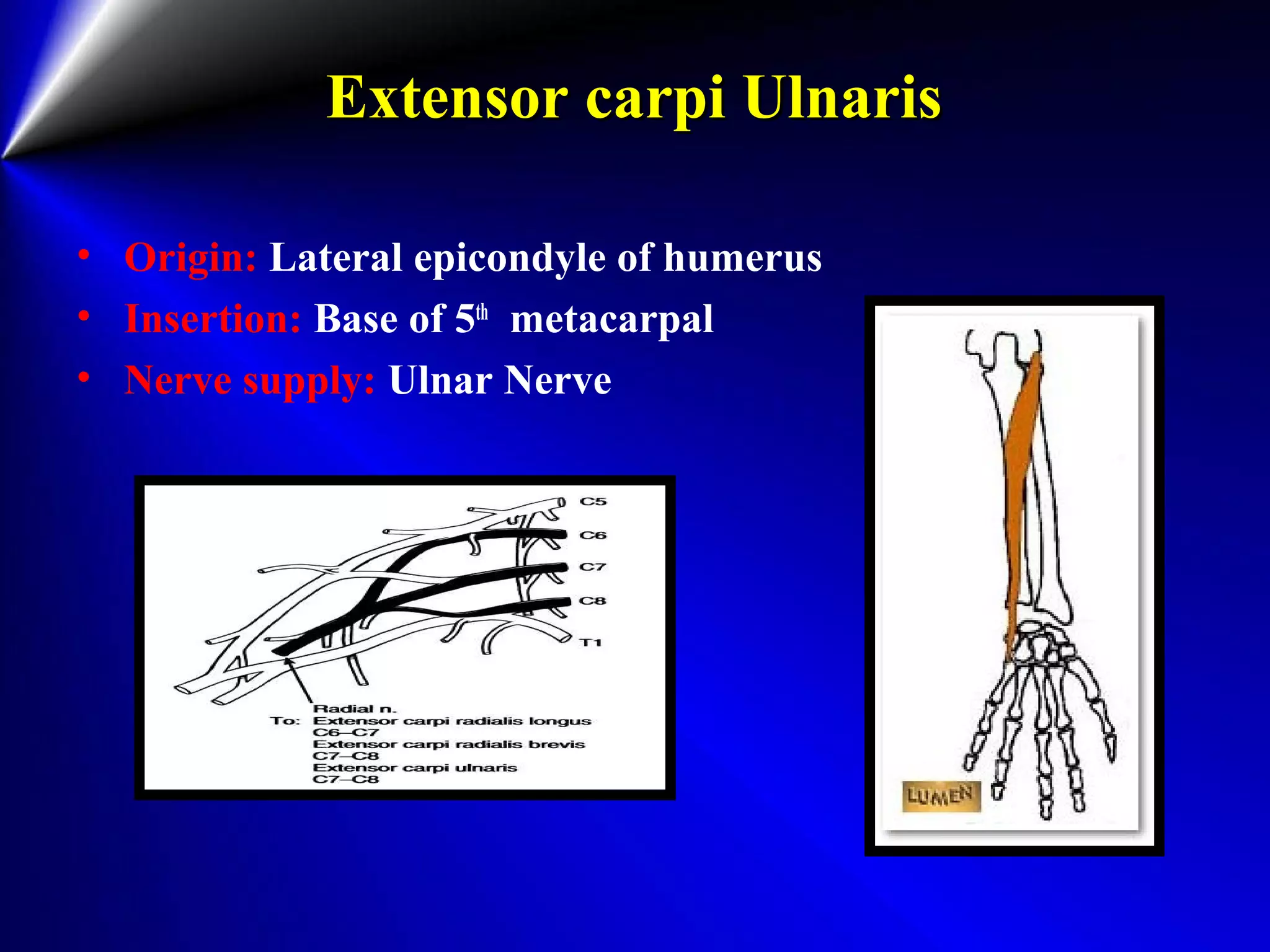
Extensor carpi UlnarisExtensor carpi Ulnaris
• Origin: Lateral epicondyle of humerus
• Insertion: Base of 5th
metacarpal
• Nerve supply: Ulnar Nerve
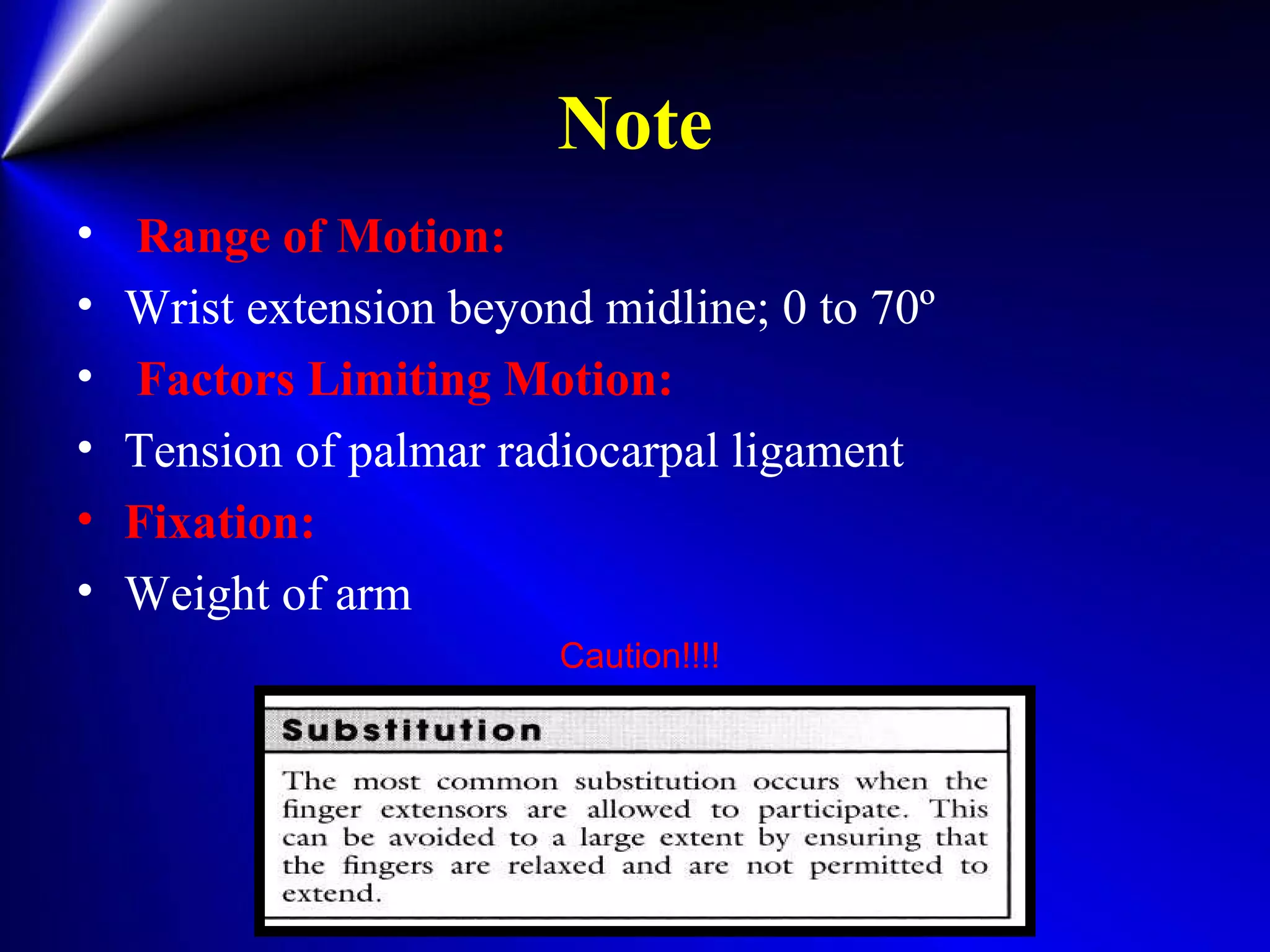
Note
• Range of Motion:
• Wrist extension beyond midline; 0 to 70º
• Factors Limiting Motion:
• Tension of palmar radiocarpal ligament
• Fixation:
• Weight of arm
Caution!!!!
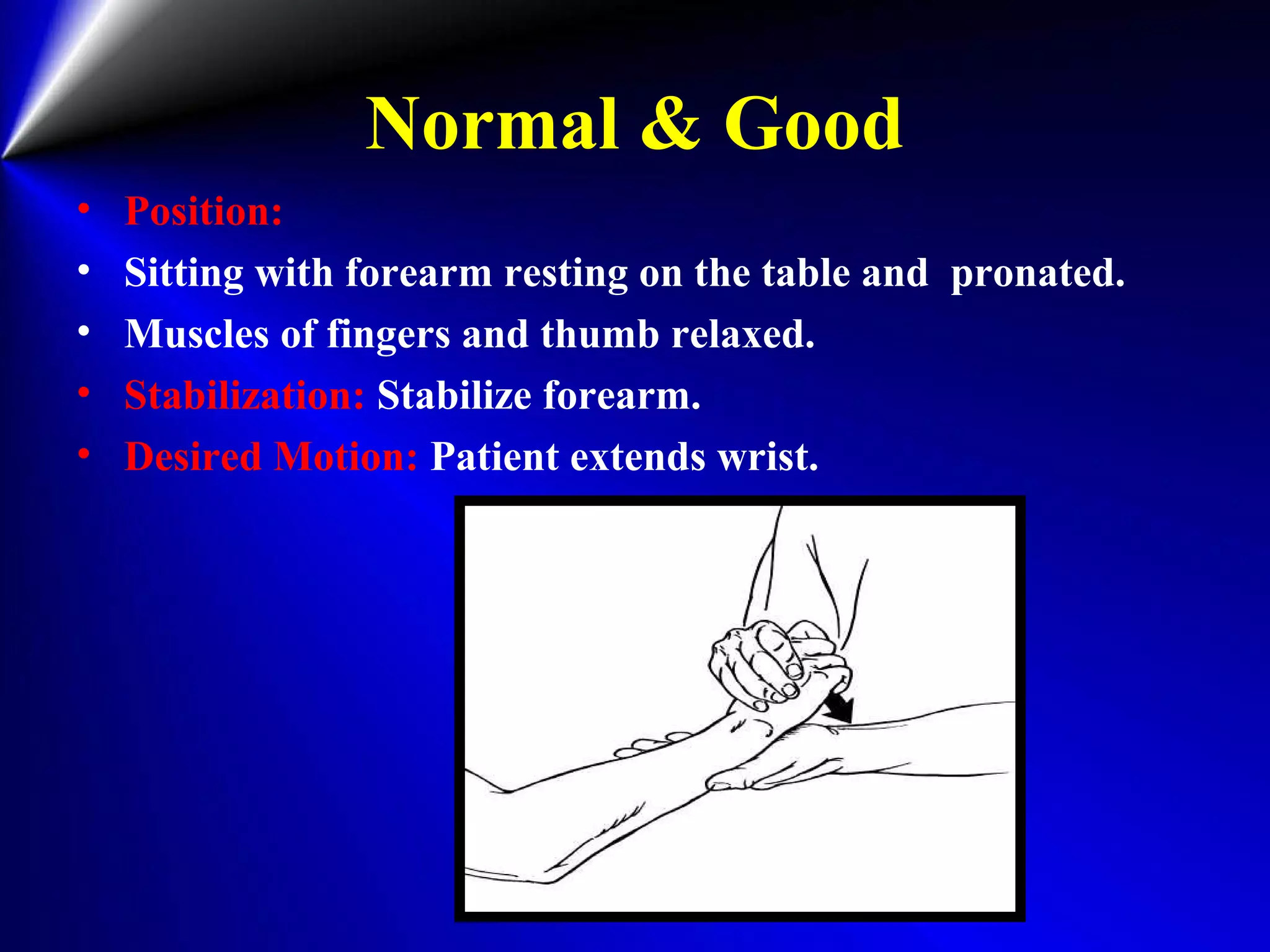
Normal & Good
• Position:
• Sitting with forearm resting on the table and pronated.
• Muscles of fingers and thumb relaxed.
• Stabilization: Stabilize forearm.
• Desired Motion: Patient extends wrist.
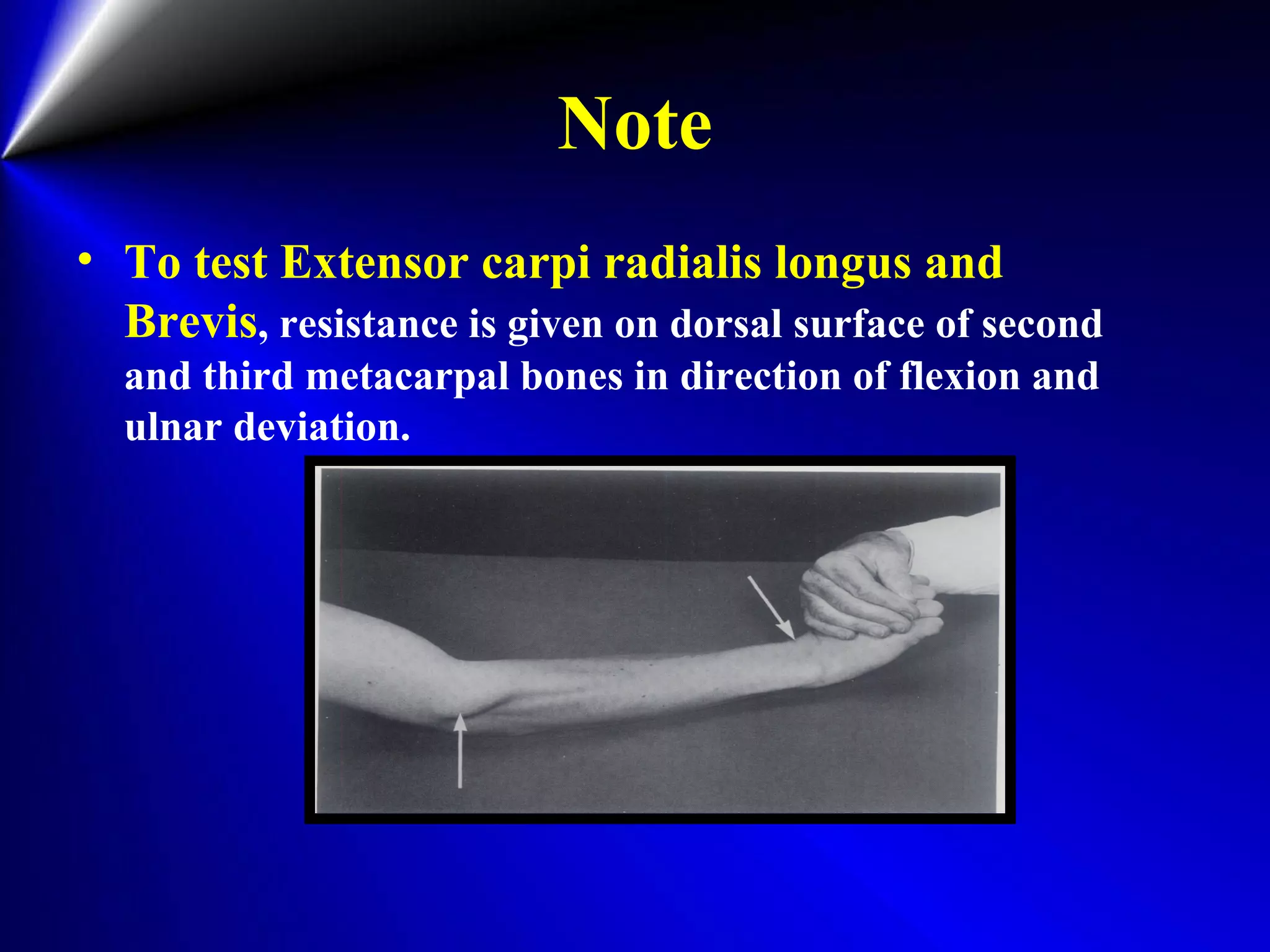
Note
• To test Extensor carpi radialis longus and
Brevis, resistance is given on dorsal surface of second
and third metacarpal bones in direction of flexion and
ulnar deviation.
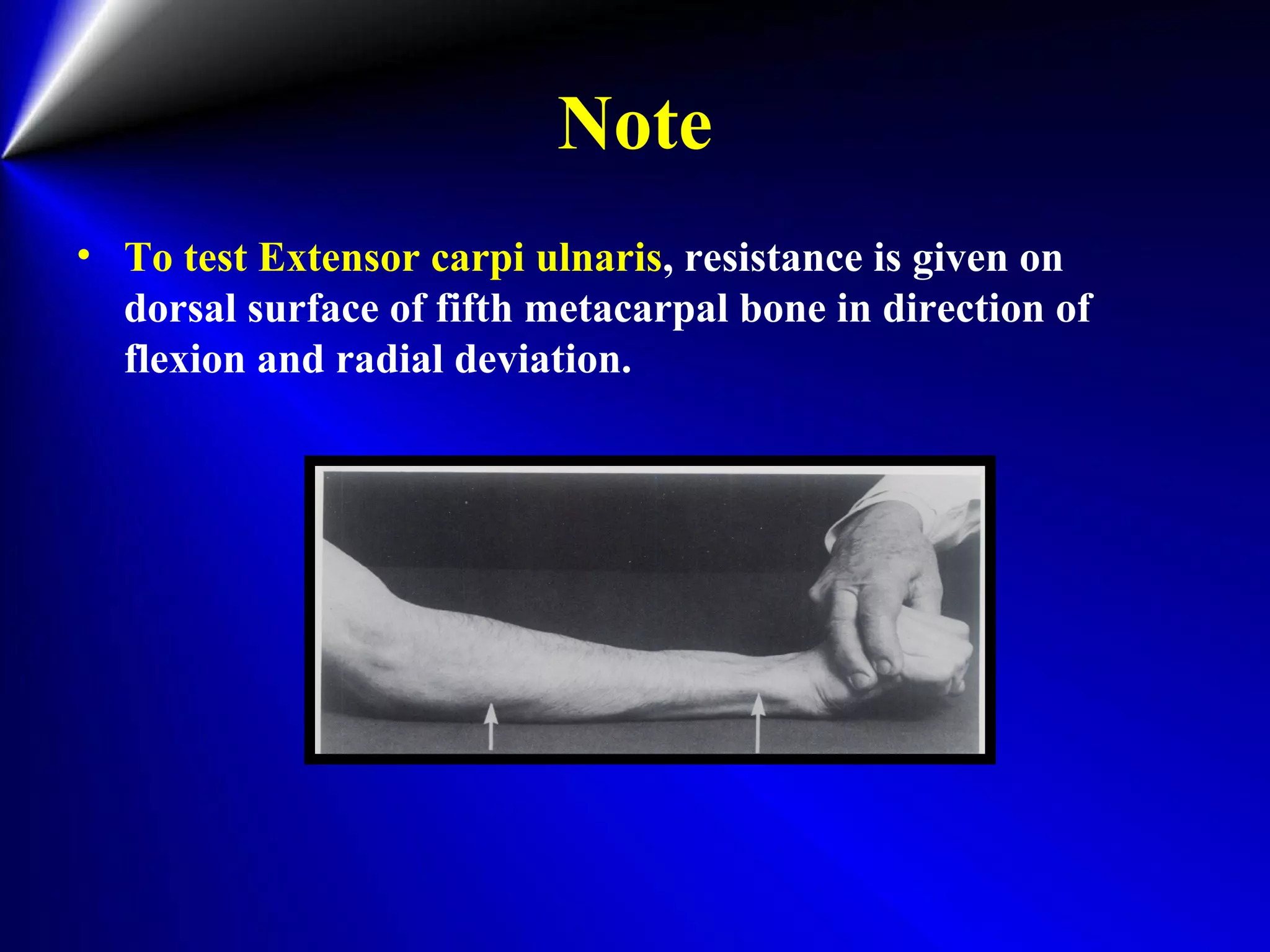
Note
• To test Extensor carpi ulnaris, resistance is given on
dorsal surface of fifth metacarpal bone in direction of
flexion and radial deviation.
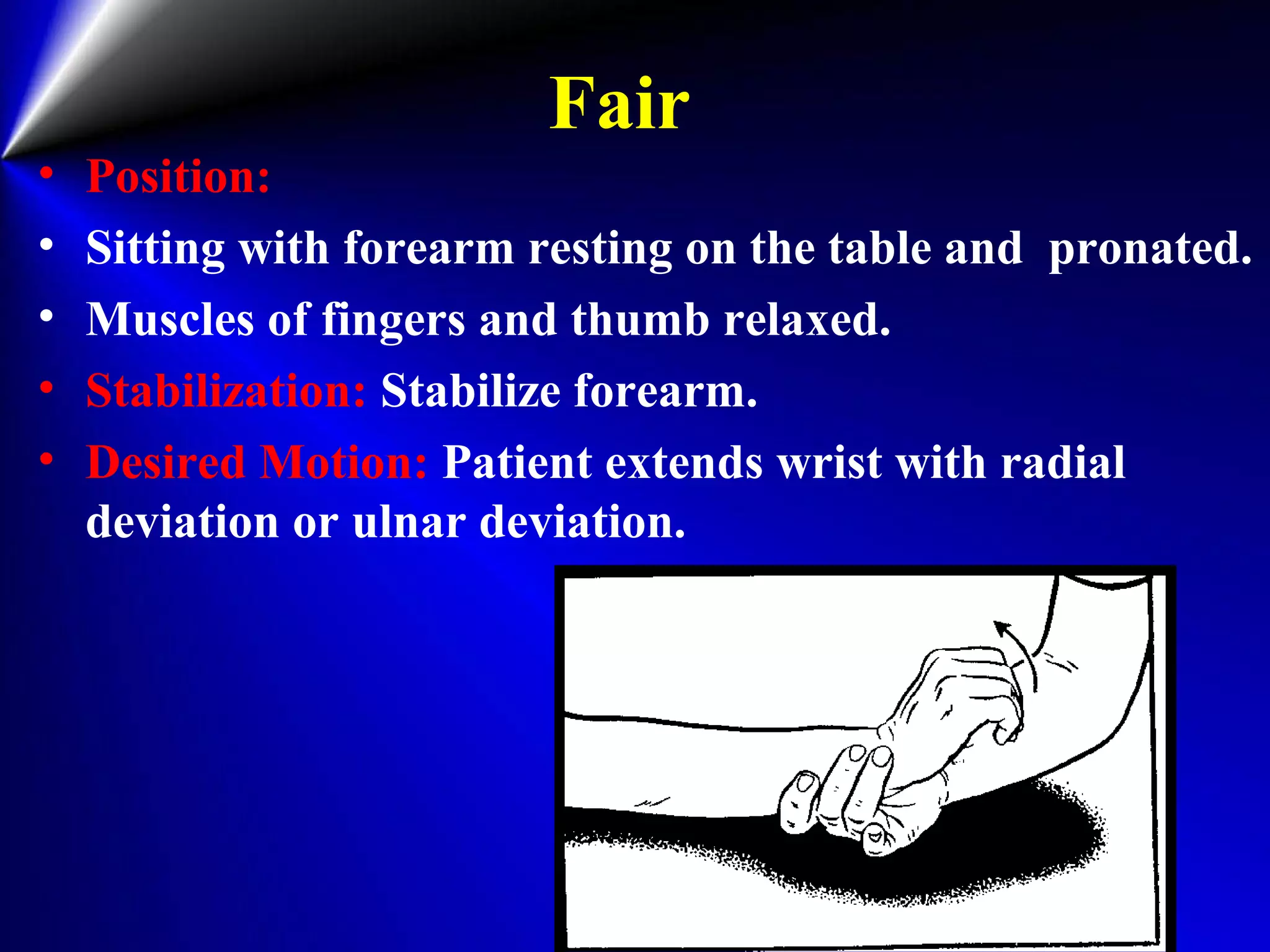
Fair
• Position:
• Sitting with forearm resting on the table and pronated.
• Muscles of fingers and thumb relaxed.
• Stabilization: Stabilize forearm.
• Desired Motion: Patient extends wrist with radial
deviation or ulnar deviation.
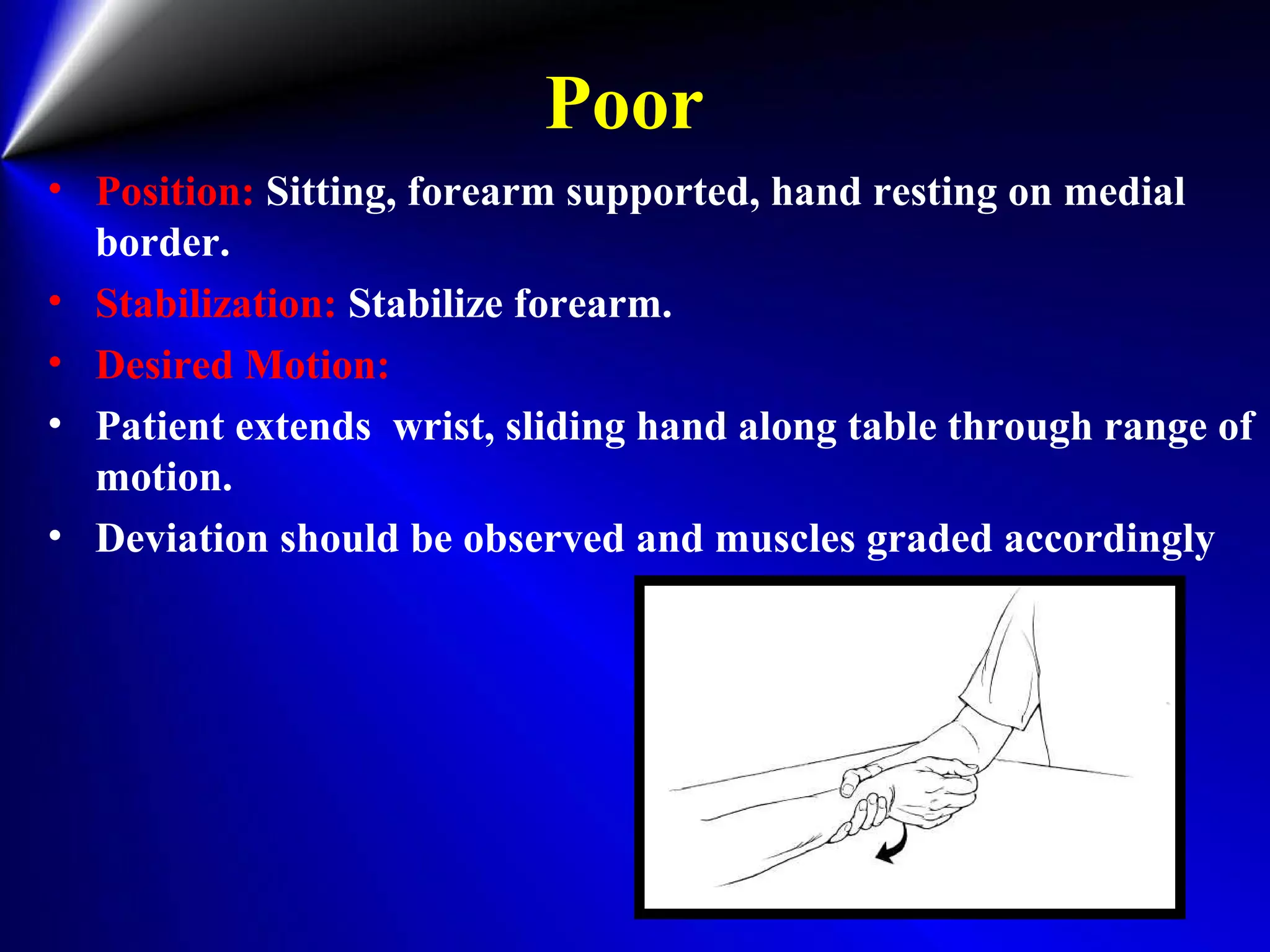
Poor
• Position: Sitting, forearm supported, hand resting on medial
border.
• Stabilization: Stabilize forearm.
• Desired Motion:
• Patient extends wrist, sliding hand along table through range of
motion.
• Deviation should be observed and muscles graded accordingly
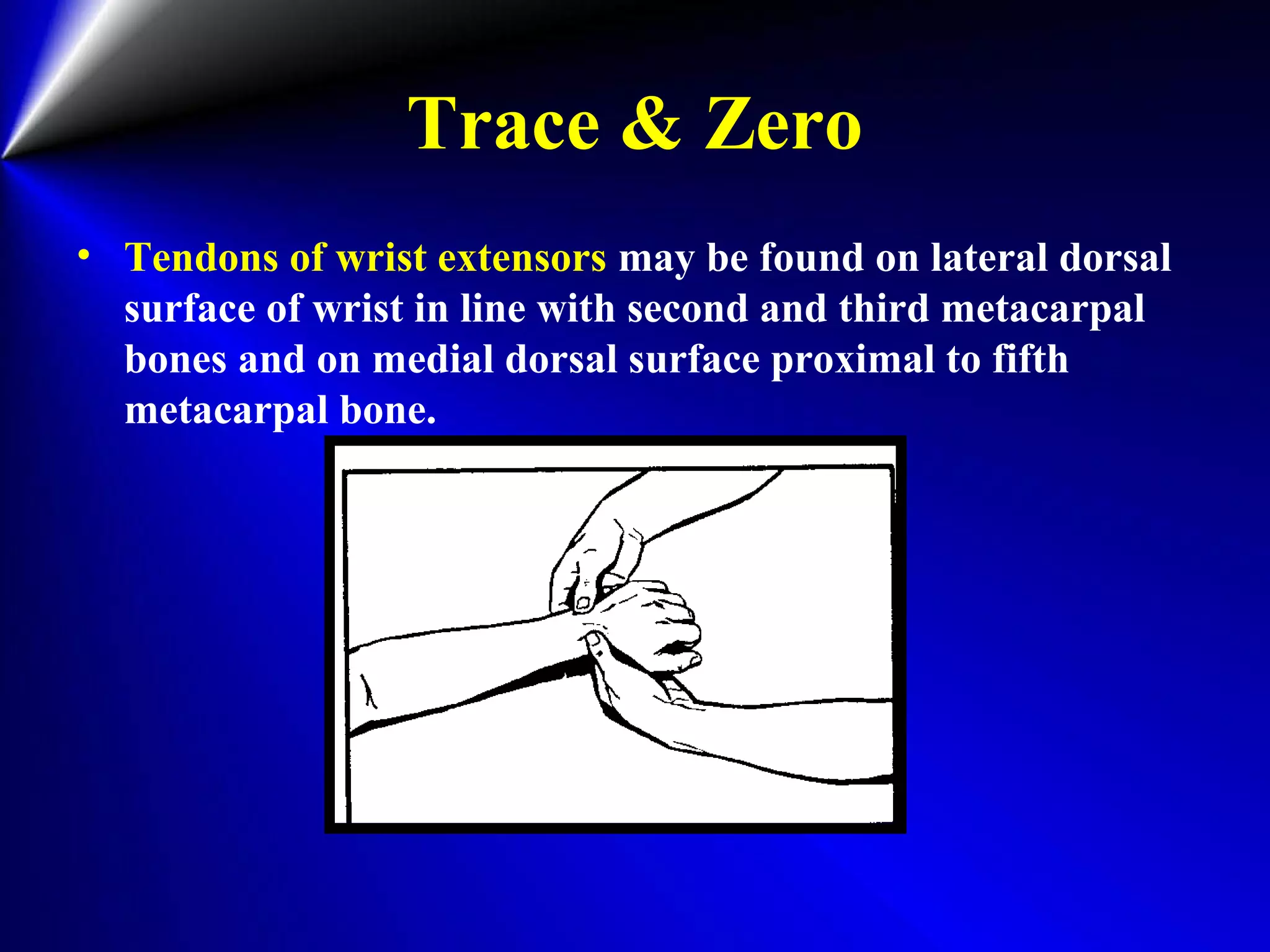
Trace & Zero
• Tendons of wrist extensors may be found on lateral dorsal
surface of wrist in line with second and third metacarpal
bones and on medial dorsal surface proximal to fifth
metacarpal bone.

Manualmusletesting 241 270

  • 1.
    Note • Range ofmotion: 0º to 90º Pronation from midposition • Factors Limiting Motion: 1-Tension of dorsal radioulnar, ulnar collateral and dorsal radiocarpal ligaments. 2-Tension of lowest fibers of interosseous membrane. • Fixation: • Weight of arm
  • 2.
    Normal & Good •Position: • Sitting with arm at side, elbow flexed to 90º to prevent rotation at the shoulder and forearm supinated. Muscles of wrist and fingers are relaxed. • Stabilization: • Stabilize arm. • Desired Motion: • Patient pronates forearm through ROM. • Resistance : • Is given on volar surface of distal end of radius with counterpressure against the dorsal surface of the ulna.
  • 3.
    Fair & Poor •Position: • Sitting with arm at side, elbow flexed to 90º, forearm supinated and supported by examiner. Muscles of wrist and fingers are relaxed. • Desired Motion: • Patient pronates forearm through full range of motion for fair grade and through partial range for poor grade Fair Poor
  • 4.
    Trace & Zero •Position: • Sitting. • Palpation: • Examiner palpates fibers of Pronator teres on upper third of volar surface of forearm on a diagonal line from medial condyle of humerus to lateral border of radius
  • 5.
    Note • Patient shouldnot be allowed to medially rotate or abduct upper arm during pronation. • This movement makes the ROM in pronation appear complete and allows forearm to roll into pronated position
  • 6.
  • 7.
    Painful Wrist • Triggerfinger • De Quvarian syndrome • Fractures • Arthritis • Tendonitis • Peripheral nerve Injuries
  • 8.
  • 10.
    Muscles contribute toWrist Flexion Wrist Flexion Flexor carpi radialis Flexor carpi ulnarisFlexor carpi radialis Flexor carpi ulnaris
  • 11.
    Flexor carpi radialisFlexorcarpi radialis • Origin: Medial epicondyle of humerusMedial epicondyle of humerus • Insertion: Base of 2nd & 3rd metacarpals, anterior surface • Nerve supply: Median Nerve (C6, C7)
  • 12.
    Flexor carpi ulnarisFlexorcarpi ulnaris • Origin: Medial epicondyle of humerusMedial epicondyle of humerus • Insertion: Pisiform, hamate & base of 5th metacarpal • Nerve supply: Ulnar Nerve C7, T1)
  • 13.
    Note • Range ofMotion: Wrist flexion: 0 to 90 ْ • Factors Limiting Motion: • Tension of dorsal radiocarpal ligament • Fixation: • Weight of arm
  • 14.
    Normal & Good •Position: Sitting with forearm resting on table with forearm supinated. • Muscles of thumb and fingers relaxed. • Stabilization: Stabilize forearm. • Desired Motion: Patient flexes wrist
  • 15.
    Note • To testFlexor carpi radialis, resistance is given at base of second metacarpal bone in direction of extension and ulnar deviation
  • 16.
    Note • To testFlexor carpi ulnaris, resistance is given at base of fifth metacarpal bone in direction of extension and radial deviation
  • 17.
    Fair • Position: Sittingwith forearm resting on table with forearm supinated. Muscles of thumb and fingers relaxed. • Stabilization: Stabilize forearm. • Desired Motion: Patient flexes wrist with radial deviation or ulnar deviation Flexor carpi radialis Flexor carpi ulnaris
  • 18.
    Poor • Position: Sitting,forearm supported, hand resting on medial border. Muscles of thumb and fingers relaxed. • Stabilization: Stabilize forearm. • Desired Motion: Patient flexes wrist, sliding hand along table. Deviation should be observed and muscles graded accordingly.
  • 19.
    Trace & Zero •Examiner palpates tendon of Flexor carpi radialis on lateral palmar aspect of wrist and tendon of Flexor carpi ulnaris on medial palmar surface.
  • 20.
    Muscles contribute toWrist Extension Extensor carpi radialis longus Extensor carpi radialis Brevis Extensor carpi UlnarisExtensor carpi radialis longus Extensor carpi radialis Brevis Extensor carpi Ulnaris
  • 21.
    Muscles contribute toWrist Extension Extensor carpi radialis longusExtensor carpi radialis longus • Origin: Humerus, lower 3Humerus, lower 3rdrd of lateral supracondylar ridgeof lateral supracondylar ridge and lateral epicondyle of humerusand lateral epicondyle of humerus • Insertion: Base of 2nd metacarpal (dorsal surface) • Nerve supply: Radial Nerve
  • 22.
    Extensor carpi radialisBrevisExtensor carpi radialis Brevis • Origin: Lateral epicondyle of humerus • Insertion: Base of 3rd metacarpal (dorsal surface) • Nerve supply: Radial Nerve
  • 23.
    Extensor carpi UlnarisExtensorcarpi Ulnaris • Origin: Lateral epicondyle of humerus • Insertion: Base of 5th metacarpal • Nerve supply: Ulnar Nerve
  • 24.
    Note • Range ofMotion: • Wrist extension beyond midline; 0 to 70º • Factors Limiting Motion: • Tension of palmar radiocarpal ligament • Fixation: • Weight of arm Caution!!!!
  • 25.
    Normal & Good •Position: • Sitting with forearm resting on the table and pronated. • Muscles of fingers and thumb relaxed. • Stabilization: Stabilize forearm. • Desired Motion: Patient extends wrist.
  • 26.
    Note • To testExtensor carpi radialis longus and Brevis, resistance is given on dorsal surface of second and third metacarpal bones in direction of flexion and ulnar deviation.
  • 27.
    Note • To testExtensor carpi ulnaris, resistance is given on dorsal surface of fifth metacarpal bone in direction of flexion and radial deviation.
  • 28.
    Fair • Position: • Sittingwith forearm resting on the table and pronated. • Muscles of fingers and thumb relaxed. • Stabilization: Stabilize forearm. • Desired Motion: Patient extends wrist with radial deviation or ulnar deviation.
  • 29.
    Poor • Position: Sitting,forearm supported, hand resting on medial border. • Stabilization: Stabilize forearm. • Desired Motion: • Patient extends wrist, sliding hand along table through range of motion. • Deviation should be observed and muscles graded accordingly
  • 30.
    Trace & Zero •Tendons of wrist extensors may be found on lateral dorsal surface of wrist in line with second and third metacarpal bones and on medial dorsal surface proximal to fifth metacarpal bone.