Please do not cite or quote without written permission of the authors


          UNITED NATIONS DEVELOPMENT PROGRAMME


Sequencing, Cost-Efficiency and Fiscal-Sustainability of Social
                 Protection—An Overview


                 By Yanchun Zhang, Nina Thelen and Nergis Gulasan


                                     Preliminary Draft
                                       25 October 2012


                               Bureau for Development Policy
                     United Nations Development Programme, New York


Note: The views expressed in this paper are those of the authors and do not necessarily reflect
those of UNDP. The authors thank Anne-Isabelle Degryse-Blateau and Selim Jahan for support
to this project. The authors are grateful for helpful comments received from Artemy Izmestiev
and Claudia Vinay. Please send comments and suggestions to the following e-mail addresses:
yanchun.zhang@undp.org, nina.thelen@undp.org and nergis.gulasan@undp.org


                                                                                             1
Please do not cite or quote without written permission of the authors


1. Introduction

Social protection1 is gaining increasing support as an instrument to counter various types of risk
and vulnerability in an ever globalizing world. The global economic and financial crisis
reasserted the importance of protecting the livelihoods of all members of societies, especially the
most vulnerable, through well-designed social protection systems.2 But while social protection
has gained momentum in empowering people to weather an ever more insecure economic
environment, social protection is more than just a buffer to the risks brought about by short term
economic shocks like the recent financial crisis or fluctuations in the business cycle in general.

More long term social pressures linked to population growth, demographic change and
urbanization as well as environmental challenges through increasing droughts, storms and floods
aggravated by climate change have put government provision of social protection higher on the
national and global agendas. When well designed, social protection can contribute to economic
growth.3 Social protection can also contribute to building more equal societies and reducing the
economic costs and distorted opportunities (e.g. slower growth) brought about by large income
differences in societies. 4 Many social protection programmes in developing countries
increasingly include transformative and productive elements which empower people to improve
their lives and to graduate out of poverty. As a result social protection becomes an integrated part
of development policy.

Many questions, however, still remain to be answered on how to build a social protection system
that protects the most vulnerable, contributes to sustainable growth and development and
enhances resilience to shocks.

Our paper focuses on three aspects of the social protection debate related to sequencing, cost-
efficiency and fiscal-sustainability of building a well-functioning social protection system in
developing countries. We aim to use some country experience to shed light on how developing
countries can proactively engage in an adaptable social protection agenda sequencing from
informal to more formal social protection arrangements, continually assess the evolution of
countries‘ potential vulnerabilities and identify cost-efficient options to address these
vulnerabilities, and firmly embed fiscally sustainable social protection in national socio-
economic development planning.

The rest of the paper is structured as follows. Section 2 analyzes the sequencing of social
protection to identify the limitations of informal and semi-formal social protection and pin down
some of the triggers for a switch to more formal social protection. Section 3 reviews cost-benefit
analysis to evaluate the economic affordability and cost efficiency of specific social protection
measures. Section 4 explores fiscal sustainability issues of a social protection system and

1
  The social protection term used in the proposed initiative is a broad concept which includes labour market
interventions, social insurance programs and social assistance.
2
  G20 leaders and international agencies like the United Nations, the World Bank and the IMF are all supporting the
implementation of sound social protection systems and are calling on governments to step up measures to protect
their peoples in order to restore growth, progress and confidence (see G20 2011).
3
  Dercon (2011); UNDP and ILO (2011).
4
  See, for instance, Stiglitz (2012). Soares et al. (2007) found that about one fifth of the 4.7 percentage point decline
in the GINI coefficient during 1995-2004 could be attributed to Bolsa Famí    lia.

                                                                                                                       2
Please do not cite or quote without written permission of the authors

developing countries‘ options to create fiscal space for social protection provision. Section 5
concludes.


2. The Sequencing of Social Protection

Over the past decade, social protection has received increasing attention in development policy
as an instrument to reduce poverty and to enhance opportunities and human capabilities. 5
Particularly since the mid-1990s, many governments of developing countries have successfully
experimented with social protection which demonstrates the potential.6 In the absence of public
social protection arrangements or inclusive and complete credit, savings and insurance markets,
many people in developing countries have historically relied much on traditional and informal
risk mitigation arrangements.

Social protection arrangements seek to reduce poverty and vulnerability and to improve human
welfare. Hence, the main motivation for the existence of social protection in societies lies in core
human values such as responsibility, reciprocity, social solidarity, civility and self-help. 7
Precisely because social protection is built on ethical values and often also rooted in traditions,
friends and family (i.e. households more broadly) serve as actors in informal social protection
arrangements. In addition, a large number of people in developing countries rely on so-called
semi-formal social protection arrangements. Examples include savings clubs, food cooperatives
and church groups. These ―mutual aid societies‖ or ―member-based organizations‖ provide social
protection where family networks have been eroded, like for instance in urban settings, or where
more formal arrangements fail to deliver.8

The types of arrangements of social protection, as well as social protection initiatives and
programmes vary strongly across developing countries (and regions). While differences between
low-income countries (LICs) and middle-income countries (MICs) exist, generally, many
developing countries are now considering revising their social protection programmes and
moving towards more integrated, inclusive, modern and established social protection systems.

One option for governments to take into consideration is the implementation of a basic set of
social protection arrangements at the national level, a so called ―Social Protection Floor‖. The
Social Protection Floor initiative is a UN system-wide effort to ensuring a basic cover of social
protection for all over the life cycle.9 The reasoning of such a floor is that all in need should have
access to essential health care and to basic income security.10

In this section, we first explain what social protection is and, for the purpose of this paper, settle
on a definition of the term. We then provide an overview and elaborate on the types of


5
  Cook and Kabeer (2009).
6
  Cook and Kabeer (2009).
7
  Chen, Jhabvala and Lund (2002); UN (2000).
8
  Tshoose (2010).
9
  http://www.ilo.org/public/english/protection/spfag/index.htm
10
   www.social-protection.org/gimi/gess/ShowTheme.do?tid=1321

                                                                                                    3
Please do not cite or quote without written permission of the authors

arrangements in which social protection is provided (i.e. informal, semi-formal and formal).11
Second, we discuss the limits of informal and semi-formal social protection arrangements.
Third, we discuss evidence on triggers for a switch to more formal, modern, integrated and
established social protection in different countries (world regions). The section concludes with
findings on enabling conditions that have helped developing countries to integrate social
protection into their national development strategies and recommendations that developing
countries may with to consider when embedding existing non-formal social protection
arrangements in their national development strategies.


2.1. Definition and Categorization of Social Protection

There is no unanimous definition of social protection 12 or clear categorization of social
protection measures in the literature or in policy practice.13 For the purpose of this paper, we
define social protection measures as interventions that are intended to reduce poverty and
vulnerability (including transitory poverty and vulnerability owing to economic and other
shocks) and to improve human welfare. Many social protection measures support poor and
vulnerable groups of people, which includes groups like the (non-working) young, unemployed,
elderly and special groups (children, sick, disabled and minorities) to cope with economic
hardships.14

Social protection includes social insurance, social assistance and labour market interventions.15
Contributory social insurance programmes under which people receive benefits or services based
on regular financial contributions to an insurance programme include publicly mandated
insurance against ageing, disability, sickness, death or unemployment. Most social insurance
schemes are provided by the government and closely linked to the formal labour market which
often limits their coverage to formal workers. However, we also count insurance schemes that
protect against risks to livelihoods arranged by actors other than the government in our
definition.


11
   This paper is merely intended to provide an illustrative and informative overview of the topic. It is not intended to
provide a new analytical framework. For an alternative, deeper analysis of levels of social protection, formality and
actors, please see Holzmann and Jø   rgensen (2001).
12
   The term social protection is generally considered to encompass a broader array of arrangements and actors than
social security. For instance, the former counts protection arranged through family members or members of a local
community (ILO 2010a). However, given the fact that the terms are often used interchangeably in the literature, we
use the terms social protection and social security interchangeably, unless noted otherwise.
13
   It should be noted that there is no generally recognized definition of social protection. In fact, various
international organization, scholars and even countries developed their own (Bonilla Garcí and Gruat 2003). For a
                                                                                             a
compilation of social protection definitions of selected international organizations, see Annex Box 1. Various
scholars have discussed social protection components and have developed typologies, see for instance Devereux and
Sabates-Wheeler (2004).
14
   We are aware that our definition may not be precise and can be broadly looked at as social policy measures, but
decided to use it for the purposes of this paper.
15
   Some narrower definitions of social protection used in other studies exclude interventions measures on public
health, education, housing or labour market interventions (see Annex 1, Box 1). Our definition refers to the most
common areas of social protection as defined by the Governance and Social Development Resource Center (GSDRC
2012).

                                                                                                                      4
Please do not cite or quote without written permission of the authors

Social assistance programmes are non-contributory transfer programmes targeted at the poor and
those vulnerable to poverty and shocks. There is no universal consensus on the types of
interventions covered by the social assistance label. Common examples include cash transfers
(conditional cash transfers (CCTs) which are transfers to poor households conditional on specific
behavior) and unconditional cash transfers (UCTs) like non-contributory pensions, etc.); in-kind
transfers (e.g. food transfers); fee waivers (health fees, school fees, scholarships); utility
subsidies (e.g. electricity, housing and water) and so on.

Labour market interventions are aimed at protecting people who are in the labour market or at
poor people who are able to work.16

For the purpose of this paper, we differentiate between three types of social protection
arrangements17: (i) informal; (ii) semi-formal; and (iii) formal (public and private) arrangements.
Informal arrangements are based on friends and family (―kinship‖).18 Semi-formal arrangements
are based on voluntary or membership associations, civil society organizations (CSOs) (e.g. non-
governmental organizations (NGOs), trade unions). Formal arrangements are based on public
actors (i.e. the central or local government) and private actors (i.e. insurance companies (and
banks)).

Social protection can be arranged informally, semi-formally or formally. Various actors are
involved in these different types of arrangements. In the absence of formal social protection
mechanisms and—oftentimes—market mechanisms (for instance for credit and insurance
products), people in many developing countries have historically reverted to friends and family
for help in the face of adverse conditions.19 This is what we define as traditional and informal
social protection arrangements. The exact mechanisms of social protection provided in this
informal way very much depend on the particular traditions of the society in question. Likewise,

16
   It should be noted that our definition of labour market interventions is broader than the definition by the
Governance and Social Development Resource Center that only counts ―[l]abour market interventions [that] provide
protection for poor people who are able to work‖ (GSDRC 2012). Labour market interventions include (vocational)
training and skills development and changes to labour legislation. They also include labour market measures that
likely fall under one of the other two areas of social protection (social insurance or social assistance) but are focused
on the labour market, like unemployment insurance, and part-time unemployment benefits. Public works
programmes (the poor working for food or cash), can be considered labour market interventions, but they are also
sometimes referred to as social assistance, since they basically function like conditional transfers (i.e. cash or food is
handed out in return for work on public infrastructure projects).
17
   It should be noted that this is the authors‘ own elaboration. We settled on this tentative typology to ease
understanding of the landscape of possible arrangements of social protection. There is no generally accepted
definition of ―formal‖ and ―informal‖ social protection arrangements in the literature. While Holzmann and
Jø rgensen (2001) identify three main arrangements of social protection (public, market based and informal) as do
Hoogeveen at al. (2004) (formal, market based and informal), Mohanty (2011) refers to CSOs as actors in semi-
formal arrangements of social protection. Gentilini and Omamo (2009) consider both public and private actors to be
―formal‖ actors in social protection arrangements. Our categorization includes three categories of social protection
arrangements: social protection through public and private actors (formal), social protection through community,
groups, or member-based organizations (semi-formal) and social protection through households (informal).
18
   UN (2000).
19
   Mendola (2010). For a literature review on how people cope in the absence of publicly provided social protection
and often not accessible credit and insurance markets in low-income settings, please refer to Mendola (2010). For an
overview of how people cope with risk in an environment of non-inclusive markets, please refer to Mendoza and
Thelen (2008).

                                                                                                                        5
Please do not cite or quote without written permission of the authors

the nature and number of events that are covered by informal social protection also vary
depending on the cultural and country context.

Much for the same reason as informal social protection provision, semi-formal social protection
arrangements are found to have developed. Mutual aid arrangements at community level as well
as money transfer between people that belong to the same community or neighborhood or family
are examples of semi-formal social protection arrangements. Instead of merely relying on friends
and family, many people have joined forces in mutual aid schemes like burial societies or other
community-based arrangements. Supporting one another, mutual aid arrangements are organized
through groups, associations and social networks.20 Mutual aid schemes are found to partly have
developed in response to the process of industrialization and urbanization in developing
countries, supporting individuals where the original extended family system had been eroded.21
Burial societies and stokvels 22 in Africa, for example, are found to be more present in urban
areas.23 Burial societies help meet (material and non-material) obligations to organize a dignified
funeral according to traditions for a deceased family member which otherwise might stretch a
family‘s budget. Civil Society Organizations (CSOs) are found to be involved in the provision of
child protection services in the Pacific Island Countries (PICs) while church groups are found to
play an important role in caring for the aged and disabled in Africa. 24 Some of these groups
specifically target those in need. For instance, social protection arrangements in church groups in
Zimbabwe only cater to members who are unable to help themselves.25

In the category formal social protection arrangements, the public sector (local and federal
government) is an important actor. Another actor in formal, modern social protection
arrangements is the private sector. Private actors play a role in the areas of microinsurance as
well as general insurance afforded by insurance companies (and, in some cases, banks). 26
Microinsurance27 provides an affordable alternative for low-income populations who are either
excluded from insurance markets or without access to appropriate public social protection, where
it exists. It can help people with limited financial means to hedge themselves against risks such
as old age, death or illness.28 Microinsurance can usefully be attached to or linked to existing
formal social protection arrangements, so that public and private instruments together can
contribute to broadening coverage against those risks that pose the greatest challenge for the
poor. 29 Microinsurance is regarded as ―a social protection instrument that can complement
existing social protection systems in a meaningful way‖.30 Regulations for private actors as well

20
   Mendola (2010).
21
   Tshoose (2010).
22
   Stokvels are common in Africa, are invitation only clubs and usually comprised of 12 or more members who
contribute on a regular basis, based on their income. Each month, a different member receives the money. Regular
meetings assure that members pay their contributions, a constitution regulates the functioning of the stokvel. For
more information, see http://durban.thebeehive.org/content/39/1344.
23
   Tshoose (2010).
24
   Dhemba, Gumbo and Nvamusara (2002); Mohanty (2011).
25
   Dhemba, Gumbo and Nvamusara (2002).
26
   We do acknowledge that not all microinsurance providers are formal private actors (please see note in Table 1 for
more information).
27
   Per definition, microinsurance is targeted at low-income populations (Churchill 2006).
28
   BMZ (2011).
29
   BMZ (2011).
30
   BMZ (2011, p.2).

                                                                                                                  6
Please do not cite or quote without written permission of the authors

as close monitoring are needed to make sure that private actors can effectively complement
governments in social protection.

The private sector and the public sector can also usefully engage in partnerships in the areas of
pension. Many developing countries have started to develop ―hybrid pension systems‖, a mix of
public and private pensions. One example is Chile. Introduced in 1981, the private pension plan
helped to accumulate a large pool of capital but had the downside of only benefiting those who
paid contributions (i.e. salaried workers in the formal sector).31 In 2008, the Chilean government
expanded public pensions to groups left out by the private pension system (i.e. the poor and
informal workers).32 About two-thirds of Chilean pension income will be paid from pre-funded
retirement accounts, one-third will be paid from tax-financed public benefits.33 A recent impact
assessment of the 2008 reform‘s most important component, the new Basic Solidarity Pension
(Pension Bá    sica Solidaria) aimed at poor individuals aged 65 and older finds that targeted
households (poor households with at least one person age 65 and older) received about 2.4
percent more annual household income and were able to improve their welfare. 34 The study
finds little evidence that the Basic Solidarity Pension led to a crowding-out of private transfers.35
While the 2008 reforms have brought important improvements, a large share of the informal
sector remains outside Chile‘s pension system.36

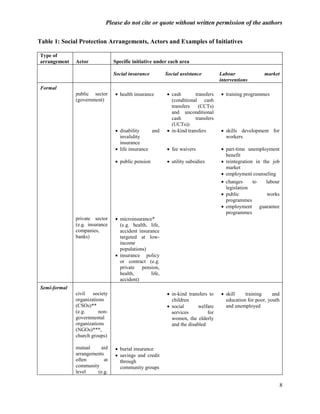
Table 1 provides an illustrative overview of social protection arrangements (i.e. informal, semi-
formal and formal), the actors involved in these arrangements, the three main areas of social
protection interventions as well as examples of initiatives that fall under these main areas in the
respective types of arrangement.37 For instance, utility subsidies are an example of a specific
social protection initiative in the area of social assistance which is usually placed in the formal
(public) arrangement category. A caveat regarding our overview that needs to be mentioned is
that borders between categories are often not clear cut. The line between informal and semi-
formal social protection, for instance, is a fine one as is the line between semi-formal and
formal.38 Thus, social protection initiatives can fall under more than one arrangement (sometimes
even with the involvement of external donors and other external actors).39

While important, informal and semi-formal social protection arrangements face a number of
limitations which we will analyze in the next section.


31
   Gallardo (2008).
32
   Gallardo (2008).
33
   James, Cox Edwards and Iglesias (2010, p.25).
34
   Behrman et al. (2011, p.2) and Shelton (2012).
35
   Behrman et al. (2011).
36
   Shelton (2012).
37
   This compilation is merely meant to be illustrative and to provide an overview to the reader.
38
   There is no clear categorization of and/or distinction between semi-formal and informal arrangements of social
protection (e.g. ADB (2010) even considers NGOs to be formal actors in social protection arrangements).
39
   The government can, in some cases, collaborate with the private sector and/or civil society actors in social
protection arrangements.

                                                                                                               7
Please do not cite or quote without written permission of the authors


Table 1: Social Protection Arrangements, Actors and Examples of Initiatives

Type of
arrangement   Actor             Specific initiative under each area

                                Social insurance         Social assistance         Labour              market
                                                                                   interventions
Formal
              public sector      health insurance        cash        transfers    training programmes
              (government)                                 (conditional cash
                                                           transfers    (CCTs)
                                                           and unconditional
                                                           cash        transfers
                                                           (UCTs))
                                 disability     and      in-kind transfers        skills development for
                                  invalidity                                         workers
                                  insurance
                                 life insurance          fee waivers              part-time unemployment
                                                                                     benefit
                                 public pension          utility subsidies        reintegration in the job
                                                                                     market
                                                                                    employment counseling
                                                                                    changes     to labour
                                                                                     legislation
                                                                                    public         works
                                                                                     programmes
                                                                                    employment guarantee
                                                                                     programmes
              private sector     microinsurance*
              (e.g. insurance     (e.g. health, life,
              companies,          accident insurance
              banks)              targeted at low-
                                  income
                                  populations)
                                 insurance policy
                                  or contract (e.g.
                                  private pension,
                                  health,        life,
                                  accident)
Semi-formal
              civil   society                             in-kind transfers to     skill    training     and
              organizations                                children                  education for poor, youth
              (CSOs)**                                    social       welfare      and unemployed
              (e.g.      non-                              services         for
              governmental                                 women, the elderly
              organizations                                and the disabled
              (NGOs)***,
              church groups)

              mutual     aid     burial insurance
              arrangements       savings and credit
              often        at     through
              community           community groups
              level    (e.g.

                                                                                                                 8
Please do not cite or quote without written permission of the authors

                  burial
                  societies,
                  Rotating
                  Credit     and
                  Savings
                  Associations
                  (ROSCAs))
 Informal****
                  family/kinship       remittances       /
                  (blood-               direct      money
                  related),             transfer
                  friends              gift exchange / in-
                                        kind exchange

Sources: Own elaboration based on Dekker (2008), Dhemba, Gumbo and Nvamusara (2002), GSDRC (2012),
Holzmann and Jø   rgensen (2001), Mohanty (2011).
* Churchill and Matul (2012) differentiate between formal providers of microinsurance (e.g. insurance companies),
and what we call ―semi-formal‖ providers (e.g. cooperatives, community-based organizations, mutuals, friendly
societies).
** Devereux (2010, p.13) broadly defines civil society to include ―[…] trade unions, rights-based NGOs,
representatives of special interest groups (women, children, pensioners, people with disabilities, people affected by
HIV and AIDS, homeless people, youth) community-based organisations (CBOs) and faith-based organisations
(FBOs), as well as activist academics and the independent media.‖
*** While we do recognize that NGO‘s can also be international actors (e.g. Save the Children), we mostly
considered nationally based NGOs.
**** We consider informal social protection to be solely based on individuals and households. However, we do
recognize the argument that communities are sometimes extended families.


2.2. Limitations of Informal and Semi-formal Social Protection

A major part of the world‘s population still relies on informal arrangements as the main source of
social protection. 40 Informal and semi-formal social protection, however, is present in most
developing countries: it has developed to fill gaps at the community and family/household level
that government policies have not been able (or willing) to address 41 or that markets have not
managed to (or have not been willing to) reach.42


40
   Holzmann and Jø  rgensen (2001); Hoogeveen et al. (2004). Comprehensive social protection systems exist in only
one-third of countries, where 28 percent of the global population lives; however, most of these systems cover only
workers in formal employment ILO (2010a, p.33). According to the ILO (2010a, p.33), only around 20 percent of
the global working-age population and their families have access to comprehensive social protection. It is roughly
estimated that somewhere between 20 percent and 60 percent of the global population has access to basic social
protection only ILO (2010a, p.33). According to the ILO, those enjoying only a basic level of income security
(guaranteeing income at the level of the poverty line) at all stages of the life cycle as well as access to essential
health services are considered to benefit from basic social protection, or i.e., the social protection floor (ILO 2010a,
p.22).
41
   Dercon (2002).
42
   For an analysis of how to make credit markets more inclusive for the poor, please refer to Mendoza and Thelen
(2008).

                                                                                                                      9
Please do not cite or quote without written permission of the authors

While being vital for a large share of the population, especially the most vulnerable, these
informal and semi-formal arrangements can have two important downsides: first, they may
provide inadequate protection since they might collapse or malfunction under certain
circumstances or since pay-outs might be too small. Factors that can contribute to the
malfunctioning of informal and semi-formal arrangements include inherent characteristics of
these types of arrangements themselves (like the mere size of the mutual assistance group/pool)
and the complex nature of the risks they are not equipped to cover (diversification of the mutual
assistance group/pool). Second, they may be exclusive of the poorest or discriminate certain
social groups.

First, in some cases, informal and semi-formal social protection arrangements provide
inadequate protection. For instance, when exposed to a risk that affects everyone in the risk pool.
Risks can affect whole communities/regions (covariate risks) or they can affect a particular
individual (idiosyncratic risks). 43 By definition, insurance does not work for covariate risks, i.e.
in order for an insurance scheme to work the risk pool needs to be sufficiently diversified so that
a particular adverse event only affects a limited number of members of the risk pool. Thus, for
example in the case of community-based insurance schemes, if an adverse event affects the
whole community this social protection set up does not work. 44 Given the size of typical
communities, there are many risks that qualify as covariate risks. They include financial crises,
other macro-economic shocks, or natural disasters. Likewise, many diseases that afflict
developing countries are also covariate risks. For instance, HIV/AIDS diminishes the earning
potential of entire communities and is found to have hindered capacity and operability of
informal social protection mechanisms in Eastern and Southern Africa.45

Naturally, the likelihood of a covariate risk increases the smaller the size of and the more
homogeneous the risk pool.46 Since some informal and semi-formal risk-coping arrangements are
small in size, chances are high that a shock may hit the whole group. 47 Also, payouts might not
be particularly high if the insured group is small.48 An informal and semi-formal arrangement is
also found to be less effective in case it is a ―horizontal‖ (between two equally poor parties)
arrangement as opposed to a ―vertical‖ (between a rich and a poor party) arrangement since the
poor parties both have less resources at their disposal.49 Hence, unless informal and semi-formal
arrangements are able to transfer part of the risk to insurance markets outside the community,
they are likely to collapse when experiencing a covariate risk. 50 Formal social protection


43
   The counterpart of covariate risks are idiosyncratic risks, e.g. risks that affect a particular individual in a
community. Examples of idiosyncratic risks are illness, disability, theft, etc. Informal risk coping arrangements are
found to work better in the context of risks that only affect an individual in a community instead of affecting the
whole community (Dercon 2002).
44
   Dercon (2002).
45
   ILO (2001); UNICEF (2008).
46
   It should be noted that small informal groups with a high level of trust have also been found to achieve risk
sharing and punishment in case of non-compliance (Mendola 2010). One should assume that the insured risk was of
idiosyncratic nature.
47
   Bhattamishra and Barrett (2010).
48
   Bhattamishra and Barrett (2010).
49
   Devereux (1999).
50
   Dercon (2002) notes that communities or individuals can alternatively also revert to intertemporal transfers, like
using individual or community-level savings. However, the poorest might not possess savings.

                                                                                                                  10
Please do not cite or quote without written permission of the authors

arrangements can usefully complement or strengthen community-based arrangements to access
commercial reinsurance markets.51

On the other hand, some semi-formal social protection schemes have found to be overwhelmed
by their membership size. While broad coverage means that there is strong demand for the semi-
formal arrangement, it can also overburden its administrative and managerial capacity. Some
burial societies in South Africa, for instance, have grown so big that they could possibly improve
their service were they to be more regulated.52

Second, informal and/or semi-formal social protection arrangements, in some cases, can be
exclusive of the poorest or discriminative of certain social groups and minorities. For instance,
they are exclusive of the very poor53 when they require contributions in cash or in kind which the
poorest are unable to pay. The poorest households in Fiji Islands and Vanuatu, themselves often
part of a family network of equally poor people, have been found to oftentimes be unable to
revert to family support or to honor their contribution commitments to the community, church,
etc. 54 Another barrier preventing people from accessing these arrangements can be
discrimination (for instance, based on ethnic background, migrant status, religion or gender).55
More formal, more equitable social protection arrangements could help extend social protection
to the poorest and those excluded by discrimination.56

While important, informal and semi-formal arrangements have many downsides as they can
reinforce the poor‘s dependent status without making them resilient to (possible) frequent
shocks.57 For instance, in the absence of formal insurance markets and social protection, farmers
in Sub-Saharan Africa have been found to improvise measures like using mixed cropping
systems and planting multiple varieties to reduce the impact of shocks on their harvest. The price
they pay is high: more work and lower yields.58 Governments may usefully strengthen informal
arrangements in a given country context but may consider providing more formal solutions in
others.59


2.3. Potential Triggers for a Switch to More Formal Social Protection

As mentioned in the previous section, informal and semi-formal social protection arrangements
may have a number of limitations that can lead to inadequate protection or non-inclusive
provision. That may not in itself be a reason for a government to initiate a new formal social
protection scheme or to broaden coverage of an existing social protection system. Our findings
suggest that a broad number of factors may potentially trigger a developing country to initiate a
more formal social protection system by creating an enabling environment. These factors fall
51
   Bhattamishra and Barrett (2010).
52
   Bester et al. (2004); Olivier, Kaseke and Mpedi (2008).
53
   Bhattamishra and Barrett (2010); Dercon (2002).
54
   ADB (2010).
55
   Cook (2009).
56
   Bhattamishra and Barrett (2010).
57
   Cook and Kabeer (2009).
58
   UNDP (2012a).
59
   Cook and Kabeer (2009).

                                                                                                  11
Please do not cite or quote without written permission of the authors

into two broad categories: internal triggers and external triggers. Internal triggers can be related
to the limitations of existing informal and semi-formal social protection schemes and
arrangements themselves or to a change in a country‘s political and economic context which in
turn can influence the development path of a country (i.e. change in wealth level, population
related change), or boost public support and political will. External triggers include change in
the nature of shocks (i.e. from idiosyncratic to covariate), economic crises, natural disasters, etc.

Many governments have moved in the direction of scaling up existing or implementing new
formal social protection schemes when such a potential trigger is present. If not addressed in a
timely fashion and with the right responses, vulnerabilities that are exposed in economic crises
and through other triggers may threaten growth prospects, hard-earned development gains and
social stability. In this section we explore which factors appear to potentially trigger countries to
move towards a more modern, more efficient (and ultimately towards a more formalized) social
protection system.


2.3.1. Potential Internal Triggers for a Switch to More Formal Social Protection

A change of a country‘s political or economic context may provide a trigger for broadening
formal social protection coverage. For instance, many formerly planned economies started
broadening public social assistance coverage to previously excluded groups when switching to
market economy systems. 60 Apart from the regime change itself, liberalization, increased
external competition and pressure on public accounts are factors that are found to have pushed
towards an extension of social protection.61 The Republic of Korea, for instance, experienced a
period of extremely rapid growth brought about by industrialization. One of the least developed
countries in the 1960s, by 1995, the Republic of Korea was classified as an upper middle-income
country and today is classified as a high income country.62

With increasing wealth, the Republic of Korea started to gradually implement social protection
initially following the model of Western welfare states using the social insurance model covering
formal sector workers. The Republic of Korea‘s four main social insurance programmes have
been progressively built up since the mid-1960s: Industrial Accident Compensation Insurance
(1964), Medical Insurance (1977), National Pension Insurance (1988) and Employment
Insurance (1995).63 Increasingly, the Republic of Korea‘s the development path on which the
Republic of Korea embarked, started to challenge the country‘s existing social protection system.
As the Republic of Korea moved up the development ladder, it started facing different and
evolving challenges like expanding and/or aging population, fast urban migration, and increasing
demand for more equal access to quality social services. The fast aging of the Republic of
Korea‘s population poses challenges to the country‘s pension system. By 2040, fewer than two
people of working age in the Republic of Korea are expected to support every person age 65 and
older.64 One innovative approach the Republic of Korea has taken to address this problem is to

60
   Cook and Kabeer (2009).
61
   Cook and Kabeer (2009).
62
   Jung and Shin (2002, p.270); World Bank (2012).
63
   Jung and Shin (2002, p.270).
64
   The Economist (2012).

                                                                                                  12
Please do not cite or quote without written permission of the authors

provide subsidies for the employment of the elderly so they continue working and providing for
themselves for longer. 65 As of 2008, elderly people in the Republic of Korea also have a
universal basic pension, earned-income tax credit and an insurance scheme providing long-term
care at their disposal, amongst others.66 Similar challenges are also faced in the developing Asia
region more broadly where informal social protection mechanisms are eroding due to changes in
working habits, cultural values, family structures and urbanization.67

In Latin America, the change in the political context was marked by the democratization in the
late 1980s, early 1990s of many countries in the region. Democratization is said to have
contributed to scaling up bottom up public support for social protection in Latin America.68 A
study cites ―strong popular demand for social protection‖ 69 as an enabling environment for the
birth of a generation of ―highly innovative, domestically designed poverty and vulnerability
reduction programmes‖ 70 in Latin America (e.g. Bolsa Escola/Famí                  lia (Brazil),
Progresa/Oportunidades (Mexico), and Chile Solidario (Chile)). Brazil is an example of a
country where the government, in collaboration and pushed by civil society, has shown strong
support for social programmes. The end of the military dictatorship in Brazil in 1985 was
accompanied by an increasing occupation of the public arena by civil society and various grass-
roots movements which brought the concerns of the people to the country‘s agenda. These
movements played a key role in the establishment of a new Constitution. With the approval of
the Constitution in 1988 ―a new landmark point was established as a universalized social security
model came to life that was grounded in citizenship rights.‖71

While bottom up support by the citizens was a key trigger for Brazil‘s move towards more
formal social protection, political will at the federal level was the key driver to broaden
coverage, efficiency and areas of social protection interventions. The outspoken support of social
programmes by a new government put social protection high on the agenda of the federal
government in the early 2000s; the current government continued and deepened this course.
Investing heavily in social as well as economic development, Brazil‘s approach to social
protection demonstrates that the government is treating poverty as a multi-dimensional problem
that goes well beyond the lack of income.72 Since the early 2000s, the government has extended,
designed and implemented a number of integrated programmes for social protection, extension
of basic services, and food security that have helped break vicious circles of social exclusion,
lack of opportunity, low incomes, and poor health. 73

Bottom up support through civil society, citizens and even the media are also said to have served
as a driving force in some successful African country cases. 74 In South Africa, civil society,
through media campaigns, advocacy and street protests and even judicial proceedings, has

65
   The Economist (2012).
66
   The Economist (2012).
67
   AusAid (2012).
68
   Barrientos and Hulme (2008).
69
   Barrientos and Hulme (2008, p.9).
70
   Barrientos and Hulme (2008, p.9).
71
   UNDP and ILO (2011, p.66).
72
   UNDP (2012b).
73
   UNDP (2012b).
74
   Devereux (2010).

                                                                                                  13
Please do not cite or quote without written permission of the authors

demanded changes towards more equal and inclusive social protection policies. 75 Part of the
success of civil society in South Africa was due to the fact that it used jurisdiction to claim the
right to social assistance (i.e. this right is written in the South African Constitution). 76While
social protection systems in LICs in Eastern and Southern Africa are still in the initial stages of
development, they are more advanced in MICs in the region.77 Successful upscaling of social
protection in African countries is found to be linked to strong political will at the federal level (as
opposed to an agenda of donors).78 South Africa is said to avail of the most comprehensive social
protection system in Sub-Saharan Africa, also to a great extent thanks to political will.79

Lastly, transition from conflict toward a more stable, accountable regime can be a potential
trigger for a government to implement or broaden social protection schemes. For instance, some
LICs, after exiting from conflict, broadened their social protection coverage. 80 In Liberia and
Sierra Leone the governments invested in labour market interventions aimed at the young. 81
Social protection in post-conflict countries helped the government to build trust though the
provision of support and opportunities to its citizens. Social protection was also a key instrument
in building a more peaceful and equal nation after the end of the Apartheid regime in South
Africa.82 The South African government broadened its formal social protection system primarily
focusing on child grants and non-contributory pensions and with the help of labour market
policies bringing more people into jobs.83


2.3.2. Potential External Triggers for a Switch to More Formal Social Protection

As discussed above, the change in the nature of shocks that households experience has an impact
on the functioning of informal social protection arrangements. For example, while households
and individuals in the South-East and East Asia region have historically experienced shocks that
are mostly of idiosyncratic nature, the increasing integration of the regional economy implies
that economic shocks increasingly affect a broader range of people, challenging informal
arrangements.84 This situation can trigger the need for more formal, more stable social protection
systems.

Economic crises have proved to be a testing moment for the adequacy of a country‘s social
protection system as they tend to expose the system‘s flaws and weaknesses. In the case of Latin
America, the economic crisis in the early 1980s is often cited as a trigger to a switch to a more
formal and systematic approach to social protection.85 Prior to the crisis, like in many developing
world regions, social protection in Latin America was mostly limited to workers in the formal

75
   Devereux (2010).
76
   Devereux (2010).
77
   UNICEF (2008).
78
   Devereux (2010).
79
   Devereux (2010).
80
   Cook and Kabeer (2009).
81
   Alderman andYemtsov (2012).
82
   Alderman andYemtsov (2012).
83
   Du Toit and Neves (2009).
84
   Cook (2009); Sumarto and Bazzi (2011).
85
   Barrientos and Hulme (2008).

                                                                                                    14
Please do not cite or quote without written permission of the authors

sector.86 The crisis brought about structural adjustment and economic liberalization which in turn
were followed by a rise in poverty and inequality. Initially, no broad social protection reforms
followed (only social insurance institutions for the formally employed were reformed and
fragmented social assistance programmes and social funds were mounted). The step for more
comprehensive and permanent public responses only started in the mid 1990s.87

Another example is the Mexican economic crisis of 1994 (known as the ―Tequila Crisis‖) that
motivated a change of the social protection system in Mexico. 88 The crisis exposed the
insufficiency of the existing mechanisms to protect the poor, so the new incoming administration
embarked on a two-pronged approach between (modestly) increasing support under existing
mechanisms and slowly replacing the old system with new programmes. 89 Mexico‘s well-known
conditional cash-transfer programme Progresa-Oportunidades has its roots in the change created
by the Mexican economic crisis of 1994.90 And while the recent global economic and financial
crisis triggered the expansion of existing social protection arrangements (including of the
Oportunidades programme) it also led to the creation of a more comprehensive approach to
social protection, the Vivir Mejor (Live Better) strategy, which is essentially a Social Protection
Floor.91

The Asian crisis of 1997-1998 is another example. Despite earlier reforms, the Asian crisis hit
the Republic of Korea hard; growth plummeted, unemployment rates soared and poverty levels
increased. 92 Exposing the limitations of informal arrangements in those East Asian countries
whose systems were based on ‗Confucian familism‘ (characterized by a ‗smaller government‘
that provided less social protection for its citizens, relying on the family as a provider instead)
the Asian crisis turned out to be strong trigger for more formal social protection systems.93 Prior
to the Asian crisis, in the Republic of Korea, for instance, welfare services (e.g. health care and
pensions) were delivered by state-owned corporations rather than the government. Furthermore,
people between 18 and 65 years of age were not entitled to receive public assistance. 94 After the
Asian crisis social assistance programmes like a cash transfer programme to the poor, even if
they were able to work, were introduced.95 Initial evidence suggests that the social protection
reforms implemented after the Asian crisis have helped to shield the Korean people from the
detrimental impact of the recent global economic and financial crisis.96

The global economic and financial crisis of 2008 may also have pushed many Latin American
countries to start a second round of reforms of their pension systems. After the first round of
reforms in the 1980s, the second round of reforms is found to pay more attention to tackling

86
   Barrientos and Hulme (2008).
87
   Barrientos and Hulme (2008).
88
   Levy (2006).
89
   Levy (2006).
90
   Levy (2006).
91
   UNDP and ILO (2011).
92
   World Bank (2012) and http://pressroom.ipc-undp.org/2011/ipc-ig-presentation-social-protection-experiences-
from-south-korea/.
93
   Cook (2009).
94
   The Economist (2012).
95
   The Economist (2012).
96
   http://pressroom.ipc-undp.org/2011/ipc-ig-presentation-social-protection-experiences-from-south-korea/

                                                                                                                 15
Please do not cite or quote without written permission of the authors

poverty of the elderly, to expand coverage and equity to shield people from market risks. Hence,
non-contributory schemes like social pension and more universal pensions have been placed
higher on the agenda.97

The case of Indonesia serves as a striking example of a country whose steady path to economic
growth and poverty reduction was interrupted by an external trigger, the Asian crisis of 1997-
1998 (see Box 1).

Box 1: Time to Act When a Trigger Exposes Vulnerabilities and Limitations: The Case of
Indonesia

The Asian crisis of 1997-1998 hit Indonesia at a time when it had experiences around 30 years of
strong economic growth and poverty reduction. When the crisis hit, GDP growth plummeted and
poverty rates increased, showing that the poor were hard hit by the crisis. The financial and
economic crisis soon became a political crisis, forcing the head of government at the time to step
down. By early 1998 the country was suffering from the combined effects of financial,
economic, and political crises. Exposing the insufficient protection of a large share of the
population to such a shock, Indonesia‘s government had to react swiftly, implementing social
assistance programmes to shield the most vulnerable. What started as formally provided social
assistance has developed into the beginning of a social protection floor for all which in Indonesia
includes components in the areas of health care (JAMKESMAS scheme targeted at the poor and
near-poor (76.4 million people), universal health insurance coverage is envisioned by 2014),
food security (subsidized ―rice for the poor‖ programme), access to education (scholarships for
students from poor families), UCTs, CCTs (Programme Keluarga Harapan or PKH) and a
Community Empowerment Programme (PNPM).
Sources: World Bank (2012) and www.socialsecurityextension.org/gimi/gess/ShowCountryProfile.do?cid=444

Since social protection should usefully be in place once a country is hit by a shock (ex ante),
governments have increasingly been encouraged by the international community and by example
of their peers (e.g. Brazil, South Africa are role models in social protection for many other
developing countries) to invest in social protection even in the absence of shocks and other
triggers.


2.4. Embedding Social Protection in a National Development Strategy

We previously identified limitations of non-formal social protection. Vital for a large share of the
population in developing countries and a useful source of information on the local context, these
existing arrangements might usefully be made part of a country‘s social protection strategy.98 We
also identified a number of potential triggers that may contribute to creating an enabling
environment for a country to implement a more formal system and a more broad-based coverage
of social protection. Building on this information, we will present our findings on enabling
conditions that have helped developing countries to integrate social protection into their national
development strategies and on recommendations that developing countries may with to consider

97
     Calvo, Bertranou and Bertranou (2010).
98
     Hoogeveen et al. (2004); Olivier, Kaseke and Mpedi (2008).

                                                                                                         16
Please do not cite or quote without written permission of the authors

when embedding existing non-formal social protection arrangements into their development
strategies.

Public support has been found to be a strong driving force behind the successful social protection
country cases Brazil and South Africa.99 Both cases demonstrate that the formalization of social
protection initiatives, through writing them into law, makes it more likely that they will be taken
to scale or institutionalized.100 According to Pero and Szerman (2005):

        ―The New [Brazilian] Constitution was ambitious: it settled social-democrat guidelines
        for social policy, stressing the universality of coverage and benefits, thus opposing the
        patterns prevailing until the 1970s. […] the use of selectivity criteria to distribute benefits
        to the most needy was also introduced. Furthermore, the Constitution deepened the
        ongoing decentralization process, strengthening the fiscal and administrative autonomy of
        sub-national governments.‖101

One of the aspects pushed by Brazil‘s new Constitution was the decentralization of spending and
better targeting of social expenditure for those who needed it most. 102 Despite high social
spending, social indicators in Brazil deteriorated further throughout the 1980s 103 and first
determined steps to breaking the inability of social spending to reduce poverty and inequality in
Brazil and towards implementing a new social development strategy were only adopted by a new
government as of 1995. 104 Improvements in social protection spending, policy design and
implementation in Brazil owe much to partnerships between the federal government, sub-
national governments, civil society and the private sector. An important building block of
Brazil‘s Bolsa Famí (the Bolsa Escola programme) was first developed and implemented at
                      lia
the municipal level before being scaled up to the national level.105 The partnership with civil
society has helped the Brazilian government to improve the accuracy of Bolsa Famí           lia’s
                                                                  106
beneficiary registry, and hence its targeting accuracy over time.

Strong political will at the federal level is also a key prerequisite for the successful expansion of
social protection. A review 107 of social protection in Southern Africa concludes that social
protection interventions have higher chances of succeeding if they are driven by political will,
i.e. if they are government-led from the beginning than if they are donor-driven. For instance,
successful social pension schemes for all older citizens were introduced in Lesotho (2004) and
Swaziland (2005).108 These schemes were designed and implemented without donor support.109
In general, in Southern Africa, government-led SP systems in South Africa, Botswana, Namibia,
99
   Devereux (2011); UNDP (2012a).
100
    Devereux (2010).
101
    Pero and Szerman (2005, p.5).
102
    Pero and Szerman (2005).
103
    Brazil‘s GINI index peaked in 1989 at 63, making Brazil one of the most unequal societies in the world (World
Bank 2012).
104
    World Bank (1988) as quoted in Pero and Szerman (2005). For detailed information on Brazil‘s social
development strategy under Cardoso, please refer to Faria (2002).
105
    De Janvry (2005); Pero and Szerman (2005).
106
    Lindert et al.(2007).
107
    Devereux (2010).
108
    Devereux (2010).
109
    Devereux (2010).

                                                                                                              17
Please do not cite or quote without written permission of the authors

and (until recently) Zimbabwe are found to be more successful than donor-led SP systems in
Lesotho, Malawi, Mozambique, Swaziland and Zambia.110

In some cases, government-donor or public-private partnerships are usefully implemented to
complement capacities. For instance, in Ethiopia and Malawi, index-based weather insurance
scheme pilots have been set up for farmers. While donors pay the insurance premiums,
transferring the cost of droughts to the international insurance markets, national governments
provide weather station infrastructure, foster an appropriate legal and regulatory environment
and educate farmers on insurance matters. 111 In Nepal, external actors like international
organizations and bilateral aid agencies are found to play a strong role in the country‘s social
protection context. Over the past 20 years, these agents are found to have contributed with
knowledge and expertise to promotion, design and implementation of social protection in Nepal
while the government has been primarily responsible for financing and administering social
protection initiatives.112

The public sector might usefully engage existing schemes when considering scaling up formal
social protection systems. This is also the approach that the Social Protection Floor promoted by
the UN-system is taking. According to UNDP and ILO (2011):

        ―A key strength of the social protection floor approach is that it does not start from
        scratch but with a careful analysis and stocktaking of existing structures and strengths
        and weaknesses of schemes and programmes in place. Building on the national social
        protection system by improving coordination of different activities, exploring synergies
        and increasing efficiency will free resources for extending social protection to those
        currently not covered.‖113

Governments are well-advised to carefully analyze existing non-formal social protection
arrangements when considering to implement new or to scale up existing formal social
protection schemes. 114 This is due to the fact that a randomly implemented formal social
protection scheme might do more harm than good. For instance, the implementation of a formal
food for work programme may incentivize able bodied individuals to drop out of informal
insurance arrangements. This might leave the informal arrangement with a less diversified risk
pool of less able bodied individuals (i.e. the elderly).115

Integration should ultimately aim at serving the purpose of increasing the extension of coverage
and/or providing a minimum level of protection.116 Prior to setting up a new formal system or
extending an existing one, the reasons behind the existence of informal social security
arrangements as well as the nature of the relationship between current informal and formal
arrangements need to be analyzed and understood. In order to be considered worthy candidates

110
    Devereux (2010).
111
    UNDP (2012a).
112
    Upreti et al. (2012, p.39).
113
    UNDP and ILO (2011, p.15).
114
    Hoogeveen et al. (2004); Olivier, Kaseke and Mpedi (2008).
115
    Hoogeveen et al. (2004).
116
    This paragraph is based on Olivier, Kaseke and Mpedi (2008). It should be noted that the original study talks
about ―social security‖, not social protection.

                                                                                                              18
Please do not cite or quote without written permission of the authors

for integration, informal arrangement should be able to meet a number of criteria that include
prudent management, capacity financial viability and sustainability. Once an informal
arrangement is found suitable to be scaled up and/ or integrated, governments can avail of an
array of government interventions to integrate them into, or link them to formal provision. These
interventions include training, subsidies, technical assistance, etc.

For instance, an assessment in the Southern African Development Community (SADC) region117
concludes that self-organized mutual support systems (at community level) in the SADC region
lend themselves better to being incorporated into social security systems than traditional support
systems which are often rooted in African traditional values.118 Burial societies in Ethiopia and
Tanzania, may also be suitable candidates for linking them to additional types of insurance since
they are often relatively formal in nature.119 However, evidence on how, why and when informal
and semi-formal arrangements have been taken into account in the process of broadening
coverage of social protection systems is scarce. More information could contribute to more and
better informed decisions.

Finally, social protection systems should be judged and measured against its efficiency of
contributing to more equal societies, to more security for people (especially the poor and the
most vulnerable), more stable and inclusive growth. The government is the actor that has the
authority to set the legislative and regulatory framework for other social protection providers to
thrive and to assure that social protection is equitable and inclusive. Governments can and
should, usefully engage in close cooperation with actors that are well-informed about local
conditions and public needs (like NGOs) and actors that might be able to improve efficiency
(like the private sector). 120 Governments in many developing countries have partnered with
private insurance companies to extend, assure (and provide) pension.121


3. Cost Efficiency of Social Protection

The affordability of social protection schemes is a major concern for many developing countries,
in particular the LICs. For a long time, the prevailing view was that social protection was not
affordable in developing countries. It was mostly believed that social expenditures were
unproductive measures that would crowd out private investment and create large fiscal deficits
that would not be manageable.122

In this section we will explore cost-efficiency of formal social protection programmes. In this
context, it is important to highlight differences between cost-efficiency and cost-effectiveness as
these two similar concepts can often lead to confusion and mistakenly can be used

117
    Current members of SADC are: Angola, Botswana, Democratic Republic of Congo (DRC), Lesotho,
Madagascar, Malawi, Mauritius, Mozambique, Namibia, Seychelles, South Africa, Swaziland, United Republic of
Tanzania, Zambia and Zimbabwe. For more information, see www.sadc.int/english/about-sadc/
118
    Olivier, Kaseke and Mpedi (2008).
119
    Dercon et al. (2004).
120
    For instance, building the link between the government and the people, NGOs in the Pacific Island Countries are
found to contribute to provide advocacy services, counseling, education and training (Mohanty 2011).
121
    Tapia (2008).
122
    Cook and Kabeer (2010, p. 7); Ortiz and Yablonski (2011, p. 51).

                                                                                                                19
Please do not cite or quote without written permission of the authors

interchangeably. Whereas the main objective for cost-effectiveness is to achieve results at a
lower cost compared with alternatives, for cost-efficiency the main objective is ―to achieve the
maximum possible outputs, outcomes, and impacts with the minimum possible inputs.‖123

Therefore, cost-efficiency of a particular social protection programme will not depend solely on
the level of financial sources allocated to it but also, and most importantly, on achieving the
desired impact (e.g. improvements in human development outcomes, mitigation of risks and
vulnerabilities) based on country-specific development priorities. The concept of cost-efficiency
places more emphasis on impacts than the concept of cost-effectiveness does and in turn takes
into account a broader set of costs and benefits.

There are various costs associated with social protection that can be broadly grouped into direct
and indirect costs. Direct costs include those associated with setting up, implementing, and
revising (as appropriate) a social protection programme. Indirect costs include both opportunity
costs of not allocating resources to other programmes and negative externalities on non-
beneficiaries and/or local economy.

Besides the costs, affordability of a social protection scheme needs to be evaluated with
consideration of both the direct and indirect benefits 124 and impacts on people and on the
sustainability of the economy as well as the contribution to building resilience to shocks of such
a scheme. Since it is not feasible to quantify all costs and benefits involved, qualitative analyses
offer an important complementary role to quantitative analyses.

A careful needs assessment would enable a country to identify the most prevailing and urgent
vulnerabilities that need to be addressed by a social protection programme.125 After determining
the priority areas for action, the main challenges lie in ensuring that social protection
programmes are well designed, help achieve desired outcomes based on country priorities, are
affordable, and do not lead to costly entitlements that a country cannot sustain over time.
Therefore, a comprehensive cost-benefit analysis for a social protection programme based on
country priorities would be the one that would explore not only current affordability but also
fiscal sustainability.

However, comprehensive cost-benefit analyses of social protection programmes are rare in
developing countries mainly because of time and capacity constraints to assess social protection
programmes. Another reason why comprehensive cost-benefit analyses are not common in
developing countries could be political if those in power aim at reaping political benefits of
social protection programmes within limited timeframes (e.g. before elections).

It should be noted that with regard to certain social protection schemes, absence of cost-benefit
analyses (both ex-ante and ex-post) are not unusual even in advanced countries. For instance, a
123
    IEG (2007, p. 65). For more comprehensive definitions of and discussions on efficiency and cost-effectiveness,
see Chapter 11 of IEG (2007).
124
    In this paper, the concept ―benefit‖ refers to all positive impacts of a social protection program and should not be
confused with the ―benefit amount‖ of a particular scheme.
125
    In this context, the ILO‘s Rapid Assessment Protocol (RAP) provides a useful tool for developing countries to
take stock of and map existing social protection measures and identify priority areas for intervention (UNICEF and
ILO, 2011, p. 11).

                                                                                                                     20
Please do not cite or quote without written permission of the authors

2007 inventory of youth employment interventions in 84 countries from all regions in the world
demonstrated that among the OECD countries, only Canada, the U.K. and the U.S conducted
impact evaluations and cost-benefit analyses of such interventions.126 Outside these countries and
other than studies sponsored by international organizations, rigorous evaluations of youth
employment interventions were found to be very rare. 127 The ILO has recently adopted a
resolution to call on governments, social partners and the multilateral system to take urgent and
renewed action to address the crisis of youth employment. 128 This resolution also stressed that
the ILO‘s own activities promoting youth employment ―should be subject to rigorous monitoring
and evaluation to ensure approaches are cost-effective and provide a positive impact.‖129

One example of a developing country that has been undertaking social protection cost-benefit
analyses is Cambodia. The Government of Cambodia recently developed a social protection
strategy based on a vulnerability and gap analysis; consultations with development partners and
other stakeholders; as well as technical assistance from various International Organizations
including for costing exercises. Cambodia‘s strategy stresses that ―financing of the social
protection programme must be seen as an investment rather than as an expenditure.‖130 Box 2
summarizes how Cambodia‘s social protection strategy has been evolving in order to provide the
reader an overview of possible issues that developing countries can encounter while expanding
social protection and exploring affordability of priority programmes.

Box 2: Cambodia’s National Social Protection Strategy for the Poor and Vulnerable

In 2011, the Government of Cambodia adopted its National Social Protection Strategy for the
Poor and Vulnerable (NSPS). Before developing this Strategy, the Government first identified
gaps and constraints with regard to the effective and efficient provision of social protection such
as lack of longer-term vision for social assistance development; low local capacity; limited
coordination among social protection interventions; problems with collecting and monitoring
data and assessing existing interventions; and inadequate budget for implementation.

The Government of Cambodia stresses that ―limited fiscal space and implementation capacities
call for prioritisation of options for social protection development in the short term.‖ The NSPS
gives priority to addressing major sources of vulnerability (such as chronic and transient poverty,
hunger, shocks, and social exclusion) by taking short- and medium-term measures including cash
and in-kind transfers and fee exemptions; public works programmes; and social welfare services.
The Strategy also sets the long-term framework for sustainable and comprehensive social
protection for all in accordance with the Social Protection Floor Initiative. The aim is to
establish both contributory social security mechanisms for the formal sector and improved social
assistance for the informal sector.

While preparing the NSPS, the Government held technical consultations with development
partners and national stakeholders, such as civil society organizations. Several International

126
    Betcherman, et al. (2007, p. 31).
127
    Betcherman, et al. (2007, p. ii).
128
    ILO (2012a).
129
    ILO (2012a, p. 14).
130
    UNDP and ILO (2011, p. 156).

                                                                                                    21
Please do not cite or quote without written permission of the authors

Organizations including the World Food Programme (WFP) and the World Bank assisted the
Government in undertaking a scoping and mapping exercise on existing safety-net programmes.
The ILO also applied a diagnostic tool called Social Protection Expenditure and Performance
Review (SPER) in order to assess system financing, to identify coverage gaps, and to discuss
policy issues for consideration by national policy makers. The ILO estimated that the total
existing social expenditure for the year 2010, including ODA-funded programmes and subsidies
for the health sector was at about 5.5 percent of GDP. The majority of social spending was
allocated for health, corresponding to about 60 percent of total social expenditure.

As part of the technical consultations the World Bank conducted a study that estimated that a
conditional cash transfer programme for poor families with pregnant mothers or children under
five would cost 0.21 percent of GDP (excluding certain administrative costs and supply-side cost
of providing nutrition services). Moreover, the NSPS provides preliminary cost estimates for
each short-term (up to 2013) priority programmes and actions but exact resource requirements
will be determined through further analyses and assessments. The Strategy states that ―a costing
exercise for the medium- and long-term implementation of the NSPS will be developed as a
priority activity during the first year of implementation (including a detailed costing of existing
and planned interventions and a fiscal space analysis). Financing arrangements, including joint
pool arrangements for certain tasks, will be discussed with development partners to embark on a
programme-based approach for social protection in Cambodia and to align and harmonise donor
support for the NSPS.‖ It is also stressed that during this process financing of the social
protection programme must be seen as an investment rather than as an expenditure.

Sources: ILO (2012b), Kingdom of Cambodia (2010), Royal Government of Cambodia (2011), UNDP and ILO
(2011).

In the following sub-sections, we will discuss cost-efficiency of social protection by taking stock
of several costing exercises and analyzing potential short- and long-term benefits of social
protection.


3.1. Cost-Benefit Analyses

Institutions such as HelpAge, International Labour Organization (ILO), Overseas Development
Institute (ODI), UNICEF, and World Health Organization (WHO) developed social protection
costing models and/or undertook costing exercises. Some of these models have been applied by
individual countries in order to examine the feasibility of certain social protection programmes.
At the same time, a number of institutions conducted broader studies looking into various sets of
countries in order to contribute to the affordability debate.

One widely cited example is the costing studies that the ILO undertook in seven sub-Saharan
African131 and five Asian countries132 estimating the annual costs of a basic social protection


131
      Burkina Faso, Cameroon, Ethiopia, Guinea, Kenya, Senegal, and the United Republic of Tanzania
132
      Bangladesh, India, Nepal, Pakistan, and Viet Nam

                                                                                                      22
Please do not cite or quote without written permission of the authors

package that includes universal basic old-age and disability pensions, 133 basic universal child
benefits, 134 universal access to essential health care, 135 and a 100 day employment guarantee
scheme.136 For the countries considered, the annual cost of a basic social protection package is
estimated to be in the range of 3.7 to 10.6 percent of GDP in 2010.137 The estimated annual costs
of each element are as follows:138

     Universal basic old-age and disability pensions: between 0.6 and 1.5 percent of GDP
     Basic universal child benefits: between 1.2 and 3.6 percent of GDP
     Universal access to essential health care: between 1.5 and 5.5 percent of GDP
     100 day employment guarantee scheme: between 0.3 and 0.8 percent of GDP

The cost of providing universal health care is noticeably higher than the cost of the remaining
elements of the package. The results of this ILO study have been cited in the literature139 with the
purpose of demonstrating that a basic social protection package excluding universal health care
provision would be affordable even in low-income countries (the selected group includes both
low-income and lower middle-income countries).

Nevertheless, affordability is not evident merely from these numbers. According to this ILO
study, even when governments increase the share of public spending attributed to social
protection to 20 percent of their total budget, seven out of twelve countries analyzed will still not
be able to fill the financing gap from domestic resources by 2030. 140 Moreover, these costs were
calculated before the global financial and economic crisis hit, therefore the crisis impact on fiscal
space available to developing countries was not taken into account.141

Other costing exercises have focused on specific elements of a basic social protection package
looking at different or a greater number of countries. Some of these exercises estimate only

133
    ―It was assumed that the simulated universal old-age and disability pension would be set at 30 percent of GDP
per capita, with a maximum of one US dollar (PPP) per day (increased in line with inflation) and would be paid to
all men and women aged 65 and older; and to persons with serious disabilities in working age (the eligibility ratio
was assumed to be 1 percent of the working-age population, which reflects a very conservative estimate of the rate
of disability).‖ ILO (2008, p. 6).
134
    The level of the child benefit is assumed to be ―15 percent of GDP per capita with a maximum of half of one US
dollar (PPP) per day (increased in line with inflation) and paid for up to two children under the age of 14 per woman
who has given birth. The rationale behind this assumption is to tackle claims that universal child benefits would
provide an incentive to increase fertility.‖ ILO (2008, p. 7).
135
    It was assumed that basic health care costs would be based on a ratio of 300 medical staff to 100,000 population,
with medical staff wages indexed in line with GDP per capital growth (health staff wages were assumed at a
minimum of three times GDP per capita) and overhead costs of 67 percent of staff costs. ILO (2008, p. 21).
136
    The assumed beneficiary group of the employment guarantee scheme constitutes 10 percent of the working-age
population in each country. ―The benefit is only available to households not benefiting from any other form of cash
transfer. It was assumed that the simulated employment scheme would provide a benefit set at 30 percent of GDP
per capita, with a maximum of one US dollar (PPP) per day (increased in line with inflation). The benefit would be
paid for a total of 100 days in the year.‖ ILO (2008, p. 9).
137
    ILO (2008, p. 10).
138
    ILO (2008, pp. 6-9).
139
    ILO (2011); Ortiz and Yablonski (2011).
140
    ILO (2008, pp. 13-14). These seven countries are Burkina Faso, Cameroon, Ethiopia, Kenya, United Republic of
Tanzania, Bangladesh, and Nepal.
141
    UN NGLS (2010, p. 18).

                                                                                                                  23
Please do not cite or quote without written permission of the authors

current costs, while others also provide estimates of future costs to discuss sustainability. The
following sub-sections give an overview of these studies. It is worth highlighting that the aim is
not necessarily to provide comparisons (as methodologies, assumptions, and countries analyzed
differ from one study to another) but instead to offer the reader a wide range of existing analyses.


3.1.1. Universal Old-Age Pensions

A HelpAge International study built on previous costing exercises by organizations such as the
ILO and estimated the cost of a universal old-age pension in 50 low- and middle-income
countries.142 The study argues that universal old-age pensions in the countries analyzed would be
currently affordable (in 2010). It is estimated that a universal pension for everyone over 65143
would cost less than 1.8 percent of GDP in all 50 countries (exceeding 1.5 percent of GDP only
in China, Jamaica, Sri Lanka, and Thailand).144 Such scheme would cost around 1 percent of
GDP or less in most sub-Saharan African countries.145 Moreover, these costs would not surpass 8
percent of current government expenditure in any of the 50 countries. 146 In 15 countries, these
costs correspond to around or less than 2 percent of government expenditure (e.g. Burkina Faso,
Malawi, Senegal, Mongolia, Ghana).147

Moreover, in order to assess sustainability, this study projected the future costs of a universal
old-age pension for everyone over 60 in Rwanda, Paraguay, and Thailand under different
scenarios. For example, when the pension is indexed to average income, the costs would rise
over time in all three countries as populations age. As a percent of GDP, the costs would
correspond to 1.4 in Rwanda, 3 in Paraguay, and 5.2 in Thailand by 2040.148 The reason behind
the higher cost for Thailand is that by 2040 a quarter of its population is projected to be over
60.149 The study argues that governments can contain these costs by indexing the value of the
transfers to inflation and/or by increasing eligibility age as populations age and healthy life
expectancy increases.150


3.1.2. Universal Health Care

A WHO study estimated that providing key health services in 49 low-income countries would
cost around USD 44 per capita on average in 2009, increasing to around USD 60 per capita by
2015.151 This estimate includes the cost of interventions to achieve the health-related MDGs as


142
    Knox-Vydmanov (2011). HelpAge International calculations assume a transfer level of 20 percent of GDP per
capita and set administrative costs as 5 percent of the total cost of transfers. (pp. 2-3).
143
    The study also provided separate cost estimates of pensions covering everyone over 60 and 70.
144
    Knox-Vydmanov (2011, Figure 1, p. 3).
145
    Knox-Vydmanov (2011, Figure 1, p. 3).
146
    Knox-Vydmanov (2011, Figure 2, p. 4).
147
    Knox-Vydmanov (2011, Figure 2, p. 4).
148
    Knox-Vydmanov (2011, p. 7).
149
    Knox-Vydmanov (2011, p. 7).
150
    Knox-Vydmanov (2011, p. 8).
151
    WHO (2010, p. 22).

                                                                                                          24
Please do not cite or quote without written permission of the authors

well as those targeting noncommunicable diseases. 152 Cost estimates were made for each
country, and then aggregated; hence they are ―simply an (unweighted) average across the 49
countries at the two points in time.‖153 Obviously, cost estimates vary by country. For instance,
while five of the countries analyzed would need to spend more than USD 80 per capita in 2015,
six countries would need to spend less than USD 40.154

Current health spending varies substantially from one country to another. For instance, annual
health spending in the US and Norway surpasses USD 7,000 per capita and OECD members as a
group spend on average around USD 3,600 per capita. 155 On the other hand, among WHO‘s
Member States, 31 countries spend less than USD 35 per capita annually and four countries
spend less than USD 10, even when external aid is taken into account. 156 The WHO stresses that
the poorest countries would need assistance from the international community to expand access
to health services since the Organization argues that ―even with relatively high levels of domestic
growth, and national budgets that prioritize health, only eight of the 49 countries have any
chance of financing the required level of services from domestic resources in 2015.‖157


3.1.3. Child Benefits

A Save the Children UK study estimated the likely current costs of providing different types of
unconditional child benefits for a large sample that includes 57 developing countries. 158 The
average cost159 of providing universal child benefits for children under 5 is estimated to be 2.08
percent of GDP. 160 When children under 5 who are below the poverty line are targeted, the
average cost decreases to 1.28 percent of GDP.161

While the average costs look relatively modest, the results of this study exhibit significant
variations across countries and regions. On a positive note, in many poor and middle-income
countries in Asia the cost of a universal cash transfer for children under 5 would be less than 1.5
percent of GDP.162 However, one exception is Nepal, where this cost is estimated to exceed 2.5

152
    More specifically, the study ―included interventions proven to reduce mortality among mothers, newborns and
children under five; childbirth care; reproductive health services; prevention and treatment of the main infectious
diseases; diagnosis, information, referral, and palliative care for any presenting conditions; and health promotion.‖
WHO (2010, p. 38).
153
    WHO (2010, p. 23).
154
    WHO (2010, p. 23).
155
    WHO (2010, p. 21).
156
    WHO (2010, p. 21).
157
    WHO (2010, p. 23).
158
    Yablonski and O‘Donnell note that this is a static analysis of the likely current cost of child benefits and
estimates will change over time according to the particular combination of changes in each country arising from:
population growth, changes in poverty headcount, changes in average poverty gap, economic growth, potential
changes in administrative costs over time (p. 44).
159
    The average cost has been calculated for 54 countries as Burundi, Liberia, and Democratic Republic of Congo are
treated as outliers.
160
    Yablonski and O‘Donnell (2009, Table 2, p. 26).
161
    Yablonski and O‘Donnell (2009, Table 2, p. 26).
162
    Yablonski and O‘Donnell (2009, Figure 6, p. 27). These countries include Bangladesh, China, Cambodia, India,
Indonesia, Laos, and Pakistan.

                                                                                                                  25
Please do not cite or quote without written permission of the authors

percent of GDP. 163 Moreover, for LICs in Africa, a universal cash transfer for children under 5
is found to be unaffordable in most cases. It is argued that some of these countries would need
considerable external assistance to fill the gap. For instance, Liberia and Tanzania would need
donor funding equal to approximately 90–95 percent and 70-85 percent of costs, respectively.164
Countries such as Sierra Leone, Niger and Mozambique currently are not able to afford even the
more narrowly targeted options at national scale out of domestic resources.165


3.1.4. Social Pensions and Child Benefits

A joint UNICEF and ODI study estimated the possible costs of social pensions and child benefits
(universal and/or selective) in five West African countries. These simulations as a percentage of
both GDP and recurrent expenditure are presented in Table 2 and vary significantly across these
five countries. For instance, while the cost of a universal child benefit and social pension
provision is estimated at 1.1 percent of GDP in Equatorial Guinea, the same provision for Ghana
is estimated to cost 11.3 percent of GDP (which is considerably higher than the upper range of
related ILO estimates) corresponding to more than 60 percent of recurrent expenditure. The
estimated costs for Equatorial Guinea are substantially lower than the ones for Ghana because
the former‘s per capita GDP is much higher due to its oil exports.166

However, the study highlights that affordability in simple aggregate terms does not necessarily
imply feasibility of a programme. For instance, whereas the oil-rich Equatorial Guinea seems to
have necessary fiscal space to finance additional social protection expenditures, it may face
political and institutional challenges. In Section 4, we will discuss in more detail a range of
challenges that countries may encounter in addition to financial constraints.


163
    Yablonski and O‘Donnell (2009, Figure 6, p. 27).
164
    Yablonski and O‘Donnell (2009, p. 27).
165
    Yablonski and O‘Donnell (2009, pp. 26-28). In such cases, the authors recommend rolling out a universal
programme geographically in areas with the highest poverty rates and argue that ―gradual expansion by age or
geography will help to keep costs manageable, and allow time for building the systems and capacity necessary to
deliver programmes at scale.‖ (p. 28).
166
    UNICEF and ODI (2009, p. 25).

                                                                                                            26
Please do not cite or quote without written permission of the authors


Table 2: Annual Programme Expenditure Cost Estimates of Child Benefit and Social
Pension Options: Simulations for Congo, Mali, Senegal, Equatorial Guinea and Ghana

                    Congo,                                                        Equatorial
Costs               Republic                   Mali             Senegal           Guinea              Ghana


                                     Pension


                                                                                            Pension


                                                                                                              Pension
                                     Social


                                                                                            Social


                                                                                                              Social
                     UCB


                                               UCB


                                                                UCB


                                                                                   UCB


                                                                                                      UCB
                             SCB


                                                       SCB


                                                                          SCB
% of GDP            2.0      1.2    1.0        5.9    3.2       6.4      3.7      0.9      0.2        8.7     2.6

% of                16.7     9.9    8.3        42.8   23.5      30.0     17.6     20.8     5.0        46.3    13.9
recurrent
expenditure
Note: UCB: Universal Child Benefit, SCB: Selective Child Benefit.
Source: UNICEF and ODI (2009, Table 2, p. 26).


3.1.5. The Social Protection Floor Costing Tool

In addition to undertaking costing exercises that covered a selected group of countries, some
international organizations have built costing tools that can be applied by individual countries.
For example, following the adoption of the Social Protection Floor (SPF) Initiative, UNICEF and
ILO jointly developed the SPF Costing Tool in 2010. The objective of the tool is to help support
policy decisions regarding selection, revision and investment in social protection programmes by
providing an initial basic assessment of the potential costs of both new schemes and
modifications to existing ones.167 It should be noted that the tool is only adapted to estimating the
cost and impact of cash transfers.168

Whereas the SPF Costing Tool was developed in order to support the Social Protection Floor
Initiative, the tool can be applied to other social protection contexts. The cost of a specific social
protection scheme would of course vary across countries depending on demographic, labour, and
macroeconomic conditions. While the SPF tool allows users to enter these relevant data points,
the tool has certain built-in assumptions about how these different parameters interact. Countries
can choose to conduct a simple application of the tool by using its built-in assumptions only (e.g.
Senegal), or can carry out more elaborated costing exercises by modifying these assumptions
based on their national context (e.g. Argentina and Egypt—See Box 3). 169 Some countries


167
    UNICEF and ILO (2011).
168
    The SPF Costing Tool can provide cost estimates for old-age pensions, child benefits, disability benefits, orphan
benefits, education stipends, birth lump-sum benefits, youth labour market programmes, and unemployment
programmes (UNICEF and ILO (2011, p. 5)). For a discussion of the SPF Costing Tool‘s limitations, see UNICEF
and ILO (2011, pp. 9-10).
169
    UNICEF and ILO (2011, pp. 3-4). The countries that have conducted social protection costing exercises using the
SPF Costing Tool include Argentina, Egypt, Madagascar, Mozambique, and Senegal.

                                                                                                                    27
Please do not cite or quote without written permission of the authors

choose to utilize multiple tools. For instance, Senegal‘s simple application of the SPF Costing
Tool was complemented by the World Bank‘s ADePT tool for estimating poverty impacts.170

Box 3: Application of the SPF Costing Tool in Egypt

A recent study applied the SPF Costing Tool for a proposed system of child cash transfers in
Egypt, in order to estimate not only its costs but also poverty impacts. The study simulations
show that with an overall cost of 0.88 percent of GDP, the proposed scheme can lift 19.3 percent
of poor people in Egypt out of poverty according to the national poverty line. The potential
impact on children is expected to be greater with an estimated poverty reduction of 28.2 percent
among poor children up to 14 years of age.

While examining the sustainability of such a scheme, the study took population dynamics into
account. Egypt‘s demographic profile appears to be favourable because of the growing ratio of
working age population in the overall population. Hence, over the period 2012-2020 the cost of
the scheme is projected to fall as a percentage of GDP benefiting from the declining dependency
ratio—regardless of whether the scheme‘s benefit amount is held constant in real terms or as a
percentage of GDP per capita.

Source: Rabi (2012).


3.1.6. Rapid Assessment Protocol (RAP)

On the basis of the SPF Costing Tool, the ILO (in close collaboration with UNICEF) has
recently developed a new costing tool called the Rapid Assessment Protocol (RAP), which
provides a useful method for developing countries to take stock of and map existing social
protection measures and identify priority areas for intervention.171 The tool also provides ―a basis
to discuss and simulate alternative financing options and fiscal space.‖172

The first step in this exercise is to construct an SPF Rapid Assessment Matrix (see Figure 1) in
order to analyze the present and planned future social protection provisions according to the
benchmarks set by the four guarantees of the SPF and to identify gaps in policy design and
implementation.173


170
    UNICEF and ILO (2011).
171
    UNICEF and ILO (2011, p. 11).
172
    ILO and IMF (2012, p. 3).
173
    Bonnet et al. (2012, p. 7).

                                                                                                 28
Please do not cite or quote without written permission of the authors


Figure 1: Structure of the Social Protection Floor Rapid Assessment Matrix


Source: Bonnet et al. (2012, p. 8).

After constructing an SPF Rapid Assessment Matrix, the RAP identifies and defines the policy
options that would complete the SPF and provides cost estimates for different measures and
relates them to projections of the government budget. 174 This tool ―builds on single age
population projections; single age estimates of labour force participation rates; a relatively crude
economic scenario as determined by assumptions of the overall GDP growth rates, productivity
rates, inflation and base real wage rates and increases over the projection period, and interest
rates, as well as initial poverty rates‖ 175 and uses these variables as drivers of expenditures and
revenues. Since the RAP conducts a more detailed analysis than the SPF Costing Tool, it offers
more robust results; however, the RAP is also more time demanding. Box 4 provides key
comparisons between the SPF Costing Tool and the RAP and Section 4 will give examples of its
application.


174
      Bonnet et al. (2012, p. 17).
175
      Bonnet et al. (2012, p. 17).

                                                                                                       29
Please do not cite or quote without written permission of the authors


Box 4: Key Comparisons between the SPF Costing Tool and the Rapid Assessment
Protocol

 COSTING TOOL                                        RAPID ASSESSMENT PROTOCOL
 1. Fixed and pre-defined format                     1. Flexible format
 2. Not time demanding                               2. Time demanding
 3. Features: pre-defined scenarios,                 3. The construction of the model goes
    types of benefits; pre-defined                      hand in hand with a dialogue process
    poverty impact module                               involving national authorities and
 4. No previous knowledge on Excel                      other actors dealing with social
    modelling, demographics,                            protection
    macroeconomics, government                       4. Previous knowledge on Excel
    finances, benefit design or poverty                 modelling, demographics,
    impact is necessary.                                macroeconomics, government
                                                        finances, benefit design or poverty
                                                        impact is required.


Source: Behrendt (2011, slides 4 and 5).


3.1.7. Importance of Prioritization

Another study took a different approach for exploring affordability of social protection and
compared five African countries‘ 176 actual expenditure levels in social protection and other
development sectors to the spending targets they committed to in international agreements.177

176
  Ethiopia, Kenya, Malawi, Mozambique, and Uganda.
177
  Hagen-Zanker and McCord (2011) identified six key development sectors as social protection, health, education,
water and sanitation, agriculture, and infrastructure. In order to calculate ―actual‖ expenditure levels, they used the
most recent data available, which was for 2006-2007.

                                                                                                                    30
Please do not cite or quote without written permission of the authors

The results show that most targets are not met (see Table 3) and even though individual sectoral
targets may be affordable, the targets are not jointly affordable, pointing to the need for sectoral
trade-offs.

Table 3: Sector Expenditure as a Share of Total Government Expenditure/GDP in Selected
African Countries in 2006-07


Note: Shading indicates that target has been met.
Source: Hagen-Zanker and McCord (2011, p. 13).

Therefore, assessing whether a social protection measure is affordable requires much more than
undertaking a costing exercise and exploring availability of fiscal space. While setting budget
priorities, there will naturally be competing policy options for allocation of public resources. For
this reason, it is critical to analyze not only the associated costs, but also potential and relative
benefits of a social protection scheme.


3.2. Benefits

Social protection can promote economic growth and sustainable development by augmenting
labour productivity, enhancing human development outcomes, reducing poverty and inequality,
and facilitating social cohesion (e.g. through improving food security, empowering women).
Also as demonstrated by various impact analyses, some social protection schemes have positive
externalities on local economy and/or non-beneficiaries. For instance, old age pensions can have
positive impact on children living in households that receive the pension.178

Social protection measures can help countries build resilience against economic crises and
external shocks by acting as automatic stabilizers.179 Social protection is increasingly seen as ―a
‗win-win‘ investment that pays off both in the short term, given its effects as macroeconomic
stabilizer, and in the long term, due to the impact on human development and productivity.‖180
178
    ILO and UNDP (2011, p. 24).
179
    ILO (2011, p. 2 and p. 52).
180
    ILO (2011, p. xxii).

                                                                                                  31
Please do not cite or quote without written permission of the authors

Some argue that the fiscal costs of investing in social protection ―are normally offset by positive
economic returns and the enhanced productivity of a well-educated, healthy, and well-nourished
workforce.‖181

Effective social protection measures contributing to economic growth can also support their own
sustainability and future financing by extending the resource base. 182 An analysis of cash
transfers stresses that ―the greater the growth impact, the more affordable and politically
desirable is the social cash transfer programme—and this has a positive effect on
sustainability.‖183

Moreover, for countries that already have well-functioning social protection programmes in
place, it is relatively easier to take discretionary measures to protect the vulnerable populations
during times of crisis by extending or revising existing schemes. For instance, during the latest
global economic and financial crisis, government responses to increasing unemployment levels
have varied among different country groups. A survey of policy responses to the crisis in 77
countries shows that high-income countries mostly modified existing unemployment benefit
systems, while middle-income countries extended cash transfer or public work schemes. 184 For
example, the United States provided federal funding for social assistance payments to the
unemployed who had exhausted their unemployment benefits. 185 The Republic of Korea
introduced early reemployment allowances, vocational skills development allowances as well as
jobseeking and moving allowances. 186 Among the MICs group, Colombia‘s conditional cash
transfer programme Familias en Accion was expanded to an additional 1.5 million families.187
On the other hand, low-income countries, most of which were already facing underemployment
before the crisis, had limited options available, such as food subsidies and public works.188

A range of successful national programmes have demonstrated the role of social protection in
reducing poverty and inequality. For instance, Brazil‘s conditional cash transfer programme
Bolsa Famí is estimated to be responsible for one sixth of the reduction in poverty and
             lia
inequality (as measured by changes in the Gini co-efficient) during 2003-2009.189 Bolsa Famí   lia
is the largest conditional cash transfer programme in the world, reaching to a quarter of Brazil‘s
population.190 It is also notable for its relatively low overall cost (0.4 percent of the GDP in
2010) as well as low operational costs that correspond to 5 percent of the programme budget.191

Furthermore, it is estimated that the combined effect of grants in South Africa (including the old-
age pension, disability grant and child support grant) may decrease the number of people in


181
    Ortiz and Yablonski (2011, p. 51).
182
    Samson (2009, p. 47).
183
    Samson (2009, p. 48).
184
    ILO and World Bank (2012, p. 27).
185
    ILO and World Bank (2012, p. 27).
186
    ILO (2011, pp. 51-52).
187
    ILO and World Bank (2012, p. 29).
188
    ILO and World Bank (2012, p. 27, p.29).
189
    UNDP (2012b).
190
    ILO (2010a, p. 76).
191
    UNDP and ILO (2011, p. 72).

                                                                                                 32
Please do not cite or quote without written permission of the authors

poverty by 16 percentage points and reduce the Gini coefficient by 3 percent.192 South Africa‘s
Child Support Grant covers approximately 90 percent of eligible poor families with children (7.5
million children) and costs about 1 percent of GDP. 193 The Old Persons Grant covers almost 2.6
million people and costs about 1.4 percent of GDP.194

There are also various studies showing positive impacts of India‘s Mahatma Gandhi National
Rural Employment Guarantee Act (MGNREGA) including rise in agricultural productivity,
women‘s empowerment through an emphasis on equal wages, as well as positive impact on the
geographical-ecological environment by creating productive green jobs. 195 The scheme provides
―at least one hundred days of guaranteed wage employment in a financial year to every
household whose adult members volunteer to do unskilled manual work.‖196 It reaches around
52.5 million households197 and it is one of the largest rights-based social protection initiatives in
the world.198 The MGNREGA contributed to increasing income levels and employment in the
rural areas199; and thus, it is regarded as an important factor behind the recent boost in rural
consumption which grew faster than consumption in cities during the last two years (March
2010-March 2012).200 Through creating economic opportunities in rural areas, the programme
also decreased out-migration from villages. 201 It is also considered as the largest financial
inclusion scheme of the rural poor as ninety million accounts were opened in banks and post
offices for wage disbursement. 202 The cost of the MGNREGA was around 0.5 percent of GDP
in 2010-2011.203 Despite the modest cost, there is some criticism and debate over the specifics
and future costs of the scheme especially in the context of India‘s rising fiscal deficit.

On the other hand, not every affordable social protection scheme can lead to significant
reductions in poverty and inequality levels in the short-run. For example, after conducting cost-
benefit analyses for various design options, a recent study proposed a cash transfer programme
targeting all households that have a child under five in the 15 poorest districts in Senegal, which
would cost 0.55 percent of GDP corresponding to 2.17 percent of government expenditure.204
The cost is modest compared to the UNICEF/ODI estimates presented above; however, the
estimated poverty and inequality impacts are not large. The simulations suggest that the
reduction in poverty among children under five would be 2.32 percent and the Gini coefficient
would decrease by 1.2 percent.205 This result was attributed to the big size of targeted households
and their distance from the poverty line. Accordingly, the study recommends implementing small
scale pilot programmes first in order to test their effectiveness at reaching the poor and achieving


192
    ILO (2011, p. 39).
193
    ILO (2011, p. 14).
194
    ILO (2011, p. 14).
195
    Government of India (2012a). ILO (2011, p. 60), UNDP and ILO (2011, p.16).
196
    Government of India (2012b, p. 312).
197
    ILO (2011, p. 15).
198
    ILO (2010a, p. 77).
199
    CRISIL (2012).
200
    http://blogs.ft.com/beyond-brics/2012/08/30/rural-india-keeping-up-the-spending/#axzz254Nvc3bI
201
    UNDP and ILO (2011, p. 16).
202
    UNDP and ILO (2011, p. 279).
203
    http://indiabudget.nic.in/vol2.asp?pageid=7
204
    Schnitzer (2011, p. 54).
205
    Schnitzer (2011, p. 52).

                                                                                                     33
Please do not cite or quote without written permission of the authors

desired impacts. 206 In general, many international organizations also recommend piloting and
gradual expansion of new social protection programmes.


3.2.1. Costs of Inaction

A report by the United Nations Secretary-General (UN 2000) stressed that:

      ―Any trade-off between public spending items and between various economic needs and
      the need for social protection must incorporate recognition of the long–term negative
      impact of social pathologies. Finance ministries need to be as rigorous in estimating the
      economic and social benefits of social programmes as they are about calculating their
      costs.‖ 207

Some authors argue that policy makers need to take proper account of the costs associated with
not providing effective social protection. The absence of effective social protection can lead to
an increase in poverty and vulnerability, increasing inequality, social disintegration, malnutrition,
stunting, low educational achievement, and loss of assets. 208 For example, in the event of an
economic crisis or natural shock, ―the coping strategies the poor utilize, such as selling
productive assets or sending children to work, have high opportunity costs.‖209 The losses in
human capital and productive capacities can become a constraint on growth and development. 210

Because of these significant costs associated with the absence of effective social protection, not
providing social protection in developing countries is not regarded as a viable option. Some
experts also argue that for developing countries ―affordability is less of an issue when the costs
of not having social protection are factored in‖ and the major concern is about long-term
sustainability rather than affordability.211 However, as demonstrated by various costing exercises
earlier, affordability remains a serious concern in many developing countries.

Evaluating affordability of a certain social protection programme also requires taking proper
account of existing and potential financing options. We will discuss fiscal sustainability aspects
and financing options and strategies in the next section.


4. Fiscal Sustainability of Social Protection

As discussed in previous sections, when a country decides to build or extend a formal social
protection system as part of its national development strategy, the country needs to decide
specifics on what to build and where to start. Even though nearly all countries in the world avail
of some form of social protection provision, these interventions are often not comprehensive or
206
    Schnitzer (2011, p. 57).
207
    UN (2000, p. 7).
208
    ILO (2011); Ortiz and Yablonski (2011); Barrientos (2010); Barrientos and Hulme (2008).
209
    ILO (2010b, p. 6).
210
    Barrientos and Hulme (2008, p.16). Also see Ortiz and Yablonski (2011, pp. 46-47) for an overview of ―long-
term human costs of malnutrition and losses in education and health‖.
211
    Barrientos (2010, p. 16).

                                                                                                            34
Please do not cite or quote without written permission of the authors

universal, covering only a few contingencies and accessible for only parts of the vulnerable
population. There is a strong argument for extending and strengthening social protection
programmes in developing countries, and a high demand to generate concrete processes to bring
good theories to practice.

It is argued that some basic country-specific social protection programmes, when designed well
and implemented gradually, are not only affordable but can even pay for themselves in the long
run by enhancing labour productivity, the resilience and the stability of society.212 On the other
hand, an overly ambitious or generous social protection system could trigger fiscal difficulties or
even a sovereign debt crisis down the road.

In this section, we focus on reviewing fiscal sustainability issues of a social protection system
and different options for creating fiscal space to finance social protection programmes. Taking a
dynamic and comprehensive approach, we argue that a prudent medium- and long-term (even
intergenerational) fiscal framework is needed to help policymakers evaluate the long-lived
implications and crowding-out effects of actions taken today on governments‘ current and future
fiscal positions, underlying growth trends and welfare of future generations.

In theory, it is well recognized that a social protection programme has to be evaluated based on
both the direct and indirect costs and benefits of such a programme on people and on the
economy, not only now but also over time. In practice the costs, benefits and medium- and long-
term fiscal sustainability have largely been examined in a simplified fashion and deserve much
more attention from researchers and policymakers. In this section, we will review some latest
studies that start to examine these issues in a dynamic and comprehensive framework.


4.1. Fiscal Space and Fiscal Sustainability

4.1.1. Definitions

We define a fiscally sustainable social protection system as one that does not undermine a
government‘s overall fiscal position and underlying trends in the medium- and long-term. 213
Fiscal space is broadly defined as the available budgetary room that a government can use to
spend on a desired purpose.214 Fiscal space and fiscal sustainability are two related concepts.
When fiscal space is exhausted, a government‘s fiscal position may be threatened and become
unsustainable.

212
    ILO (2011).
213
    Our definition is similar to the one used in Roy, Heuty and Letouzé (2009). Often used indicators of fiscal
sustainability include a targeted debt level, overall deficit, or primary deficit (i.e. the fiscal deficit excluding interest
payments) as a share of Gross Domestic Product. Factors determining fiscal sustainability include the projected
economic growth rate, fiscal revenue growth, expenditure growth, and the interest rate at which the Government can
borrow to finance its fiscal deficit.
214
    This broad definition is taken from Heller (2005, p. 3) which defines fiscal space as ―the availability of budgetary
room that allows a government to provide resources for a desired purpose without any prejudice to the sustainability
of a government‘s financial position‖. There are other definitions of fiscal space. For example, Development
Committee (2006) defines fiscal space as the gap between the current level of expenditure and the maximum level of
expenditures that a government can undertake without impairing its solvency.

                                                                                                                          35
Please do not cite or quote without written permission of the authors


In principle, there are a variety of ways to create fiscal space and improve fiscal sustainability.
Additional fiscal space can be created by raising government revenues, cutting lower priority
government spending, or both. Additional revenues can be generated internally or externally.
Ceteris paribus, faster economic growth will contribute to higher tax revenues, so will raising
taxes and improving tax collection; and more grants from external sources will also help create
fiscal space. 215 A tax-based financing has the advantage of linking budgetary processes to social
protection policy and therefore ensuring the sustainability and legitimacy of social protection
funding. On the spending side, less desirable expenditures can be cut or postponed to make room
for higher priority expenditures such as social protection. In addition, fiscal space can also be
created through borrowing, either from domestic or external sources.


4.1. 2. Fiscal Space and Fiscal Sustainability: a Dynamic and Comprehensive Approach

Fiscal space and fiscal sustainability need to be assessed within the context of a dynamic
(forward-looking and intergenerational) and comprehensive (cross-sector) fiscal and budgetary
framework.

A dynamic approach is needed because many types of social protection expenditures— building
social housing, supporting pensions and health insurance, providing unemployment benefits,
offering vocational training — will require not only some budgetary room today but also the
availability of future budgetary resources as these social protection programmes have clear
implications for subsequent spending on operations and maintenance.216

Therefore exploitation of fiscal space for social protection requires a careful assessment whether
social protection expenditures incurred today and over time can be sufficiently financed from
current and future revenues. Some additional fiscal space or leeway is probably also needed to
ensure that a government can meet unanticipated fiscal challenges in the future. 217 For LICs
receiving significant flows of external resources dedicated to social protection purposes,
domestic financing will be essential in the medium and longer run.

A comprehensive approach is needed because fiscal space created for social protection may
immediately or ultimately crowd out spending on other programmes. A government facing
budget constraints has to weigh the relative merits of spending across different sectors and set its
expenditure priorities. It also should be noted that even if fiscal space exists today for additional
social protection programmes without any cut on other expenditures, if such a fiscal space may
not be available in the future the fiscal sustainability concern will emerge and may force a
government to cut spending on other expenditure areas in the future.

A dynamic and comprehensive approach to fiscal space and fiscal sustainability of social
protection implies that a government‘s revenue and expenditure policies must be assessed in the
context of the government's broad strategic priorities and stated fiscal objectives over the short

215
    Another way of creating fiscal space is through seigniorage.
216
    Heller (2005).
217
    Heller (2005).

                                                                                                   36
Please do not cite or quote without written permission of the authors

and longer term. A dynamic and comprehensive approach also implies that we need a better
understanding of the long-term effects of social protection spending on economic growth and
human development.218 If social protection programmes are debt financed, then the impacts of
debt on the underlying economic growth rate, inflation and welfare are also need to be assessed.


4.2. Practice of Social Protection Fiscal Sustainability Analysis

In our view, analyzing fiscal sustainability of social protection programmes in developing
countries is about connecting the dots between costs, fiscal space and the potential benefits that
such social protection programmes are associated with.

With countries increasingly recognizing the importance of social protection, efforts have been
made to yield better understanding of fiscal sustainability of specific social protection measures
or full-fledged social protection systems. The recent collaborative work among various
international organizations (ILO, IMF, UNDP, UNICEF, World Bank, and others) in assessing
the fiscal cost and fiscal space available for the implementation of social protection floor policies
over the medium term has helped ―provide the factual bases for national dialogues on alternative
policy options, implementation priorities and the phasing-in of SPF policies‖.219 Despite being a
quite simplified model, the RAP has emerged as a useful analytical tool to tackle the technical
questions associated with social protection that developing countries face in their policy making
process.

In the following sub-section, we will review several country studies (Viet Nam, El Salvador,
Mozambique, and Thailand) applying the RAP to assess fiscal space, budget allocations and
fiscal sustainability of social protection programmes over the short and medium term. These
RAP studies are supported by a national consultation process through which the range, level and
priorities of social protection measures, financing options and fiscal space have been
discussed.220

A dynamic approach to fiscal sustainability of social protection requires a costing exercise that
not only estimates the start-up costs of social protection measures but also projects the
maintaining and operating costs over the medium and long term. The data constraints limit the


218
    Roy, Heuty and Letouzé(2009). Besides long-term fiduciary sustainability, Roy, Heuty and Letouzé(2009) point
out that for developing countries which fiscal space relying on volatile and exogenous sources of external finance
such as bilateral aid, concessional and non-concessional foreign borrowing, long-term fiscal sustainability also
requires minimizing the reliance on external finance over longer term.
219
    ILO and IMF (2012, p. 7). ―In what appears to be emerging as a standard procedure, the UN is leading the
costing exercise and developed the various benefit scenarios according to the national priorities and the recently
approved NBSS strategy, helped by macroeconomic and general government operations data provided by the IMF
for the model. The IMF led the analysis on the creation of fiscal space for government priorities in a medium-term
fiscal framework […]‖.
220
    ILO and IMF (2012); IMF (2012a).

                                                                                                               37
Please do not cite or quote without written permission of the authors

evaluation of long term costs (10 years or longer),221 and most studies on developing countries
focus on estimating the costs over the medium-term (5 - 10 years)222.

The cases of Viet Nam (Box 5), Mozambique, El Salvador and Thailand all show that the
identified programmes to close the social protection coverage gaps in each of these countries are
affordable both for now and consistent with a sustainable medium-term fiscal framework and
macroeconomic stability.223

After a costing exercise is carried out over the medium term, fiscal space has to be identified to
finance the proposed social protection measures that help close the SPF gap. Examining the
current revenue and expenditure and the underlying trend is a necessary step to identify the
current and future fiscal space. The RAP estimates that Viet Nam (Box 5) will need an extra
fiscal space (net of additional interest payments) of about 2.2 percent of GDP by 2015 and a
maximum of 2.3 percent in 2016 to 2020. 224

As discussed earlier, fiscal space can be created by an increases of government revenues, a cut in
other government spending, or both. In practice, it is not easy to cut government spending
anywhere and it is in particular difficult in developing countries as first the room for cut is rather
small because of limited fiscal space, and second many spending items are regarded crucial for
supporting and accelerating economic growth. Therefore the focus of creating fiscal space for
proposed social protection measures has been on increasing government revenues.

In Viet Nam‘s case, the RAP proposes that a combination of an increase in personal income tax,
which is currently very low, by 1.3 percent of GDP (which will move the income tax revenue in
Viet Nam towards the average level of income tax revenues in upper-middle income countries),
and a 1 percent increase of the value-added tax rate could already generate the 2.3 percent of
GDP that close the SPF financing gap while keeping the overall government deficit at a
projected level of 3 percent of GDP.225 Alternatively, and administratively easier, that additional
financing requirement could be generated by raising the general VAT rate by about 2.5
percentage points, or 25 percent in relative terms. 226


221
    An exception is the HelpAge International study to estimate the cost of a universal old-age pension in 50 low-
and middle-income countries. The study find that the costs of old-age pension would rise over time and reach 1.4
percent of GDP in Rwanda, 3 percent of GDP in Paraguay, and 5.2 percent of GDP in Thailand by 2040.
222
    The Egypt study on child cash transfers discussed in the last section finds the proposed cash transfer program has
a modest overall cost of 0.88 percent of GDP but a big poverty reduction impact of lifting 19.3 percent of poor
people in Egypt out of poverty. While examining the sustainability of such a programme, the study took Egypt‘s
favourable population dynamics into account and projected the cost of the programme will fall as a percentage of
GDP over the period 2012-2020.
223
    Successful capacity building and improvement in revenue collection will be required as well.
224
    ILO and IMF (2012, p. 32).
225
    ILO and IMF (2012, p. 33). However, further investments in tax collection would probably be needed.
226
    ILO and IMF (2012, p. 33).

                                                                                                                   38
Please do not cite or quote without written permission of the authors


Box 5: Application of RAP in Viet Nam over 2010-2020

A joint study on Viet Nam conducted by the ILO and the IMF applies the RAP to estimate the
costs of closing the SPF gaps in the country. Social protection measures focusing on increasing
pension for the elderly, a package of benefits including both cash and educational services for the
young, and employment guarantees for the working age are proposed, and the associated costs
have been evaluated based on a set of assumptions (for example, assumption on population
growth are taken from the UN population projections, and assumption on labour force growth are
taken from the ILO generic labour force participation projections).

For the elderly, an enhanced social pension was suggested, by increasing the benefit level and
lowering the age threshold. Gradual implementation and two different scenarios were assumed:
the first scenario providing the social pension to people not covered by the formal pension, with
a maximum cost of 0.6 percent of GDP; and the second providing 50 percent of the benefit to
those receiving the formal pension as a step to building a universal non-contributory programme;
the latter would cost up to 0.8 percent of GDP.

For child benefit, a package for children under 16 years old, composed of an allowance,
additional education services and one meal per day, was suggested for gradual implementation
over five years. The ILO designed two scenarios for poor children: one benefit capped to two
children per household, which would cost 0.47 percent of GDP; and another without any ceiling,
with a maximum cost close to 0.87 percent of GDP by 2016.

For the working-age population, the ILO proposed the gradual implementation over four years of
an employment guarantee of 100 days, similar to the Mahatma Gandhi National Rural
Employment Guarantee Act of India, combined with social assistance for the disabled and
training services to facilitate return to employment and the creation of micro-enterprises. This
benefit is estimated to have a maximum cost of 1.14 percent of GDP.

Different combinations of elderly pension, child benefit and labour market support measures are
examined and the associated costs are calculated. The RAP finds that with gradual
implementation, the cost of a moderate combination of proposed social protection measures
would peak around 2016, once fully implemented for the working-age benefit and child benefit
and with the retirement age reduced for the uncovered to 72 years old. The total cost of the entire
package declines from a peak of around 2.33 in 2016 to 2.3 percent of GDP in 2020 (Box 5
Figure 1).

The RAP projects overall public revenue and expenditure in Viet Nam from 2010 to 2020 based
on a number of economic assumptions and the public revenue and expenditure projections from
the IMF. General government revenue starts out at a level of 28.2 percent of GDP in 2010 and is
assumed to be about 27.9 percent of GDP in 2020. During the same period general government
expenditure is projected to decrease from 34.6 to 30.8 percent of GDP. The projected income and
expenditure developments result in a crisis-triggered high deficit equal to 6.4 percent of GDP in
2010 which slowly decreases to 3.0 percent of GDP in 2020 (Box 5 Figure 2).


                                                                                                39
Please do not cite or quote without written permission of the authors


Box 5 Figure 1. Total Additional Costs of Combined SP Components


Box 5 Figure 2. Projected Fiscal Space Needed for Combined SP Components


The estimated costs for the proposed additional social protection measures are then added to the
status quo budget projection, and different combinations of financing options could be designed
to close the budget gap. In a modest variant of measures to close the SPF gap (benefits for all
poor children, pensions for all pensioners not covered elsewhere and limited social assistance for
unemployed in active age), the country would face additional benefit expenditure (net of
additional interest payments) of about 2.2 percent of GDP by 2015 and a maximum of 2.3
percent in 2016 to 2020.

Source: ILO and IMF (2012).


                                                                                                40
Please do not cite or quote without written permission of the authors

In another study on Mozambique, several international organizations collaborated and helped to
identify the priorities and available fiscal space of a set of revised social protection programmes
in the country over the medium term. A revamped and streamlined social protection system
rolled out by the Mozambican government in the fall of 2011 comprises cash transfers, the
provision of social services, and new programmes for labour-intensive public works, and the
government pledged to allocate adequate budget resources for social protection and embed it in
the national economic programme.

The Mozambique study suggests that the government‘s current target of reaching 815,000 poor
households would require an annual resource allocation of 0.4 to 0.8 percent of GDP over the
next 10 years (Figure 2), which is affordable and consistent with a sustainable medium-term
fiscal framework and macroeconomic stability. 227 The study also finds that gains from fiscal
reforms, in particular from phasing out the fuel subsidy would more than offset the trend decline
in foreign aid and would create additional fiscal space of 2.5 percent of GDP cumulatively
during 2012-22 (medium-term). 228 Such a projected fiscal space could be even larger if more
fiscal revenues become available from the country‘s to-be-developed natural resource sector and
further donor support. Therefore the government could consider using the identified fiscal space
for social protection and other government priorities, such as infrastructure investment.229

Figure 2. Identifying Fiscal Space for Social Protection in Mozambique


Source: IMF (2012a, Box 2, p. 20).

The RAP is also applied to El Salvador to evaluate the fiscal feasibility and sustainability of
expanding basic cash transfers to children, women, and the unemployed, a social pension to the
elderly and the disabled, and basic health care protection programmes in the country. The study
compares the possible costs of three RAP-Scenarios,230 which are designed based on the gaps

227
    IMF (2012a, p. 20).
228
    IMF (2012a, p. 20).
229
    The possibility of obtaining further donor resources for extending social protection programs, possibly through
the creation of a common fund, is currently being discussed (IMF 2012a).
230
    The three RAP-Scenarios studied are Extreme Poverty Focus scenario, Poverty Focus scenario, and Universalism
scenario. The three RAP scenarios are composed of same benefits and only differ in terms of target population. The

                                                                                                                41
Please do not cite or quote without written permission of the authors

indentified in the current social protection system in El Salvador, and of the current government
social protection strategy Plan Quinquenal, which is based on a 5-year Development Plan (2009-
2014) established by the current government foreseeing the implementation of a universal social
protection system.

The costs of several scenarios were estimated and two scenarios, the Plan Quinquenal and the
Extreme Poverty scenario targeting the poorest population came out as the most financially
viable scenarios (Figure 3). The identified funding options include collecting general taxes more
efficiently, reducing subsidies, raising income and value-added taxes, exercising new taxes and
lowering minimum pension costs.231


Figure 3. Cost estimates (Percent of GDP) and projected revenues (millions of USD) in El
Salvador, 2011-2020.


first scenario targets the extremely poor population, the second the poor population and the third scenario would
ensure universal coverage of unemployment benefits, pensions and health care by covering those not covered by
social insurance (ILO and IMF 2012, p. 13).
231
    ILO and IMF (2012). The study also finds out that the high costs of the minimum pension guarantees in El
Salvador is mainly due to the high transition cost triggered by pension privatization and therefore recommends,
amongst others, the re-introduction of a public pillar that is actuarially balanced and well managed, which could
reduce the transition cost.

                                                                                                              42
Please do not cite or quote without written permission of the authors


Source: ILO and IMF (2012, Figure 5 and Figure 7, pp. 14-15).

In an ongoing study on Thailand, the RAP is applied to estimate the cost of the proposed social
protection programmes over the 2012-2020 period.232 Two scenarios combing different benefits
for children, working age populations and the elderly are examined. The RAP estimated that the
two scenarios will cost up to 0.9 percent of GDP for the low-level benefit combination and 1.6
percent of GDP for the high-level benefit combination (Figure 4).


Figure 4. Projection of Costs for Low and High Benefit Combinations in Thailand
(percentage of GDP)


Source: ILO (2012c, p.14).


To connect the dots between costs, fiscal space and the potential benefits that social protection
programmes are associated with, an assessment of benefits is needed and will provide some
technical facts for the government to set priorities when planning its social protection strategy.


232
      ILO (2012c).

                                                                                                 43
Please do not cite or quote without written permission of the authors

A well designed social protection system can yield many benefits. One of the most important
goals that a government aims to achieve through social protection programmes is poverty
reduction. The poverty impact of social protection is often examined based on a simple static
micro-simulation exercise of the (direct) impact of social protection measures on
individual/household expenditure and poverty status. 233 Despite its limitations, this simple
assessment provides some technical facts for the government to set priorities when planning its
social protection strategy within the context of sustaining and promoting economic growth and
human development.

For example, in the Viet Nam study, 234 a micro-simulation based on data from the latest
available Viet Nam Household Living Standards Survey 2008 is conducted. The poverty impact
is shown by comparing the poverty rates before and after the implementation of the proposed
social protection programmes.235

The study finds that for the three social protection programmes studied in the RAP, the elderly
pension would reduce poverty among the elderly population from its current level of 14.5 to 12.2
percent in 2020. 236 The less expensive child benefit package capping the benefits to maximum of
two children per household would reduce child poverty from 20.8 to 12.2 percent, while the
more expensive package without any ceiling would cut child poverty drastically to 2.2 percent.237
Guarantee work and other working-age benefit would reduce the working-age population
poverty rate from 12.1 to 5.3 percent and the disabled poverty rate from 25.8 to 9.4 percent. 238
The simulation results therefore imply that the child benefit targeting all poor children would
yield the highest impact on poverty reduction, followed by the working-age benefit.


4.3. Financing Social Protection

It could be challenging for low income countries (LICs) to create fiscal space for social
protection expansion. In those countries where less than 20 percent of GDP is mobilized for
public spending (Annex Table 1), even if social expenditures are kept below 5 percent of GDP,
they still constitute a big portion of government budget and a big burden on the national
economy.

There are studies that demonstrate potential (not necessarily existing) affordability of certain
social protection schemes conditional upon effective domestic resource mobilization. For
example, the cost of introducing a social protection package239 in Zambia was estimated between

233
    A full dynamic assessment of the impact is very difficult as such an assessment will need to take behavioural
changes into account.
234
    ILO and IMF (2012).
235
    Three major assumptions are made to conduct a poverty impact analysis: the individuals/households consume the
benefit in full; an equal sharing of individual benefits among all household members; a perfect targeting of benefits.
These assumptions may overestimate (or underestimate) the impact for this type of benefit.
236
    ILO and IMF (2012, p. 10).
237
    ILO and IMF (2012, p. 10).
238
    ILO and IMF (2012, p. 10).
239
     The proposed package includes a universal old-age pension, a cash transfer targeting the most vulnerable
households, and a child benefit.

                                                                                                                   44
Please do not cite or quote without written permission of the authors

2.8 and 3.7 percent of GDP during the first year, which is projected to decrease to 1–1.5 percent
of GDP by 2025.240 The introduction of such a package is regarded as potentially affordable for
Zambia provided that the government commits itself to a clear resource mobilization strategy. 241

So, how can countries mobilize additional financial resources for social protection? It is argued
that finding or creating fiscal space is feasible even in the poorest countries depending on policy
actions and reforms that governments would pursue for resource mobilization.242 Over the last
decade, domestic revenue to GDP ratios have increased in all country groupings but the progress
was more notable in resource-rich countries and middle-income countries. The percentage of
sub-Saharan African countries that raised less than 15 percent of GDP as public revenue
decreased from 30 percent in 2002 to 17 percent (corresponding to eight countries) in 2011.243
Despite this improvement, it is estimated that half of sub-Saharan African countries can further
increase the equivalent of 2 percent to 4 percent of GDP in domestic revenue.244

Fiscal space can be created through many different sources; however not all of them would be
applicable in all settings. Options to create fiscal space should be carefully assessed taking into
account political and socio-economic contexts and future growth perspectives.245 There may be
trade-offs and potential risks (e.g. volatility) associated with various financing options depending
on the country context.246

Whereas the simplest way of creating fiscal space is through economic growth, in the absence of
high growth, fiscal space can be created by ―improving revenue collection, reallocating
expenditure and increasing spending efficiency‖ provided there is political will.247 There are also
a range of innovative financing mechanisms that countries can use to raise additional funds for
social spending. Other options include lobbying for increased aid and transfers and borrowing
and restructuring existing debt248; however these are only viewed as short-term solutions. Next
subsections discuss these financing options in more detail.


4.3.1. Increasing Tax Revenues

Tax-based financing is regarded as the most effective way in ensuring the sustainability and
legitimacy of social protection schemes as it links budgetary processes to societal policy
priorities. 249 Expanding coverage over time and scaling up programmes gradually based on
revenue growth is also recommended.250

240
    Aguzzoni (2011, p. 1).
241
    Aguzzoni (2011, p. xiv).
242
    Ortiz, Chai, and Cummins (2011, p. 1).
243
    OECD (2012, p. 24). In comparison, the average (unweighted) tax revenue in OECD countries was 33.8 percent
of GDP in 2009 (OECD (2011, Table A)).
244
    OECD (2012, p. 24).
245
    Aguzzoni (2011, p. 8).
246
    Ortiz, Chai, and Cummins (2011, p. vi).
247
    ILO (2011, p. 67).
248
    Ortiz, Chai, and Cummins (2011).
249
    ILO (2011, p. 68).
250
    Ortiz and Yablonski (2011, pp. 51-52).

                                                                                                           45
Please do not cite or quote without written permission of the authors


General and broad-based taxation is advocated for financing social protection in order to ensure
its sustainability.251 Some middle-income countries such as Brazil, China, India and South Africa
have extended social assistance programmes mainly through general taxation. 252 Domestic
revenue generation was facilitated by rapid economic growth particularly in China and India. 253
South Africa and Brazil have recently managed to increase their tax revenues as percent of GDP.
In addition, Lesotho and Swaziland are examples for countries that finance their universal social
pension schemes through general tax revenues.254

It is also important to finance social protection through progressive taxes, which would ―ensure
that the poor do not pay disproportionably more tax as a proportion of their income than the
rich.‖ 255 There are studies that show that greater progressivity in taxation and higher social
spending reduce inequality.256

A rough measure for the progressivity of taxation is the ratio of direct to indirect taxes. A higher
ratio indicates a potentially more progressive tax system. 257As Figure 5 shows, the progressivity
of tax systems has been declining in LICs despite the increase in social benefits and subsidies (as
percent of potential GDP) since the 1990s.


Figure 5: Ratio of Direct to Indirect Taxes and Social Benefits and Subsidies in Different
Income Groups, 1980-2009


Source: IMF (2012b, p. 52).


251
    Newson and Walker Bourne (2011, p. 5).
252
    ILO (2011, p. 68).
253
    ILO (2011, p. 68).
254
    Newson and Walker Bourne (2011, p. 2).
255
    Newson and Walker Bourne (2011, p. 9).
256
    IMF (2012b, p. 54)
257
    IMF (2012b, p. 54).

                                                                                                 46
Please do not cite or quote without written permission of the authors

For the LICs, the IMF advises that ―efforts are needed to increase fiscal revenues over the
medium term, for example, by establishing effective customs and tax administrations,
eliminating exemptions, implementing a broad-based VAT with a fairly high threshold, and
establishing a broad-based corporate income tax at internationally competitive rates.‖258

Developed countries mostly finance their social protection programmes with payroll taxes;
however, this option is not available to many MICs let alone to LICs because of the high degree
of informality in employment. 259 One major challenge for developing countries is finding the
way to broaden the tax base by also including the people in the informal sector.260

While raising tax revenue is especially challenging in countries with large informal sectors,
Indonesia is seen as a notable example where there have been improvements in tax collection
despite the large informal sector.261 Indonesia achieved this through simplifying its tax system
and making its administration more transparent; encouraging voluntary compliance; and
adopting a policy of zero-tolerance towards corruption.262 Accordingly, non-oil tax collection
increased from 9.9 percent to 11 percent of GDP within first four years of implementation and
most of the additional resources were allocated to health spending.263

Indonesia showcases the importance of strengthening tax administrations and mitigating tax
evasion and fraud, which in turn can create additional revenue for social spending. Tax evasion
is a major concern for developing countries as it has been estimated to result in total revenue
losses of USD 285 billion annually.264 While undertaking tax reforms, developing countries can
also benefit from best practices in other countries as well as technical assistance from
development partners.265

In some countries, it may be easier to receive political support for higher taxes on the condition
that the revenue would be spent on social sectors. One such example is Ghana, which increased
consumption taxes by 2.5 percent and earmarked the tax revenue for health spending in 2003.
Currently the revenue for this earmarked tax provides 61 percent of its National Health Insurance
Scheme‘s budget.266 Moreover, there is evidence that Ghana‘s consumption tax is progressive
despite earlier concerns.267

In certain contexts, modest tax increases may create sufficient resources for a given social
protection scheme. For example, it is estimated that a 0.5 percentage point increase in value
added tax in Sri Lanka would raise adequate resources to pay for a universal pension that would
258
    IMF (2012b, p. 23).
259
    Barrientos (2007, p. 5); Newson and Walker Bourne (2011, p. 7).
260
    OECD (2012, p. 26) notes that ―this may require reviewing the taxation of land and buildings; exploring new
ways to tax households; re-examining the tax treatment of small and medium-sized enterprises; working to minimise
the wasteful impact of tax incentives for investment; or introducing simple environmental taxes. It may also require
moving towards a heavier reliance on fees and charges.‖
261
    WHO (2010, p. 26).
262
    WHO (2010, p. 26).
263
    WHO (2010, p. 26).
264
    Ortiz, Cummins, and Chai (2011, p. 8).
265
    Newson and Walker Bourne (2011, p. 5).
266
    Lagomarsino et al. (2012, p. 936).
267
    Lagomarsino et al. (2012, p. 936).

                                                                                                                 47
Please do not cite or quote without written permission of the authors

cover everyone over 70 and over. 268 On the other hand, it is recommended to have tax revenues
as diverse as possible, which would decrease ―the over-reliance on any one tax source.‖269 For
example, in 2000 Costa Rica financed its pension through a combination of sales tax (48.3
percent), payroll taxes (46.2 percent), alcohol and cigarette taxes (5.4 percent) and accrued
interest on judicial deposits and bank accounts (1.7 percent). 270


4.3.2. Reprioritization and Increasing Efficiency of Public Expenditures

Some countries also might have the option of shifting budgetary allocations by reducing
expenditure in low-priority areas, despite possible political obstacles. One potential and perhaps
politically less challenging option is shifting resources from military budget. For instance, Costa
Rica and Thailand decreased or eliminated, respectively, military expenditure and shifted
resources to social protection.271 South Africa also decreased defense spending by almost half in
order to finance social protection programmes fully from domestic revenue. 272

Various countries have raised additional resources for social protection by eliminating inefficient
and regressive subsidies. For instance, El Salvador removed untargeted energy subsidies and
used the resulting savings to increase social spending to safeguard the poor against the impact of
higher fuel and food prices. 273 In Indonesia savings from a reduction in petroleum subsidies
contributed to financing a cash transfer programme in 2005.274 Currently, India is recommended
to reform its subsidy system to make it more sustainable especially in the context of high fiscal
deficit (projected to be nearly 9 percent of GDP in 2012), underperforming tax revenues, and
increased demands for social spending due to the weakest monsoon since 2009.275

Furthermore, eliminating inefficiencies in public expenditure and fighting with corruption would
also be critical. In addition to assessing the overall cost-effectiveness of a specific programme,
there is need to strengthen supervision and inspection and reduce corruption.276 For example, in
Zambia and the United Republic of Tanzania there have been leakages of about 60 percent of the
budget allocated to education spending.277 It is estimated that total losses due to corruption in
sub-Saharan Africa were USD 148 billion in 2002, corresponding to nearly half of total tax
revenues. 278 Similarly, it would be vital to fight against illicit financial flows in developing
countries.


4.3.3. International Assistance

268
    Newson and Walker Bourne (2011, p. 6).
269
    Newson and Walker Bourne (2011, p. 9).
270
    Newson and Walker Bourne (2011, p. 2).
271
    ILO (2011, p. 70).
272
    ILO (2011, p. 69).
273
    ILO (2011, p. 46).
274
    ILO and UNDP (2011b, p. 27).
275
    IMF (2012b, p. 5).
276
    Ortiz, Cummins, and Chai (2011, pp. 6-7).
277
    Aguzzoni (2011, p. 16).
278
    ILO (2011, p. 70).

                                                                                                  48
Please do not cite or quote without written permission of the authors


Official Development Assistance (ODA) and technical support from donors would be important
in particular at the initial phases of designing and piloting a social protection intervention and
financing one-off expenses. Earlier in the paper, we have presented examples of countries, which
are not in a position to feasibly finance certain social protection programmes out of domestic
resources in the short run; and hence need complementary international aid.

On the other hand, since sustainable and predictable funding is important for social protection,
domestic financing is critical especially in the medium and long term. For instance, with regard
to building social protection floors, the ILO stresses that ―international solidarity in the form of
aid can help to kick-start and consolidate the process in low-income countries, but over the long
run implementation has to be financially sustainable at the national level.‖279 Moreover, building
sufficient government capacity and ownership is also important for the sustainability of social
protection programmes. 280

At the same time, it is recognized that some successful programmes such as Progresa (Mexico)
and Bolsa Famí (Brazil) CCTs were designed domestically. After these programmes rendered
                 lia
positive results, donors showed interest in promoting CCTs as ‗best practices‘ and provided
funding to other developing countries to implement similar programmes. 281 In this context, it is
noteworthy to emphasize the complementary role of emerging donors in knowledge sharing and
capacity building. In addition to highlighting the need for predictable multi-year aid to LICs, the
Social Protection Floor Advisory Group (ILO 2011) made the following recommendation:

      ―We suggest that traditional donors, such as the OECD member countries, and emerging
      donors, such as the BRICs (Brazil, Russian Federation, India and China), agree on
      triangular cooperation mechanisms to enable the building of social protection systems in
      partner low-income countries. These mechanisms could create a division of labour in
      which traditional donors could provide predictable multi-year funding through direct
      budgetary support to expand affordability of social programmes, while emerging donors
      could continue focusing on knowledge sharing and capacity building based on their own
      development experiences. International forums on development cooperation, such as the
      high-level forums on aid effectiveness could serve as a platform for the agreement of such
      mechanisms.‖282

It would be important for traditional donors to honor their ODA commitments despite recent
budgetary constraints that led to a decrease in ODA levels by around 3 percent in 2011 (in
constant prices and exchange rates).283

Many countries have also benefited from debt relief through the Heavily Indebted Poor
Countries (HIPC) Initiative and have directed resources to social protection. For instance,


279
    ILO (2011, p. 67).
280
    Newson and Walker Bourne (2011, p. 9).
281
    Britto (2006, p. 17).
282
    ILO (2011, p. 97).
283
    UN (2012, p. 8).

                                                                                                 49
Please do not cite or quote without written permission of the authors

Nigeria uses ―general revenues freed through debt relief to fund pilot coverage programmes for
pregnant women and children.‖ 284


4.3.4. Innovative Sources of Financing

Innovative financing mechanisms for creating additional funds for social protection could
include a financial transaction tax, currency transaction tax, carbon taxes, debt swap
mechanisms, solidarity levies on airline tickets, and measures to facilitate remittances, among
others.285 Some of these options are currently being explored such as global currency transaction
tax (see Box 6).

It is stressed that not all innovative financing options will be applicable in all country settings
and potential revenues that can be raised will also differ among countries. For instance, the
currency transactions tax may not apply to most LICs and MICs as 10 high-income countries
account for 85 percent of the traditional foreign exchange trade.286 On the other hand, India is a
notable exception with a significant foreign exchange market. It is estimated that India can raise
about USD 370 million annually if it implements a currency transaction levy of 0.005 percent on
its foreign exchange trade.287

In addition, increasing excise taxes is regarded as an innovative way to raise domestic resources.
Excise taxes are collected through goods that create negative externalities such as beer, cigarettes
and petroleum.288 Increases in these taxes may be politically more acceptable if the revenue is
earmarked for social spending. 289 Some excise taxes have the potential to raise significant
amount of resources. For example, it is estimated that a 50 percent increase 290 in taxes on
tobacco in 22 of the 49 LICs (where data is available) would generate USD 1.42 billion
additional revenues.291

Since 2009, 10 out of 15 emerging market economies studied by the IMF, have increased excise
taxes and seven of these countries have also improved tax compliance, 292 which ―typically
improves the degree of progressivity in taxation‖. 293 Moreover, Costa Rica‘s social pension
scheme received 5.4 percent of revenue from taxes on tobacco and alcohol in 2000. 294 Another
example is the Thai Health Promotion Fund, which was established in 2001 and financed with a
2 percent additional surcharge on tobacco and alcohol.295


284
    Lagomarsino et al. (2012, p. 936).
285
    ILO (2011, p. xxxii).
286
    WHO (2010, p, 28).
287
    WHO (2010, p, 28).
288
    Newson and Walker Bourne (2011, p. 7).
289
    Newson and Walker Bourne (2011, p. 7).
290
    Currently excise taxes in these countries range from 11 percent to 52 percent of the retail price of the most
popular brand of cigarettes. (WHO 2010, p. 30).
291
    WHO (2010, p. 30).
292
    IMF (2012b, Table 4, p. 18).
293
    IMF (2012b, p. 21).
294
    Newson and Walker Bourne (2011, p. 7).
295
    WHO (2010, p. 30).

                                                                                                              50
Please do not cite or quote without written permission of the authors

Resource-rich countries can also raise revenue by introducing taxes from (non-renewable)
natural resources.296 For example, Peru has expanded taxes levied on the mining sector in order
to further invest in health and education programmes. 297 Due to commodity price volatility,
many countries, including Chile, Iran, Papua New Guinea, and Russia, created stabilization
funds and some of these countries accessed these funds to increase social protection during the
latest global economic crisis.298

Another innovative financing method has been used in Gabon, which has introduced a levy on
mobile phone use to raise resources for health spending. 299 Similarly, in Nigeria an earmarked
national tax on mobile phone bills has been proposed to raise funds for the National Health
Insurance Scheme. 300

Box 6: Innovative Sources of Financing Applied to Social Protection

Financial transaction tax: Many countries – including Brazil, the Republic of Korea, India and
the United Kingdom – have implemented some sort of financial transaction tax, most commonly
an ad valorem tax on share trades of 10–50 basis points. On average, these taxes raise less than
0.5 percent of GDP. In Brazil, the provisional contribution on financial transactions helped to
consolidate the universalization of the health system. The Bill Gates report to the G20 Cannes
Summit estimates that a small tax of 10 basis points on equities and 2 basis points on bonds
would yield about USD 48 billion a year in the G20. If introduced, part of these resources could
be allocated towards the development of social protection in low-income countries.

Global currency transaction tax: The Leading Group on Innovative Financing for
Development estimated that a tax of 0.005 percent on foreign exchange transactions in all major
currency markets at the point of settlement would raise about USD 25 billion to USD 36 billion
for the four major currencies (dollar, euro, yen and sterling). The group suggests the resources be
used to set up a Global Solidarity Fund, which could be dedicated to international development
cooperation, including the implementation of social floors.

Solidarity levy on airline tickets: In 2006, Brazil, Chile, France, Norway and the United
Kingdom, in collaboration with the UN, agreed to tax airline tickets and invest the funds raised
in basic health protection, in particular by facilitating the purchase of drugs and medicines to
fight AIDS, tuberculosis and malaria in low-income countries. Benin, Burkina Faso, Cameroon,
Republic of the Congo, Côte d‘Ivoire, Guinea, Republic of Korea, Madagascar, Mali, Mauritius
and Niger later joined the scheme. The cost to passengers ranges from USD 1 (economy class
tickets) to USD 40 (business class). Since its creation, the airline levy has helped UNITAID to
collect about USD 2 billion to fund programmes benefiting people in 94 countries.

Remittances: Decisive action to reduce transaction costs, which are estimated to average 9
percent, can increase the net income transferred. A recent study in rural areas of Mozambique

296
    Ortiz, Cummins, and Chai (2011, p. 14).
297
    Ortiz, Cummins, and Chai (2011, p. 14).
298
    Ortiz, Cummins, and Chai (2011, pp. 14-15).
299
    WHO (2010, p. xi).
300
    Lagomarsino et al. (2012, p. 936).

                                                                                                 51
Please do not cite or quote without written permission of the authors

shows that migration associated with remittances is positively related to stimulating solidarity in
communities. Risk pooling and financial inclusion mechanisms among remittance recipients
could also be stimulated to enhance the impact of remittance flows on community well-being and
convert informal arrangements into formal social floor schemes.

Debt-base instruments: Since 2007, under the Debt2health swap scheme, Australia and
Germany have converted about USD 160 million in bilateral debt owed by Côte d‘Ivoire, Egypt,
Ethiopia, Indonesia and Pakistan into investments in basic health in these countries. Under this
scheme, the creditor cancels bilateral debt and the debtor commits to invest in basic health. Debt
swap and debt cancelation facilities could be enhanced to increase investment in social
protection.

Source: Excerpted from ILO (2011, p. 74) and partly shortened.


4.3.5. Bottlenecks

In certain cases a specific social protection measure may seem affordable on financial grounds
but there may be other bottlenecks or limitations in a given country. These may include delivery
capacity limitations as well as lack of political will, good governance and accountability
mechanisms.301

Evidence shows that social spending levels differ considerably even among countries with the
same size government budgets.302 Therefore resources allocated to social protection cannot be
explained solely on financial grounds. Besides fiscal space, new social protection programmes
require ―political space‖ as well.303

Delivery capacity limitations pose a significant challenge in many developing countries,
particularly in LICs. These limitations can be observed with regard to ―the capacity to study,
measure, and analyze poverty and vulnerability, the capacity to design and implement
appropriate policies, and the capacity to deliver and evaluate social protection programmes.‖ 304
In order to address capacity issues, developing countries can seek technical assistance from
donors and international organizations in designing pilot programmes and later scaling up
successful ones. The role of North-South, South-South, and triangular knowledge sharing is also
critical in building these capacities.

For instance, Timor-Leste has a Sovereign Wealth Fund which provides a viable option to
finance social protection; however for a long time it could not channel these resources to
effective poverty reduction and social protection programmes due to delivery capacity
limitations.305 In 2007, Timor-Leste designed a conditional cash transfer programme, Bolsa da
Mae, with the aim of improving health and education outcomes.306 Due to several challenges
301
    Cook and Kabeer (2010, p. 24).
302
    Ortiz and Yablonski (2011, pp. 51-52).
303
    UNICEF and ODI (2009, p. 9).
304
    Barrientos and Hulme (2008, p. 17).
305
    Ortiz, Chai and Cummins (2011, p. 27).
306
    ILO and UNDP (2011a, p. 35).

                                                                                                 52
Please do not cite or quote without written permission of the authors

related to capacity and design issues, the programme has been modified benefiting from the
lessons learned from the South, in particular from Brazil.307 UNDP is also currently providing
technical assistance to the government on monitoring and evaluation, identification of
beneficiaries, and the development of e-tools.308 The Bolsa da Mae programme is seen as an
example of how technical assistance and South-South knowledge transfers can improve cost-
efficiency of social protection programmes by reducing costly trial and error processes while
building national capacity.309

Developing countries can also receive support from international NGOs or consultancy
companies in order to tackle capacity limitations particularly in service delivery; however, this
can only constitute a short-term solution.310

In order to achieve desired impacts of social protection programmes, there may be need to
complement these programmes with other government policies and actions. For instance, CCTs
cannot generate desired impacts if relevant services are difficult to reach by the targeted
population, or have poor quality, or simply do not exist. Hence, complementary government
actions are critical in order to ensure availability and quality of essential services. 311 Moreover,
effectiveness of social protection programmes particularly in reducing poverty and inequality
also depends on synergies with economic policies, such as employment and entrepreneurship
support policies.


5. Conclusion

The cases of developing countries reviewed in this paper provide evidence that well-designed,
prudent social protection systems can help strengthen countries‘ resilience to shocks; safeguard
economic, political and social stability; achieve sustainable growth and human development; and
facilitate countries‘ transition from one economic development stage to another. The recent
global economic and financial crisis confirmed the importance of social protection in cushioning
economies against shocks and in achieving more sustainable, balanced and inclusive growth.

Many questions remain to be answered on how to build a social protection system that protects
the most vulnerable, contributes to sustainable growth and development and enhances resilience
to shocks. In this overview paper, we have focused on sequencing, cost efficiency and fiscal
sustainability of social protection.

The types of social protection arrangements evolve over time and differ across countries and
regions. Informal and semi-formal social protection is present and even dominant in some
developing countries. In the paper, we scan literature and case studies for evidence on how
countries switch to more formal social protection systems. We find that while informal and semi-
formal arrangements are vital for a large share of the population, especially the most vulnerable,

307
    ILO and UNDP (2011a, p. 35).
308
    UNDP (2012c, p. 62).
309
    ILO and UNDP (2011a, pp. 34-35); UNDP (2012c).
310
    Barrientos and Hulme (2008, p. 17).
311
    ILO and UNDP (2011a, p. 18).

                                                                                                  53
Please do not cite or quote without written permission of the authors

they can be limited in providing adequate protection for all. Changes in their political and
economic contexts have been pushing many developing countries towards more integrated,
inclusive, modern and established social protection systems.

The affordability of social protection schemes is a major concern for many developing countries,
in particular the LICs. Contrary to the previous view that social protection was not affordable in
developing countries, social protection has been increasingly recognized as an investment that
boosts economic growth by augmenting human capital and labor productivity. It also has a
critical developmental role as it contributes to reduction of poverty, inequality, and future social
costs and counters various types of risk and vulnerability.

In the paper we have explored cost-efficiency of formal social protection programmes by
considering various direct and indirect costs associated with social protection and both the direct
and indirect benefits and impacts on people and on the economy. In practice, a vulnerability
assessment is often conducted as a first step to determine the priority areas for action.
Subsequently a quantitative cost-benefit analysis for a social protection programme,
complemented by qualitative evaluations, would be conducted to examine not only short-term
affordability but also medium- and long-term fiscal sustainability.

The cases of Viet Nam, Mozambique, El Salvador and Thailand reviewed in this paper show that
the identified social protection programmes to close the social protection coverage gaps are
affordable. These country cases also demonstrate that well-designed and gradually-implemented
programmes would be consistent with a sustainable medium-term fiscal framework and
macroeconomic stability.

Creating fiscal space for social protection is feasible in developing countries as domestic
revenues have recently increased, in particular for resource-rich countries and middle-income
countries. Domestic resource mobilization is crucial for creating fiscal space for a sustainable
social protection system. Tax-based financing is probably the most effective way in ensuring the
sustainability and legitimacy of social protection schemes as it links budgetary processes to
societal policy priorities. Fiscal space can be also created by reducing expenditure in low-priority
areas. International aid can play an important role especially in the LICs during the initial stages
of introducing and scaling up social protection programmes. On the other hand, aid flows are
often volatile and currently face increasing uncertainty because of downward pressure on donor
country aid budgets after the latest global economic crisis; hence, they should be considered only
as a short-term financing option. Looking forward, innovative financing mechanisms deserve
more attention.


                                                                                                 54
Please do not cite or quote without written permission of the authors


Bibliography

ADB (Asian Development Bank). 2010. Weaving Social Safety Nets. Mandaluyong City,
        Philippines. [www.adb.org/publications/weaving-social-safety-nets].
ADB (Asian Development Bank). 2009. ―Social Protection: Reducing Risks, Increasing
        Opportunities.‖ Manila.
Aguzzoni, Luca. 2011. ―The Concept of Fiscal Space and Its Applicability to the Development
        of Social Protection Policy in Zambia.‖ ILO Extension of Social Security Series, ESS
        Paper          28.       International       Labour         Organization,       Geneva.
        [www.socialsecurityextension.org/gimi/gess/RessShowRessource.do?ressourceId=28148
        ].
Alderman, Harold and Ruslan Yemtsov. 2012. ―Productive Role of Safety Nets.‖ Social
        Protection and Labor Discussion Paper No. 1203. World Bank, Washington, D.C.
        [http://siteresources.worldbank.org/SOCIALPROTECTION/Resources/SP-Discussion-
        papers/430578-1331508552354/1203.pdf].
AusAid. 2012. ―Informal Social Protection in Pacific Island Countries: Strengths and
        Weaknesses.‖                   Commonwealth                   of               Australia.
        [www.ausaid.gov.au/aidissues/foodsecurity/Documents/informal-social-protection.pdf].
Barrientos, Armando. 2010. ―Social Protection and Poverty.‖ Social Policy and Development
        Programme Paper Number 42. United Nations Research Institute for Social
        Development,               Geneva.             [www.abdn.ac.uk/sustainable-international-
        development/uploads/files/Barrientos-pp.pdf].
Barrientos, Armando. 2008. ―Financing Social Protection.‖ In Armando Barrientos and David
        Hulme, eds., Social Protection for the Poor and Poorest: Concepts, Policies and Politics.
        London, UK: Palgrave Macmillan.
Barrientos, Armando and David Hulme. 2008. ―Social Protection for the Poor and Poorest in
        Developing Countries: Reflections on a Quiet Revolution.‖ BWPI Working Paper 30.
        Brooks World Poverty Institute, The University of Manchester, Manchester.
        [www.bwpi.manchester.ac.uk/resources/Working-Papers/bwpi-wp-3008.pdf].
Behrendt, Christina. 2011. ―ILO Basic Social Protection Costing Models and Policy
        Implications.‖ Presentation given at ODI International Conference on Financing Social
        Protection in LICs: Finding the Common Ground, London, 26-27 May 2011.
        International Labour Office, Social Security Department, Geneva. [www.social-
        protection.org/gimi/gess/RessShowRessource.do?ressourceId=23847].
Behrman, Jere R., Maria Cecilia Calderon, Olivia Mitchell, Javiera Vasquez and David Bravo,
        2011. ―First-Round Impacts of the 2008 Chilean Pension System Reform.‖ PARC
        Working Paper Series 11-01. Population Aging Research Center, University of
        Pennsylvania, Philadelphia, PA. [http://repository.upenn.edu/parc_working_papers/33].
Bester, Hennie, Doubell Chamberlain, Ryan Hawthorne, Stephan Malherbe and Richard Walker.
        2004. ―Making Insurance Markets Work for the Poor in South Africa - Scoping Study.‖
        Johannesburg, South Africa: Genesis Analytics.
Betcherman, Gordon, Martin Godfrey, Susana Puerto, Friederike Rother and Antoneta Stavreska.
        2007. ―A Review of Interventions to Support Young Workers: Findings of the Youth
        Employment Inventory.‖ SP Discussion Paper No. 0715. World Bank, Washington D. C.


                                                                                              55
Please do not cite or quote without written permission of the authors

        [http://siteresources.worldbank.org/SOCIALPROTECTION/Resources/SP-Discussion-
        papers/Labor-Market-DP/0715.pdf].
Bhattamishra, Ruchira and Christopher B. Barrett. 2010. ―Community-Based Risk Management
        Arrangements: A Review.‖ World Development 38(7):923-932.
Black Sash. 2010. ―Social Assistance: A Reference Guide for Paralegals.‖ Cape Town.
BMZ (German Federal Ministry for Economic Cooperation and Development). 2011.
        ―Microinsurance        as      a      Social      Protection     Instrument.‖      Berlin.
        [www.bmz.de/en/publications/topics/social_security/FlyerMicroinsurance.pdf].
Bonilla García, A. and J.V. Gruat. 2003. ―Social Protection: A Life Cycle Continuum Investment
        for Social Justice, Poverty Reduction and Sustainable Development.‖ Geneva:
        International                                Labour                                Office.
        [www.ilo.org/public/english/protection/download/lifecycl/lifecycle.pdf].
Bonnet, Florence, Michael Cichon, Carlos Galian, Gintare Mazelkaite. 2012. ―Analysis of the
        Viet Nam National Social Protection Strategy (2011-2020) in the context of Social
        Protection Floor objectives: A rapid assessment.‖ ESS Paper No. 32. Global Campaign
        on Social Security and Coverage for All. International Labour Office, Social Security
        Department,                               Geneva.                            [www.social-
        protection.org/gimi/gess/RessShowRessource.do?ressourceId=30497].
Britto, Tatiana. 2006. ―Conditional Cash Transfers in Latin America.‖ In Social Protection: The
        Role of Cash Transfers. Poverty in Focus, June 2006: 15-17. International Poverty
        Centre, UNDP, Brasilia. [www.ipc-undp.org/pub/IPCPovertyInFocus8.pdf].
Calvo, Esteban, Fabio M. Bertranou and Evelina Bertranou. 2010. ―Are Old-age Pension
        System Reforms: Moving Away from Individual Retirement Accounts in Latin
        America?‖ Journal of Social Policy 39(2): 223–234.
Chen, Martha Alter, Renana Jhabvala, Frances Lund. 2002. ―Supporting Workers in the Informal
        Economy: A Policy Framework.‖ Working Paper on the Informal Economy prepared for
        the     International    Labor     Organisation     (Employment       Sector)    (2002/2).
        [www.ilo.org/wcmsp5/groups/public/---
        ed_emp/documents/publication/wcms_122055.pdf].
Cook, Sarah. 2009. ―Social Protection in East and South East Asia: A Regional Review.‖
        Prepared as part of a Social Protection Scoping Study funded by the Ford Foundation.
        Centre       for    Social    Protection,    Institute     of   Development       Studies.
        [www.ids.ac.uk/files/dmfile/SocialProtectioninEastandSouthEastAsia.pdf].
Cook, Sarah and Naila Kabeer. 2010. ―Introduction: Exclusions, Deficits and Trajectories.‖ In
        Sarah Cook and Naila Kabeer, eds., Social Protection as Development Policy: Asian
        Perspectives. New Delhi: Routledge India.
Cook, Sarah and Naila Kabeer. 2009. ―Socio-economic Security Over the Life Course: A Global
        Review of Social Protection.‖ Prepared as the final report of a Social Protection Scoping
        Study funded by the Ford Foundation. Centre for Social Protection, Institute of
        Development Studies.
        [www.ids.ac.uk/files/dmfile/AGlobalReviewofSocialProtection.pdf].
Churchill, Craig and Michal Matul, eds. 2012. Protecting the Poor: A Microinsurance
        Compendium, Volume 2. Geneva: International Labour Organization. [www.munichre-
        foundation.org/dms/MRS/Documents/MicroinsuranceCompendium_VolII0/Microinsuran
        ceCompendium_VolII.pdf].


                                                                                               56
Please do not cite or quote without written permission of the authors

Churchill, Craig, ed. 2006. Protecting the Poor: A Microinsurance Compendium, Volume 1.
      Geneva: International Labour Organization.
CRISIL (Credit Rating Information Services of India Limited). 2012. ―Budget Analysis.‖ March
      2012.                                    Powai,                                 Mumbai.
      [www.crisilresearch.com/Union_Budget/Budget%20Analysis%202012-13.pdf].
De Janvry, Alain, Frederico Finan, Elisabeth Sadoulet, Donald Nelson, Kathy Lindert, Bé dicte
                                                                                       né
      de la Brière, and Peter Lanjouw. 2005. ―Brazil‘s Bolsa Escola Program: The Role of
      Local Governance in Decentralized Implementation.‖ SP Discussion Paper No. 0542.
      World                      Bank,                     Washington,                    D.C.
      [http://siteresources.worldbank.org/SOCIALPROTECTION/Resources/SP-Discussion-
      papers/Safety-Nets-DP/0542.pdf].
Dekker, Andriette Hendrina. 2008. ―Mind the Gap: Suggestions for Bridging the Divide between
      Formal and Informal Social Security.‖ Law, Democracy & Development 12(1):117-131.
      [www.ldd.org.za/index.php?option=com_zine&view=article&id=54%3Amind-the-gap-
      suggestions-for-bridging-the-divide-between-formal-and-informal-social-
      security&Itemid=14].
Dercon, Stefan. 2011. ―Social Protection, Efficiency and Growth.‖ WPS/2011-17. Centre for the
      Study          of      African       Economies,         University       of      Oxford.
      [www.csae.ox.ac.uk/workingpapers/pdfs/csae-wps-2011-17.pdf].
Dercon, Stefan. 2002. ―Income Risk, Coping Strategies, and Safety Nets.‖ World Bank Research
      Observer 17(2): 141-166.
Dercon, Stefan, Tessa Bold, Joachim De Weerdt and Alula Pankhurst. 2004. ―Extending
      Insurance? Funeral Associations in Ethiopia and Tanzania.‖ OECD Development Centre
      Working Paper No. 240. OECD Development Centre, Issy-les-Moulineaux, France.
      [www.oecd.org/social/povertyreductionandsocialdevelopment/34106491.pdf].
Dercon, Stefan and Pramila Krishnan. 2000. ―In Sickness and in Health: Risk Sharing within
      Households in Rural Ethiopia.‖ Journal of Political Economy 108(4):688-727.
Devereux, Stephen. 2011. ―Social Protection in South Africa: Exceptional or Exceptionalism?‖
      Canadian Journal of Development Studies 32(4):414-425.
Devereux, Stephen. 2010. ―Building Social Protection Systems in Southern Africa.‖ Paper
      prepared in the framework of the European Report on Development 2010.
      [http://erd.eui.eu/media/BackgroundPapers/Devereaux%20-
      %20BUILDING%20SOCIAL%20PROTECTION%20SYSTEMS.pdf].
Devereux, Stephen. 1999. ―Making Less Last Longer: Informal Safety Nets in Malawi.‖ IDS
      Discussion Paper No. 373. Institute of Development Studies, Brighton, UK.
      [www.ids.ac.uk/files/Dp373.pdf].
Devereux, Stephen and Rachel Sabates-Wheeler. 2004. ―Transformative Social Protection.‖ IDS
      Working Paper 232. Institute of Development Studies, Brighton, UK.
      [www.ids.ac.uk/files/Wp232.pdf].
DFID (United Kingdom Department for International Development).2005. ―Social Transfers and
      Chronic Poverty: Emerging Evidence and the Challenge Ahead.‖ Practice Paper. London.
Dhemba, Jotham, P. Gumbo and J. Nvamusara. 2002. ―Social Security in Zimbabwe.‖ Journal of
      Social            Development          in         Africa          17(2):        111-131.
      [http://archive.lib.msu.edu/DMC/African%20Journals/pdfs/social%20development/vol17
      no2/jsda017002008.pdf].


                                                                                            57
Please do not cite or quote without written permission of the authors

Drechsler, Denis and Johannes Jütting. 2005. ―Is there a Role for Private Health Insurance in
         Developing Countries?‖ Discussion Paper 517. German Institute for Economic Research,
         Berlin. [www.diw.de/documents/publikationen/73/diw_01.c.43736.de/dp517.pdf].
Du Toit, Andries and David Neves. 2009. ―Informal Social Protection in Post-Apartheid Migrant
         Networks: Vulnerability, Social Networks and Reciprocal Exchange in the Eastern and
         Western Cape, South Africa.‖ BWPI Working Paper No. 74. Brooks World Poverty
         Institute,     Manchester,      UK.      [www.bwpi.manchester.ac.uk/resources/Working-
         Papers/bwpi-wp-7409.pdf].
Faria, Vilmar E. 2002. ―Institutional Reform and Government Coordination in Brazil‘s Social
         Protection Policy. CEPAL Review 77.
Gallardo, Eduardo. 2008. ―Chile‘s Private Pension System adds Public Payouts for Poor.‖ New
         York Times 10 March. [www.nytimes.com/2008/03/10/business/worldbusiness/10iht-
         pension.4.10887983.html].
Garcí A.B. and J.V. Gruat. 2003. ―Social Protection: A Life Cycle Continuum Investment for
      a,
         Social Justice, Poverty Reduction and Sustainable Development.‖ Geneva: ILO.
Gentilini, Ugo and StevenWere Omamo. 2009. ―Unveiling Social Safety Nets.‖ WFP Occasional
         Paper 20. World Food Programme, Rome. [www.wfp.org/sites/default/files/OP20%20-
         %20Unveiling%20Social%20Safety%20Nets%20-%20English.pdf].
Government of India. 2012a. ―Mahatma Gandhi National Rural Employment Guarantee Act,
         2005: Report to the People, 2nd February 2012.‖ Ministry of Rural Development,
         Department             of        Rural        Development,          New           Delhi.
         [http://nrega.nic.in/circular/Report%20to%20the%20people_english%20web.pdf].
Government of India. 2012b. ―Economic Survey 2011–12.‖ Ministry of Finance, New Delhi.
         [http://indiabudget.nic.in/survey.asp].
Gringle, Merilee. 2010. ―Social Policy in Development: Coherence and Cooperation in the Real
         World.‖ Faculty Research Working Paper Series 10-024. Harvard Kennedy School,
         Harvard University, Cambridge, MA.
GSDRC (Governance and Social Development Resource Center). 2012. ―Social Protection.‖
         [www.gsdrc.org/go/topic-guides/social-protection/types-of-social-protection#ins].
         Accessed on 7 September.
G20 (Group of Twenty), 2011. CommuniquéG20 Leaders Summit. 3-4 November 2011. Cannes:
         G20.
Hagen-Zanker, Jessica and Anna McCord. 2011. ―The Affordability of Social Protection in the
         Light of International Spending Commitments.‖ ODI Social Protection Series. Overseas
         Development Institute, London. [www.odi.org.uk/resources/docs/7086.pdf].
Heller, Peter. 2005. ―Understanding Fiscal Space.‖ IMF Policy Discussion Paper. International
         Monetary Fund, Washington D.C.
Hoogeveen, Johannes, Emil Tesliuc, Renos Vakis, and Stefan Dercon. 2004. ―A Guide to the
         Analysis of Risk, Vulnerability and Vulnerable Groups.‖ Social Protection Unit. Human
         Development            Network.         World      Bank,       Washington,         D.C.
         [http://siteresources.worldbank.org/INTSRM/Publications/20316319/RVA.pdf].
Holzmann, Robert and Steen Jørgensen. 2001. ―Social Risk Management: A New Conceptual
         Framework for Social Protection, and Beyond.‖ International Tax and Public Finance
         8(4):529-556.
Hu, Aidi. 2010. ―Social Protection Floor for All: A UN Joint Crisis Iniative‖. In Sri Wening
         Handayani ed., Enhancing Social Protection in Asia and the Pacific: The Proceedings of


                                                                                              58
Please do not cite or quote without written permission of the authors

       the      Regional       Workshop.       Manila:      Asian       Development       Bank.
       [www.adb.org/sites/default/files/pub/2011/proceedings-enhancing-social-protection.pdf].
IEG (Independent Evaluation Group). 2007. Sourcebook for Evaluating Global and Regional
       Partnership Programs: Indicative Principles and Standards. Washington, DC : World
       Bank. [https://openknowledge.worldbank.org/handle/10986/6601].
ILO (International Labour Organization). 2012a. ―The youth employment crisis: A call for
       action.‖ Resolution and conclusions of the 101st Session of the International Labour
       Conference, Geneva, 2012. International Labour Office, Geneva.
ILO (International Labour Organization). 2012b. ―Cambodia. Social Protection Expenditure and
       Performance Review.‖ Final Draft. EU/ILO Partnership Programme Project ―Improving
       Social Protection and Promoting Employment" in cooperation with GIZ Phnom Penh.
       February 2012. International Labour Office, Social Security Department, Geneva.
       [www.socialprotection.gov.kh/documents/CrossCuttingIssue/SocialBudget/SPExpenditur
       ePerformanceReview.pdf].
ILO (International Labour Organization). 2012c. ―The United Nations Social Protection Floor
       Joint Team in Thailand: A Replicable Experience for other UN Country Teams.‖
       International     Labour      Organization,     Geneva.      [www.socialprotectionfloor-
       gateway.org/files/Thailand_SPF.Costing_led_by_ILO_using_RAP.pdf].
ILO (International Labour Organization). 2011. ―Social Protection Floor for a Fair and Inclusive
       Globalization.‖ Report of the Advisory Group Chaired by Michelle Bachelet, Convened
       by the ILO with the Collaboration of the WHO. International Labour Organization,
       Geneva. [www.ilo.org/public/english/protection/secsoc/downloads/bachelet.pdf].
ILO (International Labour Organization). 2010a. World Social Security Report 2010/11:
       Providing Coverage in Times of Crisis and Beyond. Geneva.
       [www.ilo.org/public/english/protection/secsoc/downloads/policy/wssr.pdf].
ILO (International Labour Organization). 2010b. ―Extending Social Security to All: A Guide
       Through Challenges and Options.‖ International Labour Organization, Geneva.
       [www.ilo.org/wcmsp5/groups/public/---dgreports/---dcomm/---
       publ/documents/publication/wcms_146616.pdf].
ILO (International Labour Organization). 2008. ―Can Low-income Countries Afford Basic
       Social Security?‖ Social Security Policy Briefings, Paper 3. International Labour
       Organization, Geneva. [www.ilo.org/public/libdoc/ilo/2008/108B09_73_engl.pdf].
ILO (International Labour Organization). 2001. ―Report VI. Social Security: Issues, Challenges
       and Prospects. Sixth Item on the Agenda.‖ International Labour Conference 89th Session.
       [www.ilo.org/public/english/standards/relm/ilc/ilc89/pdf/rep-vi.pdf].
ILO (International Labour Organization) and IMF (International Monetary Fund). 2012.
       ―Towards Effective and Fiscally Sustainable Social Protection Floors.‖ Preliminary Draft
       10 May 2012. International Labour Office, Geneva and International Monetary Fund,
       Washington, D.C.
       [www.socialsecurityextension.org/gimi/gess/RessShowRessource.do?ressourceId=30810
       ].
ILO (International Labour Organization) and UNDP (United Nations Development Programme).
       2011. ―Inclusive and Resilient Development: The Role of Social Protection.‖ Mimeo.
ILO (International Labour Organization) and World Bank. 2012. ―ILO-World Bank Joint
       Synthesis Report: Inventory of Policy Responses to the Financial and Economic Crisis.‖
       Geneva        and      Washington,       D.C:       ILO       and      World       Bank.


                                                                                             59
Please do not cite or quote without written permission of the authors

       [www.ilo.org/wcmsp5/groups/public/---ed_emp/---
       emp_elm/documents/publication/wcms_186324.pdf].
IMF (International Monetary Fund). 2012a. ―Republic of Mozambique: Fourth Review under the
       Policy Support Instrument and Request for Modification of Assessment Criteria‖. IMF
       Country Report 12/148. Washington DC: IMF.
IMF (International Monetary Fund). 2012b. ―Fiscal Monitor October 2012, Taking Stock: A
       Progress Report on Fiscal Adjustment.‖ IMF World Economic and Financial Surveys.
       IMF, Washington D.C. [www.imf.org/external/pubs/ft/fm/2012/02/pdf/fm1202.pdf].
IMF (International Monetary Fund). 2001. ―Government Financial Statistics Manual.‖
       Washington, D.C.
James, Estelle, Alejandra Cox Edwards and Augusto Iglesias. 2010. ―Chile‘s New Pension
       Reforms.‖ Policy Report No. 326. National Center for Policy Analysis, Dallas, TX.
       [www.ncpa.org/pdfs/st326].
Jung, Young-Tae and Dong-Myeon Shin. 2002. ―Social Protection in South Korea.‖ In Erfried
       Adam, Michael von Hauff and Marei John, eds., Social Protection in Southeast & East
       Asia. Friedrich-Ebert-Stiftung: Bonn. [http://library.fes.de/pdf-files/iez/01443.pdf]
Kingdom of Cambodia. 2010. ―Towards a Social Protection Strategy for the Poor and
       Vulnerable: Outcomes of the consultation process.‖ Council for Agricultural and Rural
       Development,                                     July                                 2010.
       [www.socialprotection.gov.kh/documents/publication/background%20note%20social%2
       0protection%20en.pdf].
Knox-Vydmanov, Charles. 2011. ―The price of income security in older age: cost of a universal
       pension in 50 low- and middle-income countries.‖ Pension Watch Briefings on social
       protection in older age, Briefing no. 2, HelpAge International, London. [www.pension-
       watch.net/about-social-pensions/about-social-pensions/pension-watch-briefing-series/].
Lagomarsino, Gina, Alice Garabrant, Atikah Adyas, Richard Muga, Nathaniel Otoo. 2012.
       ―Moving Towards Universal Health Coverage: Health Insurance Reforms in Nine
       Developing Countries in Africa and Asia.‖ The Lancet 380(9845): 933-943.
Levy, Santiago. 2006. Progress Against Poverty: Sustaining Mexico’s Progresa-Oportunidades
       Program. Washington, D.C.: Brookings Institution.
Lindert, Kathy, Anja Linder, Jason Hobbs, Bénédicte de la Brière. 2007. ―The Nuts and Bolts of
       Brazil‘s Bolsa Família Program: Implementing Conditional Cash Transfers in a
       Decentralized Context.‖ SP Discussion Paper No. 0709. World Bank, Washington. D.C.
       [http://siteresources.worldbank.org/INTLACREGTOPLABSOCPRO/Resources/BRBolsa
       FamiliaDiscussionPaper.pdf].
Mendola, Mariapia. 2010. ―Migration and Informal Social Protection in Rural Mozambique.‖
       Paper prepared for the Workshop ―Promoting Resilience through Social Protection in
       Sub-Saharan Africa‖ Organised by the European Report on Development in Dakar, 28-30
       June. [http://erd.eui.eu/media/BackgroundPapers/Mendola.pdf].
Mendoza, Ronald U. and Nina Thelen. 2008. ―Innovations to Make Markets More Inclusive for
       the Poor.‖ Development Policy Review 26(4):427-458.
Mohanty, Manoranjan. 2011. ―Informal Social Protection and Social Development in Pacific
       Island Countries: Role of NGOs and Civil Society.‖ Asia-Pacific Development Journal
       18(2):25-56. [www.unescap.org/pdd/publications/apdj-18-2/2-Mohanty.pdf].
Newson, Lara and Astrid Walker Bourne. 2011. ―Financing social pensions in low- and middle-
       income countries.‖ Pension Watch Briefings on social protection in older age, Briefing


                                                                                               60
Please do not cite or quote without written permission of the authors

        no. 4. HelpAge International, London. [www.pension-watch.net/about-social-
        pensions/about-social-pensions/pension-watch-briefing-series/].
O‘Cleirigh, Earnan. 2009. ―Affordability of Social Protection Measures in Poor Developing
        Countries.‖ In Promoting Pro-Poor Growth: Social Protection. Paris: Organisation for
        Economic Cooperation and Development (OECD).
OECD (Organisation for Economic Cooperation and Development). 2012. ―OECD‘s Current
        Tax Agenda 2012.‖ Paris. [www.oecd.org/ctp/1909369.pdf].
OECD (Organisation for Economic Cooperation and Development). 2011. ―Revenue Statistics
        1965-2010:                     2011                   Edition.‖                   Paris.
        [www.oecd.org/tax/taxpolicyanalysis/revenuestatistics1965-20102011edition.htm].
OECD (Organisation for Economic Co-operation and Development). 2009. Social Protection.
        Paris.
Olivier, MP, E Kaseke and LG Mpedi. 2008. ―Informal Social Security in Southern Africa:
        Developing a Framework for Policy Intervention.‖ Paper prepared for presentation at the
        International Conference on Social Security organised by the National Department of
        Social Department, South Africa, 10-14 March 2008, Cape Town.
        [http://unpan1.un.org/intradoc/groups/public/documents/CPSI/UNPAN030287.pdf].
Ortiz, Isabel, Jingqing Chai and Matthew Cummins. 2011. ―Identifying Fiscal Space: Options for
        Social and Economic Development for Children and Poor Households in 182 Countries.‖
        UNICEF Social and Economic Policy Working Paper. UNICEF, New York.
        [www.unicef.org/socialpolicy/files/Fiscal_Space_-_17_Oct_-_FINAL.pdf].
Ortiz, Isabel and Jennifer Yablonski. 2010. ―Investing in People: Social Protection for All.‖ In
        Sri Wening Handayani ed., Enhancing Social Protection in Asia and the Pacific: The
        Proceedings of the Regional Workshop. Manila: Asian Development Bank.
        [www.adb.org/sites/default/files/pub/2011/proceedings-enhancing-social-protection.pdf].
Pacheco Santos, Leonor Maria, Romulo Paes-Sousa, Edina Miazagi, Tiago Falcã Silva, Ana
                                                                                   o
        Maria Medeiros da Fonseca. 2011. ―The Brazilian Experience with Conditional Cash
        Transfers: A Successful Way to Reduce Inequity and to Improve Health. Draft
        background paper commissioned by the World Health Organization for the World
        Conference on Social Determinants of Health, held 19-21 October 2011, in Rio de
        Janeiro,                                                                         Brazil.
        [www.who.int/sdhconference/resources/draft_background_paper1_brazil.pdf].
Pauly, Mark V., Peter Zweifel, Richard M. Scheffler, Alexander S. Preker and Mark Bassett.
        2006. ―Private Health Insurance In Developing Countries.‖ Health Affairs 25(2):369-379.
Pero, Valéria and Dimitri Szerman. 2005 (first draft). ―The New Generation of Social Programs
        in Brazil.‖ Universidade Federal Do Rio De Janiero Instituto de Economia.
        [www.ie.ufrj.br/eventos/pdfs/seminarios/pesquisa/the_new_generation_of_social_progra
        ms_in_brazil.pdf].
Rabi, Amjad. 2012. ―Integrating a System of Child Benefits into Egypt‘s Fiscal Space: Poverty
        Impact,      Costing,      and     Fiscal     Space.‖     UNICEF,       New       York.
        [www.unicef.org/socialpolicy/files/Egypt.Costing_Tool_application.pdf].
Roy, Rathin, Antoine Heuty and Emmanuel Letouzé. 2009. ―Fiscal Space for What? Analytical
        Issues from a Human Development Perspective.‖ In Rathin Roy and Antoine Heuty, eds.,
        Fiscal Space: Policy Options for Financing Human Development. Sterling: Earthscan.
Royal Government of Cambodia. 2011. ―National Social Protection Strategy for the Poor and
        Vulnerable.‖               Supported             by             UN                ICEF.


                                                                                             61
Please do not cite or quote without written permission of the authors

        [www.unicef.org/cambodia/National_Social_Protection_Strategy_for_the_Poor_and_Vul
        nerable_Eng.pdf].
Samson, Michael. 2009. ―Social Cash Transfers and Pro-Poor Growth.‖ In Organisation for
        Economic Cooperation and Development, ed., Promoting Pro-Poor Growth: Social
        Protection. Paris. [www.oecd.org/dac/povertyreduction/43514563.pdf].
Schnitzer, Pascale. 2011. ―Design Options, Cost and Impacts of a Cash Transfer Program in
        Senegal: Simulation Results.‖ UNICEF Senegal Country Office, Senegal.
        [www.unicef.org/socialpolicy/files/Senegal.Costing_Tool_application.pdf].
Shelton, Alison M. 2012. ―Chile‘s Pension System: Background in Brief.‖ CRS Report for
        Congress       R42449.     Congressional      Research    Service,  Monterey,     CA.
        [www.hsdl.org/?view&did=707798].
Soares, Sergei, Rafael Guerreiro Osó      rio, Fábio Veras Soares, Marcelo Medeiros, Eduardo
        Zepeda. 2007. ―Conditional Cash Transfers in Brazil, Chile and Mexico: Impacts upon
        Inequality.‖ Working Paper No. 35. International Poverty Centre, United Nations
        Development Programme, Brasilia. [www.ipc-undp.org/pub/IPCWorkingPaper35.pdf].
Stiglitz, Joseph E. 2012. The Price of Inequality: How Today's Divided Society Endangers Our
        Future. New York: W.W. Norton.
Sumarto, Sudarno and Samuel Bazzi. 2011. ―Social Protection in Indonesia: Past Experiences
        and Lessons for the Future.‖ Paper presented at the 2011 Annual Bank Conference on
        Development Opportunities (ABCDE) jointly organized by the World Bank and OECD,
        30                  May-1                  June              2011,               Paris.
        [http://siteresources.worldbank.org/EXTABCDE/Resources/7455676-
        1292528456380/7626791-1303141641402/7878676-1306270833789/ABCDE-
        Submission-Sumarto_and_Bazzi.pdf].
Tapia, Waldo. 2008. ―Description of Private Pension Systems.‖ OECD Working Papers on
        Insurance        and      Private      Pensions      No.     22.    OECD,        Paris.
        [www.oecd.org/insurance/privatepensions/41408080.pdf].
The       Economist.       2012.     ―New       Cradles     to    Graves.‖   September       8.
        [www.economist.com/node/21562210].
Tshoose, Clarence Itumeleng. 2010. ―The Impact of HIV/AIDS Regarding Informal Social
        Security: Issues and Perspectives from a South African Context.‖ Potchefstroom
        Electronic                   Law                  Journal               13(3):408-447.
        [http://papers.ssrn.com/sol3/papers.cfm?abstract_id=1744653##].
UN (United Nations). 2012. ―MDG Gap Task Force Report 2012: The Global Partnership for
        Development: Making Rhetoric a Reality.‖ United Nations, New York.
        [www.un.org/en/development/desa/policy/mdg_gap/mdg_gap2012/mdg8report2012_eng
        w.pdf].
UN (United Nations). 2000. ―Enhancing Social Protection and Reducing Vulnerability in a
        Globalizing World: Report of the Secretary-General.‖ United Nations Economic and
        Social Council, Commission for Social Development, E/CN.5/2001/2. New York.
        [http://daccess-dds-
        ny.un.org/doc/UNDOC/GEN/N00/792/23/PDF/N0079223.pdf?OpenElement].
UNDP (United Nations Development Programme). 2012a. Africa Human Development Report
        2012: Towards a Food Secure Future. New York: United Nations Development
        Programme. [www.afhdr.org/the-report/].


                                                                                            62
Please do not cite or quote without written permission of the authors

UNDP (United Nations Development Programme). 2012b. Case Studies of Sustainable
        Development in Practice: Triple Wins for Sustainable Development. New York: United
        Nations Development Programme. [www.undp.org/content/dam/undp/library/Cross-
        Practice%20generic%20theme/Triple-Wins-for-Sustainable-Development-web.pdf].
UNDP (United Nations Development Programme). 2012c. ―Ensuring Inclusion: e-Discussion on
        Social Protection.‖ UNDP Asia-Pacific Regional Centre, Bangkok. [www.snap-
        undp.org/elibrary/Publications/SocialProtectionE-Discussion.pdf].
UNDP (United Nations Development Programme) and ILO (International Labour Organization).
        2011. ―Sharing Innovative Experiences: Successful Social Protection Floor Experiences.‖
        United Nations Development Programme: New York.
UNICEF (United Nations Children‘s Fund). 2008. ―Social Protection in Eastern and Southern
        Africa: A Framework and Strategy for UNICEF.‖ UNICEF, New York.
        [www.unicef.org/socialpolicy/files/Social_Protection_Strategy(1).pdf].
UNICEF (United Nations Children‘s Fund) and ILO (International Labour Organization). 2011.
        ―UNICEF-ILO Social Protection Floor Costing Tool: Explanatory Note.‖ New York.
        [www.unicef.org/socialpolicy/files/Costing_Tool_Explanatory_Note.pdf].
UNICEF (United Nations Children‘s Fund) and ODI (Overseas Development Institute). 2009.
        ―Fiscal Space for Strengthened Social Protection: West and Central Africa.‖ Regional
        Thematic Report 2 Study. UNICEF Regional Office for West and Central Africa, Dakar.
        [www.unicef.org/wcaro/wcaro_UNICEF_ODI_2_Fiscal_Space.pdf].
UN NGLS (United Nations Non-Governmental Liaison Service). 2010. Decent Work and Fair
        Globalization: A Guide to Policy Dialogue. New York and Geneva: United Nations.
        [www.un-ngls.org/docs/un-ngls/decentwork.pdf].
Upreti, Bishnu Raj, Sony KC, Richard Mallett and Babken Babajanian, with Kailash Pyakuryal,
        Safal Ghimire, Anita Ghimire and Sagar Raj. 2012. ―Livelihoods, Basic Services and
        Social Protection in Nepal.‖ Working Paper 7. Secure Livelihoods Research Consortium,
        Overseas Development Institute. London. [www.odi.org.uk/resources/docs/7784.pdf].
World Bank. 2012. ―World Development Indicators Database.‖ Washington, D.C. Accessed 30
        August 2012. [http://data.worldbank.org/data-catalog/world-development-indicators].
World Bank. 2006. ―Fiscal Policy for Growth and Development: An Interim Report.‖
        Washington D.C.
World Bank. 1988. Brazil: Public Spending on Social Programs; Issues and Options. Report No
        7086-BR. World Bank, Washington DC.
WHO (World Health Organization). 2010. The World Health Report 2010. Health Systems
        Financing:        The       Path        to      Universal      Coverage.        Geneva.
        [www.who.int/whr/2010/whr10_en.pdf].
Yablonski, Jennifer and Michael O‘Donnell. 2009. Lasting Benefits: The Role of Cash Transfer
        in    Tackling      Child    Mortality.    London:     Save     the    Children     UK.
        [www.savethechildren.org.uk/sites/default/files/docs/Lasting_Benefits_low_res_comp_re
        vd_1.pdf].
Zhang, Yanchun. 2012. ―European Sovereign Debt Crisis: An Unfolding Crisis Leading to an
        Unraveling Euro Zone?‖ Strategic Policy Unit/UNDP Working Paper. United Nations
        Development Programme, New York.
Zhang, Yanchun, Nina Thelen and Aparna Rao. 2012. ―Social Protection in Fiscal Stimulus
        Packages.‖ In Caroline Harper, Nicola Jones, Ronald U. Mendoza, David Stewart and


                                                                                            63
Please do not cite or quote without written permission of the authors

Erika Strand, eds., Children in Crisis: Seeking Child-sensitive Policy Responses. London:
Palgrave Macmillan.


                                                                                      64
Please do not cite or quote without written permission of the authors


Annex

Annex Box 1: Definitions of Social Protection

ADB (ADB 2009): ‗[…] policies and programs designed to reduce poverty and vulnerability by
promoting efficient labor markets, diminishing people‘s exposure to risks, enhancing their
capacity to protect themselves against hazards and interruption/loss of income.‘ ADB names five
main areas in social protection: labour markets, social insurance, social assistance, micro- and
area-based schemes and child protection.
DFID (DFID 2005): ‗[…] a sub-set of public actions—carried out by the state or privately—that
address risk, vulnerability and chronic poverty.‘ For operational reasons, DFID (2005) sub-
divides social protection into three key components: social insurance, social assistance and
setting and enforcing minimum standards.
ILO (García and Gruat 2003): ‗[…] the set of public measures that a society provides for its
members to protect them against economic and social distress that would be caused by the
absence or a substantial reduction of income from work as a result of various contingencies
(sickness, maternity, employment injury, unemployment, invalidity, old age, and death of the
breadwinner); the provision of health care; and, the provision of benefits for families with
children. This concept of social protection is also reflected in the various ILO standards.‘
IMF (IMF 2001): ‗[…] government outlays on social protection include expenditures on services
and transfers provided to individual person and households and expenditures on services
provided on a collective basis. […] Collective social protection services are concerned with
matters such as formulation and administration of government policy; formulation and
enforcement of legislation and standards for providing social protection; and applied research
and experimental development into social protection affairs and services.‘ Health care is not
included in the IMF definition of social protection expenses as it is classified as a separate
expense.
OECD (OECD 2009): ‗[…] social protection and empowerment provide security and unlock
human potential and thereby encourage poor people to take advantage of opportunities, which in
turn promotes more sustainable pro-poor growth strategies. Social protection cuts across all
sectors, and is considered important for breaking the intergenerational cycle of poverty, and for
achieving a social contract on nation-building and accelerating progress towards the MDGs.‘
OECD also states that social protection measures are ‗[…] investments in people of all ages
[that] […] have a clear gender dimension.‘
UN (2000): ‗[…] a set of public and private policies and programmes undertaken by societies in
response to various contingencies to offset the absence or substantial reduction of income from
work; to provide assistance for families with children as well as provide people with health care
and housing. This definition is not exhaustive; it basically serves as a starting point of the
analysis […] as well as a means to facilitate this analysis.‘
Source: Zhang, Thelen and Rao (2012, p.).


                                                                                                 65
Please do not cite or quote without written permission of the authors


Annex Table 1:

Total Public and State Social Expenditure in an International Context, 2009 (with updated
GDP data for 2011)

Country          GDP        per   GDP     per   General        Total         Social         Public
                 capita, PPP      capita,       government     public        expenditure    social
                 current          current       expenditure,   social        excluding      security
                 international    US$, 2011     percent of     security      health care,   benefit
                 UDS, 2011                      GDP (latest    expenditure   percent of     expenditure
                                                available      including     GDP            excluding
                                                year)          health,                      health care,
                                                               percent of                   percent of
                                                               government                   total
                                                               expenditure                  government
                                                                                            expenditure
Zimbabwe                   n.a.          776           49.64           7.9            0.3            0.6
Liberia                    577           281           21.82          65.2            9.9          45.2
Burundi                    608           271           32.09           5.7            1.1            2.8
Niger                      732           374           19.89          12.2            0.5            1.5
Sierra Leone               877           374           21.99          12.3            1.0            4.5
Madagascar                 972           467           21.84          10.4            0.3            7.1
Mozambique                 982           535           38.00          10.4            0.7           n.a.
Togo                      1042           584           22.16          10.6            1.3            5.9
Ethiopia                  1116           374           27.92          34.3            6.5            4.8
Guinea                    1128           502           14.92           5.1            0.1            1.3
Rwanda                    1251           583           24.27          20.2            0.8            2.1
Nepal                     1256           619           18.90          15.5            1.3            4.2
Burkina Faso              1310           600           23.05          21.3            1.6            6.9
Uganda                    1354           487           19.37          12.1            0.4            2.1
Tanzania                  1521           529           24.48          18.2            1.2            4.9
Zambia                    1623          1425           22.53          17.9            1.6            7.1
Benin                     1628           802           21.56          18.6            1.0            2.3
Bangladesh                1788           735           15.42          13.0            1.1            2.9
Côte d‘Ivoire             1803          1195           21.32           8.3            0.9            4.2
Ghana                     1884          1570           33.28          12.7            1.9            5.7
Senegal                   1981          1119           25.39          14.2            1.9            7.5
Gambia                    2135           625           28.81          14.4            1.2            4.2
Yemen                     2349          1361           38.11          17.4            4.7          12.3
Cameroon                  2383          1271           16.99          11.5            0.5            2.9
Kyrgyzstan                2424          1075           31.85          26.6            6.1          19.2
Mauritania                2571          1151           28.48           8.2            0.8            1.8
Papua New
Guinea                    2695          1845           36.25          10.5            0.2            0.6
Pakistan                  2763          1194           25.23           7.6            1.5            5.5


                                                                                                     66
Please do not cite or quote without written permission of the authors


Laos PDR           2809         1320         18.26         7.3          0.6          3.3
Solomon Islands    2943         1517         34.69        13.4          0.7          2.0
Uzbekistan         3310         1546         29.49        36.2          8.3         28.1
Moldova, Rep. of   3392         1967         37.28        46.9         12.6         31.2
Viet Nam           3435         1411         34.60        10.2          2.2          8.5
India              3652         1489         28.25        14.3          3.1         13.8
Philippines        4140         2370         20.42        15.7          1.9          9.3
Congo              4429         3563         21.42         8.4          0.9          2.8
Indonesia          4668         3495         20.92        11.1          1.4          5.3
Fiji               4787         4391         31.16        16.7          2.3          9.3
Bolivia            5130         2421         35.73        21.3          4.4         13.9
Georgia            5503         3203         32.25        19.8          4.9         16.8
Sri Lanka          5620         2835         24.90        24.5          4.2         16.9
Bhutan             5810         2288         18.00        16.9          0.2          n.a.
Armenia            5829         3305         19.96        29.6          4.2         12.5
Jordan             6007         4666         43.77        28.7          8.4         19.0
Belize             6722         4133         28.93        13.0          1.0          3.8
El Salvador        6877         3702         26.34        24.9          3.9          8.8
Ukraine            7251         3615         43.75        51.9         18.8         37.9
China              8466         5445         19.09        31.3          4.1         22.3
Thailand           8703         4972         19.95        23.8          2.6          8.1
Saint Lucia        9385         7001         32.62        15.9          1.9          5.8
Tunisia            9415         4297         35.63        27.6          7.5         20.9
Azerbaijan         10136        6916         29.18        29.0          7.6         26.0
St Vincent &
Grenadines         10812        6291         40.52        16.8          3.4          8.4
South Africa       11035        8070         36.40        33.9          8.4         13.6
Brazil             11719       12594         49.90        25.4          9.6         19.2
Costa Rica         12236        8676         24.78        38.4          4.2         16.9
Dominica           12678        7126         47.12        18.2          4.1          6.5
Venezuela          12836       10810         27.15        14.7          2.1          7.6
Kazakhstan         13189       11245         22.98        27.2          3.9         19.8
Mauritius          14523        8797         23.56        33.9          5.9         22.6
Bulgaria           14603        7158         34.67        48.6         12.0         32.0
Belarus            15040        5820         47.00        38.4         13.5         29.2
St Kitts & Nevis   15154       13364         37.55        16.2          2.6          6.9
Romania            15163        8405         32.64        45.5         11.0         27.3
Mexico             15270       10064         24.41        30.3          4.5         16.8
Malaysia           15589        9656         27.77        23.2          4.2         15.1
Panama             15695        8590         43.67        23.6          5.1         11.7
Chile              17311       14394         19.81        42.2          5.4         30.9
Turkey             17499       10498         24.27        56.4          8.3         34.2

                                                                                     67
Please do not cite or quote without written permission of the authors


 Argentina                    17674          10941           32.36    39.7         8.5         26.2
 Latvia                       17692          12726           37.18    33.3         8.6         24.2
 Croatia                      20031          14488           43.22    50.3        15.7         37.8
 Lithuania                    20374          13339           32.63    50.9        11.1         28.2
 Russian
 Federation                   21248          13089           31.01    39.6         8.3         28.2
 Poland                       21310          13463           43.78    48.0        16.7         40.7
 Hungary                      21610          14044           51.74    43.5        16.5         31.1
 Estonia                      21942          16556           32.83    37.2         9.0         27.4
 Slovakia                     24022          17646           37.49    44.3        11.3         29.1
 Portugal                     25385          22330           46.32    49.9        15.9         37.3
 Trinidad &
 Tobago                       25951          16699           32.93    16.2         3.1         11.4
 Czech Republic               26046          20407           43.95    44.4        13.2         29.4
 Seychelles                   26420          11711           57.34    29.1        12.6         14.2
 Greece                       26948          26427           36.59    56.0        14.9         47.6
 Slovenia                     27412          24142           45.42    50.1        16.6         35.4
 Korea, Rep                   30254          22424           30.10    22.9         3.7         12.3
 Spain                        32424          32244           38.38    55.2        15.4         39.3
 Italy                        32928          36116           48.87    51.2        18.2         39.5
 Japan                        34294          45903           36.69    50.7        12.3         33.5
 France                       34993          42377           52.97    55.1        21.4         40.0
 United Kingdom               35494          38818           44.49    47.9        14.3         40.9
 Iceland                      36085          44072           42.70    39.6        10.6         35.4
 Finland                      38083          49391           49.31    52.9        19.9         40.4
 Belgium                      38605          46469           48.59    54.3        19.1         44.0
 Germany                      39211          43689           45.26    59.0        19.0         46.0
 Canada                       40440          50345           39.33    42.0         9.7         30.8
 Denmark                      40983          59684           51.15    53.0        21.2         45.4
 Sweden                       41300          56927           53.93    54.5        22.6         44.3
 Ireland                      41543          48423           33.95    49.2        10.2         31.5
 Austria                      42225          49707           49.18    55.3        20.4         43.7
 Netherlands                  42834          50087           46.39    45.1        14.9         44.2
 United States                48442          48442           36.69    43.3         8.9         24.3
 Switzerland                  49151          80391           34.76    58.4        14.2         58.4
 Singapore                    61103          46241           21.16     7.3         0.6          2.6
 Norway                       61882          98102           40.63    53.2        15.8         42.3
 Luxembourg                   89992         115038           38.83    59.7        16.2         40.4


Source: Bonnet et al. (2012, Annex 3, pp.50-51), World Bank (2012).


                                                                                                68

Social Protection Överview

  • 1.
    Please do notcite or quote without written permission of the authors UNITED NATIONS DEVELOPMENT PROGRAMME Sequencing, Cost-Efficiency and Fiscal-Sustainability of Social Protection—An Overview By Yanchun Zhang, Nina Thelen and Nergis Gulasan Preliminary Draft 25 October 2012 Bureau for Development Policy United Nations Development Programme, New York Note: The views expressed in this paper are those of the authors and do not necessarily reflect those of UNDP. The authors thank Anne-Isabelle Degryse-Blateau and Selim Jahan for support to this project. The authors are grateful for helpful comments received from Artemy Izmestiev and Claudia Vinay. Please send comments and suggestions to the following e-mail addresses: yanchun.zhang@undp.org, nina.thelen@undp.org and nergis.gulasan@undp.org 1
  • 2.
    Please do notcite or quote without written permission of the authors 1. Introduction Social protection1 is gaining increasing support as an instrument to counter various types of risk and vulnerability in an ever globalizing world. The global economic and financial crisis reasserted the importance of protecting the livelihoods of all members of societies, especially the most vulnerable, through well-designed social protection systems.2 But while social protection has gained momentum in empowering people to weather an ever more insecure economic environment, social protection is more than just a buffer to the risks brought about by short term economic shocks like the recent financial crisis or fluctuations in the business cycle in general. More long term social pressures linked to population growth, demographic change and urbanization as well as environmental challenges through increasing droughts, storms and floods aggravated by climate change have put government provision of social protection higher on the national and global agendas. When well designed, social protection can contribute to economic growth.3 Social protection can also contribute to building more equal societies and reducing the economic costs and distorted opportunities (e.g. slower growth) brought about by large income differences in societies. 4 Many social protection programmes in developing countries increasingly include transformative and productive elements which empower people to improve their lives and to graduate out of poverty. As a result social protection becomes an integrated part of development policy. Many questions, however, still remain to be answered on how to build a social protection system that protects the most vulnerable, contributes to sustainable growth and development and enhances resilience to shocks. Our paper focuses on three aspects of the social protection debate related to sequencing, cost- efficiency and fiscal-sustainability of building a well-functioning social protection system in developing countries. We aim to use some country experience to shed light on how developing countries can proactively engage in an adaptable social protection agenda sequencing from informal to more formal social protection arrangements, continually assess the evolution of countries‘ potential vulnerabilities and identify cost-efficient options to address these vulnerabilities, and firmly embed fiscally sustainable social protection in national socio- economic development planning. The rest of the paper is structured as follows. Section 2 analyzes the sequencing of social protection to identify the limitations of informal and semi-formal social protection and pin down some of the triggers for a switch to more formal social protection. Section 3 reviews cost-benefit analysis to evaluate the economic affordability and cost efficiency of specific social protection measures. Section 4 explores fiscal sustainability issues of a social protection system and 1 The social protection term used in the proposed initiative is a broad concept which includes labour market interventions, social insurance programs and social assistance. 2 G20 leaders and international agencies like the United Nations, the World Bank and the IMF are all supporting the implementation of sound social protection systems and are calling on governments to step up measures to protect their peoples in order to restore growth, progress and confidence (see G20 2011). 3 Dercon (2011); UNDP and ILO (2011). 4 See, for instance, Stiglitz (2012). Soares et al. (2007) found that about one fifth of the 4.7 percentage point decline in the GINI coefficient during 1995-2004 could be attributed to Bolsa Famí lia. 2
  • 3.
    Please do notcite or quote without written permission of the authors developing countries‘ options to create fiscal space for social protection provision. Section 5 concludes. 2. The Sequencing of Social Protection Over the past decade, social protection has received increasing attention in development policy as an instrument to reduce poverty and to enhance opportunities and human capabilities. 5 Particularly since the mid-1990s, many governments of developing countries have successfully experimented with social protection which demonstrates the potential.6 In the absence of public social protection arrangements or inclusive and complete credit, savings and insurance markets, many people in developing countries have historically relied much on traditional and informal risk mitigation arrangements. Social protection arrangements seek to reduce poverty and vulnerability and to improve human welfare. Hence, the main motivation for the existence of social protection in societies lies in core human values such as responsibility, reciprocity, social solidarity, civility and self-help. 7 Precisely because social protection is built on ethical values and often also rooted in traditions, friends and family (i.e. households more broadly) serve as actors in informal social protection arrangements. In addition, a large number of people in developing countries rely on so-called semi-formal social protection arrangements. Examples include savings clubs, food cooperatives and church groups. These ―mutual aid societies‖ or ―member-based organizations‖ provide social protection where family networks have been eroded, like for instance in urban settings, or where more formal arrangements fail to deliver.8 The types of arrangements of social protection, as well as social protection initiatives and programmes vary strongly across developing countries (and regions). While differences between low-income countries (LICs) and middle-income countries (MICs) exist, generally, many developing countries are now considering revising their social protection programmes and moving towards more integrated, inclusive, modern and established social protection systems. One option for governments to take into consideration is the implementation of a basic set of social protection arrangements at the national level, a so called ―Social Protection Floor‖. The Social Protection Floor initiative is a UN system-wide effort to ensuring a basic cover of social protection for all over the life cycle.9 The reasoning of such a floor is that all in need should have access to essential health care and to basic income security.10 In this section, we first explain what social protection is and, for the purpose of this paper, settle on a definition of the term. We then provide an overview and elaborate on the types of 5 Cook and Kabeer (2009). 6 Cook and Kabeer (2009). 7 Chen, Jhabvala and Lund (2002); UN (2000). 8 Tshoose (2010). 9 http://www.ilo.org/public/english/protection/spfag/index.htm 10 www.social-protection.org/gimi/gess/ShowTheme.do?tid=1321 3
  • 4.
    Please do notcite or quote without written permission of the authors arrangements in which social protection is provided (i.e. informal, semi-formal and formal).11 Second, we discuss the limits of informal and semi-formal social protection arrangements. Third, we discuss evidence on triggers for a switch to more formal, modern, integrated and established social protection in different countries (world regions). The section concludes with findings on enabling conditions that have helped developing countries to integrate social protection into their national development strategies and recommendations that developing countries may with to consider when embedding existing non-formal social protection arrangements in their national development strategies. 2.1. Definition and Categorization of Social Protection There is no unanimous definition of social protection 12 or clear categorization of social protection measures in the literature or in policy practice.13 For the purpose of this paper, we define social protection measures as interventions that are intended to reduce poverty and vulnerability (including transitory poverty and vulnerability owing to economic and other shocks) and to improve human welfare. Many social protection measures support poor and vulnerable groups of people, which includes groups like the (non-working) young, unemployed, elderly and special groups (children, sick, disabled and minorities) to cope with economic hardships.14 Social protection includes social insurance, social assistance and labour market interventions.15 Contributory social insurance programmes under which people receive benefits or services based on regular financial contributions to an insurance programme include publicly mandated insurance against ageing, disability, sickness, death or unemployment. Most social insurance schemes are provided by the government and closely linked to the formal labour market which often limits their coverage to formal workers. However, we also count insurance schemes that protect against risks to livelihoods arranged by actors other than the government in our definition. 11 This paper is merely intended to provide an illustrative and informative overview of the topic. It is not intended to provide a new analytical framework. For an alternative, deeper analysis of levels of social protection, formality and actors, please see Holzmann and Jø rgensen (2001). 12 The term social protection is generally considered to encompass a broader array of arrangements and actors than social security. For instance, the former counts protection arranged through family members or members of a local community (ILO 2010a). However, given the fact that the terms are often used interchangeably in the literature, we use the terms social protection and social security interchangeably, unless noted otherwise. 13 It should be noted that there is no generally recognized definition of social protection. In fact, various international organization, scholars and even countries developed their own (Bonilla Garcí and Gruat 2003). For a a compilation of social protection definitions of selected international organizations, see Annex Box 1. Various scholars have discussed social protection components and have developed typologies, see for instance Devereux and Sabates-Wheeler (2004). 14 We are aware that our definition may not be precise and can be broadly looked at as social policy measures, but decided to use it for the purposes of this paper. 15 Some narrower definitions of social protection used in other studies exclude interventions measures on public health, education, housing or labour market interventions (see Annex 1, Box 1). Our definition refers to the most common areas of social protection as defined by the Governance and Social Development Resource Center (GSDRC 2012). 4
  • 5.
    Please do notcite or quote without written permission of the authors Social assistance programmes are non-contributory transfer programmes targeted at the poor and those vulnerable to poverty and shocks. There is no universal consensus on the types of interventions covered by the social assistance label. Common examples include cash transfers (conditional cash transfers (CCTs) which are transfers to poor households conditional on specific behavior) and unconditional cash transfers (UCTs) like non-contributory pensions, etc.); in-kind transfers (e.g. food transfers); fee waivers (health fees, school fees, scholarships); utility subsidies (e.g. electricity, housing and water) and so on. Labour market interventions are aimed at protecting people who are in the labour market or at poor people who are able to work.16 For the purpose of this paper, we differentiate between three types of social protection arrangements17: (i) informal; (ii) semi-formal; and (iii) formal (public and private) arrangements. Informal arrangements are based on friends and family (―kinship‖).18 Semi-formal arrangements are based on voluntary or membership associations, civil society organizations (CSOs) (e.g. non- governmental organizations (NGOs), trade unions). Formal arrangements are based on public actors (i.e. the central or local government) and private actors (i.e. insurance companies (and banks)). Social protection can be arranged informally, semi-formally or formally. Various actors are involved in these different types of arrangements. In the absence of formal social protection mechanisms and—oftentimes—market mechanisms (for instance for credit and insurance products), people in many developing countries have historically reverted to friends and family for help in the face of adverse conditions.19 This is what we define as traditional and informal social protection arrangements. The exact mechanisms of social protection provided in this informal way very much depend on the particular traditions of the society in question. Likewise, 16 It should be noted that our definition of labour market interventions is broader than the definition by the Governance and Social Development Resource Center that only counts ―[l]abour market interventions [that] provide protection for poor people who are able to work‖ (GSDRC 2012). Labour market interventions include (vocational) training and skills development and changes to labour legislation. They also include labour market measures that likely fall under one of the other two areas of social protection (social insurance or social assistance) but are focused on the labour market, like unemployment insurance, and part-time unemployment benefits. Public works programmes (the poor working for food or cash), can be considered labour market interventions, but they are also sometimes referred to as social assistance, since they basically function like conditional transfers (i.e. cash or food is handed out in return for work on public infrastructure projects). 17 It should be noted that this is the authors‘ own elaboration. We settled on this tentative typology to ease understanding of the landscape of possible arrangements of social protection. There is no generally accepted definition of ―formal‖ and ―informal‖ social protection arrangements in the literature. While Holzmann and Jø rgensen (2001) identify three main arrangements of social protection (public, market based and informal) as do Hoogeveen at al. (2004) (formal, market based and informal), Mohanty (2011) refers to CSOs as actors in semi- formal arrangements of social protection. Gentilini and Omamo (2009) consider both public and private actors to be ―formal‖ actors in social protection arrangements. Our categorization includes three categories of social protection arrangements: social protection through public and private actors (formal), social protection through community, groups, or member-based organizations (semi-formal) and social protection through households (informal). 18 UN (2000). 19 Mendola (2010). For a literature review on how people cope in the absence of publicly provided social protection and often not accessible credit and insurance markets in low-income settings, please refer to Mendola (2010). For an overview of how people cope with risk in an environment of non-inclusive markets, please refer to Mendoza and Thelen (2008). 5
  • 6.
    Please do notcite or quote without written permission of the authors the nature and number of events that are covered by informal social protection also vary depending on the cultural and country context. Much for the same reason as informal social protection provision, semi-formal social protection arrangements are found to have developed. Mutual aid arrangements at community level as well as money transfer between people that belong to the same community or neighborhood or family are examples of semi-formal social protection arrangements. Instead of merely relying on friends and family, many people have joined forces in mutual aid schemes like burial societies or other community-based arrangements. Supporting one another, mutual aid arrangements are organized through groups, associations and social networks.20 Mutual aid schemes are found to partly have developed in response to the process of industrialization and urbanization in developing countries, supporting individuals where the original extended family system had been eroded.21 Burial societies and stokvels 22 in Africa, for example, are found to be more present in urban areas.23 Burial societies help meet (material and non-material) obligations to organize a dignified funeral according to traditions for a deceased family member which otherwise might stretch a family‘s budget. Civil Society Organizations (CSOs) are found to be involved in the provision of child protection services in the Pacific Island Countries (PICs) while church groups are found to play an important role in caring for the aged and disabled in Africa. 24 Some of these groups specifically target those in need. For instance, social protection arrangements in church groups in Zimbabwe only cater to members who are unable to help themselves.25 In the category formal social protection arrangements, the public sector (local and federal government) is an important actor. Another actor in formal, modern social protection arrangements is the private sector. Private actors play a role in the areas of microinsurance as well as general insurance afforded by insurance companies (and, in some cases, banks). 26 Microinsurance27 provides an affordable alternative for low-income populations who are either excluded from insurance markets or without access to appropriate public social protection, where it exists. It can help people with limited financial means to hedge themselves against risks such as old age, death or illness.28 Microinsurance can usefully be attached to or linked to existing formal social protection arrangements, so that public and private instruments together can contribute to broadening coverage against those risks that pose the greatest challenge for the poor. 29 Microinsurance is regarded as ―a social protection instrument that can complement existing social protection systems in a meaningful way‖.30 Regulations for private actors as well 20 Mendola (2010). 21 Tshoose (2010). 22 Stokvels are common in Africa, are invitation only clubs and usually comprised of 12 or more members who contribute on a regular basis, based on their income. Each month, a different member receives the money. Regular meetings assure that members pay their contributions, a constitution regulates the functioning of the stokvel. For more information, see http://durban.thebeehive.org/content/39/1344. 23 Tshoose (2010). 24 Dhemba, Gumbo and Nvamusara (2002); Mohanty (2011). 25 Dhemba, Gumbo and Nvamusara (2002). 26 We do acknowledge that not all microinsurance providers are formal private actors (please see note in Table 1 for more information). 27 Per definition, microinsurance is targeted at low-income populations (Churchill 2006). 28 BMZ (2011). 29 BMZ (2011). 30 BMZ (2011, p.2). 6
  • 7.
    Please do notcite or quote without written permission of the authors as close monitoring are needed to make sure that private actors can effectively complement governments in social protection. The private sector and the public sector can also usefully engage in partnerships in the areas of pension. Many developing countries have started to develop ―hybrid pension systems‖, a mix of public and private pensions. One example is Chile. Introduced in 1981, the private pension plan helped to accumulate a large pool of capital but had the downside of only benefiting those who paid contributions (i.e. salaried workers in the formal sector).31 In 2008, the Chilean government expanded public pensions to groups left out by the private pension system (i.e. the poor and informal workers).32 About two-thirds of Chilean pension income will be paid from pre-funded retirement accounts, one-third will be paid from tax-financed public benefits.33 A recent impact assessment of the 2008 reform‘s most important component, the new Basic Solidarity Pension (Pension Bá sica Solidaria) aimed at poor individuals aged 65 and older finds that targeted households (poor households with at least one person age 65 and older) received about 2.4 percent more annual household income and were able to improve their welfare. 34 The study finds little evidence that the Basic Solidarity Pension led to a crowding-out of private transfers.35 While the 2008 reforms have brought important improvements, a large share of the informal sector remains outside Chile‘s pension system.36 Table 1 provides an illustrative overview of social protection arrangements (i.e. informal, semi- formal and formal), the actors involved in these arrangements, the three main areas of social protection interventions as well as examples of initiatives that fall under these main areas in the respective types of arrangement.37 For instance, utility subsidies are an example of a specific social protection initiative in the area of social assistance which is usually placed in the formal (public) arrangement category. A caveat regarding our overview that needs to be mentioned is that borders between categories are often not clear cut. The line between informal and semi- formal social protection, for instance, is a fine one as is the line between semi-formal and formal.38 Thus, social protection initiatives can fall under more than one arrangement (sometimes even with the involvement of external donors and other external actors).39 While important, informal and semi-formal social protection arrangements face a number of limitations which we will analyze in the next section. 31 Gallardo (2008). 32 Gallardo (2008). 33 James, Cox Edwards and Iglesias (2010, p.25). 34 Behrman et al. (2011, p.2) and Shelton (2012). 35 Behrman et al. (2011). 36 Shelton (2012). 37 This compilation is merely meant to be illustrative and to provide an overview to the reader. 38 There is no clear categorization of and/or distinction between semi-formal and informal arrangements of social protection (e.g. ADB (2010) even considers NGOs to be formal actors in social protection arrangements). 39 The government can, in some cases, collaborate with the private sector and/or civil society actors in social protection arrangements. 7
  • 8.
    Please do notcite or quote without written permission of the authors Table 1: Social Protection Arrangements, Actors and Examples of Initiatives Type of arrangement Actor Specific initiative under each area Social insurance Social assistance Labour market interventions Formal public sector  health insurance  cash transfers  training programmes (government) (conditional cash transfers (CCTs) and unconditional cash transfers (UCTs))  disability and  in-kind transfers  skills development for invalidity workers insurance  life insurance  fee waivers  part-time unemployment benefit  public pension  utility subsidies  reintegration in the job market  employment counseling  changes to labour legislation  public works programmes  employment guarantee programmes private sector  microinsurance* (e.g. insurance (e.g. health, life, companies, accident insurance banks) targeted at low- income populations)  insurance policy or contract (e.g. private pension, health, life, accident) Semi-formal civil society  in-kind transfers to  skill training and organizations children education for poor, youth (CSOs)**  social welfare and unemployed (e.g. non- services for governmental women, the elderly organizations and the disabled (NGOs)***, church groups) mutual aid  burial insurance arrangements  savings and credit often at through community community groups level (e.g. 8
  • 9.
    Please do notcite or quote without written permission of the authors burial societies, Rotating Credit and Savings Associations (ROSCAs)) Informal**** family/kinship  remittances / (blood- direct money related), transfer friends  gift exchange / in- kind exchange Sources: Own elaboration based on Dekker (2008), Dhemba, Gumbo and Nvamusara (2002), GSDRC (2012), Holzmann and Jø rgensen (2001), Mohanty (2011). * Churchill and Matul (2012) differentiate between formal providers of microinsurance (e.g. insurance companies), and what we call ―semi-formal‖ providers (e.g. cooperatives, community-based organizations, mutuals, friendly societies). ** Devereux (2010, p.13) broadly defines civil society to include ―[…] trade unions, rights-based NGOs, representatives of special interest groups (women, children, pensioners, people with disabilities, people affected by HIV and AIDS, homeless people, youth) community-based organisations (CBOs) and faith-based organisations (FBOs), as well as activist academics and the independent media.‖ *** While we do recognize that NGO‘s can also be international actors (e.g. Save the Children), we mostly considered nationally based NGOs. **** We consider informal social protection to be solely based on individuals and households. However, we do recognize the argument that communities are sometimes extended families. 2.2. Limitations of Informal and Semi-formal Social Protection A major part of the world‘s population still relies on informal arrangements as the main source of social protection. 40 Informal and semi-formal social protection, however, is present in most developing countries: it has developed to fill gaps at the community and family/household level that government policies have not been able (or willing) to address 41 or that markets have not managed to (or have not been willing to) reach.42 40 Holzmann and Jø rgensen (2001); Hoogeveen et al. (2004). Comprehensive social protection systems exist in only one-third of countries, where 28 percent of the global population lives; however, most of these systems cover only workers in formal employment ILO (2010a, p.33). According to the ILO (2010a, p.33), only around 20 percent of the global working-age population and their families have access to comprehensive social protection. It is roughly estimated that somewhere between 20 percent and 60 percent of the global population has access to basic social protection only ILO (2010a, p.33). According to the ILO, those enjoying only a basic level of income security (guaranteeing income at the level of the poverty line) at all stages of the life cycle as well as access to essential health services are considered to benefit from basic social protection, or i.e., the social protection floor (ILO 2010a, p.22). 41 Dercon (2002). 42 For an analysis of how to make credit markets more inclusive for the poor, please refer to Mendoza and Thelen (2008). 9
  • 10.
    Please do notcite or quote without written permission of the authors While being vital for a large share of the population, especially the most vulnerable, these informal and semi-formal arrangements can have two important downsides: first, they may provide inadequate protection since they might collapse or malfunction under certain circumstances or since pay-outs might be too small. Factors that can contribute to the malfunctioning of informal and semi-formal arrangements include inherent characteristics of these types of arrangements themselves (like the mere size of the mutual assistance group/pool) and the complex nature of the risks they are not equipped to cover (diversification of the mutual assistance group/pool). Second, they may be exclusive of the poorest or discriminate certain social groups. First, in some cases, informal and semi-formal social protection arrangements provide inadequate protection. For instance, when exposed to a risk that affects everyone in the risk pool. Risks can affect whole communities/regions (covariate risks) or they can affect a particular individual (idiosyncratic risks). 43 By definition, insurance does not work for covariate risks, i.e. in order for an insurance scheme to work the risk pool needs to be sufficiently diversified so that a particular adverse event only affects a limited number of members of the risk pool. Thus, for example in the case of community-based insurance schemes, if an adverse event affects the whole community this social protection set up does not work. 44 Given the size of typical communities, there are many risks that qualify as covariate risks. They include financial crises, other macro-economic shocks, or natural disasters. Likewise, many diseases that afflict developing countries are also covariate risks. For instance, HIV/AIDS diminishes the earning potential of entire communities and is found to have hindered capacity and operability of informal social protection mechanisms in Eastern and Southern Africa.45 Naturally, the likelihood of a covariate risk increases the smaller the size of and the more homogeneous the risk pool.46 Since some informal and semi-formal risk-coping arrangements are small in size, chances are high that a shock may hit the whole group. 47 Also, payouts might not be particularly high if the insured group is small.48 An informal and semi-formal arrangement is also found to be less effective in case it is a ―horizontal‖ (between two equally poor parties) arrangement as opposed to a ―vertical‖ (between a rich and a poor party) arrangement since the poor parties both have less resources at their disposal.49 Hence, unless informal and semi-formal arrangements are able to transfer part of the risk to insurance markets outside the community, they are likely to collapse when experiencing a covariate risk. 50 Formal social protection 43 The counterpart of covariate risks are idiosyncratic risks, e.g. risks that affect a particular individual in a community. Examples of idiosyncratic risks are illness, disability, theft, etc. Informal risk coping arrangements are found to work better in the context of risks that only affect an individual in a community instead of affecting the whole community (Dercon 2002). 44 Dercon (2002). 45 ILO (2001); UNICEF (2008). 46 It should be noted that small informal groups with a high level of trust have also been found to achieve risk sharing and punishment in case of non-compliance (Mendola 2010). One should assume that the insured risk was of idiosyncratic nature. 47 Bhattamishra and Barrett (2010). 48 Bhattamishra and Barrett (2010). 49 Devereux (1999). 50 Dercon (2002) notes that communities or individuals can alternatively also revert to intertemporal transfers, like using individual or community-level savings. However, the poorest might not possess savings. 10
  • 11.
    Please do notcite or quote without written permission of the authors arrangements can usefully complement or strengthen community-based arrangements to access commercial reinsurance markets.51 On the other hand, some semi-formal social protection schemes have found to be overwhelmed by their membership size. While broad coverage means that there is strong demand for the semi- formal arrangement, it can also overburden its administrative and managerial capacity. Some burial societies in South Africa, for instance, have grown so big that they could possibly improve their service were they to be more regulated.52 Second, informal and/or semi-formal social protection arrangements, in some cases, can be exclusive of the poorest or discriminative of certain social groups and minorities. For instance, they are exclusive of the very poor53 when they require contributions in cash or in kind which the poorest are unable to pay. The poorest households in Fiji Islands and Vanuatu, themselves often part of a family network of equally poor people, have been found to oftentimes be unable to revert to family support or to honor their contribution commitments to the community, church, etc. 54 Another barrier preventing people from accessing these arrangements can be discrimination (for instance, based on ethnic background, migrant status, religion or gender).55 More formal, more equitable social protection arrangements could help extend social protection to the poorest and those excluded by discrimination.56 While important, informal and semi-formal arrangements have many downsides as they can reinforce the poor‘s dependent status without making them resilient to (possible) frequent shocks.57 For instance, in the absence of formal insurance markets and social protection, farmers in Sub-Saharan Africa have been found to improvise measures like using mixed cropping systems and planting multiple varieties to reduce the impact of shocks on their harvest. The price they pay is high: more work and lower yields.58 Governments may usefully strengthen informal arrangements in a given country context but may consider providing more formal solutions in others.59 2.3. Potential Triggers for a Switch to More Formal Social Protection As mentioned in the previous section, informal and semi-formal social protection arrangements may have a number of limitations that can lead to inadequate protection or non-inclusive provision. That may not in itself be a reason for a government to initiate a new formal social protection scheme or to broaden coverage of an existing social protection system. Our findings suggest that a broad number of factors may potentially trigger a developing country to initiate a more formal social protection system by creating an enabling environment. These factors fall 51 Bhattamishra and Barrett (2010). 52 Bester et al. (2004); Olivier, Kaseke and Mpedi (2008). 53 Bhattamishra and Barrett (2010); Dercon (2002). 54 ADB (2010). 55 Cook (2009). 56 Bhattamishra and Barrett (2010). 57 Cook and Kabeer (2009). 58 UNDP (2012a). 59 Cook and Kabeer (2009). 11
  • 12.
    Please do notcite or quote without written permission of the authors into two broad categories: internal triggers and external triggers. Internal triggers can be related to the limitations of existing informal and semi-formal social protection schemes and arrangements themselves or to a change in a country‘s political and economic context which in turn can influence the development path of a country (i.e. change in wealth level, population related change), or boost public support and political will. External triggers include change in the nature of shocks (i.e. from idiosyncratic to covariate), economic crises, natural disasters, etc. Many governments have moved in the direction of scaling up existing or implementing new formal social protection schemes when such a potential trigger is present. If not addressed in a timely fashion and with the right responses, vulnerabilities that are exposed in economic crises and through other triggers may threaten growth prospects, hard-earned development gains and social stability. In this section we explore which factors appear to potentially trigger countries to move towards a more modern, more efficient (and ultimately towards a more formalized) social protection system. 2.3.1. Potential Internal Triggers for a Switch to More Formal Social Protection A change of a country‘s political or economic context may provide a trigger for broadening formal social protection coverage. For instance, many formerly planned economies started broadening public social assistance coverage to previously excluded groups when switching to market economy systems. 60 Apart from the regime change itself, liberalization, increased external competition and pressure on public accounts are factors that are found to have pushed towards an extension of social protection.61 The Republic of Korea, for instance, experienced a period of extremely rapid growth brought about by industrialization. One of the least developed countries in the 1960s, by 1995, the Republic of Korea was classified as an upper middle-income country and today is classified as a high income country.62 With increasing wealth, the Republic of Korea started to gradually implement social protection initially following the model of Western welfare states using the social insurance model covering formal sector workers. The Republic of Korea‘s four main social insurance programmes have been progressively built up since the mid-1960s: Industrial Accident Compensation Insurance (1964), Medical Insurance (1977), National Pension Insurance (1988) and Employment Insurance (1995).63 Increasingly, the Republic of Korea‘s the development path on which the Republic of Korea embarked, started to challenge the country‘s existing social protection system. As the Republic of Korea moved up the development ladder, it started facing different and evolving challenges like expanding and/or aging population, fast urban migration, and increasing demand for more equal access to quality social services. The fast aging of the Republic of Korea‘s population poses challenges to the country‘s pension system. By 2040, fewer than two people of working age in the Republic of Korea are expected to support every person age 65 and older.64 One innovative approach the Republic of Korea has taken to address this problem is to 60 Cook and Kabeer (2009). 61 Cook and Kabeer (2009). 62 Jung and Shin (2002, p.270); World Bank (2012). 63 Jung and Shin (2002, p.270). 64 The Economist (2012). 12
  • 13.
    Please do notcite or quote without written permission of the authors provide subsidies for the employment of the elderly so they continue working and providing for themselves for longer. 65 As of 2008, elderly people in the Republic of Korea also have a universal basic pension, earned-income tax credit and an insurance scheme providing long-term care at their disposal, amongst others.66 Similar challenges are also faced in the developing Asia region more broadly where informal social protection mechanisms are eroding due to changes in working habits, cultural values, family structures and urbanization.67 In Latin America, the change in the political context was marked by the democratization in the late 1980s, early 1990s of many countries in the region. Democratization is said to have contributed to scaling up bottom up public support for social protection in Latin America.68 A study cites ―strong popular demand for social protection‖ 69 as an enabling environment for the birth of a generation of ―highly innovative, domestically designed poverty and vulnerability reduction programmes‖ 70 in Latin America (e.g. Bolsa Escola/Famí lia (Brazil), Progresa/Oportunidades (Mexico), and Chile Solidario (Chile)). Brazil is an example of a country where the government, in collaboration and pushed by civil society, has shown strong support for social programmes. The end of the military dictatorship in Brazil in 1985 was accompanied by an increasing occupation of the public arena by civil society and various grass- roots movements which brought the concerns of the people to the country‘s agenda. These movements played a key role in the establishment of a new Constitution. With the approval of the Constitution in 1988 ―a new landmark point was established as a universalized social security model came to life that was grounded in citizenship rights.‖71 While bottom up support by the citizens was a key trigger for Brazil‘s move towards more formal social protection, political will at the federal level was the key driver to broaden coverage, efficiency and areas of social protection interventions. The outspoken support of social programmes by a new government put social protection high on the agenda of the federal government in the early 2000s; the current government continued and deepened this course. Investing heavily in social as well as economic development, Brazil‘s approach to social protection demonstrates that the government is treating poverty as a multi-dimensional problem that goes well beyond the lack of income.72 Since the early 2000s, the government has extended, designed and implemented a number of integrated programmes for social protection, extension of basic services, and food security that have helped break vicious circles of social exclusion, lack of opportunity, low incomes, and poor health. 73 Bottom up support through civil society, citizens and even the media are also said to have served as a driving force in some successful African country cases. 74 In South Africa, civil society, through media campaigns, advocacy and street protests and even judicial proceedings, has 65 The Economist (2012). 66 The Economist (2012). 67 AusAid (2012). 68 Barrientos and Hulme (2008). 69 Barrientos and Hulme (2008, p.9). 70 Barrientos and Hulme (2008, p.9). 71 UNDP and ILO (2011, p.66). 72 UNDP (2012b). 73 UNDP (2012b). 74 Devereux (2010). 13
  • 14.
    Please do notcite or quote without written permission of the authors demanded changes towards more equal and inclusive social protection policies. 75 Part of the success of civil society in South Africa was due to the fact that it used jurisdiction to claim the right to social assistance (i.e. this right is written in the South African Constitution). 76While social protection systems in LICs in Eastern and Southern Africa are still in the initial stages of development, they are more advanced in MICs in the region.77 Successful upscaling of social protection in African countries is found to be linked to strong political will at the federal level (as opposed to an agenda of donors).78 South Africa is said to avail of the most comprehensive social protection system in Sub-Saharan Africa, also to a great extent thanks to political will.79 Lastly, transition from conflict toward a more stable, accountable regime can be a potential trigger for a government to implement or broaden social protection schemes. For instance, some LICs, after exiting from conflict, broadened their social protection coverage. 80 In Liberia and Sierra Leone the governments invested in labour market interventions aimed at the young. 81 Social protection in post-conflict countries helped the government to build trust though the provision of support and opportunities to its citizens. Social protection was also a key instrument in building a more peaceful and equal nation after the end of the Apartheid regime in South Africa.82 The South African government broadened its formal social protection system primarily focusing on child grants and non-contributory pensions and with the help of labour market policies bringing more people into jobs.83 2.3.2. Potential External Triggers for a Switch to More Formal Social Protection As discussed above, the change in the nature of shocks that households experience has an impact on the functioning of informal social protection arrangements. For example, while households and individuals in the South-East and East Asia region have historically experienced shocks that are mostly of idiosyncratic nature, the increasing integration of the regional economy implies that economic shocks increasingly affect a broader range of people, challenging informal arrangements.84 This situation can trigger the need for more formal, more stable social protection systems. Economic crises have proved to be a testing moment for the adequacy of a country‘s social protection system as they tend to expose the system‘s flaws and weaknesses. In the case of Latin America, the economic crisis in the early 1980s is often cited as a trigger to a switch to a more formal and systematic approach to social protection.85 Prior to the crisis, like in many developing world regions, social protection in Latin America was mostly limited to workers in the formal 75 Devereux (2010). 76 Devereux (2010). 77 UNICEF (2008). 78 Devereux (2010). 79 Devereux (2010). 80 Cook and Kabeer (2009). 81 Alderman andYemtsov (2012). 82 Alderman andYemtsov (2012). 83 Du Toit and Neves (2009). 84 Cook (2009); Sumarto and Bazzi (2011). 85 Barrientos and Hulme (2008). 14
  • 15.
    Please do notcite or quote without written permission of the authors sector.86 The crisis brought about structural adjustment and economic liberalization which in turn were followed by a rise in poverty and inequality. Initially, no broad social protection reforms followed (only social insurance institutions for the formally employed were reformed and fragmented social assistance programmes and social funds were mounted). The step for more comprehensive and permanent public responses only started in the mid 1990s.87 Another example is the Mexican economic crisis of 1994 (known as the ―Tequila Crisis‖) that motivated a change of the social protection system in Mexico. 88 The crisis exposed the insufficiency of the existing mechanisms to protect the poor, so the new incoming administration embarked on a two-pronged approach between (modestly) increasing support under existing mechanisms and slowly replacing the old system with new programmes. 89 Mexico‘s well-known conditional cash-transfer programme Progresa-Oportunidades has its roots in the change created by the Mexican economic crisis of 1994.90 And while the recent global economic and financial crisis triggered the expansion of existing social protection arrangements (including of the Oportunidades programme) it also led to the creation of a more comprehensive approach to social protection, the Vivir Mejor (Live Better) strategy, which is essentially a Social Protection Floor.91 The Asian crisis of 1997-1998 is another example. Despite earlier reforms, the Asian crisis hit the Republic of Korea hard; growth plummeted, unemployment rates soared and poverty levels increased. 92 Exposing the limitations of informal arrangements in those East Asian countries whose systems were based on ‗Confucian familism‘ (characterized by a ‗smaller government‘ that provided less social protection for its citizens, relying on the family as a provider instead) the Asian crisis turned out to be strong trigger for more formal social protection systems.93 Prior to the Asian crisis, in the Republic of Korea, for instance, welfare services (e.g. health care and pensions) were delivered by state-owned corporations rather than the government. Furthermore, people between 18 and 65 years of age were not entitled to receive public assistance. 94 After the Asian crisis social assistance programmes like a cash transfer programme to the poor, even if they were able to work, were introduced.95 Initial evidence suggests that the social protection reforms implemented after the Asian crisis have helped to shield the Korean people from the detrimental impact of the recent global economic and financial crisis.96 The global economic and financial crisis of 2008 may also have pushed many Latin American countries to start a second round of reforms of their pension systems. After the first round of reforms in the 1980s, the second round of reforms is found to pay more attention to tackling 86 Barrientos and Hulme (2008). 87 Barrientos and Hulme (2008). 88 Levy (2006). 89 Levy (2006). 90 Levy (2006). 91 UNDP and ILO (2011). 92 World Bank (2012) and http://pressroom.ipc-undp.org/2011/ipc-ig-presentation-social-protection-experiences- from-south-korea/. 93 Cook (2009). 94 The Economist (2012). 95 The Economist (2012). 96 http://pressroom.ipc-undp.org/2011/ipc-ig-presentation-social-protection-experiences-from-south-korea/ 15
  • 16.
    Please do notcite or quote without written permission of the authors poverty of the elderly, to expand coverage and equity to shield people from market risks. Hence, non-contributory schemes like social pension and more universal pensions have been placed higher on the agenda.97 The case of Indonesia serves as a striking example of a country whose steady path to economic growth and poverty reduction was interrupted by an external trigger, the Asian crisis of 1997- 1998 (see Box 1). Box 1: Time to Act When a Trigger Exposes Vulnerabilities and Limitations: The Case of Indonesia The Asian crisis of 1997-1998 hit Indonesia at a time when it had experiences around 30 years of strong economic growth and poverty reduction. When the crisis hit, GDP growth plummeted and poverty rates increased, showing that the poor were hard hit by the crisis. The financial and economic crisis soon became a political crisis, forcing the head of government at the time to step down. By early 1998 the country was suffering from the combined effects of financial, economic, and political crises. Exposing the insufficient protection of a large share of the population to such a shock, Indonesia‘s government had to react swiftly, implementing social assistance programmes to shield the most vulnerable. What started as formally provided social assistance has developed into the beginning of a social protection floor for all which in Indonesia includes components in the areas of health care (JAMKESMAS scheme targeted at the poor and near-poor (76.4 million people), universal health insurance coverage is envisioned by 2014), food security (subsidized ―rice for the poor‖ programme), access to education (scholarships for students from poor families), UCTs, CCTs (Programme Keluarga Harapan or PKH) and a Community Empowerment Programme (PNPM). Sources: World Bank (2012) and www.socialsecurityextension.org/gimi/gess/ShowCountryProfile.do?cid=444 Since social protection should usefully be in place once a country is hit by a shock (ex ante), governments have increasingly been encouraged by the international community and by example of their peers (e.g. Brazil, South Africa are role models in social protection for many other developing countries) to invest in social protection even in the absence of shocks and other triggers. 2.4. Embedding Social Protection in a National Development Strategy We previously identified limitations of non-formal social protection. Vital for a large share of the population in developing countries and a useful source of information on the local context, these existing arrangements might usefully be made part of a country‘s social protection strategy.98 We also identified a number of potential triggers that may contribute to creating an enabling environment for a country to implement a more formal system and a more broad-based coverage of social protection. Building on this information, we will present our findings on enabling conditions that have helped developing countries to integrate social protection into their national development strategies and on recommendations that developing countries may with to consider 97 Calvo, Bertranou and Bertranou (2010). 98 Hoogeveen et al. (2004); Olivier, Kaseke and Mpedi (2008). 16
  • 17.
    Please do notcite or quote without written permission of the authors when embedding existing non-formal social protection arrangements into their development strategies. Public support has been found to be a strong driving force behind the successful social protection country cases Brazil and South Africa.99 Both cases demonstrate that the formalization of social protection initiatives, through writing them into law, makes it more likely that they will be taken to scale or institutionalized.100 According to Pero and Szerman (2005): ―The New [Brazilian] Constitution was ambitious: it settled social-democrat guidelines for social policy, stressing the universality of coverage and benefits, thus opposing the patterns prevailing until the 1970s. […] the use of selectivity criteria to distribute benefits to the most needy was also introduced. Furthermore, the Constitution deepened the ongoing decentralization process, strengthening the fiscal and administrative autonomy of sub-national governments.‖101 One of the aspects pushed by Brazil‘s new Constitution was the decentralization of spending and better targeting of social expenditure for those who needed it most. 102 Despite high social spending, social indicators in Brazil deteriorated further throughout the 1980s 103 and first determined steps to breaking the inability of social spending to reduce poverty and inequality in Brazil and towards implementing a new social development strategy were only adopted by a new government as of 1995. 104 Improvements in social protection spending, policy design and implementation in Brazil owe much to partnerships between the federal government, sub- national governments, civil society and the private sector. An important building block of Brazil‘s Bolsa Famí (the Bolsa Escola programme) was first developed and implemented at lia the municipal level before being scaled up to the national level.105 The partnership with civil society has helped the Brazilian government to improve the accuracy of Bolsa Famí lia’s 106 beneficiary registry, and hence its targeting accuracy over time. Strong political will at the federal level is also a key prerequisite for the successful expansion of social protection. A review 107 of social protection in Southern Africa concludes that social protection interventions have higher chances of succeeding if they are driven by political will, i.e. if they are government-led from the beginning than if they are donor-driven. For instance, successful social pension schemes for all older citizens were introduced in Lesotho (2004) and Swaziland (2005).108 These schemes were designed and implemented without donor support.109 In general, in Southern Africa, government-led SP systems in South Africa, Botswana, Namibia, 99 Devereux (2011); UNDP (2012a). 100 Devereux (2010). 101 Pero and Szerman (2005, p.5). 102 Pero and Szerman (2005). 103 Brazil‘s GINI index peaked in 1989 at 63, making Brazil one of the most unequal societies in the world (World Bank 2012). 104 World Bank (1988) as quoted in Pero and Szerman (2005). For detailed information on Brazil‘s social development strategy under Cardoso, please refer to Faria (2002). 105 De Janvry (2005); Pero and Szerman (2005). 106 Lindert et al.(2007). 107 Devereux (2010). 108 Devereux (2010). 109 Devereux (2010). 17
  • 18.
    Please do notcite or quote without written permission of the authors and (until recently) Zimbabwe are found to be more successful than donor-led SP systems in Lesotho, Malawi, Mozambique, Swaziland and Zambia.110 In some cases, government-donor or public-private partnerships are usefully implemented to complement capacities. For instance, in Ethiopia and Malawi, index-based weather insurance scheme pilots have been set up for farmers. While donors pay the insurance premiums, transferring the cost of droughts to the international insurance markets, national governments provide weather station infrastructure, foster an appropriate legal and regulatory environment and educate farmers on insurance matters. 111 In Nepal, external actors like international organizations and bilateral aid agencies are found to play a strong role in the country‘s social protection context. Over the past 20 years, these agents are found to have contributed with knowledge and expertise to promotion, design and implementation of social protection in Nepal while the government has been primarily responsible for financing and administering social protection initiatives.112 The public sector might usefully engage existing schemes when considering scaling up formal social protection systems. This is also the approach that the Social Protection Floor promoted by the UN-system is taking. According to UNDP and ILO (2011): ―A key strength of the social protection floor approach is that it does not start from scratch but with a careful analysis and stocktaking of existing structures and strengths and weaknesses of schemes and programmes in place. Building on the national social protection system by improving coordination of different activities, exploring synergies and increasing efficiency will free resources for extending social protection to those currently not covered.‖113 Governments are well-advised to carefully analyze existing non-formal social protection arrangements when considering to implement new or to scale up existing formal social protection schemes. 114 This is due to the fact that a randomly implemented formal social protection scheme might do more harm than good. For instance, the implementation of a formal food for work programme may incentivize able bodied individuals to drop out of informal insurance arrangements. This might leave the informal arrangement with a less diversified risk pool of less able bodied individuals (i.e. the elderly).115 Integration should ultimately aim at serving the purpose of increasing the extension of coverage and/or providing a minimum level of protection.116 Prior to setting up a new formal system or extending an existing one, the reasons behind the existence of informal social security arrangements as well as the nature of the relationship between current informal and formal arrangements need to be analyzed and understood. In order to be considered worthy candidates 110 Devereux (2010). 111 UNDP (2012a). 112 Upreti et al. (2012, p.39). 113 UNDP and ILO (2011, p.15). 114 Hoogeveen et al. (2004); Olivier, Kaseke and Mpedi (2008). 115 Hoogeveen et al. (2004). 116 This paragraph is based on Olivier, Kaseke and Mpedi (2008). It should be noted that the original study talks about ―social security‖, not social protection. 18
  • 19.
    Please do notcite or quote without written permission of the authors for integration, informal arrangement should be able to meet a number of criteria that include prudent management, capacity financial viability and sustainability. Once an informal arrangement is found suitable to be scaled up and/ or integrated, governments can avail of an array of government interventions to integrate them into, or link them to formal provision. These interventions include training, subsidies, technical assistance, etc. For instance, an assessment in the Southern African Development Community (SADC) region117 concludes that self-organized mutual support systems (at community level) in the SADC region lend themselves better to being incorporated into social security systems than traditional support systems which are often rooted in African traditional values.118 Burial societies in Ethiopia and Tanzania, may also be suitable candidates for linking them to additional types of insurance since they are often relatively formal in nature.119 However, evidence on how, why and when informal and semi-formal arrangements have been taken into account in the process of broadening coverage of social protection systems is scarce. More information could contribute to more and better informed decisions. Finally, social protection systems should be judged and measured against its efficiency of contributing to more equal societies, to more security for people (especially the poor and the most vulnerable), more stable and inclusive growth. The government is the actor that has the authority to set the legislative and regulatory framework for other social protection providers to thrive and to assure that social protection is equitable and inclusive. Governments can and should, usefully engage in close cooperation with actors that are well-informed about local conditions and public needs (like NGOs) and actors that might be able to improve efficiency (like the private sector). 120 Governments in many developing countries have partnered with private insurance companies to extend, assure (and provide) pension.121 3. Cost Efficiency of Social Protection The affordability of social protection schemes is a major concern for many developing countries, in particular the LICs. For a long time, the prevailing view was that social protection was not affordable in developing countries. It was mostly believed that social expenditures were unproductive measures that would crowd out private investment and create large fiscal deficits that would not be manageable.122 In this section we will explore cost-efficiency of formal social protection programmes. In this context, it is important to highlight differences between cost-efficiency and cost-effectiveness as these two similar concepts can often lead to confusion and mistakenly can be used 117 Current members of SADC are: Angola, Botswana, Democratic Republic of Congo (DRC), Lesotho, Madagascar, Malawi, Mauritius, Mozambique, Namibia, Seychelles, South Africa, Swaziland, United Republic of Tanzania, Zambia and Zimbabwe. For more information, see www.sadc.int/english/about-sadc/ 118 Olivier, Kaseke and Mpedi (2008). 119 Dercon et al. (2004). 120 For instance, building the link between the government and the people, NGOs in the Pacific Island Countries are found to contribute to provide advocacy services, counseling, education and training (Mohanty 2011). 121 Tapia (2008). 122 Cook and Kabeer (2010, p. 7); Ortiz and Yablonski (2011, p. 51). 19
  • 20.
    Please do notcite or quote without written permission of the authors interchangeably. Whereas the main objective for cost-effectiveness is to achieve results at a lower cost compared with alternatives, for cost-efficiency the main objective is ―to achieve the maximum possible outputs, outcomes, and impacts with the minimum possible inputs.‖123 Therefore, cost-efficiency of a particular social protection programme will not depend solely on the level of financial sources allocated to it but also, and most importantly, on achieving the desired impact (e.g. improvements in human development outcomes, mitigation of risks and vulnerabilities) based on country-specific development priorities. The concept of cost-efficiency places more emphasis on impacts than the concept of cost-effectiveness does and in turn takes into account a broader set of costs and benefits. There are various costs associated with social protection that can be broadly grouped into direct and indirect costs. Direct costs include those associated with setting up, implementing, and revising (as appropriate) a social protection programme. Indirect costs include both opportunity costs of not allocating resources to other programmes and negative externalities on non- beneficiaries and/or local economy. Besides the costs, affordability of a social protection scheme needs to be evaluated with consideration of both the direct and indirect benefits 124 and impacts on people and on the sustainability of the economy as well as the contribution to building resilience to shocks of such a scheme. Since it is not feasible to quantify all costs and benefits involved, qualitative analyses offer an important complementary role to quantitative analyses. A careful needs assessment would enable a country to identify the most prevailing and urgent vulnerabilities that need to be addressed by a social protection programme.125 After determining the priority areas for action, the main challenges lie in ensuring that social protection programmes are well designed, help achieve desired outcomes based on country priorities, are affordable, and do not lead to costly entitlements that a country cannot sustain over time. Therefore, a comprehensive cost-benefit analysis for a social protection programme based on country priorities would be the one that would explore not only current affordability but also fiscal sustainability. However, comprehensive cost-benefit analyses of social protection programmes are rare in developing countries mainly because of time and capacity constraints to assess social protection programmes. Another reason why comprehensive cost-benefit analyses are not common in developing countries could be political if those in power aim at reaping political benefits of social protection programmes within limited timeframes (e.g. before elections). It should be noted that with regard to certain social protection schemes, absence of cost-benefit analyses (both ex-ante and ex-post) are not unusual even in advanced countries. For instance, a 123 IEG (2007, p. 65). For more comprehensive definitions of and discussions on efficiency and cost-effectiveness, see Chapter 11 of IEG (2007). 124 In this paper, the concept ―benefit‖ refers to all positive impacts of a social protection program and should not be confused with the ―benefit amount‖ of a particular scheme. 125 In this context, the ILO‘s Rapid Assessment Protocol (RAP) provides a useful tool for developing countries to take stock of and map existing social protection measures and identify priority areas for intervention (UNICEF and ILO, 2011, p. 11). 20
  • 21.
    Please do notcite or quote without written permission of the authors 2007 inventory of youth employment interventions in 84 countries from all regions in the world demonstrated that among the OECD countries, only Canada, the U.K. and the U.S conducted impact evaluations and cost-benefit analyses of such interventions.126 Outside these countries and other than studies sponsored by international organizations, rigorous evaluations of youth employment interventions were found to be very rare. 127 The ILO has recently adopted a resolution to call on governments, social partners and the multilateral system to take urgent and renewed action to address the crisis of youth employment. 128 This resolution also stressed that the ILO‘s own activities promoting youth employment ―should be subject to rigorous monitoring and evaluation to ensure approaches are cost-effective and provide a positive impact.‖129 One example of a developing country that has been undertaking social protection cost-benefit analyses is Cambodia. The Government of Cambodia recently developed a social protection strategy based on a vulnerability and gap analysis; consultations with development partners and other stakeholders; as well as technical assistance from various International Organizations including for costing exercises. Cambodia‘s strategy stresses that ―financing of the social protection programme must be seen as an investment rather than as an expenditure.‖130 Box 2 summarizes how Cambodia‘s social protection strategy has been evolving in order to provide the reader an overview of possible issues that developing countries can encounter while expanding social protection and exploring affordability of priority programmes. Box 2: Cambodia’s National Social Protection Strategy for the Poor and Vulnerable In 2011, the Government of Cambodia adopted its National Social Protection Strategy for the Poor and Vulnerable (NSPS). Before developing this Strategy, the Government first identified gaps and constraints with regard to the effective and efficient provision of social protection such as lack of longer-term vision for social assistance development; low local capacity; limited coordination among social protection interventions; problems with collecting and monitoring data and assessing existing interventions; and inadequate budget for implementation. The Government of Cambodia stresses that ―limited fiscal space and implementation capacities call for prioritisation of options for social protection development in the short term.‖ The NSPS gives priority to addressing major sources of vulnerability (such as chronic and transient poverty, hunger, shocks, and social exclusion) by taking short- and medium-term measures including cash and in-kind transfers and fee exemptions; public works programmes; and social welfare services. The Strategy also sets the long-term framework for sustainable and comprehensive social protection for all in accordance with the Social Protection Floor Initiative. The aim is to establish both contributory social security mechanisms for the formal sector and improved social assistance for the informal sector. While preparing the NSPS, the Government held technical consultations with development partners and national stakeholders, such as civil society organizations. Several International 126 Betcherman, et al. (2007, p. 31). 127 Betcherman, et al. (2007, p. ii). 128 ILO (2012a). 129 ILO (2012a, p. 14). 130 UNDP and ILO (2011, p. 156). 21
  • 22.
    Please do notcite or quote without written permission of the authors Organizations including the World Food Programme (WFP) and the World Bank assisted the Government in undertaking a scoping and mapping exercise on existing safety-net programmes. The ILO also applied a diagnostic tool called Social Protection Expenditure and Performance Review (SPER) in order to assess system financing, to identify coverage gaps, and to discuss policy issues for consideration by national policy makers. The ILO estimated that the total existing social expenditure for the year 2010, including ODA-funded programmes and subsidies for the health sector was at about 5.5 percent of GDP. The majority of social spending was allocated for health, corresponding to about 60 percent of total social expenditure. As part of the technical consultations the World Bank conducted a study that estimated that a conditional cash transfer programme for poor families with pregnant mothers or children under five would cost 0.21 percent of GDP (excluding certain administrative costs and supply-side cost of providing nutrition services). Moreover, the NSPS provides preliminary cost estimates for each short-term (up to 2013) priority programmes and actions but exact resource requirements will be determined through further analyses and assessments. The Strategy states that ―a costing exercise for the medium- and long-term implementation of the NSPS will be developed as a priority activity during the first year of implementation (including a detailed costing of existing and planned interventions and a fiscal space analysis). Financing arrangements, including joint pool arrangements for certain tasks, will be discussed with development partners to embark on a programme-based approach for social protection in Cambodia and to align and harmonise donor support for the NSPS.‖ It is also stressed that during this process financing of the social protection programme must be seen as an investment rather than as an expenditure. Sources: ILO (2012b), Kingdom of Cambodia (2010), Royal Government of Cambodia (2011), UNDP and ILO (2011). In the following sub-sections, we will discuss cost-efficiency of social protection by taking stock of several costing exercises and analyzing potential short- and long-term benefits of social protection. 3.1. Cost-Benefit Analyses Institutions such as HelpAge, International Labour Organization (ILO), Overseas Development Institute (ODI), UNICEF, and World Health Organization (WHO) developed social protection costing models and/or undertook costing exercises. Some of these models have been applied by individual countries in order to examine the feasibility of certain social protection programmes. At the same time, a number of institutions conducted broader studies looking into various sets of countries in order to contribute to the affordability debate. One widely cited example is the costing studies that the ILO undertook in seven sub-Saharan African131 and five Asian countries132 estimating the annual costs of a basic social protection 131 Burkina Faso, Cameroon, Ethiopia, Guinea, Kenya, Senegal, and the United Republic of Tanzania 132 Bangladesh, India, Nepal, Pakistan, and Viet Nam 22
  • 23.
    Please do notcite or quote without written permission of the authors package that includes universal basic old-age and disability pensions, 133 basic universal child benefits, 134 universal access to essential health care, 135 and a 100 day employment guarantee scheme.136 For the countries considered, the annual cost of a basic social protection package is estimated to be in the range of 3.7 to 10.6 percent of GDP in 2010.137 The estimated annual costs of each element are as follows:138  Universal basic old-age and disability pensions: between 0.6 and 1.5 percent of GDP  Basic universal child benefits: between 1.2 and 3.6 percent of GDP  Universal access to essential health care: between 1.5 and 5.5 percent of GDP  100 day employment guarantee scheme: between 0.3 and 0.8 percent of GDP The cost of providing universal health care is noticeably higher than the cost of the remaining elements of the package. The results of this ILO study have been cited in the literature139 with the purpose of demonstrating that a basic social protection package excluding universal health care provision would be affordable even in low-income countries (the selected group includes both low-income and lower middle-income countries). Nevertheless, affordability is not evident merely from these numbers. According to this ILO study, even when governments increase the share of public spending attributed to social protection to 20 percent of their total budget, seven out of twelve countries analyzed will still not be able to fill the financing gap from domestic resources by 2030. 140 Moreover, these costs were calculated before the global financial and economic crisis hit, therefore the crisis impact on fiscal space available to developing countries was not taken into account.141 Other costing exercises have focused on specific elements of a basic social protection package looking at different or a greater number of countries. Some of these exercises estimate only 133 ―It was assumed that the simulated universal old-age and disability pension would be set at 30 percent of GDP per capita, with a maximum of one US dollar (PPP) per day (increased in line with inflation) and would be paid to all men and women aged 65 and older; and to persons with serious disabilities in working age (the eligibility ratio was assumed to be 1 percent of the working-age population, which reflects a very conservative estimate of the rate of disability).‖ ILO (2008, p. 6). 134 The level of the child benefit is assumed to be ―15 percent of GDP per capita with a maximum of half of one US dollar (PPP) per day (increased in line with inflation) and paid for up to two children under the age of 14 per woman who has given birth. The rationale behind this assumption is to tackle claims that universal child benefits would provide an incentive to increase fertility.‖ ILO (2008, p. 7). 135 It was assumed that basic health care costs would be based on a ratio of 300 medical staff to 100,000 population, with medical staff wages indexed in line with GDP per capital growth (health staff wages were assumed at a minimum of three times GDP per capita) and overhead costs of 67 percent of staff costs. ILO (2008, p. 21). 136 The assumed beneficiary group of the employment guarantee scheme constitutes 10 percent of the working-age population in each country. ―The benefit is only available to households not benefiting from any other form of cash transfer. It was assumed that the simulated employment scheme would provide a benefit set at 30 percent of GDP per capita, with a maximum of one US dollar (PPP) per day (increased in line with inflation). The benefit would be paid for a total of 100 days in the year.‖ ILO (2008, p. 9). 137 ILO (2008, p. 10). 138 ILO (2008, pp. 6-9). 139 ILO (2011); Ortiz and Yablonski (2011). 140 ILO (2008, pp. 13-14). These seven countries are Burkina Faso, Cameroon, Ethiopia, Kenya, United Republic of Tanzania, Bangladesh, and Nepal. 141 UN NGLS (2010, p. 18). 23
  • 24.
    Please do notcite or quote without written permission of the authors current costs, while others also provide estimates of future costs to discuss sustainability. The following sub-sections give an overview of these studies. It is worth highlighting that the aim is not necessarily to provide comparisons (as methodologies, assumptions, and countries analyzed differ from one study to another) but instead to offer the reader a wide range of existing analyses. 3.1.1. Universal Old-Age Pensions A HelpAge International study built on previous costing exercises by organizations such as the ILO and estimated the cost of a universal old-age pension in 50 low- and middle-income countries.142 The study argues that universal old-age pensions in the countries analyzed would be currently affordable (in 2010). It is estimated that a universal pension for everyone over 65143 would cost less than 1.8 percent of GDP in all 50 countries (exceeding 1.5 percent of GDP only in China, Jamaica, Sri Lanka, and Thailand).144 Such scheme would cost around 1 percent of GDP or less in most sub-Saharan African countries.145 Moreover, these costs would not surpass 8 percent of current government expenditure in any of the 50 countries. 146 In 15 countries, these costs correspond to around or less than 2 percent of government expenditure (e.g. Burkina Faso, Malawi, Senegal, Mongolia, Ghana).147 Moreover, in order to assess sustainability, this study projected the future costs of a universal old-age pension for everyone over 60 in Rwanda, Paraguay, and Thailand under different scenarios. For example, when the pension is indexed to average income, the costs would rise over time in all three countries as populations age. As a percent of GDP, the costs would correspond to 1.4 in Rwanda, 3 in Paraguay, and 5.2 in Thailand by 2040.148 The reason behind the higher cost for Thailand is that by 2040 a quarter of its population is projected to be over 60.149 The study argues that governments can contain these costs by indexing the value of the transfers to inflation and/or by increasing eligibility age as populations age and healthy life expectancy increases.150 3.1.2. Universal Health Care A WHO study estimated that providing key health services in 49 low-income countries would cost around USD 44 per capita on average in 2009, increasing to around USD 60 per capita by 2015.151 This estimate includes the cost of interventions to achieve the health-related MDGs as 142 Knox-Vydmanov (2011). HelpAge International calculations assume a transfer level of 20 percent of GDP per capita and set administrative costs as 5 percent of the total cost of transfers. (pp. 2-3). 143 The study also provided separate cost estimates of pensions covering everyone over 60 and 70. 144 Knox-Vydmanov (2011, Figure 1, p. 3). 145 Knox-Vydmanov (2011, Figure 1, p. 3). 146 Knox-Vydmanov (2011, Figure 2, p. 4). 147 Knox-Vydmanov (2011, Figure 2, p. 4). 148 Knox-Vydmanov (2011, p. 7). 149 Knox-Vydmanov (2011, p. 7). 150 Knox-Vydmanov (2011, p. 8). 151 WHO (2010, p. 22). 24
  • 25.
    Please do notcite or quote without written permission of the authors well as those targeting noncommunicable diseases. 152 Cost estimates were made for each country, and then aggregated; hence they are ―simply an (unweighted) average across the 49 countries at the two points in time.‖153 Obviously, cost estimates vary by country. For instance, while five of the countries analyzed would need to spend more than USD 80 per capita in 2015, six countries would need to spend less than USD 40.154 Current health spending varies substantially from one country to another. For instance, annual health spending in the US and Norway surpasses USD 7,000 per capita and OECD members as a group spend on average around USD 3,600 per capita. 155 On the other hand, among WHO‘s Member States, 31 countries spend less than USD 35 per capita annually and four countries spend less than USD 10, even when external aid is taken into account. 156 The WHO stresses that the poorest countries would need assistance from the international community to expand access to health services since the Organization argues that ―even with relatively high levels of domestic growth, and national budgets that prioritize health, only eight of the 49 countries have any chance of financing the required level of services from domestic resources in 2015.‖157 3.1.3. Child Benefits A Save the Children UK study estimated the likely current costs of providing different types of unconditional child benefits for a large sample that includes 57 developing countries. 158 The average cost159 of providing universal child benefits for children under 5 is estimated to be 2.08 percent of GDP. 160 When children under 5 who are below the poverty line are targeted, the average cost decreases to 1.28 percent of GDP.161 While the average costs look relatively modest, the results of this study exhibit significant variations across countries and regions. On a positive note, in many poor and middle-income countries in Asia the cost of a universal cash transfer for children under 5 would be less than 1.5 percent of GDP.162 However, one exception is Nepal, where this cost is estimated to exceed 2.5 152 More specifically, the study ―included interventions proven to reduce mortality among mothers, newborns and children under five; childbirth care; reproductive health services; prevention and treatment of the main infectious diseases; diagnosis, information, referral, and palliative care for any presenting conditions; and health promotion.‖ WHO (2010, p. 38). 153 WHO (2010, p. 23). 154 WHO (2010, p. 23). 155 WHO (2010, p. 21). 156 WHO (2010, p. 21). 157 WHO (2010, p. 23). 158 Yablonski and O‘Donnell note that this is a static analysis of the likely current cost of child benefits and estimates will change over time according to the particular combination of changes in each country arising from: population growth, changes in poverty headcount, changes in average poverty gap, economic growth, potential changes in administrative costs over time (p. 44). 159 The average cost has been calculated for 54 countries as Burundi, Liberia, and Democratic Republic of Congo are treated as outliers. 160 Yablonski and O‘Donnell (2009, Table 2, p. 26). 161 Yablonski and O‘Donnell (2009, Table 2, p. 26). 162 Yablonski and O‘Donnell (2009, Figure 6, p. 27). These countries include Bangladesh, China, Cambodia, India, Indonesia, Laos, and Pakistan. 25
  • 26.
    Please do notcite or quote without written permission of the authors percent of GDP. 163 Moreover, for LICs in Africa, a universal cash transfer for children under 5 is found to be unaffordable in most cases. It is argued that some of these countries would need considerable external assistance to fill the gap. For instance, Liberia and Tanzania would need donor funding equal to approximately 90–95 percent and 70-85 percent of costs, respectively.164 Countries such as Sierra Leone, Niger and Mozambique currently are not able to afford even the more narrowly targeted options at national scale out of domestic resources.165 3.1.4. Social Pensions and Child Benefits A joint UNICEF and ODI study estimated the possible costs of social pensions and child benefits (universal and/or selective) in five West African countries. These simulations as a percentage of both GDP and recurrent expenditure are presented in Table 2 and vary significantly across these five countries. For instance, while the cost of a universal child benefit and social pension provision is estimated at 1.1 percent of GDP in Equatorial Guinea, the same provision for Ghana is estimated to cost 11.3 percent of GDP (which is considerably higher than the upper range of related ILO estimates) corresponding to more than 60 percent of recurrent expenditure. The estimated costs for Equatorial Guinea are substantially lower than the ones for Ghana because the former‘s per capita GDP is much higher due to its oil exports.166 However, the study highlights that affordability in simple aggregate terms does not necessarily imply feasibility of a programme. For instance, whereas the oil-rich Equatorial Guinea seems to have necessary fiscal space to finance additional social protection expenditures, it may face political and institutional challenges. In Section 4, we will discuss in more detail a range of challenges that countries may encounter in addition to financial constraints. 163 Yablonski and O‘Donnell (2009, Figure 6, p. 27). 164 Yablonski and O‘Donnell (2009, p. 27). 165 Yablonski and O‘Donnell (2009, pp. 26-28). In such cases, the authors recommend rolling out a universal programme geographically in areas with the highest poverty rates and argue that ―gradual expansion by age or geography will help to keep costs manageable, and allow time for building the systems and capacity necessary to deliver programmes at scale.‖ (p. 28). 166 UNICEF and ODI (2009, p. 25). 26
  • 27.
    Please do notcite or quote without written permission of the authors Table 2: Annual Programme Expenditure Cost Estimates of Child Benefit and Social Pension Options: Simulations for Congo, Mali, Senegal, Equatorial Guinea and Ghana Congo, Equatorial Costs Republic Mali Senegal Guinea Ghana Pension Pension Pension Social Social Social UCB UCB UCB UCB UCB SCB SCB SCB % of GDP 2.0 1.2 1.0 5.9 3.2 6.4 3.7 0.9 0.2 8.7 2.6 % of 16.7 9.9 8.3 42.8 23.5 30.0 17.6 20.8 5.0 46.3 13.9 recurrent expenditure Note: UCB: Universal Child Benefit, SCB: Selective Child Benefit. Source: UNICEF and ODI (2009, Table 2, p. 26). 3.1.5. The Social Protection Floor Costing Tool In addition to undertaking costing exercises that covered a selected group of countries, some international organizations have built costing tools that can be applied by individual countries. For example, following the adoption of the Social Protection Floor (SPF) Initiative, UNICEF and ILO jointly developed the SPF Costing Tool in 2010. The objective of the tool is to help support policy decisions regarding selection, revision and investment in social protection programmes by providing an initial basic assessment of the potential costs of both new schemes and modifications to existing ones.167 It should be noted that the tool is only adapted to estimating the cost and impact of cash transfers.168 Whereas the SPF Costing Tool was developed in order to support the Social Protection Floor Initiative, the tool can be applied to other social protection contexts. The cost of a specific social protection scheme would of course vary across countries depending on demographic, labour, and macroeconomic conditions. While the SPF tool allows users to enter these relevant data points, the tool has certain built-in assumptions about how these different parameters interact. Countries can choose to conduct a simple application of the tool by using its built-in assumptions only (e.g. Senegal), or can carry out more elaborated costing exercises by modifying these assumptions based on their national context (e.g. Argentina and Egypt—See Box 3). 169 Some countries 167 UNICEF and ILO (2011). 168 The SPF Costing Tool can provide cost estimates for old-age pensions, child benefits, disability benefits, orphan benefits, education stipends, birth lump-sum benefits, youth labour market programmes, and unemployment programmes (UNICEF and ILO (2011, p. 5)). For a discussion of the SPF Costing Tool‘s limitations, see UNICEF and ILO (2011, pp. 9-10). 169 UNICEF and ILO (2011, pp. 3-4). The countries that have conducted social protection costing exercises using the SPF Costing Tool include Argentina, Egypt, Madagascar, Mozambique, and Senegal. 27
  • 28.
    Please do notcite or quote without written permission of the authors choose to utilize multiple tools. For instance, Senegal‘s simple application of the SPF Costing Tool was complemented by the World Bank‘s ADePT tool for estimating poverty impacts.170 Box 3: Application of the SPF Costing Tool in Egypt A recent study applied the SPF Costing Tool for a proposed system of child cash transfers in Egypt, in order to estimate not only its costs but also poverty impacts. The study simulations show that with an overall cost of 0.88 percent of GDP, the proposed scheme can lift 19.3 percent of poor people in Egypt out of poverty according to the national poverty line. The potential impact on children is expected to be greater with an estimated poverty reduction of 28.2 percent among poor children up to 14 years of age. While examining the sustainability of such a scheme, the study took population dynamics into account. Egypt‘s demographic profile appears to be favourable because of the growing ratio of working age population in the overall population. Hence, over the period 2012-2020 the cost of the scheme is projected to fall as a percentage of GDP benefiting from the declining dependency ratio—regardless of whether the scheme‘s benefit amount is held constant in real terms or as a percentage of GDP per capita. Source: Rabi (2012). 3.1.6. Rapid Assessment Protocol (RAP) On the basis of the SPF Costing Tool, the ILO (in close collaboration with UNICEF) has recently developed a new costing tool called the Rapid Assessment Protocol (RAP), which provides a useful method for developing countries to take stock of and map existing social protection measures and identify priority areas for intervention.171 The tool also provides ―a basis to discuss and simulate alternative financing options and fiscal space.‖172 The first step in this exercise is to construct an SPF Rapid Assessment Matrix (see Figure 1) in order to analyze the present and planned future social protection provisions according to the benchmarks set by the four guarantees of the SPF and to identify gaps in policy design and implementation.173 170 UNICEF and ILO (2011). 171 UNICEF and ILO (2011, p. 11). 172 ILO and IMF (2012, p. 3). 173 Bonnet et al. (2012, p. 7). 28
  • 29.
    Please do notcite or quote without written permission of the authors Figure 1: Structure of the Social Protection Floor Rapid Assessment Matrix Source: Bonnet et al. (2012, p. 8). After constructing an SPF Rapid Assessment Matrix, the RAP identifies and defines the policy options that would complete the SPF and provides cost estimates for different measures and relates them to projections of the government budget. 174 This tool ―builds on single age population projections; single age estimates of labour force participation rates; a relatively crude economic scenario as determined by assumptions of the overall GDP growth rates, productivity rates, inflation and base real wage rates and increases over the projection period, and interest rates, as well as initial poverty rates‖ 175 and uses these variables as drivers of expenditures and revenues. Since the RAP conducts a more detailed analysis than the SPF Costing Tool, it offers more robust results; however, the RAP is also more time demanding. Box 4 provides key comparisons between the SPF Costing Tool and the RAP and Section 4 will give examples of its application. 174 Bonnet et al. (2012, p. 17). 175 Bonnet et al. (2012, p. 17). 29
  • 30.
    Please do notcite or quote without written permission of the authors Box 4: Key Comparisons between the SPF Costing Tool and the Rapid Assessment Protocol COSTING TOOL RAPID ASSESSMENT PROTOCOL 1. Fixed and pre-defined format 1. Flexible format 2. Not time demanding 2. Time demanding 3. Features: pre-defined scenarios, 3. The construction of the model goes types of benefits; pre-defined hand in hand with a dialogue process poverty impact module involving national authorities and 4. No previous knowledge on Excel other actors dealing with social modelling, demographics, protection macroeconomics, government 4. Previous knowledge on Excel finances, benefit design or poverty modelling, demographics, impact is necessary. macroeconomics, government finances, benefit design or poverty impact is required. Source: Behrendt (2011, slides 4 and 5). 3.1.7. Importance of Prioritization Another study took a different approach for exploring affordability of social protection and compared five African countries‘ 176 actual expenditure levels in social protection and other development sectors to the spending targets they committed to in international agreements.177 176 Ethiopia, Kenya, Malawi, Mozambique, and Uganda. 177 Hagen-Zanker and McCord (2011) identified six key development sectors as social protection, health, education, water and sanitation, agriculture, and infrastructure. In order to calculate ―actual‖ expenditure levels, they used the most recent data available, which was for 2006-2007. 30
  • 31.
    Please do notcite or quote without written permission of the authors The results show that most targets are not met (see Table 3) and even though individual sectoral targets may be affordable, the targets are not jointly affordable, pointing to the need for sectoral trade-offs. Table 3: Sector Expenditure as a Share of Total Government Expenditure/GDP in Selected African Countries in 2006-07 Note: Shading indicates that target has been met. Source: Hagen-Zanker and McCord (2011, p. 13). Therefore, assessing whether a social protection measure is affordable requires much more than undertaking a costing exercise and exploring availability of fiscal space. While setting budget priorities, there will naturally be competing policy options for allocation of public resources. For this reason, it is critical to analyze not only the associated costs, but also potential and relative benefits of a social protection scheme. 3.2. Benefits Social protection can promote economic growth and sustainable development by augmenting labour productivity, enhancing human development outcomes, reducing poverty and inequality, and facilitating social cohesion (e.g. through improving food security, empowering women). Also as demonstrated by various impact analyses, some social protection schemes have positive externalities on local economy and/or non-beneficiaries. For instance, old age pensions can have positive impact on children living in households that receive the pension.178 Social protection measures can help countries build resilience against economic crises and external shocks by acting as automatic stabilizers.179 Social protection is increasingly seen as ―a ‗win-win‘ investment that pays off both in the short term, given its effects as macroeconomic stabilizer, and in the long term, due to the impact on human development and productivity.‖180 178 ILO and UNDP (2011, p. 24). 179 ILO (2011, p. 2 and p. 52). 180 ILO (2011, p. xxii). 31
  • 32.
    Please do notcite or quote without written permission of the authors Some argue that the fiscal costs of investing in social protection ―are normally offset by positive economic returns and the enhanced productivity of a well-educated, healthy, and well-nourished workforce.‖181 Effective social protection measures contributing to economic growth can also support their own sustainability and future financing by extending the resource base. 182 An analysis of cash transfers stresses that ―the greater the growth impact, the more affordable and politically desirable is the social cash transfer programme—and this has a positive effect on sustainability.‖183 Moreover, for countries that already have well-functioning social protection programmes in place, it is relatively easier to take discretionary measures to protect the vulnerable populations during times of crisis by extending or revising existing schemes. For instance, during the latest global economic and financial crisis, government responses to increasing unemployment levels have varied among different country groups. A survey of policy responses to the crisis in 77 countries shows that high-income countries mostly modified existing unemployment benefit systems, while middle-income countries extended cash transfer or public work schemes. 184 For example, the United States provided federal funding for social assistance payments to the unemployed who had exhausted their unemployment benefits. 185 The Republic of Korea introduced early reemployment allowances, vocational skills development allowances as well as jobseeking and moving allowances. 186 Among the MICs group, Colombia‘s conditional cash transfer programme Familias en Accion was expanded to an additional 1.5 million families.187 On the other hand, low-income countries, most of which were already facing underemployment before the crisis, had limited options available, such as food subsidies and public works.188 A range of successful national programmes have demonstrated the role of social protection in reducing poverty and inequality. For instance, Brazil‘s conditional cash transfer programme Bolsa Famí is estimated to be responsible for one sixth of the reduction in poverty and lia inequality (as measured by changes in the Gini co-efficient) during 2003-2009.189 Bolsa Famí lia is the largest conditional cash transfer programme in the world, reaching to a quarter of Brazil‘s population.190 It is also notable for its relatively low overall cost (0.4 percent of the GDP in 2010) as well as low operational costs that correspond to 5 percent of the programme budget.191 Furthermore, it is estimated that the combined effect of grants in South Africa (including the old- age pension, disability grant and child support grant) may decrease the number of people in 181 Ortiz and Yablonski (2011, p. 51). 182 Samson (2009, p. 47). 183 Samson (2009, p. 48). 184 ILO and World Bank (2012, p. 27). 185 ILO and World Bank (2012, p. 27). 186 ILO (2011, pp. 51-52). 187 ILO and World Bank (2012, p. 29). 188 ILO and World Bank (2012, p. 27, p.29). 189 UNDP (2012b). 190 ILO (2010a, p. 76). 191 UNDP and ILO (2011, p. 72). 32
  • 33.
    Please do notcite or quote without written permission of the authors poverty by 16 percentage points and reduce the Gini coefficient by 3 percent.192 South Africa‘s Child Support Grant covers approximately 90 percent of eligible poor families with children (7.5 million children) and costs about 1 percent of GDP. 193 The Old Persons Grant covers almost 2.6 million people and costs about 1.4 percent of GDP.194 There are also various studies showing positive impacts of India‘s Mahatma Gandhi National Rural Employment Guarantee Act (MGNREGA) including rise in agricultural productivity, women‘s empowerment through an emphasis on equal wages, as well as positive impact on the geographical-ecological environment by creating productive green jobs. 195 The scheme provides ―at least one hundred days of guaranteed wage employment in a financial year to every household whose adult members volunteer to do unskilled manual work.‖196 It reaches around 52.5 million households197 and it is one of the largest rights-based social protection initiatives in the world.198 The MGNREGA contributed to increasing income levels and employment in the rural areas199; and thus, it is regarded as an important factor behind the recent boost in rural consumption which grew faster than consumption in cities during the last two years (March 2010-March 2012).200 Through creating economic opportunities in rural areas, the programme also decreased out-migration from villages. 201 It is also considered as the largest financial inclusion scheme of the rural poor as ninety million accounts were opened in banks and post offices for wage disbursement. 202 The cost of the MGNREGA was around 0.5 percent of GDP in 2010-2011.203 Despite the modest cost, there is some criticism and debate over the specifics and future costs of the scheme especially in the context of India‘s rising fiscal deficit. On the other hand, not every affordable social protection scheme can lead to significant reductions in poverty and inequality levels in the short-run. For example, after conducting cost- benefit analyses for various design options, a recent study proposed a cash transfer programme targeting all households that have a child under five in the 15 poorest districts in Senegal, which would cost 0.55 percent of GDP corresponding to 2.17 percent of government expenditure.204 The cost is modest compared to the UNICEF/ODI estimates presented above; however, the estimated poverty and inequality impacts are not large. The simulations suggest that the reduction in poverty among children under five would be 2.32 percent and the Gini coefficient would decrease by 1.2 percent.205 This result was attributed to the big size of targeted households and their distance from the poverty line. Accordingly, the study recommends implementing small scale pilot programmes first in order to test their effectiveness at reaching the poor and achieving 192 ILO (2011, p. 39). 193 ILO (2011, p. 14). 194 ILO (2011, p. 14). 195 Government of India (2012a). ILO (2011, p. 60), UNDP and ILO (2011, p.16). 196 Government of India (2012b, p. 312). 197 ILO (2011, p. 15). 198 ILO (2010a, p. 77). 199 CRISIL (2012). 200 http://blogs.ft.com/beyond-brics/2012/08/30/rural-india-keeping-up-the-spending/#axzz254Nvc3bI 201 UNDP and ILO (2011, p. 16). 202 UNDP and ILO (2011, p. 279). 203 http://indiabudget.nic.in/vol2.asp?pageid=7 204 Schnitzer (2011, p. 54). 205 Schnitzer (2011, p. 52). 33
  • 34.
    Please do notcite or quote without written permission of the authors desired impacts. 206 In general, many international organizations also recommend piloting and gradual expansion of new social protection programmes. 3.2.1. Costs of Inaction A report by the United Nations Secretary-General (UN 2000) stressed that: ―Any trade-off between public spending items and between various economic needs and the need for social protection must incorporate recognition of the long–term negative impact of social pathologies. Finance ministries need to be as rigorous in estimating the economic and social benefits of social programmes as they are about calculating their costs.‖ 207 Some authors argue that policy makers need to take proper account of the costs associated with not providing effective social protection. The absence of effective social protection can lead to an increase in poverty and vulnerability, increasing inequality, social disintegration, malnutrition, stunting, low educational achievement, and loss of assets. 208 For example, in the event of an economic crisis or natural shock, ―the coping strategies the poor utilize, such as selling productive assets or sending children to work, have high opportunity costs.‖209 The losses in human capital and productive capacities can become a constraint on growth and development. 210 Because of these significant costs associated with the absence of effective social protection, not providing social protection in developing countries is not regarded as a viable option. Some experts also argue that for developing countries ―affordability is less of an issue when the costs of not having social protection are factored in‖ and the major concern is about long-term sustainability rather than affordability.211 However, as demonstrated by various costing exercises earlier, affordability remains a serious concern in many developing countries. Evaluating affordability of a certain social protection programme also requires taking proper account of existing and potential financing options. We will discuss fiscal sustainability aspects and financing options and strategies in the next section. 4. Fiscal Sustainability of Social Protection As discussed in previous sections, when a country decides to build or extend a formal social protection system as part of its national development strategy, the country needs to decide specifics on what to build and where to start. Even though nearly all countries in the world avail of some form of social protection provision, these interventions are often not comprehensive or 206 Schnitzer (2011, p. 57). 207 UN (2000, p. 7). 208 ILO (2011); Ortiz and Yablonski (2011); Barrientos (2010); Barrientos and Hulme (2008). 209 ILO (2010b, p. 6). 210 Barrientos and Hulme (2008, p.16). Also see Ortiz and Yablonski (2011, pp. 46-47) for an overview of ―long- term human costs of malnutrition and losses in education and health‖. 211 Barrientos (2010, p. 16). 34
  • 35.
    Please do notcite or quote without written permission of the authors universal, covering only a few contingencies and accessible for only parts of the vulnerable population. There is a strong argument for extending and strengthening social protection programmes in developing countries, and a high demand to generate concrete processes to bring good theories to practice. It is argued that some basic country-specific social protection programmes, when designed well and implemented gradually, are not only affordable but can even pay for themselves in the long run by enhancing labour productivity, the resilience and the stability of society.212 On the other hand, an overly ambitious or generous social protection system could trigger fiscal difficulties or even a sovereign debt crisis down the road. In this section, we focus on reviewing fiscal sustainability issues of a social protection system and different options for creating fiscal space to finance social protection programmes. Taking a dynamic and comprehensive approach, we argue that a prudent medium- and long-term (even intergenerational) fiscal framework is needed to help policymakers evaluate the long-lived implications and crowding-out effects of actions taken today on governments‘ current and future fiscal positions, underlying growth trends and welfare of future generations. In theory, it is well recognized that a social protection programme has to be evaluated based on both the direct and indirect costs and benefits of such a programme on people and on the economy, not only now but also over time. In practice the costs, benefits and medium- and long- term fiscal sustainability have largely been examined in a simplified fashion and deserve much more attention from researchers and policymakers. In this section, we will review some latest studies that start to examine these issues in a dynamic and comprehensive framework. 4.1. Fiscal Space and Fiscal Sustainability 4.1.1. Definitions We define a fiscally sustainable social protection system as one that does not undermine a government‘s overall fiscal position and underlying trends in the medium- and long-term. 213 Fiscal space is broadly defined as the available budgetary room that a government can use to spend on a desired purpose.214 Fiscal space and fiscal sustainability are two related concepts. When fiscal space is exhausted, a government‘s fiscal position may be threatened and become unsustainable. 212 ILO (2011). 213 Our definition is similar to the one used in Roy, Heuty and Letouzé (2009). Often used indicators of fiscal sustainability include a targeted debt level, overall deficit, or primary deficit (i.e. the fiscal deficit excluding interest payments) as a share of Gross Domestic Product. Factors determining fiscal sustainability include the projected economic growth rate, fiscal revenue growth, expenditure growth, and the interest rate at which the Government can borrow to finance its fiscal deficit. 214 This broad definition is taken from Heller (2005, p. 3) which defines fiscal space as ―the availability of budgetary room that allows a government to provide resources for a desired purpose without any prejudice to the sustainability of a government‘s financial position‖. There are other definitions of fiscal space. For example, Development Committee (2006) defines fiscal space as the gap between the current level of expenditure and the maximum level of expenditures that a government can undertake without impairing its solvency. 35
  • 36.
    Please do notcite or quote without written permission of the authors In principle, there are a variety of ways to create fiscal space and improve fiscal sustainability. Additional fiscal space can be created by raising government revenues, cutting lower priority government spending, or both. Additional revenues can be generated internally or externally. Ceteris paribus, faster economic growth will contribute to higher tax revenues, so will raising taxes and improving tax collection; and more grants from external sources will also help create fiscal space. 215 A tax-based financing has the advantage of linking budgetary processes to social protection policy and therefore ensuring the sustainability and legitimacy of social protection funding. On the spending side, less desirable expenditures can be cut or postponed to make room for higher priority expenditures such as social protection. In addition, fiscal space can also be created through borrowing, either from domestic or external sources. 4.1. 2. Fiscal Space and Fiscal Sustainability: a Dynamic and Comprehensive Approach Fiscal space and fiscal sustainability need to be assessed within the context of a dynamic (forward-looking and intergenerational) and comprehensive (cross-sector) fiscal and budgetary framework. A dynamic approach is needed because many types of social protection expenditures— building social housing, supporting pensions and health insurance, providing unemployment benefits, offering vocational training — will require not only some budgetary room today but also the availability of future budgetary resources as these social protection programmes have clear implications for subsequent spending on operations and maintenance.216 Therefore exploitation of fiscal space for social protection requires a careful assessment whether social protection expenditures incurred today and over time can be sufficiently financed from current and future revenues. Some additional fiscal space or leeway is probably also needed to ensure that a government can meet unanticipated fiscal challenges in the future. 217 For LICs receiving significant flows of external resources dedicated to social protection purposes, domestic financing will be essential in the medium and longer run. A comprehensive approach is needed because fiscal space created for social protection may immediately or ultimately crowd out spending on other programmes. A government facing budget constraints has to weigh the relative merits of spending across different sectors and set its expenditure priorities. It also should be noted that even if fiscal space exists today for additional social protection programmes without any cut on other expenditures, if such a fiscal space may not be available in the future the fiscal sustainability concern will emerge and may force a government to cut spending on other expenditure areas in the future. A dynamic and comprehensive approach to fiscal space and fiscal sustainability of social protection implies that a government‘s revenue and expenditure policies must be assessed in the context of the government's broad strategic priorities and stated fiscal objectives over the short 215 Another way of creating fiscal space is through seigniorage. 216 Heller (2005). 217 Heller (2005). 36
  • 37.
    Please do notcite or quote without written permission of the authors and longer term. A dynamic and comprehensive approach also implies that we need a better understanding of the long-term effects of social protection spending on economic growth and human development.218 If social protection programmes are debt financed, then the impacts of debt on the underlying economic growth rate, inflation and welfare are also need to be assessed. 4.2. Practice of Social Protection Fiscal Sustainability Analysis In our view, analyzing fiscal sustainability of social protection programmes in developing countries is about connecting the dots between costs, fiscal space and the potential benefits that such social protection programmes are associated with. With countries increasingly recognizing the importance of social protection, efforts have been made to yield better understanding of fiscal sustainability of specific social protection measures or full-fledged social protection systems. The recent collaborative work among various international organizations (ILO, IMF, UNDP, UNICEF, World Bank, and others) in assessing the fiscal cost and fiscal space available for the implementation of social protection floor policies over the medium term has helped ―provide the factual bases for national dialogues on alternative policy options, implementation priorities and the phasing-in of SPF policies‖.219 Despite being a quite simplified model, the RAP has emerged as a useful analytical tool to tackle the technical questions associated with social protection that developing countries face in their policy making process. In the following sub-section, we will review several country studies (Viet Nam, El Salvador, Mozambique, and Thailand) applying the RAP to assess fiscal space, budget allocations and fiscal sustainability of social protection programmes over the short and medium term. These RAP studies are supported by a national consultation process through which the range, level and priorities of social protection measures, financing options and fiscal space have been discussed.220 A dynamic approach to fiscal sustainability of social protection requires a costing exercise that not only estimates the start-up costs of social protection measures but also projects the maintaining and operating costs over the medium and long term. The data constraints limit the 218 Roy, Heuty and Letouzé(2009). Besides long-term fiduciary sustainability, Roy, Heuty and Letouzé(2009) point out that for developing countries which fiscal space relying on volatile and exogenous sources of external finance such as bilateral aid, concessional and non-concessional foreign borrowing, long-term fiscal sustainability also requires minimizing the reliance on external finance over longer term. 219 ILO and IMF (2012, p. 7). ―In what appears to be emerging as a standard procedure, the UN is leading the costing exercise and developed the various benefit scenarios according to the national priorities and the recently approved NBSS strategy, helped by macroeconomic and general government operations data provided by the IMF for the model. The IMF led the analysis on the creation of fiscal space for government priorities in a medium-term fiscal framework […]‖. 220 ILO and IMF (2012); IMF (2012a). 37
  • 38.
    Please do notcite or quote without written permission of the authors evaluation of long term costs (10 years or longer),221 and most studies on developing countries focus on estimating the costs over the medium-term (5 - 10 years)222. The cases of Viet Nam (Box 5), Mozambique, El Salvador and Thailand all show that the identified programmes to close the social protection coverage gaps in each of these countries are affordable both for now and consistent with a sustainable medium-term fiscal framework and macroeconomic stability.223 After a costing exercise is carried out over the medium term, fiscal space has to be identified to finance the proposed social protection measures that help close the SPF gap. Examining the current revenue and expenditure and the underlying trend is a necessary step to identify the current and future fiscal space. The RAP estimates that Viet Nam (Box 5) will need an extra fiscal space (net of additional interest payments) of about 2.2 percent of GDP by 2015 and a maximum of 2.3 percent in 2016 to 2020. 224 As discussed earlier, fiscal space can be created by an increases of government revenues, a cut in other government spending, or both. In practice, it is not easy to cut government spending anywhere and it is in particular difficult in developing countries as first the room for cut is rather small because of limited fiscal space, and second many spending items are regarded crucial for supporting and accelerating economic growth. Therefore the focus of creating fiscal space for proposed social protection measures has been on increasing government revenues. In Viet Nam‘s case, the RAP proposes that a combination of an increase in personal income tax, which is currently very low, by 1.3 percent of GDP (which will move the income tax revenue in Viet Nam towards the average level of income tax revenues in upper-middle income countries), and a 1 percent increase of the value-added tax rate could already generate the 2.3 percent of GDP that close the SPF financing gap while keeping the overall government deficit at a projected level of 3 percent of GDP.225 Alternatively, and administratively easier, that additional financing requirement could be generated by raising the general VAT rate by about 2.5 percentage points, or 25 percent in relative terms. 226 221 An exception is the HelpAge International study to estimate the cost of a universal old-age pension in 50 low- and middle-income countries. The study find that the costs of old-age pension would rise over time and reach 1.4 percent of GDP in Rwanda, 3 percent of GDP in Paraguay, and 5.2 percent of GDP in Thailand by 2040. 222 The Egypt study on child cash transfers discussed in the last section finds the proposed cash transfer program has a modest overall cost of 0.88 percent of GDP but a big poverty reduction impact of lifting 19.3 percent of poor people in Egypt out of poverty. While examining the sustainability of such a programme, the study took Egypt‘s favourable population dynamics into account and projected the cost of the programme will fall as a percentage of GDP over the period 2012-2020. 223 Successful capacity building and improvement in revenue collection will be required as well. 224 ILO and IMF (2012, p. 32). 225 ILO and IMF (2012, p. 33). However, further investments in tax collection would probably be needed. 226 ILO and IMF (2012, p. 33). 38
  • 39.
    Please do notcite or quote without written permission of the authors Box 5: Application of RAP in Viet Nam over 2010-2020 A joint study on Viet Nam conducted by the ILO and the IMF applies the RAP to estimate the costs of closing the SPF gaps in the country. Social protection measures focusing on increasing pension for the elderly, a package of benefits including both cash and educational services for the young, and employment guarantees for the working age are proposed, and the associated costs have been evaluated based on a set of assumptions (for example, assumption on population growth are taken from the UN population projections, and assumption on labour force growth are taken from the ILO generic labour force participation projections). For the elderly, an enhanced social pension was suggested, by increasing the benefit level and lowering the age threshold. Gradual implementation and two different scenarios were assumed: the first scenario providing the social pension to people not covered by the formal pension, with a maximum cost of 0.6 percent of GDP; and the second providing 50 percent of the benefit to those receiving the formal pension as a step to building a universal non-contributory programme; the latter would cost up to 0.8 percent of GDP. For child benefit, a package for children under 16 years old, composed of an allowance, additional education services and one meal per day, was suggested for gradual implementation over five years. The ILO designed two scenarios for poor children: one benefit capped to two children per household, which would cost 0.47 percent of GDP; and another without any ceiling, with a maximum cost close to 0.87 percent of GDP by 2016. For the working-age population, the ILO proposed the gradual implementation over four years of an employment guarantee of 100 days, similar to the Mahatma Gandhi National Rural Employment Guarantee Act of India, combined with social assistance for the disabled and training services to facilitate return to employment and the creation of micro-enterprises. This benefit is estimated to have a maximum cost of 1.14 percent of GDP. Different combinations of elderly pension, child benefit and labour market support measures are examined and the associated costs are calculated. The RAP finds that with gradual implementation, the cost of a moderate combination of proposed social protection measures would peak around 2016, once fully implemented for the working-age benefit and child benefit and with the retirement age reduced for the uncovered to 72 years old. The total cost of the entire package declines from a peak of around 2.33 in 2016 to 2.3 percent of GDP in 2020 (Box 5 Figure 1). The RAP projects overall public revenue and expenditure in Viet Nam from 2010 to 2020 based on a number of economic assumptions and the public revenue and expenditure projections from the IMF. General government revenue starts out at a level of 28.2 percent of GDP in 2010 and is assumed to be about 27.9 percent of GDP in 2020. During the same period general government expenditure is projected to decrease from 34.6 to 30.8 percent of GDP. The projected income and expenditure developments result in a crisis-triggered high deficit equal to 6.4 percent of GDP in 2010 which slowly decreases to 3.0 percent of GDP in 2020 (Box 5 Figure 2). 39
  • 40.
    Please do notcite or quote without written permission of the authors Box 5 Figure 1. Total Additional Costs of Combined SP Components Box 5 Figure 2. Projected Fiscal Space Needed for Combined SP Components The estimated costs for the proposed additional social protection measures are then added to the status quo budget projection, and different combinations of financing options could be designed to close the budget gap. In a modest variant of measures to close the SPF gap (benefits for all poor children, pensions for all pensioners not covered elsewhere and limited social assistance for unemployed in active age), the country would face additional benefit expenditure (net of additional interest payments) of about 2.2 percent of GDP by 2015 and a maximum of 2.3 percent in 2016 to 2020. Source: ILO and IMF (2012). 40
  • 41.
    Please do notcite or quote without written permission of the authors In another study on Mozambique, several international organizations collaborated and helped to identify the priorities and available fiscal space of a set of revised social protection programmes in the country over the medium term. A revamped and streamlined social protection system rolled out by the Mozambican government in the fall of 2011 comprises cash transfers, the provision of social services, and new programmes for labour-intensive public works, and the government pledged to allocate adequate budget resources for social protection and embed it in the national economic programme. The Mozambique study suggests that the government‘s current target of reaching 815,000 poor households would require an annual resource allocation of 0.4 to 0.8 percent of GDP over the next 10 years (Figure 2), which is affordable and consistent with a sustainable medium-term fiscal framework and macroeconomic stability. 227 The study also finds that gains from fiscal reforms, in particular from phasing out the fuel subsidy would more than offset the trend decline in foreign aid and would create additional fiscal space of 2.5 percent of GDP cumulatively during 2012-22 (medium-term). 228 Such a projected fiscal space could be even larger if more fiscal revenues become available from the country‘s to-be-developed natural resource sector and further donor support. Therefore the government could consider using the identified fiscal space for social protection and other government priorities, such as infrastructure investment.229 Figure 2. Identifying Fiscal Space for Social Protection in Mozambique Source: IMF (2012a, Box 2, p. 20). The RAP is also applied to El Salvador to evaluate the fiscal feasibility and sustainability of expanding basic cash transfers to children, women, and the unemployed, a social pension to the elderly and the disabled, and basic health care protection programmes in the country. The study compares the possible costs of three RAP-Scenarios,230 which are designed based on the gaps 227 IMF (2012a, p. 20). 228 IMF (2012a, p. 20). 229 The possibility of obtaining further donor resources for extending social protection programs, possibly through the creation of a common fund, is currently being discussed (IMF 2012a). 230 The three RAP-Scenarios studied are Extreme Poverty Focus scenario, Poverty Focus scenario, and Universalism scenario. The three RAP scenarios are composed of same benefits and only differ in terms of target population. The 41
  • 42.
    Please do notcite or quote without written permission of the authors indentified in the current social protection system in El Salvador, and of the current government social protection strategy Plan Quinquenal, which is based on a 5-year Development Plan (2009- 2014) established by the current government foreseeing the implementation of a universal social protection system. The costs of several scenarios were estimated and two scenarios, the Plan Quinquenal and the Extreme Poverty scenario targeting the poorest population came out as the most financially viable scenarios (Figure 3). The identified funding options include collecting general taxes more efficiently, reducing subsidies, raising income and value-added taxes, exercising new taxes and lowering minimum pension costs.231 Figure 3. Cost estimates (Percent of GDP) and projected revenues (millions of USD) in El Salvador, 2011-2020. first scenario targets the extremely poor population, the second the poor population and the third scenario would ensure universal coverage of unemployment benefits, pensions and health care by covering those not covered by social insurance (ILO and IMF 2012, p. 13). 231 ILO and IMF (2012). The study also finds out that the high costs of the minimum pension guarantees in El Salvador is mainly due to the high transition cost triggered by pension privatization and therefore recommends, amongst others, the re-introduction of a public pillar that is actuarially balanced and well managed, which could reduce the transition cost. 42
  • 43.
    Please do notcite or quote without written permission of the authors Source: ILO and IMF (2012, Figure 5 and Figure 7, pp. 14-15). In an ongoing study on Thailand, the RAP is applied to estimate the cost of the proposed social protection programmes over the 2012-2020 period.232 Two scenarios combing different benefits for children, working age populations and the elderly are examined. The RAP estimated that the two scenarios will cost up to 0.9 percent of GDP for the low-level benefit combination and 1.6 percent of GDP for the high-level benefit combination (Figure 4). Figure 4. Projection of Costs for Low and High Benefit Combinations in Thailand (percentage of GDP) Source: ILO (2012c, p.14). To connect the dots between costs, fiscal space and the potential benefits that social protection programmes are associated with, an assessment of benefits is needed and will provide some technical facts for the government to set priorities when planning its social protection strategy. 232 ILO (2012c). 43
  • 44.
    Please do notcite or quote without written permission of the authors A well designed social protection system can yield many benefits. One of the most important goals that a government aims to achieve through social protection programmes is poverty reduction. The poverty impact of social protection is often examined based on a simple static micro-simulation exercise of the (direct) impact of social protection measures on individual/household expenditure and poverty status. 233 Despite its limitations, this simple assessment provides some technical facts for the government to set priorities when planning its social protection strategy within the context of sustaining and promoting economic growth and human development. For example, in the Viet Nam study, 234 a micro-simulation based on data from the latest available Viet Nam Household Living Standards Survey 2008 is conducted. The poverty impact is shown by comparing the poverty rates before and after the implementation of the proposed social protection programmes.235 The study finds that for the three social protection programmes studied in the RAP, the elderly pension would reduce poverty among the elderly population from its current level of 14.5 to 12.2 percent in 2020. 236 The less expensive child benefit package capping the benefits to maximum of two children per household would reduce child poverty from 20.8 to 12.2 percent, while the more expensive package without any ceiling would cut child poverty drastically to 2.2 percent.237 Guarantee work and other working-age benefit would reduce the working-age population poverty rate from 12.1 to 5.3 percent and the disabled poverty rate from 25.8 to 9.4 percent. 238 The simulation results therefore imply that the child benefit targeting all poor children would yield the highest impact on poverty reduction, followed by the working-age benefit. 4.3. Financing Social Protection It could be challenging for low income countries (LICs) to create fiscal space for social protection expansion. In those countries where less than 20 percent of GDP is mobilized for public spending (Annex Table 1), even if social expenditures are kept below 5 percent of GDP, they still constitute a big portion of government budget and a big burden on the national economy. There are studies that demonstrate potential (not necessarily existing) affordability of certain social protection schemes conditional upon effective domestic resource mobilization. For example, the cost of introducing a social protection package239 in Zambia was estimated between 233 A full dynamic assessment of the impact is very difficult as such an assessment will need to take behavioural changes into account. 234 ILO and IMF (2012). 235 Three major assumptions are made to conduct a poverty impact analysis: the individuals/households consume the benefit in full; an equal sharing of individual benefits among all household members; a perfect targeting of benefits. These assumptions may overestimate (or underestimate) the impact for this type of benefit. 236 ILO and IMF (2012, p. 10). 237 ILO and IMF (2012, p. 10). 238 ILO and IMF (2012, p. 10). 239 The proposed package includes a universal old-age pension, a cash transfer targeting the most vulnerable households, and a child benefit. 44
  • 45.
    Please do notcite or quote without written permission of the authors 2.8 and 3.7 percent of GDP during the first year, which is projected to decrease to 1–1.5 percent of GDP by 2025.240 The introduction of such a package is regarded as potentially affordable for Zambia provided that the government commits itself to a clear resource mobilization strategy. 241 So, how can countries mobilize additional financial resources for social protection? It is argued that finding or creating fiscal space is feasible even in the poorest countries depending on policy actions and reforms that governments would pursue for resource mobilization.242 Over the last decade, domestic revenue to GDP ratios have increased in all country groupings but the progress was more notable in resource-rich countries and middle-income countries. The percentage of sub-Saharan African countries that raised less than 15 percent of GDP as public revenue decreased from 30 percent in 2002 to 17 percent (corresponding to eight countries) in 2011.243 Despite this improvement, it is estimated that half of sub-Saharan African countries can further increase the equivalent of 2 percent to 4 percent of GDP in domestic revenue.244 Fiscal space can be created through many different sources; however not all of them would be applicable in all settings. Options to create fiscal space should be carefully assessed taking into account political and socio-economic contexts and future growth perspectives.245 There may be trade-offs and potential risks (e.g. volatility) associated with various financing options depending on the country context.246 Whereas the simplest way of creating fiscal space is through economic growth, in the absence of high growth, fiscal space can be created by ―improving revenue collection, reallocating expenditure and increasing spending efficiency‖ provided there is political will.247 There are also a range of innovative financing mechanisms that countries can use to raise additional funds for social spending. Other options include lobbying for increased aid and transfers and borrowing and restructuring existing debt248; however these are only viewed as short-term solutions. Next subsections discuss these financing options in more detail. 4.3.1. Increasing Tax Revenues Tax-based financing is regarded as the most effective way in ensuring the sustainability and legitimacy of social protection schemes as it links budgetary processes to societal policy priorities. 249 Expanding coverage over time and scaling up programmes gradually based on revenue growth is also recommended.250 240 Aguzzoni (2011, p. 1). 241 Aguzzoni (2011, p. xiv). 242 Ortiz, Chai, and Cummins (2011, p. 1). 243 OECD (2012, p. 24). In comparison, the average (unweighted) tax revenue in OECD countries was 33.8 percent of GDP in 2009 (OECD (2011, Table A)). 244 OECD (2012, p. 24). 245 Aguzzoni (2011, p. 8). 246 Ortiz, Chai, and Cummins (2011, p. vi). 247 ILO (2011, p. 67). 248 Ortiz, Chai, and Cummins (2011). 249 ILO (2011, p. 68). 250 Ortiz and Yablonski (2011, pp. 51-52). 45
  • 46.
    Please do notcite or quote without written permission of the authors General and broad-based taxation is advocated for financing social protection in order to ensure its sustainability.251 Some middle-income countries such as Brazil, China, India and South Africa have extended social assistance programmes mainly through general taxation. 252 Domestic revenue generation was facilitated by rapid economic growth particularly in China and India. 253 South Africa and Brazil have recently managed to increase their tax revenues as percent of GDP. In addition, Lesotho and Swaziland are examples for countries that finance their universal social pension schemes through general tax revenues.254 It is also important to finance social protection through progressive taxes, which would ―ensure that the poor do not pay disproportionably more tax as a proportion of their income than the rich.‖ 255 There are studies that show that greater progressivity in taxation and higher social spending reduce inequality.256 A rough measure for the progressivity of taxation is the ratio of direct to indirect taxes. A higher ratio indicates a potentially more progressive tax system. 257As Figure 5 shows, the progressivity of tax systems has been declining in LICs despite the increase in social benefits and subsidies (as percent of potential GDP) since the 1990s. Figure 5: Ratio of Direct to Indirect Taxes and Social Benefits and Subsidies in Different Income Groups, 1980-2009 Source: IMF (2012b, p. 52). 251 Newson and Walker Bourne (2011, p. 5). 252 ILO (2011, p. 68). 253 ILO (2011, p. 68). 254 Newson and Walker Bourne (2011, p. 2). 255 Newson and Walker Bourne (2011, p. 9). 256 IMF (2012b, p. 54) 257 IMF (2012b, p. 54). 46
  • 47.
    Please do notcite or quote without written permission of the authors For the LICs, the IMF advises that ―efforts are needed to increase fiscal revenues over the medium term, for example, by establishing effective customs and tax administrations, eliminating exemptions, implementing a broad-based VAT with a fairly high threshold, and establishing a broad-based corporate income tax at internationally competitive rates.‖258 Developed countries mostly finance their social protection programmes with payroll taxes; however, this option is not available to many MICs let alone to LICs because of the high degree of informality in employment. 259 One major challenge for developing countries is finding the way to broaden the tax base by also including the people in the informal sector.260 While raising tax revenue is especially challenging in countries with large informal sectors, Indonesia is seen as a notable example where there have been improvements in tax collection despite the large informal sector.261 Indonesia achieved this through simplifying its tax system and making its administration more transparent; encouraging voluntary compliance; and adopting a policy of zero-tolerance towards corruption.262 Accordingly, non-oil tax collection increased from 9.9 percent to 11 percent of GDP within first four years of implementation and most of the additional resources were allocated to health spending.263 Indonesia showcases the importance of strengthening tax administrations and mitigating tax evasion and fraud, which in turn can create additional revenue for social spending. Tax evasion is a major concern for developing countries as it has been estimated to result in total revenue losses of USD 285 billion annually.264 While undertaking tax reforms, developing countries can also benefit from best practices in other countries as well as technical assistance from development partners.265 In some countries, it may be easier to receive political support for higher taxes on the condition that the revenue would be spent on social sectors. One such example is Ghana, which increased consumption taxes by 2.5 percent and earmarked the tax revenue for health spending in 2003. Currently the revenue for this earmarked tax provides 61 percent of its National Health Insurance Scheme‘s budget.266 Moreover, there is evidence that Ghana‘s consumption tax is progressive despite earlier concerns.267 In certain contexts, modest tax increases may create sufficient resources for a given social protection scheme. For example, it is estimated that a 0.5 percentage point increase in value added tax in Sri Lanka would raise adequate resources to pay for a universal pension that would 258 IMF (2012b, p. 23). 259 Barrientos (2007, p. 5); Newson and Walker Bourne (2011, p. 7). 260 OECD (2012, p. 26) notes that ―this may require reviewing the taxation of land and buildings; exploring new ways to tax households; re-examining the tax treatment of small and medium-sized enterprises; working to minimise the wasteful impact of tax incentives for investment; or introducing simple environmental taxes. It may also require moving towards a heavier reliance on fees and charges.‖ 261 WHO (2010, p. 26). 262 WHO (2010, p. 26). 263 WHO (2010, p. 26). 264 Ortiz, Cummins, and Chai (2011, p. 8). 265 Newson and Walker Bourne (2011, p. 5). 266 Lagomarsino et al. (2012, p. 936). 267 Lagomarsino et al. (2012, p. 936). 47
  • 48.
    Please do notcite or quote without written permission of the authors cover everyone over 70 and over. 268 On the other hand, it is recommended to have tax revenues as diverse as possible, which would decrease ―the over-reliance on any one tax source.‖269 For example, in 2000 Costa Rica financed its pension through a combination of sales tax (48.3 percent), payroll taxes (46.2 percent), alcohol and cigarette taxes (5.4 percent) and accrued interest on judicial deposits and bank accounts (1.7 percent). 270 4.3.2. Reprioritization and Increasing Efficiency of Public Expenditures Some countries also might have the option of shifting budgetary allocations by reducing expenditure in low-priority areas, despite possible political obstacles. One potential and perhaps politically less challenging option is shifting resources from military budget. For instance, Costa Rica and Thailand decreased or eliminated, respectively, military expenditure and shifted resources to social protection.271 South Africa also decreased defense spending by almost half in order to finance social protection programmes fully from domestic revenue. 272 Various countries have raised additional resources for social protection by eliminating inefficient and regressive subsidies. For instance, El Salvador removed untargeted energy subsidies and used the resulting savings to increase social spending to safeguard the poor against the impact of higher fuel and food prices. 273 In Indonesia savings from a reduction in petroleum subsidies contributed to financing a cash transfer programme in 2005.274 Currently, India is recommended to reform its subsidy system to make it more sustainable especially in the context of high fiscal deficit (projected to be nearly 9 percent of GDP in 2012), underperforming tax revenues, and increased demands for social spending due to the weakest monsoon since 2009.275 Furthermore, eliminating inefficiencies in public expenditure and fighting with corruption would also be critical. In addition to assessing the overall cost-effectiveness of a specific programme, there is need to strengthen supervision and inspection and reduce corruption.276 For example, in Zambia and the United Republic of Tanzania there have been leakages of about 60 percent of the budget allocated to education spending.277 It is estimated that total losses due to corruption in sub-Saharan Africa were USD 148 billion in 2002, corresponding to nearly half of total tax revenues. 278 Similarly, it would be vital to fight against illicit financial flows in developing countries. 4.3.3. International Assistance 268 Newson and Walker Bourne (2011, p. 6). 269 Newson and Walker Bourne (2011, p. 9). 270 Newson and Walker Bourne (2011, p. 2). 271 ILO (2011, p. 70). 272 ILO (2011, p. 69). 273 ILO (2011, p. 46). 274 ILO and UNDP (2011b, p. 27). 275 IMF (2012b, p. 5). 276 Ortiz, Cummins, and Chai (2011, pp. 6-7). 277 Aguzzoni (2011, p. 16). 278 ILO (2011, p. 70). 48
  • 49.
    Please do notcite or quote without written permission of the authors Official Development Assistance (ODA) and technical support from donors would be important in particular at the initial phases of designing and piloting a social protection intervention and financing one-off expenses. Earlier in the paper, we have presented examples of countries, which are not in a position to feasibly finance certain social protection programmes out of domestic resources in the short run; and hence need complementary international aid. On the other hand, since sustainable and predictable funding is important for social protection, domestic financing is critical especially in the medium and long term. For instance, with regard to building social protection floors, the ILO stresses that ―international solidarity in the form of aid can help to kick-start and consolidate the process in low-income countries, but over the long run implementation has to be financially sustainable at the national level.‖279 Moreover, building sufficient government capacity and ownership is also important for the sustainability of social protection programmes. 280 At the same time, it is recognized that some successful programmes such as Progresa (Mexico) and Bolsa Famí (Brazil) CCTs were designed domestically. After these programmes rendered lia positive results, donors showed interest in promoting CCTs as ‗best practices‘ and provided funding to other developing countries to implement similar programmes. 281 In this context, it is noteworthy to emphasize the complementary role of emerging donors in knowledge sharing and capacity building. In addition to highlighting the need for predictable multi-year aid to LICs, the Social Protection Floor Advisory Group (ILO 2011) made the following recommendation: ―We suggest that traditional donors, such as the OECD member countries, and emerging donors, such as the BRICs (Brazil, Russian Federation, India and China), agree on triangular cooperation mechanisms to enable the building of social protection systems in partner low-income countries. These mechanisms could create a division of labour in which traditional donors could provide predictable multi-year funding through direct budgetary support to expand affordability of social programmes, while emerging donors could continue focusing on knowledge sharing and capacity building based on their own development experiences. International forums on development cooperation, such as the high-level forums on aid effectiveness could serve as a platform for the agreement of such mechanisms.‖282 It would be important for traditional donors to honor their ODA commitments despite recent budgetary constraints that led to a decrease in ODA levels by around 3 percent in 2011 (in constant prices and exchange rates).283 Many countries have also benefited from debt relief through the Heavily Indebted Poor Countries (HIPC) Initiative and have directed resources to social protection. For instance, 279 ILO (2011, p. 67). 280 Newson and Walker Bourne (2011, p. 9). 281 Britto (2006, p. 17). 282 ILO (2011, p. 97). 283 UN (2012, p. 8). 49
  • 50.
    Please do notcite or quote without written permission of the authors Nigeria uses ―general revenues freed through debt relief to fund pilot coverage programmes for pregnant women and children.‖ 284 4.3.4. Innovative Sources of Financing Innovative financing mechanisms for creating additional funds for social protection could include a financial transaction tax, currency transaction tax, carbon taxes, debt swap mechanisms, solidarity levies on airline tickets, and measures to facilitate remittances, among others.285 Some of these options are currently being explored such as global currency transaction tax (see Box 6). It is stressed that not all innovative financing options will be applicable in all country settings and potential revenues that can be raised will also differ among countries. For instance, the currency transactions tax may not apply to most LICs and MICs as 10 high-income countries account for 85 percent of the traditional foreign exchange trade.286 On the other hand, India is a notable exception with a significant foreign exchange market. It is estimated that India can raise about USD 370 million annually if it implements a currency transaction levy of 0.005 percent on its foreign exchange trade.287 In addition, increasing excise taxes is regarded as an innovative way to raise domestic resources. Excise taxes are collected through goods that create negative externalities such as beer, cigarettes and petroleum.288 Increases in these taxes may be politically more acceptable if the revenue is earmarked for social spending. 289 Some excise taxes have the potential to raise significant amount of resources. For example, it is estimated that a 50 percent increase 290 in taxes on tobacco in 22 of the 49 LICs (where data is available) would generate USD 1.42 billion additional revenues.291 Since 2009, 10 out of 15 emerging market economies studied by the IMF, have increased excise taxes and seven of these countries have also improved tax compliance, 292 which ―typically improves the degree of progressivity in taxation‖. 293 Moreover, Costa Rica‘s social pension scheme received 5.4 percent of revenue from taxes on tobacco and alcohol in 2000. 294 Another example is the Thai Health Promotion Fund, which was established in 2001 and financed with a 2 percent additional surcharge on tobacco and alcohol.295 284 Lagomarsino et al. (2012, p. 936). 285 ILO (2011, p. xxxii). 286 WHO (2010, p, 28). 287 WHO (2010, p, 28). 288 Newson and Walker Bourne (2011, p. 7). 289 Newson and Walker Bourne (2011, p. 7). 290 Currently excise taxes in these countries range from 11 percent to 52 percent of the retail price of the most popular brand of cigarettes. (WHO 2010, p. 30). 291 WHO (2010, p. 30). 292 IMF (2012b, Table 4, p. 18). 293 IMF (2012b, p. 21). 294 Newson and Walker Bourne (2011, p. 7). 295 WHO (2010, p. 30). 50
  • 51.
    Please do notcite or quote without written permission of the authors Resource-rich countries can also raise revenue by introducing taxes from (non-renewable) natural resources.296 For example, Peru has expanded taxes levied on the mining sector in order to further invest in health and education programmes. 297 Due to commodity price volatility, many countries, including Chile, Iran, Papua New Guinea, and Russia, created stabilization funds and some of these countries accessed these funds to increase social protection during the latest global economic crisis.298 Another innovative financing method has been used in Gabon, which has introduced a levy on mobile phone use to raise resources for health spending. 299 Similarly, in Nigeria an earmarked national tax on mobile phone bills has been proposed to raise funds for the National Health Insurance Scheme. 300 Box 6: Innovative Sources of Financing Applied to Social Protection Financial transaction tax: Many countries – including Brazil, the Republic of Korea, India and the United Kingdom – have implemented some sort of financial transaction tax, most commonly an ad valorem tax on share trades of 10–50 basis points. On average, these taxes raise less than 0.5 percent of GDP. In Brazil, the provisional contribution on financial transactions helped to consolidate the universalization of the health system. The Bill Gates report to the G20 Cannes Summit estimates that a small tax of 10 basis points on equities and 2 basis points on bonds would yield about USD 48 billion a year in the G20. If introduced, part of these resources could be allocated towards the development of social protection in low-income countries. Global currency transaction tax: The Leading Group on Innovative Financing for Development estimated that a tax of 0.005 percent on foreign exchange transactions in all major currency markets at the point of settlement would raise about USD 25 billion to USD 36 billion for the four major currencies (dollar, euro, yen and sterling). The group suggests the resources be used to set up a Global Solidarity Fund, which could be dedicated to international development cooperation, including the implementation of social floors. Solidarity levy on airline tickets: In 2006, Brazil, Chile, France, Norway and the United Kingdom, in collaboration with the UN, agreed to tax airline tickets and invest the funds raised in basic health protection, in particular by facilitating the purchase of drugs and medicines to fight AIDS, tuberculosis and malaria in low-income countries. Benin, Burkina Faso, Cameroon, Republic of the Congo, Côte d‘Ivoire, Guinea, Republic of Korea, Madagascar, Mali, Mauritius and Niger later joined the scheme. The cost to passengers ranges from USD 1 (economy class tickets) to USD 40 (business class). Since its creation, the airline levy has helped UNITAID to collect about USD 2 billion to fund programmes benefiting people in 94 countries. Remittances: Decisive action to reduce transaction costs, which are estimated to average 9 percent, can increase the net income transferred. A recent study in rural areas of Mozambique 296 Ortiz, Cummins, and Chai (2011, p. 14). 297 Ortiz, Cummins, and Chai (2011, p. 14). 298 Ortiz, Cummins, and Chai (2011, pp. 14-15). 299 WHO (2010, p. xi). 300 Lagomarsino et al. (2012, p. 936). 51
  • 52.
    Please do notcite or quote without written permission of the authors shows that migration associated with remittances is positively related to stimulating solidarity in communities. Risk pooling and financial inclusion mechanisms among remittance recipients could also be stimulated to enhance the impact of remittance flows on community well-being and convert informal arrangements into formal social floor schemes. Debt-base instruments: Since 2007, under the Debt2health swap scheme, Australia and Germany have converted about USD 160 million in bilateral debt owed by Côte d‘Ivoire, Egypt, Ethiopia, Indonesia and Pakistan into investments in basic health in these countries. Under this scheme, the creditor cancels bilateral debt and the debtor commits to invest in basic health. Debt swap and debt cancelation facilities could be enhanced to increase investment in social protection. Source: Excerpted from ILO (2011, p. 74) and partly shortened. 4.3.5. Bottlenecks In certain cases a specific social protection measure may seem affordable on financial grounds but there may be other bottlenecks or limitations in a given country. These may include delivery capacity limitations as well as lack of political will, good governance and accountability mechanisms.301 Evidence shows that social spending levels differ considerably even among countries with the same size government budgets.302 Therefore resources allocated to social protection cannot be explained solely on financial grounds. Besides fiscal space, new social protection programmes require ―political space‖ as well.303 Delivery capacity limitations pose a significant challenge in many developing countries, particularly in LICs. These limitations can be observed with regard to ―the capacity to study, measure, and analyze poverty and vulnerability, the capacity to design and implement appropriate policies, and the capacity to deliver and evaluate social protection programmes.‖ 304 In order to address capacity issues, developing countries can seek technical assistance from donors and international organizations in designing pilot programmes and later scaling up successful ones. The role of North-South, South-South, and triangular knowledge sharing is also critical in building these capacities. For instance, Timor-Leste has a Sovereign Wealth Fund which provides a viable option to finance social protection; however for a long time it could not channel these resources to effective poverty reduction and social protection programmes due to delivery capacity limitations.305 In 2007, Timor-Leste designed a conditional cash transfer programme, Bolsa da Mae, with the aim of improving health and education outcomes.306 Due to several challenges 301 Cook and Kabeer (2010, p. 24). 302 Ortiz and Yablonski (2011, pp. 51-52). 303 UNICEF and ODI (2009, p. 9). 304 Barrientos and Hulme (2008, p. 17). 305 Ortiz, Chai and Cummins (2011, p. 27). 306 ILO and UNDP (2011a, p. 35). 52
  • 53.
    Please do notcite or quote without written permission of the authors related to capacity and design issues, the programme has been modified benefiting from the lessons learned from the South, in particular from Brazil.307 UNDP is also currently providing technical assistance to the government on monitoring and evaluation, identification of beneficiaries, and the development of e-tools.308 The Bolsa da Mae programme is seen as an example of how technical assistance and South-South knowledge transfers can improve cost- efficiency of social protection programmes by reducing costly trial and error processes while building national capacity.309 Developing countries can also receive support from international NGOs or consultancy companies in order to tackle capacity limitations particularly in service delivery; however, this can only constitute a short-term solution.310 In order to achieve desired impacts of social protection programmes, there may be need to complement these programmes with other government policies and actions. For instance, CCTs cannot generate desired impacts if relevant services are difficult to reach by the targeted population, or have poor quality, or simply do not exist. Hence, complementary government actions are critical in order to ensure availability and quality of essential services. 311 Moreover, effectiveness of social protection programmes particularly in reducing poverty and inequality also depends on synergies with economic policies, such as employment and entrepreneurship support policies. 5. Conclusion The cases of developing countries reviewed in this paper provide evidence that well-designed, prudent social protection systems can help strengthen countries‘ resilience to shocks; safeguard economic, political and social stability; achieve sustainable growth and human development; and facilitate countries‘ transition from one economic development stage to another. The recent global economic and financial crisis confirmed the importance of social protection in cushioning economies against shocks and in achieving more sustainable, balanced and inclusive growth. Many questions remain to be answered on how to build a social protection system that protects the most vulnerable, contributes to sustainable growth and development and enhances resilience to shocks. In this overview paper, we have focused on sequencing, cost efficiency and fiscal sustainability of social protection. The types of social protection arrangements evolve over time and differ across countries and regions. Informal and semi-formal social protection is present and even dominant in some developing countries. In the paper, we scan literature and case studies for evidence on how countries switch to more formal social protection systems. We find that while informal and semi- formal arrangements are vital for a large share of the population, especially the most vulnerable, 307 ILO and UNDP (2011a, p. 35). 308 UNDP (2012c, p. 62). 309 ILO and UNDP (2011a, pp. 34-35); UNDP (2012c). 310 Barrientos and Hulme (2008, p. 17). 311 ILO and UNDP (2011a, p. 18). 53
  • 54.
    Please do notcite or quote without written permission of the authors they can be limited in providing adequate protection for all. Changes in their political and economic contexts have been pushing many developing countries towards more integrated, inclusive, modern and established social protection systems. The affordability of social protection schemes is a major concern for many developing countries, in particular the LICs. Contrary to the previous view that social protection was not affordable in developing countries, social protection has been increasingly recognized as an investment that boosts economic growth by augmenting human capital and labor productivity. It also has a critical developmental role as it contributes to reduction of poverty, inequality, and future social costs and counters various types of risk and vulnerability. In the paper we have explored cost-efficiency of formal social protection programmes by considering various direct and indirect costs associated with social protection and both the direct and indirect benefits and impacts on people and on the economy. In practice, a vulnerability assessment is often conducted as a first step to determine the priority areas for action. Subsequently a quantitative cost-benefit analysis for a social protection programme, complemented by qualitative evaluations, would be conducted to examine not only short-term affordability but also medium- and long-term fiscal sustainability. The cases of Viet Nam, Mozambique, El Salvador and Thailand reviewed in this paper show that the identified social protection programmes to close the social protection coverage gaps are affordable. These country cases also demonstrate that well-designed and gradually-implemented programmes would be consistent with a sustainable medium-term fiscal framework and macroeconomic stability. Creating fiscal space for social protection is feasible in developing countries as domestic revenues have recently increased, in particular for resource-rich countries and middle-income countries. Domestic resource mobilization is crucial for creating fiscal space for a sustainable social protection system. Tax-based financing is probably the most effective way in ensuring the sustainability and legitimacy of social protection schemes as it links budgetary processes to societal policy priorities. Fiscal space can be also created by reducing expenditure in low-priority areas. International aid can play an important role especially in the LICs during the initial stages of introducing and scaling up social protection programmes. On the other hand, aid flows are often volatile and currently face increasing uncertainty because of downward pressure on donor country aid budgets after the latest global economic crisis; hence, they should be considered only as a short-term financing option. Looking forward, innovative financing mechanisms deserve more attention. 54
  • 55.
    Please do notcite or quote without written permission of the authors Bibliography ADB (Asian Development Bank). 2010. Weaving Social Safety Nets. Mandaluyong City, Philippines. [www.adb.org/publications/weaving-social-safety-nets]. ADB (Asian Development Bank). 2009. ―Social Protection: Reducing Risks, Increasing Opportunities.‖ Manila. Aguzzoni, Luca. 2011. ―The Concept of Fiscal Space and Its Applicability to the Development of Social Protection Policy in Zambia.‖ ILO Extension of Social Security Series, ESS Paper 28. International Labour Organization, Geneva. [www.socialsecurityextension.org/gimi/gess/RessShowRessource.do?ressourceId=28148 ]. Alderman, Harold and Ruslan Yemtsov. 2012. ―Productive Role of Safety Nets.‖ Social Protection and Labor Discussion Paper No. 1203. World Bank, Washington, D.C. [http://siteresources.worldbank.org/SOCIALPROTECTION/Resources/SP-Discussion- papers/430578-1331508552354/1203.pdf]. AusAid. 2012. ―Informal Social Protection in Pacific Island Countries: Strengths and Weaknesses.‖ Commonwealth of Australia. [www.ausaid.gov.au/aidissues/foodsecurity/Documents/informal-social-protection.pdf]. Barrientos, Armando. 2010. ―Social Protection and Poverty.‖ Social Policy and Development Programme Paper Number 42. United Nations Research Institute for Social Development, Geneva. [www.abdn.ac.uk/sustainable-international- development/uploads/files/Barrientos-pp.pdf]. Barrientos, Armando. 2008. ―Financing Social Protection.‖ In Armando Barrientos and David Hulme, eds., Social Protection for the Poor and Poorest: Concepts, Policies and Politics. London, UK: Palgrave Macmillan. Barrientos, Armando and David Hulme. 2008. ―Social Protection for the Poor and Poorest in Developing Countries: Reflections on a Quiet Revolution.‖ BWPI Working Paper 30. Brooks World Poverty Institute, The University of Manchester, Manchester. [www.bwpi.manchester.ac.uk/resources/Working-Papers/bwpi-wp-3008.pdf]. Behrendt, Christina. 2011. ―ILO Basic Social Protection Costing Models and Policy Implications.‖ Presentation given at ODI International Conference on Financing Social Protection in LICs: Finding the Common Ground, London, 26-27 May 2011. International Labour Office, Social Security Department, Geneva. [www.social- protection.org/gimi/gess/RessShowRessource.do?ressourceId=23847]. Behrman, Jere R., Maria Cecilia Calderon, Olivia Mitchell, Javiera Vasquez and David Bravo, 2011. ―First-Round Impacts of the 2008 Chilean Pension System Reform.‖ PARC Working Paper Series 11-01. Population Aging Research Center, University of Pennsylvania, Philadelphia, PA. [http://repository.upenn.edu/parc_working_papers/33]. Bester, Hennie, Doubell Chamberlain, Ryan Hawthorne, Stephan Malherbe and Richard Walker. 2004. ―Making Insurance Markets Work for the Poor in South Africa - Scoping Study.‖ Johannesburg, South Africa: Genesis Analytics. Betcherman, Gordon, Martin Godfrey, Susana Puerto, Friederike Rother and Antoneta Stavreska. 2007. ―A Review of Interventions to Support Young Workers: Findings of the Youth Employment Inventory.‖ SP Discussion Paper No. 0715. World Bank, Washington D. C. 55
  • 56.
    Please do notcite or quote without written permission of the authors [http://siteresources.worldbank.org/SOCIALPROTECTION/Resources/SP-Discussion- papers/Labor-Market-DP/0715.pdf]. Bhattamishra, Ruchira and Christopher B. Barrett. 2010. ―Community-Based Risk Management Arrangements: A Review.‖ World Development 38(7):923-932. Black Sash. 2010. ―Social Assistance: A Reference Guide for Paralegals.‖ Cape Town. BMZ (German Federal Ministry for Economic Cooperation and Development). 2011. ―Microinsurance as a Social Protection Instrument.‖ Berlin. [www.bmz.de/en/publications/topics/social_security/FlyerMicroinsurance.pdf]. Bonilla García, A. and J.V. Gruat. 2003. ―Social Protection: A Life Cycle Continuum Investment for Social Justice, Poverty Reduction and Sustainable Development.‖ Geneva: International Labour Office. [www.ilo.org/public/english/protection/download/lifecycl/lifecycle.pdf]. Bonnet, Florence, Michael Cichon, Carlos Galian, Gintare Mazelkaite. 2012. ―Analysis of the Viet Nam National Social Protection Strategy (2011-2020) in the context of Social Protection Floor objectives: A rapid assessment.‖ ESS Paper No. 32. Global Campaign on Social Security and Coverage for All. International Labour Office, Social Security Department, Geneva. [www.social- protection.org/gimi/gess/RessShowRessource.do?ressourceId=30497]. Britto, Tatiana. 2006. ―Conditional Cash Transfers in Latin America.‖ In Social Protection: The Role of Cash Transfers. Poverty in Focus, June 2006: 15-17. International Poverty Centre, UNDP, Brasilia. [www.ipc-undp.org/pub/IPCPovertyInFocus8.pdf]. Calvo, Esteban, Fabio M. Bertranou and Evelina Bertranou. 2010. ―Are Old-age Pension System Reforms: Moving Away from Individual Retirement Accounts in Latin America?‖ Journal of Social Policy 39(2): 223–234. Chen, Martha Alter, Renana Jhabvala, Frances Lund. 2002. ―Supporting Workers in the Informal Economy: A Policy Framework.‖ Working Paper on the Informal Economy prepared for the International Labor Organisation (Employment Sector) (2002/2). [www.ilo.org/wcmsp5/groups/public/--- ed_emp/documents/publication/wcms_122055.pdf]. Cook, Sarah. 2009. ―Social Protection in East and South East Asia: A Regional Review.‖ Prepared as part of a Social Protection Scoping Study funded by the Ford Foundation. Centre for Social Protection, Institute of Development Studies. [www.ids.ac.uk/files/dmfile/SocialProtectioninEastandSouthEastAsia.pdf]. Cook, Sarah and Naila Kabeer. 2010. ―Introduction: Exclusions, Deficits and Trajectories.‖ In Sarah Cook and Naila Kabeer, eds., Social Protection as Development Policy: Asian Perspectives. New Delhi: Routledge India. Cook, Sarah and Naila Kabeer. 2009. ―Socio-economic Security Over the Life Course: A Global Review of Social Protection.‖ Prepared as the final report of a Social Protection Scoping Study funded by the Ford Foundation. Centre for Social Protection, Institute of Development Studies. [www.ids.ac.uk/files/dmfile/AGlobalReviewofSocialProtection.pdf]. Churchill, Craig and Michal Matul, eds. 2012. Protecting the Poor: A Microinsurance Compendium, Volume 2. Geneva: International Labour Organization. [www.munichre- foundation.org/dms/MRS/Documents/MicroinsuranceCompendium_VolII0/Microinsuran ceCompendium_VolII.pdf]. 56
  • 57.
    Please do notcite or quote without written permission of the authors Churchill, Craig, ed. 2006. Protecting the Poor: A Microinsurance Compendium, Volume 1. Geneva: International Labour Organization. CRISIL (Credit Rating Information Services of India Limited). 2012. ―Budget Analysis.‖ March 2012. Powai, Mumbai. [www.crisilresearch.com/Union_Budget/Budget%20Analysis%202012-13.pdf]. De Janvry, Alain, Frederico Finan, Elisabeth Sadoulet, Donald Nelson, Kathy Lindert, Bé dicte né de la Brière, and Peter Lanjouw. 2005. ―Brazil‘s Bolsa Escola Program: The Role of Local Governance in Decentralized Implementation.‖ SP Discussion Paper No. 0542. World Bank, Washington, D.C. [http://siteresources.worldbank.org/SOCIALPROTECTION/Resources/SP-Discussion- papers/Safety-Nets-DP/0542.pdf]. Dekker, Andriette Hendrina. 2008. ―Mind the Gap: Suggestions for Bridging the Divide between Formal and Informal Social Security.‖ Law, Democracy & Development 12(1):117-131. [www.ldd.org.za/index.php?option=com_zine&view=article&id=54%3Amind-the-gap- suggestions-for-bridging-the-divide-between-formal-and-informal-social- security&Itemid=14]. Dercon, Stefan. 2011. ―Social Protection, Efficiency and Growth.‖ WPS/2011-17. Centre for the Study of African Economies, University of Oxford. [www.csae.ox.ac.uk/workingpapers/pdfs/csae-wps-2011-17.pdf]. Dercon, Stefan. 2002. ―Income Risk, Coping Strategies, and Safety Nets.‖ World Bank Research Observer 17(2): 141-166. Dercon, Stefan, Tessa Bold, Joachim De Weerdt and Alula Pankhurst. 2004. ―Extending Insurance? Funeral Associations in Ethiopia and Tanzania.‖ OECD Development Centre Working Paper No. 240. OECD Development Centre, Issy-les-Moulineaux, France. [www.oecd.org/social/povertyreductionandsocialdevelopment/34106491.pdf]. Dercon, Stefan and Pramila Krishnan. 2000. ―In Sickness and in Health: Risk Sharing within Households in Rural Ethiopia.‖ Journal of Political Economy 108(4):688-727. Devereux, Stephen. 2011. ―Social Protection in South Africa: Exceptional or Exceptionalism?‖ Canadian Journal of Development Studies 32(4):414-425. Devereux, Stephen. 2010. ―Building Social Protection Systems in Southern Africa.‖ Paper prepared in the framework of the European Report on Development 2010. [http://erd.eui.eu/media/BackgroundPapers/Devereaux%20- %20BUILDING%20SOCIAL%20PROTECTION%20SYSTEMS.pdf]. Devereux, Stephen. 1999. ―Making Less Last Longer: Informal Safety Nets in Malawi.‖ IDS Discussion Paper No. 373. Institute of Development Studies, Brighton, UK. [www.ids.ac.uk/files/Dp373.pdf]. Devereux, Stephen and Rachel Sabates-Wheeler. 2004. ―Transformative Social Protection.‖ IDS Working Paper 232. Institute of Development Studies, Brighton, UK. [www.ids.ac.uk/files/Wp232.pdf]. DFID (United Kingdom Department for International Development).2005. ―Social Transfers and Chronic Poverty: Emerging Evidence and the Challenge Ahead.‖ Practice Paper. London. Dhemba, Jotham, P. Gumbo and J. Nvamusara. 2002. ―Social Security in Zimbabwe.‖ Journal of Social Development in Africa 17(2): 111-131. [http://archive.lib.msu.edu/DMC/African%20Journals/pdfs/social%20development/vol17 no2/jsda017002008.pdf]. 57
  • 58.
    Please do notcite or quote without written permission of the authors Drechsler, Denis and Johannes Jütting. 2005. ―Is there a Role for Private Health Insurance in Developing Countries?‖ Discussion Paper 517. German Institute for Economic Research, Berlin. [www.diw.de/documents/publikationen/73/diw_01.c.43736.de/dp517.pdf]. Du Toit, Andries and David Neves. 2009. ―Informal Social Protection in Post-Apartheid Migrant Networks: Vulnerability, Social Networks and Reciprocal Exchange in the Eastern and Western Cape, South Africa.‖ BWPI Working Paper No. 74. Brooks World Poverty Institute, Manchester, UK. [www.bwpi.manchester.ac.uk/resources/Working- Papers/bwpi-wp-7409.pdf]. Faria, Vilmar E. 2002. ―Institutional Reform and Government Coordination in Brazil‘s Social Protection Policy. CEPAL Review 77. Gallardo, Eduardo. 2008. ―Chile‘s Private Pension System adds Public Payouts for Poor.‖ New York Times 10 March. [www.nytimes.com/2008/03/10/business/worldbusiness/10iht- pension.4.10887983.html]. Garcí A.B. and J.V. Gruat. 2003. ―Social Protection: A Life Cycle Continuum Investment for a, Social Justice, Poverty Reduction and Sustainable Development.‖ Geneva: ILO. Gentilini, Ugo and StevenWere Omamo. 2009. ―Unveiling Social Safety Nets.‖ WFP Occasional Paper 20. World Food Programme, Rome. [www.wfp.org/sites/default/files/OP20%20- %20Unveiling%20Social%20Safety%20Nets%20-%20English.pdf]. Government of India. 2012a. ―Mahatma Gandhi National Rural Employment Guarantee Act, 2005: Report to the People, 2nd February 2012.‖ Ministry of Rural Development, Department of Rural Development, New Delhi. [http://nrega.nic.in/circular/Report%20to%20the%20people_english%20web.pdf]. Government of India. 2012b. ―Economic Survey 2011–12.‖ Ministry of Finance, New Delhi. [http://indiabudget.nic.in/survey.asp]. Gringle, Merilee. 2010. ―Social Policy in Development: Coherence and Cooperation in the Real World.‖ Faculty Research Working Paper Series 10-024. Harvard Kennedy School, Harvard University, Cambridge, MA. GSDRC (Governance and Social Development Resource Center). 2012. ―Social Protection.‖ [www.gsdrc.org/go/topic-guides/social-protection/types-of-social-protection#ins]. Accessed on 7 September. G20 (Group of Twenty), 2011. CommuniquéG20 Leaders Summit. 3-4 November 2011. Cannes: G20. Hagen-Zanker, Jessica and Anna McCord. 2011. ―The Affordability of Social Protection in the Light of International Spending Commitments.‖ ODI Social Protection Series. Overseas Development Institute, London. [www.odi.org.uk/resources/docs/7086.pdf]. Heller, Peter. 2005. ―Understanding Fiscal Space.‖ IMF Policy Discussion Paper. International Monetary Fund, Washington D.C. Hoogeveen, Johannes, Emil Tesliuc, Renos Vakis, and Stefan Dercon. 2004. ―A Guide to the Analysis of Risk, Vulnerability and Vulnerable Groups.‖ Social Protection Unit. Human Development Network. World Bank, Washington, D.C. [http://siteresources.worldbank.org/INTSRM/Publications/20316319/RVA.pdf]. Holzmann, Robert and Steen Jørgensen. 2001. ―Social Risk Management: A New Conceptual Framework for Social Protection, and Beyond.‖ International Tax and Public Finance 8(4):529-556. Hu, Aidi. 2010. ―Social Protection Floor for All: A UN Joint Crisis Iniative‖. In Sri Wening Handayani ed., Enhancing Social Protection in Asia and the Pacific: The Proceedings of 58
  • 59.
    Please do notcite or quote without written permission of the authors the Regional Workshop. Manila: Asian Development Bank. [www.adb.org/sites/default/files/pub/2011/proceedings-enhancing-social-protection.pdf]. IEG (Independent Evaluation Group). 2007. Sourcebook for Evaluating Global and Regional Partnership Programs: Indicative Principles and Standards. Washington, DC : World Bank. [https://openknowledge.worldbank.org/handle/10986/6601]. ILO (International Labour Organization). 2012a. ―The youth employment crisis: A call for action.‖ Resolution and conclusions of the 101st Session of the International Labour Conference, Geneva, 2012. International Labour Office, Geneva. ILO (International Labour Organization). 2012b. ―Cambodia. Social Protection Expenditure and Performance Review.‖ Final Draft. EU/ILO Partnership Programme Project ―Improving Social Protection and Promoting Employment" in cooperation with GIZ Phnom Penh. February 2012. International Labour Office, Social Security Department, Geneva. [www.socialprotection.gov.kh/documents/CrossCuttingIssue/SocialBudget/SPExpenditur ePerformanceReview.pdf]. ILO (International Labour Organization). 2012c. ―The United Nations Social Protection Floor Joint Team in Thailand: A Replicable Experience for other UN Country Teams.‖ International Labour Organization, Geneva. [www.socialprotectionfloor- gateway.org/files/Thailand_SPF.Costing_led_by_ILO_using_RAP.pdf]. ILO (International Labour Organization). 2011. ―Social Protection Floor for a Fair and Inclusive Globalization.‖ Report of the Advisory Group Chaired by Michelle Bachelet, Convened by the ILO with the Collaboration of the WHO. International Labour Organization, Geneva. [www.ilo.org/public/english/protection/secsoc/downloads/bachelet.pdf]. ILO (International Labour Organization). 2010a. World Social Security Report 2010/11: Providing Coverage in Times of Crisis and Beyond. Geneva. [www.ilo.org/public/english/protection/secsoc/downloads/policy/wssr.pdf]. ILO (International Labour Organization). 2010b. ―Extending Social Security to All: A Guide Through Challenges and Options.‖ International Labour Organization, Geneva. [www.ilo.org/wcmsp5/groups/public/---dgreports/---dcomm/--- publ/documents/publication/wcms_146616.pdf]. ILO (International Labour Organization). 2008. ―Can Low-income Countries Afford Basic Social Security?‖ Social Security Policy Briefings, Paper 3. International Labour Organization, Geneva. [www.ilo.org/public/libdoc/ilo/2008/108B09_73_engl.pdf]. ILO (International Labour Organization). 2001. ―Report VI. Social Security: Issues, Challenges and Prospects. Sixth Item on the Agenda.‖ International Labour Conference 89th Session. [www.ilo.org/public/english/standards/relm/ilc/ilc89/pdf/rep-vi.pdf]. ILO (International Labour Organization) and IMF (International Monetary Fund). 2012. ―Towards Effective and Fiscally Sustainable Social Protection Floors.‖ Preliminary Draft 10 May 2012. International Labour Office, Geneva and International Monetary Fund, Washington, D.C. [www.socialsecurityextension.org/gimi/gess/RessShowRessource.do?ressourceId=30810 ]. ILO (International Labour Organization) and UNDP (United Nations Development Programme). 2011. ―Inclusive and Resilient Development: The Role of Social Protection.‖ Mimeo. ILO (International Labour Organization) and World Bank. 2012. ―ILO-World Bank Joint Synthesis Report: Inventory of Policy Responses to the Financial and Economic Crisis.‖ Geneva and Washington, D.C: ILO and World Bank. 59
  • 60.
    Please do notcite or quote without written permission of the authors [www.ilo.org/wcmsp5/groups/public/---ed_emp/--- emp_elm/documents/publication/wcms_186324.pdf]. IMF (International Monetary Fund). 2012a. ―Republic of Mozambique: Fourth Review under the Policy Support Instrument and Request for Modification of Assessment Criteria‖. IMF Country Report 12/148. Washington DC: IMF. IMF (International Monetary Fund). 2012b. ―Fiscal Monitor October 2012, Taking Stock: A Progress Report on Fiscal Adjustment.‖ IMF World Economic and Financial Surveys. IMF, Washington D.C. [www.imf.org/external/pubs/ft/fm/2012/02/pdf/fm1202.pdf]. IMF (International Monetary Fund). 2001. ―Government Financial Statistics Manual.‖ Washington, D.C. James, Estelle, Alejandra Cox Edwards and Augusto Iglesias. 2010. ―Chile‘s New Pension Reforms.‖ Policy Report No. 326. National Center for Policy Analysis, Dallas, TX. [www.ncpa.org/pdfs/st326]. Jung, Young-Tae and Dong-Myeon Shin. 2002. ―Social Protection in South Korea.‖ In Erfried Adam, Michael von Hauff and Marei John, eds., Social Protection in Southeast & East Asia. Friedrich-Ebert-Stiftung: Bonn. [http://library.fes.de/pdf-files/iez/01443.pdf] Kingdom of Cambodia. 2010. ―Towards a Social Protection Strategy for the Poor and Vulnerable: Outcomes of the consultation process.‖ Council for Agricultural and Rural Development, July 2010. [www.socialprotection.gov.kh/documents/publication/background%20note%20social%2 0protection%20en.pdf]. Knox-Vydmanov, Charles. 2011. ―The price of income security in older age: cost of a universal pension in 50 low- and middle-income countries.‖ Pension Watch Briefings on social protection in older age, Briefing no. 2, HelpAge International, London. [www.pension- watch.net/about-social-pensions/about-social-pensions/pension-watch-briefing-series/]. Lagomarsino, Gina, Alice Garabrant, Atikah Adyas, Richard Muga, Nathaniel Otoo. 2012. ―Moving Towards Universal Health Coverage: Health Insurance Reforms in Nine Developing Countries in Africa and Asia.‖ The Lancet 380(9845): 933-943. Levy, Santiago. 2006. Progress Against Poverty: Sustaining Mexico’s Progresa-Oportunidades Program. Washington, D.C.: Brookings Institution. Lindert, Kathy, Anja Linder, Jason Hobbs, Bénédicte de la Brière. 2007. ―The Nuts and Bolts of Brazil‘s Bolsa Família Program: Implementing Conditional Cash Transfers in a Decentralized Context.‖ SP Discussion Paper No. 0709. World Bank, Washington. D.C. [http://siteresources.worldbank.org/INTLACREGTOPLABSOCPRO/Resources/BRBolsa FamiliaDiscussionPaper.pdf]. Mendola, Mariapia. 2010. ―Migration and Informal Social Protection in Rural Mozambique.‖ Paper prepared for the Workshop ―Promoting Resilience through Social Protection in Sub-Saharan Africa‖ Organised by the European Report on Development in Dakar, 28-30 June. [http://erd.eui.eu/media/BackgroundPapers/Mendola.pdf]. Mendoza, Ronald U. and Nina Thelen. 2008. ―Innovations to Make Markets More Inclusive for the Poor.‖ Development Policy Review 26(4):427-458. Mohanty, Manoranjan. 2011. ―Informal Social Protection and Social Development in Pacific Island Countries: Role of NGOs and Civil Society.‖ Asia-Pacific Development Journal 18(2):25-56. [www.unescap.org/pdd/publications/apdj-18-2/2-Mohanty.pdf]. Newson, Lara and Astrid Walker Bourne. 2011. ―Financing social pensions in low- and middle- income countries.‖ Pension Watch Briefings on social protection in older age, Briefing 60
  • 61.
    Please do notcite or quote without written permission of the authors no. 4. HelpAge International, London. [www.pension-watch.net/about-social- pensions/about-social-pensions/pension-watch-briefing-series/]. O‘Cleirigh, Earnan. 2009. ―Affordability of Social Protection Measures in Poor Developing Countries.‖ In Promoting Pro-Poor Growth: Social Protection. Paris: Organisation for Economic Cooperation and Development (OECD). OECD (Organisation for Economic Cooperation and Development). 2012. ―OECD‘s Current Tax Agenda 2012.‖ Paris. [www.oecd.org/ctp/1909369.pdf]. OECD (Organisation for Economic Cooperation and Development). 2011. ―Revenue Statistics 1965-2010: 2011 Edition.‖ Paris. [www.oecd.org/tax/taxpolicyanalysis/revenuestatistics1965-20102011edition.htm]. OECD (Organisation for Economic Co-operation and Development). 2009. Social Protection. Paris. Olivier, MP, E Kaseke and LG Mpedi. 2008. ―Informal Social Security in Southern Africa: Developing a Framework for Policy Intervention.‖ Paper prepared for presentation at the International Conference on Social Security organised by the National Department of Social Department, South Africa, 10-14 March 2008, Cape Town. [http://unpan1.un.org/intradoc/groups/public/documents/CPSI/UNPAN030287.pdf]. Ortiz, Isabel, Jingqing Chai and Matthew Cummins. 2011. ―Identifying Fiscal Space: Options for Social and Economic Development for Children and Poor Households in 182 Countries.‖ UNICEF Social and Economic Policy Working Paper. UNICEF, New York. [www.unicef.org/socialpolicy/files/Fiscal_Space_-_17_Oct_-_FINAL.pdf]. Ortiz, Isabel and Jennifer Yablonski. 2010. ―Investing in People: Social Protection for All.‖ In Sri Wening Handayani ed., Enhancing Social Protection in Asia and the Pacific: The Proceedings of the Regional Workshop. Manila: Asian Development Bank. [www.adb.org/sites/default/files/pub/2011/proceedings-enhancing-social-protection.pdf]. Pacheco Santos, Leonor Maria, Romulo Paes-Sousa, Edina Miazagi, Tiago Falcã Silva, Ana o Maria Medeiros da Fonseca. 2011. ―The Brazilian Experience with Conditional Cash Transfers: A Successful Way to Reduce Inequity and to Improve Health. Draft background paper commissioned by the World Health Organization for the World Conference on Social Determinants of Health, held 19-21 October 2011, in Rio de Janeiro, Brazil. [www.who.int/sdhconference/resources/draft_background_paper1_brazil.pdf]. Pauly, Mark V., Peter Zweifel, Richard M. Scheffler, Alexander S. Preker and Mark Bassett. 2006. ―Private Health Insurance In Developing Countries.‖ Health Affairs 25(2):369-379. Pero, Valéria and Dimitri Szerman. 2005 (first draft). ―The New Generation of Social Programs in Brazil.‖ Universidade Federal Do Rio De Janiero Instituto de Economia. [www.ie.ufrj.br/eventos/pdfs/seminarios/pesquisa/the_new_generation_of_social_progra ms_in_brazil.pdf]. Rabi, Amjad. 2012. ―Integrating a System of Child Benefits into Egypt‘s Fiscal Space: Poverty Impact, Costing, and Fiscal Space.‖ UNICEF, New York. [www.unicef.org/socialpolicy/files/Egypt.Costing_Tool_application.pdf]. Roy, Rathin, Antoine Heuty and Emmanuel Letouzé. 2009. ―Fiscal Space for What? Analytical Issues from a Human Development Perspective.‖ In Rathin Roy and Antoine Heuty, eds., Fiscal Space: Policy Options for Financing Human Development. Sterling: Earthscan. Royal Government of Cambodia. 2011. ―National Social Protection Strategy for the Poor and Vulnerable.‖ Supported by UN ICEF. 61
  • 62.
    Please do notcite or quote without written permission of the authors [www.unicef.org/cambodia/National_Social_Protection_Strategy_for_the_Poor_and_Vul nerable_Eng.pdf]. Samson, Michael. 2009. ―Social Cash Transfers and Pro-Poor Growth.‖ In Organisation for Economic Cooperation and Development, ed., Promoting Pro-Poor Growth: Social Protection. Paris. [www.oecd.org/dac/povertyreduction/43514563.pdf]. Schnitzer, Pascale. 2011. ―Design Options, Cost and Impacts of a Cash Transfer Program in Senegal: Simulation Results.‖ UNICEF Senegal Country Office, Senegal. [www.unicef.org/socialpolicy/files/Senegal.Costing_Tool_application.pdf]. Shelton, Alison M. 2012. ―Chile‘s Pension System: Background in Brief.‖ CRS Report for Congress R42449. Congressional Research Service, Monterey, CA. [www.hsdl.org/?view&did=707798]. Soares, Sergei, Rafael Guerreiro Osó rio, Fábio Veras Soares, Marcelo Medeiros, Eduardo Zepeda. 2007. ―Conditional Cash Transfers in Brazil, Chile and Mexico: Impacts upon Inequality.‖ Working Paper No. 35. International Poverty Centre, United Nations Development Programme, Brasilia. [www.ipc-undp.org/pub/IPCWorkingPaper35.pdf]. Stiglitz, Joseph E. 2012. The Price of Inequality: How Today's Divided Society Endangers Our Future. New York: W.W. Norton. Sumarto, Sudarno and Samuel Bazzi. 2011. ―Social Protection in Indonesia: Past Experiences and Lessons for the Future.‖ Paper presented at the 2011 Annual Bank Conference on Development Opportunities (ABCDE) jointly organized by the World Bank and OECD, 30 May-1 June 2011, Paris. [http://siteresources.worldbank.org/EXTABCDE/Resources/7455676- 1292528456380/7626791-1303141641402/7878676-1306270833789/ABCDE- Submission-Sumarto_and_Bazzi.pdf]. Tapia, Waldo. 2008. ―Description of Private Pension Systems.‖ OECD Working Papers on Insurance and Private Pensions No. 22. OECD, Paris. [www.oecd.org/insurance/privatepensions/41408080.pdf]. The Economist. 2012. ―New Cradles to Graves.‖ September 8. [www.economist.com/node/21562210]. Tshoose, Clarence Itumeleng. 2010. ―The Impact of HIV/AIDS Regarding Informal Social Security: Issues and Perspectives from a South African Context.‖ Potchefstroom Electronic Law Journal 13(3):408-447. [http://papers.ssrn.com/sol3/papers.cfm?abstract_id=1744653##]. UN (United Nations). 2012. ―MDG Gap Task Force Report 2012: The Global Partnership for Development: Making Rhetoric a Reality.‖ United Nations, New York. [www.un.org/en/development/desa/policy/mdg_gap/mdg_gap2012/mdg8report2012_eng w.pdf]. UN (United Nations). 2000. ―Enhancing Social Protection and Reducing Vulnerability in a Globalizing World: Report of the Secretary-General.‖ United Nations Economic and Social Council, Commission for Social Development, E/CN.5/2001/2. New York. [http://daccess-dds- ny.un.org/doc/UNDOC/GEN/N00/792/23/PDF/N0079223.pdf?OpenElement]. UNDP (United Nations Development Programme). 2012a. Africa Human Development Report 2012: Towards a Food Secure Future. New York: United Nations Development Programme. [www.afhdr.org/the-report/]. 62
  • 63.
    Please do notcite or quote without written permission of the authors UNDP (United Nations Development Programme). 2012b. Case Studies of Sustainable Development in Practice: Triple Wins for Sustainable Development. New York: United Nations Development Programme. [www.undp.org/content/dam/undp/library/Cross- Practice%20generic%20theme/Triple-Wins-for-Sustainable-Development-web.pdf]. UNDP (United Nations Development Programme). 2012c. ―Ensuring Inclusion: e-Discussion on Social Protection.‖ UNDP Asia-Pacific Regional Centre, Bangkok. [www.snap- undp.org/elibrary/Publications/SocialProtectionE-Discussion.pdf]. UNDP (United Nations Development Programme) and ILO (International Labour Organization). 2011. ―Sharing Innovative Experiences: Successful Social Protection Floor Experiences.‖ United Nations Development Programme: New York. UNICEF (United Nations Children‘s Fund). 2008. ―Social Protection in Eastern and Southern Africa: A Framework and Strategy for UNICEF.‖ UNICEF, New York. [www.unicef.org/socialpolicy/files/Social_Protection_Strategy(1).pdf]. UNICEF (United Nations Children‘s Fund) and ILO (International Labour Organization). 2011. ―UNICEF-ILO Social Protection Floor Costing Tool: Explanatory Note.‖ New York. [www.unicef.org/socialpolicy/files/Costing_Tool_Explanatory_Note.pdf]. UNICEF (United Nations Children‘s Fund) and ODI (Overseas Development Institute). 2009. ―Fiscal Space for Strengthened Social Protection: West and Central Africa.‖ Regional Thematic Report 2 Study. UNICEF Regional Office for West and Central Africa, Dakar. [www.unicef.org/wcaro/wcaro_UNICEF_ODI_2_Fiscal_Space.pdf]. UN NGLS (United Nations Non-Governmental Liaison Service). 2010. Decent Work and Fair Globalization: A Guide to Policy Dialogue. New York and Geneva: United Nations. [www.un-ngls.org/docs/un-ngls/decentwork.pdf]. Upreti, Bishnu Raj, Sony KC, Richard Mallett and Babken Babajanian, with Kailash Pyakuryal, Safal Ghimire, Anita Ghimire and Sagar Raj. 2012. ―Livelihoods, Basic Services and Social Protection in Nepal.‖ Working Paper 7. Secure Livelihoods Research Consortium, Overseas Development Institute. London. [www.odi.org.uk/resources/docs/7784.pdf]. World Bank. 2012. ―World Development Indicators Database.‖ Washington, D.C. Accessed 30 August 2012. [http://data.worldbank.org/data-catalog/world-development-indicators]. World Bank. 2006. ―Fiscal Policy for Growth and Development: An Interim Report.‖ Washington D.C. World Bank. 1988. Brazil: Public Spending on Social Programs; Issues and Options. Report No 7086-BR. World Bank, Washington DC. WHO (World Health Organization). 2010. The World Health Report 2010. Health Systems Financing: The Path to Universal Coverage. Geneva. [www.who.int/whr/2010/whr10_en.pdf]. Yablonski, Jennifer and Michael O‘Donnell. 2009. Lasting Benefits: The Role of Cash Transfer in Tackling Child Mortality. London: Save the Children UK. [www.savethechildren.org.uk/sites/default/files/docs/Lasting_Benefits_low_res_comp_re vd_1.pdf]. Zhang, Yanchun. 2012. ―European Sovereign Debt Crisis: An Unfolding Crisis Leading to an Unraveling Euro Zone?‖ Strategic Policy Unit/UNDP Working Paper. United Nations Development Programme, New York. Zhang, Yanchun, Nina Thelen and Aparna Rao. 2012. ―Social Protection in Fiscal Stimulus Packages.‖ In Caroline Harper, Nicola Jones, Ronald U. Mendoza, David Stewart and 63
  • 64.
    Please do notcite or quote without written permission of the authors Erika Strand, eds., Children in Crisis: Seeking Child-sensitive Policy Responses. London: Palgrave Macmillan. 64
  • 65.
    Please do notcite or quote without written permission of the authors Annex Annex Box 1: Definitions of Social Protection ADB (ADB 2009): ‗[…] policies and programs designed to reduce poverty and vulnerability by promoting efficient labor markets, diminishing people‘s exposure to risks, enhancing their capacity to protect themselves against hazards and interruption/loss of income.‘ ADB names five main areas in social protection: labour markets, social insurance, social assistance, micro- and area-based schemes and child protection. DFID (DFID 2005): ‗[…] a sub-set of public actions—carried out by the state or privately—that address risk, vulnerability and chronic poverty.‘ For operational reasons, DFID (2005) sub- divides social protection into three key components: social insurance, social assistance and setting and enforcing minimum standards. ILO (García and Gruat 2003): ‗[…] the set of public measures that a society provides for its members to protect them against economic and social distress that would be caused by the absence or a substantial reduction of income from work as a result of various contingencies (sickness, maternity, employment injury, unemployment, invalidity, old age, and death of the breadwinner); the provision of health care; and, the provision of benefits for families with children. This concept of social protection is also reflected in the various ILO standards.‘ IMF (IMF 2001): ‗[…] government outlays on social protection include expenditures on services and transfers provided to individual person and households and expenditures on services provided on a collective basis. […] Collective social protection services are concerned with matters such as formulation and administration of government policy; formulation and enforcement of legislation and standards for providing social protection; and applied research and experimental development into social protection affairs and services.‘ Health care is not included in the IMF definition of social protection expenses as it is classified as a separate expense. OECD (OECD 2009): ‗[…] social protection and empowerment provide security and unlock human potential and thereby encourage poor people to take advantage of opportunities, which in turn promotes more sustainable pro-poor growth strategies. Social protection cuts across all sectors, and is considered important for breaking the intergenerational cycle of poverty, and for achieving a social contract on nation-building and accelerating progress towards the MDGs.‘ OECD also states that social protection measures are ‗[…] investments in people of all ages [that] […] have a clear gender dimension.‘ UN (2000): ‗[…] a set of public and private policies and programmes undertaken by societies in response to various contingencies to offset the absence or substantial reduction of income from work; to provide assistance for families with children as well as provide people with health care and housing. This definition is not exhaustive; it basically serves as a starting point of the analysis […] as well as a means to facilitate this analysis.‘ Source: Zhang, Thelen and Rao (2012, p.). 65
  • 66.
    Please do notcite or quote without written permission of the authors Annex Table 1: Total Public and State Social Expenditure in an International Context, 2009 (with updated GDP data for 2011) Country GDP per GDP per General Total Social Public capita, PPP capita, government public expenditure social current current expenditure, social excluding security international US$, 2011 percent of security health care, benefit UDS, 2011 GDP (latest expenditure percent of expenditure available including GDP excluding year) health, health care, percent of percent of government total expenditure government expenditure Zimbabwe n.a. 776 49.64 7.9 0.3 0.6 Liberia 577 281 21.82 65.2 9.9 45.2 Burundi 608 271 32.09 5.7 1.1 2.8 Niger 732 374 19.89 12.2 0.5 1.5 Sierra Leone 877 374 21.99 12.3 1.0 4.5 Madagascar 972 467 21.84 10.4 0.3 7.1 Mozambique 982 535 38.00 10.4 0.7 n.a. Togo 1042 584 22.16 10.6 1.3 5.9 Ethiopia 1116 374 27.92 34.3 6.5 4.8 Guinea 1128 502 14.92 5.1 0.1 1.3 Rwanda 1251 583 24.27 20.2 0.8 2.1 Nepal 1256 619 18.90 15.5 1.3 4.2 Burkina Faso 1310 600 23.05 21.3 1.6 6.9 Uganda 1354 487 19.37 12.1 0.4 2.1 Tanzania 1521 529 24.48 18.2 1.2 4.9 Zambia 1623 1425 22.53 17.9 1.6 7.1 Benin 1628 802 21.56 18.6 1.0 2.3 Bangladesh 1788 735 15.42 13.0 1.1 2.9 Côte d‘Ivoire 1803 1195 21.32 8.3 0.9 4.2 Ghana 1884 1570 33.28 12.7 1.9 5.7 Senegal 1981 1119 25.39 14.2 1.9 7.5 Gambia 2135 625 28.81 14.4 1.2 4.2 Yemen 2349 1361 38.11 17.4 4.7 12.3 Cameroon 2383 1271 16.99 11.5 0.5 2.9 Kyrgyzstan 2424 1075 31.85 26.6 6.1 19.2 Mauritania 2571 1151 28.48 8.2 0.8 1.8 Papua New Guinea 2695 1845 36.25 10.5 0.2 0.6 Pakistan 2763 1194 25.23 7.6 1.5 5.5 66
  • 67.
    Please do notcite or quote without written permission of the authors Laos PDR 2809 1320 18.26 7.3 0.6 3.3 Solomon Islands 2943 1517 34.69 13.4 0.7 2.0 Uzbekistan 3310 1546 29.49 36.2 8.3 28.1 Moldova, Rep. of 3392 1967 37.28 46.9 12.6 31.2 Viet Nam 3435 1411 34.60 10.2 2.2 8.5 India 3652 1489 28.25 14.3 3.1 13.8 Philippines 4140 2370 20.42 15.7 1.9 9.3 Congo 4429 3563 21.42 8.4 0.9 2.8 Indonesia 4668 3495 20.92 11.1 1.4 5.3 Fiji 4787 4391 31.16 16.7 2.3 9.3 Bolivia 5130 2421 35.73 21.3 4.4 13.9 Georgia 5503 3203 32.25 19.8 4.9 16.8 Sri Lanka 5620 2835 24.90 24.5 4.2 16.9 Bhutan 5810 2288 18.00 16.9 0.2 n.a. Armenia 5829 3305 19.96 29.6 4.2 12.5 Jordan 6007 4666 43.77 28.7 8.4 19.0 Belize 6722 4133 28.93 13.0 1.0 3.8 El Salvador 6877 3702 26.34 24.9 3.9 8.8 Ukraine 7251 3615 43.75 51.9 18.8 37.9 China 8466 5445 19.09 31.3 4.1 22.3 Thailand 8703 4972 19.95 23.8 2.6 8.1 Saint Lucia 9385 7001 32.62 15.9 1.9 5.8 Tunisia 9415 4297 35.63 27.6 7.5 20.9 Azerbaijan 10136 6916 29.18 29.0 7.6 26.0 St Vincent & Grenadines 10812 6291 40.52 16.8 3.4 8.4 South Africa 11035 8070 36.40 33.9 8.4 13.6 Brazil 11719 12594 49.90 25.4 9.6 19.2 Costa Rica 12236 8676 24.78 38.4 4.2 16.9 Dominica 12678 7126 47.12 18.2 4.1 6.5 Venezuela 12836 10810 27.15 14.7 2.1 7.6 Kazakhstan 13189 11245 22.98 27.2 3.9 19.8 Mauritius 14523 8797 23.56 33.9 5.9 22.6 Bulgaria 14603 7158 34.67 48.6 12.0 32.0 Belarus 15040 5820 47.00 38.4 13.5 29.2 St Kitts & Nevis 15154 13364 37.55 16.2 2.6 6.9 Romania 15163 8405 32.64 45.5 11.0 27.3 Mexico 15270 10064 24.41 30.3 4.5 16.8 Malaysia 15589 9656 27.77 23.2 4.2 15.1 Panama 15695 8590 43.67 23.6 5.1 11.7 Chile 17311 14394 19.81 42.2 5.4 30.9 Turkey 17499 10498 24.27 56.4 8.3 34.2 67
  • 68.
    Please do notcite or quote without written permission of the authors Argentina 17674 10941 32.36 39.7 8.5 26.2 Latvia 17692 12726 37.18 33.3 8.6 24.2 Croatia 20031 14488 43.22 50.3 15.7 37.8 Lithuania 20374 13339 32.63 50.9 11.1 28.2 Russian Federation 21248 13089 31.01 39.6 8.3 28.2 Poland 21310 13463 43.78 48.0 16.7 40.7 Hungary 21610 14044 51.74 43.5 16.5 31.1 Estonia 21942 16556 32.83 37.2 9.0 27.4 Slovakia 24022 17646 37.49 44.3 11.3 29.1 Portugal 25385 22330 46.32 49.9 15.9 37.3 Trinidad & Tobago 25951 16699 32.93 16.2 3.1 11.4 Czech Republic 26046 20407 43.95 44.4 13.2 29.4 Seychelles 26420 11711 57.34 29.1 12.6 14.2 Greece 26948 26427 36.59 56.0 14.9 47.6 Slovenia 27412 24142 45.42 50.1 16.6 35.4 Korea, Rep 30254 22424 30.10 22.9 3.7 12.3 Spain 32424 32244 38.38 55.2 15.4 39.3 Italy 32928 36116 48.87 51.2 18.2 39.5 Japan 34294 45903 36.69 50.7 12.3 33.5 France 34993 42377 52.97 55.1 21.4 40.0 United Kingdom 35494 38818 44.49 47.9 14.3 40.9 Iceland 36085 44072 42.70 39.6 10.6 35.4 Finland 38083 49391 49.31 52.9 19.9 40.4 Belgium 38605 46469 48.59 54.3 19.1 44.0 Germany 39211 43689 45.26 59.0 19.0 46.0 Canada 40440 50345 39.33 42.0 9.7 30.8 Denmark 40983 59684 51.15 53.0 21.2 45.4 Sweden 41300 56927 53.93 54.5 22.6 44.3 Ireland 41543 48423 33.95 49.2 10.2 31.5 Austria 42225 49707 49.18 55.3 20.4 43.7 Netherlands 42834 50087 46.39 45.1 14.9 44.2 United States 48442 48442 36.69 43.3 8.9 24.3 Switzerland 49151 80391 34.76 58.4 14.2 58.4 Singapore 61103 46241 21.16 7.3 0.6 2.6 Norway 61882 98102 40.63 53.2 15.8 42.3 Luxembourg 89992 115038 38.83 59.7 16.2 40.4 Source: Bonnet et al. (2012, Annex 3, pp.50-51), World Bank (2012). 68