UNIted nations
development programme
(UNDP)
Pranay Krishnan
Msc evs part 1
SIES (Nerul) College of arts, science
and commerce.
UNITED NATIONS
• The United Nations (UN) is a unique international
organization of 192 sovereign states established in
1945.
• Its goal is to maintain international peace and security,
to develop friendly relations among nations, and to
promote social progress, a better living standard and
human rights.
• Its member states are bound together by the principles
of the UN Charter.
• One of the central mandates of the United Nations is
the promotion of economic and social development.
WHAT IS UNDP
• UN's global development network.
• Currently present in 177 countries.
• UNDP emanated from the merging of the United
Nations Expanded Programme of Technical
Assistance(1949) and the United Nations Special
Fund(1958).
• Established on 22nd Nov 1965 by the General Assembly
of the United Nations.
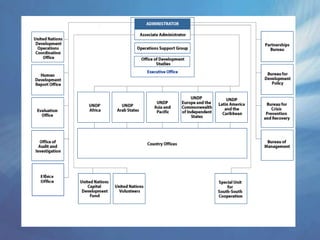
• Headquarters are located in New York.
• Offices in Geneva, Brussels, Copenhagen, Tokyo, and
Washington D.C.
FUNCTIONS
• UNDP links and coordinates global and
national efforts to achieve the goals and
national development priorities laid out by
host countries.
• 4 point working plan:
Democratic governance
Poverty reduction
Crisis prevention and recovery
Environment and Energy
DEMOCRATIC GOVERNANCE
• UNDP supports national democratic transitions
by
Providing policy advice and technical support.
Improving institutional and individual capacity
within countries.
Educating populations about and advocating for
democratic reforms.
Promoting negotiation and dialogue.
Sharing successful experiences from other
countries and locations.
POVERTY REDUCTION
• UNDP helps countries develop strategies to
combat poverty by
Expanding access to economic opportunities and
resources,
Linking poverty programs with countries’ larger
goals and policies,
Ensuring a greater voice for the poor.
• UNDP also works at the macro level to reform
trade, foreign investment, and ensure the poorest
of the poor benefit from globalization.
CRISIS PREVENTION AND RECOVERY
• UNDP works to reduce the risk of armed conflicts or disasters, and
promote early recovery after crisis have occurred.
• UNDP risk reduction programs include
 Efforts to control small arms proliferation,
 Strategies to reduce the impact of natural disasters,
 Programs to encourage use of diplomacy and prevent violence.
• Recovery programs include
 Disarmament, demobilization and reintegration of ex-combatants,
demining efforts,
 Programs to reintegrate displaced persons,
restoration of basic services,
 Transitional justice systems for countries recovering from warfare.
ENVIRONMENT AND ENERGY
• UNDP works with countries to strengthen their
capacity to address global environmental issues
by providing innovative policy advice and linking
partners through environmentally sensitive
development projects that help poor people
build sustainable livelihoods.
• UNDP seeks to address environmental issues in
order to improve developing countries’ abilities
to develop sustainably, increase human
development and reduce poverty.
• UNDP’s environmental strategy focuses on
Effective water governance including access
to water supply and sanitation.
Access to sustainable energy services.
Sustainable land management to
combat desertification and land degradation.
Conservation and sustainable use of biodiversity.
Policies to control emissions of harmful pollutants
and ozone-depleting substances.
• UNDP's Equator Initiative office biennially offers
the Equator Prize.
UNDP - INDIA
MILLENNIUM DEVELOPMENT GOALS
• In 2000, the members of the United Nations set the international
agenda for the beginning of the new century.
• The Millennium Development Goals extract and refine those
elements of the Millennium Declaration which are related to
development.
• The goals are time-bound, starting in 1990 and to be achieved by
2015.
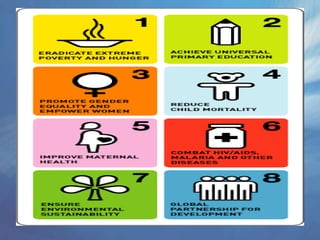
• The first seven goals stress the responsibility of developing
countries to undertake policy reforms and enhance good
governance.
• Goal eight focuses on the responsibility of developed nations to
relieve debt, increase aid and give developing countries better
access to its technologies and markets.
• The Millennium Development Goals include 21 targets for the eight
goals. One goal is normally defined by one or two targets.
MGD w.r.t INDIA
1.Halve, between 1990 and 2015, proportion of population below national poverty
line.
2.Halve, between 1990 and 2015, proportion of people who suffer from hunger.
3.Ensure that by 2015 children everywhere, boys and girls alike, will be able to
complete a full course of primary education.
4.Eliminate gender disparity in primary and secondary education, preferably by
2005, and in all levels of education no later than 2015.
5.Reduce by two-thirds, between 1990 and 2015, the under-five mortality rate.
6.Reduce by three quarters, between 1990 and 2015, the maternal mortality ratio.
7.Have halted by 2015 and begun to reverse the spread of HIV/AIDS.
8.Have halted by 2015 and begun to reverse the incidence of malaria
and other major diseases.
9.Integrate the principles of sustainable development into country
policies and programmes and reverse the loss of environmental
resources.
10.Halve, by 2015, the proportion of people without sustainable
access to safe drinking water and basic sanitation.
11.By 2020, to have achieved, a significant improvement in the lives of
at least 100 million slum dwellers.
12.In cooperation with the private sector, make available the benefits
of new technologies, especially information and communication
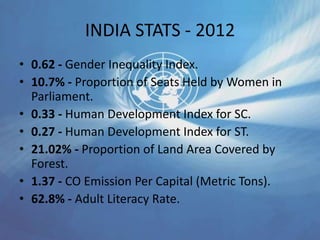
INDIA STATS - 2012
• 0.62 - Gender Inequality Index.
• 10.7% - Proportion of Seats Held by Women in
Parliament.
• 0.33 - Human Development Index for SC.
• 0.27 - Human Development Index for ST.
• 21.02% - Proportion of Land Area Covered by
Forest.
• 1.37 - CO Emission Per Capital (Metric Tons).
• 62.8% - Adult Literacy Rate.
INDIA – UNDP
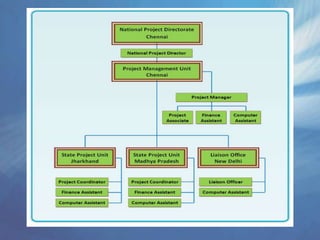
PROJECT (BIODIVERSITY)
• Project Title: “Strengthening Institutional Structures to Implement
the Biological Diversity Act”
• Project Duration: 2009 – 2012.
• Project States: Jharkhand & Madhya Pradesh.
• Responsible Party : The project is headed by the Member Secretary
of the State Biodiversity Board.
• Objective : Strengthening the institutional capacities at various
levels and brings in behavioral changes to manage natural resources
in an integrated, participatory and sustainable manner.
• Launch Workshop: Project Launch Workshop in Jharkhand was
organized on 15th September, 2009 at the ATI Conference Hall.
• Project District : In Jharkhand initially two districts have been
selected i.e., Hazaribag & Latehar.
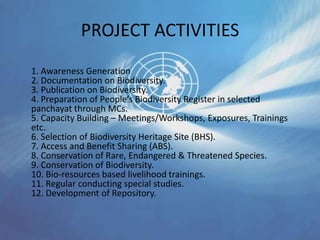
PROJECT ACTIVITIES
1. Awareness Generation
2. Documentation on Biodiversity.
3. Publication on Biodiversity.
4. Preparation of People’s Biodiversity Register in selected
panchayat through MCs.
5. Capacity Building – Meetings/Workshops, Exposures, Trainings
etc.
6. Selection of Biodiversity Heritage Site (BHS).
7. Access and Benefit Sharing (ABS).
8. Conservation of Rare, Endangered & Threatened Species.
9. Conservation of Biodiversity.
10. Bio-resources based livelihood trainings.
11. Regular conducting special studies.
12. Development of Repository.
OTHER PROJECTS
• A2J Programme in North India
• Sustainable Fishing Programme in South India.
• Sustainable energy projects.
REFERENCES
• http://www.undp.org/content/undp/en/home
.html
• http://en.wikipedia.org/wiki/United_Nations_
Development_Programme
• http://jbbjharkhand.org/india-undp-project
• http://radiancemedia.in/newsDetails.php?Id=
128
United nations development programme

United nations development programme

  • 1.
    UNIted nations development programme (UNDP) PranayKrishnan Msc evs part 1 SIES (Nerul) College of arts, science and commerce.
  • 2.
    UNITED NATIONS • TheUnited Nations (UN) is a unique international organization of 192 sovereign states established in 1945. • Its goal is to maintain international peace and security, to develop friendly relations among nations, and to promote social progress, a better living standard and human rights. • Its member states are bound together by the principles of the UN Charter. • One of the central mandates of the United Nations is the promotion of economic and social development.
  • 3.
    WHAT IS UNDP •UN's global development network. • Currently present in 177 countries. • UNDP emanated from the merging of the United Nations Expanded Programme of Technical Assistance(1949) and the United Nations Special Fund(1958). • Established on 22nd Nov 1965 by the General Assembly of the United Nations. • Headquarters are located in New York. • Offices in Geneva, Brussels, Copenhagen, Tokyo, and Washington D.C.
  • 6.
    FUNCTIONS • UNDP linksand coordinates global and national efforts to achieve the goals and national development priorities laid out by host countries. • 4 point working plan: Democratic governance Poverty reduction Crisis prevention and recovery Environment and Energy
  • 7.
    DEMOCRATIC GOVERNANCE • UNDPsupports national democratic transitions by Providing policy advice and technical support. Improving institutional and individual capacity within countries. Educating populations about and advocating for democratic reforms. Promoting negotiation and dialogue. Sharing successful experiences from other countries and locations.
  • 8.
    POVERTY REDUCTION • UNDPhelps countries develop strategies to combat poverty by Expanding access to economic opportunities and resources, Linking poverty programs with countries’ larger goals and policies, Ensuring a greater voice for the poor. • UNDP also works at the macro level to reform trade, foreign investment, and ensure the poorest of the poor benefit from globalization.
  • 9.
    CRISIS PREVENTION ANDRECOVERY • UNDP works to reduce the risk of armed conflicts or disasters, and promote early recovery after crisis have occurred. • UNDP risk reduction programs include  Efforts to control small arms proliferation,  Strategies to reduce the impact of natural disasters,  Programs to encourage use of diplomacy and prevent violence. • Recovery programs include  Disarmament, demobilization and reintegration of ex-combatants, demining efforts,  Programs to reintegrate displaced persons, restoration of basic services,  Transitional justice systems for countries recovering from warfare.
  • 10.
    ENVIRONMENT AND ENERGY •UNDP works with countries to strengthen their capacity to address global environmental issues by providing innovative policy advice and linking partners through environmentally sensitive development projects that help poor people build sustainable livelihoods. • UNDP seeks to address environmental issues in order to improve developing countries’ abilities to develop sustainably, increase human development and reduce poverty.
  • 11.
    • UNDP’s environmentalstrategy focuses on Effective water governance including access to water supply and sanitation. Access to sustainable energy services. Sustainable land management to combat desertification and land degradation. Conservation and sustainable use of biodiversity. Policies to control emissions of harmful pollutants and ozone-depleting substances. • UNDP's Equator Initiative office biennially offers the Equator Prize.
  • 13.
  • 14.
    MILLENNIUM DEVELOPMENT GOALS •In 2000, the members of the United Nations set the international agenda for the beginning of the new century. • The Millennium Development Goals extract and refine those elements of the Millennium Declaration which are related to development. • The goals are time-bound, starting in 1990 and to be achieved by 2015. • The first seven goals stress the responsibility of developing countries to undertake policy reforms and enhance good governance. • Goal eight focuses on the responsibility of developed nations to relieve debt, increase aid and give developing countries better access to its technologies and markets. • The Millennium Development Goals include 21 targets for the eight goals. One goal is normally defined by one or two targets.
  • 16.
    MGD w.r.t INDIA 1.Halve,between 1990 and 2015, proportion of population below national poverty line. 2.Halve, between 1990 and 2015, proportion of people who suffer from hunger. 3.Ensure that by 2015 children everywhere, boys and girls alike, will be able to complete a full course of primary education. 4.Eliminate gender disparity in primary and secondary education, preferably by 2005, and in all levels of education no later than 2015. 5.Reduce by two-thirds, between 1990 and 2015, the under-five mortality rate. 6.Reduce by three quarters, between 1990 and 2015, the maternal mortality ratio. 7.Have halted by 2015 and begun to reverse the spread of HIV/AIDS.
  • 17.
    8.Have halted by2015 and begun to reverse the incidence of malaria and other major diseases. 9.Integrate the principles of sustainable development into country policies and programmes and reverse the loss of environmental resources. 10.Halve, by 2015, the proportion of people without sustainable access to safe drinking water and basic sanitation. 11.By 2020, to have achieved, a significant improvement in the lives of at least 100 million slum dwellers. 12.In cooperation with the private sector, make available the benefits of new technologies, especially information and communication
  • 18.
    INDIA STATS -2012 • 0.62 - Gender Inequality Index. • 10.7% - Proportion of Seats Held by Women in Parliament. • 0.33 - Human Development Index for SC. • 0.27 - Human Development Index for ST. • 21.02% - Proportion of Land Area Covered by Forest. • 1.37 - CO Emission Per Capital (Metric Tons). • 62.8% - Adult Literacy Rate.
  • 20.
    INDIA – UNDP PROJECT(BIODIVERSITY) • Project Title: “Strengthening Institutional Structures to Implement the Biological Diversity Act” • Project Duration: 2009 – 2012. • Project States: Jharkhand & Madhya Pradesh. • Responsible Party : The project is headed by the Member Secretary of the State Biodiversity Board. • Objective : Strengthening the institutional capacities at various levels and brings in behavioral changes to manage natural resources in an integrated, participatory and sustainable manner. • Launch Workshop: Project Launch Workshop in Jharkhand was organized on 15th September, 2009 at the ATI Conference Hall. • Project District : In Jharkhand initially two districts have been selected i.e., Hazaribag & Latehar.
  • 22.
    PROJECT ACTIVITIES 1. AwarenessGeneration 2. Documentation on Biodiversity. 3. Publication on Biodiversity. 4. Preparation of People’s Biodiversity Register in selected panchayat through MCs. 5. Capacity Building – Meetings/Workshops, Exposures, Trainings etc. 6. Selection of Biodiversity Heritage Site (BHS). 7. Access and Benefit Sharing (ABS). 8. Conservation of Rare, Endangered & Threatened Species. 9. Conservation of Biodiversity. 10. Bio-resources based livelihood trainings. 11. Regular conducting special studies. 12. Development of Repository.
  • 23.
    OTHER PROJECTS • A2JProgramme in North India • Sustainable Fishing Programme in South India. • Sustainable energy projects.
  • 24.
    REFERENCES • http://www.undp.org/content/undp/en/home .html • http://en.wikipedia.org/wiki/United_Nations_ Development_Programme •http://jbbjharkhand.org/india-undp-project • http://radiancemedia.in/newsDetails.php?Id= 128