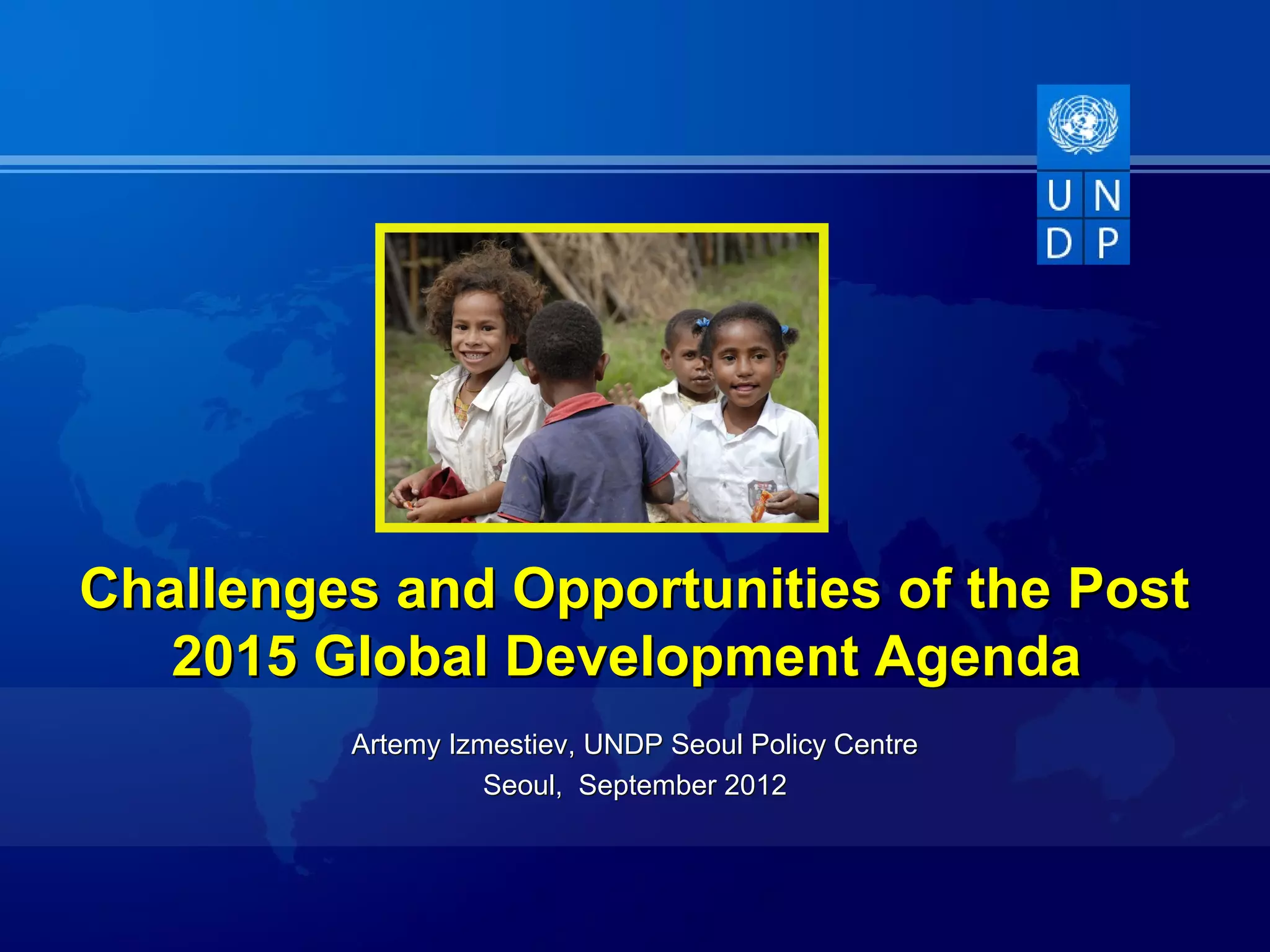
Challenges and Opportunities of the Post
   2015 Global Development Agenda
         Artemy Izmestiev, UNDP Seoul Policy Centre
                   Seoul, September 2012
Content

• Preparatory Process for developing the new Global
  development framework
• Role of the UN system & Fundamental principles
• Challenges
• Opportunities
• Asian approaches on post-2015
Preparatory Process for the new Global
         development framework

• The Report by the Secretary General: June 2012
  Accelerating progress towards the Millennium
  Development Goals: options for sustained and
  inclusive growth and issues for advancing the
  United Nations development agenda beyond 2015
• High Level Panel on post-2015 development
  framework established August 2012
• 50+ national consultations and 9 thematically
  focused meetings by March 2013
• HPL report presentation at GA Sept 2013
UN Task Team on Post-2015


Prepared the report for the SG
Macro questions it raised:
•What should be the purpose of the post-2015
agenda: advocacy, guidepost, instrument for policy
coherence?
•Was a 15-year timeframe realistic to bring about
transformative change?
•Should the post-2015 agenda be prescriptive and
if so, how far can it go without constraining policy
space at country level?
Fundamental principles

                                           G Report: “The
                                           world cannot
                                           continue on its
                                           current course.
                                           There is a need for
                                           an agenda aimed at
                                           transformative
                                           change leading to a
                                           shared, secure and
                                           sustainable future
                                           for all”.


                                           undamental
                                           principles for future
                                           agenda:
 Human rights
•
 Equality
•
 Sustainability
•
Challenges
Challenges of Post-2015: process

• Reaching agreement is increasingly difficult;
• How ambitious should the goals be and where to
  draw a line?
• How should the global goals be linked to the
  national processes?
• What should be the international governance of
  post-2015 agenda including the monitoring?
Challenges of Post-2015: Format

• How to make sure that the goals are simple and
  can be easily communicated?
• How to ensure measurability and robustness of
  data?
• To which extent the current MDGs should be
  taken used in formulation of the new framework?
Opportunities
UN Task Team on Post-2015 (cont.)


Role for the UN system:
•Putting the concept of sustainable development at
the heart of the post-2015 agenda
•How to build on MDGs
•Expanding the scope beyond MDGs
•Designing the future goals to address both local
and global development challenges
•Incorporating measurability and accountability
Consultations


• 50+ consultations in developing countries in
  2012-2013
National consultations will not focus on goal setting and
  universality, but on how people see their future.
•   Global and regional thematic meetings;
•   Social media discussions and other forms of
    outreach.
Web platform to foster outreach.
Consensus & buy in- participation
Themes of Global Meetings


• Inequalities (across all dimensions):
• Health (MDGs 4, 5, 6 + non communicable
  diseases)
• Education (at all levels)
• Growth and employment
• Environmental sustainability
• Food security and nutrition
• Governance (at all levels)
• Conflict and fragility
• Population dynamics
Youth Engagement

• Giving regional youth a voice in the global consultations
• Follows an UNDP initiative in the Pacific Islands
• 40 students. Korea, Japan, China, Mongolia.
• 3 days of debates and workshops
  - Did the MDGs work?
  - Do we need another framework?
  - What is the world we want to see post-2015?
• Declaration to be fed into global consultations.
Opportunities for CSOs

•   UN-CSO Dialogue
•   Country and thematic consultations
•   CSO Platforms (e.g. Beyond 2015)
•   Promote awareness and creativity
•   Link with other areas of global agenda
Asian Approaches to Post-2015

• Asia’s experience with the implementation of the
  MDGs holds valuable lessons for the formulation
  of the new global development agenda
• Asia is the only developing region that has
  successfully narrowed the gap with advanced
  economies over the past half century
• Investment in human capital and the creation of
  enabling conditions for its development were
  important to Asian countries’ progress
Asian Approaches to Post-2015 (cont.)

• World today is very different from the world
  when the MDGs were formulated (poverty is
  increasingly an MIC phenomenon, rise of
  emerging countries)
• Asia is on the forefront of changing global
  dynamics, being home to many of the world’s
  “emerging” nations
• Merit of “creative chaos” that may be present at
  the initial stages of the consultations
• Keep the global ambition high in the formulation
  of the future goals
Thank you!

•   undp.org/uspc
•   Facebook.com/UNDPSPC
•   Twitter: @UNDPSPC

Cso forum challenges opportunities post 2015

  • 1.
    Challenges and Opportunitiesof the Post 2015 Global Development Agenda Artemy Izmestiev, UNDP Seoul Policy Centre Seoul, September 2012
  • 2.
    Content • Preparatory Processfor developing the new Global development framework • Role of the UN system & Fundamental principles • Challenges • Opportunities • Asian approaches on post-2015
  • 3.
    Preparatory Process forthe new Global development framework • The Report by the Secretary General: June 2012 Accelerating progress towards the Millennium Development Goals: options for sustained and inclusive growth and issues for advancing the United Nations development agenda beyond 2015 • High Level Panel on post-2015 development framework established August 2012 • 50+ national consultations and 9 thematically focused meetings by March 2013 • HPL report presentation at GA Sept 2013
  • 4.
    UN Task Teamon Post-2015 Prepared the report for the SG Macro questions it raised: •What should be the purpose of the post-2015 agenda: advocacy, guidepost, instrument for policy coherence? •Was a 15-year timeframe realistic to bring about transformative change? •Should the post-2015 agenda be prescriptive and if so, how far can it go without constraining policy space at country level?
  • 5.
    Fundamental principles G Report: “The world cannot continue on its current course. There is a need for an agenda aimed at transformative change leading to a shared, secure and sustainable future for all”. undamental principles for future agenda: Human rights • Equality • Sustainability •
  • 6.
  • 7.
    Challenges of Post-2015:process • Reaching agreement is increasingly difficult; • How ambitious should the goals be and where to draw a line? • How should the global goals be linked to the national processes? • What should be the international governance of post-2015 agenda including the monitoring?
  • 8.
    Challenges of Post-2015:Format • How to make sure that the goals are simple and can be easily communicated? • How to ensure measurability and robustness of data? • To which extent the current MDGs should be taken used in formulation of the new framework?
  • 9.
  • 10.
    UN Task Teamon Post-2015 (cont.) Role for the UN system: •Putting the concept of sustainable development at the heart of the post-2015 agenda •How to build on MDGs •Expanding the scope beyond MDGs •Designing the future goals to address both local and global development challenges •Incorporating measurability and accountability
  • 11.
    Consultations • 50+ consultationsin developing countries in 2012-2013 National consultations will not focus on goal setting and universality, but on how people see their future. • Global and regional thematic meetings; • Social media discussions and other forms of outreach. Web platform to foster outreach. Consensus & buy in- participation
  • 12.
    Themes of GlobalMeetings • Inequalities (across all dimensions): • Health (MDGs 4, 5, 6 + non communicable diseases) • Education (at all levels) • Growth and employment • Environmental sustainability • Food security and nutrition • Governance (at all levels) • Conflict and fragility • Population dynamics
  • 13.
    Youth Engagement • Givingregional youth a voice in the global consultations • Follows an UNDP initiative in the Pacific Islands • 40 students. Korea, Japan, China, Mongolia. • 3 days of debates and workshops - Did the MDGs work? - Do we need another framework? - What is the world we want to see post-2015? • Declaration to be fed into global consultations.
  • 14.
    Opportunities for CSOs • UN-CSO Dialogue • Country and thematic consultations • CSO Platforms (e.g. Beyond 2015) • Promote awareness and creativity • Link with other areas of global agenda
  • 15.
    Asian Approaches toPost-2015 • Asia’s experience with the implementation of the MDGs holds valuable lessons for the formulation of the new global development agenda • Asia is the only developing region that has successfully narrowed the gap with advanced economies over the past half century • Investment in human capital and the creation of enabling conditions for its development were important to Asian countries’ progress
  • 16.
    Asian Approaches toPost-2015 (cont.) • World today is very different from the world when the MDGs were formulated (poverty is increasingly an MIC phenomenon, rise of emerging countries) • Asia is on the forefront of changing global dynamics, being home to many of the world’s “emerging” nations • Merit of “creative chaos” that may be present at the initial stages of the consultations • Keep the global ambition high in the formulation of the future goals
  • 17.
    Thank you! • undp.org/uspc • Facebook.com/UNDPSPC • Twitter: @UNDPSPC

Editor's Notes

  • #13 4 (1,3,4,5) out of 5 points Need to be explained and show what is different from before