MITIGATING VULNERABILITIES
& PROMOTING RESILIENT GROWTH

  Sequencing, cost-efficiency and fiscal-sustainability of social
              protection– Policy Dialogue


                                                        Yos Vajragupta
                                                          Senior Researcher
                                     Thailand Development Research Institute


                                                        November 1-2, 2012
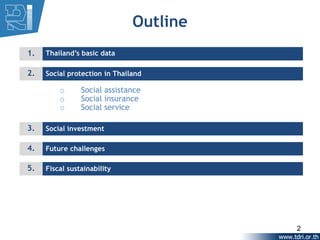
Outline
1.   Thailand’s basic data

2.   Social protection in Thailand

         o      Social assistance
         o      Social insurance
         o      Social service

3.   Social investment

4.   Future challenges

5.   Fiscal sustainability


                                         2
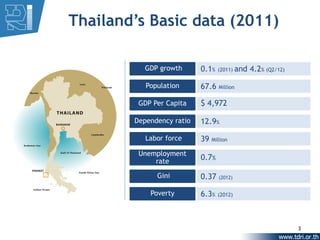
Thailand’s Basic data (2011)

          GDP growth       0.1%   (2011) and   4.2% (Q2/12)

           Population      67.6    Million


         GDP Per Capita    $ 4,972

        Dependency ratio   12.9%

           Labor force     39   Million

         Unemployment
             rate
                           0.7%

              Gini         0.37    (2012)


            Poverty        6.3%   (2012)


                                                              3
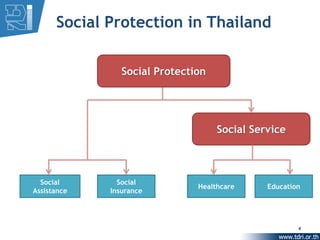
Social Protection in Thailand

                Social Protection


                                    Social Service


  Social       Social
                               Healthcare     Education
Assistance   Insurance


                                                      4
Social Assistance

• Social assistance programs in Thailand started in 1941.

• Target groups are disadvantaged people such as children, seniors,
  disabled individuals, women, low-income persons, and people suffered
  from natural disaster.

• Social assistance programs focus on cash transfer,
  counseling, training, in-kind assistance, and
  emergency accommodation.

• Cash benefits are provided to elderly, disabled person, and HIV infected
  person (500 baht or $14.5 per month).


                                                                        5
Social Assistance
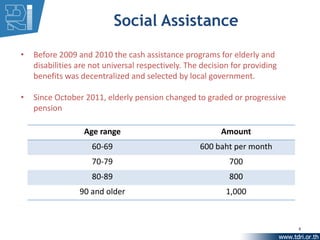
•   Before 2009 and 2010 the cash assistance programs for elderly and
    disabilities are not universal respectively. The decision for providing
    benefits was decentralized and selected by local government.

•   Since October 2011, elderly pension changed to graded or progressive
    pension

                  Age range                               Amount
                     60-69                          600 baht per month
                     70-79                                   700
                     80-89                                   800
                 90 and older                               1,000


                                                                              6
Social Assistance
•   Funeral allowance of 2,000 baht ($58) for senior citizen aged 60+
    years.

•   Monetary assistance has been low since the Ministry
    of Social Development and Human Security received small budget
    (less than 1% of government budget).

•   Besides the cash transfer, government also provides assistance
    through government-run nursing homes,
    elderly care centers, care home for disabilities and disadvantage
    children.


                                                                        7
Social Insurance
Pension for Government Official

•   A retired government officials who started their job with government
    before March 1997 can choose between receiving a lump sum
    payment or a pension from the government.

•   After March 1997, new government officials must be a membership of
    the Government Pension Fund (GPF).

•   GPF: 2nd pillar under the World Bank’s Multi-Pillar system.

•   GPF member can contribute between 3 to 12 percent of salary while
    government contributes only 3 percent plus another 2% for post-
    reform compensations.


                                                                      8
Social Insurance
    Social Security Fund (SSF)

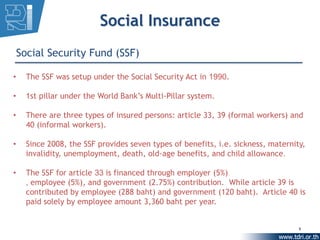
•     The SSF was setup under the Social Security Act in 1990.

•     1st pillar under the World Bank’s Multi-Pillar system.

•     There are three types of insured persons: article 33, 39 (formal workers) and
      40 (informal workers).

•     Since 2008, the SSF provides seven types of benefits, i.e. sickness, maternity,
      invalidity, unemployment, death, old-age benefits, and child allowance.

•     The SSF for article 33 is financed through employer (5%)
      , employee (5%), and government (2.75%) contribution. While article 39 is
      contributed by employee (288 baht) and government (120 baht). Article 40 is
      paid solely by employee amount 3,360 baht per year.


                                                                                   9
Social Insurance
Provident Fund

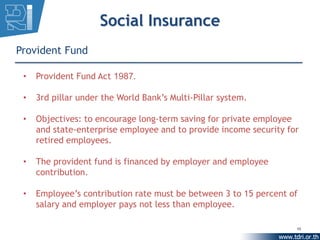
 •   Provident Fund Act 1987.

 •   3rd pillar under the World Bank’s Multi-Pillar system.

 •   Objectives: to encourage long-term saving for private employee
     and state-enterprise employee and to provide income security for
     retired employees.

 •   The provident fund is financed by employer and employee
     contribution.

 •   Employee’s contribution rate must be between 3 to 15 percent of
     salary and employer pays not less than employee.

                                                                    10
Social Service
 Healthcare
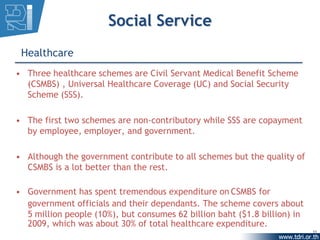
• Three healthcare schemes are Civil Servant Medical Benefit Scheme
  (CSMBS) , Universal Healthcare Coverage (UC) and Social Security
  Scheme (SSS).

• The first two schemes are non-contributory while SSS are copayment
  by employee, employer, and government.

• Although the government contribute to all schemes but the quality of
  CSMBS is a lot better than the rest.

• Government has spent tremendous expenditure on CSMBS for
  government officials and their dependants. The scheme covers about
  5 million people (10%), but consumes 62 billion baht ($1.8 billion) in
  2009, which was about 30% of total healthcare expenditure.
                                                                           11
Social Service
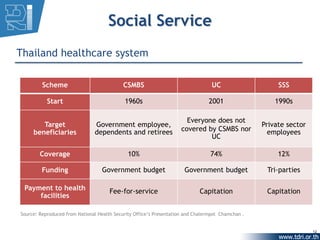
Thailand healthcare system

         Scheme                             CSMBS                                 UC                    SSS

           Start                            1960s                               2001                   1990s

                                                                      Everyone does not
        Target                 Government employee,                                                Private sector
     beneficiaries             dependents and retirees              covered by CSMBS nor             employees
                                                                             UC

        Coverage                              10%                                74%                    12%

         Funding                  Government budget                   Government budget             Tri-parties

 Payment to health                    Fee-for-service                       Capitation              Capitation
     facilities

Source: Reproduced from National Health Security Office’s Presentation and Chalermpol Chamchan .


                                                                                                                    12
Social Service
Education

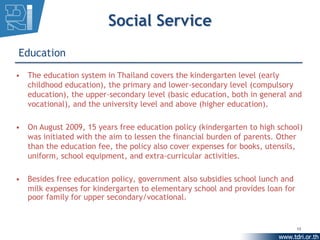
• The education system in Thailand covers the kindergarten level (early
  childhood education), the primary and lower-secondary level (compulsory
  education), the upper-secondary level (basic education, both in general and
  vocational), and the university level and above (higher education).

• On August 2009, 15 years free education policy (kindergarten to high school)
  was initiated with the aim to lessen the financial burden of parents. Other
  than the education fee, the policy also cover expenses for books, utensils,
  uniform, school equipment, and extra-curricular activities.

• Besides free education policy, government also subsidies school lunch and
  milk expenses for kindergarten to elementary school and provides loan for
  poor family for upper secondary/vocational.


                                                                              13
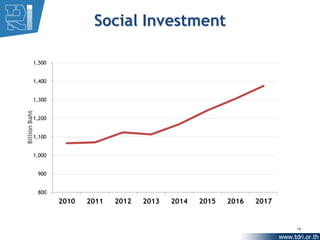
Social Investment

           1,500


           1,400


           1,300
Billion Baht


           1,200


           1,100


           1,000


               900


               800
                     2010   2011   2012   2013   2014   2015   2016   2017


                                                                             14
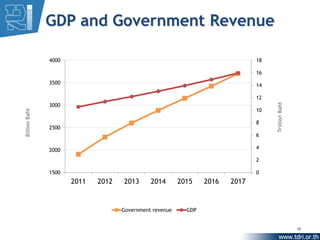
GDP and Government Revenue

               4000                                                            18

                                                                               16
               3500                                                            14

                                                                               12
               3000


                                                                                    Trillion Baht
                                                                               10
Billion Baht


                                                                               8
               2500
                                                                               6

               2000                                                            4

                                                                               2

               1500                                                            0
                      2011   2012   2013      2014       2015    2016   2017


                                    Government revenue     GDP


                                                                                                    15
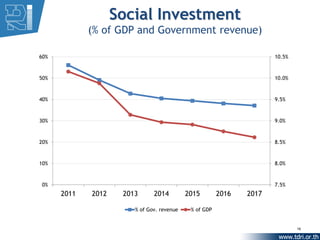
Social Investment
             (% of GDP and Government revenue)

60%                                                                   10.5%


50%                                                                   10.0%


40%                                                                   9.5%


30%                                                                   9.0%


20%                                                                   8.5%


10%                                                                   8.0%


0%                                                                    7.5%
      2011   2012    2013      2014         2015        2016   2017

                        % of Gov. revenue    % of GDP


                                                                              16
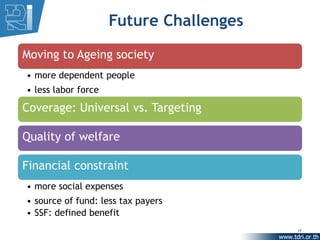
Future Challenges

Moving to Ageing society
• more dependent people
• less labor force

Coverage: Universal vs. Targeting

Quality of welfare

Financial constraint
• more social expenses
• source of fund: less tax payers
• SSF: defined benefit
                                         17
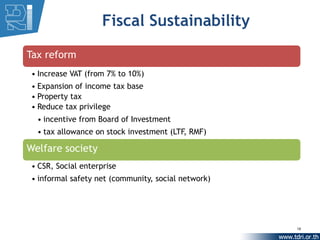
Fiscal Sustainability

Tax reform
• Increase VAT (from 7% to 10%)
• Expansion of income tax base
• Property tax
• Reduce tax privilege
  • incentive from Board of Investment
  • tax allowance on stock investment (LTF, RMF)

Welfare society
• CSR, Social enterprise
• informal safety net (community, social network)


                                                    18

Country Presentation Thailand (2)

  • 1.
    MITIGATING VULNERABILITIES & PROMOTINGRESILIENT GROWTH Sequencing, cost-efficiency and fiscal-sustainability of social protection– Policy Dialogue Yos Vajragupta Senior Researcher Thailand Development Research Institute November 1-2, 2012
  • 2.
    Outline 1. Thailand’s basic data 2. Social protection in Thailand o Social assistance o Social insurance o Social service 3. Social investment 4. Future challenges 5. Fiscal sustainability 2
  • 3.
    Thailand’s Basic data(2011) GDP growth 0.1% (2011) and 4.2% (Q2/12) Population 67.6 Million GDP Per Capita $ 4,972 Dependency ratio 12.9% Labor force 39 Million Unemployment rate 0.7% Gini 0.37 (2012) Poverty 6.3% (2012) 3
  • 4.
    Social Protection inThailand Social Protection Social Service Social Social Healthcare Education Assistance Insurance 4
  • 5.
    Social Assistance • Socialassistance programs in Thailand started in 1941. • Target groups are disadvantaged people such as children, seniors, disabled individuals, women, low-income persons, and people suffered from natural disaster. • Social assistance programs focus on cash transfer, counseling, training, in-kind assistance, and emergency accommodation. • Cash benefits are provided to elderly, disabled person, and HIV infected person (500 baht or $14.5 per month). 5
  • 6.
    Social Assistance • Before 2009 and 2010 the cash assistance programs for elderly and disabilities are not universal respectively. The decision for providing benefits was decentralized and selected by local government. • Since October 2011, elderly pension changed to graded or progressive pension Age range Amount 60-69 600 baht per month 70-79 700 80-89 800 90 and older 1,000 6
  • 7.
    Social Assistance • Funeral allowance of 2,000 baht ($58) for senior citizen aged 60+ years. • Monetary assistance has been low since the Ministry of Social Development and Human Security received small budget (less than 1% of government budget). • Besides the cash transfer, government also provides assistance through government-run nursing homes, elderly care centers, care home for disabilities and disadvantage children. 7
  • 8.
    Social Insurance Pension forGovernment Official • A retired government officials who started their job with government before March 1997 can choose between receiving a lump sum payment or a pension from the government. • After March 1997, new government officials must be a membership of the Government Pension Fund (GPF). • GPF: 2nd pillar under the World Bank’s Multi-Pillar system. • GPF member can contribute between 3 to 12 percent of salary while government contributes only 3 percent plus another 2% for post- reform compensations. 8
  • 9.
    Social Insurance Social Security Fund (SSF) • The SSF was setup under the Social Security Act in 1990. • 1st pillar under the World Bank’s Multi-Pillar system. • There are three types of insured persons: article 33, 39 (formal workers) and 40 (informal workers). • Since 2008, the SSF provides seven types of benefits, i.e. sickness, maternity, invalidity, unemployment, death, old-age benefits, and child allowance. • The SSF for article 33 is financed through employer (5%) , employee (5%), and government (2.75%) contribution. While article 39 is contributed by employee (288 baht) and government (120 baht). Article 40 is paid solely by employee amount 3,360 baht per year. 9
  • 10.
    Social Insurance Provident Fund • Provident Fund Act 1987. • 3rd pillar under the World Bank’s Multi-Pillar system. • Objectives: to encourage long-term saving for private employee and state-enterprise employee and to provide income security for retired employees. • The provident fund is financed by employer and employee contribution. • Employee’s contribution rate must be between 3 to 15 percent of salary and employer pays not less than employee. 10
  • 11.
    Social Service Healthcare •Three healthcare schemes are Civil Servant Medical Benefit Scheme (CSMBS) , Universal Healthcare Coverage (UC) and Social Security Scheme (SSS). • The first two schemes are non-contributory while SSS are copayment by employee, employer, and government. • Although the government contribute to all schemes but the quality of CSMBS is a lot better than the rest. • Government has spent tremendous expenditure on CSMBS for government officials and their dependants. The scheme covers about 5 million people (10%), but consumes 62 billion baht ($1.8 billion) in 2009, which was about 30% of total healthcare expenditure. 11
  • 12.
    Social Service Thailand healthcaresystem Scheme CSMBS UC SSS Start 1960s 2001 1990s Everyone does not Target Government employee, Private sector beneficiaries dependents and retirees covered by CSMBS nor employees UC Coverage 10% 74% 12% Funding Government budget Government budget Tri-parties Payment to health Fee-for-service Capitation Capitation facilities Source: Reproduced from National Health Security Office’s Presentation and Chalermpol Chamchan . 12
  • 13.
    Social Service Education • Theeducation system in Thailand covers the kindergarten level (early childhood education), the primary and lower-secondary level (compulsory education), the upper-secondary level (basic education, both in general and vocational), and the university level and above (higher education). • On August 2009, 15 years free education policy (kindergarten to high school) was initiated with the aim to lessen the financial burden of parents. Other than the education fee, the policy also cover expenses for books, utensils, uniform, school equipment, and extra-curricular activities. • Besides free education policy, government also subsidies school lunch and milk expenses for kindergarten to elementary school and provides loan for poor family for upper secondary/vocational. 13
  • 14.
    Social Investment 1,500 1,400 1,300 Billion Baht 1,200 1,100 1,000 900 800 2010 2011 2012 2013 2014 2015 2016 2017 14
  • 15.
    GDP and GovernmentRevenue 4000 18 16 3500 14 12 3000 Trillion Baht 10 Billion Baht 8 2500 6 2000 4 2 1500 0 2011 2012 2013 2014 2015 2016 2017 Government revenue GDP 15
  • 16.
    Social Investment (% of GDP and Government revenue) 60% 10.5% 50% 10.0% 40% 9.5% 30% 9.0% 20% 8.5% 10% 8.0% 0% 7.5% 2011 2012 2013 2014 2015 2016 2017 % of Gov. revenue % of GDP 16
  • 17.
    Future Challenges Moving toAgeing society • more dependent people • less labor force Coverage: Universal vs. Targeting Quality of welfare Financial constraint • more social expenses • source of fund: less tax payers • SSF: defined benefit 17
  • 18.
    Fiscal Sustainability Tax reform •Increase VAT (from 7% to 10%) • Expansion of income tax base • Property tax • Reduce tax privilege • incentive from Board of Investment • tax allowance on stock investment (LTF, RMF) Welfare society • CSR, Social enterprise • informal safety net (community, social network) 18