PRESENTATION ON
INTERVIEW
Presented by:
Anushka Vasu
Aparna Mishra
Ariba Daud
Anshuman
Khushwaha
Anuj Kr.Pal
INTRODUCTION
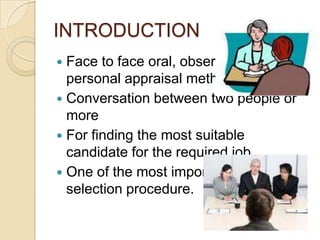
ď‚— Face to face oral, observational and
personal appraisal method.
ď‚— Conversation between two people or
more
ď‚— For finding the most suitable
candidate for the required job.
ď‚— One of the most important part of
selection procedure.
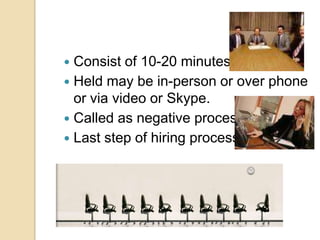
ď‚— Consist of 10-20 minutes
ď‚— Held may be in-person or over phone
or via video or Skype.
ď‚— Called as negative process.
ď‚— Last step of hiring process.
ď‚— Usually it is more than a means of
getting information. It involves:
ď‚— Giving information that will help the
applicant to make up his mind about the
company
ď‚— Giving advice that may serve to
change the mental or emotional attitude
to the interviewee.
ď‚— Provides the opportunity to meet one
another, exchange information and
come to tentative conclusion about
“hiring” one another.
ď‚— An opportunity where you can
describe your experiences and skills
and can get an idea of what is
happening with the company.
ď‚— A two way process.
Need for interview
ď‚— To judge the overall personality of the
candidate
ď‚— To know whether you are able to
perform the required job or not
ď‚— To judge the skills and attributes which
are not mentioned in c.v.
ď‚— Apart from your knowledge
your ability and capacity to do the job
ď‚— To find out what motivates you, how
well you communicate
ď‚— Your actual strengths and
weaknesses.
TYPE OF INTERVIEW
STRUCTURED INTERVIEW
ď‚— Structured interview are preplanned.
ď‚— Set of question are asked in a
standard way across all respondents.
STRUCTURED INTERVIEW
ď‚— Interviewee is only is supposed only to
answer the questions put by the interviewer.
ď‚— Structured interviews is also called directed
or guided interview.
UNSTRUCTURED
INTERVIEW
ď‚— Interviewer does not ask direct and
specific question.
ď‚— Interviewer ask question as they come
into mind.
UNSTUCTURED
INTERVIEW
ď‚— It is also called as Non-Directed
interview.
ď‚— Candidates are more relaxed and are
encouraged to express themselves
about different subject based on their
background, interest etc.
STRESS INTERVIEW
ď‚— The interview, attempts to find how
applicants would respond to
aggressive, embarrassing, rude and
insulting questions.
STRESS INTERVIEW
ď‚— A stress interview allows interviewers
to see how well you work under
pressure
GROUP INTERVIEW
ď‚— It is an interview of a number of
applicants in a group.
ď‚— It is used where it is essential to know
how the candidate behave in group.
GROUP INTERVIEW
ď‚— Group interview is usually designed to
uncover the leadership potential of
applicants.
PANEL INTERVIEW
ď‚— Panel means a selection committee
that is appointed for interviewing the
candidate.
ď‚— Panel may include three or five
members.
PANEL INTERVIEW
ď‚— Questions are asked to candidates
about different aspects and marks are
given to each candidate.
ď‚— Final decision are taken by all
members collectively by rating the
candidates.
TELEPHONE INTERVIEW
ď‚— Many organizations will conduct
interviews by telephone to narrow a
field of candidates.
TELEPHONE INTERVIEW
ď‚— Telephone interviews may also be
used as a preliminary interview for
candidates who live far away from the
job site.
EXIT INTERVIEW
ď‚— When an employee leaves the
company, he is interviewed either by
his immediate superior or by the HRD
manager. This interview is called an
exit interview.
EXIT INTERVIEW
ď‚— Exit interview is taken to find out why
the employee is leaving the company.
ď‚— Exit interviews are taken to create a
good image of the company in the
minds of the employees who are
leaving the company.

Presentation on interview

  • 1.
    PRESENTATION ON INTERVIEW Presented by: AnushkaVasu Aparna Mishra Ariba Daud Anshuman Khushwaha Anuj Kr.Pal
  • 2.
    INTRODUCTION ď‚— Face toface oral, observational and personal appraisal method. ď‚— Conversation between two people or more ď‚— For finding the most suitable candidate for the required job. ď‚— One of the most important part of selection procedure.
  • 3.
    ď‚— Consist of10-20 minutes ď‚— Held may be in-person or over phone or via video or Skype. ď‚— Called as negative process. ď‚— Last step of hiring process.
  • 4.
    ď‚— Usually itis more than a means of getting information. It involves: ď‚— Giving information that will help the applicant to make up his mind about the company ď‚— Giving advice that may serve to change the mental or emotional attitude to the interviewee.
  • 5.
     Provides theopportunity to meet one another, exchange information and come to tentative conclusion about “hiring” one another.  An opportunity where you can describe your experiences and skills and can get an idea of what is happening with the company.  A two way process.
  • 6.
    Need for interview ď‚—To judge the overall personality of the candidate ď‚— To know whether you are able to perform the required job or not ď‚— To judge the skills and attributes which are not mentioned in c.v. ď‚— Apart from your knowledge your ability and capacity to do the job
  • 7.
    ď‚— To findout what motivates you, how well you communicate ď‚— Your actual strengths and weaknesses.
  • 8.
  • 9.
    STRUCTURED INTERVIEW ď‚— Structuredinterview are preplanned. ď‚— Set of question are asked in a standard way across all respondents.
  • 10.
    STRUCTURED INTERVIEW ď‚— Intervieweeis only is supposed only to answer the questions put by the interviewer. ď‚— Structured interviews is also called directed or guided interview.
  • 11.
    UNSTRUCTURED INTERVIEW ď‚— Interviewer doesnot ask direct and specific question. ď‚— Interviewer ask question as they come into mind.
  • 12.
    UNSTUCTURED INTERVIEW ď‚— It isalso called as Non-Directed interview. ď‚— Candidates are more relaxed and are encouraged to express themselves about different subject based on their background, interest etc.
  • 13.
    STRESS INTERVIEW ď‚— Theinterview, attempts to find how applicants would respond to aggressive, embarrassing, rude and insulting questions.
  • 14.
    STRESS INTERVIEW ď‚— Astress interview allows interviewers to see how well you work under pressure
  • 15.
    GROUP INTERVIEW ď‚— Itis an interview of a number of applicants in a group. ď‚— It is used where it is essential to know how the candidate behave in group.
  • 16.
    GROUP INTERVIEW ď‚— Groupinterview is usually designed to uncover the leadership potential of applicants.
  • 17.
    PANEL INTERVIEW ď‚— Panelmeans a selection committee that is appointed for interviewing the candidate. ď‚— Panel may include three or five members.
  • 18.
    PANEL INTERVIEW ď‚— Questionsare asked to candidates about different aspects and marks are given to each candidate. ď‚— Final decision are taken by all members collectively by rating the candidates.
  • 19.
    TELEPHONE INTERVIEW ď‚— Manyorganizations will conduct interviews by telephone to narrow a field of candidates.
  • 20.
    TELEPHONE INTERVIEW ď‚— Telephoneinterviews may also be used as a preliminary interview for candidates who live far away from the job site.
  • 21.
    EXIT INTERVIEW ď‚— Whenan employee leaves the company, he is interviewed either by his immediate superior or by the HRD manager. This interview is called an exit interview.
  • 22.
    EXIT INTERVIEW ď‚— Exitinterview is taken to find out why the employee is leaving the company. ď‚— Exit interviews are taken to create a good image of the company in the minds of the employees who are leaving the company.